Channel Optimisation and Interference Mitiqation
Techniques for Advanced Cellular Mobile
Communication
V.Thrimurthulu1, Dr. N S Murti Sarma2
1
Research Scholar ECE, Rayalaseema University, Kurnool, A.P., India 2
Professor, Dept. of ECE, Sreenidhi Institute of Science & Technology, Ghatkesar, Hyderabad, T.S, India
Abstract: The next generation wireless cellular communication networks are envisioned to deal with the expected thousand-fold increase in total mobile broadband data and the hundred-fold increase in connected devices. In order to provide higher data rates, improved end-to-end performance and coverage, low latency, and low energy consumption at low cost per transmission, 5G systems are required to overcome various handicaps of current cellular networks and wireless links. One of the key handicaps of 5G systems is the performance degradation of the communication link, due to the increased level of interference. Due to the scarcity of the available spectrum, all the cells are allocated the same frequency resources, leading to significant inter-cell interference problems. Given the negative impact of interference on system performance, several interference mitigation techniques have been proposed, where restrictions are made on resource blocks usage, power allocation, or both. In this paper, we conduct a comprehensive survey on the existing ICIC techniques. We classify these techniques, and we study their performance while taking into consideration various design parameters.
Inter-Cell Interference Coordination (ICIC) techniques are required to mitigate the impact of ICI on system performance. In this paper, we address the resource and power allocation problem in multiuser Orthogonal Frequency Division Multiple Access (OFDMA) networks such as LTE/LTE-A networks and dense small cell networks. We start screening the state-of-the-art schemes, and provide an exhaustive classification of the existing ICIC approaches. This qualitative classification is followed by a quantitative investigation of several interference mitigation techniques under uniform and non-uniform UE distributions, and for various network loads and radio conditions. The obtained results allow us to select the most adequate technique for each network scenario.
Keywords Inter-cell interference coordination; OFDMA; 3GPP LTE; 5G; dense small cell networks; spectral efficiency; energy efficiency; resource allocation; power allocation; throughput fairness.
I. INTRODUCTION
The significant advances in cellular networks and mobile devices have led to a rapidly growing demand for high speed multimedia applications. To support this increasing data traffic, the capacity of cellular networks can be improved via the dense deployment of small cells with aggressive frequency reuse. Thus, resource allocation and interference management is a key research challenge in present and future cellular networks. In this paper, we provide a global description of the inter-cell interference problems in cellular networks as well as the motivation behind our research work on interference mitigation techniques.
II.BACKGROUND
During the last few decades, the traffic demands in mobile networks have tremendously increased. The global mobile data traffic grew by 70 percent in 2012, and it grew by 81 percent in 2013. Consequently, mobile data traffic in 2017 will be 13 times that of 2012. This rapidly growing demand drove the 3GPP to introduce the Long Term Evolution (LTE) of the Universal Mobile Terrestrial radio access System (UMTS)[3]. LTE- Advanced (LTE-A) [3GP08] was also proposed to improve cell-edge spectral efficiency, and to increase the peak transmission rates. However, network capacity and spectral efficiency should be further improved in order to address the exponentially increasing demands for mobile broadband communications.
mitigation techniques becomes a necessity for the next generation cellular networks. ICIC techniques are designed to alleviate the impact of ICI, and to improve system performance. These target objectives are achieved by modifying various system resources allocation such as frequency resources and transmission power. For instance, several RRM schemes perform resource allocation between the different cells, and packet scheduling among the active UEs in each cell, in order to improve system performance and to increase its spectral efficiency.
To support the demand for future high speed data transfers for mobile users, the resulting 5G system should be able to support a more efficient energy and resource utilization, in order to allow a constant growth in capacity at acceptable overall cost and energy dissipation. Therefore, the traditional techniques for radio resource management and power allocation may not be efficient in future mobile networks.
III. LTE/LTE-A ARCHITECTURE
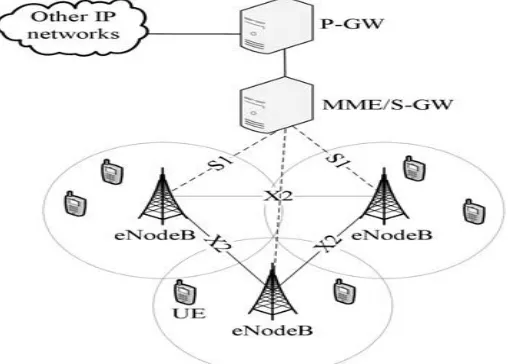
The LTE/LTE-A system architecture consists of a radio access network, called Evolved- Universal Terrestrial Radio Access Network (E-UTRAN) and a core network known as Evolved Packet Core (EPC). The network architecture is shown in Figure 1 and it is labeled System Architecture Evolution (SAE).
Figure 1LTE/LTE-A system architecture
The Mobility Management Entity (MME) and the Serving Gateway (S-GW) are located at the core network, and they are connected to the LTE/LTE-A base stations, called evolved-Node Bs (eNodeBs) via the S1 interface[1]. The MME entity handles several functions related to network access control, radio resource management, and mobility management, while the S-GW acts as a local mobility anchor point for inter-eNodeB handovers and for the handling of data packet transfer between the core network and the UEs. The Packet data network Gateway (P-GW) provides connectivity between the core network and other Internet Protocol (IP) networks. It also serves as an anchor for mobility between 3GPP and non-3GPP technologies. The radio access network is comprised of eNodeBs and UEs. Each eNodeB is connected to its neighboring cells through the X2 interface that allows the exchange of signaling messages and information related to resource usage and power allocation.
A. Orthogonal Frequency Division Multiple Access (OFDMA)
[image:3.612.183.439.264.446.2]B. Dense Small Cell Networks
Due to the increasing demand for mobile broadband communications, the dense deployment of low power base stations within the coverage area of existing macro cells improves network capacity, and increases the available bandwidth per UE. In Figure 2 shows an LTE/LTE-A cell served by a macro base station, with several small cells coexisting in the same geographical area. Small cells include microcells, picocells, femtocells, and relay nodes.
Figure 2 LTE/LTE-A macro cell with dense small cell deployment
The Next Generation Mobile Networks (NGMN) alliance expects the emergence of new use cases and business models driven by the customers’ and operators’. Beyond 2020, mobile broadband access should be guaranteed in densely populated areas, such as dense urban city centers, or events where thousands of people are located within a small geographical area. Interference management challenges will arise due to the following reasons:
1) Dense deployment of wireless devices.
2) Coverage imbalances due to varying transmit powers of the different base stations coexisting in the same geographical area.
3) Public or private access restrictions in the different tiers.
4) Cooperation among base stations, and direct communications between the UEs.
C. Radio Resource Management
In cellular networks, RRM functionalities include the partitioning of the available spectrum between base stations (macro cells and small cells), resource allocation among the different UEs within each cell, link adaptation, handover management, and admission control. Link adaptation function is achieved through Adaptive Modulation and Coding (AMC) and transmission power control. Among these functionalities, resource partitioning between the different cells, UE scheduling, and transmission power control are the ones used to alleviate the negative impact of ICI on system performance.
IV. INTER-CELL INTERFERENCE COORDINATION TECHNIQUES
Due to the scarcity of the available spectrum, all the cells are allocated the same frequency resources, leading to significant inter-cell interference problems. Given the negative impact of interference on system performance, several interference mitigation techniques have been proposed, where restrictions are made on resource blocks usage, power allocation, or both. In this paper, we conduct a comprehensive survey on the existing ICIC techniques. We classify these techniques, and we study their performance while taking into consideration various design parameters. The techniques are compared throughout intensive system level simulations under several parameters such as different network loads, radio conditions, and user distributions. Simulation results show the advantages and the limitations of each technique compared to the frequency reuse-1 model. Thus, we are able to identify the most suitable ICIC technique for each network scenario.
A. Classification of ICIC Techniques
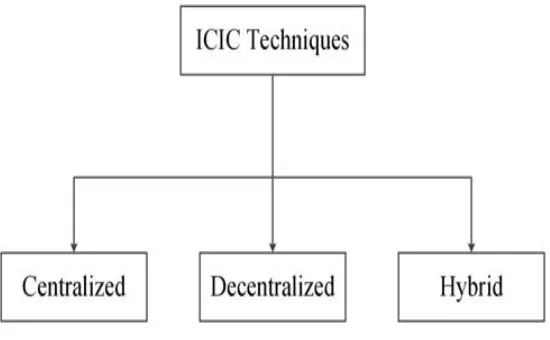
[image:5.612.170.445.266.436.2]Rather than promoting standardized techniques, 3GPP provides support for proactive and reactive schemes, and it allows constructors and operators to configure a wide range of non-standardized ICIC techniques. We classify these techniques into centralized, decentralized, and hybrid schemes.
Figure 3 Cooperation-based classifications of ICIC techniques
Centralized ICIC techniques require the existence of a central management entity that controls the entire network. It collects information related to channel quality and UE throughput demands. Then, it finds the optimal resource allocation between the existing base stations, and it also performs resource allocation among UEs (scheduling). The centralized approach offers the optimal resource allocation solution. However, a large amount of signaling messages is generated. Thus, it is only recommended for small-sized cellular networks.
The decentralized non-cooperative approach allows each cell to determine its own resource allocation, without the need to cooperate with other cells. The existence of a centralized control entity is not required. This approach does not generate any additional signaling overhead, and it is characterized by a low implementation complexity. However, it does not guarantee the optimal resource allocation. Hence, decentralized ICIC techniques are adequate for large-sized cellular networks.
Hybrid ICIC techniques are also qualified as semi-centralized. They are proposed as a compromise between the centralized and the decentralized techniques. In these schemes, a centralized control entity collects channel quality information and UE throughput demands in order to adjust resource allocation between the network cells, while RB allocation to the active UEs is locally performed by each base station. The hybrid approach achieves a tradeoff between the previously mentioned approaches, and it is suitable for medium-sized cellular networks. ICIC techniques classification based on the cooperation required between the cells is illustrated in Figr 3
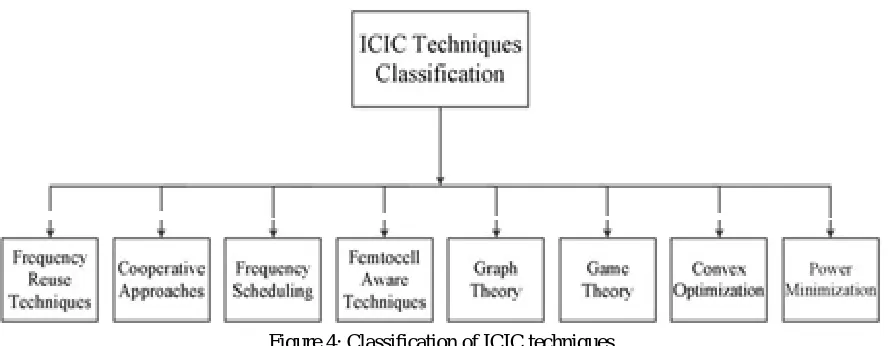
Figure 4: Classification of ICIC techniques
D. Frequency Reuse Techniques
Frequency reuse based ICIC techniques, such as fractional frequency reuse and soft frequency reuse, have been widely suggested to minimize interference between adjacent cells, and to increase bandwidth efficiency. However, FFR and SFR are not able to dynamically adapt to situations where the throughput demands or the UE positions are not homogeneously distributed between the different cells[4]. The proposed scheme is based on FFR, and it searches for the optimal dimensions of cell-center and cell-edge zones as well as the optimal frequency reuse factor. In a multi-objective algorithm for improving SFR performance is proposed. It addresses the tradeoff between enhancing network capacity and improving cell-edge performance. From an operator perspective, SFR optimization is a problem in which the interest is placed not only in maximizing the overall network spectral efficiency, but also in guaranteeing to UEs a certain levels of QoS, at the lowest possible cost. It enhances the performance of SFR in realistic irregular cellular networks by simultaneously improving the system spectral efficiency and reducing ICI in the cell-edge zone. Co operative Approach Cooperative ICIC techniques make use of the communications between the neighboring cells in order to mitigate ICI. Resource allocation becomes more efficient when additional information about resource usage, power allocation, and UE throughput demands are exchanged between adjacent cells. An interference avoidance scheme is presented, where the objective is to mitigate interference for cell-edge UEs without reducing network throughput[5]. The proposed scheme is comprised of a two-level algorithm: one at the base station two-level and the other at a central controller to which a group of base stations are connected. First, each cell calculates its own restrictions on resource allocation locally, after receiving channel quality information from its active UEs. These decisions are forwarded to a centralized entity that processes requests from several adjacent sectors, and the final restrictions on resource allocation are sent by the control entity to each of the concerned sectors.
A cooperative ICIC scheme of LTE femtocells for the downlink is introduced. A dedicated signaling channel is established over the X2 interface in order to exchange information related to inter-cell interference and traffic load of each cell. An optimization problem that maximizes the sum of the logarithmic rate of all UEs is formulated. Resource and power allocation procedure is divided into two steps. In the first step, resources are allocated to the active UEs using a proportional fair scheduling technique, while in the second step, power allocation is performed on the scheduled resources by solving the Lagrangian of the maximization problem using the Karush-Kuhn-Tucker conditions.
E. Frequency Scheduling Techniques
Small cells, including picocells and femtocells, are deployed to enhance the coverage of the existing macrocells, and to improve the spectral efficiency. Nevertheless, this deployment leads to significant interference in such heterogeneous networks. Femtocell-aware ICIC techniques modify resource allocation between the macro LTE/LTE-A cells and the small cells deployed within their coverage area[6]. The available spectrum is divided into a macro-dedicated portion and a Femto-sharing portion. A list of macro UEs that are potential interferes to nearby Femto-cells is identified. The idea is to allocate resources from the macro-dedicated spectrum to these UEs, while other UEs can be allocated resources from the macro-dedicated and from the Femto-sharing portions.
Within the same context, two resource allocation approaches are proposed. The first one is autonomous, and it does not imply communication among femtocells. Thus, each Femtocell independently takes its own scheduling decisions. An optimization problem that aims at minimizing the downlink transmission power is formulated, and it is solved by each Femtocell using local information only. The second approach is cooperative, where the neighboring cells coordinate their resource allocation to cell-edge UEs through a message passing approach over the Femtocell gateway. It is recommended when the femtocells have sufficiently high bandwidth and low latency at the backhaul. The coordination is realized by adding an additional constraint to the optimization problem of the autonomous approach. It guarantees that power constraints imposed by the neighboring cells are fulfilled at the local femtocell.
G. Graph Theory
When a multitude of small cells are randomly deployed within the coverage area of an LTE/LTE-A network, managing interference problems between these cells becomes very complicated. In this case, the resource allocation problem can be solved using graph theory, where a graph is used to represent the interference relationships.
The scheduling process is divided into two parts. First, a graph is created based on the interference relations among all UEs. Its
edges represent critical interference relations in between UEs i.e., those who are connected must not be served by the same set of
resources. Second, a graph coloring algorithm is used to assign resources to the active UEs, while taking into account constraints related to the interference graph. Similarly, a two-steps approach based on graph theory is presented. In the first step, an interference graph is constructed by connecting the interfering UEs. Moreover, each edge is given an integer cost or weight that characterizes the potential interference between two UEs. It is inferred from the geographical locations of the UEs. In the second step, resource allocation is performed by finding among the possible resource assignments, the one that best leverages the instantaneous channel quality [6]. Each node of the interference graph represents a base station, and each link indicates that the two connected nodes are interfering with each other.
The proposed graph coloring approach maximizes the number of colors assigned for resource allocation. An optimization problem that aims at maximizing the usage of the available resources is formulated, with constraints related to interference and QoS requirements. For instance, two linked nodes are not assigned the same color. Although this approach improves the spectral efficiency, a centralized system implementation is required. A large amount of signaling overhead is generated, and the overall complexity is prohibitively high.
H. Game Theory
Game theory is a mathematical modeling tool that helps to achieve equilibrium among multiple decision-makers. It assigns a strategy so that each decision-maker cannot increase the payoff by changing its strategy while others maintain theirs. In resource allocation scenarios, decision-makers are the base stations, and the strategies correspond to resource management. The cooperative game is a competition between coalitions of players rather than between individual players. At the first level, a fair resource distribution among flow classes is performed. A cooperative game is used to form coalitions between the flow classes (the players) to distribute the available bandwidth among them. At the second level, each flow class distributes its corresponding portion of resources to all the flows belonging to it.
I. Convex Optimization
Resource and power allocation problem can be formulated as a constrained maximization of an objective function. Convex optimization problems consist in minimizing a convex function (or maximizing a concave function) over a convex constraint set. Moreover, we can make use of Lagrange duality properties to link the original problem into a dual problem. This leads to iterative algorithms that converge to the global optimum.
downlink transmission power allocation. The proposed algorithms run in a centralized controller that collects channel measurements from the different eNodeBs. Similarly, a convex optimization problem is formulated, where a single cell OFDMA network is considered. The energy efficiency objective function is studied and a low complexity suboptimal algorithm is proposed to reduce the computational burden of the optimal solution[9].
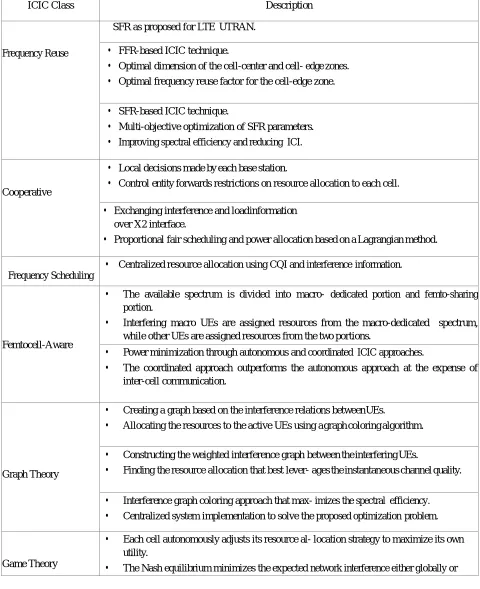
Table 2.1: Surveyed ICIC Techniques
ICIC Class Description
Frequency Reuse
SFR as proposed for LTE UTRAN.
• FFR-based ICIC technique.
• Optimal dimension of the cell-center and cell- edge zones.
• Optimal frequency reuse factor for the cell-edge zone.
• SFR-based ICIC technique.
• Multi-objective optimization of SFR parameters.
• Improving spectral efficiency and reducing ICI.
Cooperative
• Local decisions made by each base station.
• Control entity forwards restrictions on resource allocation to each cell.
• Exchanging interference and load information
over X2 interface.
• Proportional fair scheduling and power allocation based on a Lagrangian method.
Frequency Scheduling
• Centralized resource allocation using CQI and interference information.
Femtocell-Aware
• The available spectrum is divided into macro- dedicated portion and femto-sharing
portion.
• Interfering macro UEs are assigned resources from the macro-dedicated spectrum,
while other UEs are assigned resources from the two portions.
• Power minimization through autonomous and coordinated ICIC approaches.
• The coordinated approach outperforms the autonomous approach at the expense of
inter-cell communication.
Graph Theory
• Creating a graph based on the interference relations between UEs.
• Allocating the resources to the active UEs using a graph coloring algorithm.
• Constructing the weighted interference graph between the interfering UEs.
• Finding the resource allocation that best lever- ages the instantaneous channel quality.
• Interference graph coloring approach that max- imizes the spectral efficiency.
• Centralized system implementation to solve the proposed optimization problem.
• Each cell autonomously adjusts its resource al- location strategy to maximize its own
J. Power Minimization Approaches
We also identify another category of ICIC techniques that avoid ICI by reducing the transmission power of the base stations. Transmission power adjustment will potentially reduce the interference caused to the neighboring cells.
An optimization problem is defined, where the objective is to minimize the required transmission power for the base station. Resources and transmission powers are jointly allocated, and constraints on the minimum throughput per UE and on the transmission power of each base station are defined. The proposed scheme runs independently at each base station, but some signaling overhead is required in order to exchange information related to the maximum transmission power estimated at each cell. These information are taken into account by the neighboring cells when locally solving their joint resource and power allocation problem. In a heuristic downlink power allocation strategy is introduced. Power is allocated to each resource according to the received CQI feedbacks. It is a distributed algorithm that operates independently of the chosen scheduler, and it aims at avoiding the power wastage. Results show that the energy efficiency is improved, and ICI is reduced [8].
V.CONCLUSION
The increasing demands for data in mobile networks, as well as the exponential growth in mobile applications have lead the mobile network operators to apply dense frequency reuse model to improve spectral efficiency and increase network capacity. However, inter- cell interference problems have a negative impact on UE throughput and system performance. ICIC techniques are proposed to mitigate ICI, and to improve UEs throughput without largely reducing spectral efficiency.
Our results show that SFR has the highest spectral efficiency, since it allows using the entire available spectrum in every cell, while imposing restrictions on power allocation for RBs available in each zone. Therefore, it succeeds in reducing ICI while increasing spectral efficiency for all UE distributions, except the case where the majority of UEs are GR.
VI. ACKNOWLEDGMENT
I am Very thankful to my guide Dr.N S Murti Sarma for his valuable suggestions to make this paper ready.
REFERENCES
[1]. Xiao Xiao, Xiaoming Tao, and Jianhua Lu. Energy-Efficient Resource Allocation in LTE-Based MIMO-OFDMA Systems with User Rate Constraints. IEEE Trans. Vehicular Technology, 64(1):185–197, January 2015.
[2]. S.S. Prasad, C.K. Shukla, and R.F. Chisab. Performance Analysis of OFDMA in LTE. In 3rd International Conference on Computing Communication Networking Technologies, pages 1–7, July 2012.
[3]. Chrysovalantis Kosta, Bernard Hunt, Atta U. Quddus, and Rahim Tafazolli. An Improved Inter-cell Interference Coordination (ICIC) for OFDMA Multi-Cell Systems. In Proceedings of the 19th European Wireless Conference, pages 1–5, April 2013.
[4]. Cong Xiong, G.Y. Li, Shunqing Zhang, Yan Chen, and Shugong Xu. Energy Efficient Resource Allocation in OFDMA Networks. IEEE Trans. on Commun, 60(12):3767–3778, December 2012.
[5]. Dengkun Xiao, Xiaoyu Yu, and Dongkai Yang. A Novel Downlink ICIC Method Based on User Position in LTE-Advanced Systems. In 2012 IEEE Vehicular Technology Conference (VTC Fall), pages 1–5, September 2012.
[6]. M. Yassin, M. AboulHassan, S. Lahoud, M. Ibrahim, D. Mezher, B. Cousin, and E. Sourour. Survey of ICIC Techniques in LTE Networks under Various Mobile Environment Parameters. Accepted for publication in Springer Wireless Networks, 2015.
[7]. I. Toufik S. Sesia and M. Baker. LTE - The UMTS Long Term Evolution from Theory to Practice. Wiley, Chichester, 1 edition, 2009.
[8]. C. Kosta, B. Hunt, A.U. Quddus, and R. Tafazolli. On Interference Avoidance Through Inter-Cell Interference Coordination (ICIC) Based on OFDMA Mobile Systems. IEEE Commun. Surveys Tutorials, 15(3):973– 995, December 2013.
[9]. Gabor Fodor, Chrysostomos Koutsimanis, Andras Racz, Norbert Reider, Arne Simonsson, and Walter Muller. Intercell interference coordination in ofdma networks and in the 3gpp long term evolution system. J. Commun., 4:445–453, 2009.
V. THRIMURTHULU M.E, MIETE., MISTE