
Design and Optimization of Multi-Leaf Spring by
Finite Element and Grey Relation Method
Jayesh Raj Pal1, Arun Singh Kushwah2
1
Research scholar, ME Department, ITM University, Gwalior, India
2
Assistant Professor, ME Department, Gwalior, India
Abstract: The Automobile Industry has great interest for replacement of steel leaf spring with that of composite leaf spring,
since the composite materials has high strength to weight ratio, good corrosion resistance. The objective is to compare the different types of composite material and load carrying capacity, stress stiffness and weight savings of composite leaf spring with that of steel leaf spring. The dimensions of an existing conventional steel leaf spring of a light commercial vehicle TATA ACE EDGE are selected for this work investigation. Similar dimensions of conventional leaf spring are used to design in Solid works of composite multi leaf spring material for analysis that is E- Glass/Epoxy, Carbon Epoxy and Graphite Epoxy unidirectional laminate. Finite Element Analysis with full load on 3-D model of composite multi leaf spring is done using ANSYS 14.5 and the analytical results are compared with experimental results. Run the 16 experiment with the combination of load and material which gives output responses in terms of stress, deflection and weight. Compare the all material with their respective load and select the best one by comparison. Optimize the responses of 16 combinations by Grey Relation Analysis for the better input parameter against output responses.
Keywords: Leaf Spring, Solid Works, ANSYS, Grey Analysis.
I. INTRODUCTION
Leaf springs are mainly used in suspension systems used to absorb the shock loads in automobiles such as L.C.V, H.C.V. It used to carry lateral loads, brake torque and driving torque with shock absorbing [1]. Leaf spring covers advantages over helical spring are that the ends of the leaf spring can be guided along a definite path because it deflects to act as a structural member along with energy absorbing device. According to previous studies made, a material which had maximum strength and minimum modulus of elasticity in the longitudinal direction is the most suitable material for a leaf spring [2]. The leaf springs get more affected due to fatigue loads, as they are a part of the unstrung mass of the automobile. Performance measures of any leaf springs are its stiffness and fatigue life. [1].
Fig.1 Leaf spring assembled at rear axle of automotive & Multi-Leaf Spring [2]
A. Principle of Leaf Spring
With the introduction of composites, a better suspension system along with better ride quality can be achieved. In designing of springs, strain energy becomes the major factor [1]. The relationship of the specific strain energy can be expressed as;
U = σ2/ρE
B. Composite Materials
When two or more materials are combined then it results in better properties than those of the individual components which can be used alone, can be defined as Composite material. Every material retains its separate chemical, physical, and mechanical properties, when compared to metallic alloys. Composite materials offers advantages such as high strength and stiffness, combined with low density, when compared with bulk materials, which allows for weight reduction for the finished part [3].
C. Applications
Composites material has their commercial and industrial applications on major structural application areas which includes aircraft, space, automotive, sporting goods, and marine engineering.
Other applications include such as structural chassis components, such as drive shafts and road wheels, have been successfully tested in the laboratories and are currently being developed for future cars and vans.
1) Benefits
a) Weight reduction & High strength: Composites are light in weight, compared to most woods and metals & far stronger than aluminum or steel.
b) Corrosiveness & Low Thermal Conductivity: Composites resist damage from the weather and from harsh chemicals & are low conductor of heat and cold and are good insulator.
c) Design Flexibility & Durable: As compare to other materials composites can be molded into complicated shapes more easily & have a long life and need little maintenance.
II. PROBLEM FORMULATION
Based on the problems and past research gap analysis objective of work are focused on compare the load carrying capacity, stresses, deflection and weight savings of composite leaf spring with that of steel leaf spring. And paying attention on composite materials by replacing steel in conventional leaf springs of a suspension system to reduce stresses, deflection are follow some objective;
A. Select the vehicle leaf spring for calculate its dimension and its effective load.
B. Deign the leaf spring in CAD software with assemble which provide the requisite dimension to the body structure as well as to bear the load in actual condition.
C. Design the input parameters for analysis in ANSYS tool. As per the design with selected parameters perform the analysis and record the responses.
D. Optimize the responses with suitable multi-objective technique.
E. Compare these responses with respect to load for selected the material of leaf spring.
III. MATERIALS DESCRIPTION A. Steel and composite material
PROPERTY NAME
VALUE AND UNIT
Young’s Modulus 200000 Mpa
Tensile Strength 650~880 Mpa
Elongation 8~25%
Fatigue 275 Mpa
Yield strength 350~550 Mpa
Density 7700 Kg/m3
Resistivity 0.55 ohm×mm2/m
Poisson’s ratio 0.27-0.30
[image:3.612.215.396.516.719.2]S.NO PROPERTIES EGLASS/ EPOXY
CARBON EPOXY
GRAPHITE EPOXY 1 Tensile stress at X direction Ex (Mpa) 43000 177000 294000 2 Tensile stress at Y direction Ey (Mpa) 6500 10600 6400 3 Tensile stress at Z direction Ey (Mpa) 6500 10600 6400
4 Poisson ratio at XY direction Pxy 0.27 0.27 0.023
5 Poisson ratio at YZ direction Pyz 0.06 0.02 0.01
6 Poisson ratio at ZX direction Pzx 0.06 0.02 0.01
[image:4.612.64.546.75.244.2]7 Shear Modulus at XY direction Gxy (Mpa) 4500 7600 4900 8 Shear Modulus at YZ direction Gyz (Mpa) 2500 2500 3000 9 Shear Modulus at ZX direction Gzx (Mpa) 2500 2500 3000 10 Density δ (kg/mm3) 0.000002 0.0000016 0.0000015
Table 2 Orthotropic properties of Composite materials [10]
B. Selection of lcv and dimension
NAME OF DATA DATA UNIT
Total num. of leaves 5 _ _
Span length 940(+ -3) Mm
Material name EN47 _ _
Total length(Eye to Eye) 956 Mm
Free camber at no load condition 100(+ -4) Mm
Thickness 1ST ,2ND and 3RD 7 Mm
Thickness 4TH and 5TH 6 Mm
Width of leaf 60 Mm
Outer Diameter of Eye End 45.8 ~ 46 Mm
Inner Diameter of Eye End 58 Mm
Table 3 SELECTED LCV – TATA ACE EDGE 102.
Basic requirements of load: Maximum capacity = 2250 Kg = 2250 x 10 = 22500 N TATA ACE EDGE 102 is equipped with 4 nos. of semi-elliptical leaf spring,
So load acting on the leaf spring assembly = 22500÷4 = 5625 N Calculation of load and effective length of leaf spring:
Consider the leaf spring is cantilever beam, 2 × W = 5625, W =5625÷2, W= 2812.5 N.
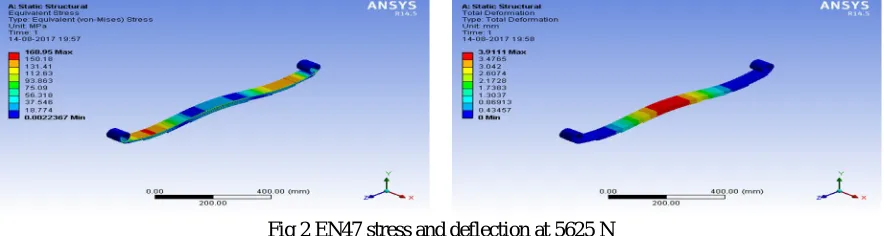
[image:4.612.86.528.589.707.2]Now On basis of parameters calculation leaf spring are designed in SOLID WORKS and FEA in ANSYS v14.5. FEA of every material are run and results are shown in below fig.
Fig 2 EN47 stress and deflection at 5625 N
IV. OPTIMZATION
Based on analysis in ANSYS software with respect to design parameter their responses are tabulated in table 4, these responses are in terms of maximum stress and maximum deflection.
S. No.
L
(N) M
W (Kg) σ (MPa) δ (mm)
Input Parameter Output Response
1 5625 EN47 11.665 168.95 3.911
2 5625 E glass 3.03 58.038 13.008
3 5625 Carbon Epoxy 2.424 58.145 8.381
4 5625 Graphite Epoxy 2.4088 57.611 13.039
5 5600 EN47 11.665 168.2 3.894
6 5600 E glass 3.03 57.78 12.95
7 5600 Carbon Epoxy 2.424 57.887 8.344
8 5600 Graphite Epoxy 2.4088 57.355 12.981
9 5575 EN47 11.665 167.45 3.876
10 5575 E glass 3.03 57.522 12.892
11 5575 Carbon Epoxy 2.424 57.628 8.307
12 5575 Graphite Epoxy 2.4088 57.099 12.923
13 5550 EN47 11.665 166.7 3.859
14 5550 E glass 3.03 57.264 12.835
15 5550 Carbon Epoxy 2.424 57.37 8.269
16 5550 Graphite Epoxy 2.4088 56.843 12.865
Table 4 Response Table [4]
Applying Grey Relational Analysis (GRA) is an impacting capacity method.
( ) = ( ) −( )
max( ) −min( ) … . . (1) Normalizing Equation
Grey Relation Coefficient Gi(k) for the kth response characteristics in the ith experiment can be expressed as
= +
( ) + … … . . (2)
Where Li(k) is the kth value in Li different data series. Lmax and Lmin are the global maximum and global minimum values in the different data series, the mean of the range of ɛ = 0.5,
After GRC, Grey Relation Grade ( Γ ) is calculated, the highest value of GRG is the optimum result. GRG is calculated as:
=1 ……. ( )
The magnitude of γ reflects the overall degree of standardized deviation.
Normalizing and Calculating Grey Relation Coefficient and Grey Relation Grade [4] in below table: S.
No. L M W Xi σ Xi δ Gi σ Gi δ Γ
1 5625 EN47 11.665 0 0.994336 0.333333 0.988798 0.661066
2 5625 E glass 3.03 0.989341 0.003377 0.979126 0.334085 0.656606 3 5625 Carbon Epoxy 2.424 0.988386 0.507407 0.977299 0.503731 0.740515 4 5625 Graphite Epoxy 2.4088 0.993149 0 0.986484 0.333333 0.659909 5 5600 EN47 11.665 0.00669 0.996187 0.334827 0.992432 0.66363 6 5600 E glass 3.03 0.991642 0.009695 0.983559 0.335502 0.65953 7 5600 Carbon Epoxy 2.424 0.990687 0.511438 0.981715 0.505785 0.74375 8 5600 Graphite Epoxy 2.4088 0.995433 0.006318 0.990949 0.334743 0.662846
10 5575 E glass 3.03 0.993943 0.016013 0.988032 0.33693 0.662481 11 5575 Carbon Epoxy 2.424 0.992998 0.515468 0.986189 0.507856 0.747022 12 5575 Graphite Epoxy 2.4088 0.997716 0.012636 0.995454 0.336165 0.665809
13 5550 EN47 11.665 0.02007 1 0.337854 1 0.668927
14 5550 E glass 3.03 0.996245 0.022222 0.992545 0.338346 0.665446 15 5550 Carbon Epoxy 2.424 0.995299 0.519608 0.990686 0.51 0.750343
[image:6.612.97.515.250.429.2]16 5550 Graphite Epoxy 2.4088 1 0.018954 1 0.337599 0.6688
Table 5 Calculation of GRC and GRG [4]
V. RESULT AND DISCUSSION OBTAINED
From optimization done above we get result for optimum load, stress, deflection and optimum material to be suggested for replacement of conventional steel.
Optimum stress and deflection for Carbon epoxy at load 5550N is shown in Fig.3
A. Comparison of GRG
5625 5600 5575 5550 Average GRG Rank
EN47 0.661066 0.66363 0.666322 0.668927 0.66498625 2
E glass 0.656606 0.65953 0.662481 0.665446 0.66101575 4
Carbon Epoxy 0.740515 0.74375 0.747022 0.750343 0.7454075 1
Graphite Epoxy 0.659909 0.662846 0.665809 0.6688 0.664341 3
Table 6 GRG Comparison
Fig. 4 Comparison Graph of GRG 0.6
0.65 0.7 0.75 0.8
EN47 E glass Carbon
Epoxy
Graphite Epoxy
G
R
G
V
al
u
e
Materials
5625 N
5600 N
5575 N
[image:6.612.45.566.471.720.2]Fig 5 Percent of weight of each material [1]
VI. CONCLUSION
From the static analysis results it is found that there is a maximum displacement of 13.039 mm in the Graphite epoxy spring and the corresponding displacements in Steel E-glass / epoxy, and carbon/epoxy are 3.911mm, 13.008 mm and 8.3811mm respectively on maximum load. From the static analysis results it is found that there is a maximum stress of 168.95 MPa in the steel spring and the corresponding displacements in E-glass/epoxy, Graphite epoxy and carbon/epoxy are 58.038 MPa, 57.611 MPa and 58.145 MPa respectively on maximum load. From the optimization by grey relation analysis observed the minimum stress and deflection simultaneously drawn on load 5550 N with Carbon Epoxy material. By comparing GRG with respect to load and material the optimize material is Carbon epoxy with all load, its minimum stress are found 57.37 MPa and deflection 8.2694 mm. Among the three composite leaf springs, only Carbon/epoxy composite leaf spring has optimum stresses and deflection than the other material leaf spring. Carbon/epoxy composite leaf spring can be suggested for replacing the steel leaf spring from stress and stiffness point of view. As comparing the weight of steel to other material carbon epoxy has optimum weight is 2.424 as comparing with steel percent the reduction in weight for suggested material is 79.219. But the minimum weight percent reduction is obtained 79.35 % of Graphite epoxy which is almost equivalent to carbon epoxy.
REFERENCES
[1]. R ranjit rajale, s mayuresh rana, praveen k mali (2016). Design and analysis of composite leaf spring, International Journal Of Innovative Research In Science,
Engineering And Technology, Vol. 5, Issue 5, pp: 6993-7001
[2]. Pakale prashant n., patil d.m. (2016).A review on “design, analysis & experimental investigation of composite leaf spring”, International Research Journal Of
Engineering And Technology (Irjet), Volume: 03 Issue: 10, pp- 830-833.
[3]. S. Sachin wagh, s, dhananjayzanjad, malipraveen k (2016). Composite leaf spring- review paper, international journal on theoretical and applied research in
mechanical engineering (ijtarme) v-5 no.2, pp 81-84
[4]. Devesh Shrivastava & S. K. Ganguly, Optimization Of Biodegradable Lubricant For Rolling Process By Grey Relational Method, Jour. Sci. Res. A. Sci.2,
No.6, (2016) 261-271.
[5]. Nutalapatisyambabu (2015). Design and analysis of leaf spring by using composite material for light vehicles, International Journal Of Mechanical Engineering
And Technology (Ijmet) Volume 6, Issue 12, pp 36-59
[6]. Burande S.W., Chavhan G.R., Dhole L.P. (2014). Analysis of leaf springs in light automotive vehicles by experimental and finite element approach,
International Journal Of Advanced Engineering Research And Studies,, Pp: 15-16
[7]. Sharma Avinash, Bergaleyajeet, Bhatia Singh Satbeer (2014). Design and analysis of composite leaf spring – a review, International Journal Of Engineering
Trends And Technology (Ijett) – Volume 9 Number 3, pp: 124-128
[8]. Wahanechetna , jain abhishek, khare vivek (2014). Comparative analysis of en 45 steel & thermoplastic polyimide (30% carbon fiber reinforced) used in mono
leaf spring under static loading condition Using Ansys, International Journal For Scientific Research & Development| Vol. 2, Issue 08, pp 189-193
[9]. Babuniranjantharigonda, bhaskar p, moulali s (2014).Design and analysis of leaf spring with composite materials, International Journal Of Engineering
Sciences & Research Technology, 3(8), pp: 759-763
[10]. Shamim shahrukh, anwerjamil (2014). Design and optimization of automotive multi-leaf spring by finite element method, International Journal Of Research In
Aeronautical And Mechanical Engineering, Vol.2 Issue.8, pp 46-54.
[11]. B.kajay., gophanemandar, baskar p (2014). Design and analysis of leaf spring with different arrangements of composite leaves with steel leaves, international
journal of engineering trends and technology (ijett) – volume 11 number 2, pp 88-92
[12]. Patel jignesh r. (2014). Design and analysis of composite leaf spring, Department Of Mechanical Engineering U.V. Patel College Of Engineering, pp 1-66.
[13]. Chandrabosesubhash, thamotharan c., naveenchandran p. And anbazhagan r. (2014).Design optimization and analysis of a parabolic leaf spring,Middle-East
Journal Of Scientific Research vol. 20 , Issue 11, pp 1590-1596
0 50 100
EN47 E glass Carbon Epoxy Graphite
Epoxy
![Table 1 EN47 material properties [1]](https://thumb-us.123doks.com/thumbv2/123dok_us/8306487.856291/3.612.215.396.516.719/table-en-material-properties.webp)
![Table 5 Calculation of GRC and GRG [4]](https://thumb-us.123doks.com/thumbv2/123dok_us/8306487.856291/6.612.45.566.471.720/table-calculation-grc-grg.webp)
![Fig 5 Percent of weight of each material [1]](https://thumb-us.123doks.com/thumbv2/123dok_us/8306487.856291/7.612.92.517.73.235/fig-percent-weight-material.webp)
