End To End Physical Layer Design for Efficient Data
Transmission in Wireless Communication
Neelima Gupta
& Alok Srivastava
([email protected]), ([email protected]2) Chandravati Group of Institutions
ABSTRACT:
In any network designed for data or communication physical layer is the most important layer because it is ultimately depends upon physical layer for any type of transmission. Its importance can be understood by the fact that all the layers of open system interface or transmission control protocol are designed either for serving physical layer or being served by physical layer. The main problems associated with physical layers are attenuation, noise and
bandwidth limitations while main
responsibilities are end to end efficient and secure data transmission. With the increasing demand bandwidth availability is decreasing while other factors like noise and attenuation is also increasing. In this paper we have designed a physical layer for a wireless channel because on one hand a wireless channel has to face noise, attenuation and bandwidth limitation more severely than its wired counterpart while on other hand and they are most widely in use because of easiness of establishment.
KEYWORDS: OSI, TCP, Physical Layer,
Computer network.
I.INTRODUCTION
Communication is the most important aspect of modern edge life. Electronic communication evolved in dependently in different parts of world, so compatibility was a major concern for intercontinental communication. To solve this problem first open system interface and then
transmission control protocol reference models, proposed layered architecture for networking. In both the reference models there were some similarities and differences as given in table 1.
Sr
No OSI TCP/IP
1 Layered architecture Layered architecture
2 Not dependent on
protocols
Depends on protocols
3 Total 7 layers Total 4 layers
4 Transport and
presentation layers defined
No such layers exists
5 Top down approach Level or horizontal
approach
6 Clear classification
of works
Multiple tasks has been assigned to same layer
7 Transport layer
guarantees end to end packet delivery
Does not have any such layer even though equally reliable
8 Can be used for
connection less and connection oriented services.
Can be used for connection less and connection oriented services.
9 Transport layer
deliver packets after making connections
Transport layer is not dependent on connection.
10 Network layer works
in both modes ie connection oriented and connection less
Network layer works in connection less mode
efficient data transfer. The ultimate goal of these models is to provide seamless communication between different type of communication medium and equipment used in different parts of world.
2. PHYSICAL LAYER
The physical layer itself includes various elements necessary to carry signals. These signals can be divided in two parts
(a) Analog Signal: These signals are
continuous in nature and may attain any value. Normally these signals are blend of various types of signals but can be represented by sine wave.
(b) Digital signal: These signals may be
continuous or discrete in nature but may attain only predefined fixed values.
These signals flow through either wired or wireless medium. This part of communication system is most critical as these are most affected by noise and face maximum attenuation. Various types of codes has been used depending upon condition of environment and channel conditions.
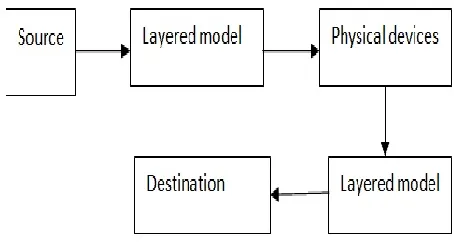
Fig 1 Block diagram source to destination data transmission
So in short physical layer work can be divided in 4 parts
(a) Hardware specific: Physical layer have
to deal with cables, switching system etc
(b) Line encoding: This is the work of
physical layer to generate signal and encode data according to the physical devices used.
(c) Data support: Physical layer have to
convert data packets to signal and vice versa.
(d) Physical network design: This layer also
deals with the physical address of device.
Proposed work: For the paper we have simulated a communication system as per the following block diagram
Fig 2 Block diagram of proposed work
For the system we used OFDM modulator and frequency domain equalizer because OFDM modulators (orthogonal frequency division multiplexing) are capable to modulate digital data on multiple frequency carriers. Thus we can reduce the effect of selective attenuation in a particular channel while frequency domain analyser keeps control over bandwidth requirement of the transmitted signal.
By analyzing the results it is very clear that that output is optimized. We also find SNR within the range of 0-12 and symbol error rate 0-10. So using OFDM along with MIMO has improved the signal reception.
5. CONCLUSION & FUTURE SCOPE
We have not disturbed the conventional system of data transmission so definitely this system will have no impact on cost and system can be implemented very easily.
REFERENCES
[1] F. Khan and Z. Pi, “An introduction to millimeter-wave mobile broadband systems,” IEEE Commun. Mag., vol. 49, no. 6, pp. 101– 107, Jun. 2011.
[3] S. Rangan, T. S. Rappaport, and E. Erkip, “Millimeter-wave cellular wireless networks: Potentials and challenges,” Proc. IEEE, vol. 102, no. 3, pp. 366–385, Mar. 2014.
[4] J. Andrews, S. Buzzi, W. Choi, S. Hanly, A. Lozano, A. Soong, and J. Zhang, “What will 5G be?” IEEE J. Sel. Areas Commun., vol. 32, no. 6, pp. 1065–1082, June 2014.
[5] A. Ghosh, T. A. Thomas, M. C. Cudak, R. Ratasuk, P. Moorut, F. W. Vook, T. S. Rappaport, G. MacCartney, S. Sun, and S. Nie, “Millimeter wave enhanced local area systems: A high data rate approach for future wireless networks,” IEEE J. Sel. Areas Commun., vol. 32, no. 6, pp. 1152–1163, June 2014.
[6] J. Gozalvez, “5G tests and demonstrations [mobile radio],” IEEE Vehicular Technology Magazine, vol. 10, no. 2, pp. 16–25, June 2015.
[7] M. Akdeniz, Y. Liu, M. Samimi, S. Sun, S. Rangan, T. Rappaport, and E. Erkip, “Millimeter wave channel modeling and cellular capacity evaluation,” IEEE J. Sel. Areas Commun., vol. 32, no. 6, pp. 1164–1179, June 2014.
[8] T.Bai and R. Heath, “Coverage and rate analysis for millimeter-wave cellular networks,” IEEE Trans. Wireless Commun., vol. 14, no. 2, pp. 1100–1114, Feb. 2015.
[9] D. E. Berraki, S. M. D. Armour, and A. R. Nix, “Codebook based beam forming and multiuser scheduling scheme for mm wave outdoor cellular systems in the 28, 38 and 60 GHz bands,” in IEEE Globecom Workshops (GC Wkshps), 2014, Dec 2014, pp. 382–387.
[10] K. Allen et al., Building penetration loss measurements at 900 MHz, 11.4 GHz, and 28.8
MHz, ser. NTIA report – 94-306. Boulder, CO: U.S.
Dept. of Commerce, National Telecom. and Information Administration, 1994.
[11] C. R. Anderson and T. S. Rappaport, “In-building wideband partition loss measurements at 2.5 and 60 GHz,” IEEE Trans. Wireless Comm., vol. 3, no. 3, pp. 922–928, May 2004.
[12] A. Alejos, M. Sanchez, and I. Cuinas, “Measurement and analysis of propagation mechanisms at 40 GHz: Viability of site shielding forced by obstacles,” IEEE Trans. Vehicular Technology, vol. 57, no. 6, pp.3369– 3380, Nov. 2008. [13] S. Singh, F. Ziliotto, U. Madhow, E. M. Belding, and M. J. Rodwell, “Millimeter wave WPAN: cross-layer modeling and multi-hop architecture,” in Proc. IEEE INFOCOM, 2007, pp. 2336–2340.
[14] H. Zhao, R. Mayzus, S. Sun, M. Samimi, J. K. Schulz, Y. Azar, K. Wang, G. N. Wong, F. Gutierrez, and T. S. Rappaport, “28 GHz
millimeter wave cellular communication
measurements for reflection and penetration loss in and around buildings in New York City,” in Proc. IEEE ICC, June 2013.
[15] J. S. Lu, D. Steinbach, P. Cabrol, and P. Pietraski, “Modeling human blockers in
millimeter wave radio links,” ZTE
Communications, vol. 10, no. 4, pp. 23–28, Dec. 2012.
[16] B. Levasseur, M. Claypool, and R. Kinicki, “A TCP cubic implementation in ns-3,” in Proceedings of the 2014 Workshop on ns-3. ACM, 2014.
[17] M. Mezzavilla, S. Dutta, M. Zhang, M. R. Akdeniz, and S. Rangan, “5G mmWave module for the ns-3 network simulator,” in Proceedings of the 18th ACM International Conference on Modeling, Analysis and Simulation of Wireless and Mobile Systems. ACM, 2015, pp. 283–290.
mmwave cellular networks in ns-3,” arXiv:1602.06932 [cs.NI]., Feb. 2016.
[19] T. S. Rappaport, G. R. Maccartney, M. K. Samimi, and S. Sun, “Wideband millimeter-wave propagation measurements and channel models for future wireless communication system design,” IEEE Transactions on, Communications, vol. 63, no. 9, pp. 3029–3056, May 2015.
[20] N. F. Abdullah, D. Berraki, A. Ameen, S. Armour, A. Doufexi, A. Nix, and M. Beach, “Channel parameters and throughput predictions
for mmWave and LTE-A networks in urban
environments,” in Proc. IEEE VTC, 2015.
[21] Neelima, Alok “ A Noval Approach For Optimization of Physical Layer for Wireless and Mobile Communication” IJR e-ISSN: 2348-6848 p-ISSN: 2348-795X Volume 05 Issue 04 February 2018
[22]Sonal, Alok “ Path Loss Analysis of Amplify and Forward Protocol”(IJRTM) ISSN 2454-6240 Volume 2 Issue 6, August 2016