Implementation of Fractional Order PID
Controller for An AVR System Using GA
Optimization Technique
Javvadi. Gowtham Sreeram1, V. Gowtham2
1Pg student, Electrical Engineering Department Gudlvleru Engineering College, Gudlavalleru
2Assistant Professor, Pg Student, Electrical Engineering Department Gudlvleru Engineering College, Gudlavalleru
Abstract: In recent years, the research and studies on fractional order (FO) modelling of dynamic systems and controllers are quite advancing. To improve the stability and dynamic response of automatic voltage regulation (AVR) system, we presented fractional Order PID (FOPID) controller by employing Genetic Algorithm (GA) technique. We used fractional order tool kit a
masked fractional order PID block in MATLAB programming to implement the P ⋋ controller for any type of system.
Comparisons are made with a PID controller from standpoints of transient response. It is shown that the proposed FOPID controller can improve the performance of the AVR in all the aspects.
I. INTRODUCTION
Even so much research was developed in soft computing techniques for designing controllers, still these techniques fails areas. Neuro-controllers works according to the training given to them and their performance depends on the availability of vast data set of training inputs and target values of the process. Certainly, there is a probability of missed data in the training set, in such case the controller fails to generate an accurate output. Also, the performance of the fuzzy controllers is purely based on the rule base, selection of membership functions and their range and it was still challenging to decide the fuzzy parameters. Still today most of the control problems are smoothly solved by PID controllers due to simplicity in their design and easy implementation. It has been shown that two extra degrees of freedom from the use of a fractional-order integrator and differentiator make it possible to further improve the performance of traditional PID controllers. Details of past and present progress in the analysis of dynamic systems modeled by Fractional order differential equations (FODEs) can be found in [1–14]. Literature survey gives the fractional controller
which was developed by Crone in [3], while [4, 12, 13] presented the controller and [3,14] proposed the P⋋ controller.
We extended the benefits of P ⋋ controller for AVR system. In Particular, a masked P⋋ controller is developed in matlab by
programming to optimize the parameters based on the recently developed optimization techniques instead of using toolbox which was restrained for using advanced optimization techniques. Genetic Algorithm (GA) technique has already been used to determine optimal solution to several power engineering problems and we employed these algorithms to design an FOPID controller for Automatic voltage regulator (AVR) problem. The proposed controller is simulated within various scenarios and its performance is compared with those of an optimally-designed PID controller. Transient response and performance robustness characteristics of both controllers are studied and superiority of the proposed controller in all two respects is illustrated.
II. FRACTIONAL MODELING
PID (Proportional-Integral-Derivative) control is one of the earlier control strategies a most popular industrial controller due to its simplicity and the ability to turn a few parameters automatically controller is used in more than 90% of the control loop, flexibility help the design more robust system. The turning of the PID controller is mostly done using Zeigler and Nichols turning method. Fractional Order P controllers are described by fractional order differential equations, expanding derivatives and integrals to fractional order can adjust control system’s frequency response directly and continuously.
A. Integer Order Approximations
B.Oustaloup’s Recursive Filter
Some continuous filter have been summarized in [13]. Among the filters, the well-established Oustaloup recursive filter has a very good fitting to the fractional-order differentiators [14.15].Assume that the expected fitting range is ( , ).
The filter can be written as
(s) = K ∏ ……… (1)
Where γ is the order of the differentiation and N is the order of approximation.
=
( )
, =
( )
, K = ……… (2)
C.A Refined Oustaloup Filter
Here we introduce a new approximate realization method for the fractional-order derivative in the frequency range of interest
[ , ].Our proposed method here gives a better approximation than Oustaloup’s method with respect to both low frequency and
high frequency. Assume that the frequency range to be fit is defined as ( , ). Within the pre-specified frequency range, the
fractional-order operator can be approximated by the fractional-order transfer function as
K(s) = → ( ) = → ∏ ………. (3)
According to the recursive distribution of real zeros and poles, the zero and pole of rank can be written as
= , = ……….. (4)
Through confirmation by experimentation and theoretical analysis, the synthesis approximation can obtain the good effect when b = 10 and d = 9.
III. FRACTIONAL ORDER PID CONTROLLER
The block diagram of Fractional Order PID Controller is shown in Fig.1
The differential equation of a fractional order P ⋋ controllers is described by
U(t) = ( ) + ⋋
e(t) + e(t) ……… (5)
The continuous transfer function of FOPID is obtained through Laplace transform and is given by
Where , and are proportional, integrator and derivative gain respectively. Gamma and delta are orders of the integral and derivative part, ⋋ and µ respectively. and are lower and upper frequencies respectively for which the fractional order integral and derivative are approximated to integer order. Here, the fractional order by using derivative and integral are approximated to integer order by using oustaloup filter and N is the order of approximation. ⋋ = . is approximated to integral order by using oustaloup filter.
The optimization tool, provided in FOMCON, can in practice be used for fractional PID tuning due to its flexibility. The tool can be accessed from the PID design tool menu by typing fpid_optim.the tool is shown in fig 2
Fig.2 Fractional PID optimize tool
IV. AVR DESIGN USING FOPID CONTROLLER
A. Linearized Model of Excitation System
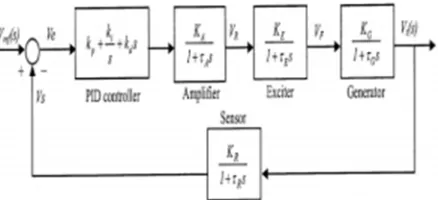
amplifier, exciter, excitation voltage limiters, generator, measurement and filtering includes in the mathematical model of AVR system by ignoring the saturation and other non-linearityies [19] .The transfer function of these components are represented as follows.
1) Amplifier model.
The amplifier model is given by
( )
( ) = ( ) …………. (7)
Typical values of are in the range of 10 to 400. The amplifier time-constant often range from 0.02 to 0.1 s
2) Exciter model.
Exciter model and parameters greatly depend on its type. A simplified transfer function of a modern exciter is
( )
( ) = ……… (8)
Typical values of are in the range of 0.8 to 1 and the time constant for an AC exciter in the range of 0.5 to 1.0 s.
3) Generator model.
The transfer function relating the generator terminal voltage to its field voltage can be simplified to
( )
( ) = ( ) ……… (9)
The constants are load dependent, may vary between 0.7 and 1.0, and between 1.0 and 2.0 s from full load to no load.
4) Measurement model.
The voltage measurement block, including PT, rectifier and filter, is often modelled with a single time constant.
( )
( ) = ………. (10)
ranges over 0.001 to 0.06 s.
5) Excitation voltage limiters.
AVR and exciter output voltages are limited by windup and non-windup limiters [20]. Also, dedicated over excitation and under excitation limiters are employed to assure safe operation of the generator. Block diagram of the AVR compensated with an FOPID controller is shown in Fig.4. In this figure, the combined effects of these limiters are represented by the upper and lower limits set to three times of the nominal value of the field voltage.
B. Performance Criterion
In control system design and analysis or for optimal control purposes, performance indices are calculated to be used as quantitative measures to evaluate a system’s performance, where a control system is judged as an optimum system when the system parameters are adjusted so that the index used in the design reaches its minimum value, while constraints of the controlled system are respected. The commonly used indices are integral of the square of the error (ISE), integral of the absolute value of the error (IAE), integral of time multiplied by absolute value of the error (ITAE), integral of time multiplied by the squared error (ITSE). The ITAE measure, which will be implemented in this paper, is given by the following equation
ITAE = ∫ | ( )| dt ………. (11)
Therefore, the proposed performance criterion J (K) is defined as.
where k is [ , , ,⋋,μ]. The Genetic Algorithm (GA) utilized to design these five controller parameters such that the controlled
system exhibits desired response and robust stability as evaluated by the proposed performance criterion.
V. OPTIMIZATION ALGORITHMS
A. Genetic Algorithm
A genetic algorithm is introduced to optimization problems and they consist of proportional gain, integral gain , derivative gain, derivative order and integral order.
[image:6.612.192.411.292.392.2]Genetic algorithm (GA) is the process of searching the most suitable one of the chromosomes that built the population in the potential solutions space. A search like this, tries to balance two opposite objectives: searching the best solutions (exploit) and expanding the search space. Thus, GA has become a robust optimization tool for solving the problems related to different field of the technical and social sciences, Genetic Algorithms (GA) is global optimizing ones, based on natural selection and genetics mechanisms. They use a parallel procedure and structured strategy, but random, aiming to reinforce searching of high aptitude points. GA can be able to overcome complex non-linear optimization tasks like non-convex problems, non-continuous objective functions iteratively using the three operators in random way but based on the fitness function evolution to perform the basic tasks of copying strings, exchanging portions of strings as well as changing some bits of strings, and finally find and decode the solutions to the problem from the last pool of mature strings.
Fig .3 Linearized model of an AVR system
VI. PROBLEM FORMUATING
The overall transfer function for an AVR system is
=( .
. . )
=
.
By using R-H criterion we got ultimate gain and ultimate period
= 0.09
= 3.63sec
PID controllers can be turned by using different methodologies. Ziegler Nicholas method is one of the conventional methods used for turning Due to high overshoot in ZM method some advanced methods are needed which does not need retuning like ZN method.
A. Details of FOPID Design Using GA for the AVR
The following parameters are used for carrying out the FOPID design using GA:
1) Population size = 95
2) Generations=100
3) Crossover fraction=0.75
5) The order of approximation is set to N = 5
[image:7.612.106.528.116.299.2]Comparision Of The Evaluation Values Between Both Pid And Fopid Controllers
[image:7.612.38.570.468.737.2]TABLE.1
Fig. 4. step response of the AVR controller by PID and FOPID in the presence of generator and exciter uncertainties
VII. CONCLUSION
Performance comparisons of FOPID(GA), FOPID, PID(GA) and PID controller have been reviewed and it is founded that response of FOPID(GA) controller is better than above three methods. The settling time and rise time of the response acquired by FOPID(GA) controller is founded to be less comparison acquired by PID controller the proposed algorithms performed efficient search for the optimal FOPID controller parameters to the practical AVR system. Furthermore, it can be concluded from the above programming that the proposed FOPID controller has more robust stability and performance characteristics than the PID controller applied to the AVR system.
REFERENCES
[1] Tushar Verma, Akhilesh Kumar Mishra, “Comparative study of PID and FOPID Controllers Response for Automatic Voltage Regulation” ISSN:2250-3021, VOL,04, Issue 2014.
[2] Jun-Yi Cao, Jin Liang, Bing-Gang Cao,” Optimization Of fractional order PID controller based on Genetic algorithms” Xi an Jiaotong University, china, IEEE 2005,0-7803-9091-1/05.
[3] C. A. Monje, Y. Q. Chen, B. M. Vinagre, D. Xue, and V. Feliu, “Fractional-Order Systems and Controls: Fundamentals and Applications”. New York: Springer-Verlag, 2010.
[4] Torvik P. J., Bagley R. L, “On the appearance of the fractional derivative in the behaviour of real materials”, Transactions of the ASME, 1984, 51(4):294–298. [5] Axtell M., Bise E. M, “Fractional calculus applications in control systems”, in Proceeding of the IEEE 1990 Natational Aerospace and Electronics Conference.
New York, 1990, 563– 566.
[6] Matignon D, “Stability result on fractional differential equations with applications to control processing”, in IMACSSMC Proceedings. Lille, France, 1996, 963–968.
[7] Oldham K. B., Spanier J, “The Fractional Calculus”, New York: Academic Press, 1974
[8] Podlubny I, “The Laplace transform method for linear differential equations of the fractional order”, In Proceedings of the 9th International BERG Conference. Kosice, Slovak Republic, 1997, 119–119 (in Slovak
[9] Woon S. C, “Analytic continuation of operators — operators acting complex s-times. Applications: from number theory and group theory to quantum field and string theories”, reviews in Mathematical Physics, 1999, 11(4):463–50
[10] OustaloupA. “LaDérivation non Entière”, Paris: HERMES, 1995
[11] Petras I., Dorcak L., Kostial I, “Control quality enhancement by fractional order controllers”, Acta Montanistica Slovaca, 1998, 2:143–14
[12] Podlubny I, “Fractional-Order Systems and Fractional-Order Controllers”, Technical Report UEF-03-94, The Academy of Sciences Institute of Experimental Physics, Kosice, Slovak Republic, 1994
[13] Podlubny I, “Fractional-order systems and PI⋋D – controllers”, IEEE Transactions on Automatic Control,1999, 44(1):208–214
[14] Petras I., Podlubny I., O’Leary P, “Analogue Realization of Fractional Order Controllers”, Fakulta BERG, TU Košice, 2002
[15] Oustaloup A., Levron F., Mathiew B., Nanot F, “Frequency band complex noninteger differentiator: Characterization and synthesis”, IEEE Transactions on Circuits and Systems I: Fundamental Theory and Applications, 2000, 47(1):25–39
Automation. Luoyang, China, 2006, 1043–1048
[17] IEEE Standard Definition for Excitation Systems for Synchronous Machines (ANSI), IEEE Std 421.1-1986. [18] P. Kundur, Power System Stability and Control, McGraw-Hill, 1994
[19] R. A. Krohling and J. P. Rey, “Design of optimal disturbance rejection PID controllers using genetic algorithm,” IEEE Trans. Evol. Comput., Vol. 5, pp. 78–82, Feb. 2001
[20] Coley, D.A.: “An introduction to genetic algorithms for scientists and engineers”, World Scientific Pub.Co. Inc. (1999)
[21] Quagliarella, D., Periaux, J., Poloni, C., Winter, G.: “Genetic Algorithms and Evolution Strategy in Engineering Computer Science”, John Wiley, NY (1998).