Technology (IJRASET)
A New Approach to Detect and Recognize Face
Using MSCR and Skin Color and Comparison with
Knowledge, Text, and Edge based Techniques
Samiksha Shukla 1, Sunil Sharma2 1
M Tech Scholar, 2Asst. Professors, Computer Science & Engineering Department Dr C V Raman University Bilaspur (C.G.), India
Abstract : The Important role in various biometrics applications is face detection in face processing system. Various colors, brightness and pose they used in face detection are illuminization condition is very chhallanging task. There are two main scheme that solve the problem for this, first is skin color based and second is MSCR based approaches. They are simple, roboust and most popular For face detection this method is more faster than the algorithm available in this category. We have implemented this algorithm to get faster as well as accurate resut. Also we have used some existing algorithm to detect face with same input data and compared the results with our proposed algorithm. We have got better result as compare to other existing algorithm such as Text based, Edge Based and Knowledge Based.
KeyWords: Pattern Recognition, Knowledge base, Text Based, Face Detection, Skin Color, MSCR.
I. INTRODUCTION
Many different facial according the human physiology is used to authorize any person identity. The science of determining the identity with respect to different characteristics feature of human being is called biometrics. The characteristics attribute can be broadly classified in to two categories i.e. physiological and behavioral. Face is one of the most important external features of people, so it plays an enormously important role in interpersonal communication. The critical component of automatic face recognition system is face detection which is always in the spotlight. The aim of face detection system is the task of checking whether the given input image contains any human face, and if so, returning face in the location of the human the image.
The wide variety of applications and the difficulty of face detection have made it an interesting problem for the researchers in recent years. It has a wide range of applications in e-commerce, content-based image retrieval, intelligent human-machine interfaces and so on. Face detection is difficult mainly due to a large component of non-rigidity and textural differences among faces. A large number of factors that challenges face detection. There are many in the list such as pose, facial expression, orientation, facial sizes found in the luminance condition occlusion gender and complexity if image background.
Skin color is one of the most significant features of human face. In color images, skin color detection is very effective as skin color is relatively concentrated; so skin is the stable region in the image which does not rely on the details of facial features. Color processing is also faster and robust in nature compared to other features like edge, shape and texture etc.
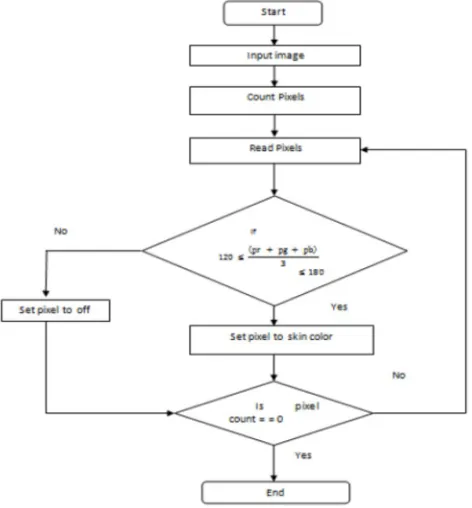
Figure 1 Data Flow Diagram of Skin color Detection
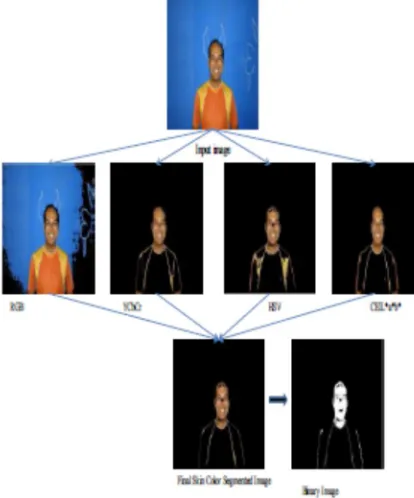
In this paper we have used novel color based segmentation technique to localize a face region from images. There are many color space models for skin segmentation like, RGB, YUV, YIQ, HSV, YCbCr, YCgCr etc having varying levels of performance. And choosing an effective color space is very important as it can affect the detection process substantially. This model utilizes the additional hue and chrominance information of the image on top of standard RGB properties to improve the discriminality between skin pixels and non-skin pixels. This paper presents an enhanced color based segmentation technique to segment the skin regions in a group picture and use of skin based segmentation in face detection.
A. RGB Color Space
The RGB Color space consists of three additive primaries: Red, Green, and Blue. These spectral components are used to produce the resultant color. Fig.1 shows the RGB model represented by a 3-Dimensional cube. A 3-dimensional cube with red green and blue at the corners represents the RGB model on each axis.
The colors red, green and blue are at the corners of each axis. Black is at the origin and white is at the opposite end of the cube. The RGB model simplifies the design of computer graphics systems but is not ideal for all applications due to the strong correlation among red, green and blue color components. As RGB color model is light sensitive, it cannot be used in techniques like histogram equalization which works only on the intensity component of an image.
B. HSV Color Space
Technology (IJRASET)
Figure 2: RGB Color Space distribution
C. YCBCR Color Space
YCbCr is the main color space used for digital video encoding, where a color is represented by using brightness and two color difference signals. Y refers to the brightness (luminance) component, and is computed as a weighted sum of RGB values. Cb and Cr are the chrominance components, where Cb is computed as the difference between the blue component and a reference value and Cr is the difference between the red component and a reference value. The separation of the luminance component from chrominance makes the YCbCr color space luminance independent and more adequate than RGB for face detection by skin color segmentation.
II. LITERATURE REVIEW
There are many numbers of methods proposed by different researchers for face detection and recognition. It can be widely classify on the basis of face on which it can be applied.
Anchal Chauhan et al [23]: author idea is to increase the security in range of application domains Face recognition in video has gained wide attention as a covert method for surveillance. As compared to still face images it is expected that a video which contains temporal information as well as multiple instances of face leads to improved face recognition performance. Here it should be investigating the aspects of genetic algorithm face recognition. Genetic Algorithms (GA’s) are characterized as one search technique inspired by Darwin Evolutionist Theory. This paper deals with the combinations basics of Genetic Algorithm (GA) and Back Propagation Neural Networks (BPNN) and their applications in Pattern Recognition for Face Recognition problems. These models are expected to deal with problem solving in a manner different from conventional computing. The neural network has the ability to adapt to unknown situations & it trains itself by learning through datasets and is fault tolerant while the Genetic algorithm is an optimization technique used in computing to find the exact or approximate solutions. It handles large & poorly understood search spaces easily and handles noisy functions well.
Tanvi Chauhan et al [1] Face recognition in video has gained wide attention as a covert method for surveillance to enhance security in variety of application domains (e.g., airports, traffic, Terrorist attack).A video contains temporal information as well as multiple instances of a face, so it is expected to lead to better face recognition performance compared to still face images. However, faces appearing in avideo have substantial variations in pose and lighting. We have proposed a face recognition algorithm that detects and identifies faces in digital video. In this the system utilizes the rich information in digital video. The detail explanation of the proposed method and preliminary results are provided.
Gabor feature. A lot of time will be involved to extract feature and the dimensions of such Gabor feature vector are prohibitively high. A novel local Gabor filter bank with part of frequency and orientation parameters is proposed. In order to evaluate the performance of the local Gabor filter bank, we first employed a two-stage feature compression method PCA plus LDA to select and compress the Gabor feature, then adopted minimum distance classifier to recognize facial expression. Experimental results show that the method is effective for both dimension reduction and good recognition performance in comparison with traditional entire Gabor filter bank. The best average recognition rate achieves 97.33% for JAFFE facial expression database.
III. PROPOSED METHODOLOGY
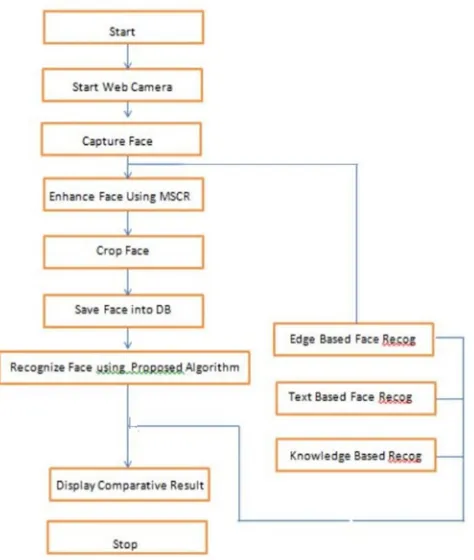
A. In this Proposed Work Following are the Steps
1) Start the Web Camer
2) Click the picture
3) Input a picture or image clicked by web cam
4) Detect region of skin area in an input images
5) Apply Multi scale color restoration on crop region to make that image more clear.
6) . Crop the region
7) Save Image into database.
8) Apply our proposed algorithm
9) Execute the existing algorithm of Edge based face detection
[image:5.612.189.426.382.662.2]10) Execute the existing algorithm of Text based face detection 11) . Execute the existing algorithm of Knowledge based face detection 12) Compare all the results.
Figure 3: Proposed Flowchart for our system.
B. Input Image
Technology (IJRASET)
C. Detect Skin RegionIn this work after image i input into the system and then after clicking on the button it will detect the region where face parameters are available it will work on the color space approach.
D. Crop the Skin Region
We have got the picture with full screen where there are unnecessary things present in frame that is also called as noise tho remove this noise without an algorithm to make the frame so tht it contain only essential things like face only. This would be easy for our algorithm to work smoothly.
E. Apply Multi-Scale Color Restoration on Cropped Region (MSCR)
Multi-scale color restoration is technique to restore original color of image whose pixels are distorted because of noise induction. We propose this MSCR method that work on following principle—
1) The image pixels should not be fully 0 or 1 i.e. white and black pixels.
2) Pixels should have to be in proper range
3) In order to find which are closer to either dark or white colours, need to collect all those pixels cluster wise.
4) Set all those pixels closer to either dark or white color to average skin color without affecting internal contains of skin region. 5) Repeat step 3 until all cluster of identified skin region is set to average skin color.
Before applying MSCR technique on Image Pixels, an Image is segmented into region to identify an area where to apply MSCR.
Where
Si=Image Segment
N=Total Number of Pixels in an Image Pi=Current Pixel value.
Setting New Value to Custer pixels as per equation
If
10 ≤ Si < 245
IV. PROJECT GUI
Figure 4: First frame of the system
Technology (IJRASET)
Figure 5: Result analysis
VI. CONCLUSION
We have studied so many number of the research paper thoroughly for face recognition and detection algorithm. We have also performed so many tests with many values as images at different condition. Many real time data is being used to perform this test that is picture captured by laptop web camera.
We have proposed this approach which has got feature of capturing images and these images in sequence as input performed and has applied into our method. More time video sequences that captures an image sequence from a web camera, detects efficiently a human face. It is an optimal model likely to be performed at every hardware as per criteria. Matlab is used as a tool to implement our concept and make it livewire. We have got an experimental result which shows that proposed algorithm is even faster than existing methods like edge, text, knowledge base systems. So this justify that overall performance of our project is not only reliable but also gives faster and accurate output.
REFERENCES
[1] Tanvi Chauhan and Vineet Richhariya “Real Time Face Detection with Skin and Feature based Approach and Reorganization using Genetic Algorithm” CiiT International Journal of digital Image Processing Issue: January 2013
[2] K. Sandeep, A.N. Rajagopalan,”Human Face Detection in Cluttered Color Images Using Skin Color and Edge Information”, ICVGIP Proceeding, 2002. [3] H. Deng, L. Jin, L. Zhen, and J. Huang. A new facial expression recognition method based on local gabor filter bank and pca plus lda. International Journal of
Information Technology, 11(11):86-96,2005.
[4] L. Shen and L. Bai. Information theory for gabor feature selection for face recognition. Hindawi Publishing Corporation, EURASIP Journal on Applied Signal Processing, Article ID 30274, 2006.
[5] J Essam Al Daoud, ”Enhancement of the Face Recognition Using a Modified Fourier-Gabor Filter”,Int. J. Advance. Soft Comput. Appl., Vol. 1, No. 2, 2009. [6] Z. Y. Mei, Z. Ming, and G. YuCong. Face recognition based on low dimensional Gabor feature using direct fractional-step lda. In Proceedings of the
Computer Graphics, Image and Vision: New Treds (CGIV'05), IEEE Computer Society, 2005.
[7] B. Schiele, J. Crowley,”Recognition without correspondence using multidimensional receptive field Histograms”, International Journal on Computer Vision.36:3152, 2000.
[8] Christopher M Bishop, “Neural Networks for Pattern Recognition” London, U.K.: Oxford University Press, 1995.
[9] H. Martin Hunke, Locating and tracking of human faces with neural network, Master’s thesis, University of Karlsruhe, 1994.
[10] Henry A. Rowley, Shumeet Baluja, and Takeo Kanade. “Neural network based face detection,”IEEE Transactions on Pattern Analysis and Machine Intelligence, 20(I), pp.23-38, 1998.
[11] B. Schiele and J. Crowley. “Recognition without correspondence using multidimensional receptive field histograms”. International Journal on Computer Vision, 36:3152, 2000.
[12] K Messer, J Matas, J Kittler, J Luettin, and Gmaitre, ” Xm2vtsdb: The extended m2vts database”, In Second International Conference of Audio and Video-based Biometric Person Authentication, March 1999.
[13] L. Sirovich, M. Kirby, Low-dimensional procedure for the characterization of human faces, J. Opt. Soc. Am. A 4 (3) (1987) 519}524.
[14] M. Turk, A. Pentland, Eigenfaces for recognition, J. Cogni-tive Neurosci. 3 (1) (1991) 71}86.[14] N. Intrator, D. Reisfeld, Y. Yeshurun, Face recognition using a hybrid supervised/unsupervised neural network, Pattern Recognition Lett. 17 (1996) 67}76.
[15] B. Moghaddam, A. Pentland, Face recognition using view-based and modular eigenspaces, SPIE: Automat.Systems Ident. Inspect. Humans 2277 (1994). [16] R. Brunelli, T. Poggio, Face recognition: features versus template, IEEE PAMI 15 (10) (1993) 1042}1052.
[17] R. Chellappa, C. L. Wilson, S. Sirohey, “Human and machine recognition of faces: a survey”, Proceedings of the IEEE, Volume 83, No. 5, pp. 705-740, May 1995.
[20] A. Albiol, L. Torres, C.A. Bouman and E. J. Delp, “A simple and efficient face detection algorithm for video database applications”, Proceedings of the IEEE International Conference on Image Processing,Vancouver, Canada, vol. 2, pp. 239-242, September 2000.
[21] L. Torres, L. Lorente and J. Vilà, “Face recognition using self-eigenfaces,” Proceedings of the International Syposium on Image/Video Communications Over Fixed and Mobile Networks, Rabat, Morocco, pp. 44-47, April 2000.
[22] A. Albiol, L. Torres, E. Delp, “An unsupervised color image segmentation algorithm for face detection applications”, IEEE International Conference on Image Processing, Thessaloniki, Greece, October 7-10, 2001.
[23] Aanchal Chauhan, Zuber Farooqui, “An Inventive Approach For Face Detection With Skin Segmentation And Multi-Scale Color Restoration Technique Using Genetic Algorithm”, International Journal Of Research In Computer Applications And Robotics, pp. 2320-7345, Jan 2016.
BIOGRAPHIES
Samiksha Shukla received his B.E. degree in Informtion Technology and Engineering from, SSIT, Swami Vivekanand Technical University Bhilai, India in 2013. She has done her M. Tech. from Dr C V Raman University Bilaspur, India. Her research interests include face detection and pattern recognization.