5
X
October 2017
An Indoor Navigation System for Mall Using
Bluetooth Beacons
Rama Gaikwad1, Shivraj Pol2, Kanchan Bhor3, Dhondubai Bamagude4, Abhishek Kankal5
1
Professor, Department of Computer Engineering, 2, 3, 4,5Graduate Student, SPPU,Maharashtra,India
Abstract:over last few years the need for indoor localization and navigation is emerging fast. Previously it's used only for Blind, Visually Impaired and Disoriented peoples [5]. But nowadays it's a need for finding out the exact location and navigating in big buildings like shopping malls and hospital. In shopping malls finding out the location of shops is a tedious job. Before this wall printed maps are used to find out the location of shops. The main aim of our system is to develop an indoor positioning and navigating system for shopping mall using Bluetooth technique. As there are many techniques like Wi-Fi, Bluetooth, inertial sensors of smartphones for localization. The Bluetooth beacons are used in this system as it is cost effective and more accurate than other. It contains mobile android application for positioning, navigating and for showing the customized offer as per user's location.
Keywords: Bluetooth Low Energy, Shortest distance, Route, RSSI, Dijkstra’s Algorithm.
I. INTRODUCTION
In the world of smart phones and digitization there is need of doing smart work in all day to day life activities. For big commercials buildings like shopping mall, or for big hospitals or museums finding out the exact location must be a smart activity. For this localization of user is most important. During the last few years, various research efforts have been taken to resolve the localization issue. GPS (Global Positioning System) is not feasible for indoor location as it gives very poor result for indoor localization. There are some localization system already proposed by using Wi-Fi, ZigBee, Bluetooth, RFID and smart phones inertial sensors such as accelerometer and gyroscope. This system uses Bluetooth low energy beacons for localization and navigation in shopping mall. Bluetooth Low Energy (BLE) is very cost effective and energy efficient as compared to Wi-Fi. BLE has high accuracy than Wi-Fi, phone inertial sensors system and all the other systems. In this system there are two parts one for admin to add maps and one for user to navigate in mall. This system can be used by any shopping mall authority by customizing for that respective area. User can find its location and navigate in mall. Also user can see the customized offers for specific location.
The remaining paper divided as follows the section 2 includes Related Work, section 3 includes Proposed System, section 4 includes Advantages and section 5 includes Conclusion.
II. RELATEDWORK
Survey Shows 10 IEEE papers on various ways of indoor navigation and positioning which helped us to select Bluetooth as the way for Indoor Navigation and Positioning.
A. Energy-Efficient Indoor Localization of Smart Hand-Held Devices Using Bluetooth:
This paper gives a system in which we can localize or find the location of a device using another device. Here for this they used Bluetooth RSSI (Received Signal Strength Indicator) values. It uses localization algorithm to obtain the match record from the database to find location. Algorithm used for this is MADT (Motion-Assisted Device Tracking algorithm) [3].
B. A Bluetooth Signal Strength Based Indoor Localization Method
This is an indoor localization system. In this system they have used Bluetooth as low cost and widely available device. It uses Base station and Transmitters as Bluetooth devices. In this error function is calculated using RSSI. This error function is based on modified Mean Square Error (RMSE) metric. A low calculated error value indicates high probability of user location. The main reasons for errors in this system are the base station is blocked with some obstacles [1].
C. Design and Realization of A Mobile Seamless Navigation and Positioning System Based on Bluetooth Technology:
phones. This system can calculate the position of pedestrians and monitor the human body motion. The data from foot inertial sensors is transferred to mobile phone using Bluetooth [2].
3D Indoor Location and Navigation System Based on Bluetooth:
This system uses 3D design model instead of normal 2D design for finding out location in the 3D world. It uses Bluetooth radio technology. For building 3D designs it uses 3D design tools with M3G formats. It also uses RSSI. For calculating locations KNN method is used [6].
D. Generalizable Spatial Feature for Human Positioning based on Bluetooth Beacons:
Bluetooth beacons having low cost and long battery life. Bluetooth beacons used for indoor navigation via. Localization. BLE consist of 40 channels, 3 of them used for advertising purpose. Beacons as well as emitters broadcast their id using these channel. Gimbal series 10 and estimate proximity beacons are used in this application [4].
E. Accuracy Evaluation of an Indoor Positioning Method Using iBeacons
iBeacons generally used for indoor navigation.The k-nearest and nearest neighbor algorithm are used for iBeacons. Nearest neighbor algorithm gives more accurate result than k- nearest algorithm [9].
F. Guide Beacon: Beacon – based indoor WayFinding for the Blind, Visually Impaired and Disoriented :
This paper presents an indoor WayFinding system called guide beacon for Blind, Visually impaired and Disoriented. It uses Proximity Detection (PD) algorithm. The objective of guide beacon system is to find the shortest end to end path from a given source point to destination point. User interfaces are built upon the speech recognition within Android OS and Text-to-Speech from Google [5].
G. BLE Localization using RSSI Measurements and iRingLA:
This is a smart home system in which elderly persons can be identified using Bluetooth Low Energy. It is hybrid system that combines the radio signal and sound information. RSSI model is used which give accuracy down to 4.0 meter. The application of this system is health care and monitoring services [10].
H. Robust and Accurate Smartphone-based Step Counting for Indoor Localization:
This system is based on indoor navigation using phones inertial sensors. In existing system when user walk from one point to another point, they use their phone for texting, gaming which gives result in step over-counting problem. These over step counting problem are solved in this system. Peak detection method used for measuring accuracy. System tested for accuracy for Normal walking-6.56%, free walking-9.54%, false walking-58.92%. Compared other step counting system this system gives high accuracy [7].
I. Indoor Navigation Using Virtual Anchor Points :
In this paper we use Virtual Anchor Point (VAP) concept which support proximity like interface from time series of Wi-Fi reading. It detects certain location inside an area of interest showing unambiguous pattern of receivable Wi-Fi signals. This system is cost effective than any iBeacon system. [8]
III.PROPOSEDSYSTEM
The present and proposed work explain and innovative idea for navigating in indoor location using Bluetooth. In this system some big buildings like shopping mall or museum or hospitals are made target for indoor navigation and position finding. This system is specifically build for shopping malls. Any shopping mall can use this system for use. As seen in related work there are many ways for indoor navigation as Bluetooth, Wi-Fi, Smart phone's inertial sensors such as accelerometer and gyroscope. There are also other methods like image processing too. In this system Bluetooth is used for indoor position and navigation. For this Bluetooth beacons are used.
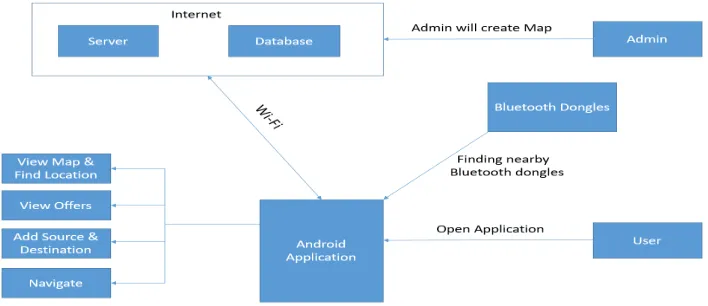
Fig. 1 Architecture Diagram of Indoor Navigation System for Mall
Admin will create map for the specific floor of shopping mall, add the Bluetooth beacons details, and add relevant offer for the specified location as per shops. These data gets stored on database server. On the other side user in android application can download these data using internet connection or Wi-Fi facility at shopping malls. As user enters into the shopping mall, first user opens the android application and Bluetooth of that smart phone. Application will start finding nearby Bluetooth beacons. Using their respective RSSI values application will find out the exact location of user in the map. Application will show the offer for respective location. User can add source and destination in the application to find out the minimum path for navigation and the system gives the exact navigation to user. For finding out the minimum path system uses Dijkstra's Algorithm. Dijkstra’s algorithm is well known algorithm for finding out minimum distance between two places on the graph. It has complexity O(v2) where v is the vertices of the graph. [11]
IV.ADVANTAGES
A. Cost-effective.
B. Unremarkable hardware (it does not require any additional hardware). C. Low energy consumption.
D. Works where other positioning techniques do not have a signal. E. Bluetooth Compatible with iOS and android.
F. High accuracy compared to Wi-Fi.
G. Flexible integration into the existing infrastructure.
V. CONCLUSION
We have developing an approach to provide indoor navigation for mall based on Bluetooth. This application can be used in any mall where indoor navigation is necessary. An indoor localization application to be implemented in smart phones. Not only it will reduce stress of getting lost, but this technology also can improve the shopping experience. In this we have used Bluetooth low Energy beacons for installing in the mall. That will lead to cost effective and energy efficient system. This system is also can be extended to carry out the same experimentation in hospitals and museum or any commercial building instead of only focusing on shopping malls.
VI.ACKNOWLEDGMENT
We would like to thank many people who have helped us with various standpoints of this study. We also thankful of prof.Rama Gaikwad. Her knowledge and experience is very helpful for us in overcoming many difficulties.
REFERENCES
System Based on Bluetooth Technology” presented at Proceedings of 2016 IEEE Chinese Guidance, Navigation and Control Conference August 12-14, 2016 Nanjing, China.
[3] yu gu and fuji ren, “energy-efficient indoor localization of smart hand-held devices using bluetooth” presented at special section on big data for green communications and computing.
[4] Kevin Bouchard, Mahir Rafi Eusufzai, Ramin Ramezani, Arash Naeim, “Generalizable Spatial Feature for Human Positioning based on Bluetooth Beacons” presented at 2016 IEEE 7th Annual Ubiquitous Computing, Electronics and Mobile Communication Conference (UEMCON).
[5] Seyed Ali Cheraghi, Vinod Namboodiri Laura Walker, “GuideBeacon: Beacon-Based Indoor Wayfinding for the Blind, Visually Impaired, and Disoriented” presented at 2017 IEEE International Conference on Pervasive Computing and Communications (PerCom)
[6] Omar Cruz, Erik Ramos, and Moisés Ramírez, “3D Indoor Location and Navigation System Based on Bluetooth” presented at CONIELECOMP 2011, 21st International Conference on Electrical Communications and Computers.
[7] Fuqiang Gu, Jianga Shang, “Robust and Accurate Smartphone-based Step Counting for Indoor Localization” presented at IEEE SENSORS JOURNAL, VOL. XX, NO. XX, XX 2017.
[8] Eike Jens Hoffmann, Martin Werner, Lorenz Schauer, “Indoor Navigation Using Virtual Anchor Points” presented at 2016 European Navigation Conference (ENC)
[9] Chiaki Takahashi, Kazuhiro Kondo, “Accuracy Evaluation of an Indoor Positioning Method Using iBeacons” presented at 2016 IEEE 5th Global Conference on Consumer Electronics
[10] Adel THALJAOUI, Thierry VAL, Nejah NASRI, “BLE Localization using RSSI Measurements and iRingLA” presented at 2015 IEEE International Conference on Industrial Technology (ICIT)