Citation:
Farrell, LG (2016) Dissertation IT Toolkit. In: ALDinHE 2016: The Learning Development Confer-ence, 21-23 March 2016, Herriot Watt University, Edinburgh. (Unpublished)
Link to Leeds Beckett Repository record: http://eprints.leedsbeckett.ac.uk/2420/
Document Version:
Conference or Workshop Item
The aim of the Leeds Beckett Repository is to provide open access to our research, as required by funder policies and permitted by publishers and copyright law.
The Leeds Beckett repository holds a wide range of publications, each of which has been checked for copyright and the relevant embargo period has been applied by the Research Services team.
We operate on a standard take-down policy. If you are the author or publisher of an output and you would like it removed from the repository, please contact us and we will investigate on a case-by-case basis.
Creating a Dissertation IT Kit
Lyn Farrell, Online Learning Tutor
School of Education and Childhood
Carnegie Faculty
Creating a Dissertation IT Kit
Abstract
Despite the theory of the Digital Native (Prensky 2001) persevering in its popularity, the reality is that HE students' come to university with mixed levels of academic IT skills (Farrell 2013). It is also true that IT skills support is usually not provided to the same extent as academic communication skills (e.g. essay and report writing,
literature reviews, and critical thinking) with some institutions reporting very limited IT provision. Yet digital literacy and employability are two recognised desirable
graduate attributes of UK students. Digital literacy includes the ability to undertake higher level IT skills and IT proficiency in graduates is listed as one of the top ten skills employers are looking for in graduates (Forbes 2014).
Twelve years of experience as an academic IT tutor has highlighted that final year dissertations and postgraduate theses are often where students struggle due to their lack of knowledge in how to format structured documents. This paper presents a practical and holistic kit that was designed to ensure students are equipped with the right academic IT skills and understanding of time management issues to embed the IT part of the dissertation into their overall dissertation planning. The kit will also give them valuable IT skills to add to their employability portfolio.
The toolkit consists of three elements; a set of podcasts, video tutorials and a written guide. It can be produced fairly simply, without the need for highly specialised IT skills. It is something therefore, that could be created by institutions across the UK.
Keywords: digital literacy; digital native; higher education; IT skills, academic IT skills, dissertations.
Introduction
Academic skills support is widely recognised in HE as essential but academic IT skills support does not enjoy the same level of recognition. The range of writing skills and maths skills amongst HE students is expected to vary but where IT is
concerned, students are still sometimes perceived as a homogenous population, with assumptions made about their existing skill levels on entry to higher education. For almost two decades theorists have been forecasting a huge shift in the way technology and students interact, from Tapscott (1998) who proposed that a new generation were growing up surrounded by technology which was shaping their communications to Oblinger (2003) who coined the term ‘millennials’ for the cohort she claimed had a distinct, technology based learning style. Prensky’s Digital Native theory (2001) is perhaps the best known of these theories; he argued that a radical change was coming in the way students interacted with education, due to their being immersed in technologies and stated that students born in the new millennium because they were adapted to learning new technology merely by using it.
However, Brown and Czerniewicz (2010) found variation in technology use within the digital native group. Research by Corrin et al (2010) found that social technology use did not transfer to academic use and Margaryan and Littlejohn (2011) found no difference in the way in which ‘millennials’ studied. Farrell (2013) argued that the theory was seriously flawed stating that not all HE students are from the digital native generation, that students should not be treated as a homogenous group because of age, and that social IT skills do not equate to academic IT skills. Her review of the research into assumptions about the digital native generation supported her own case study findings, of the great variance within student populations regarding existing academic IT skills. She concluded that IT skills should be identified, not be assumed to exist.
Significantly, they argue that the provision of support for students to acquire advanced digital technology skills is needed to support formal learning.
Slechtova (2014) carried out a survey regarding attitudes to ICT use for education on two hundred undergraduate students, aged 21-25, from four different courses
including Tourism and Computing. She found that that students’ use of ICT varied according to the particular course of study.
For example social work students were less likely to utilise ICT in their study tasks that tourism students and computing students reported a preference for studying specific software rather than general ICT. She concluded that generalisations about students’ ITC preferences, skills, attitudes and learning styles cannot be made on age and concluded that the so called Net generation is a heterogeneous population.
Similarly Thompson (2014) conducted a survey of almost four hundred ‘digital native’ freshmen to investigate links between their technology use and learning habits; checking for a distinct ‘digital native’ learning set. She found no positive correlation between use of ICT and productive learning habits and that they frequent used only a narrow set of technologies; web resources (for example looking up a ‘fact’,
listening to music) and ‘rapid communication technology’ (for example Facebook, email, text messaging). Significantly, she confirmed that web searches were often lacking depth and that they were missing the digital skills needed to make best use of web resources.
Graduate Attributes, Employability and Academic IT Skills
The importance of graduate IT skills cannot be underestimated. Adams (2014) reviewed the 2013 NACE survey which placed computer software proficiency (including creating and editing reports, information gathering and data analysis) in the top ten skills employers are looking for in graduate recruits. Similarly, Page (2014) reported IT skills were deemed essential by graduate recruitment businesses. Empowering students to develop their academic skills allows them not only to
research, and in the face of the wealth of evidence that refutes it. Academic IT skills, despite being recognised by employers and universities to be of high importance, are not always a part of HE provision.
One main reason for creating the Dissertation IT kit was that students coming for academic IT support presented the same three main problems year on year: lack of time allocated for formatting their assignments, a lack of knowledge in Microsoft Word (the software the vast majority of students used) and lack of knowledge of the library services needed for submission of finished work once formatting was
complete. Students consistently and considerably underestimated the time involved from start to finish of the formatting process which was too often perceived as ‘just the IT bit’. It was therefore essential that the kit helped them to understand that they needed to plan and time manage effectively in order to finish on time. Although some had some knowledge of how to use Word they usually had gaps in their skills and many started formatting tasks in the wrong order which caused problems later on that needed to be rectified. They also went to the university library unprepared which lead to huge queues for services and costly delays in submitting their work,
sometimes to the level of invoking penalties for late submission.
Arguably, one of the most critical times for academic IT skills support is when
students have to prepare their final year dissertations or postgraduate theses. Some campuses have no IT support and even where it exists, part time or distance
students may not have the same level of access. Competition for services at peak periods might also be problematic in terms of accessing help. Therefore a
Dissertation IT kit, accessible 24/7, that students can use to guide them through the whole process from preparation to submission is potentially of great benefit.
The Dissertation IT Kit
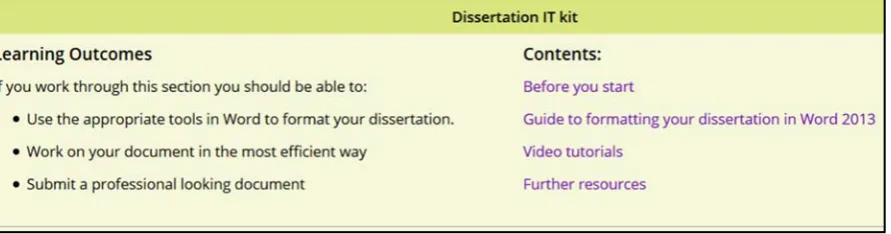
The kit is organised as a learning object, comprised of three parts, on the Skills for Learning website1, shown in Fig 1. The learning object sets outs the aims and
[image:7.595.81.527.211.328.2]objectives of the kit and then guides students through the kit in the order of podcasts, written guide and video tutorials. Students can alternatively choose which parts of the toolkit they find most useful and go directly to that part of the tool.
Figure 1 Dissertation Kit Learning Object
Podcasts
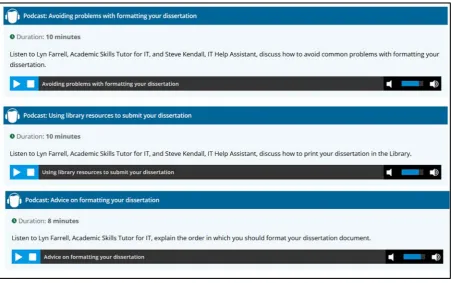
The podcasts are the first part of the kit, in the ‘Before You Start’ section, shown in Fig 2. They provide students with a realistic idea of what is involved in formatting a dissertation, to enable them to time manage effectively. There are three podcasts in total; ‘Avoiding problems with formatting your dissertation’, ‘Using library resources to submit your dissertation’ and ‘Advice on formatting your dissertation’.
1 Skills for Learning is a website housing a collection of resources to support the learning and teaching of
Figure 2 Dissertation IT Kit Podcasts
The first podcast, ‘Avoiding problems with formatting your dissertation’, highlights the common problems to avoid: formatting problems (for example numbering, diagrams and charts, table of contents, section breaks), library resource problems (for example forgetting passwords and pins, printing, copying and uploading issues) and time management problems (for example running out of time to format properly,
competition for library resources at peak submission periods). There then follows a discussion about minimising these problems through timely preparation, using the video tutorials and what to bring to the library to avoid delays).
The final podcast, ‘Advice on formatting your dissertation’, goes through the different formatting tasks involved and emphasises the order in which students should
complete them. It can also acts as a reference checklist for students to listen to as they work through their own documents.
The podcasts were created by using an inexpensive field recorder in a quiet room. They were then edited using Audacity (free, open source software) to tidy up the recordings: removing unwanted repeats, long silences or hesitations, “umms” and “errs”, normalising audio levels, creating silences between specific points made, fade ins and outs and adding theme music to the beginning/end (all the Skills for Learning podcasts have a set introduction and theme music). The audio files were then
exported to mp3 files and uploaded onto the site. Post recording edits were simple to do; anyone with an interest in audio editing can learn the required low level of
Audacity quickly. Post recording edits are also optional; the kit can be built just by recording and uploading the podcasts.
Formatting Guide
The guide is produced in Word and saved as PDF, shown in Fig 3. It was created with the intention that students use it as reference after working through the tutorials but it can also be used as a standalone guide for those that prefer written
instructions. It goes through the formatting tasks in the same order as the video
tutorials and has screenshots to illustrate the different tasks. Creating the guide is easy for anyone with a good working knowledge of Word.
Video Tutorials
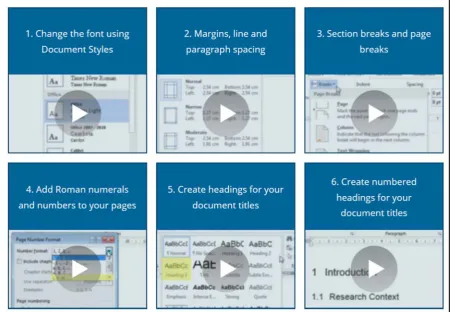
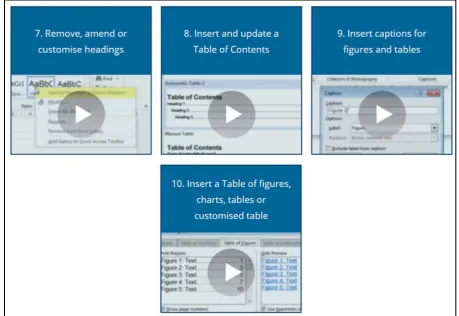
The final part of the kit is comprised of a set of video tutorials that guide the student, step by step, through the different tasks that they need to create a formatted
[image:10.595.75.526.299.611.2]dissertation. Figs 4 and 5 illustrate the different tasks students complete by watching the videos. The tutorials were created with Captivate software, capturing on-screen interactions with MS Word. Instruction captions were then added to each recording. The level of Captivate training needed to produce the tutorials was not extensive. After approximately four weeks of part time self-study, using video tutorials and basic printed guide, skills were adequate to build the tutorials. There are also free screen recorder programs for any institution that doesn’t have Captivate.
Figure 5 Final 4 Video Tutorials
Evaluation of the Dissertation IT kit
The Dissertation IT kit hasn’t, as yet, undergone formal evaluation and would undoubtedly benefit from this. Limited website traffic data is available from
September 2014 to February 2016 which suggests that hits on the index page of the IT kit accounted for 18% of the total hits on the website. Peak months were October (2014), January and May (2015) and October (2015). Summer 2015 saw a drop in the number of hits on the page which was true for other parts of the site. This is to be expected in vacation period. If other institutions create a similar kit, it is
recommended that evaluation takes place so that needed revisions and enhancements to the kit can be highlighted.
Conclusion
References
Adams, S. (2014) The 10 skills employers most want in 2015 graduates. ‘Forbes’ [Online]. Available from:
http://www.forbes.com/sites/susanadams/2014/11/12/the-10-skills-employers-most-want-in-2015-graduates/#7d918e7919f6 [Accessed 22
January 2016].
Brown, C. and Czerniewicz, L. (2010) ‘Debunking the 'digital native': beyond digital apartheid, towards digital democracy’, Journal of Computer Assisted Learning, 26(5), pp. 357-369 [Online]. Available from:
http://eds.b.ebscohost.com.ezproxy.leedsbeckett.ac.uk/eds/pdfviewer/pdfviewer?vid
=1&sid=7c2efc85-b1b4-4e20-9545-82fdacb21458%40sessionmgr114&hid=114
[Accessed 7 March2016].
Corrin, L., Bennett, S. and Lockyer, L. (2010) ‘Digital natives: everyday life versus academic study’, Proceedings of the 7th International Conference on Networked Learning 2010. Denmark 3-4 May [Online]. Available from:
http://www.lancaster.ac.uk/fss/organisations/netlc/past/nlc2010/abstracts/PDFs/Corri
n.pdf [Accessed: 7 March 2016].
Farrell, L (2013) ‘Challenging Assumptions about IT skills in higher education’, Journal of Learning Development in Higher Education, 6, 2013 [Online]. Available from:
http://www.aldinhe.ac.uk/ojs/index.php?journal=jldhe&page=article&op=view&path[]=
173&path[]=138 [Accessed: 22 January 2016]
Kwok-Wing, L & Kian-Sam, H (2014) Technology use and learning characteristics of students in higher education: Do generational differences exist? British Journal of Educational Technology, 46, 4, pp. 725-738. Available from: doi:10.1111/bjet.12161 [Accessed 16 February 16].
Margaryan, A. and Littlejohn, A. (2011) ‘Are digital natives a myth or reality?: Students’ use of technologies for learning’, Computers & Education, 56(2), pp. 429-440.
Page, L. (2014) How to get a job when you graduate. The Guardian [Online], 31 May 2016. Available from:
Prensky, M. (2001) ‘Digital natives, digital immigrants’, On the Horizon, 9(5), pp. 1-6. Available from:
http://www.marcprensky.com/writing/Prensky%20-%20Digital%20Natives,%20Digital%20Immigrants%20-%20Part1.pdf [Accessed: 22
January 2016].
Oblinger, D. (2003) ‘Boomers, gen-xers and millennials: understanding the new students’, EDUCAUSE Review, 38(4), pp. 37-47 [Online]. Available from:
http://www.educause.edu [Accessed: 7 March 2016].
Slechtova, P.(2015), 'Attitudes of Undergraduate Students to the Use of ICT in Education [Online]. Procedia - Social And Behavioral Sciences, 171, 171, 5th ICEEPSY International Conference on Education & Educational Psychology, pp. 1128-1134 Available from:
http://www.sciencedirect.com.ezproxy.leedsbeckett.ac.uk/science/article/pii/S187704
2815002487 [Accessed: 22 January 2016].
Tapscott, D. (1998) Growing up digital: the rise of the Net generation. New York: McGraw-Hill.
http://link.springer.com.ezproxy.leedsbeckett.ac.uk/article/10.1007%2Fs10639-013-9295-3 [Accessed 16 February 16]
Thompson, P. (2013). The digital natives as learners: Technology use patterns and approaches to learning. Computers & Education 65, 12-33.
Author Bio