Document Version: Book
Creative Commons: Attribution-Noncommercial 3.0
The aim of the Leeds Beckett Repository is to provide open access to our research, as required by funder policies and permitted by publishers and copyright law.
The Leeds Beckett repository holds a wide range of publications, each of which has been checked for copyright and the relevant embargo period has been applied by the Research Services team.
We operate on a standard take-down policy. If you are the author or publisher of an output and you would like it removed from the repository, please contact us and we will investigate on a case-by-case basis.
Using assessment to
support student learning
Contents
1. Introduction 1
2. How assessment influences student learning 2
3. Pedagogic principles underlying the use of assessment to support learning 8
4. Assessment tactics that support student learning 20
5. Case studies of the use of assessment to support student learning within
Leeds Metropolitan University 29
6. Evaluating the impact of assessment on student learning 34
References 42
Acknowledgements
Introduction
Assessment makes more difference to the way that students spend their time, focus their effort, and perform, than any other aspect of the courses they study, including the teaching. If teachers want to make their course work better, then there is more leverage through changing aspects of the assessment than anywhere else, and it is often easier and cheaper to change assessment than to change anything else.
This manual is designed to support Scheme, Course, Award and Programme level leaders to introduce changes to assessment with the aim of improving student learning. It is not meant to be a list of ‘tips’, although there are plenty of practical ideas here in Section 4, and case studies from within Leeds Metropolitan University in Section 5. Rather it is intended to provide a way of thinking about how assessment works, and how students respond to it, so that teachers can make sense of what is currently happening on their own courses, and make their own context-relevant decisions about what they might do to improve things. It reviews the available empirical evidence in some detail, so that, as far as possible, these decisions can be made with confidence that they will produce improvements in student performance. It also provides three evaluation tools to help diagnose potential problems and measure any improvements brought about by changes teachers might make.
Good luck!
graham gibbs
2
Miller & Parlett focused on the extent to which students were oriented to cues about what was rewarded in the assessment system. They described different kinds of students: the ‘cue seekers’, who went out of their way to get out of the lecturer what was going to come up in the exam and what their personal preferences were; the ‘cue conscious’, who heard and paid attention to tips given out by their lecturers about what was important; and the ‘cue deaf’, for whom any such guidance passed straight over their heads. This ‘cue seeking’ student describes exam question spotting:
“I am positive there is an examination game. You don’t learn certain facts, for instance, you don’t take the whole course, you go and look at the examination papers and you say ‘looks as though there have been four questions on a certain theme this year, last year the professor said that the examination would be much the same as before’, so you excise a good bit of the course immediately …”
(Miller & Parlett, 1974, p. 60)
In contrast, these students were described as ‘cue deaf’:
“I don’t choose questions for revision – I don’t feel confident if I only restrict myself to certain topics.”
“I will try to revise everything …”
(Miller & Parlett, 1974, p. 63)
Miller & Parlett were able to predict with great accuracy which students would get good degree results:
“… people who were cue conscious tended to get upper seconds and those who were cue deaf got lower seconds.”
(Miller & Parlett, 1974, p. 55)
Many students are perfectly capable of distinguishing between what assessment requires them to pay attention to and what results in worthwhile learning, as this postgraduate Oceanography student explained:
In the early 1970s, researchers on both sides of the Atlantic (Snyder, 1971; Miller & Parlett, 1974) were engaged in studies of student learning at two universities. What they found was that, unexpectedly, what influenced students most was not the teaching but the assessment. Students described all aspects of their study – what they attended to, how much work they did and how they went about their studying – as being completely dominated by the way they perceived the demands of the assessment system. Derek Rowntree stated that “if we wish to discover the truth about an educational system, we must first look to its assessment procedures” (Rowntree, 1987, p.1). The Snyder and Miller & Parlett studies went further and highlighted the way students respond to these assessment procedures. More recently, qualitative studies have
emphasised the importance of understanding the way students respond to innovations in assessment (Sambell & McDowell, 1998). Snyder’s work gave birth to the notion of the ‘hidden curriculum’: different from the formal curriculum written down in course documentation, but the one students had to discover and pay attention to if they wanted to succeed:
“From the beginning I found the whole thing to be a kind of exercise in time budgeting … . You had to filter out what was really important in each course … you couldn’t physically do it all. I found out that if you did a good job of filtering out what was important you could do well enough to do well in every course.”
(Snyder, 1971, pp. 62-63)
Once students had worked out what this hidden curriculum consisted of, they could allocate their effort with great efficiency: “I just don’t bother doing the homework now. I approach the courses so I can get an ‘A’ in the easiest manner, and it’s amazing how little work you have to do if you really don’t like the course.”
3
the effectiveness of
coursework assignments
Students tend to gain higher marks from coursework assignments than they do from examinations. Chansarkar & Raut-Roy (1987) studied the effects of combinations of various forms of coursework with examinations. They found that all combinations of coursework of varying types with examinations produced better average marks than did examinations alone: up to 12% higher average marks. Gibbs & Lucas (1987) reported an analysis of marks on more than 1,700 modules at Oxford Polytechnic. Modules with 100% coursework had an average mark 3.5% higher than modules with 100% examinations, and there were three times as many failed students on modules where there were only examinations. There was a significant positive correlation between the proportion of coursework on a module and the average marks students achieved. Bridges et al (2002) studied the differences in coursework and exam marks in six subjects at four universities. They found coursework marks to be higher by one-third of a degree classification in English and History (similar to the Oxford Polytechnic finding) and higher by two-thirds of a degree classification in Biology, Business Studies, Computer Studies and Law.
Students also prefer coursework. Starr (1970) reported that 90% of students from four departments preferred half or more of their marks to come from coursework and 56% preferred all their marks to come from coursework. Students consider coursework to be fairer than exams, to measure a greater range of abilities than exams and to allow students to organise their own work patterns to a greater extent (Kniveton, 1996). Higher average marks and student
preference would not count for much if coursework were inherently less valid as an assessment – but it is not. First, examinations are very poor predictors of any subsequent performance, such as success at work. A review of 150 studies of the relationship between exam results and a wide range of “If you are under a lot of pressure then you
will just concentrate on passing the course. I know that from bitter experience. One subject I wasn’t very good at I tried to understand the subject and I failed the exam. When I re-took the exam I just concentrated on passing the exam. I got 96% and the guy couldn’t understand why I failed the first time. I told him this time I just concentrated on passing the exam rather than understanding the subject. I still don’t understand the subject so it defeated the object, in a way.”
(Gibbs, 1992, p. 101)
4
adult achievement found the relationship to be, at best, slight (Baird, 1985). For example, first degree results explain less than 10% of the variance in performance in graduate studies (Warren, 1971). Second, coursework marks are a better predictor of long-term learning of course content than are exams. Conway et al (1992) reported a study of the performance of Psychology students on a range of tests of their understanding and recall of content of a cognitive psychology course taken some years before. They found that student marks on coursework assignments undertaken up to 13 years previously correlated with these test scores, while students’ original exam marks did not. Presumably the kind of learning that coursework involves has long-term consequences, while the kind of learning involved in revision for exams does not. Studies of surface and deep approaches to learning have shown similar results: that any positive impact on test results of students taking a surface approach in preparation for the test are very short-lasting (Marton & Wenestam, 1978).
Third, in experimental studies in which students have studied either exam-based or assignment-based courses, the quality of their learning has been shown to be higher in the assignment-based courses. For example Tynjala (1998) compared two student groups: the first group studied via conventional lectures, a text-book and an exam. The second group studied via assignments based on the text-book, discussion with other students about these assignments, and a coursework essay marked by the teacher. This second group then also took the exam so as to enable a comparison with the first group, even though the students had not studied for the exam. The second group was found to place more emphasis on thinking and had developed more sophisticated conceptions of learning (see Säljö, 1982). In their exam answers they revealed more comparisons, more evaluations and more sophisticated structures to their writing (Biggs & Collis,
5
assessment and student workload
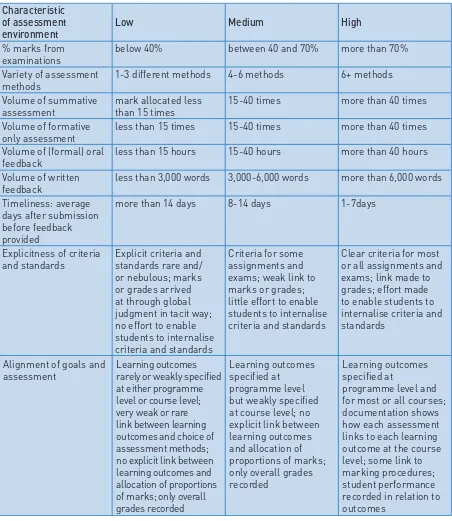
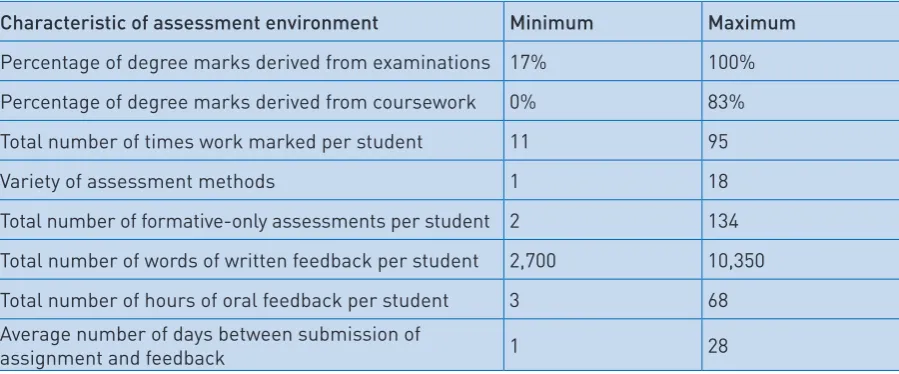
It is a common observation of higher education teachers that if coursework is taken away from a module because of resource constraints, then students simply do not do the associated studying; for example students will rarely write unassessed essays. It is argued that you have to assess everything in order to capture students’ time and energy. There are several problems with this rationale, both logistical and pedagogic.It may not be possible to set enough assignments to actually capture much student time. A study of the nature of assessment systems at the level of whole degree programmes (Gibbs & Dunbar-Goddet, 2007) found, first, that programmes tended to have either high levels of
assessed work for marks (and some degree programmes mark well over 100 separate assignments and examinations over three years) and very little assessed work for feedback only (as few as two assignments in three years), while other programmes had very low levels of assessed work for marks (as few as 11 in three years) and very high levels of assessed work for feedback only (up to 134 in three years) and also a great deal of oral feedback. A few programmes had neither high levels of summative assessment (for marks) nor formative-only assessment (for feedback), but no programmes had high levels of both. This seems to be simply economic reality – you can afford to mark often or give feedback often but you cannot afford to do both often. Second, it was found that programmes with low levels of marked work but high levels of feedback (with no marks attached) had students who worked harder and distributed their effort evenly across weeks and across topics on courses. In contrast, where there were only one or two marked assignments per course unit, these were all students spent their time on, largely ignoring all topics other than those addressed in the assignments and spending little time on
6
the effectiveness of feedback
Summaries of what makes most difference to student achievement, involving reviews of many thousands of studies spanning decades of research, show clearly that the most powerful single influence is feedback (Hattie, 1987; Hattie & Timperley, 2007). Similarly, a comprehensive review of formative assessment (Black & Wiliam, 1998) emphasised the extraordinarily large and consistent positive effects that feedback has on learning, compared with other things teachers might try and do. There have been many attempts both to understand the nature of this impact and to harness its power through innovation, especially in schools, in response to this incontrovertible evidence.
In higher education, feedback to individual students in class must have declined significantly as class sizes have increased, though we have no evidence about this. Writing comments on assignments, however, remains a major component of teachers’ workload in higher education. As resources per student have declined there have been some economies of scale in teaching (simply by packing more students into classrooms), but economies of scale are difficult to achieve for assessment: most assessment costs go up in direct proportion to the number of students. As a result, assessment costs can overtake teaching costs and teachers can find themselves spending much of their time marking. Is all this effort worthwhile?
In the Course Experience Questionnaire (Ramsden, 1991), used extensively in Australia and elsewhere to evaluate the quality of courses, the questionnaire item that most clearly distinguishes the best and worst courses is: “Teaching staff here normally give helpful feedback on how you are going” (Ramsden, 1992, p.107). Similarly, the variable on the National Student Survey that best distinguishes between universities and contributes most to determining
their overall ranking concerns feedback.
This does not mean that higher education teachers in fact give helpful feedback. It means that the extent of helpfulness of the feedback they give makes more difference to students than anything else they do.
How well does feedback actually work? Maclellen (2001) surveyed 130 students and 80 lecturers at the University of Strathclyde about their perceptions concerning
assessment. Among the 40 questions asked, four were about feedback and these revealed wide discrepancies between students and lecturers. While most teachers responded that feedback is frequently helpful in detail, helps students to understand and helps learning, most students responded that feedback was only sometimes helpful in these ways. 30% of students reported that feedback never helps them to understand. While 63% of lecturers responded that feedback frequently prompts discussion with a tutor, only 2% of students responded in the same way and 50% responded that feedback never prompted discussion. In another study, only 1% of students reported that reading feedback prompted them to go back to the subject matter and spend any more time on it (Gibbs et al, 2003).
There may be a problem here with the quantity and quality of feedback such that it is not actually helpful to students – after all, teachers are under enormous time pressure and it is difficult to provide comprehensive and useful feedback under such circumstances. But there are other problems. Studies of what students do with feedback makes for depressing reading. Feedback is often not read at all (Hounsell, 1987) or not understood (Lea & Street, 1998). Wojtas (1998) reported:
“Some students threw away the feedback if they disliked the grade, while others seemed concerned only with the final result and did not collect the marked work.”
7
as indicating their personal ability or worthas it is usually ‘norm-referenced’: it tells you, primarily, where you stand in relation to others. A poor grade may damage a student’s ‘self-efficacy’ or sense of ability to be successful. Yorke (2001) elaborates on the ways in which formative assessment can affect student retention and emphasises its role in ‘academic integration’ (Tinto, 1993). In contrast, feedback on its own is more likely to be perceived as a comment on what has been learnt. In the absence of marks it has been reported that students read feedback much more carefully (Black & Wiliam, 1998) and use it to guide their learning. In the light of this (school-based) research evidence, some schools have adopted policies that all assignments should only have feedback and that no marks should be provided.
This is not a pretty picture. Assessment sometimes appears to be, at one and the same time, enormously expensive, disliked by both students and teachers, and largely ineffective in supporting learning, given the way it is often conducted. In the light of these problems, what follows is an attempt to justify a set of principles to guide assessment practice. The evidence is rarely conclusive enough to argue that if your assessment follows these principles then learning will inevitably be more effective, but they are a plausible set of guidelines given what we know.
This is not the first attempt to identify such principles but is the first attempt in the context of higher education. School-based research has identified lists of effects of formative assessment. Gagne (1977) argued on the basis of evidence that feedback: 1. Reactivates or consolidates prerequisite
skills or knowledge prior to introducing the new material
2. Focuses attention on important aspects of the subject
3. Encourages active learning strategies 4. Gives students opportunities to practise
skills and consolidate learning
5. Provides knowledge of results and corrective feedback
6. Helps students to monitor their own progress and develop skills of self-evaluation
7. Guides the choice of further instructional or learning activities to increase mastery 8. Helps students to feel a sense of
accomplishment.
(derived from Crooks, 1988)
The principles outlined in this manual refer to two relatively distinct categories of influence:
• the influence of the design of assessment systems and assignments on how much students study, what they study and on the quality of their engagement
8
3.1.
there should be sufficient assessed
tasks to capture sufficient student study
time
This issue concerns how much time and effort students allocate – the ‘time on task’ principle (Chickering & Gamson, 1987) that if students don’t spend enough time on something they won’t learn it. Berliner (1984), summarising research in the ‘time on task’ principle, concluded that there was strong empirical evidence of a direct relationship between time allocation by courses, student time management and actual student time on task on the one hand, and student achievement on the other. The relationship between effort and marks is not always straightforward. Kember et al (1996) found that students’ perceptions of their effort depended on their motivation more than on the number of hours they actually allocated, and that it was possible for students to put in many hours unproductively, especially if they adopted a surface approach to their studies. Some kinds of assessment can generate long hours of ineffective memorisation. Courses in UK higher education are designed to involve a specified number of learning hours related to the number of credits for the course. Students are normally expected to spend between about one and four hours out of class for each hour in class (depending largely on the discipline involved). Innis (1996) found students at Leeds Metropolitan University spend between 1.4 and 3.0 hours out of class for each hour in class. How much of this ‘out of class’ time is actually allocated to studying may be determined largely by assessment demands. In the USA, higher education students on average spend less than half as many hours out of class for each hour in class as teachers expect: between 0.3 and 1.0 hours out of class when teachers, on average, expect 2.1 hours out of class for each hour in class (Moffat, 1989; Hutchings et al, 1991; Gardiner, 1997; Brittingham, 1998). The emphasis in the USA
on attempts to improve student performance through assessment is on ‘classroom
assessment’ – activities undertaken in class to test students – and then on using this assessment information to guide both students and teaching (Angelo & Cross, 1993). This focus on the classroom could be interpreted as a recognition of the failure to generate much out of class learning through the type of assessment teachers use. Diary studies (such as that by Innis, ibid) show how students in the UK allocate their time largely to assessed tasks and that this becomes a more narrow focus over time as they become more experienced, with students allocating as little as 5% of their time to unassessed study tasks by year 3. Subject areas with less frequent assessed tasks (e.g. text-based subjects) have students who study fewer hours (Vos, 1991). Science and technology subjects that generate greater total study effort tend to have more frequent (though smaller) assessed tasks, such as problem sheets and laboratory reports.
9
units as and when they have the time, giventheir need to work to support themselves. In the UK students seem to think it is acceptable to undertake paid work for many hours a week and still complete in three years. Studies of the impact of students undertaking paid employment in parallel with full-time study show that such students study fewer hours (Curtis & Shami, 2002) and perform significantly less well (Paton-Salzberg & Lindsay, 1993). Studies show that up to three-quarters of full-time students work during term-time and are likely to allocate their reduced study hours especially strategically in relation to assessment requirements. These studies show reduced reading and other out of class study activity. Assignments are not the only way to
capture student time and effort through assessment. The conventional way to do this is by having unpredictable sampling of course content in unseen examinations, so that for a student to ignore anything is a high risk activity. The quality, quantity and distribution of the study effort captured in this way is somewhat unpredictable and probably varies with student perceptions of the likely exam demands and the risks associated with choosing not to study some of the topics. However, the same rationale as is used in sampling the curriculum through exam questions can be applied to coursework. Students can be expected to undertake coursework on every topic and this coursework can be sampled for marking – perhaps two chosen randomly to be marked from eight that students have undertaken.. Time and effort can also be captured through social pressure, for example through the potential embarrassment of the poor quality of your work being seen by colleagues, as when a seminar presentation is assessed, or when a laboratory report is written and displayed publicly in the form of a poster. The potential censure from colleagues if a student were to fail to complete his or her component of an assessed group assignment can also generate effort.
‘Bunking off’ or ‘social loafing’ during group
10
3.2. assessment demands should be
designed so as to orient students to
distribute appropriate amounts of time
and effort across all the important
aspects of the course
This principle concerns what student effort is spent on. Students usually distribute their time unevenly across courses, often focusing on topics associated with assessment
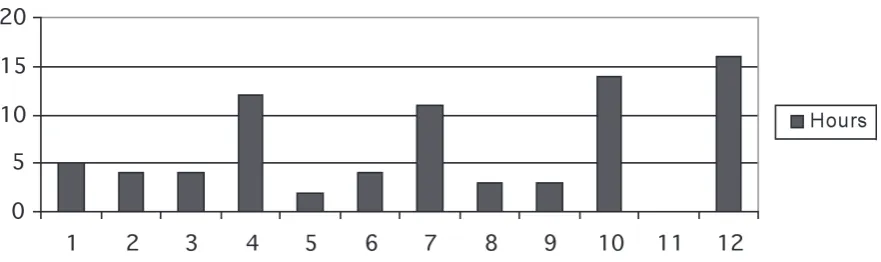
and nothing else. If they drew a graph of weekly study effort for all the weeks of an individual course involving a sequence of assignments, it might look more like the Alps than Holland. Exams can have the effect of concentrating study into a short intense period at the end of the course with, for example, little study of lecture notes until many weeks after the lecture. Frequent assignments (such as short problem sheets) or tests (such as computer-based assessment) can distribute student effort across the course, often on a weekly basis, while infrequent assignments (such as extended essays) may result in intensive studying for a week or two immediately prior to the assignment deadline, while topics not covered by the assignment can be largely ignored. We know very little about the distribution of student effort, and higher education teachers tend to know little about what their students do with their time and when. Section 6 contains a simple prompt for students to tell you how they distribute their time.
3.3. tackling the assessed task engages
students in productive learning activity
of an appropriate kind
11
integrative experience, even describing itas the most valuable part of the course. The following two quotations from students contrast these experiences of revision: “You just go back to the lecture notes, and then just try and remember as much as I can … just looking at lecture notes and trying to remember stuff.”
“…you actually had time to – I think there was also an element of being able to go back and consolidate everything by revising for the exam.”
(Gibbs et al, ibid)
Many assignments simply fail to engage students with appropriate types of learning activity. Submitting a laboratory report of a teacher-designed procedure is unlikely to help students to learn how to design experiments. Probably the only way to learn how to solve problems is to solve lots of problems. Probably the only way to gain facility with the discourse of a discipline is to undertake plenty of practice in using that discourse, for example through writing. Assignments are the main way in which such practice is generated.
Some assignments create appropriate learning activity as a by-product. For example, setting essays can generate ‘reading around’ and can support the working up of coherent arguments in a way that simply asking students to read what is on the reading list does not. If you were to take the essay away, the appropriate form of reading and thinking would not occur even in the unlikely event of a similar volume of reading of similar material taking place. The product, the essay, and the marks associated with it may be less important to the learning than the framework the assignment provides for the learning activities of ‘reading around’ and ‘constructing arguments’. Similarly, with laboratory reports or design briefs, the product may be less important than details of the studying required to fulfill the assignment requirements. Group projects can engage students in much discussion and can confront individuals with alternative
views and different standards of work. The quality of the group product (such as a report) that is marked may be less important than the qualities of the learning process that created it.
Students can tackle assignments that are intended as learning activities so as to maximise the marks they obtain rather than maximising the learning achieved from engaging with the assignment. This may involve ‘faking good’ and pretending to be competent or knowledgeable,
deliberately covering up misunderstanding and ignorance, telling teachers what they think they want to hear rather than what they as students want to say, and so on. To some extent this is a consequence of the student’s orientation (Beaty et al, 1997), but assessment tasks, marking régimes and the way in which feedback functions can override such individual orientations and even encourage student behaviour that reduces learning. In the example below an intrinsically-oriented student describes, in a learning log, the way he used to tackle assignments in Engineering so as to obtain marks at the expense of learning:
“The average lecturer likes to see the right result squared in red at the bottom of the test sheet, if possible with as few lines of calculation as possible – above all else don’t put any comments. He hates that. He thinks that you are trying to fill the page with words to make the work look bigger. Don’t leave your mistakes, either, even corrected. If you’ve done it wrong, bin the lot. He likes to believe that you’ve found the right solution at the first time. If you’re still making mistakes, that means you didn’t study enough. There’s no way you can re-do an exercise a few months after because you’ve only got the plain results without comments. If you have a go, you may well make the same mistakes you’ve done before because you’ve got no record of your previous errors.”
12
3.4 assessment should communicate
clear and high standards
This issue was highlighted in the ‘seven principles of good practice in undergraduate education’ (Chickering & Gamson, 1987; 1991): “good practice communicates clear and high expectations”. Assignments need to appear challenging, but possible provided that you work hard enough, rather than easy. It also needs to be clear what kind of challenge has been set. The extent to which students experience “clear goals and standards” (as measured by the Course Experience Questionnaire, Ramsden, 1991) is closely associated with the extent to which students take a surface approach or a deep approach to their studies (Säljö, 1981). Students who don’t understand what they are supposed to be doing tend to revert to a surface approach and simply reproduce material, in the absence of any clearer imperatives.
Much of the effort to communicate clear goals has been expended on specifying assessment criteria, and students do need to understand what counts as good or bad if they are to orient their effort appropriately and put in enough effort. However, the words used in articulating criteria are seldom meaningful to students and it is difficult for a student to tell what standard is expected or would be considered inadequate. For example Penny & Grover (1996) have reported the extent to which students misunderstood the criteria used to assess their final-year research project. The students expected criteria to be concerned with low-level goals such as style and presentation, while their teachers emphasised high-level goals such as theoretical and conceptual understanding. A comparison of degree programmes has shown that it is not when criteria are spelled out in detail for each assignment that
students are clear about goals and standards, but when they get plenty of written and oral feedback (Gibbs & Dunbar-Goddet, 2007). Much of the literature on the use of self- and peer-assessment is about the reliability of
13
the influence of feedback on learning
“Knowing what you know and don’t know focuses learning. Students need appropriate feedback on performance to benefit from courses. In getting started, students need help in assessing existing knowledge and competence. In classes, students need frequent opportunities to perform and receive suggestions for improvement. At various points during college, and at the end, students need chances to reflect on what they have learnt, what they still have to learn, and how to assess themselves.”(Chickering & Gamson, 1987)
Conventionally, feedback is conceptualised as an issue of ‘correction of errors’ (Bruner, 1974) or ‘knowledge of results’. If a student is informed that she is accurate then she will learn. The following principles are concerned, instead, with how the provision of feedback affects student learning behaviour: with how feedback results in students taking action that involves, or does not involve, further learning.
3.5 sufficient feedback needs to be
provided, both often enough and in
enough detail
This issue concerns what is conventionally defined as formative assessment: the impact on learning of feedback on progress, usually provided after a ‘performance’ on an assignment. The volume and thoroughness of feedback varies enormously between courses – far more than the variation in quantity or quality of teaching (Gibbs & Dunbar-Goddet, in press).
This feedback may need to be quite regular, and on relatively small chunks of course content, to be useful. One piece of detailed feedback on an extended essay or design task after ten weeks of study is unlikely to support learning across a whole course very well. There has been very widespread adoption of computer-based testing to provide at least some feedback on progress, and in some assessment software it is possible to provide ‘remedial feedback’ when incorrect answers are selected. Cook (2001) has reported that students’ final exam marks were closely related to the number (and therefore frequency) of computer-marked assignments they had tackled. The frequency and speed of response of such feedback, which it is possible to provide reasonably economically, may compensate for its relatively poor quality and lack of individualisation.
14
been reported as wanting specific, detailed facilitative feedback. Greer (2001) reports a study that illuminates exactly what kind of impact feedback was achieving on the learning of Accountancy.
Much of the feedback to students provided in the rest of the higher education sector would be picked up by the Open University’s Staff Tutors (who monitor tutors’ marking) as being totally inadequate and would lead to quality assurance and staff development interventions. If this seems excessively interventionist it should be noted that the Open University has been ranked top in the National Student Survey results year after year, and primarily on the basis of its extraordinarily high student ratings for assessment and feedback.
3.6 Feedback should focus on students’
performance, on their learning and on
actions under the students’ control,
rather than on the students themselves
and on their characteristics
15
3.7 Feedback should be timely: received
by students while it still matters to them
and in time for them to pay attention
to further learning or receive further
assistance
This is another of the ‘seven principles of good practice in undergraduate education’ (Chickering & Gamson, 1987). It is based on a range of studies of the timing of feedback (for summaries, see Dunkin, 1986; McKeachie et al, 1986). A teaching method which places great emphasis on immediate feedback at each stage of a student’s progress through course units, the Personalised System of Instruction (PSI), has been demonstrated in many studies to improve student performance (Kulik et al, 1980).
If students do not receive feedback fast enough then they will have moved on to new content and the feedback will be irrelevant to their ongoing studies and unlikely to result in additional appropriate learning activity, directed by the feedback. Owing to resource pressures and quality assurance worries about grades, feedback is today being provided more slowly, and as courses in the UK are quite short, this may mean that feedback on coursework is not provided until after students have completed their studying for that course. Much such expensively-provided feedback is likely to be wasted. There may be a trade-off between the rapidity and quality of feedback so that, for example, imperfect feedback from a fellow student provided almost immediately may have more impact than more perfect feedback from a tutor four weeks later. Carroll (1995) described ‘formative assessment workshops’ for classes of 300 medical students which consisted of multiple choice question test items followed immediately by a short remedial tutorial on the questions. There was no individualised feedback in this system but the feedback was very immediate and the workshop sessions were scheduled to allow students time to study more material before moving on to the next section of the course. 85%
16
more than they do about the topic), or what a laboratory report is for (when it has already been written hundreds of times before in exactly the same format), or what a design task has been set for (when only the product is assessed and not the learning that was involved in creating it). Many academic tasks make little sense to students. This inevitably causes problems when they come to read feedback about whether they have tackled this incomprehensible task appropriately.
Students’ conceptions of learning
Underlying the students’ confusion about what the tutor really wants could be an unsophisticated conception of learning. Säljö (1982) describes students as having one of five conceptions of learning:
1. Learning as passive receipt of information 2. Learning as active memorisation of
information
3. Learning as active memorisation of information or procedures, to be used at some time in the future
4. Learning as understanding
5. Learning as a change in personal reality: seeing the world differently.
A student with conceptions of learning 1, 2 or 3 might have trouble interpreting feedback that stated: “Not enough
discussion” if they had accurately provided the tutor with information they had diligently collected. Feedback needs to be sensitive to the unsophisticated conceptions of learning that may be revealed in students’ work.
Students’ conception of knowledge
Perry’s “scheme of intellectual and ethical development” describes how students develop over time, and through academic experience, their understanding of what knowledge itself is (Perry, 1970). He describes students as starting off thinking that there are an enormous number of facts and that their job is to learn these and give as many of them as possible back to the teacher, correctly. Perry describes this learning process with the memorable
3.8 Feedback should be appropriate in
relation to students’ understanding of what
they are supposed to be doing
My daughter, while studying Sociology, received a comment on one of her essays which read: “Not Sociological enough”. Her response was: “If I’d understood how to be ‘Sociological enough’ I’d have done it!” My daughter’s experience is echoed many times in accounts in the literature. For example Higgins et al (2001) discuss the failures of communication that take place in feedback. They describe a case in which the tutor’s entire feedback consisted of: “A satisfactory effort. More critical analysis of key issues would have helped.” The student, who wanted to be better than ‘satisfactory’, was left frustrated by the poor quality of critical analysis by the tutor. Four different constraints on students’ understanding of the nature of academic tasks, and hence of feedback on them, are discussed here.
Students’ conceptions of the task
Students have to make sense of what kind of a task they have been set when they tackle an assignment. They can easily
misunderstand and be confused by whatever briefing and feedback they have been given, as in this example:
Interviewer: “What do you think the tutor was looking for in this essay?”
Student: “Ah … well!, this is confusing me. I know the tutor likes concise work, but doesn’t like generalisations, and doesn’t like too much detail, although on the whole I think he’d like more detail than generalisations. And because it was such a general question, I thought ‘oh help!’, I don’t know what he’s looking for.”
(Hounsell, 1987)
17
phrase “quantitative accretion of discreterightness”. He describes students as moving through a number of stages of increased understanding of the nature of knowledge towards, eventually, a flexible commitment to a particular way of seeing things, in the knowledge that more evidence or better theory might alter this perspective in the future. Along this intellectual journey many students display extreme relativism, in which all answers are seen as equally right. A student who does not draw a conclusion to an essay may be leaving it up to the reader to decide, given that all conclusions are seen as equally valid. Feedback that simply read ‘No conclusion’ might not help such a student to progress! Teachers’ feedback is often (though not always) generated from a more sophisticated epistemological stance than that of the student and this offers plenty of scope for misunderstanding of feedback or blank incomprehension.
Students’ conception of the discourse of the discipline
Lea & Street (1998) describe a student who, after submitting an essay on a History course, received the feedback: “I like your conclusions to what is a carefully argued and relevant essay.” At the same time the same student received feedback on an essay submitted on a parallel Anthropology course which was so critical of the student’s ability to write a clear argument or produce a justified conclusion that they were advised to seek study skills counselling. Lea & Street interpreted this as a consequence of Anthropology involving a very different form of discourse with different forms of argumentation and use of evidence, as it was clearly not a case of generalised essay-writing inadequacies. If the student did not understand the discourse of Anthropology and was unpractised in using it, then generalised essay-writing advice was unlikely to be helpful, whether from the lecturer or from a study skills counsellor. Feedback needs to be sensitive to what kind of writing is expected and what students
18
3.9 Feedback needs to be received and
attended to
A number of studies have described students receiving their assignment back, glancing at the mark at the bottom, and then simply throwing it in the bin, including all the feedback.
“Sometimes I do read the comments but I find that I’ll never write the same essay again anyway …. I tend to ignore them in some ways, unless there is something very startling.”
(Hounsell, 1987)
Crooks (1988) has summarised a range of research on this issue. Where marks on intermediate tests or coursework assignments count significantly towards final marks, students pay less attention to accompanying feedback. Jackson (1995) found that third-year students were particularly likely only to look at the grade rather than at feedback on essays. He reported that students liked to see the feedback, but more to assure them that their essay had been read carefully and marked fairly. It is not inevitable that students will read and pay attention to feedback even when that feedback is lovingly crafted and promptly provided. Special steps may need to be taken to engage students with feedback, such as:
• asking students to specify, on their
assignment, what they would like feedback on, and giving feedback on nothing else • providing feedback but no marks, so that
students have to read the feedback to get any idea how they are progressing
• requiring assignments to be self-assessed before they are submitted (without any marks being involved) so that students pay attention to whether teachers’ views correspond to their own. A review of literature on self- and peer-assessment has reported that overt self-assessment has been shown to increase student performance (compared with a control group, in controlled studies) and increase
students’ control over their learning strategies (Dochy et al, 1999)
• using two-stage assignments with feedback on the first stage, intended to enable the student to improve the quality of work for a second stage submission, which is only graded. Cooper (2000) has reported how such a system can improve almost all students’ performance, particularly the performance of some of the weaker students. A comparison of students’ learning responses to assessment on different courses at the Open University (Gibbs et al, 2003) found that the course with much the highest level of student use of feedback involved a sequence of eight assignments, each of which fed into the next one. It would have been a very dim student who did not pay attention to such feedback – not because it was better feedback but because the design of the assessment enabled it to ‘feed forward’. Much ‘feedback’ is ignored while ‘feedforward’ is much more likely to be effective
19
3.10 Feedback should be provided in
such a way that students act on it and
change their future studying
This issue concerns the impact of feedback on future learning. Feedback may accurately correct errors but still lead to no change in the way a student goes about the next assignment or tackles any future learning task. This may occur for a variety of reasons: • feedback may come too late to be acted on
by students
• feedback may be backward-looking – addressing issues associated with material that will not be studied again, rather than forward-looking and addressing the next study activities or assignments
• feedback may be unrealistic or unspecific in its aspirations for student effort (e.g. “read the literature” rather than “for the opposite view, see Smith Chapter 2 pages 24-29”) • feedback may ask the student to do
something they do not know how to do (e.g. “express yourself more clearly”)
• feedback may be context-specific and only apply to the particular assignment rather than concerning generic issues such as study skills or approaches that generalise across assignments
• feedback may be discouraging and lead to less study effort rather than more
• there may be no follow-up to check if students have taken any action, so they can ignore feedback with impunity.
Ding (1998) suggests that even if students read feedback comments, they often do little with them. In contrast Brookhart (2001) found that successful students use both marks and feedback and actively self-assess, both to learn and to direct their future studying. The most important variables here may be, as so often, to do with the student rather than with the teacher. Teaching students to monitor their own performance is, in Sadler’s theoretical analysis of the role of feedback, the ultimate goal of feedback (Sadler,
1989). Research on the impact of the use of ‘classroom assessment’ in college in the USA again and again stresses the impact not on the learning of specific content but on the development in students of
20
• mechanised (e.g. computer-aided assessment (Caa)) testing and/or
marking. Multiple choice question testing can be a very economical option and allow a much larger proportion of the curriculum to be tested and student effort to be
more widely distributed. However, as was mentioned earlier, this can be at the risk of accidentally mis-orienting students to low-level educational goals, and in particular to memorising facts. • self- and/or peer-marking. There is a
considerable literature on whether you can trust students’ own marks – of their own work or of the work of others (see for example reviews by Falchikov & Goldfinch, 2000, and Dochy et al, 1999) – sufficiently to use them as a substitute for tutor marks. In summary, with certain safeguards it is possible to produce levels of reliability from both self- and peer-assessment that are similar to levels of reliability of tutor marks. However, this is largely because the level of reliability of tutor marking is also low, rather than because students are particularly reliable. Students are not very good at judging unconventional or ‘professional’ tasks, and are poor at producing marks against each of a list of criteria: they are more reliable when making a single overall judgement of a form of academic assignment they are familiar with, such as an essay. But the real issue here is that you almost certainly do not need more marks. The real value of self- and peer-assessment lies in its impact on students’ learning to self-supervise in relation to standards that they have come to understand, through marking. More would be gained by making self- or peer-assessed tasks a course requirement and then concentrating on the usefulness of self and peer feedback, than by training students to produce reliable marks.
4.1 Capturing student time and effort
and distributing that effort across topics
and weeks
Capturing students’ effort across a whole course basically requires regular assignments. It is neither necessary nor productive to mark all these assignments to gain student engagement. Instead a range of tactics is available:
• Completion of assignments as a course requirement, without marking. Course requirements can be imposed as a condition for taking a subsequent assignment or examination. For example Forbes & Spence (1991) describe an Engineering course in which students had to complete about 80% of an extensive set of problems on problem sheets or they were not allowed to sit the end of course examination which carried 100% of the marks.
21
• exam demands that are unpredictable and/or sample everything, so that students haveto study everything. The following two students, studying Social Science in two different universities, had quite different perceptions of what they needed to do to prepare for their examinations, on the basis of looking at past exam papers:
Student 1 distributed her limited study effort narrowly on a few topics, while student 2 studied everything, and in depth, driven largely by their different perceptions of what was required in the exam.
Example
A Law course that previously had one marked essay in a semester had failed to capture student time and effort and students ended up studying the topic they wrote an essay on, and little else, before revising for the end-of-semester exam. This was replaced with a course requirement to complete six essays – roughly one every two weeks. The first three had to be submitted by set dates and feedback consisted of a ‘model answer’. Students briefly discussed with each other the difference between their essay and the model answer, in a peer-review exercise in class. One of the second set of three essays was randomly selected to be marked, but students did not know which one it would be, and so had to take all three seriously. There was no feedback on these essays. In this new assessment pattern, students tackled six topic areas in some depth, instead of one, put in much more effort, and distributed this effort reasonably evenly across the weeks of the semester. As there was no written feedback on essays 4–6 it took the teacher less time than previously.
Student 1:
“I had a module that we did, we had three questions to answer and two of them were on specific thinkers. And we had maybe ten thinkers that we could look at, but you only had to answer a question on two of those, and for that I only did three thinkers for it, knowing that if I did three really well I’d be able to answer a question on two of them. I did another option … and for that we had to answer three questions in three hours, and there [were] ten topics, you would only be asked on three of them so I did four topics. So I learnt four topics really well, and then didn’t really revise six topics at all.”
Student 2:
22
4.2 generating high quality learning
effort, oriented towards clear and high
standards
large-scale open-ended assignments tend to be experienced as more challenging, improve engagement and induce a deep approach. In contrast small-scale, short and simple assignments that are easy to tackle can produce only very superficial and short-lasting engagement. Project work courses tend to capture not simply more effort, but better quality effort. Comparisons of ‘problem-based’ and conventional courses, in a variety of subject areas, tend to show marked differences in the extent to which students take a deep approach (see Dochy et al (2003) for a review). Complex problems seem to be inherently intellectually stimulating.
assignments involving interaction and collaboration with other students, in or out of class, also work consistently well across a range of disciplines to engage time and effort, as well as producing better learning outcomes (see Springer et al (1999) for a review of 383 studies comparing group-based with individual study).
explicit specification of goals, criteria and standards in course guides may help, but the evidence about students’ understanding of written criteria is not very encouraging (e.g. Price & Rust, 1999). Sometimes this is because the specification itself is thoroughly confusing, as in this example:
Interviewer: “Did the feedback that the tutors wrote on it relate to the criteria that they had set for the coursework?”
Student: “I suppose I did get a bit confused about that, because we’d have a topic, and maybe there were three questions. And then they’d show a percent weighting on each question. But then we’d have this criteria sheet, that would be assessing knowledge, content, references and how it was written, and that would have the same sort of percent. Sometimes I never knew which side they were marking from, whether I should focus more
on question 1, or should I be focusing on my content overall.’
(Gibbs & Dunbar-Goddet, 2007)
23
avoidance of tests and exams passableby memorisation, that induce a surface approach in students. Teachers rarely set tests or exam questions with the deliberate intention of inducing a surface approach, but they do often allow students to accumulate enough marks to pass without ever doing anything more sophisticated. For students, that may be all the encouragement they need. Highly challenging exams requiring
‘performances of understanding’. The goal here is to articulate clearly for students the challenging nature of the demands of examination questions in such a way that this re-orients their efforts towards appropriate kinds of learning activity.
marking exercises. Perhaps the easiest and most effective way of orienting students to allocate the right kind of effort in an appropriately focused way, in relation to assessment demands, is to conduct a classroom exercise in which students are asked to mark three or four good, bad and indifferent assignments from students from the previous year (with their permission, and made anonymous). Students should read and allocate a mark to each example without discussion, then discuss their marks and their reasons for allocating these
marks with two or three other students who have marked the same assignments. The tutor should then reveal the marks the assignments actually received, and why, in relation to the criteria and standards for the course. Finally two more examples of assignments should be provided for the students to mark, with their now enhanced understanding of the criteria. Students undertaking such exercises have been shown to gain one grade higher for their course than they would otherwise have done, for the investment of about 90 minutes in the marking exercise, and students
continued to gain this benefit of a higher grade on a subsequent course (Rust et al, 2003). There can be few more cost-effective interventions.
Example
A Philosophy of Education course used to set exam questions of the form “Compare and contrast the educational philosophies of X and Y”. Having seen that this type of question was common in the past, many students responded to the perceived exam demands by memorising a few facts about X and a few about Y in case they might be useful, and when prompted by such a question in the exam, listed these facts in the order in which they
24
4.3 providing sufficient timely feedback
to students on their work
regular assignments, starting early. Students need early feedback, for
encouragement and to orient their efforts throughout the rest of the course, and regular opportunities to use and tune up what they know, and know how to do, through assignments with feedback.
Quality standards for the volume and quality of feedback. The Open University, who have the highest ratings for ‘feedback’ in the National Student Survey, monitor the standard of feedback that tutors provide to students. An experienced Staff Tutor samples new tutors’ marking and if they see feedback that falls below accepted standards (for example, too brief to be understandable) or is of an inappropriate form (for example, overly critical, with little advice on how to improve) they will contact the tutor for a discussion, and that tutor’s feedback will be put on a higher level of monitoring until it is seen to improve. Most universities monitor the quality of lectures in this way as a matter of course, but feedback has much more impact on student learning than do lectures. The OU also have strict rules on turn-round times for feedback and if tutors are persistently too slow they are likely not to be re-employed.
tutor briefing concerning volume and nature of feedback. The Open University also focus their tutor training on how to give feedback. They provide exemplars of good feedback and advice on using the ‘OU sandwich’ of positive comments, advice on how to improve, followed by an encouraging summary.
mechanised feedback, where mechanised tests are used. Students can sometimes gain from marks on mechanised testing – mainly about whether they have been working hard enough and which topics they need to spend more time on. Tests in class can work especially well in this respect. Some software also allows tutorial feedback to be associated with the selection of wrong answers to multiple choice questions, with
students getting an electronic summary of feedback the moment they press the ‘submit’ button on the on-screen test. Such feedback may be paid more attention if there is a later opportunity to retake the test (see ‘Two-stage tests’, below). Providing ‘self-tests’ online, for feedback purposes only, for students to take when they feel ready can also lead to more thorough and focused studying before a test or exam for marks at a later time, guided by their performance on the ‘self-test’.
audio feedback is being adopted to an increasing extent at Leeds Metropolitan University, allowing tutors to speak their comments into a digital tape recorder as they read assignments and email their digital audio files to their students in a rapid and automated way. Several of the examples and case studies below involve audio
feedback in imaginative ways. Information about the technicalities and educational issues involved can be found at:
http://sites.google.com/site/soundsgooduk/ development of student self-supervision. The fastest feedback that can be provided is by students themselves, given to themselves, as they are writing or studying. They
25
4.4 providing high quality feedback
Being specific and forward-looking. Good feedback is sufficiently detailed that students understand what, exactly, is meant, and also what to do next time to avoid the same mistake or to improve.encouragement. The emotional tone of feedback has a good deal of impact. Good feedback encourages students and increases their ‘self-efficacy’ – their belief that they are capable of doing well. Negative and personally critical comments are ineffective and damaging.
Feedback relating to educational goals, criteria and standards. Feedback should make it clearer to students what the educational goals of the course are, for example whether greater emphasis is placed on familiarity with the literature or on competence. Students should be able to see how marks are arrived at in relation to the criteria, so as to understand the criteria better in future. They should be able to understand why the grade they got is not lower or higher than it actually is. One way to do this is to use the sentence stems: “You got a better grade than you might have done because you…” and “To have got one grade higher you would have had to …”. Feedback sheets with lists of criteria may help, but if students do not understand the words used (such as ‘quality of argument’) then a tick or a ‘good’ next to the criterion will not explain much.
tutor briefing and monitoring concerning the quality of feedback. New tutors often have a limited feel for what good feedback looks like or what standard of feedback, in terms of length and specificity, is expected. They may concentrate on proving their superior knowledge to the student rather than focusing on improving the students’ work in future. It helps to provide new tutors with samples of feedback from exemplary tutors, and also examples of inadequate feedback, and to arrange private meetings in which new tutors can discuss samples of their feedback with experienced tutors. The Open University monitors the quality of feedback tutors provide.
development of students’ ability to
understand feedback. Often tutors’ feedback is understandable to other tutors, but not to students. It can help to put short periods of class time aside to have students discuss with other students the meaning and implications of the feedback they received, and to see feedback other students have received and hear what sense others make of their feedback. Confusions can be aired and resolved in public, for all to hear.
Example
A course includes a seminar where students prepare material to share as a presentation in class, rather than the lecturer providing content. This is usually an ideal opportunity for students to engage in the content in a deeper way and to receive some formative oral feedback from their tutor, and to a lesser extent from their peers.
Students really value this opportunity and usually comment on its usefulness in evaluations. However, there are often errors and omissions repeated in the subsequent summative assessment that had been clearly identified in the formative feedback in the seminar. Tutors now digitally audio record the oral feedback given to each group of students during the seminar and deposit this on X-stream [the University’s Virtual Learning Environment] for students to refer back to when they tackle the subsequent assignment. This has proved extremely popular and has resulted in improved performance in this assignment, and improved staff efficiency in not repeating feedback or having to review student work prior to its submission.
ollie Jones
26
Example
Feedback to students undertaking
translations from Spanish to English uses a colour coding scheme that students get used to interpreting.
graham Webb
Head of Languages and ELT Leeds Metropolitan University
Example
Digitally recorded audio feedback can be used successfully to replace written feedback and improve its quantity and quality. It
is easy to use and it allows you to say all the things you are thinking in your head about the strengths and weaknesses of an assignment without having to translate it first into ‘academic peak’ so that it’s grammatical and fits on the feedback proforma. I found I could say more in the same length of time as it took me to write feedback. Students appreciated the conversational nature of the feedback and it was more accessible to them. Their understanding of the feedback was significantly better. One of my students told me, having received audio feedback on one of her assignments, she now suddenly realised where she had been going wrong with all the others she had submitted previously (and had received written feedback on).
mandy asghar
Former course leader
BSc Physiotherapy in the Faculty of Health Leeds Metropolitan University
Colour used Feedback
Good translation:
Purple Really captures the meaning and sense of the original in well expressed English Weak translation:
Turquoise A bit too literal, not well expressed in English, doesn’t sound very English Poor translation:
Brown Far too literal, poorly expressed in English, doesn’t mean anything, syntax (word order) incorrect Wrong translation:
Red Mistranslated, the original doesn’t mean this, comprehension of original poor Suggested word or
phrase: Green This word or phrase is the correct one or is more appropriate Other comment or
suggestion: Blue Positive comment or suggestion for improvement
Indicative mark
27
4.5 ensuring that students use feedback
Faster feedback
The most effective way to ensure that students are likely to pay attention to
feedback is to provide it quickly: fast enough that they are still thinking about their
assignment and soon enough to be useful to them in tackling the next assignment. Quick and imperfect feedback can be much more effective than slow and perfect feedback. Providing fast feedback can be expensive – section 4.3 contains ideas for reducing the resources required to give feedback quickly.
Requests for feedback
If you ask students to make specific requests concerning what feedback they would like when they submit an assignment, then they will already be thinking about feedback before they receive it; you can target feedback just on those things they are interested in, and they are more likely to read it. It could save you time as well, through not giving feedback on anything the student did not request. Students will get better, over time, in making more useful requests.
Discussion of use of feedback
If you have gone to a lot of time and trouble to provide feedback then it makes sense to put aside a small proportion of class contact time to arrange discussion between students. Ask them to bring their last assignment with its feedback to class and ask them, in twos or threes, to take turns to answer these questions:
What did you do well in this assignment? What would you have needed to have done to have got a better grade?
What can you learn from this assignment that could help you in your next assignment? What would you like feedback on next time?
Two-stage assignments
If assignments are designed in two stages, with the first stage formative (with feedback but no marks) and the second stage
summative (with marks but no feedback), then students are likely to pay a great deal of attention to your feedback on the first stage and to produce better quality work at the second stage. PhD supervision, involving feedback on drafts of chapters, uses this principle. Carless (2002) reports that feedback of this kind can successfully re-orient student effort in appropriate ways.
Two-stage tests
Where assessment takes the form of short tests or multiple choice question tests, the feedback that students normally get – which questions they got wrong and right – is not much use as the next test will be on different subject matter. If students get two ‘goes’ at similar tests, with the first treated as a formative assignment and the second, about a week later, just for marks, they will put extra time into working on those topics where they made errors the first time round. A number of studies have shown substantial improvements in student grades, and
Example
Previously assessment of a double module involved a single substantial project
report (10,000 words) with no formative assessment or feedback before its final submission. This has been supplemented by interim formative-only assessment which involves both a poster presentation and a succinct 4,000-word report, both of which receive feedback which students can use in drafting their final report. steve Wilkinson
Level 3 Individual Project
BSc (Hons) Multimedia & Entertainment, Hong Kong
28
reductions in failure, through the introduction of two-stage tests to replace one-stage tests.
Integrated multi-component assignments
You can set students a substantial
assignment or project which is tackled in multiple stages, each of which contributes to the next stage and to the whole report submitted at the end for marks. At each stage you can introduce some kind of feedback mechanism (for example peer feedback using a checklist, or a ‘model answer’ that is discussed). This provides ideal opportunities for ‘feedforward’,
maximising the likelihood of students paying attention to and using feedback.
Requirement for students to demonstrate response to feedback in subsequent assignments
You can require students to attach to their assignment a cover sheet which explains how they have used previous feedback to tackle this assignment more effectively. This can be made a formal course requirement: if they do not have an adequate cover sheet then you can refuse to mark it. When you provide feedback you can concentrate on how well they have improved their work since last time.
Generic feedback
29
Students were given feedback (not a mark)using the following proforma within 2-3 weeks. This gave the students a minimum of two weeks to use the feedback to change their assignment and to state how they had used their feedback.
On submission of the final assignment students were required to complete the right-hand box of the proforma and attach it and their draft as an appendix. 10% of the marks for the final assignment were allocated to the students’ responses to feedback on the proforma.
The results
As a result of the strategy, in last year’s cohort of students two out 40 students failed their assignment: a decrease of four. The marks gained for the section that was submitted for feedback were better than for the section the students did not submit. It was hoped that the feedback for one section would have an effect on the quality of the un-submitted section but that does not seem to have been the case. The students varied in their responses to the feedback as detailed in their comments on the proforma but it was evident that many had used the feedback in a positive way to change their final piece of work.
It is often said that this formal submission of drafts for feedback is time-consuming
5.1 engaging students with feedback
The situation
At Level 1 of the BSc (Hons) Physiotherapy much of the assessment is practically orientated and the students only submit two assignments during the whole year. This has resulted in students having difficulty in grasping the nuances of writing at Level 1 and often being disappointed with their marks. It is also difficult to evaluate how much the students engage with the feedback that is provided to them subsequently
and if they actually then go on to use it to improve their standard of writing in Level 2 assignments. In 2006-07 six out of 37 students failed the skills assignment at first submission, so it was identified as an area that would benefit from the implementation of a formal formative assessment strategy.
The strategy
The skills assignment traditionally involved two 1,000-word sections based on a case study scenario: the students had to justify treatment approaches to address the patient’s problems in their answers, using research evidence and clinical reasoning. Students were provided with marking criteria to assist with their essay. The formative strategy employed required the students to submit either of the two sections of the assignment as a draft approximately five weeks before the final submission date.
5. Case studies of the use of assessment to support student
learning within Leeds Metropolitan University
Name of student:
Section 1/Section 2 Delet