MANAGEMENT ACCOUNTING PRACTICES IN
SBI AND DCCB IN KARIMNAGAR DISTRICT OF TELANGANA STATE- A COMPARATIVE RESEARCH
Linga Reddy Katipalli
Assistant Professor of Commerce, Government Degree &PG College Jammikunta, Karimnagar, Telangana.
Abstract This paper compares the use of management accounting practices in SBI and DCCB units operating in Karimnagar district of Telangana state, using data obtained from a survey among 25 SBI and 25 DCCB units. The main aim is to identify the significant management accounting practices used in the sample respondents and to investigate whether management accounting practices differ significantly between SBI and DCCB units, and whether these differences can be explained by differences in terms of demographic characteristics. The findings of study identified most important management accounting practices in the sample SBI and DCCB units. This research found significant differences in the application of management accounting practices among the Indian SBI and DCCB units. The results indicate that there is no significant relationship between management accounting practices variables and respondents’ characteristics. Finally, this study contributed to the current knowledge in management accounting practices in SBI and DCCB units.
Keywords: DCCB, Management Accounting, Banking.
INTRODUCTION
In current era of business environment there is a lot of competition in business and corporate world in developed as well as developing countries. Management accounting practices are very essential to success for the organization and these practices have been used in traditional way in organization. Management accounting is the practical science of value creation within organizations in both the private and the public sectors.
Bank is the any institution, which collects and lends money having a motive of profit. According to Walter Leaf “A bank is a person or corporation which holds it out to receive from the public, deposits payable on demand by cheque”. Thus we can say that a bank is a financial institution which deals in debts and credits. It accepts deposits, lends money and also creates money. It bridges the gap between the savers and borrowers. Banks are not merely traders in money but also in an important sense manufacturer of money
Karimnagar district located in the northern part of Telangana with a fast growing demographics and economy in the state. State Bank of India is the lead bank in Karimnagar district of Telangana State functioning with 52 branches in this district. The Co-operative mechanism in India is of organization nature. Though the existence of Co-operative institution is independent of different layers, their working is same and it aims at maximum social benefit. The District Co-operative Credit Bank Machinery is created mainly for the development of agricultural occupation in India.
International Research Journal of Management and Commerce ISSN: (2348-9766)
Impact Factor 5.564 Volume 5, Issue 4, April 2018
The District Co-operative Credit Bank (DCCB) is the apex body for providing credit to agriculture and other sectors in Karimnagar district of Telangana state. There are 47 branches functioning under the District Co-operative Credit Bank of Karimnagar District.
The District Co-operative Credit Banks seek to mobilize the limited and scanty resources of the middle and working classes and harness it with the Co-operative mechanism thereby mobilizing public deposits and serving the varied needs of the District and semi-District population. As a result of this, the District co-operative has emerged as “the shield of the weak rather than the word for the strong”. It has greatly and substantially contributed in economic liberation and empowerment of the ‘have-notes’ thereby providing accessible and reasonable credit facilities, and ample investment opportunities, and banking facilities for people with small means thereby ensuring their economic empowerment. With the adoption of the LPG policy, Indian economy is extended its scope thereby becoming global, open market-driven, and more liberal opening new avenues and prospect of opportunities not only for expected international and national trade and industrial progress.
So, District Co-operative Credit Banks as a unique model of economic empowerment in District and semi-District area has its own unique features, significance and place in District economy of the country.
The enormous changes during the last ten years in DCCB operations and information technology have dramatically affected the environment of management accounting practices in SBI units. Also recent research has introduced new measuring and reporting concepts that, in turn, have created an expanded role of management accounting in DCCB organisations especially SBI units. These developments required that more exploratory studies should be conducted in the area of management accounting in comparative nature.
In light of the above, the objective of this study is to identify the significant management accounting practices used in the sample respondents and to investigate whether management accounting practices differ significantly between SBI and DCCB functioning in Karimnagar district of Telangana state and whether these differences can be explained by differences in terms of demographic characteristics.
THEORETICAL CONSIDERATIONS AND HYPOTHESIS DEVELOPMENT
Thampy (2002) designed activity-based costing system for ascertaining DCCB cost for different customers with a case study of two branches of a large Indian private sector bank. The use of activity-based cost information in benchmarking, branch network restructuring, business process outsourcing, and identification of value-added and non-value added activity has been argued.
Collier and Gregory (1995) highlighted the role of management accounting in the provision of information in the development of strategic plans as well as for monitoring the market and competitors’ price structure and costs. Similarly, Mia and Patiar, (2001) opined management accounting can assist tourism and SBI organizations in making decisions relating to sales promotion, pricing, and profitability. Further, Lowry (1990) stated that the characteristics of DCCB units differ from those of manufacturers on a number of criteria including average number of employees. The accounting implications of these circumstances may include reappraisal of the behavioral assumptions of management accounting; the roles of budgets; appropriate budget use styles; the utility of management accounting in ambiguous situations; and qualitative research into organizational contexts.
LeBruto et al. (1997) stressed that cost volume profit analysis appears to be a practice that is strongly used by manufacturing companies in the food business. Further, Ittner and Larcker (2002) pointed out that management accounting practices as a variety of methods specially considered for businesses so as to support the organization’s infrastructure and accounting processes. Management accounting practices can include budgeting, performance evaluation, information for decision-making; and strategic analyses are some of the methods used among many others. Similarly, Abdel-Kader and Luther’s (2006) analysis of the accounting practices used suggests that the management accounting systems employed in many food and drinks companies are not particularly sophisticated. Taking the industry as a whole, there is little evidence of management accounting directly connected with ‘value creation’. There are, however, indications that increased use may be expected of techniques relating to cost of quality information, nonfinancial measures relating to employees, and analysis of competitors’ strengths and weaknesses.
Anderson and Lanen (1999) presented a broad overview of changes in management accounting practices in India after economic reforms. They suggested that increased competition, an increased level of delegation in strategic processes and increased internationalization were main factors affecting changes in management accounting practices of Indian firms in 1991. Similarly, Maliah Bt. Sulaiman et al. (2004) examined the extent to which traditional and contemporary management accounting tools are being used in four Asian countries: Singapore, Malaysia, China, and India. They suggested that to succeed in the present dynamic business environment, tools or strategies such as JIT, ABC, TQM, process re-engineering, life cycle assessment, and target costing would greatly enhance the ability of corporations to meet global competition. Further, Liaqat Ali (2006) pointed out that there is a lack of knowledge concerning the current state of management accounting practices in developing countries like India. It is argued that due to cultural factors, Indian manufacturing companies are slow in adopting new management accounting practices. The study found that ‘overall profitability’ and ‘cost reduction’ are the major priorities for management accounting in Indian companies.
especially on cost reduction and quality improvement. Further results indicate the major obstacles for application of management accounting techniques in Indian SMHEs relating to ownership and size characteristics and extensive high cost. Many authors have conducted studies on management accounting in SBI industry (Chand and Lal, 2008; Burgess, 1996; Gipson, 2002; Garrison and Noreen, 2000; Potter and Schmidgall, 19999; Jones, 1998; DeFranco, 1997; Pickup, 1985; Mia and Patier, 2001; Brander and McDonnell, 1995; Atkinson and Brander Brown, 2001; Harris and Mongiello, 2001; Lamminmaki, 2008). However, most of the studies were of a particular organisation and were not at comparative nature. In fact, today’s business environment is more complex and interdependent.
Thus, present research has been conduct to avoid this gap and focus on SBI and DCCB functioning in Karimnagar district of Telangana state in India.
HYPOTHESES
The study provides three hypotheses in order to achieve objectives:
H1: There is a set of common management accounting practices that is of most importance.
H2: There are significant differences in management accounting practices between SBI and DCCB units.
H3: There is a positive association between the control variables (demographic) and use of management accounting techniques.
RESEARCH METHODOLOGY Sample and Data
Data were collected using mail questionnaires. The questionnaires were addressed to CEOs, mangers of 25each of SBI and DCCB branches operating in Karimnagar district of Telangana (Table1). The data were analysed using SPSS. The questionnaire was tested for reliability and internal consistency using Cronbach α. This test calculates the reliability coefficient (α) if one variable is removed from the original set of variables in the questionnaire. This test helps to determine the set of variables with high reliability based on α coefficient above 0.80.
Measures
RESULTS AND DISCUSSION
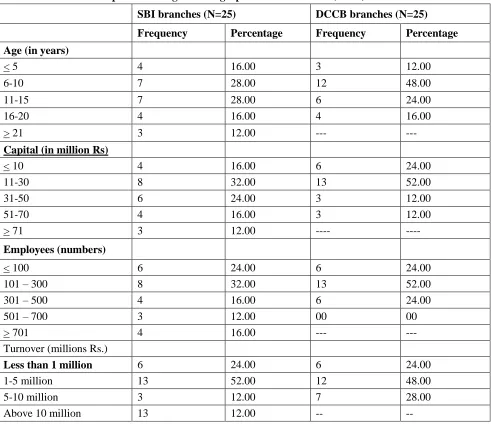
Distribution of Sample According to Demographic Characteristics (N=50)
SBI branches (N=25) DCCB branches (N=25)
Frequency Percentage Frequency Percentage
Age (in years)
< 5 4 16.00 3 12.00
6-10 7 28.00 12 48.00
11-15 7 28.00 6 24.00
16-20 4 16.00 4 16.00
> 21 3 12.00 --- ---
Capital (in million Rs)
< 10 4 16.00 6 24.00
11-30 8 32.00 13 52.00
31-50 6 24.00 3 12.00
51-70 4 16.00 3 12.00
> 71 3 12.00 ---- ----
Employees (numbers)
< 100 6 24.00 6 24.00
101 – 300 8 32.00 13 52.00
301 – 500 4 16.00 6 24.00
501 – 700 3 12.00 00 00
> 701 4 16.00 --- ---
Turnover (millions Rs.)
Less than 1 million 6 24.00 6 24.00
1-5 million 13 52.00 12 48.00
5-10 million 3 12.00 7 28.00
Above 10 million 13 12.00 -- --
[image:5.612.71.562.68.492.2]*Sources: Primary Data Collected through questionnaire.
Table 1 presents the distribution of the sample organizations according to the controls used in the study. The vast majority of respondents were in the age group 6-15 years. With respect to the size of the organisation, 72% of the sample SBI branches and 88% DCCB branches were rather medium organisations with less than 50 million Rs in operating capital, and 66% of the sample respondents were also medium organisations with less than 300 employees.
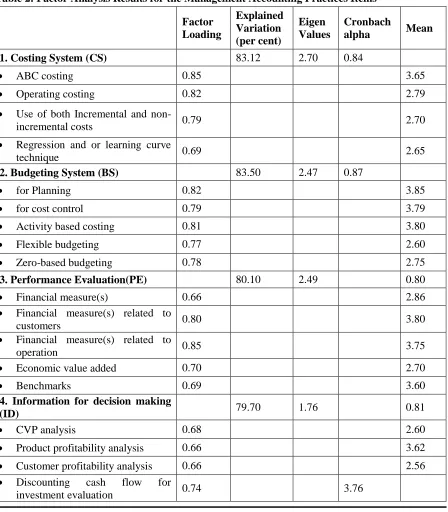
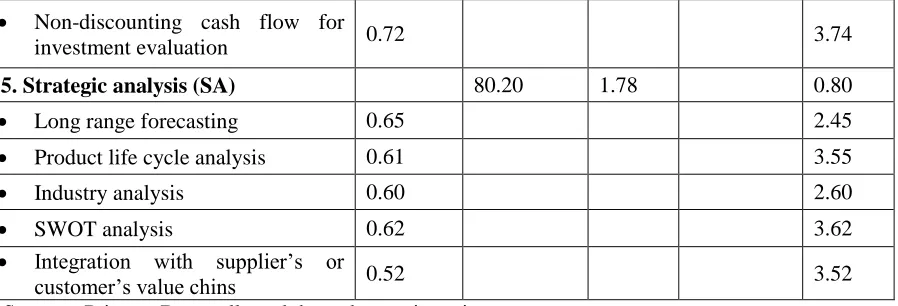
rotation on the25 individual management accounting technique items categorized into five groups. The management accounting technique items were factored into five factors explaining from 52.00 to 85.00 percent of total variation. The first factor (management accounting practices) we label as ‘costing system’ (CS) that comprises ABC costing, operating costing, use of both incremental and non-incremental costs and regression and or learning curve technique. The second factor ‘budgeting system’ (BS) comprises budgeting for planning, budgeting for cost control, activity based costing, flexible budgeting, and zero-based budgeting. The third factor ‘performance evaluation’ (PE) consists of financial performance measures, performance measures related to customers, performance measures related to employee, performance measures related to operation, economic value added and benchmarks.
Table 2: Factor Analysis Results for the Management Accounting Practices Items
Factor Loading
Explained Variation (per cent)
Eigen Values
Cronbach
alpha Mean
1. Costing System (CS) 83.12 2.70 0.84
ABC costing 0.85 3.65
Operating costing 0.82 2.79
Use of both Incremental and
non-incremental costs 0.79 2.70
Regression and or learning curve
technique 0.69 2.65
2. Budgeting System (BS) 83.50 2.47 0.87
for Planning 0.82 3.85
for cost control 0.79 3.79
Activity based costing 0.81 3.80
Flexible budgeting 0.77 2.60
Zero-based budgeting 0.78 2.75
3. Performance Evaluation(PE) 80.10 2.49 0.80
Financial measure(s) 0.66 2.86
Financial measure(s) related to
customers 0.80 3.80
Financial measure(s) related to
operation 0.85 3.75
Economic value added 0.70 2.70
Benchmarks 0.69 3.60
4. Information for decision making
(ID) 79.70 1.76 0.81
CVP analysis 0.68 2.60
Product profitability analysis 0.66 3.62
Customer profitability analysis 0.66 2.56
Discounting cash flow for
Non-discounting cash flow for
investment evaluation 0.72 3.74
5. Strategic analysis (SA) 80.20 1.78 0.80
Long range forecasting 0.65 2.45
Product life cycle analysis 0.61 3.55
Industry analysis 0.60 2.60
SWOT analysis 0.62 3.62
Integration with supplier’s or
customer’s value chins 0.52 3.52
*Sources: Primary Data collected through questionnaire.
The fourth factor ‘information for decision making’ (ID) comprises CVP analysis, product profitability analysis, customer profitability analysis, discounting cash flow for investment evaluation and non-discounting cash flow for investment evaluation. Finally, the fifth factor ‘strategic analysis’ comprises long range forecasting, product life cycle analysis, industry analysis, SWOT analysis, and integration with suppliers’ or customers’ value chains.
[image:7.612.94.543.43.196.2]Summarizing the findings shown in Table 2, it may be said that the set of ABC costing, budgeting for planning, budgeting for control, activity based costing, financial measure to operation, profitability analysis, discounting cash flow for investment evaluation, SWOT analysis, financial measure(s) related to employee, integration with suppliers’ or customers’ value chains may constitute the most import ant management accounting practices in the Banking units. In light of these results H1 may be accepted, supporting that there is a set of management accounting practices in the Banking units that is of most importance. These results may be similar with the findings of Chand and Dahiya (2010).
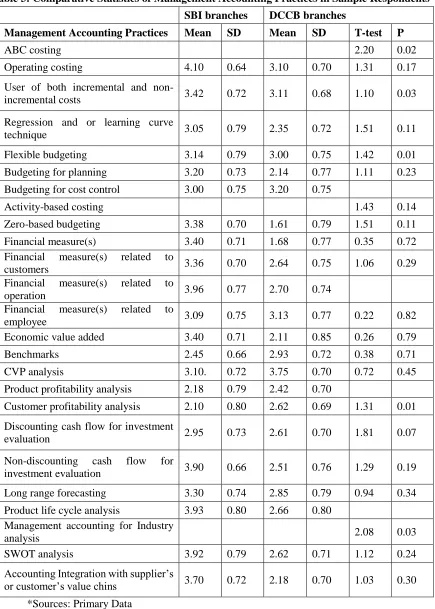
Table 3 presents the t-test result comparing perceived management accounting practices in the SBI and DCCB units. Mean comparison yielded a few significant differences and they were in the hypothesized direction. In most of the cases of DCCB units obtained higher mean score compared to its counterpart. In the rest of the cases the mean differences were not significant although DCCB units had always an edge over the SBI units. Analysis of the data suggests that the management accounting practices in the sample respondents were, on the whole, not well-founded. Most respondents were able to provide reasoned justification for the practices that they employed. The findings also provide needed implementation guidelines to practitioners for effective management accounting practices implementation and gives possible reasons to explain some cases of DCCB and SBI units where the perceived benefits fell short of expectations. Thus, results indicated that DCCB units will be rated higher than SBI units on management accounting practices.
In light of these results we may reject H2; supporting that there are significant differences in management accounting practices between DCCB and SBI units.
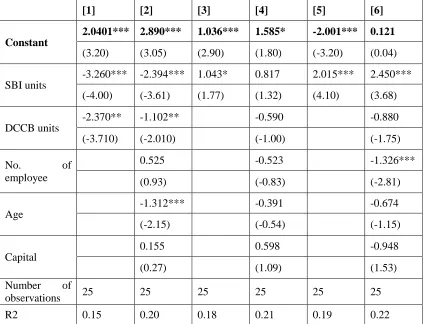
the hypothesis on the relationship between the level of development and the choice of the MAP as discussed in this paper. This result hold seven if we include control variables for size, age, number of employee and capital (column [2]). Moreover, the results show that the choice for the CS is also determined by the size of the firm and the age of the respondents; both variables have a negative and statistically significant coefficient. This means that SBI units use the CS method less often than DCCB units do.
Further, table 4 shows that the SBI units effect for the capital is positive and significant, which indicates that the BS is used more often by SBI units than by DCCB units (column [3]). Note, however, that the coefficient is only significant at the 10 percent confidence level. If we introduce the control variables in the model, the capital effect is still positive, yet it becomes insignificant (column [4]).
This suggests that the choice for the BS may not really be different between both the respondents. This finding is perhaps somewhat surprising in the light of the hypothesis on the all management accounting practices as discussed, based on which we might have expected that DCCB units are more regular users of management accounting practices than SBI are. On the other hand, combined with the findings with respect to the use of the AMAV, these findings may make sense. It might be the case that in recent years SBI units have been substituting their management accounting practices to edge over the rivers.
The results partially supported H3, that there is a positive association between the enterprise characteristics and the adoption of management accounting practices.
CONCLUSIONS AND SUGGESTIONS
The scope of this paper was three-fold purpose; first, to explore the significant management accounting practices used in the sample respondents and to investigate whether management accounting practices differ significantly between SBI and DCCB and whether these differences can be explained by differences in terms of demographic characteristics.
The study showed that respondents perceived that the management accounting practices employed within their units were very effective and contributed to the success of the organisation. It was also found that the management accounting practices were consistent and standardized across the group. The findings of study identified most important management accounting practices in the sample Indian SBI and DCCB units such as ABC costing, budgeting for planning, budgeting for control, activity based costing, financial measure to operation, profitability analysis, discounting cash flow for investment evaluation, SWOT analysis, financial measure(s) related to employee, Integration with suppliers’ or customers’ value chains.
Table 3: Comparative Statistics of Management Accounting Practices in Sample Respondents SBI branches DCCB branches
Management Accounting Practices Mean SD Mean SD T-test P
ABC costing 2.20 0.02
Operating costing 4.10 0.64 3.10 0.70 1.31 0.17
User of both incremental and
non-incremental costs 3.42 0.72 3.11 0.68 1.10 0.03
Regression and or learning curve
technique 3.05 0.79 2.35 0.72 1.51 0.11
Flexible budgeting 3.14 0.79 3.00 0.75 1.42 0.01
Budgeting for planning 3.20 0.73 2.14 0.77 1.11 0.23
Budgeting for cost control 3.00 0.75 3.20 0.75
Activity-based costing 1.43 0.14
Zero-based budgeting 3.38 0.70 1.61 0.79 1.51 0.11
Financial measure(s) 3.40 0.71 1.68 0.77 0.35 0.72
Financial measure(s) related to
customers 3.36 0.70 2.64 0.75 1.06 0.29
Financial measure(s) related to
operation 3.96 0.77 2.70 0.74
Financial measure(s) related to
employee 3.09 0.75 3.13 0.77 0.22 0.82
Economic value added 3.40 0.71 2.11 0.85 0.26 0.79
Benchmarks 2.45 0.66 2.93 0.72 0.38 0.71
CVP analysis 3.10. 0.72 3.75 0.70 0.72 0.45
Product profitability analysis 2.18 0.79 2.42 0.70
Customer profitability analysis 2.10 0.80 2.62 0.69 1.31 0.01
Discounting cash flow for investment
evaluation 2.95 0.73 2.61 0.70 1.81 0.07
Non-discounting cash flow for
investment evaluation 3.90 0.66 2.51 0.76 1.29 0.19
Long range forecasting 3.30 0.74 2.85 0.79 0.94 0.34
Product life cycle analysis 3.93 0.80 2.66 0.80
Management accounting for Industry
analysis 2.08 0.03
SWOT analysis 3.92 0.79 2.62 0.71 1.12 0.24
Accounting Integration with supplier’s
or customer’s value chins 3.70 0.72 2.18 0.70 1.03 0.30
Table 4: Determinants of the Use of Management Accounting: Multivariate Analysis
[1] [2] [3] [4] [5] [6]
Constant
2.0401*** 2.890*** 1.036*** 1.585* -2.001*** 0.121
(3.20) (3.05) (2.90) (1.80) (-3.20) (0.04)
SBI units
-3.260*** -2.394*** 1.043* 0.817 2.015*** 2.450***
(-4.00) (-3.61) (1.77) (1.32) (4.10) (3.68)
DCCB units
-2.370** -1.102** -0.590 -0.880
(-3.710) (-2.010) (-1.00) (-1.75)
No. of
employee
0.525 -0.523 -1.326***
(0.93) (-0.83) (-2.81)
Age
-1.312*** -0.391 -0.674
(-2.15) (-0.54) (-1.15)
Capital
0.155 0.598 -0.948
(0.27) (1.09) (1.53)
Number of
observations 25 25 25 25 25 25
R2 0.15 0.20 0.18 0.21 0.19 0.22
Note: All models presented in this table are estimated using the logic estimation method. The variables used in the analysis are defined as follows: Costing system = CS; Budgeting system = BS; Performance Evaluation = PE; Information for decision making, ID and Strategic analysis = SA; all management accounting variables = AMAV. The figures between brackets are t-test statistics. *, **, *** are significance levels of 10, 5 or 1 percent respectively. The R2 is an analogue to the R2 reported for regular OLS regression models, implementation and gives possible reasons to explain some cases of DCCB and SBI units where the perceived benefits fell short of expectations.
This research found significant differences in the application of management accounting practices among the SBI and DCCB. The results indicate that there is no significant relationship between management accounting practices variables and respondents’ characteristics. In some cases this is leading to the development of a more integrated strategic approach to the usage of management accounting practices. However, this research is only indicative, much remains to be examined. The research has suggested that management accounting practices may play a more prominent role in the bundling of Organisational performance.
REFERENCES
Atkinson, Á., Banker, R., Kaplan, R. & Young, M. (2001).Management Accounting. New Jersey Prentice Hall.
Brander, B. J. &Mc Donnell, B. (1995). The balance scorecard: Short-term guest or long term resident?
International Journal of Contemporary SBI Management, 7(2),7-11.
Brignall, T., Fitzgerald, L., Silvestro, R. & Johnson, R. (1991).Product costing in DCCB organizations.
Management Accounting Research, 2(2), 227-248.
Burgess, C. L. (1996). A profile of hotel financial controller in the UK, United States and Hong Kong.
International Journal of SBI Management, 15(1), 19-28.
Chand, M. & Dahiya, A. (2010). Application of management accounting techniques in Indian small and medium SBI units: An empirical study. International Journal Entrepreneurship and Small Business, 11(1),25-41.
Chand, M. & Lal, H. (2008). Human resource accounting: An implication for managerial decisions in Indian hotel industry. International Journal of SBI and Tourism Systems, 1(1), 88-92. Chand, M. (2009). Managing SBI Operation. NewDelhi: Anmol Publications.
Collier, P. & Gregory, A. (1995). Strategic management accounting: UK hotels sector case study.
International Journal of Contemporary SBI Management, 7(1),16-21.
DeFranco, A. (1997). The importance and use of financial forecasting and budgeting at the departmental level in the hotel industry as perceived by hotel controllers.SBI Research Journal, 20(3), 99-110.
Dent, J. F. (1991). Accounting and organizational cultures: Afield study of the emergence of a new organizational reality. Accounting, Organization and Society, 16(8), 705-732.
Duck, R. E. V. (1971). The use of management accounting techniques in industry. Journal of Management Studies,8(3), 355-359.
Farjana, Y. & Fowzia, R. (2010). Management accounting Practices: A comparative analysis of manufacturing and DCCB industries. Journal of Centre for Socio-Economic Research, ASA University Bangladesh Review, 4(1).
Garrison, R. & Noreen, E. (2000). Management Accounting. Chicago: Mc-Graw Hill Higher Education.
Ghosh, B. & Chan, Y. (1997). Management accounting in Singapore- Well in place? Managerial Auditing Journal,12(1), 16-18.
Harris, P. & Brown, B. (1998).Research and development in SBI accounting and financial management.SBI Management, 17(1), 161-181.
Potter, G. & Schmidgall, R. (1999).SBI management accounting: Current problems and future opportunities.SBI Management, 18(5), 387-400.
Harris, P. & Mongiello, M. (2001). Key performance indicators in European hotel properties: General mangers’ choices and company profiles. International Journal of Contemporary SBI Management,
13(3), 120-127.
Islam, M. & Kantor, J. (2005). The development of quality management accounting in China.
Managerial Auditing Journal, 20(7), 707-724.
Ittner, C. & Larcker, D. (2002). Empirical managerial accounting research: Are we just describing management accounting practice? European Accounting Review, 11(4),787-794.
Jones, T. (1998). UK hotel operators’ use of budgetary procedures. International Journal of Contemporary SBI Management, 10(3), 96-100.
Joshi, P. L. (2001). The international diffusion of new management accounting practices: The case of India original research article. Journal of International Accounting, Auditing and Taxation, 10(1), 85-109.
Lamminmaki, D. (2008). Accounting and the management of outsourcing: An empirical study in the hotel industry. Management Accounting Research, 19(2), 163-181.
LeBruto, S., Ashley, R. &Quain, W. (1997). Using the contribution margin aspects of menu engineering to enhance financial results. International Journal of Contemporary SBI Management, 9(4), 161-167.
Lowry, J. F. (1990). Management accounting and DCCB industries: An exploratory account of historical and current economic contexts. Abacus, 26(2), 159-184.
Mia, L. & Patier, A. (2001). The use of management accounting systems in hotels: An exploratory study. SBI Management, 20(2), 111-128.
Ministry of Finance. (2011). The Gazette of India, PART 1 -Section 1. New Delhi.
Narasimhan, M. S. & Thampy, A. (2002). Activity based costing in banking DCCB: A case study of a large Indian private sector bank. Prajnan, 31(2), 95-110.
Olson, O., Guthrie, J. & Humphrey, P. (1998).Global Warning! Debating International Developments in New Public Financial Management. Oslo, Cappalen: Akademisk Forlag.
Robyn, K., Clarkson, M. P. & Wallace, S. (2010). Budgeting practices and performance in small healthcare businesses. Management Accounting Research, 21(1), 40-55.
Sulaiman, M. B. et al. (2004). Management accounting practices in selected Asian countries: A review of the literature. Managerial Auditing Journal, 19(4), 493-508.
Sharma, D. (2002). The differential effect of environmental dimensionality, size, and structure on budget system characteristics in hotels. Management Accounting Research,13(1), 101-130.
Sulaiman, M., Ahmad, N. N. & Alwi, N. (2004). Management accounting practices in selected Asian countries: A review of the literature. Managerial Auditing Journal, 19(4),493-508.
Yeshmin Farjana and Das Sumon (2009). Management accounting techniques: appraisal of managerial performance of the financial institutions in Bangladesh. Institute of Chartered Secretaries and Managers of Bangladesh(ICSMB), 9(3).
Atkinson, A.A, Kaplan, R. Matsumura, E. Young, S. Kumar, G. (2014), Management accounting, How management accounting information supports decision making. 6th edition, Pearson; New Delhi
CIMA. 2009. Thought Leadership. Retrieved from: http://www.cimaglobal.com/
Thoughtleadership/Newsletters/Insighte-magazine/Insight-2009/Insight-June-2009/What-isCIMAs-definition-of-management-accounting. [Accessed:12th December 2014]
Frank, W.G. 1990. Back to the future: A retrospective view of J. Maurice Clark's Studies in the Economics of Overhead Costs. Journal of Management Accounting Research,(2), 155-166.