2018 IX International Conference on Optimization and Applications (OPTIMA 2018) ISBN: 978-1-60595-587-2
The Computational Technique for Nonlinear Nonconvex Optimal Control
Problems Based on Modified Gully Method
Alexander GORNOV, Tatiana ZARODNYUK*, and Anton ANIKIN
Matrosov Institute for System Dynamics and Control Theory of SB RAS, Irkutsk, Russia
Corresponding author
Keywords: Global optimization, Optimal control problem, Numerical methods.
Abstract. The paper describes a technology for the numerical investigation of nonlinear non-
convex optimal control problems. This approach is based on the basin-hopping algorithm at the globalizing stage and the modified Nesterov’s gully method at the stage of local extremum search. We present two applied problems solved by the proposed technique.
Introduction
The complexity of modern applied optimal control problems demands high quality both of com- putational methods and software for these problems. Numerous publications have been devoted to the construction of numerical procedures for the search of optimal solutions in optimization prob- lems of dynamical systems, among which are the papers of R. Bellman, O.V. Vasiliev, R. Gabasov and F.M. Kirillova, Yu.G. Evtushenko, V.I. Gurman, N.N. Krasovskii, A.I. Tyatyushkin, R.P. Fe- dorenko, F.L. Chernousako (see, for example, [4], [1], [20], [14], [15], [11], [12], [8]) and other scientists. Universal algorithms oriented to solving a wide class of the optimization problems are not sufficiently flexible since they do not take into account their specific features and, in spite of the high performance of modern computers, often require excessive expenditures of computer time and the amount of RAM. Therefore, the development of algorithms that take into account the features of the desired control and the constraint structure continues to be relevant both from the point of view of efficient search for the numerical solution of the complex applied problem and from the point of view of developing software for solving various classes of the optimal control problems.
Requirements from practical applications are constantly growing, in particular, the dimensions of optimization problems are increasing. According to the classification of Yu.G. Evtushenko, the optimization problems with a variables number exceeding 100 are super-large problems of global optimization [10]. Existing approaches cease to be effective for these applied problems. The main problem, as before, is the problem of reliability. Algorithms that can guarantee the achievement of the solution (methods of Lipschitz optimization, methods of an interval analysis, see for ex- ample [19]) require large computational costs and, as a rule, are solved by using supercomputer technologies.
In the theory of the complexity of the algorithms, new interesting modern results [16] allow creating new approaches the least dependent on the dimension of the problem. The article presents
*
the computational technique based on the optimization results obtained in recent years and inte-grating the traditional methods with the resources of parallel optimization.
The Standard Statement of the Optimal Control Problem
The controlled process is described by a system of ordinary differential equations with initial conditions
˙
x(t) = f(x, u, t, p), x(t0) =x0, (1)
and defined on the interval T = [t0, t1]. Here t is independent variable, x(t) is n-vector of phase
variables, u(t) is r-vector of controls, p is vector of model parameters. The initial phase vector
x(t0) = x0 is given. The control u(t)∈ U ⊂Er for ∀t is feasible, here U is a set of the following
type
ui ≤ui ≤u¯i, i= 1, r. (2)
These constraints are called direct.
The optimal control problem in the standard formulation consists in finding the feasible control vector u∗ that allows achieving a minimum of the functional
I0(u) =ϕ0(x(t1), p) (3)
Vector-function f(x, u, t, p) is assumed to be continuously differentiable with respect to x and
u, and also piecewise continuous in t. The functionϕ0(x(t1, p)) is continuously differentiable with
respect to x. The system of differential equations is non-rigid.
An Auxiliary Problem of Unconditional Minimization with Bounded Control
The problem is to minimize the objective functional when only direct control constraints are satisfied. These type of problems are auxiliary to the methods of consecutive unconditional mini-mization used for solving standard OCPs.
In the standard reduced gradient method [21], [22] at the k-th iteration an auxiliary control is constructed
uki =
ui, vi < ui,
vi ui ≤vi ≤ui, i= 1, r
¯
ui, vi > ui,
where v = uk − ∇I
0(uk). Here uk(t) is the available approximation, ∇I0(uk) is the functional
gradient for this approximation. Using the constructed auxiliary control, we search a minimum of the functional in a given interval
min
α∈[0,1]I0(u
k+α(uk−uk)) =I
0(uk+1). (4)
The method of the conjugate gradient with sinusoidal transformation assumes the preliminary reduction of the gradient in the feasible parallelepiped under the formula
dk = 0.5(u−u) cos
arcsin
2uk−u−u u−u
∇I0(uk). (5)
The conjugate direction is constructed according to the Fletcher-Reeves method [18]
qk =−dk+βk·qk−1, (6)
where
βk =
( ||dk||2
||dk−1||2, k /∈K
0 k ∈K,
K is the update iteration number. The length of the variation step is obtained from the solution of the problem
min
α∈[0,α]
I0(u(α)) = I0(uk+1). (7)
The formula for the control variation has the form
u(α) = 0.5(u+u) + 0.5(u−u) sin
arcsin
2uk−u−u u−u
+αqk
. (8)
The disadvantage of the algorithm is the possible effect when control is sticking to the boundary, so when constructing a general algorithm for the standard problem, it is applied in alternation with the reduced gradient method.
Proposed Computational Technique
The basic algorithms included in the implemented computational technique are modifications, sometimes significant, of canonical methods. The authors have available methods for generating random control of several classes (relay, piecewise linear, “spline”) [?]. Parallelepiped constraints on variables are taken into account constructively: the method realizes variations only within the feasible set. For projection of unacceptable values, the method of nonequivalent transformations is used, which is close to the technique of internal point methods [23].
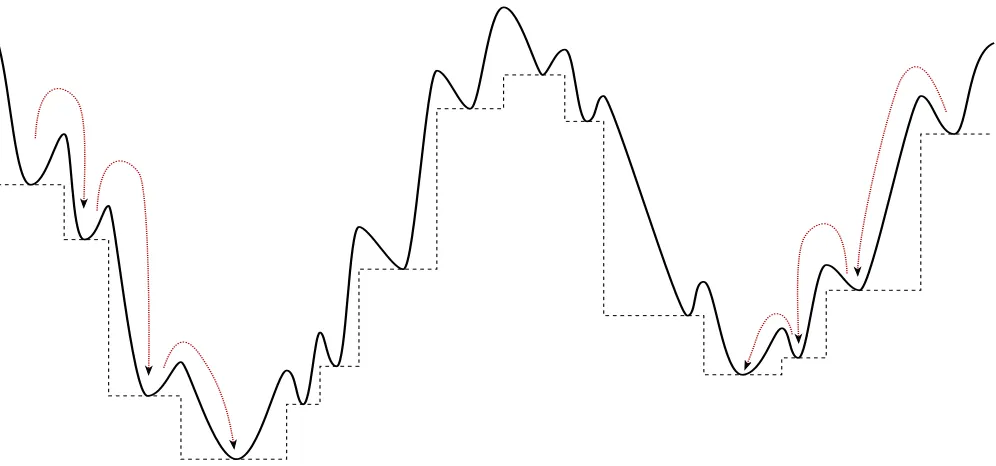
As a globalizing method, we propose to use the basin-hopping method (MSBH) [24], [2]. This global method belongs to the stochastic class and demonstrated its effectiveness in solving a lot of applied problems. The main idea of the method is an application of a two-level approach. On the top level, it is realized a random “shooting” across the entire accessible search area from subsequent local searchers. On the lower level, method carries out the dense “shooting” with search in a small area around the achieved local extremum (see Fig. 1).
The presented technique contains in its composition a parallel implementation of the MSBH method for the use of modern multi-core systems. To increase the efficiency of global extremum search in the considerable problem with the use of OpenMP technology it is performed start parallel computing flows, each of which independently performs both the first and second level of the algorithm. The proposed option also allows without significant costs to implement an effective version of the algorithm for systems with distributed memory, which is an important factor in solving global optimization problems.
Figure 1. An example of the one-dimensional multiextremal function (the solid line) with the appropriate transformed structure (the dashed line).
Implemented parallel algorithm showed high computational performance – on 10-core Intel Xeon E5-2680v2 processor we have an acceleration of about 9 times. Acceleration here means the reduction of the time spent on the execution of a given number of local descents. Due to the fact that we consider the problem of finding a global extremum (i.e. we do not know the real solution), and also due to the fact that the MSBH algorithm is stochastic and uses heuristics, it is impossible to give an unambiguous assessment of how much faster the solution will be found when using, for example, 10 processors instead of 1. Global search algorithms depend on the starting point, pseudo-random number generator settings, and many other factors. The common approach to global minimum search implies that executing more descents gives a stronger confidence in the reliability of the founded solution.
The proposed implementation of the MSBH method was successfully applied for solutions to many global optimization problems, including search minimum of the Morse potential, which many leading specialists in the field of optimization belong to the very complex statement.
In this paper, we implement at the globalizing stage the original modification of the MSBH method to investigate nonlinear nonconvex optimal control problems. At the local stage, we use the method proposed by Yu.E. Nesterov [17], [16] and allows to minimize strongly convex functions, assumes that of the constant of strong convexity and the Lipschitz constant for the gradient is given. Let us present a modification of this method for an optimal control problem, which includes built-in mechanisms for estimating considerable constants on iterations of the algorithm.
The Main Algorithm
1. Assume that A0 =M0 =L0 = 1, v0(t) =u0(t),t ∈T.
On the k-th ineration:
2. Calculate βk>0 from equation Lk(βk)2 = (1−βk)Ak.
3. Assume that
yk(t) = arg min
I0(u(α,·))|u(α, t) = uk(t) +α(vk(t)−uk(t)),−∞< α <∞ .
4. Search the variable value
uk+1(t) = arg min
I0(u(α,·))|u(α, t) = yk(t)−α∇I0(yk(t)),0≤α <∞ , t∈T.
5. Calculate Ak+1 =βkMk+ (1−βk)Ak.
6. Find
Nk =
∇I0(uk+1(t))− ∇I0(uk(t)), uk+1(t)−uk(t)
||uk+1(t)−uk(t)||2 , t∈T. (9)
7. Estimate the values Mk+1 = min
Nk, Mk and Lk+1 = max
Nk, Lk .
8. Assume
vk+1(t) = (1−βk)vk(t) A
k
Ak+1 +β
kyk(t) M k
Ak+1 − ∇I0(y
k(t)) β k
Ak+1, t∈T. (10)
9. Check the stopping criterion. If it is not satisfied, then k := k + 1 and go to step 2, else go to step 10.
10. The algorithm is finished.
Instead of the prescribed number of iterations, you can use any stopping criterion on each restart. In particular, wait until the norm (or the square of the norm) of the functional gradient is halved. It is not necessary to make the prescribed number of iterations on each restart with such stop criterion [13]. At present, the question of choosing the best stop criterion of algorithms for solving nonconvex optimal control problems remains open.
Solutions of Applied Optimal Control Problems
The optimal control problems are extremely diverse, so it is difficult, remaining within the framework of common sense, to come up with a single form for all of them. To solve a wide class of these problems, the following approach is proposed: to isolate the standard form of the formulation (Section 2) and to select a set of methods for reducing more complicated problems to an initial one. As common methods (see, for example, [9]) the following are used:
1. The integral functional
Z t1
t0
f0(x, u, t)dt→min (11)
can be reduced to the terminal by introducing an additional phase variable.
˙
xn+1 =f0(x, u, t), xn+1(t0) = 0. (12)
Then it is obvious
Z t1
t0
f0(x, u, t)dt=xn+1(t1). (13)
2. The problems with non-fixed time are reduced to the standard form by introducing the additional control parameter and the new phase variable. We pass to a new timeτ =ur+1·t, τ ∈[0,1].
Then the speed problem, for example, is to findxn+1(t)→min, when ˙xn+1 =ur+1, xn+1(0) =
0.
3. The intermediate constraints of the form xs(θ) ≤ 0 are the most easily brought to the
terminal by means of the new phase variable
˙
xn+1 =
(
fs(x, u, t), t∈[t0, θ]
0 t∈[θ, t1],
Herexn+1(t0) = 0, xs(θ) = xn+1(t1).
Using these techniques, it is possible to reduce the various statements of the applied optimal control problems to the standard considered type.
The Optimization Problems for the Forest Management
Forest tracts in new areas of Siberia development are characterized by the prevalence of mature and over-mature forest stands. As a consequence, the estimated felling areas for main use ensure logging only for 50–70 years, after which the production, and with them, the settlements are forced to move to other areas. Such a strategy violates the main requirement of permanent and restorative forest management and, in addition, entails significant economic and social costs. For the majority of operational forests, where logging can be carried out in a continuous logging method, the most economical and, with a reasonable approach, environmentally friendly, the optimization of forest management assumes the creation of normal forest ranges that ensure the uniformity of forest use. For the Siberian forests, the main methodological complexity is that, in addition to the age dynamics, it is also necessary to take into account the processes of rock change, and, ideally, also to manage these processes. The problem of developing a strategy for permanent forest management, taking into account regional specifics and developing methods for normalizing the structure of planted forests, was posted in [5], [7] for the Ilimsky Leskhoz located in the northwestern part of the Irkutsk Region.
The model of natural and anthropogenic dynamics of forest stands is described by a system of differential equations
dS0i dt =
X
j
uij −
X
k
α0ik·S0k−u0i−
X
k,l
γkl0i·Skl, (14)
dSi1 dt =
X
k
α0ki·S0k+u0i−u1i−γi01·Si1, (15)
dSij
dt =αij−1·Sij−1−αij ·Sij −γij ·Sij +Iij −γ 0
ij ·Sij −uij. (16)
HereSij(t) is the area of plantations with a predominance of the i-th breed of thej-th class of age
at the time t (hectares), i = 1, n, j = 1, m; n = 8 is the number of rocks, m = 6 is the number of the tree rocks ages, S0i(t) is the areas not covered by forest (burnt and cut wood), from forests
with the predominance of thei-th breed (hectares);αij is coefficient of forests age dynamics ofi-th
breed for j-th age class, the relative intensity of the transition from the j-th age class to the next (the unit of measure is 1/year);α0ik is coefficient of felling overgrowing intensity from the forests
of the i-th breed by the youngest of the k-th breed; γkl
ij is intensity coefficient of forests change
of i-th breed of j-th age class on forests of k-th breed of l-th age class (1/year); γij = Pk,lγijkl, γij0 is the intensity coefficient of natural death of forests with the predominance of the i-th breed
of the j-th age class with the subsequent transition to the forest-free area (1/year), u0i(t) is the
cultures area of the i-th breed, formed per unit of time (1year) at timet (hectare/year); uij(t) is
the felling area in the forests of the i-th breed of thej-th age class (j ≤j0 is felling age class) for
the year at time t (hectare/year).
The coefficients of the model were identified on the basis of aerospace survey data and forest inventory materials using the specialized methodology [6]. The initial state for the phase variables was the current state of the forests of the Ilimsk forestry enterprise. The forest plantation areas were considered as the control of the system. As the objective functional, the indicator of the maximum volume of logging for a period of 100 years was used:
I(u0i) =
Z 100
0
X
k,i
Dkiuki(t)dt→max, (17)
where Dki is weight coefficients that depend on phase variables.
Natural limitation are imposed on problem variables
Sij(t)≥0, 0≤u0i ≤1, i= 1, n, j = 1, m. (18)
Thus the optimal control problem with 48 phase variables, 8 controls, and 48 phase constraints is formulated. It was solved by using the proposed technology. The phase constraints were taken into account by introducing integral penalty quadratic functionals. The solution was divided into a number of stages by parametrizing the problem in time: at the first stage, the optimization of forest management was carried out over a time interval of 20 years, then the interval was increased by 5 years, and the optimization problem was again solved, etc.
As a result of solving the optimal control problem, the cutting area for individual breed groups (in percent of the total area) was determined: light coniferous – 64%, dark coniferous – 10%, deciduous – 12%, the terms of logging on which can be extended from 70 to 100 years. To maintain the capacity of the logging enterprise at a constant level, it is necessary to change the form of logging – an increase in the amount of selective felling. The number of forest plantations, according to calculations, should approximately correspond to 90% of the felling area, as a result of which the age structure gradually normalizes and the relative stability of the structure of the forest tracts of the territory is achieved.
On the basis of the calculations obtained, a methodology has been developed for an approximate optimal level for felling and forest plantations for the Ilimsky leskhoz, which makes it possible to achieve a uniform forest use while preserving logging volumes.
Forecasting the Economic Situation of Kabanskii Region of Buryatia
The Kabanskii region is one of the most economically developed regions of Buryatia Republic. Favorable economic and geographical position of the region allows local authorities to set the task of achieving sustainable development of the territory under their jurisdiction. Since 1997, there has been a steady increase in production volumes by about 10% per year. There is an outstripping dynamics of growth of own revenues of the district budget. The main industries that determine the parameters of the revenue side of the budget of the Kabanskii region are such sustainable industries as the pulp and paper industry, the construction materials industry and railway transport, which provide more than 90% of the revenues to the local budget. Indicators of the budgetary sphere
dynamics for the region can serve as objective characteristics for the analysis of the results and prospects for the territory development, the natural conditions of activity, the level of economic development, and the established system of economic relations are displayed in an integrated form. However, along with positive patterns of development, there are also multidirectional trends in the economic behavior of economic entities, which provoke the imbalance of this economic system. The problem of achieving optimal behavior of subjects of economic relations continues to remain extremely relevant for the region.
Diagnostics of the municipal entity behavior as a consumer and producer of public goods makes it possible to trace the influence of factors that favor or impede the effective functioning of this system and determine the directions of stimulation or inhibition of their impact. The dynamics model of budget revenues of the Kabanskii region was developed at the Institute of Geography of the SB RAS by A.K. Cherkashin on the basis of data on the structure of budget revenues with the use of modern methods of system analysis.
The dynamics of budgetary factors is described by a system of equations
˙
y(t) =B11+B10f(t) +B12y(t) +B13x(t) +B14z(t), (19)
¨
x(t) = B21+B20f(t) +B22y(t) +B23x(t) +B24z(t), (20)
...
z(t) =B31+B30f(t) +B32y(t) +B33x(t) +B34z(t), (21)
f(t) = B41+B42y(t) +B43x(t) +B44z(t), (22)
wheref is the resource component, yis the consumption level, xis the development of productive forces, z is the population activity, expressed in scaled relative units.
By introducing the additional variables, the original system reduces to the system of six first-order linear differential equations. The dimension of the system decreases by substituting the expression forf(t) into equations (19)–(21).
In this formulation, this system of equations is considered as a model for sustainable develop-ment of the region. After the formulation of the dynamics equations, the problem of information support (parametric identification) of the developed mathematical model arises. In solving the problem of information support the main difficulty is a contradiction between the selected inertia deep dynamic models (as reflected in the use of the second and the third order of the simulated variables) with the limited number of measurements on which the coefficients need to be identified. To overcome this problem, the Pade multi-point approximation technology [3] is used, which allows taking into account the inertia of the initial information.
As a result, it was possible to formulate the corresponding optimal control problem with the following values of the found model parameters
˙
y(t) = 12.45−1.35y(t)−0.64x(t) + 0.28z(t) +uy+ 3.41uf (23)
˙
x(t) =x1(t) (24)
˙
˙
z(t) = z1(t) (26)
˙
z1(t) = z2(t) (27)
˙
z2(t) = 42.0−7.32y(t) + 13.54x(t) + 0.30z(t) +uz+ 3.93uf (28)
The additive variables-controls, in general, depending on time, have the following meaning: uf
is an additional resource potential, uy is growth of the population incomes (grants and subsidies,
increase in wages, decrease in unemployment), ux is growth in investments, uz is growth in public
activity (raising the level of community awareness, accelerated social development, growth of self-awareness and business activity).
All controls have natural restrictions from above and below: u0 ≤u≤um.
A functional criterion for the effectiveness of the territorial system (the criterion of control optimality) is the amount of maximization of the funds shares in the budget over a period of time
T
J =
Z T
0
(axx(t) +ayy(t) +azz(t))dt→max. (29)
Hereax,ay, az are weights coefficients determining the priorities of the region development.
As a result of the numerical solution of the problem, with the help of the proposed computer technology, it is established that the basic variant of optimal control in conditions of socioeconomic equilibrium requires extensive use of resources, investment growth and awareness of the population when population subsidies are limited. These trends can be taken into account by varying the free coefficients in the basic equations. The obtained results satisfied experts and allowed to formulate recommendations to local authorities for making managerial decisions.
Conclusions
The paper describes the standard optimal control problem, which in the general case can be the multiextremal optimization problem, and the methods for reducing the optimization problems of a wider class. The technology for its numerical investigation based on the MSBH method at the globalizing stage and the modified Nesterov’s gully method at the stage of the local extremum search from successful approximations found at the first stage has been developed. The testing of the corresponding technology was carried out in solving series test problems of different com-plexity. We present two applied problems solving by the proposed technique: the optimization problems for the forest management and the problem of forecasting the economic situation of Ka-banskii region of Buryatia. The solutions of these problems by the heuristic method of the random multistart, traditionally used to study the nonconvex global optimization problems, was obtained with less accuracy and for a much longer time. The obtained results made it possible to verify the effectiveness of the proposed approach for investigation nonconvex nonlinear optimal control problems.
Acknowledgements
This research was supported by the Russian Foundation for Basic Research, Grant No 17-07-00627.
References
[1] A.V. Agrutchintsev and O.V. Vasiliev. Iterative processes of the maximum principle and their modifications in systems with distributed parameters, Differential Equations. 32(6) (1996) 797-803.
[2] A.N. Andrianov, A.S. Anikin, I.V. Bychkov, and A.Y. Gornov. Numerical solution of huge-scale quasiseparable optimization problems, Lobachevskii J Math. 38(5) (2017) 870-873. [3] J. Bayker and P. Graves-Morris. Pade approximations. Mir, Moscow (1986).
[4] R. Bellman. Mathematical programming. Nauka, Moscow (1976) (in Russian).
[5] A.K. Cherkashin. The model of forestry forestry dynamics and its application for forecasting problems, Planning and forecasting of natural-economic systems (1984) 69-81 (in Russian). [6] A.K. Cherkashin and A.Yu. Gornov. The forest management optimization in taiga of the forest
resources base of Ust-Ilimskiy Timber Complex, Optimization of geosystems (1991) 99-112 (in Russian).
[7] A.K. Cherkashin and A.V. Myadzelets. Step-by-step formation of the territorial organization on a landscape basis in the Siberian and Arctic regions In: Proc. of XII International landscape conference “Landscape science: the theory, methods, landscape-ecological maintenance of wildlife management and sustainable development“, Tyumen-Tobolsk, August, 22-25th (2017) 46-49 (in Russian).
[8] V.A. Dykhta. Positional strengthenings of the maximum principle and sufficient optimality conditions. In: Proc. Steklov Inst. Math. 21(2) (2015) 43-57.
[9] Yu.G. Evtushenko. Methods for solving extremal problems and their application in optimiza-tion systems. Nauka, Moscow (1982).
[10] Yu.G. Evtushenko, V.U. Malkova, and A.A. Stanevichyus. Parallel global optimization of functions of several variables. Comput. Math. Math. Phys. 49(2) (2009) 246–260.
[11] F.P. Fedorenko. Approximate solutions of optimal control problems. Nauka, Moscow (1978) (in Russian).
[12] R. Gabasov and F.M. Kirillova. The maximum principle in the theory of optimal control. URSS Editorial, Moscow (2011) (in Russian).
[13] A.V. Gasnikov and Yu.E. Nesterov. Universal method for stochastic composite optimization problems. Comput. Math. Math. Phys., 58:1 (2018) 48-64.
[14] A.Yu. Gornov, T.S. Zarodnyuk, E.A. Finkelshtein, and A.S. Anikin. The method of uniform monotonous approximation of the reachable set border for a controllable system. J Global Optim. 66(1) (2016) 53-64.
[15] V.F. Krotov and V.I. Gurman. Methods and problems of optimal control. Nauka, Moscow (1973) (in Russian).
[16] Yu.E. Nesterov. Introduction to convex optimization. Moscow center continuous mathematical education, Moscow (2010).
[17] Yu.E. Nesterov. Effective methods in nonlinear programming. Radio and Communication, Moscow (1989).
[18] B.T. Polyak. Introduction to Optimization. Nauka, Moscow (1983).
[19] S.P. Shary. Randomized Algorithms in Interval Global Optimization. Numerical Analysis and Applications. 1(4) (2008) 376-389.
[20] A.I. Tyatyushkin and Zarodnyuk T.S. Numerical Method for Solving Optimal Control Prob-lems with Phase Constraints. Numerical algebra, control and optimization. 7(4) (2017) 483-494.
[21] O.V. Vasiliev. Lectures on optimization methods. Publishing house of Irkutsk State University, Irkutsk (1994) (in Russian).
[22] O.V. Vasiliev. General schemes of first-order optimization methods for various types of ad-missible control varieties in problems with lumped and distributed parameters. Modern opti-mization methods and their application to power systems (2003) 7-29.
[23] N.I. Voropai and V.I. Zorkaltsev. Models and methods of optimization in power systems research. In: Knopov, P.S., Zorkaltsev, V.I., Ivanyo, Ya.M. (eds.) Stochastic programming and its applications (2016) 9-35.
[24] D.J. Wales and J.P.K. Doye. Global Optimization by Basin-Hopping and the Lowest Energy Structures of Lennard-Jones Clusters Containing up to 110 Atoms. J. Phys. Chem. A. 101 (1997) 5111-5116.