Exploring the Emergence of Renewable Energy Grids in
Developing Countries with Agent Based Models
by
Jose Alfaro
A dissertation submitted in partial fulfillment
of the requirements for the degree of
Doctor of Philosophy
(Natural Resources and Environment)
in the University of Michigan
2014
Doctoral Committee:
Associate Professor Shelie Miller, Chair Professor Gregory A. Keoleian
© Jose Alfaro
2014
Dedication
To all the L’s in my life and my one S, Lindy, Leidy, Luis B., Luis A. and Sidney, and to God who’s strength never left me even when I left him.
Acknowledgements
I would like to acknowledge the generous funding sources that allowed me to complete my work. The National Science Foundation allowed me a great freedom to pursue my academic interests and become a potential faculty member through the Graduate Student Fellowship Program. Rackham Graduate School provided me with a dissertation grant that helped me focus on my final steps at the end of my Ph.D. The School of Natural Resources and Environment also helped fund my last year at UM so that I could focus on my research and publications. Through my career I was also fortunate to obtain grants for diverse projects and endeavors from the EHELD program, the African Studies Center, the United Nations Development Program, and other donors.
We may be fooled to think that getting a Ph.D. is an individual accomplishment, but its not. Many people are involved in pushing the student towards the achievement. While at some points the work is incredibly lonely and in the end the student is responsible, no one would be able to make it without help and direction from a wonderful group of people.
I was incredibly blessed with the committee that guided my work. My advisor, Shelie Miller, was patient, kind, and incredibly insightful. From the moment we met at a meeting not even planned, to the very end, she saw things in me that I could not. Her insistence that I could come up with a unique research theme separate from her work scared me to pieces, but in the end was one of the best things she did for me. Shelie provided an incredible wealth of knowledge, encouragement, and even tough love when it was necessary. She provided me with freedom to pursue academic endeavors and wise guidance to turn them into useful contributions my field. Not to mention she was even crazy enough to join us on a trip to Liberia and go fishing with her bare hands in the muck!
extramural activities with Sustainability Without Borders and engaged learning. His support and vision for the program are key to how the organization and the opportunities for students at SNRE have gained momentum.
I can’t say enough about Rick Riolo. I was fortunate to receive my introduction to complexity from such a key player in the field. Every time I spoke to Rick I was more keenly aware of the wealth of knowledge he had but more importantly of how he was trying to throw me into the deep end of thought exercises I never thought I could participate in. Rick’s comments and feedback were never easy to handle. Mainly because I could find myself going down a rabbit hole of new ideas and opportunities that could take me a life time to pursue. I owe so much to Rick, specially knowing that even when struggling with his health he was always available to help me, to advise me, or to offer the best wine he had around to enjoy a friendly evening.
I am indebted to Ming Xu for pushing me into clearly defining the literature I would base my work on and for encouraging me to make my literature review deeper and more robust. I also owe Ming a great deal for providing me with some amazing opportunities for growing as a professional in academia.
I highly recommend for all graduate students to find a mentor outside of their committee. I was lucky enough to have Rachel Kaplan as my mentor and friend. She became what I call my Academic Fairy-‐God-‐Mother. I know I can always bring anything to Rachel and expect to hear wise and honest words. She took time to make sure I knew how to find things I needed, ensured that I asked myself the right questions for success, and above all she was always a source of support and encouragement. In her I had a crutch and a champion that allowed me to reach higher than I expected.
I want to thank Jeremiah Johnson for becoming a wonderful collaborator. Jeremiah looked at my work with a critical eye that pushed me to improve. He also allowed me to bridge my work towards developed countries and to include more realistic and robust considerations in everything I did. I am pretty sure that without him I would have finished faster but with him I finished stronger.
provided me with a platform where I gained professional experiences that I would have never dreamed off. His kindness and trust allowed me to develop a project that has lit a passion in me for engaged education and for increasing the ability of students at both sides of the ocean to interact with each other.
Along with Herb, Kelly Askew allowed me to serve in the STEM Africa Committee and gave me a network of people that I have learned to admire and emulate. Not to mention Kelly was always protecting our progress to graduation even if that meant our involvement in EHELD had to be dialed back.
Cinda Sue Davis became an amazing supporter and mentor. I have to thank her for all she did to ensure that EHELD and I would be successful but also for showing me the passion needed for engaging students in STEM fields. Cinda’s passion and endless energy motivate me to continue pushing for better education for all students I may have in the future. I must thank her also for being a faithful supporter of my efforts and my crazy ideas.
I also have to thank the students and volunteers that participated in EHELD and in Sustainability Without Borders. Without them my work at Michigan and Liberia would have much harder and lonely. With them it was a constant adventure of learning, teaching, and support. My sincere thanks to those students and volunteers from Michigan, Liberia, Sierra Leon, and other places that made me a much richer man!
Some seven years ago my friends Matt Moore and Will McGinty sat in my living room for one of our many man-‐meetings. I remember telling them that I would be happy running experiments and finding things out for the rest of my life. I had the perfect job, an unlimited expense account, and a home with the picket fence… the American dream. They did no bat an eye in encouraging me to leave it all behind to pursue the desires of my heart. I used to write poetry at the time. When I said I was afraid I would not be able to write a dissertation Matt told me “Write it as poem!” It was probably the first time I considered it possible for me to write something important. I wish I had been able to write my dissertation in verse. Sorry Matt! I owe those guys incredibly!
the arms of people who love me. They encouraged me to pursue this degree and I owe them for that.
The same is true for Dr. Jerry Russell who told me when I graduated from undergrad that he believed I was not done learning. I have come to be weary of Dr. Russell’s comments, he tends to prophesy. But perhaps no one has had more influence in my desire to travel the globe and engage with communities than him. I love him as a spiritual mentor and the amazing man that has always encouraged me to chase an adventure.
Quiero agradecerle a mis padres Leidy Villalobos y Luis González por el amor que siempre me han otorgado. A pesar de que a veces no saben o entienden lo que yo hago nunca han dejado de apoyarme y empujarme a hacer lo mejor que yo pueda. Nunca me han dejado de amar con un corazón al que no le importa lo que yo halla hecho, si no el simple hecho de que ellos son mi familia. Me aman, y eso ha sido mi escudo y mi lanza para seguir adelante pase lo que pase. Como siempre me lo han dicho, al fin y al cabo siempre seré su chiquito y siempre podre regresar a mi hogar donde sé que soy amado. Esa seguridad, y sus oraciones, me han dado el coraje y la bravura para intentar cosas que nunca me soñé antes. Soy el producto de sus esfuerzos y espero que estén orgullosos de los resultados. Los amo con todo el corazón!
Parte de esa increíble forma de apoyo siempre ha sido mi hermanito Luis Alonso. Siempre lo he dicho que sin el yo no sabría que hacer. Luis siempre me recuerda no tomarme a mi mismo tan enserio y me ayuda a soñar. Me tomó mucho tiempo dejar de verme como una figura paterna para él y empezar a ser simplemente su amigo y su hermano. Me alegro que lo logré porque con él puedo siempre soñar y aspirar a ser mejor pero mas importante puedo ver el mundo desde su punto de vista, optimista, lleno de esperanza, alegría, y sin limites!
to give her or when I was gone for months at a time traveling through Africa. Instead of wanting me to stay home she took what little vacation time she had and spent it with me volunteering in programs I was involved with. She has served as a counselor for SWB, a teacher for EHELD, a career advisor for students, and continuous to give her time and energy freely to make those programs succeed.
Table of Contents
Dedication ... ii
Acknowledgements ... iii
List of Figures ... xi
List of Tables ... xiii
Chapter 1 ... 1
Introduction ... 1
1.1 Overview ... 1
1.2 Research Questions ... 4
1.3 Method Overview ... 5
1.4 Renewable Energy Deployment ... 9
1.5 Complex and Socio-‐Technical Systems ... 10
1.6 Liberia ... 12
1.7 Publication of Chapters ... 13
Chapter 2 ... 14
Using Agent Based Modeling for Infrastructure Planning in the Deployment of Renewable Energy in Developing Countries ... 14
2.1 Abstract ... 14
2.2 Introduction ... 15
2.2.1 Grid Extension and Decentralized Generation ... 17
2.2.2 Top-‐down and Bottom-‐Up Decision Strategies ... 20
2.2.3 Agent Based Modeling ... 22
2.3 Methodology ... 23
2.3.1 Model Assumptions ... 23
2.3.2 Model Components ... 24
2.3.4 Scenario Simulations ... 31
2.3.5 Distribution System Macro-‐scale Metrics ... 33
2.4 Results and Discussion ... 34
2.5 Conclusions ... 40
2.6 Supporting Information for Chapter 2 ... 42
Chapter 3 ... 44
Satisfying the Rural Residential Demand in Liberia with Decentralized Renewable Energy Schemes ... 44
3.1 Abstract ... 44
3.2 Introduction ... 45
3.2.1 Background ... 45
3.2.2 Reaching Rural Populations in Liberia ... 47
3.2.3 Available Renewable Energy Resources in Liberia ... 48
3.3 Methods ... 48
3.3.1 Estimating Demand ... 48
3.3.2 Estimating Capital Costs ... 51
3.3.3 Estimating Price of Electricity ... 52
3.3.4 Gathering Renewable Energy Potential Data ... 53
3.3.5 Estimating Ability to Pay Monthly Electricity Bills ... 54
3.4 Results and Discussion ... 56
3.4.1 Main Results ... 56
3.4.2 Sensitivity Analysis ... 60
3.4.3 Fuel Accessibility ... 61
3.4.4 Intermittency of Renewables ... 61
3.4.5 Comparative Summary ... 63
3.4.6 Decentralized Electricity as an Economic Development Tool ... 64
3.4.7 Financing Projects ... 66
3.4.8 Industrial Loads ... 67
3.5 Conclusions ... 68
3.6 Acknowledgements for Chapter 3 ... 70
3.7 Supporting Information ... 71
Chapter 4 ... 75
Informing the Development of the Renewable Energy Sector in Liberia through Industrial Ecology and Complexity ... 75
4.1 Abstract ... 75
4.2 Introduction ... 76
4.2.1 Complementing Industrial Ecology Through Agent Based Models ... 76
4.2.2 Modeling Environmentally Dependent Socio-‐technical Systems ... 78
4.2.3 Policy Planning Experiments ... 79
4.2.4 Liberia Case Study ... 80
4.3 Methods ... 82
4.3.1 Model Components ... 83
4.4 Agent Interaction and Decision Strategies ... 90
4.4.1 Model Simulations ... 94
4.5 Results and Discussion ... 95
4.6 Conclusions ... 100
4.7 Supporting Information for Chapter 4 ... 102
Chapter 5 ... 104
Conclusions ... 104
5.1 Summary ... 104
5.2 Future Work ... 108
5.2.1 Additional dynamics and underlying data ... 108
5.2.2 Multi-‐Objective ABM ... 110
5.2.3 Stakeholder Involvement ... 111
5.2.4 Beyond Electrification ... 112
List of Figures
Figure 1-1: Schematic of research methodology applied to renewable electricity emergence
in LIC ... 9
Figure 2-1: Example of 3 different clusters ... 18
Figure 2-2: Illustration of Path-Dependence ... 21
Figure 2-3: Schematic of agent types and their relationships ... 26
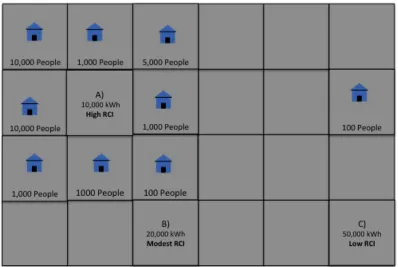
Figure 2-4: Model Scenarios ... 27
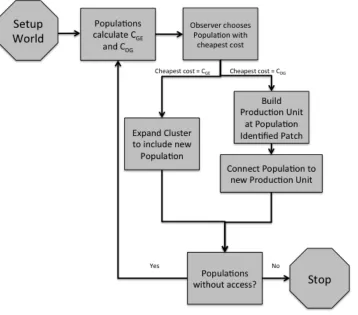
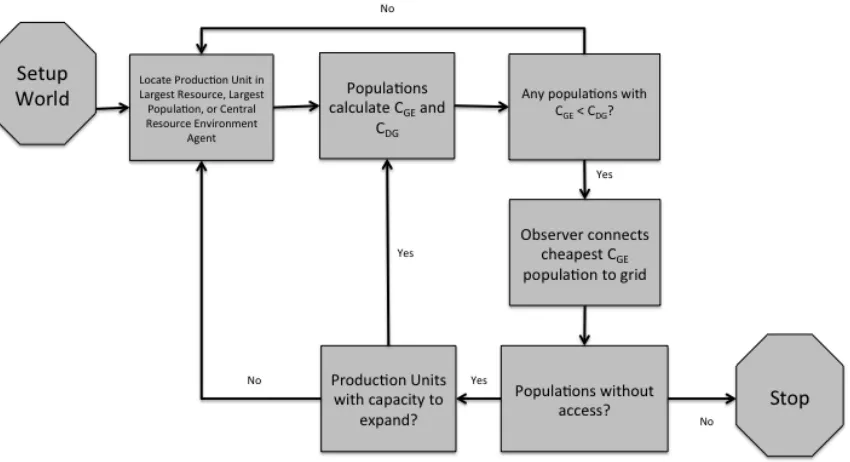
Figure 2-5: Bottom-up strategy model flow ... 29
Figure 2-6: Top-Down Strategy model flow ... 30
Figure 2-7: Schematic representation of RCI ... 32
Figure 2-8: Electricity Distribution System overnight capital cost and MDG according to personal demand for a World with 2385 TWh/yr and 0.25 million people ... 36
Figure 2-9: Electricity Distribution System overnight capital cost and MDG according to personal demand for a World with 219 GWhr/yr and 50 million people ... 38
Figure 2-10: Distribution System Overnight Capital Costs in a World with 10 Million people and increasing electricity potential ... 39
Figure 3-1: Overnight Capital Cost to Fulfill Expected Demand in 2050 ... 57
Figure 3-2: Levelized prices of electricity ... 58
Figure 3-3: Monthly Costs of Electricity For Each Technology ... 59
Figure 3-4: Modeling software screenshot ... 71
Figure 3-5: Sensitivity analysis for total electricity demand ... 72
Figure 3-6: Sensitivity analysis for overnight capital costs ... 72
Figure 3-7: Sensitivity analysis for solar electricity prices ... 73
Figure 3-8: Sensitivity analysis for biomass electricity costs ... 73
Figure 3-10: Sensitivity analysis for diesel electricity prices ... 74
Figure 4-1: Models GIS and Data Layering ... 84
Figure 4-2: Biomass potential aggregation. ... 87
Figure 4-3: Location of potential small hydro projects and their maximum potential. ... 88
Figure 4-4: Population Agent construction schematic. ... 89
Figure 4-5: Summary of Simulation Results ... 95
List of Tables
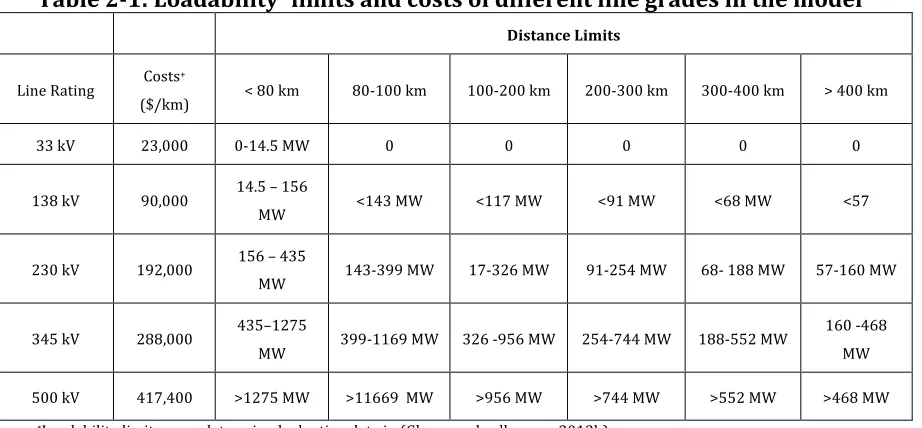
Table 2-1: Loadability limits and costs of different line grades in the model ... 26
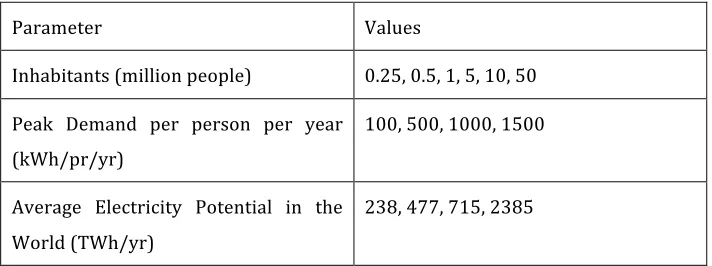
Table 2-2: Values studied for each parameter ... 33
Table 3-1: Access Rates and Electricity Tariffs in Selected Countries of West Africa ... 45
Table 3-2: Parameters for estimate of demand ... 50
Table 3-3: Parameters for Cost and Levelized Price of Electricity Calculations ... 55
Table 3-4: Estimated Electricity Demand in 2050 and Renewable Energy Potential in Liberia ... 56
Table 3-5: Comparative Analysis of Decentralized Generation Technologies ... 63
Table 4-1: Stakeholders included in consultations ... 81
Table 4-2: Biomass Potential per County ... 85
Table 4-3: Parameter Values and Sources for Overnight Capital Cost Calculations ... 91
Table 4-4: Loadability Limits for Lines Used in the Model ... 92
Chapter 1
Introduction
1.1
Overview
The following work creates Agent Based Models (ABM) and tools for policy planning and appropriate deployment of renewable energy for electricity generation in developing countries. At the surface, deployment of renewable energy technologies can be considered as an exercise in least cost analysis of the different resources available in the region. However, the problem is of a more complex nature. Renewable energy is geographically constrained, as are the demand points that require the electricity generated. A least cost delivery system is needed to appropriately deploy renewable energy resources and transmit electricity.
Further, the choice of different resources to be deployed and the priorities for supply given to the demand centers is influenced by the preferences of stakeholders, including policy planners, investors, local governments, and key decision makers. For example, it is common for urban demand centers to receive priority in the provision of services and infrastructure, including electrification (World Energy Council 1999).
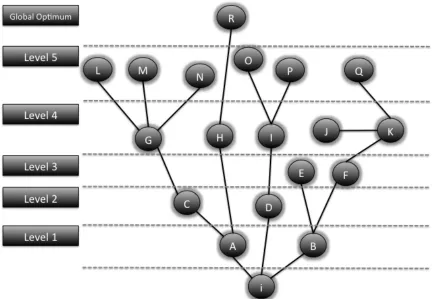
Each step in the development of a new electricity grid or electrification process affects the possible next steps and the final outcomes that are attainable by the system, a concept known as path-‐dependence. This means that “history matters” (Arthur 1994) and upon the completion of each step new possible optimums for the remaining areas awaiting development must be calculated.
Ecology and Energy Modeling literature. Industrial Ecology presents a call for more descriptive models and away from prescriptive models (Dijkema and Basson 2009). It also calls for the consideration of social contexts in which systems develop and tools that can capture dynamic emergence instead of static snapshots (Ehrenfeld 2009, 2007).
Tools for energy planning based on different modeling techniques are available throughout the literature. However, these tools have not provided adequate support for less industrialized countries (LIC), their complexities, and policy considerations (Bhattacharyya and Timilsina 2010; Urban and colleagues 2007). Urban and colleagues point in particular to the lack of focus on off-‐grid renewable energies, poverty, and rural energy programs. (2007). Bhattacharyya and Timilsina point to models that can capture developing countries’ particular contexts as a key input for future policy formulation (2010).
Literature also points to the use of simulations, bottom-‐up hybrid models, and disaggregated approaches as the most promising solutions for future models in developing countries (Bhattacharyya and Timilsina 2010; Urban and colleagues 2007). These authors warn that the tradeoff of such models is increased complexity, high data requirements, and high skills needed for use.
Clean energy solutions, including electricity and clean cooking facilities, are key to the accomplishment of the millennium development goals (MDG) issued by the United Nations to eliminate poverty (International Energy Agency 2010). While all MDGs are tied to clean energy, there is not a particular MDG devoted to clean energy and focused policy efforts will be necessary to achieve the desired increases in this sector (International Energy Agency 2010).
It is then no surprise that significant activity in electrification research for LICs and in particular rural areas abounds. However, these analyses have consistently viewed the issue as a question of expanding grid coverage in a region through the extensions of a central generating structure versus the deployment of small house or community level renewable energy electricity technologies (Parshall and colleagues 2009; Sanoh and colleagues 2012; Levin and Thomas 2012). Most of the grids considered are fossil based and in many cases already taxed and inefficient. Countries in Sub-‐Saharan Africa for example have electricity grids that face frequent black outs, poor maintenance, and low quality of service (Foster & Steinbuks, 2009). Expanding a struggling infrastructure may result in reduction of energy services for people who already received them.
Economic parameters are widely used as decision basis. This ignores the ways in which humans are involved in the planning process. Not all decisions are based on economics and imperfect incentives exist when dealing with coupled needs of LICs. Preferences of stakeholders play a big role in the way a system evolves. For example, stakeholders may have a source of funding that explicitly encourages solar photovoltaic (PV) technologies. Even though this is one the most expensive technologies and its applications are limited, the stakeholders may put emphasis on them at the cost of other opportunities with better economic performance.
The work presented here seeks to create models that are user friendly for stakeholder engagement, applicable for in-‐silico experiments of policy development, and inclusive of the complexities of renewable energy, human actors, environmental considerations, and the interaction between the three spheres. The models attempt to provide descriptive scenarios that include non-‐economic metrics for the support of policy, trade-‐off analysis, and planning exercises.
This work expands the literature through four main considerations:
1) Analyzing the “clean slate” case where no existing infrastructure is present and therefore can’t provide ancillary services for development of renewables. This is practical for areas of LIC with little or no infrastructure.
3) Including parameters beyond the economic that affect the way the delivery infrastructure would emerge and evolve, such as job generation, fuel portfolios, equality, and development. These parameters capture the preferences that stakeholders may present when developing policy or electrification plans and the path dependence that is inherent in the development process.
4) Providing a novel tool for trade-‐off analysis that fills the literature gaps identified above.
1.2
Research Questions
These contributions come from three main research questions:
1) How will renewable electricity networks develop without the presence of existing infrastructure or fossil fuels and nuclear energy?
2) How will stakeholder decisions and the interactions with technical and environmental spheres affect the resulting networks?
3) Can policy-‐planning models capture these interactions and provide useful tradeoff analysis?
Providing an answer to Question 1 allows this work to inform the case of many LIC where little infrastructure is present or, if present, can’t be relied upon to increase electrification. It also includes the geographical limitations of renewable energy potential and the demand points that need to be serviced.
industrial ecologists, modelers, policy planners, decision makers, stakeholders, and investors. It would also provide scientifically based information for the decision process.
1.3
Method Overview
To address Research Questions 1 and 2, Complex Systems Science (CS) or Complexity Theory is used. CS moves away from reductionism and seeks to capture the emergence of unexpected macro-‐system behavior that results from apparently simple interactions between system components (Mitchell). What constitutes complexity is hard to define, even by the experts in the field. Perhaps because the science of complexity is trying to deal with diverse and dynamic issues from a plethora of disciplines (Waldrop 1992). Some examples of these systems are the collapse of the Soviet Union, the crash in the stock market on a single Monday in 1987, sudden extinctions, the process in which the brain creates feelings, and life itself (Waldrop 1992).
One of the modeling tools that has gained popularity in CS is Agent-‐Based Modeling (ABM). ABM seeks to capture macro-‐level behavior by modeling individual entities that make up systems and the rules that govern their interactions within the system. These software entities are then allowed to interact in a virtual world. The result the modeler is seeking is the emergence of the macro-‐scale state and behaviors of the system. For example, a modeler may create thousands of virtual sardines and provide them with simple rules for navigation such as the maximum and minimum space they should leave between themselves and another sardine and their preferred direction for swimming. A model containing thousands of these sardines may allow the modeler to observe the flocking behavior of the sardines into a bait ball and how changing the rules of interaction may dissipate or create the ball.
Through this model the research goes beyond simple analysis of technical and economic feasibility to the consideration of best practices for the development of infrastructure for electricity delivery with considerations of stakeholder preferences for renewable energy sites and balances between centralized and decentralized decision making. This initial ABM studies the delivery system as a key factor for minimizing total cost.
The model captures the emergence of renewable electricity delivery grids by creating representations of the environment and the renewable potential in it, the populations and demand centers that require electricity, the production units that would use the resources in the environment to provide electricity, the transmission lines that would be needed to carry the electricity, and a central planner or stakeholder that determines the strategies and preferences for different deployment. Through these agents and the rules created for their interaction the model becomes a test bed for the way that stakeholder interactions and preferences affect the costs and decentralized mix of generation units in a stylized world with no infrastructure or fossil fuels.
To apply the discoveries form Chapter 2 to a more specific context and to answer Research Question 3 the case study of Liberia, West Africa is introduced. Liberia is the least electrified country in the world (Africa Energy Unit 2011) and a typical example of LICs, which pose the largest challenge for electrification increases (International Energy Agency 2010). Before applying the ABM created in Chapter 2 to the case study, an individual analysis of Liberia’s renewable energy potential, its suppressed rural residential demand, and opportunities to fulfill demand through fully decentralized renewable energy projects is created in Chapter 3. This serves as initial evidence of how renewable energy can fulfill large electricity demands in certain regions. It also sets up the dissertation for deeper considerations of the Liberian case through the use of the ABM for policy-‐planning and expanded considerations of stakeholders’ roles in shaping the economic and technical performance of an electricity system.
at a time and includes the provision of decentralized diesel generation as a comparison to the costs of fossil fuels technologies.
The Chapter stands on its own as an analysis of the Liberian situation and has been published in the Renewable and Sustainable Energy Reviews (Alfaro and Miller 2014). However, it also provides the data and background necessary for Chapter 4 and the expansion of the ABM in Chapter 2 to more explicit cases.
The expansion of the initial ABM pushes on Industrial Ecology (IE) boundaries. The work serves as an attempt at bridging the gap between analyzing systems and helping shape them with responsible actions, a call present in the IE literature (Dijkema and Basson 2009). The original model is expanded with a geographical information systems (GIS) solution to including country specific data and a new level of stakeholder strategies, which reflect value judgments for complementary objectives of rural electrification. The expanded ABM is illustrated through its application to the Liberian rural case as a tool for multi-‐objective policy planning and tradeoff analysis.
The inclusion of specific data consists in the incorporation of GIS layers for the creation of realistic environments and heterogeneous agents in the model. GIS data on population, political boundaries, and renewable energy potential are among those considered. Data is also included on the specific technical performance and economics of three renewable energy technologies, small biomass direct combustion or gasification, small hydro, and solar photovoltaics (PV).
Expanded value judgments and human context are included through four strategies sometimes used when planning renewable energy projects:
1) Using renewable energy projects to create new jobs (Wei and colleagues 2010; IRENA 2011)
2) Considering economic stimuli created within a community when renewable energy projects are established (Buchholz and Da Silva 2010; Dinkelman 2011)
3) Using investments in renewable energy to increase equality and social justice. This is particularly important in Liberia where recent policies call for wider inclusion of rural areas and less developed regions (Africa Energy Unit 2011; Ministry of Lands Mines and Energy 2009; Republic of Liberia 2008).
The result is a robust tool that can be used for scenario development, policy planning, stakeholder engagement, and new electrification efforts. This expanded model acts as an in-‐silico laboratory for experiments that can’t be conducted on the real system. It allows stakeholders and IE practitioners to explore the dynamic emergence of the system under the influence of the social, and environmental context. Such a tool is an expansion of IE tools that have been criticized for ignoring the context in which systems develop and for being static in nature (Ehrenfeld 2009).
Chapter 4 is used to answer Research Question 3. It shows that policy planning instruments can be provided that capture the different complexities in LIC, the interaction between social, technical, and environmental spheres, and the emergence of dynamic systems under the tradeoffs created by value judgments of decisions taking place. However, the Chapter warns that these tools are not a substitute for stakeholders or decision makers. Decisions, tough ones, must be made under sounds and responsible information. The tools provided in the chapter are an example of how industrial ecology practitioners can provide these interventions and facilitate interactions with stakeholders in a scientific and responsible manner.
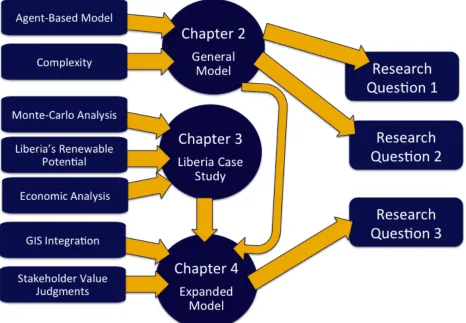
Figure 1-‐1 below shows a schematic of the research methodology used in this dissertation.
Figure 1-‐1: Schematic of research methodology applied to renewable electricity emergence in LIC
1.4
Renewable Energy Deployment
In LICs, efforts to incorporate renewable electricity have been fueled by two main objectives, increases in electrification and reduction of greenhouse gas (GHG) emissions (Abanda 2012). While reducing GHG emissions is an important aspect, this work focuses on the provision of electricity through renewable energy as a key to well-‐being and development in LIC (Kooijman-‐van Dijk 2012b; Komatsu and colleagues 2011b; International Energy Agency 2010). By analyzing the opportunities for renewable energy development without fossil based backups both goals are addressed.
[image:23.612.75.541.70.393.2]management opportunities. The focus of this work is on areas where intermittent service represents an improvement over the status quo. Literature suggests intermittency of service decreases the uptake of electricity and electrical appliances in businesses and entrepreneurial operations but appropriate communication about expected hours of service or expected blackouts allows users to adapt (Kooijman-‐van Dijk 2012b; Ibrahim and colleagues 2002).
Three main technologies are used in the models, solar PV, small hydro, and direct combustion or gasification of biomass. In the case of solar PV the cost of batteries is included in calculations to maintain stable service. For small hydro the models do not consider the maximum capacity of the resources but a limited value. This allows an increase in the probability that the base demand will be serviced. The assumption is also made that connections to these projects will be based on a power basis and not units of electricity. Examples of this type of load management are available in the literature such as the Mein River pilot project in Liberia (Winrock International 2011a, 2011b). Connections are provided with a maximum wattage and a breaker that disconnects the load if the user exceeds the power allowance. The result is a forced capping of the peak demand for easier load management. Finally, biomass technologies presented here are considered dispatchable. The stable performance of the technology even under different feedstocks allows for storage of fuels and load management.
1.5
Complex and Socio-Technical Systems
As mentioned earlier the deployment of renewable electricity without the support of existing infrastructure and fossil fuels represents the emergence of a complex system. It has already been stated that experts in the field are still defining complexity. By extension the same is true for complex systems. However a good starting point is the definition by Mitchell (2009):
Some divide complex systems in complex adaptive systems (CAS) and non-‐adaptive systems. CAS show different ways in which the subsystem parts react, learn and evolve in response to each other. Non-‐adaptive complex systems lack this distinction, for example a hurricane already in motion (Mitchell 2009).
In our example the stakeholders make decisions on the creation of production units, production units use resources in the environment, the environment changes the resources available according to the production units being created, populations change their costs of electrification according to new production units being created and other populations being electrified, and all this information is relayed back to stakeholders who are now facing a new state of the original problem. This work also considers situations in which both centralized and decentralized decisions are made. However, even when central decisions are taking place, the changes in the environment and resulting changes in other parameters are not controlled by a centralized organization making the system a CAS. Because electrification is largely dependent on the social interactions, decisions, and desires present, it can be classified as a particular type of CAS, a socio-‐technical system (STS) (Nikolic and Kasmire 2013a). Researchers first tried to model societies with ABM in 1990 (van Dam and colleagues 2013). The applications of this method have had explosive growth.
In particular STS has found traction in the IE field. Core to STS studies is taking in consideration the connections between the social, natural, and technical fields (Dijkema and Basson 2009). Using and recognizing these interactions provides opportunities for IE to guide systems into a promising future (Ehrenfeld 2007).
1.6
Liberia
Liberia, West Africa, has 3.7 million people and an area of just over 111,000 km2 (Hamdan
2010; Republic of Liberia 2009). It is a country rich in natural resources with iron ore and diamond deposits, tropical climate, large forestry potential, and more than 40% of the remaining Upper Guinean Rain Forest (Republic of Liberia 2008; Milbrandt 2009; Conservation International 2007). Its renewable energy potential is also significant. Small hydro, solar, and biomass lead the way in possibilities (Africa Energy Unit 2011; Milbrandt 2009). Coastal and off-‐shore wind are also of great potential (National Renewable Energy Lab). While recent discoveries of fossil fuels have been made, most of Liberia’s fossil supply comes from abroad creating fuel insecurities. Recently the country had more than one week of fuel shortages where diesel prices increased to $10 per gallon and public transportation, on which most Liberians depend, increased in cost by 100% (Browne, 2014, and personal communications).
Freed slaves from the United States of America sponsored by colonization societies arrived in Liberia beginning in 1820 and founded the country in 1847 (Wikipedia.org). These pilgrims became the ruling elite in Liberia institutionalizing a class divide that lasted over 130 years. A military coup in 1980 was followed by upheaval and a second coup in 1989 that ushered a brutal civil war. The war lasted for 14 years with short periods of stability. The Accra agreement of 2003 brought peace and in 2005 the first democratically elected woman in Africa, Ellen Johnson Sirleaf, took office as president of Liberia (Johnson-‐Sirleaf 2009; Wikipedia.org).
The remnants of Liberia after the war were a far cry from its period as a jewel of Western Africa in the early 80’s. Almost all infrastructure was destroyed and looted (Republic of Liberia 2008). Some 250,000 to 520,000 Liberians were dead and millions were displaced (Wikipedia.org). The country had to be restarted from scratch.
While this is a tragic turn of events, it offers Liberians and their leaders an opportunity to take significantly different roads towards development than those used in the past. The energy sector is one of the key areas for the redevelopment and a prime opportunity for deploying new solutions.
development. A strong plan is already in place to electrify the capital city of Monrovia and other important demand points (Africa Energy Unit 2011). However, more than 50% of the population in rural areas will remain unelectrified. Further, the main supply for the planned grid will be fossil based.
This dissertation provides tools that could be used in the planning and development of renewable electrification for the remaining population of Liberia. Such tools may help the country leap-‐frog over traditional paths and arrive at a universal electrification system with lower GHG and improved environmental performance compared to others in the region.
1.7
Publication of Chapters
Chapters 2-‐4 were developed as manuscripts for publication. Chapter 2 has been submitted to the journal Renewable and Sustainable Energy Reviews. Chapter 3 has been published in the same journal (Alfaro and Miller 2014). Chapter 4 was prepared as a contribution for the special issue on Complexity of the Journal of Industrial Ecology.
Although the manuscripts were submitted as separate pieces they are interdependent. Chapter 2 creates an ABM foundation for the work carried out in Liberia in Chapter 4. It also presents the initial proof of concept for the use of ABM in cost minimization, policy planning, stakeholder preferences, and the case of a clean slate region with no existing grid. Chapter 3 provides a necessary investigation of Liberia’s suppressed demand in rural areas and the feasibility to supply it through renewable energy. This is critical for the application of the ABM model created in Chapter 2 and its expansion. Finally Chapter 4 integrates the models and analyses of Chapters 2 and 3, and expands the tools towards a robust, user friendly, policy-‐planning tool that incorporates value judgments, multiple objectives in electrification, and tradeoff analysis.
Chapter 2
Using Agent Based Modeling for Infrastructure Planning in the
Deployment of Renewable Energy in Developing Countries
2.1
Abstract
Many seek to mitigate greenhouse gas emissions when planning electrification projects in developing countries. Research to date often compares the expansion of centralized, generally fossil-‐based, electricity delivery systems with decentralized renewable electricity generation at the demand point. However, existing grids in developing countries may not be suitable for expansion and distribution of renewable based electricity generated away from demand points is ignored. Tools available do not analyze different decision strategies used by stakeholders to plan a distribution system. Given the longevity of infrastructure projects, development decisions today can constrain future choices due to path dependence and can highly influence the total cost of the delivery network.
This study presents a novel application of agent-‐based modeling to identify decision strategies that result in least cost electricity delivery infrastructure systems using a mix of centralized and decentralized generation powered by renewable sources. It contributes to the existing literature by considering the case of a clean slate where no initial system is present, developing a delivery grid based completely on renewables, illustrating the decision schemes of stakeholders, and including path dependence and non-‐economic preferences.
2.2
Introduction
Over 1.4 billion people have little or no access to electricity (International Energy Agency 2010). Most of these people live in developing countries, rural and secluded areas, with low population density and electricity demand. However, these populations are endowed with abundant renewable resources for electricity generation. For example, Deichman et al. asserts that in Sub-‐Saharan Africa, the least electrified region in the world, countries have 10 to 12 times the renewable energy potential needed to satisfy their consumption (Deichmann and colleagues 2011).
Grid extension (GE) and decentralized generation (DG) are often considered the two main pathways for electrification of these areas, and their relative merits are debated, The definitions of what constitute each pathway vary (see for example (Ackermann and colleagues 2001)). In this paper, GE is considered as the expansion of existing electricity generation capacity and/or delivery networks to reach new demand centers and increase electrification rate. The expansion of the delivery network may include installation of new transmission lines, transformers, and substations. DG is contrasted to GE because it involves creation of new electricity generation and delivery systems close to the demand center that is to be serviced. Existing infrastructure is not used for this purpose and the transmission lines to be created are generally smaller in span, voltage grade, and cost. Much work has been done contrasting relative merits of GE and DG (among others (El-‐ Khattam and Salama 2004; Kaundinya and colleagues 2009; Hiremath and colleagues 2007; Hemmati and colleagues 2013; Levin and Thomas 2012). Most literature available uses case studies of different countries to draw conclusions about the best pathway for increasing electrification in that context.
Levin and Thomas analyze the choice between GE and DG in 150 countries correlating it to population, demand, cost of transmission, and cost of generation. They arrive at a parameter y* that determines the demand at which a population is more economically served by GE. They also utilize a network algorithm to determine the shortest span of GE that serves the majority of the country. The result is that each country presents one major grid with several DG sites (Levin and Thomas 2012).
Thomas, Deichman and colleagues allow several centralized grids or medium voltage clusters to expand. They use three countries as cases studies, Ethiopia, Ghana, and Kenya. Both the Levin and Deichman studies use a greedy-‐algorithm, which adds largest populations to GE first.
Parshall et al. present the case study of Kenya (Parshall and colleagues 2009). They developed a geographically based model to determine the areas of least cost expansion of the grid. They compare GE to DG using diesel and PV technologies only. They also include penetration rate, the number of households connected at each node, as a consideration in their model.
Sanoh et al. build on Parshall’s work and create a case study for Senegal (Sanoh and colleagues 2012). They compare the maximum distance of medium voltage lines that can be built before exceeding the cost of DG through diesel or PV technologies. A minimum spanning tree algorithm is used to correlate the results to actual GIS populations in the area of Leona.
These studies suggest that areas suitable for DG have low electricity demand, large distance to the existing grid, and low population size or density. They recognize them as typical rural isolated areas. Deichmann et al. conclude that only rural areas can be economically served through DG (Deichmann and colleagues 2011).
potential as an added parameter to consider for characterizing opportunities for DG. Finally, the work models the evolution of the network under decision strategies of stakeholders that include preferences for resource deployment beyond purely econometric concerns and the path dependence inherit to development based on those preferences. The paper draws conclusions from this stylized general situation that can serve as heuristics for future renewable energy infrastructure development. Because the ABM is created in an easy to use and graphically interactive freeware, it can serve policy and educational planning sessions.
2.2.1 Grid Extension and Decentralized Generation
GE requires expansion of existing infrastructure to transmit electricity to new demand centers. This paper uses the concept from network science of weakly connected components or clusters to refer to the existing infrastructure that can be extended. Weakly connected clusters are a collection of nodes that can be reached from any other node in the cluster through at least one path (Newman 2010). For our purposes nodes are production units (existing or planned generators) and demand centers (populations). The paths that connect those nodes are transmission and distribution lines. In other words, a weakly connected cluster is a group of demand centers and generation facilities connected through a web of electricity supply lines. An example of this can be seen in Figure 2-‐1, which shows three different weakly connected clusters. For simplicity the paper will refer to them as “clusters”.
GE results in a higher degree of centralized generation meaning that most nodes in the electricity distribution system are part of the same cluster. Developed countries followed GE as the preferred pathway to electrification.
Figure 2-‐1: Example of 3 different clusters
Notice the number of nodes or arrangement of the links and nodes do not determine a cluster, only the fact that all nodes are connected to each other by at least one path or web of connections. All nodes with any connections are part of a cluster.
GE and the interconnection of several generation units provides the advantages of rotating generators and reserves for system reliability, reducing the total number of generators running with no load, and providing flexibility for power transfers (Glover and colleagues 2012a). Redundancy is avoided in GE and point source emissions are moved away from main populations. Thanks to larger connected demand, economies of scale in generation and transmission can be obtained.
However, GE can present environmental, economic, and stability concerns. GE, and its associated centralized planning, has been criticized as leaving large gaps in electrification, creating class divides and national debt, and causing environmental degradation by relying on fossil fuels and causing deforestation (Hiremath and colleagues 2007, 2009; Deichmann and colleagues 2011).
This study defines DG as the production of electricity separate from existing clusters, which does not involve extension of existing infrastructure. In this way, low voltage wires in the range of 11 to 33 kilovolts (kV) and transformers are sufficient for electricity to reach the end users. The new generation and electrified population become a cluster that is available for expansion later if necessary.
a larger number of production units or generators and larger management complications may be experienced. The number of production units means that human capacity must be available at several locations in order to maintain, fix, and run the entire delivery system. In exchange, due to DG lower grade cables and shorter distances between generation facilities and populations serviced, electricity can be provided in remote areas, avoiding major capital investments in transmission infrastructure, habitat fragmentation, and with reduced line losses. Structural stability of a network may increase by adding DG. In India for example, long connection lines are being replaced by shorter segments to make way for a more structurally sound system as electrification progresses and new villages are added to the grid (Mukhopadhyay 2007).
Although often discussed as distinctly separate entities, elements of both GE and DG can be included in an overall electrification strategy. Even when dealing with existing fossil-‐based electricity networks the two paths can be complementary to reduce the overall cost of a region’s electric infrastructure while ensuring full access to electricity. Indeed, Bazilian et al. point out the need for the use of both large scale centralized projects and DG to achieve universal energy access (Bazilian and colleagues 2012). Some countries have found it economically necessary to include both approaches in their electrification efforts. Brazil, for example, embarked in a DG program in remote areas where GE was not economically f