ISSN: 1992-8645 www.jatit.org E-ISSN: 1817-3195
152
IDENTIFYING SIMILAR BUSINESS PROCESS MODELS
1YEDILKHAN D., 2BEKTEMYSSOVAG.U.
1
Institute of information and computation technologies, Almaty, Kazakhstan
2
International information technology university, Almaty, Kazakhstan
E-mail: [email protected], [email protected]
ABSTRACT
Large organizations experience shows that repositories of business process models contain lots amounts of duplication. For example, this duplication arises when the repository covers multiple variants of the same processes. This article studies the problem of identifying similar business process models. The article proposes technique for detecting clusters of approximate duplications based on well-known clustering algorithm, such as DBSCAN.
Key words:Business Process Model, Duplication Models, Standardization, BPM
1. INTRODUCTION
A business process is defined as a “group of tasks that together create a result of value to a customer” [1]. Its purpose is to offer each customer the right product or service, i.e., the right deliverable, with a high degree of performance measured against cost, longevity, service and quality [2]. Although increasing business process performance is an important topic in research and industry [3]. One of variants is the process of standardization by identifying similar process models. Detecting identical process model in Business Process Management systems allows modelers to identify opportunities for business process standardization. For example, consider the case of multiple variants of an insurance claims handling process, where each variant is captured as a separate process model. Given that disbursement of the insurance payout occurs in every variant (albeit differently depending on the type of claim), it is likely that these separate models will contain
identical process models corresponding to
disbursement activities. These models can
potentially be standardized, i.e. replaced by a single model instance, and refactored as a shared subprocess. In this way, duplication is reduced and uniformity across process models is increased, to the benefit of model maintainability. Current conceptual BPMSs do not provide explicit tools for identifying duplications in repositories of process models and do not provide recommendations about how to work with them. Furthermore, such tools need to be integrated into the process execution and require continuous monitoring.
For a further understanding of the article is important to introduce two concepts. First one is a business process management system (BPMS). BPMS is a generic software system that is driven by explicit process representations to coordinate the enactment of business processes. Moreover, second one is the process model. The business process model consists of a set of activity models and execution constraints between them.
2. LITERATURE REVIEW
The problem of process models
duplication detection has been widely studied in the field of software engineering, primarily in the context of source code duplication detection [4]. Duplicate code is a computer programming term for a sequence of source code that occurs more than once, either within a program or across different programs owned or maintained by the same entity.
Duplicate code is generally
considered undesirable for a number of reasons. [5] A minimum requirement is usually applied to the quantity of code that must appear in a sequence for it to be considered duplicate rather than coincidentally similar. Sequences of duplicate codes are sometimes known as code clones or just clones, the automated process of finding duplications in source code is called clone detection. A number of different algorithms has been proposed to detect duplicate codes such as Baker's algorithm [6], Rabin–Karp string search algorithm, Abstract Syntax Trees [7], Visual clone detection [8], Count Matrix Clone Detection [9, 10].
ISSN: 1992-8645 www.jatit.org E-ISSN: 1817-3195
153 likely to emerge in process model repositories when process modelers copy and paste fragments across models – thus creating exact duplications – and later on these exact duplications evolve separately. Identifying identical business process models can be divided into two groups. First one is searching clones in repositories of process models, second one is discovering identical process model collections from event logs.
This article presents technique for identifying approximate duplications in repositories of process models for the purpose of standardizing. Approximate duplications is copied fragments with further modifications such as changed, added or removed model elements in addition to variations allowed in syntactically identical fragments. Technique for identifying approximate duplications taken from clustering analysis and refers to density-based clustering algorithms and shortly named DBSCAN.
Density-based spatial clustering of
applications with noise (DBSCAN) is a data
clustering algorithm proposed by Martin
Ester, Hans-Peter Kriegel, Jörg Sander and Xiaowei Xu in 1996 [11]. It is a density-based clustering algorithm that is for a given set of points in some space, it groups together points that
are closely packed together (points with
many nearby neighbors), marking as outlier points
that lie alone in low-density regions (whose nearest neighbors are too far away). DBSCAN is one of the most common clustering algorithms and also most cited in scientific literature [12]. In 2014, the algorithm was awarded the test of time award (an award given to algorithms which have received substantial attention in theory and practice) at the
leading data mining conference, KDD [13]. Main
purpose of article is the task of grouping a set of process models in such a way that objects in the same group (called a cluster) are more similar to each other than to those in other clusters).
3. DENSITY-BASED SPATIAL CLUSTERING
OF APPLICATIONS WITH NOISE
(DBSCAN)
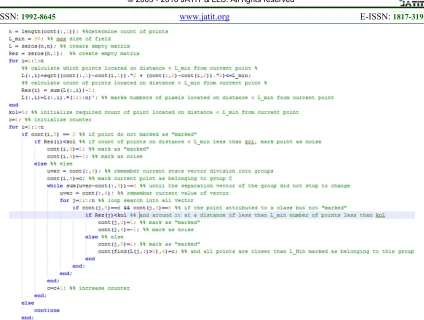
Next part of article demonstrate realized simple example of using a clustering algorithm DBSCAN in MATLAB. The input information is a
matrix cont with dimension n x 4. The first two
columns are arranged to coordinate considered points, the other two columns are filled with 0. As a result of the algorithm filled columns 3 and 4 of
the matrix cont: the third column represents
ISSN: 1992-8645 www.jatit.org E-ISSN: 1817-3195
[image:3.612.94.518.65.385.2]154
Figure 1: Realization of simple program code in MATLAB
[image:3.612.317.518.422.597.2]The initial information for the algorithm is a set of points (see. Figure below), which contains in addition to 3 clearly evolved groups, points to be attributed to noise.
Figure 2: Input data under DBSCAN
After the algorithm we get the following picture of the cluster:
Figure 3: Input data after DBSCAN
[image:3.612.96.291.471.640.2]ISSN: 1992-8645 www.jatit.org E-ISSN: 1817-3195
155
4. DBSCAN FOR IDENTIFYING SIMILAR PROCESS MODELS
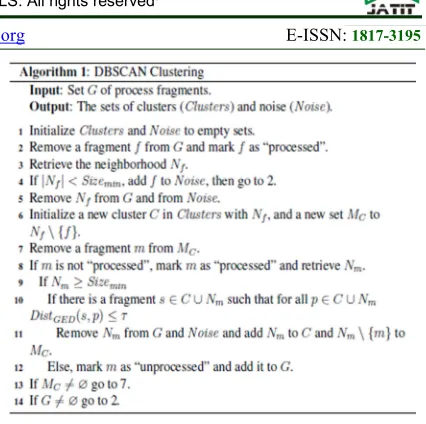
DBSCAN identifies all core objects of a given dataset and considers their neighborhoods as initial clusters. If two core objects are within each other’s neighborhood, their neighborhoods are merged into a single cluster. On the other hand, if an object does not belong to the neighborhood of any core object, it is marked as noise. Adaptation of DBSCAN for business process models is
described in Algorithm 1. Given the set of process
fragments G extracted from the RPSDAG (an index
structure designed for efficient and accurate identification of exact duplications in a collection of process models), the algorithm repeats the clustering process (Steps 2–14) until all fragments
in G have been checked whether they are core
objects. At the beginning of each iteration, a
random fragment f is removed from G and marked
as “processed”. The neighborhood Nf of f is
computed (Step 3), and if f is a core object the
fragments in Nf are removed from G and from
Noise (Step 5), and added to a new cluster C (Step
6). Otherwise f is treated as noise and another
fragment is extracted from G. The algorithm then
expands cluster C by checking whether there are
core objects in C whose neighborhoods can be
merged with C. This is done by iterating over all
fragments in Nf except f, via a set MC. For a
fragment m in MC that has not been processed, its
neighborhood Nm is computed (Step 8) to
determine whether m is itself a core object. If so,
before merging its neighborhood with C, we check
whether there is still a medoid s whose distance
with all other fragments of the combined cluster is within τ (Step 10), otherwise we will create clusters whose fragments are far apart from each other to be standardized. In case of merging, the fragments in
Nm are removed from G and added, except m, to MC
(Step 11), so that they can be checked whether they
are core objects. If Nm cannot be merged with C, m
is added back to G so that it can be eventually
processed again (Step 12). In fact, Nm may form a
[image:4.612.311.524.64.276.2]cluster by itself or be merged with some other cluster.
Figure 4: Algorithm of DBSCAN for process models
5. RESULTS AND CONCLUSION
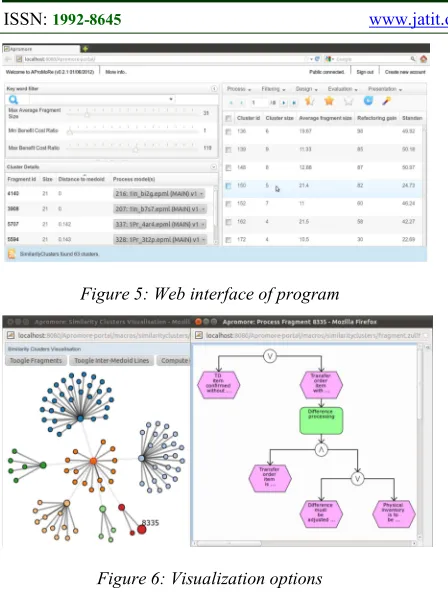
The proposed technique that allows analysts to identify, cluster, analyze and visualize approximate clones by using DBSCAN algorithm realized as plugin of the “Apromore” advanced process model repository [14]. “Apromore” uses an internal process representation format named canonical process format, which captures common
features of widely-used process modeling
languages. The duplication detection plugin operates on this canonical format, thus it can detect approximate duplications in process models defined in different modeling languages such as BPMN and EPC for example.
ISSN: 1992-8645 www.jatit.org E-ISSN: 1817-3195
156
[image:5.612.89.313.72.369.2]Figure 5: Web interface of program
Figure 6: Visualization options
For identifying similar process models we looked at dataset that is taken from an insurance company under condition of anonymity. It contains 363 models ranging from 4 to 461 nodes (average 27.12). The cluster computation is dominated by the computation of the distance matrix which took more than 2 hours for the insurance dataset. The longer time taken for the insurance dataset is justified by the size of its fragments (e.g. the largest fragment in the insurance dataset is a rigid with 461 nodes). For the insurance dataset we retrieved 243 clusters with DBSCAN (sizes between 2 and 6). This confirms the intuition that real-life process model repositories contain a large number of approximate clone clusters, and thus that copying/pasting of fragments across process models is a very common practice.
Hence, it can be concluded that the proposed technique provides a basis for identifying clusters of approximate duplications that are usable to standardization. One of direction of future work is how a detected clusters should be standardized into a single reference fragment in such a way that the stakeholders involved in the management and execution of the process are satisfied with the standardized process.
One of future research direction is how to work with identified similar process models. Interesting question is how process models can be standardized and how to use one variant of process
model in different business processes. These changes mean increasing of business process management performance.
REFERENCES:
[1] Michael Hammer. Beyond Reengineering How the process-centered organization is changing our work and our lives. Harper Collins Publishers, 1996.
[2] Ivar Jacobson, Maria Ericson, and Agneta Jacobson. The Object Advantage Business
Process Reengineering with Object
Technology. ACM Press,
Addison-Wesley Publishing, 1994.
[3] Fabio Casati. Industry trends in business process management getting ready for
prime time. In 16th International
Workshop on Database and Expert Systems Applications (DEXA 2005), First International Workshop on Business Process Monitoring and Performance Management (BPMPM 2005). IEEE Press, August 2005.
[4] C. K. Roy, J. R. Cordy, R. Koschke, Comparison and evaluation of code clone
detection techniques and tools: A
qualitative approach, Sci. Comput.
Program. 74 (7) (2009) 470–495.
[5] Stefan Wagner, Asim Abdulkhaleq, Ivan Bogicevic, Jan-Peter Ostberg, Jasmin Ramadani. How are functionally similar code clones syntactically different? An empirical study and a benchmark PeerJ Computer
Science 2:e49.doi:10.7717/peerj-cs.49.
[6] Brenda S. Baker. A Program for
Identifying Duplicated Code. Computing Science and Statistics, 24:49–57, 1992. [7] Ira D. Baxter, et al. Clone Detection Using
Abstract Syntax Trees.
[8] Visual Detection of Duplicated Code by Matthias Rieger, Stephane Ducasse. [9] Yuan, Y. and Guo, Y. CMCD: Count
Matrix Based Code Clone Detection, in
2011 18th Asia-Pacific Software
Engineering Conference. IEEE, Dec. 2011, pp. 250–257.
[10] Chen, X., Wang, A. Y., & Tempero, E. D. (2014). A Replication and Reproduction of Code Clone Detection Studies. In ACSC (pp. 105-114).
[11] Ester, Martin; Kriegel, Hans-Peter;
Sander, Jörg; Xu, Xiaowei (1996).
ISSN: 1992-8645 www.jatit.org E-ISSN: 1817-3195
157 Fayyad, Usama M., eds. A density-based
algorithm for discovering clusters in large spatial databases with noise. Proceedings of the Second International Conference on Knowledge Discovery and Data Mining
(KDD-96). AAAI Press. pp. 226–
231. ISBN 1-57735-004-9. CiteSeerX: 10.1.1.121.9220.
[12] Most cited data mining articles according to Microsoft academic search; DBSCAN is on rank 24, when accessed on: 4/18/2010.
[13] "2014 SIGKDD Test of Time
Award". ACM SIGKDD. 2014-08-18.
Retrieved 2014-08-22.
[14] M. La Rosa, H. Reijers, W. Aalst, R. Dijkman, J. Mendling, M. Dumas, L.
Garcıa-Banuelos, APROMORE: An