ORIGINAL RESEARCH ARTICLE
AL-QURAN AND MULTICULTURAL EDUCATION: DEVELOPING MULTICULTURAL
EDUCATION BASED ON INTERPRETATION IN AL-QURAN
*Rukmina Gonibala
The Lecturer of IAIN Manado
ARTICLE INFO ABSTRACT
This research is a study based on literature review, the raised theme is Al-Qur'an and Multicultural Education: Initiating multicultural education based on interpretation in the Qur'an. In this study case of the Qur'an displays some verses related to the verses that dimensionless in multilayered studies and juxtaposed with the definition and intent in the study of the Qur'an. In this case the juxtaposition of the concept of Al-Quran and multicultural is the effort of the introduction of the public that education builds the insight of the Qur'an and multicultural education in the midst of a society dominated by the domino effect of pop culture that has lost the cultural root in the origin of country. This study also referred to the term of study.
Copyright © 2018,Deepti D. Dhere et al. This is an open access article distributed under the Creative Commons Attribution License, which permits unrestricted use, distribution, and reproduction in any medium, provided the original work is properly cited.
INTRODUCTION
The development of medieval and contemporary interpretation
madzhab can not be separated from the underlying paradigm,
the pattern of each interpretation can not be separated from the development of human thought in the modern-contemporary period where the interpretation of the Qur'an’s verses have a critical tendency of scientific and colored by the hermeneutical approach is more critical-philosophical. The paradigm of multicultural education teaches people to respect and uphold cultural, ethnic, tribe, and flow (religious) diversity (Dawam,2003:103). But in the religious aspect, this model education has a theological problem because it teaches relativism and pluralism. This education teaches that all religions and beliefs contain teachings about the same universal values (Yaqin,2005:41). And if thy Lord willed, it would have been the faith of all the people on the face of the earth. Do you then (forcefully) persuade men to become believers altogether (Q.S. Yunus: 99)
َسﺎﱠﻨﻟا ُهِﺮْﻜُﺗ َﺖْﻧَﺄَﻓَأ ۚ ﺎًﻌﯿِﻤ َﺟ ْﻢُﮭﱡﻠُﻛ ِض ْرَ ْﻷا ﻲِﻓ ْﻦَﻣ َﻦَﻣ َﻵ َﻚﱡﺑَر َءﺎَﺷ ْﻮَﻟَو
َﻦﯿِﻨِﻣ ْﺆُﻣ اﻮُﻧﻮُﻜَﯾ ٰﻰﱠﺘ َﺣ
*Corresponding author: Rukmina Gonibala
The Lecturer of IAIN Manado
Meaning: And if the Lord willed, surely all the believers in the earth would have believed. Do you (want) to compel men to be believers? (Surat Yunus: 99)
In the commentary of Jalalain written by Imam al-Mahalli declared (And if your God desirous must have believed all those who are on the face of the earth altogether, do you want to force people) against what God does not want them to do (so they become believe everything?) Of course not (Mahalli: 57). Whereas in the view of M. Quraish Shihab (Shihab, 2018:22) mentay in tafseer al Misbah Message and Impression in the Qur'an If Allah wants all the earth's inhabitants believe, undoubtedly everything will believe. So you do not feel sad to see the kufr of the polytheists. Therefore, there is no faith except on the basis of voluntary hearts. Therefore, you will not be able to compel them to obey and accept the truth. Therefore do not force them to believe, because no matter how hard you try you will not be able to do it 9 (Shihab, 1998:67). Differences are often regarded as threats. What else in Indonesia has a high degree of threat on the religious aspect (Gutomo: 2016). Therefore, it is important to understand religion as a pattern of social relations. So that, in the diversity can create an environment with an inclusive religious. So, people not only live together but are able to live side by side.
ISSN: 2230-9926
International Journal of Development Research
Vol. 08, Issue, 05, pp.20515-20522, May,2018
Article History:
Received 15th February, 2018 Received in revised form 24th March, 2018
Accepted 17th April, 2018
Published online 31st May, 2018
Key Words:
Al-Quran, Multicultural, Education.
Citation: Deepti D. Dhere, Manisha A. Dhotre and V.S. Shembekar, 2018. “Probiotic properties of lactic acid bacteria isolated from animal sources”, International Journal of Development Research, 8, (05), 20515-20522.
Today, there are still many intolerant attitudes to various groups of people. This can lead to a bad attitude of sensitivity because there is discomfort when looking at things that are not in accordance with his vision. Though it is known that basically every human being has different understanding, either in knowledge, theory or practice. In addition to heart discomfort/ inner conflict, creating an environment vulnerable to conflict. Conflicts that occur not only religious conflicts but also differences between individuals. Furthermore, according to the observations of researchers, especially at the level of children's education, the reality is there is an intolerant learning method. The method or more broadly is the learning model that is consciously or will not indoctrinate the child from an early age to be intolerant. This is so in the song
method, "Tepuk Anak Sholeh", which has varied in the form of
movements and songs, which do not even know for sure who the creator. Like a veiled but clear doctrine, for without critical thinking. This pat method is still always used and innovated in movement and additional verse-meir.
How seriously harmful to the doctrine of intolerance against other religions, whether consciously or unconsciously, since this is done in early childhood education, where this age of childhood is in a "sensitive period", whose absorption of knowledge is extraordinary. According to Benjamin S. Bloom, that 80% of mental development and intelligence of children take place in early childhood. This theory is reinforced by Montessori, which describes the nature of the child as a creature that has high fiber power, known as the absorbent of mind theory. It can be analogized like the absorption of tissue paper against water. According to this theory the child has a high absorption of information from the surrounding environment. Constant information will be absorbed, either consciously or unconsciously. The child will simply absorb information without any thought activity on the information he absorbs. As adults grow, the information is gradually laid out
in the structure of knowledge and used to think (Suyanto,
2015:19).
How deeply concerned, if the future is filled with an intolerant generation. Full of conflicts and irregularities. Children who actually have the role of world reconstruction, are drowned in destruction. Due to not being able to appreciate or understand the various differences in diversity. This can be a reflection, the possibility of conflict over differences due to the intolerant doctrine from an early age received by the child. According to Ki Hadjar Dewantara, no group or race deserves to be insulted, degraded and colonized by other groups or races. Therefore, the struggle to build the awareness of the young generation of Indonesia is through learning that is nationalist humanist and embraces all groups. Furthermore, learning models that match the character and culture of Indonesians do not use coercive conditions or intolerant doctrines against other groups (Samho, 2013:70-72). It is thus necessary to model a tolerant learning, the learning model that upholds the principle of tolerance, appreciate each child for various differences and able to develop the ability of the learners according to their interests and talents. According to Sukamto, the learning model is a conceptual framework that illustrates a systematic procedure in organizing learning experiences to achieve specific learning goals and serves as a guide for instructional designers and teachers in planning teaching and learning activities (Hamruni, 2012:5). The learning model is basically a form of learning illustrated from beginning to end that is typically presented by the teacher. In other words, the learning model is a wrapper or
frame of application of an approach, strategy, method, and instructional technique. Meanwhile, according to Roy Killen (1998) in Hamruni, there are two approaches of learning: teacher centred approaches and student centred approaches. Learning strategy is still conceptual and to implement it used a variety of specific learning methods. In other words, strategy is "a plan of operation achieving something" while the method is "a way in achieving something". Furthermore, talking about a tolerant learning model needs the existence of multicultural-based educational institutions that build attitude of tolerance early on. Today, tolerance is related to the ability to process emotions and character. This tolerance is included in emotional intelligence that is more inclined to softskiil that contribute 80% to one's success in the workplace while intellectual intelligence (IQ) only contributes 20%. Education should be able to lead the students towards the future as a new hope. Although the reality of Human Development Index (HDI) is still under other countries, it indicates that there is still a low level of human resources in Indonesia, which directly indicates the quality of education in Indonesia. This is certainly not able to build human-quality human beings, so it is important to be a reflection for the world of education to prepare for future generations from an early age (Marhumah, 2013:73-74). This reflection can be done one of them through multicultural education.
Multicultural education offers an alternative through the application of educational strategies and concept based on the use of diversity in the community, especially in students such as ethnic diversity, culture, language, social status, gender,
abilities, age and race (Rofiah, 2009:85). Multicultural
issues can be witnessed in various modes of dissentation and dislocation among many of our society. Factors that encourage the birth of multicultural education can not be separated from the social circumstances, in which this idea emerged and began to emerge in the 1970s in America. Why did the idea come up? And if thy Lord willed, it would have been the faith of all the people on the face of the earth. Do ye then (then) force people to be believers? Therefore in this paper want to conduct a deep study between the Qur'an and Multicultural education.
RESULTS AND DISCUSSION
Multicultural Education: Historical study
There are not many sources that examine the history and background of the emergence of multicultural education from the few available sources that provide information on this
subject is the Encyclopedia of Wikipedia under the title
American Civil Rights Movement [1955 - 1968] 2}. This
source informs us that the emergence of multicultural education can not be separated from the events of the civil rights movement that took place in the 1960s in America. This movement came about against the existence of discriminatory life practices, both in public places in homes in workplaces, as well as in educational institutions, conducted by minority groups against minorities.
Humans created various nations to know each other
O mankind, We created you from a man and a woman, and made you nation and tribe so that you may know one another. Verily the most honorable among you by Allah is the most pious among you. Allah is the Knower, the Knower. {Q.S. Al-Hujurat: 13}
َﻞِﺋﺎَﺒَﻗَو ﺎًﺑﻮُﻌُﺷ ْﻢُﻛﺎَﻨْﻠَﻌ َﺟَو ٰﻰَﺜْﻧُأَو ٍﺮَﻛَذ ْﻦِﻣ ْﻢُﻛﺎَﻨْﻘَﻠ َﺧ ﺎﱠﻧِإ ُسﺎﱠﻨﻟا ﺎَﮭﱡﯾَأ ﺎَﯾ
َأ ِ ﱠﷲ َﺪْﻨِﻋ ْﻢُﻜَﻣَﺮْﻛَأ ﱠنِإ ۚ اﻮُﻓَرﺎَﻌَﺘِﻟ
ﺮﯿِﺒ َﺧ ٌﻢﯿِﻠَﻋ َ ﱠﷲ ﱠنِإ ۚ ْﻢُﻛﺎَﻘْﺗ
Meaning: O mankind, We created you from a man and a woman and made you nation and tribe so that you may know one another. Verily the most honorable among you by Allah is the most pious among you. Allah is the Knower, the Knower. (Q.S al Hujarat: 13).
In the view of Imam Al Mahalli in Jalalin’s commentary for example (O mankind, indeed We created you from a man and a woman) ie from Adam and Eve (and We made you
nation-nations) Syu'uuban's pronunciation is the plural form of Sya's
pronunciation 'bun, which means that the highest (and ethnic)
lineage of tribal descent is under the nation, after the tribe or
tribe is called Imarah, then Bathn, after Bathn is Fakhdz and
the bottom is Fashilah. The example is Khuzaimah is the name
of a nation, Kinanah is the name of a tribe or tribe, Quraysh is the name of an Imarah, Qushay is the name of a Bathn, Hashim is the name of a Fakhdz, and Al-Abbas is the name of a Fashilah (so that you know each other) Ta'aarafuu's pronunciation is Tata'aarafuu, then one of the two letters Ta is thrown so that it becomes Ta'aarafuu; meaning that some of you know each other not to boast each other the height of nasab or descendants, because actually the pride is only judged in terms of piety. (Verily the most honorable among you in the sight of Allah is the most wicked (Allah is All-Knowing) about you (again Gentlemen) what is in your inner being.
Whereas in the view of M. Quraish Shihab eg O people, We have created you in the same state, from one origin: Adam and Hawâ. Then We made you, with offspring, nation and tribe, so that you may know one another and help one another. Verily the most honorable man in the sight of Allah is the most wicked among you. Allah is all-Knowing and All-Knowing, no secret is hidden from Him. This discriminatory practice of life occurs because during the 1950s America only knew the dominant culture and the majority, the white culture. While the other groups in these societies are classified as minorities with restrictions on their rights. Yet factually, America when it was inhabited by a population of diverse origins. In general, according to Wilson J Gonzales Espada the American population can be grouped 2 of the indigenous and immigrant population (Aly, 2011:88).
The practice of discriminative life that occurred in America in the 1950s reaped protests from minority groups especially from African-Americans who were black. Throughout the 1970s stood scientific organizations and institutions that emphasized their study of ethnic studies such as; National Council for Social Studies (NCSS) National Council of Teachers Englisonh NCTE and Amirican Association of Colleges for Teacher Education [AACTE]. The discriminatory practice in education also draws protests from civil rights movement leaders and scientific institutions, demanding reforms of education. Sharon E Fillion explains that among the demands they are proposing is that everyone has the same right to education . It is also contained in the Qur'an Surat al-Muntahanah: 8)
َﻋ ُ ﱠﷲ ُﻢُﻛﺎَﮭْﻨَﯾ ﺎَﻤﱠﻧِإ
ْﻢُﻛِرﺎَﯾِد ْﻦِﻣ ْﻢُﻛﻮ ُﺟ َﺮ ْﺧَأَو ِﻦﯾﱢﺪﻟا ﻲِﻓ ْﻢُﻛﻮُﻠَﺗﺎَﻗ َﻦﯾِﺬﱠﻟا ِﻦ
ُﻢُھ َﻚِﺌ
َٰﻟوُﺄَﻓ ْﻢُﮭﱠﻟَﻮَﺘَﯾ ْﻦَﻣَو ۚ ْﻢُھْﻮﱠﻟَﻮَﺗ ْنَأ ْﻢُﻜِﺟاَﺮْﺧِإ ٰﻰَﻠَﻋ اوُﺮَھﺎَظَو
َنﻮُﻤِﻟﺎﱠﻈﻟا
God does not forbid you to do good and do justice to those who have not fought you for religion and have not expelled you from your country. Allah loves those who are just. {Al-Muntahanah: 8}. In the view of Imam Mahalli in Jalalin's commentary (Verily Allah only forbids you against those who fight you for religion and drives you out of your country and helps) that helps others (to drive you to make them your friends) Pronunciation An Tawallauhum becomes Badal Isytimal from the pronunciation of Al Ladzina, ie He forbade you to make them as your loyal friends. (And whoever makes them friends, they are the wrongdoers). Whereas in the view of M. Quraish Shihab inAl-misbah’s commentary declares that Allah only forbids you to help those who fight you because of religion and force you to come out of your country and help others to drive you out. Whoever makes them a helper, they are the ones who oppress themselves.
While in another verse mentioned that al-Baqarah: 48 states that:
َﻻ َو ٌﺔَﻋﺎَﻔَﺷ ﺎَﮭْﻨِﻣ ُﻞَﺒْﻘُﯾ َﻻَو ﺎًﺌْﯿَﺷ ٍﺲْﻔَﻧ ْﻦَﻋ ٌﺲْﻔَﻧ يِﺰ ْﺠَﺗ َﻻ ﺎًﻣ ْﻮَﯾ اﻮُﻘﱠﺗاَو
ِﻣ ُﺬ َﺧ ْﺆُﯾ
َنوُﺮ َﺼْﻨُﯾ ْﻢُھ َﻻَو ٌلْﺪَﻋ ﺎَﮭْﻨ
Resurrection, when one can not defend and give help to others. Not accepted intercession whatsoever. Nor is anything acceptable as a ransom for sin. No one can save the torment for the person who is tortured. Whereas in the view of Imam Al-Mahalli declare (And fear you) (one day, that day can not defend) (one person on the other hand though) on the Day of
Judgment (and not accepted) there are those who read tuqbalu
with ta there is also yuqbalu with ya (thereof intercession)
means that on the Day of Resurrection there is no intermediary and no one can serve as an intermediary (and not a ransom) (and they will not be helped) to be freed from the punishment of Allah.
While Imam Mahalli argues in the book interpretationJalalin’s commentary is. (And fear you) (one day, that day can not defend) (one person on the other hand even if one) on the Day of Judgment (and not accepted) there are those who read tuqbalu with ta and there is also yuqbalu with ya (thereof intercession ) means that on the Day of Resurrection there is no intermediary and no one can serve as an intermediary (and not even a ransom) (and they will not be helped) to be freed from the punishment of Allah. Multicultural education discourse on subsequent developments was echoed in European countries, such as; Belgium, Germany, France, England, Netherlands and Sweden. In those countries after World War II, there was an extraordinary wave of immigrants of no less than 30 million people who migrated and spread to European countries.
In the Qur'an in particular surat al Maidah: 48.
ﺎًﻨِﻤْﯿَﮭُﻣَو ِبﺎَﺘِﻜْﻟا َﻦِﻣ ِﮫْﯾَﺪَﯾ َﻦْﯿَﺑ ﺎَﻤِﻟ ﺎًﻗﱢﺪَﺼُﻣ ﱢﻖ َﺤْﻟﺎِﺑ َبﺎَﺘِﻜْﻟا َﻚْﯿَﻟِإ ﺎَﻨْﻟَﺰْﻧَأَو
َﻦِﻣ َكَءﺎ َﺟ ﺎﱠﻤَﻋ ْﻢُھَءاَﻮْھَأ ْﻊِﺒﱠﺘَﺗ َﻻَو ۖ ُ ﱠﷲ َلَﺰْﻧَأ ﺎَﻤِﺑ ْﻢُﮭَﻨْﯿَﺑ ْﻢُﻜ ْﺣﺎَﻓ ۖ ِﮫْﯿَﻠَﻋ
ْﻢُﻜْﻨِﻣ ﺎَﻨْﻠَﻌ َﺟ ﱟﻞُﻜِﻟ ۚ ﱢﻖ َﺤْﻟا
ًﺔﱠﻣُأ ْﻢُﻜَﻠَﻌ َﺠَﻟ ُ ﱠﷲ َءﺎَﺷ ْﻮَﻟَو ۚ ﺎ ًﺟﺎَﮭْﻨِﻣَو ًﺔَﻋ ْﺮِﺷ
ِ ﱠﷲ ﻰَﻟِإ ۚ ِتاَﺮْﯿ َﺨْﻟا اﻮُﻘِﺒَﺘْﺳﺎَﻓ ۖ ْﻢُﻛﺎَﺗآ ﺎَﻣ ﻲِﻓ ْﻢُﻛَﻮُﻠْﺒَﯿِﻟ ْﻦِﻜ
َٰﻟَو ًةَﺪِﺣاَو
َنﻮُﻔِﻠَﺘ ْﺨَﺗ ِﮫﯿِﻓ ْﻢُﺘْﻨُﻛ ﺎَﻤِﺑ ْﻢُﻜُﺌﱢﺒَﻨُﯿَﻓ ﺎًﻌﯿِﻤ َﺟ ْﻢُﻜُﻌِﺟ ْﺮَﻣ
Meaning: And We have sent down unto thee the Qur'an by bringing the truth, justifying what was before, the books (which were revealed) and the test of the other books; then decide their case according to what Allah revealed and do not follow their lusts by abandoning the truth that has come to you. For every people among you, We give you clear rules and paths. If Allah willed, He will make you one (only), but Allah will test you for His gift to you, then compete to do good. Only unto Allaah is the Return of all of you, and He is told unto you what ye disagree {Al-Maidah: 48} In the view of Quraish Shihab in the commentary of al-Misbah is (And We have sent down to you) O Muhammad (the Book) ie the Qur'an (with truth) relating to anzalnaa (justifying what lies before him) his previous meaning (between books and witness) or the test (against it) the book here means the earlier books. (So judge their case) means among the scribes if they complain to you (and that which Allah hath revealed) unto you (and do not follow their lusts) by perversion (from the truth which has come unto you) To every people among you We give) man (rule and way) means the real and religious path and which they will take. (If Allah willed you to be one people) with only one Shari'a (but) divided Him into several classes (to test you) to try (about what He has given you) in the form of various Shari'a see which of you are obedient and those who are ungodly (then compete to do good) to do it. (Only to Allah is the return of all of you) with the resurrection (He tells you what you refute) that is about the matter of religion and
rewarded each of you according to each other's deeds. In the context of education, in the late 1960 European countries did not prepare the educational system for immigrants and ethnic minority groups. In further development, the demands of immigration and ethnic minorities to obtain education in accordance with the aspirations of aspirations and cultural needs received a positive response from the government. In the 1990s the German government established schools with cultural backgrounds of immigrants and ethnic minorities. Furthermore, the global multicultural education discourse has also echoed in Australia, as in Germany, the need for multicultural education in Australia is also motivated by the fact that Australia is inhabited by immigrants and refugees. Recognizing the fact that the Australian population is of such background, there is a need for law and anti-discrimination and human rights law. With these laws and laws, it is expected to encourage Australians to respect the rights of others with diverse cultural backgrounds and no one to embarrass others in a discriminatory way. The suit was in a positive response by the Australian government with the promulgation of the Racial Discrimination Act 1975, the Human Rights and Equal Opportunity Commission Act 198, and Discrimination Act 1991.
According to Anne Hicking Hudson, schools in Australia can be grouped into 3 (three) ethnic profile types, namely; [1] a school with a large proportion of its students coming from indigenous Australians, [2] a school of learners from several ethnic groups with a comparable number, and [3] a school whose majority of its students are of British and European descent. The echoes of multicultural education discourse were heard in Indonesia since 2000, various discussions, seminars, workshops were held, followed by research and publishing of the first multicultural books and journals. Multiculturalism is used to design the Indonesian culture of the founders of this nation. Islam associated with culture means a way of life or way of life which is also very wide coverage of the discussion. The uniqueness of Islamic culture and civilization lies in the solid foundation of culture and civilization that stands and standards. There are at least five main points that distinguish Islamic culture from other cultures; First, the concept of monotheism or oneness of God. Where and whenever Islam always displays the invitation of one God. All that is on earth is subject to only one God. With unity of God or monotheism, the individual and group positions are elevated and can not be interrupted by anyone. Independence, freedom of tauhidiyah is the culture of this society.
the Prophet's time, surely non-Muslims are guaranteed to live safely, peacefully side by side together. While if the Muslim minority lives in a non-Muslim majority country like in India it seems that things will be different. Thus, Islam has presented a new civilization and culture unprecedented essentially different from previous civilizations. Fifth, the principle of virtue learning and acquiring knowledge. The culture of reading [reading and studying the content of the Qur'an and studying the hadith is an Islamic culture that has existed since the first period until now.
Urgency of Multicultural Education
Multicultural education by definition implies that education that gives awareness to learners will understand the differences between ethnicity, race, culture, religion and gender. It can thus be interpreted as a multicultural education education diversity on social aspects in which there are various differences in humans and the environment, which, according to James Banks referred to as education for people of color. Where multicultural education wants to explore differences as sunatullah. Furthermore, how we are able to mensikapi
perbedaa with a tolerant and egalitarian spirit (Mahfud,
2014:175). This idea is the same as Paulo Freire's opinion that
education is not an "ivory tower", away from social and
cultural realities. Education must be able to create an educated and educated society structure, and not just prioritizing social prestige such as wealth and prosperity (Freire, 67). It is so much now in the public complaints where, education today keeps children from their culture and independence. For example, many children today do not want to help their parents or do not have time. Due to having to do homework (PR) from school. This is one of them because there is no learning in school that can take place at home in accordance with
socio-cultural society. Therefore, the need for a learning at home
that can be closer to the reality of socio-cultural society.
Multicultural education is a response to the development of various educational realities from all aspects of diversity. In another dimension, multicultural education is able to provide learning according to socio-cultural reality. Thus, educators need to understand the characteristics of the students. Educators who understand the characteristics of children, of course, directly learn to understand the differences of each child in all aspects. Therefore, through multicultural education covers all children without distinction from various aspects including social and cultural. This is similar to one of James Bank's (1994) explanations, that multicultural education has an important interrelated dimension: (1) content integration, which integrates cultures and groups to describe fundamental concepts, generalizations and theories of learning or discipline. (2) the knowledge construction process, which is to bring children to understand the cultural implications into a lesson. (3) an equity pedagogy, ie adjusting the learning method with the child's learning style, as an effort to facilitate academic achievement that varies both racially, culturally and socially. (4) prejudice reduction, which identifies the characteristics of the child and determines the method of teaching. Then train the group to interact with the diversity that exists in the environment, in an effort to create a tolerant and inclusive academic environment (Mahfud,2006:176-177). It can be understood practically that the dimension of multicultural education, ie integrating culture so that the birth of the basic theory of multidisciplinary science, so that it can be implied in life. Creating or using learning methods that are more
humanistic because it is tailored to the learning style and characteristics of the child. In another view, multicultural education is a concept or idea as a set of beliefs and explanations that recognize and value the importance of cultural and ethnic diversity in building lifestyles, social experiences, personal identities, and educational opportunities from individuals, groups or countries (Suryana & Rusdiana, 2015:253). In this case will be highlighted some things, how the concept of multilangural education can be implemented well in early childhood education. Namely the identity, cultural diversity and educational opportunities of each individual. Identity, if we listen to someone's identity, the first thing we get is identity as a human being. Other identities are
gender, sex, nation, ethnicity, religion, occupation,
background, status (Suryana & Rusdiana, 2015:53-57) and physical characteristics. In early childhood education, such things can be implemented on the theme of learning "self" or other themes that are integrated, namely through activities, "introduce my self". Culture is all the results of the mind, the will and the human work individually or in groups to improve the life and human life or way of life developed by the community. Furthermore, culture is a social category, which culture is seen as a whole way of life that belongs to a group of people. This is a more pluralist and democratic sense in a more
local sense (Jenks, 2013:11). Indonesia with diverse cultures is
a wealth of knowledge. In education,have begun to be explored and conserved again, for example with the discourse of curriculum based on local culture. Through the local culture is expected to build the character of the students and able to preserve the culture itself. Because essentially, culture has educational values for children for a better life. Based on the essence of multicultural education, of course, local culture that
was introduced early on is a game culture like, dolanan boy,
dolanan song, regional songs, dance area and others. Local
culture is actually close to the child or the educational environment itself. Therefore, in early childhood education, the curriculum is the environment itself. In addition to local culture, the natural environment is important to note because, in early childhood is in the exploration. So it needs a natural environment to stimulate aspects of child development.
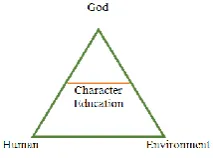
[image:5.595.381.488.701.780.2]In addition, the natural environment becomes a potential discourse for education because the current educational institutions that tend to be conventional indoor while the outdoor becomes a new discourse that is more humanist for educational institutions. In this case better known as the School of Nature. Furthermore, multicultural education can build child’s character according to their respective culture. Character according to Aristotle is a good character as living with the right tingah. Correct behavior in relationships with others and with oneself (Lickona, 2014:72). Then, according to the author, character education is a good attitude towards God, Man and Nature. These three things must be balanced in order to build a harmonious character, full of tolerance and democracy. It can be described as follows:
Another recognition of multicultural education is the opportunity of learning by every individual. Multicultural education is an effort for every individual the opportunity to obtain education. This is so by not looking at background, economy, social status, physical circumstances and other differences. This is in accordance with the Law of the Republic of Indonesia No. 23 year 2002 article 9 paragraph 1 on child protection, that is every child is entitled to receive education and teaching in the framework of his personal development and level of intelligence in accordance with his interests and talents. This is similar to the concept of inclusive education. Inclusive education is an open educational service system that accommodates all learners without discrimination by way of joint learning. Inclusive education is a national education system that includes all children together in a proper learning environment and in accordance with individual potential, development, abilities, conditions and needs of each individual (Sumiyati, 2011:13). Departing from this inclusive education, can provide insight to educators, that each child is different. So in the learning process every child needs to get stimulation according to his needs and developments.
Back to multicultural education according to Benjamin Molan, including efforts to organize a plural society into a multicultural, stable and dynamic society. As already existed, the plural society is fragmented and dominating. Become a community that work together to build a prosperous community together. This will be created if there are people or
communities who are able to organize themselves
(democratically) in a balance between freedom and equality, between justice and civilization. Education that develops free attitudes, values equality, expresses freedom within the boundaries of equality (Molan, 2015:125-126). These attitudes include character education. Therefore, indirectly multicultural education is able to build the character of each student. This education should be arranged early on, both formal education, non formal and informal. According to HAR Tilaar, the focus of multicultural education is no longer directed solely to the dominant or mainstream social, religious and cultural groups.
However, it is a "caring" attitude and want to understand
(difference), or politics of recognition (the politics of recognition of people from minority groups) (Tilaar, 2012:28). The construction of this kind of education is oriented towards a pluralist-oriented, multicultural-oriented awareness-raising process. Furthermore, multicultural pluralist Islamic education can be positioned as part of a comprehensive and systematic effort to prevent and overcome ethnic, religious, radical, religious, sparsive, and national conflicts. While the basic
value of the concept of multicultural education is "tolerance",
that is appreciating all the differences as a reality that must be positioned as it should, not implemented to enter into a certain conception (Naim &Sauqi,2011:48-52).
Ki Hadjar Dewantara (Dekker, 1998:356)with his conviction, that there is no one group or human race on this planet who deserve to be humiliated, degraded and colonized by other groups or races. This belief, championed by how to build awareness of the young generation of Indonesia through education and humanist-nationalist teaching and embrace all groups. This belief illustrates that, multicultural education is built by raising awareness of tolerance through humanist-nationalist teaching by not differentiating between classes. It can be concluded that, the basic value of multicultural education is "tolerance", "caring" or respectful attitude, which is devoted to the element of society without distinction
(minority and dominant). With these values later can be made a comprehensive effort and systematic can prevent and
overcome conflict. Furthermore, from all of these
presentations it can be concluded that, multicultural education in early childhood education is an education that is able to build tolerance from various differences such as religion, culture, language, ethnicity, race, gender, background, economic and social status, other differences.
Multicultural interpretation in the Qur'an
According to multiculturalists, the problem of difference is not only experienced in the level of life among religious believers, but also in each religion. Because the question of diversity can not be separated from the human interpretation of the sacred text or divine text that is believed to be a direct expression of God to man. While in the framework of work, there is no uniform interpretation of a thing. There must be differences caused by various factors. It could be due to cultural, political, economic, educational, or differentiated levels of civilization. The problem of religious interpretation differences is a complicated problem when there are parties who think that the only authority is most entitled to interpret the sacred texts and only tarsirnya the most valid and true, while the interpretation of others is considered wrong. In fact the ultimate truth belongs only to God. Therefore, the discourse of pluralism-multiculturalism is needed in this region. Understanding the different interpretations of texts is expected to result in an inclusive, tolerant, and open religious understanding. On another occasion, there was a multiculturalist who criticized Islamic education, especially Islamic learning. Among the criticisms is that teaching formerly based on texts needs to be balanced by a sufficiently deep and intelligent study of the context of reality, given that the text is limited, while the events experienced by human beings are constantly evolving
(al-nushush mutanahiyah wa al -waqai 'ghairu mutanahiyah).
Therefore, auxiliary sciences are required from the disciplines of psychology, history, philosophy, sociology, economics, politics, and other sciences, to explain the fundamental nature, vision and mission of Islam
The mufassirs are different, but their differences are not a
ushul (fundamental) problem, such as, Godliness. Their
differences also do not say that all religions are equal. Thus if one interprets har using the correct method, not based on unfounded assumptions. And not all can interpret nash because if misinterpreted, the consequences become fatal. In a narration, when one interprets al-Quran with the wrong
method, although the result is true he remains wrong (fa
ashoba). Thus, although the commentators are different, they
share the same conditions used to interpret. Among the Companions who have the fatwa muscle there are six. Umar bin Khattab, Ali Bin Abi Talib, Ibn Mas'ud, Zaid bin Sabit, Ubai bin Ka'ab, Abu Musa Al-Ash'ari. The requirements of the Mufassir are: first, have deep knowledge about the Qur'an and Sunnah of Prophet Muhammad peace be upon him . Because the Qur'an interprets each other, and the Hadith of the Prophet
sallahu 'alaihi wasallam also interprets many verses of the
Qur'an. Second, to know the opinions of the companions and their interpretation of the Qur'an. Because they are the people who know best about the decline of the Qur'an and the conditions of the revelation of the declaration. Thirdly, interpretation must have a straight aqidah and uphold the
sunnah of the Prophet sallahu 'alaihi wasallam, and sincere in
knowing I'rab in Arabic, so he did not get confused when faced with the possibility of many forms of reduction. These four conditions are a must for a mufassir. According to Sheikh Manna al-Qaththan these four conditions need to be added again with one other condition that is to cleanse yourself from lust, to master your basics relating to al-Qur'an, have a strong foundation, and master the science of Arabic and its branches . Namely Nahwu, Sharaf, Ma'ani, Bayan, Badi ', Isytiqaq. Coupled with the science of Fiqh, Fiqh, Qira'at Science, Hadith science, Asbab al-Nuzul, Nasikh wa al-Mansukh, Kalam science, and mauhibah (talent given by Allah swt to people who have charitable according to the knowledge he knows). With such strict conditions, it is impossible for anyone to interpret the Qur'an. But it also does not mean to keep someone away from him. Al-Attas says precisely the strict requirement of interpreting the Qur'an is not an attempt to alienate the Qur'an from ordinary Muslims, but rather a fair attitude towards it and certainly an effective mechanism to minimize the entry of errors and confusion of interpretation. Rather than allowing the liberalization of Qur'anic interpretations based on ignorance, guesswork, and personal and group interests. Because if someone interprets but does not know the knowledge, it means he only rely on his opinion alone. Though it is forbidden.
Democracy of Multicultural Islamic Education: Preliminary Study: Ismail Faruqi mentioned that there are at least four main issues that are viewed as the normative basis of multicultural Islamic education, especially in the religious field, namely: 1] unity in the aspect of Godhead and the delivery of Revelation, 2] Prophets’ Unity, 3] in religion and 4] recognition of other existence. All that is called normative, because it is already a provision of God. Each classification is supported by the [Revelation] text although one verse may serve another justification. While the problems that arise from multicultural Islamic education in Indonesia in general there are two things, namely, multicultural education is a process means the concept of multicultural education is just starting in the world of education, especially in Indonesia requires the process of formulation of fundamental reflection on education and rights human rights.
Second, multicultural education is a multifaceted one. Therefore ask for a border crossing approach from education experts and practitioners to further refine and sharpen the concept of multicultural education needed by the people of Indonesia. The basic concept of multicultural education has four core values:
Appreciation of the reality of cultural plurality in
society
Recognition of human dignity and human rights
Development of the responsibility of the world
community
Development of human responsibility for the planet
earth.
Based on these values several objectives can be formulated with respect to those core values;
Developing a diverse historical perspective from
community groups.
Strengthen cultural awareness in the environment in the
community
Strengthen the intellectual competence and cultures that
live in the community
Combating racism, sexism and various prejudices.
Develop awareness of ownership of the planet earth
Develop social action skills (social action).
Some things need to be studied in the application of multicultural Islamic education in Indonesia. Firstly, multicultural education has inherently existed since the Indonesian nation existed with the philosophy of the Indonesian nation Bhineka Tunggal Ika like mutual assistance, respecting each other with the views of the chronology of this nation is already a requirement the entry of various foreign tribes and continue to acculturate with the people of the earth.
Education Based on Multiculum
Education is an effort in shaping the character of children on the mastery of science and the formation of children. Character formation is built with the transfer of religious values, nationality, society and values that contribute to the formation of character [morals], while the mastery of science is pursued by the delivery of the material of each discipline of science. Educational products will not be effective if the resulting output is limited to mastery or mere cognitive maturity. Education must have three domains: cognitive, effective, and psychomotoric. Affective will be applied to character formation. Multicultural education is one of the means in achieving the concept that multicultural education should be given more concrete limits (Lynch, 1986:31). Multicultural education is education in the form of intellectual, social, and personal development that has an appreciation for diversity, the formation of the personality of students will go to the level of divinity thinking over plurality. Humanitarian differences and democratization and cultural pluralism are the main goals of multicultural education. Teaching styles undertaken by teachers should consider the value of cultural or religious norms in the practice of multicultural education. Multicultural education teaches students to a diversity of realities. therefore the students have character maturity with the attitude of local wisdom.
Multicultural education products produced by schools lead to social dynamics and competitive advantage in the global era. Multicultural education is designed to accommodate the positive impact of socio-cultural and socio-political factors and eliminate racism, classism, and homophobia. The concept of Multicultural education is built through several dimensions. James Banks explains the dimensions of multicultural education as:
Content integration, which integrates various cultures
and groups to illustrate fundamental concepts, generalizations and theories in subjects or disciplines
Knowledge contruction process, which brings students
to understand the cultural implications into a subject
An equity paedagogy, ie adjusting teaching methods by
means of student learning in order to help improve students' academic achievement in a variety of racial, cultural or social
Prejudice reduction, which identifies racial
Conclusion
Based on the description above, it can be concluded that related to the insight of al-qur'an about multicultural education as follows: First, the concept of multicultural education can be done through the content integration stage, the knowledge construction process an equity paedagogy, and prejudice reduction. Second, in general the output of learning has not shown the results of moral wisdom so that anarchic arise. The practice of Islamic learning has not yet exploited universal humanitarian values. The teaching practice of Islamic education has not led to the understanding of Islamic religious norms with Rahmatan lil alamin. Islamic education has not yet raised many aspects of humanism. Islamic education is still much cognitive and psychomotor oriented and ruling out the effective design of Islamic education learning has not been optimally lead to Character buiding. Learning of Islamic education is more directed to the mastery of fiqh, al-qur'an, and Hadith, but not on morals.
REFERENCES
Al, Mudjito et. 2012. Pendidikan Inklusif. Jakarta: Baduose
Media
AL-Mahalli. Jalaludin.Tafsir Jalalain. Beirut: Maktabah al
Islamiyah
Aly, Abdullah. 2011. Pendidikan Islam Multikultural di
Pesantren. Yogyakarta: Pustaka Pelajar
Bank, James A. 2001.Multicultra Education: Historical
Development, dimentions, and practice in James A. Banks
and Cherry A. Mcgee. Sanfransisco : Jossey-Basshlm
Bartolomeus Sambo, Visi Pendidikan...,
Dawam, Ainurrofiq. 2003.Emoh Sekolah: Menolak
Komersialisme Pendidikan dan Kanibalisme Intelektual.
Yogyakarta: Inspeal
Hamruni. 2012.Strategi Pembelajaran. Yogyakarta: Insan
Madani
Interview with founder, Sanggar Anak Alam (SALAM)
Jenks, Chris. 2013. Cuture Studi Kebudayaan. Yogyakarta:
Pustaka Pelajar
Lickona,Thomas. 2014.Pendidikan Karakter: Panduan
Lengkap Mendidik Siswa Menjadi Pintar dan Baik,Pub.
II.Bandung: Nusa Media
Lynch,James. 1986.Multikultural Education: Principle and
practice.London: Reutledge & Kegan Paul
Mahfud,Choirul. 2006.Pendidikan Multikultural. Yogyakarta:
Pustaka Pelajar
Mahfud,Khoirul. 2014.Pendidikan Multikultural. Yogyakarta:
Pustaka Pelajar
Marhumah. 2013.Urgensi Pendidikan Multikutural bagi Anak
Usia Dini, “Journal”Antologi Pendidikan Anak Usia Dini
dalam Pendidikan Dasar Islam. Yogyakarta: Pasca sarjana
UIN Sunan Kalijaga Yogyakarta
Mas’ud, Abdurrahman. 2002.Menggagas Format Pendidikan
Non Dikotomik. Yogyakarta, Gama Meda
Molan, Benyamin. 2015.Multikulturalisme: Cerdas
Membangun Hidup Bersama yang Stabil dan Dinamis.
Jakarta : PT. Indeks
Naim, Ngainum and Sauqi, Achmad. 2011.Pendidikan
Multikultural: Konsep dan Aplikasi. Yogyakarta: Ar-Ruzz
Media
Nuraini, Indah. 2010. Kamus Bahasa Indonesia. Bogor: CV.
Duta Grafika Publising and Printing
P,Gutomo. 2016.“Sekolah Teori Multikulturalisme pada
Diskusi Filsafat Multikulturalisme”. in Impluse
Yogyakarta
Paulo Freire. 2008. Pendidikan Kaum Tertindas. Jakarta: LP3S
Rofiah, Sangidah. 2009. Pendidikan Multikultural “Kajian
Tokoh Indonesia HAR Tilaar” dalam Pendidikan Multikultural telaah Pemikiran dan Implementasi dalam
Pembelajaran PAI. Yogyakarta: Idea Press
Samho,Bartolomeus. 2013.Visi Pendidikan Ki Hadjar
Dewantara. Yogyakarta: Kanisius
Shihab,M. Quraish. 1998. Pesan dan Kesan Dalam Al-Quran.
Jakarta: Lentara Hati
Sumiyati. 2011.PAUD Inklusi: PAUD Masa Depan.
Yogyakara: Cakrawala Institute
Suryana, Yaya and Rusdiana. 2015.Pendidikan Multikultural
Sebagai Upaya Penguatan Jati Diri Bangsa. Bandung: CV
Pustaka Setia
Suyanto,Slamet. 2005.Dasar-dasar Pendidikan Anak Usia
Dini. Yogyakarta: Hikatat Publishing
Tilaar, H.A.R. 2012.Perubahan Sosial Dan Pendidikan:
Pengantar Pedagogik Transformatif Untuk Indonesia.
Jakarta: Rineka Cipta
Tilaar,HAR. 2002.Perubahan Sosial dan Pendidikan:
Pengantar Pedagogik Transformatif untuk Indonesia.
Jakarta: Grasindo
Wartini, Atik. 2015.“Pendidikan Multikultural Berbasis
Karakter ke-Indonesiaan pada PAUD Upaya Integrasi Ilmu ke-Islaman dan Karakter Kebudayaan Indonesia
(Studi Kasus Sanggar Anak Alam Yogyakarta)”. UIN
SUSKA RIAU, Pekanbaru Riau
Yaqin, M. Ainul. 2005.Pendidikan Multikultural
Cross-Cultural Understanding untuk Demokrasi dan Keadilan.
Yogyakarta: Pilar Media