ORIGINAL RESEARCH ARTICLE
SHAPE MEMORY POLYMERS AND SHAPE MEMORY
ALLOYS: USE IN SMART TEXTILES
*
İsmail YÜCE
Trakya University, Edirne Technical Vocational High School, Textile, Clothing, Footwear and Leather Section, 22020, Edirne, Turkey
ARTICLE INFO ABSTRACT
Smart textiles can be defined as materials that perceive and respond to an external stimulus. Interest in smart textiles has increased significantly in the academic area in recent years. As shape memory textiles respond to external stimuli (heat, light, electricity etc.), they are examined as a branch of smart textiles. Shape memory polymers (SMP) and alloys (SMA) can be used in various textile applications. In this study, general properties of shape memory alloys and polymers as well as the differences between these two materials have been mentioned. In the last part, the use of shape memory alloys and polymers in textiles has been examined. As a result of the study, it has been found out that Shape memory polymers have a wider application in textile applications and that polymers are more advantageous than alloys in terms of their ease of use, aesthetics and price.
*Corresponding author:
Copyright © 2017,İsmail YÜCE. This is an open access article distributed under the Creative Commons Attribution License, which permits unrestricted use, distribution, and reproduction in any medium, provided the original work is properly cited.
INTRODUCTION
Smart textiles are textile products that have the ability to detect and react to an external effect or effect change (light, heat, pressure, electromagnetic waves, sound and ultrasonic waves, motion etc.) (Coşkun and Ogulata, 2008; Kayacan and Bulgun, 2005).The shape memory effect is the ability to recover the original shape when a material is activated with appropriate stimuli. Materials of this property can be examined in four classes, including shape memory alloys, shape memory ceramics, shape memory polymers, and shape memory gels
(Hu, 2007; Gopi et al.). The material responding to an outside
stimulus is known as smart material whereas shape memory
textiles are part of the smart textiles (Vasile et al., 2011). In
the field of textiles, shape memory materilas are applied in two different ways: one of them is shape memory alloys while the other is shape memory polymers. While the shape memory alloys are used alone or integrated to the yarn, shape memory polymers are used on textile surfaces in the form of coating or
lamination (Vasile et al., 2011; Cho et al., 2004; Bedeloglu,
2011). Even though shape memory polymers have similar characteristics with the shape memory alloys, their main physical principles may be different (Hiltz, 2002).
The way these physical features may affect dissimilarity on the smart textile applications can also be discussed. In this study, the different aspects of shape memory polymers and alloys are addressed and their use in textiles is examined. The current aim of this study is to reveal the physical and chemical differences between shape memory polymers and shape memory alloys as well as examining their usage areas in textiles. Also, it aims to show the extent of these differences affect their usage in the area of textile. According to the results of the study, it is possible to conclude that the usages of shape memory polymers in textile are more suitable than the shape memory alloys. In addition, shape memory polymers are more commercially advantageous than the shape memory alloys. Additionally, this study presents the end-uses of shape memory alloys and polymers in textiles.
SHAPE MEMORY ALLOYS AND POLYMERS
Shape Memory Alloys (SMAs) are evaluated as smart materials. SMAs have the ability to remember its original, permanent shape.
ISSN: 2230-9926
International Journal of Development ResearchVol. 07, Issue, 11, pp.16730-16736, November,2017
Article History:
Received 19th August 2017
Received in revised form 22nd September, 2017
Accepted 24th October, 2017
Published online 29th November, 2017
Key Words:
Smart Textiles, Shape Memory Textiles, Shape Memory Polymers, Shape Memory Alloys.
Citation: İsmail YÜCE. 2017. “Shape memory polymers and shape memory alloys: use in smart textiles”, International Journal of Development Research, 7, (11), 16730-16736.
SMAs respond to an external stimulus by changing their physical properties and hence a “deformation or deflection of the structure” is observed and the permanent shape is obtained
again (Rottiers et al., 2011). SMA’s have good mechanical
features such as corrosion, strength and resistance.
Nickel-titanium, copper-aluminium-nickel and
copper-zinc-aluminium-nickel wires are the main three shape memory alloys. The most common industrial shape memory alloy is nickel-titanium (Ni-Ti) and copper-based alloy (Akdogan and Nurveren, 2003).Their common usage areas include vascular stents, medical guide wires, orthodontic wires and aerospace applications. They are also used as vibration absorber, pipe couplings, electric connections, thermostats, actuator, glass frames, brassiere clasps. Because of their high bio-compatability and super-elasticity, Ni-Ti wires are commonly used in medical area such as in glass frames, stents, odontotherapy etc. (Hu, 2007; Akdogan and Nurveren, 2003;
Jackson et al., 1972; Hu and Meng, 2011).
The polymers can change to their predetermined forms with suitable exciters such as heat, electricity, pH, ionic strength,
light and magnetic field (Gutowska et al., 1994; Asaka and
Oguro, 2000; Feil et al., 1992; Siegal and Firestone, 1988;
Jiang et al., 2006). Shape memory polymers (SMP’s) have
been common since the middle of the 1980’s. SMP can be stimulated by some stimuli such as temperature, pH, chemicals and light. They are defined by their reaction to a certain outside stimulus or their sensitivity to them. The base of shape memory effects depends on spiral polymer structure, cross link, Hydrogen bridge as well as the existence of seperate phases. If the chains are not limited by permanent or temporary cross-links or section, they tend to turn randomly into a spiral configuration (Hu, 2007). SMP’s have two segments, which are hard segment and soft segment. Hard segmetns tend to stay together. The segments coming together display a regular crystal structure and form a hydrogen bond with the other nearest hard segments. In order to have a good reverse, the percentage of hard segment should be between
25-40% (Hu et al., 2012). Soft segments, on the other hand, have
a very different structure. Those segments that are above the glass transition temperature (Tg) have an amorph structure. These two segments are connected to each other through covalent bonds (Hu, 2007; Hu, 2013). SMP’s has two states changing according to the temperature. One of them is glassy state that is hard and stronger phase, while the other is a flexible state in a higher temperature. When the temperature is above the Tg, the material gets softer and gains an elastic form. Micro-morphologies of shape memory polyurethane affect its mechanical features in a strong manner. There exist many factors affecting the morphology. They include chemical state, composition, hard segment content, all molecule weight
and distribution (Hu, 2007; Mondal et al., 2002).
Differences Between Shape Memory Polymers and Alloys
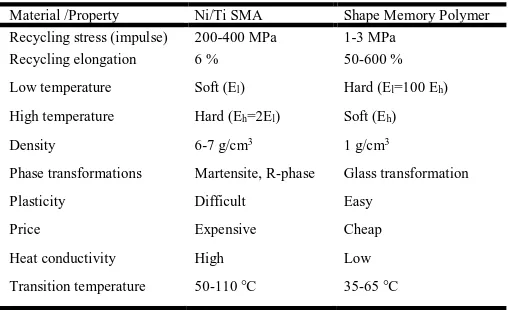
Unlike SMPs, the shape memory properties of SMA are observed as the transformation of martensite phase to the austenite phase (Hu, 2014). Some properties of Ni/Ti alloy and shape memory polymers are shown in Table 1. The SMPs have much better shape memory properties compared to SMA’s. Elongation in alloys (up to 8%) is much less when compared to that of polymers. However, SMAs has some advantages such as their ability to reverse completely to their original pre-determined shape and also their better mechanical properties
[image:2.595.307.561.85.240.2](Jackson et al., 1972).
Table 1. Comparison of Ni/Ti SMA’s and SMP Features (Hiltz, 2002)
Material /Property Ni/Ti SMA Shape Memory Polymer Recycling stress (impulse) 200-400 MPa 1-3 MPa
Recycling elongation 6 % 50-600 % Low temperature Soft (El) Hard (El=100 Eh)
High temperature Hard (Eh=2El) Soft (Eh)
Density 6-7 g/cm3 1 g/cm3
Phase transformations Martensite, R-phase Glass transformation
Plasticity Difficult Easy
Price Expensive Cheap
Heat conductivity High Low
Transition temperature 50-110 °C 35-65 °C
While the permanent shape of SMAs is created through thermal applications, the permanent shape of SMPs is
generally created at the production stage (Rottiers et al.,
2011).SMPs are lighter, easy to process, economical compared to SMA’s Also they have high shape transformations, high recovery, soft touching and the adjustment of key temperature. Some SMP’s are also biodegradable, which can be useful in medical applications. The biggest disadvantage of SMP is its
weak recycling force (Rottiers et al., 2011; Hu, 2013; Hu,
2014).On the other hand, SMP’s thermal triggering processes remain slow because the thermal conductivity of polymers is lower than that of alloys (<0.30W/m.K). However, the integration of polymers to textile structures is easier and more
appropriate (Rottiers et al., 2011; Liu and Mather, 2005).
THE USAGE OF SHAPE MEMORY ALLOYS IN TEXTILE
SMA’s can be used in industrial, medical and daily life as an actuator, plane, pipe, air conditioner, glass frame and thermostat as well as in robotic, orthopaedic surgery and
dentisty (Hu and Meng, 2011; Otsuka et al., 2002).SMAs can
be used in a fibre as a wire form after having been programmed to gain certain features. They can be used as transformed into a composite yarn together with traditional textile fibres and then as woven or integrated into a fabric or
garment (Berzowska and Coelho, 2005; Yan et al., 2007).
While producing hybrid yarns, shape memory alloys are generally added to the core of the yarn. The shape memory alloys are covered with such conventional fibers as polyester,
viscose and polyamide (Vasile et al., 2011; Stylios, 2006;
Winchester and Stylios, 2003; Ahmad et al., 2013; Ahmad et
al., 2012; Ahmad et al., 2013). It can also be used as a
composite yarn or can be integrated into the woven/knitted fabric by a sewing method as seen in Figure 1 (Tang and Stylios, 2006).
However, the usage of SMA’s in great quantity in the textile material may cause a disturbing effect on the textile state, attitude and touching. The insufficiency in the elasticity of the alloy leads to some restrictions in production and designing, yarn formation, weaving or knitting (Tang and Stylios, 2006). At the same time, the price should be lower so that shape memory alloys can be used more widely (Hu, 2007).
Figure 1. Some end-uses of SMA’s in textile: a) Shape memory composite yarn, b) Shape memory weaving layer, c) Shape
memory knitting layer (Tang and Stylios, 2006)
A number of studies were made on the usage areas of SMAs in
textiles. Some of these studies are mentioned below: Yoo et al.
(2008) designed a jacket that stretches when heated as long as the NiTi alloy wire with bi-directional shape memory is located between the cloth layers in a spiral way. This jacket will protect the user in a cold weather by increasing the insulation. These wires will expand for 10-15 mm in cold weather and form holes while the air holes will disappear and the wires will become flat in hot weather. The ones who wore the jacket mentioned that it kept them warm. A South Korea company designed shape memory brassiere by using shape memory alloys. The aim of manufacturing this brassiere was to adjust it in accordance with the body sizes against the original shape triggered with the body temperature or after washing. The same principle was used by an Italian firm that manufactured a T-shirt called iron. Another Italian firm manufactured a shirt whose sleeves got smaller when the body was heated (Wan and Stylios, 2007).
Berzowska and Coelho (2005) integrated the shape memory alloy Nitinol in felt fabrics to create two specific animated dresses, Kukkia and Vilkas, which change shape through resistive heating electronics. They have altered the elemental ratios of the nickel and titanium combination so that the alloy can be tuned to change shape at different temperatures. Then they fabricated the Nitinol wire and attempted to control the shape. Vilkas, the dress with a kinetic hemline, pulled the cloth together when it was heated. It returned to its first shape over time by gravity and the weight of the felt. Similarly, Kukkia, the dress decorated with three animated flowers that frame the neckline, closed the flowers when heated as the wire shrank and pulled the petals together.
THE USAGE OF SHAPE MEMORY POLYMERS IN TEXTILE
SMP is a more appropriate raw material for the clothing industry because of its features such as high elongation, well-processability, lightness and touching (Tang and Stylios, 2006). SMPs can be produced in a fiber form, i.e. macro, micro and nanofibers, as solution, film or foam. They are used in such textile and clothing applications as nonwoven, coating,
finish, lamination, weaving and knitting (Hu et al., 2012;
Matsumoto et al., 2012).
Shape Memory Fibers
Macro-scaled shape memory fibers can be produced with wet,
dry and melt spinning methods (Meng and Hu, 2008; Ji et al.,
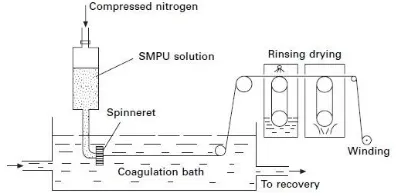
2006). Shape memory polyurethane (SMPU) fibers were prepared for the first time in 2006 with wet-spinning. In Figure 2, the wet-spinning process of fiber is shown. Under compressed nitrogen gas, shape memory polyurethane solution is pulled into the coagulation bath of 6m/min through 30 spinneret holes of 0,08 mm diameter pinholes. The coagulated fibers are wrapped after being dried and rinsed through the
cylinder with 10 m/min speed (Hu, 2007; Hu et al., 2012; Liu
and Mather, 2005). However, as it includes harmful dimethyl formamid and coagulation bath, melt spinning method is more environmental. In addition, it has the advantage of being more economical (Meng and Hu, 2008). In order to gain a commercial importance, the shape memory fibers need to have anti-oxidant, anti-thermal, chlorine-resistant and anti-aging features (Hu, 2014).
Melt spinning process was applied in order to get rid of the problems observed in wet-spinning. The shape memory fibres (SMF’s) that are melt-spinned provide a higher resistancy, a controllable elongation, a linear density, shape permanence, elasticity and key temperature. Shape recovery is better in melt spinning as a higher micro-phase distribution is obtained during its process. At the same time, this soft spinning method enables to prevent some problems such as environmental
pollution and low production efficiency (Hu et al. 2012; Hu,
[image:3.595.334.532.412.510.2]2014).
Figure 2. Wet spinning process for preparing SMPU fibers (Hu, 2007).
Meng et al. (2009) produced a hollow shape memory fiber by
using the melt spinning method. These fibers’ key transition temperature was calculated as 41 °C, durability as 1,14 cN/dtex, elongation at break as 682 %, and the recovery rate as 89 %. However, when they increased the ambient temperature above the transition temperature, the fiber turned back to its original diameter again. They suggested that these fibers can be used for thermal adjustments in smart textiles and as fibers in pillow and cushions, or can be used in smart filtration, for controlled oscillation of the medicine and fluid transfer. Cook
et al. (2005) worked on bio-directional shape memory fibers. It aimed to show that cross-section of the fiber change section according to the ambient temperature. While the cross-section of the fiber takes a hollow shape (like the shape of a crescent) in hot weather, it will take a closed shape in cold weather. As a result, the clothes produced with this fiber will be worn in both hot and cold weathers.
Shape Memory Yarns and Fabrics
With these yarns, knitted or woven fabrics can be produced (Hu et al. 2012). With the fabrics including shape memory fiber, textile and clothing products that react to (adapt to) the temperature changes can be produced. The features of the fabrics with shape memory effect include shrinkage, bending and thickness increase. The clothes made out of shape memory fibers can enlarge in accordance with the body shape of the person wearing them. In contrast to the clothes made out of conventional spandex fibers, these clothes take the shape of its user in a better way and decrease the user’s negative energy. The fabris produced with the shape memory fibers with developed perception comfort can be used in women lingerie
and low-pressure socks (Hu et al., 2012).
Some biological evaluations were made in order to prove the compatibility of fabrics containing shape memory fiber with human body. These initiated the applications of shape memory effect fabrics in biological and medical areas. For the effective application of shape memory fabrics in medical textiles, corselets were foreseen. For instance, therapeutic clothes for burned skins, sport clothes skin and some casual dresses
including female lingerie (Hu et al., 2012; Meng et al., 2009).
With the usage of shape memory polymers in medical area as controlled drug release, biodegradable sewing yarn, stent, implants, the relevant studies have been increasing (Lendlein
and Langer, 2002; Wache et al., 2003; Lendlein et al., 2010;
Goraltchouk et al., 2011). In this area, sewing yarns with
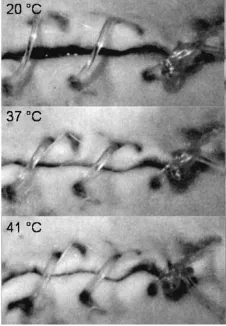
biodegradable shape memory feature was studied. With the increase in temperature, filament presses the scar and enables it to be closed (Figure 3). In addition, SMP’s having minimal temporary shape can be implanted into the body from the small scars and take their original shape with body temperature. The shape memory products of the medical area need to be supported with such controlled features as
biodegradability and drug release (Lendlein et al., 2010).
Jing et al. (2010) studied the fabrics woven with core-spun
shape memory yarns. The shape memory yarns whose core was formed with shape memory fiber were produced in two ways: One of them was ring technology while the other was friction technology. Two different fabrics were woven with these yarns. While the core-spun yarn in one of them was added to the fabric, shape memory fibers were incorporated into the yarns through ring or friction spinning method and these yarns are produced as knitted or woven fabric. They concluded that shape memory core-spun yarns have as much good shape effect as the shape memory fibres. The shape memory effect was observed more on weft side. It was also found out that the yarn produced with a ring machine and having shape memory core had better shape memory effect
when compared to that produced with friction. Liu et al.
[image:4.595.376.489.67.230.2](2007) tested three types of fabric prepared with different contents. The contents of these fabrics are as follows: 1. 100%SMPU, 2. 50/50% SMPU/Cotton and 3. 16/84% SMPU/Cotton. In the study, shape memory behaviours were examined by comparing shape memory behaviors and contents of fabrics in different temperatures. In addition, shape memory of shape memory fibres were verified by comparing them with Lycra knitted fabrics. At the end of the study, when the fabric shape memory polymer was heated above transition temperature, the shape memory effect increased in an obvious way. In fabrics with higher amount of shape memory fiber, more shape memory effect was observed. When compared to the fibres, the fabrics produced with shape memory fibers displayed shape difference in an obvious way.
Figure 3. Surgical sewing of an animal scar by using a biodegradable shape memory filament. With the increase of temperature from 20 °C to 41 °C, the shape memory filament’s
closing of the scar (Liu et al., 2007)
Shape Memory Polymer Solutions for Finish Applications
Another method of obtaining shape memory fabrics is the finish applications with shape memory chemicals. This process is based on the principle of transferring shape memory features from the polymers to the fabrics. When compared to the fabrics knitted or woven with shape memory fibres, finish process is quite an effective method. With the finish applications of shape memory polymers, various features such as anti-piling, elasticity/force protection, dimensional stability, non-shrink resistance, a good flat apperance, three-dimension pattern easiness and bulginess (Figure 4.a) can be transferred
into the fabric (Hu et al., 2012; Hu and Lu, 2013; Hu et al.,
2007).
Hu et al. (2013) developed a finish chemical for wool from shape memory polymer. The thermal and hygrothermal effects of wool fabrics were examined. They concluded that synthetic
shape memory polymers affected the thermal and
hygrothermal behaviours of the wool fabrics. Surface outlook of shape memory treated and untreated fabrics are shown in Figure 4.b. Wool fabric treated with SMP did not get harmed after having been washed and dryed 25 times in accordance with AATCC wool washing standard while untreated fabric felted after having been washed (Hu, 2010). In another study
carried out by Liu et al. (2005), modification with finish
having polyurethane was tested on a cotton fabric. At the end of the study, cotton fabrics modified with shape memory polyurethane as well as fabrics resistant to washing and corrugations were obtained.
Shape Memory Polymer Film, Foam and Laminated Textile
The functions of shape memory polymer films applied to textile products include waterproof, water vapor permeability,
seam sewing, prevention and stabilization of crease (Hu et al.,
2012). Water vapor permeability in textile is a feature that is applied in broad areas. Because of their water vapor permeability, shape memory polyurethanes are ideal for the water vapor permeable non-porous laminations. In addition to the thermomechanical features of SMPs, they displayed other outstanding features such as moisture permeability above and
Figure 4. Shape memory finished fabrics.(a)Protecting the
pattern of knitted fabric with SMPU finish (Hu et al., 2012).(b)
Comparing the felting of wool fabrics treated or untreated with shape memory polymer after washing and drying (Hu, 2010)
PU has a large number of micro-pores to allow the distribution of perspiration molecules. However, it also has enough smallness to prevent water droplets from going through the fiber. While water droplet penetration is prevented, the vapor can easily be expelled because while the diameter of water vapor molecule is about 0,4 nm, the diameter of water droplet molecules is between 1000-200000 nm. As far as the comfort of garment is considered, high water vapor penetration is necessary for physiological comfort (Hu, 2007; Mondal and
Hu, 2007). In a study carried out by Cho et al. (2004), water
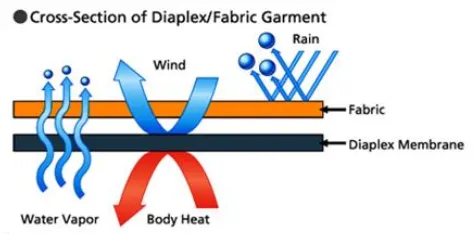
[image:5.595.44.281.536.653.2]vapor penetration and mechanical properties of a material coated with shape memory polyurethane on a polyester fabric was examined according to polyurethane concentration and hard segment. It was observed that with the increase in the coating solution concentration, water vapor penetration decreased to a great extent. Mechanical properties of the coated fabric were significantly affected by the hard segment content of the shape memory polyurethane. Another example is the laminated fabrics that are breathable and produced by the Mitsubishi Heavy Industries (Hu, 2007); these fabrics were sold under the commercial brand name, Diaplex. They enable the wearer to feel comfortable under some conditions such as rain and snow. They are waterproof and expel the sweat. This product was produced with the SMP lamination between two layers and a new membrane was formed (Figure 5).
Figure 5. Working principle of Diaplex membrane (Diaplex)
RESULTS
This study showed that the use of SMPs in textile are more suitable than the use of SMAs. The most important reason for this is the fact that shape transitions could not be triggered as the transition temperature of alloys is quite higher than the body temperature. These transition values are close to body temperature in the polymers and hence a shape change can be observed.
Another reason is that polymer material is more suitable for the textile structures (hand feeling, low weight etc.). In addition, polymer material is easier to produce both as a fibre and a yarn form. It creates easier integration to the textile structures than the alloys, which makes them much more superior. In addition, they have more pros than the alloys in terms of their prices; and besides SMAs have higher recycling stress, which provides them a priority in their shape memory behaviour.
DISCUSSION
The usage of shape memory material in textile applications has been increasing to a significant extent. This study focuses on the usage of SMA and SMP in textile. Developments in the field of shape memory polymers and alloys will create an advantage for the smart textiles. It is foreseen that the composite fabrics produced with these materials will occupy a wide place within smart textile products. The textile products containing these materials will open new grounds for casual clothes and sports clothes, technical textiles and medical textiles.
Conclusion
As result of this research, it is possible to conclude that the use of shape memory polymers in textiles is more suitable than the use of alloys. The alloys are more commonly used in medical, industrial and electronic devices, which are mentioned in various studies on this topic. On the other hand, the end-use of shape memory materials in textiles has shown an increase thanks to the fact that they are more suitable for the textile structures.
REFERENCES
Ahmad MR, Yahya MHM, Hassan MR, Salleh J, Ahmad WYW, Hassim N 2012.Some Studies on Shape Memory Alloy Friction Spun Yarn.IEEE Business, Engineering and Industrial Applications Colloquium (BEIAC).doi: 10.1109/BEIAC.2012.6226055.
Ahmad MR, Yahya MHM, Ahmad WYW, Salleh J, Hassim N 2013. Actuation, Performance of Shape Memory Alloy Friction-Spun Yarns.Indian Journal of Fibre and Textile Research. 38:193-197.
Ahmad MR, Yahya MHM, Hassan MR, Salleh J, Ahmad WYW, Hassim N 2013. Production of Shape Memory Alloy Core- Sheath Friction Yarns. Fibres and Textiles in Eastern Europe. 21, 3(99), 68-72.
Akdogan A, Nurveren K 2003. Şekil Hafızalı
Alaşımlar.Mühendis ve Makine. 44, 521, 35-44.
Asaka K, Oguro K 2000. Bending of polyelectrolyte
membrane platinum composites by electric
stimuli.Electro-analytical Chemistry. 480: 186–198. Bedeloglu A 2011. Shape Memory Alloys and Apllications on
Textile Materials. The Journal of Textiles and Engineer.
18, 83, 27-37.
Berzowska J, Coelho M 2005. Kukkia and Vilkas: Kinetic
Electronic Garments.IEEE Computer Society.
Proceedings of the 2005 Ninth IEEE International
Symposium on Wearable Computers (ISWC'05). Bob Werner. City: Osaka, Japan, 1-4.
Shape-Memory Polyurethane. Journal of Applied Polymer Science. 92, 5, 2812–2816.
Cook FL, Jacob KI, Polk M, Pourdeyhimi, B (2005). Shape Memory Polymer Fibers for Comfort Wear. NTC Project: M05-GT14.
Coskun E, Ogulata RT (2008). Akıllı Tekstiller ve Genel Özellikleri. Ç.Ü Fen Bilimleri Enstitüsü, 18-3:100-109.
Diaplex. Available from: http://www.amaterrace.com/
en/product/dl_3.html. Date of Accessed: 03.01.2016. Feil H, Bae YH, Feijen T, Kim SW (1992). Mutual Influence
of pH and Temperature on the Swelling of Ionizable and
Thermosensitive Hydrogels. Macromolecules. 25: 5228– 5230.
Gopi M, Kumar PR, Sravanth P, Aravind S. Shape Memory
Polymers. Available from: https://www.
noexperiencenecessarybook.com/MZM99/shape-memory-polymers.html.Date of Access: 10.07.2016
Goraltchouk A, Lai J, Herrmann RA 2011. Shape-memory self retaining sutures, methods of manufacture, and methods
of use. International Publication, Patent No:
US20110125188 A1.
Gutowska A, Bae YH, Jacobs H, Feijen J, Kim SW 1994. Thermosensitive Interpenetratirig Polymer Networks: Synthesis, Characterization, and Macromolecular Release.
Macromolecules. 27: 4167–4175.
Hiltz JA 2002. Shape Memory Polymers.Defence R and D Canada. City: Atlantic, Literature Review, 1-20.
Hu J 2007. Shape Memory Polymers and Textiles. Woodhead
Publishing Limited. The Textile Institute, City:
Cambridge, England.
Hu J, Chung S, Li Y 2007. Characterization about the shape
memory behaviour of woven fabrics. Transactions of the
Institute of Measurement and Control. 29, 3/4, 301–319. Hu J 2010. Shape-Memory Polymer Textile. In: Leng J, Du S
(eds) Shape-Memory Polymers and Multifunctional
Composites, CRC Press Taylor and Francis Group, pp
293-313.
Hu J, Meng Q 2011. Functional shape memory textiles. In: Pan N, Sun G (eds) Functional textiles for improved
performance, protection and health, Woodhead Publishing
Limited, pp 131-162.
Hu J, Meng H, Li G, Ibekwe SI 2012. A review of
stimuli-responsive polymers for smart textile applications. Smart
Materials and Structures. 21, 5, 1-23.
Hu J, Zhu Y, Huang H, Lu J 2012. Recent advances in shape– memory polymers: Structure, mechanism, functionality,
modeling and applications. Progress in Polymer Science.
37, 12, 1720-1763.
Hu J (2013). Advances in Shape Memory Polymers. Wood
head Publishing Series in Textiles.
Hu J, Lu J 2013. Shape memory polymers in textiles.Advances in Science and Technology. 80: 30-38.
Hu J 2014. Shape Memory Polymers: Fundamentals, Advances and Applications.Smithers Rapra Technology Ltd. City: Shawbury, United Kingdom.
Jackson CM, Wagner HJ, Wasilewski RJ 1972. 55-Nitinol-The alloy with a memory: Its physical metallurgy properties, and applications.Report, NASA-SP5110, ABD.
Ji FL, Zhu Y, Hu J.L, Liu Y, Yeung LY, Ye GD 2006. Smart polymer fibers with shape memory effect.Smart Materials and Structures. 15:1547–1554.
Jiang HY, Kelch S, Lendlein A 2006. Polymers Move in Response to Light. Advanced Materials. 18: 1471–1475.
Jing L, Hu J 2010. Study on the Properties of Core Spun Yarn and Fabrics of Shape Memory Polyurethane. Fibres and Textiles in Eastern Europe. 18, 4 (81), 39-42.
Kayacan O, Bulgun EY 2005. Smart Textiles and Electrically
Conductive Textile Based Structures. The Journal of
Textile and Engineer. 12, 58, 29-34.
Lendlein A, Langer R 2002. Biodegradable, Elastic Shape-Memory Polymers for Potential Biomedical Applications. Science. 296 (5573): 1673–1676.
Lendlein A, Behl M, Hiebl B, Wischke C 2010. Shape-memory polymers as a technology platform for
biomedical applications.Expert Rev. Med. Devices. 7(3):
357–379.
Liu C, Mather PT 2005. A Shape Memory Polymer with
Improved Shape Recovery. Materials Research Society.
855E: W4.7.1-W4.7.6.
Liu Y, Hu J, Zhu Y, Yang Z 2005. Surface modification of
cotton fabric by grafting of polyurethane. Carbohydrate
Polymers. 61: 276–280.
Liu C, Qin H, Mather PT 2007. Review of progress in
shape-memory polymers. Journal of Materials Chemistry. 17:
1543–1558.
Liu Y, Chung A, Hu J, Lv J 2007. Shape memory behavior of SMPU knitted fabric.Journal of Zhejiang University Science A. 8, 5, 830-834.
Matsumoto H, Ishiguro T, Konosu Y, Minagawa M, Tanioka A, Richau K, Kratz K, Lendlein A 2012. Shape-memory properties of electrospun non-woven fabrics prepared from degradable polyesterurethanes containing poly(ɷ-pentadecalactone) hard segments. European Polymer Journal. 48: 1866–1874.
Meng Q, Hu J 2008. Study on poly(e-caprolactone)-based shape memory copolymer fiber prepared by bulk polymerization and melt spinning.Polymers for Advanced Technologies. 19: 131–136.
Meng Q, Liu J, Shen L, Hu Y, Han J 2009. A Smart Hollow Filament with Thermal Sensitive Internal Diameter. Journal of Applied Polymer Science. 113, 4, 2440–2449. Meng Q, Hu J, Zhu Y, Lu J, Liu B 2009. Biological
Evaluations of a Smart Shape Memory Fabric. Textile Research Journal. 79(16): 1522–1533.
Mondal S, Hu J, Yang Z, Liu Y, Szeto Y 2002. Shape memory polyurethane for smart garment. RJTA. 6,(2): 75-83. Mondal S, Hu JL 2007. Water vapor permeability of cotton
fabrics coated with shape memory polyurethane. Carbohydrate Polymers. 67: 282-287.
Otsuka K, Kakeshita T, Editors G (2002). Science and
Technology of Shape-Memory Alloys: New
Developments. MRS Bulletin.27(2): 91-100.
Rottiers W, Broeck LV, Peeters C, Arras P 2011. Shape memory materials and their applications.Korolev's
Readings Location: Samara, Korolev's readings:
conference proceedings, Samara State Aerospace
University, pp. 1-20.
Siegal RA, Firestone BA (1988). pH-dependent Equilibrium Swelling Properties of Hydrophobic Polyelectrolyte Copolymer Gels.Macromolecules. 21: 3254–3259. Stylios GK 2006. Engineering textile and clothing aesthetics
using shape changing materials. In: Mattila H and Mattila
HR (eds) Intelligent Textiles and Clothing. Woodhead
Publishing, pp 165–190.
Tang LP, Stylios GK 2006. An overview of smart technologies
for clothing design and engineering. International Journal
Vasile S, Githaiga J, Ciesielska-Wrobel IL 2011. Comparative Analysis of the Mechanical Properties of Hybrid Yarns with Superelastic Shape Memory Alloys (SMA) Wires Embedded. Fibres and Textiles. 19, (89), 41-46.
Wache HM, Tartakowska DJ, Hentrich A, Wagner MH 2003. Development of a polymer stent with shape memory
effect as a drug delivery system. Journal of Materials
Science: Materials in Medicine. 14(2): 109–112.
Wan T, Stylios GK 2007. Shape memory training for intelligent fabrics.RJTA. 11(1): 11-17.
Winchester RCC, Stylios GK 2003. Designing knitted apparel by engineering the attributes of shape memory alloy.
International Journal of Clothing Science and Technology. 15(5): 359-366.
Wu MH, Schetky L 2000. Industrial Applications For Shape Memory Alloys. Proceedings of the International Conference on Shape Memory and Superelastic Technolgies, Pacific Grove, California, pp 171-182. Yoo S, Yeo J, Hwang S, Kim YH, Hur SG, Kim E 2008.
Application of a NiTi alloy two-way shape memory
helical coil for a versatile insulating jacket. Materials