R E S E A R C H
Open Access
PD feedback
H
∞
control for uncertain
singular neutral systems
Jichun Wang
1,2, Qingling Zhang
1,3*and Dong Xiao
4*Correspondence:
1Institute of Systems Science,
Northeastern University, Shenyang, Liaoning 110819, China
3State Key Laboratory of Synthetical
Automation for Process Industries, Northeastern University, Shenyang, Liaoning 110819, China
Full list of author information is available at the end of the article
Abstract
This paper focuses on the problem of proportional-plus-derivative (PD) feedbackH∞
control for uncertain singular neutral systems. The parameter uncertainties are assumed to be time-varying norm-bounded and appearing not only in the state matrix but also in the derivative matrix. This paper introduces new effective criteria which make the systems stable and meet theH∞performance by PD feedback controller. Different from most existing methods, this study attempts to introduce the information between derivative matrices. Based on such an idea, the PD feedback controller for singular neutral systems is first of all proposed which makes the derivative matrices (especially neutral matrix) meet the requirement which guarantees the existence of the solution for the system. So the criteria in this paper are less conservative to some extent. Finally, illustrate examples are given to demonstrate the effectiveness of the proposed approach.
Keywords: H∞control; singular neutral system; LMI; PD feedback controller
1 Introduction
Since the late s, interests have been focused on the study of theH∞control problem
[] due to its practical and theoretical importance. Various approaches have been devel-oped and a great number of results for continuous systems as well as discrete systems have been reported in the literature: [] discussed the State space solutions to standard HandH∞control problems; [] studied delay-dependent robustH∞controller synthesis
for discrete singular delay systems; [] statedH∞control for descriptor systems: a matrix
inequalities approach; [] addressed non-fragileH∞control for linear systems with
mul-tiplicative controller gain variations. It should be pointed out that all of the works men-tioned above are concerned with theH∞ control problem for conventional state-space
systems as well as conventional singular systems. However, many practical processes can be modeled as neutral delay systems [–] such as networks of interconnected systems [], lossless transmission lines, partial element equivalent circuits in electrical engineer-ing, controlled constrained manipulators in mechanical engineering [, ], and certain implementation schemes of predictive controllers []. So there are many results for the study of the neutral systems [, ] performance. For example, [] studied estimates of perturbation of nonlinear indirect interval control system of neutral type; [] studied a stabilization method in neutral type direct control systems; [] studied stabilization of
neutral-type indirect control systems to absolute stability state;etc.Most of the literature studies the stability [–] for the linear neutral systems. But it appears that little results are available so far onH∞ control of the neutral systems [, ] as well as the neutral
singular systems [–]. The above results are all for the theoretical research of this kind of system. For the practical application research is rarely. In the future, we can achieve more practical results from the application background; for example, results as regards a dissolving tank of chemical process, a large circuit system, and recent general data-driven methods [, ].
Circuit analysis, power systems, chemical process simulation,etc.can be modeled as a general form of neutral type system,i.e.neutral singular systems. Therefore, the study of stability problems for neutral singular systems is of theoretical and practical importance. It is well known that the stability of the differential operatoris the prerequisite condi-tion for the stability of neutral systems []. Its stability is determined by the derivative matrices. In most previous literature [–] the differential operatoris presumed to be stable. That is to say, derivative matrices need to meet certain conditions. This has great significance. However, not all of the neutral systems have a stable operator. To make the system meaningful, one should design the controller which makes the operator of the sys-tem is stable. Owing to the operator being related to the state with derivative, we only use derivative feedback control to stabilize the operator. To the best of our knowledge, little attention has been given to the neutral singular systems with the operator unsta-ble. Up to now, the proportional-plus-derivative (PD) feedback control problem of neu-tral singular systems with the operator unstable has not been investigated when the H∞ performance of the closed-loop system is required. The main objective of this
pa-per is to present the PD feedback controller for neutral singular systems. It can make the systems asymptotically stable with anH∞ disturbance attenuationγ > for all nonzero
w(t)∈LP
[, +∞].
The remaining sections of this paper are organized as follows. The neutral singular sys-tem description and some relevant lemmas are given in Section . Section presents an H∞performance analysis of the neutral singular systems and Section designs PD state feedback stabilizing controllers. In Section , numerical examples are presented to illus-trate the effectiveness of the proposed theoretical results in this paper. Finally, conclusions are given in Section .
The following notation will be used throughout the paper:Rdenotes the set of real num-bers.Rndenotes then-dimensional Euclidean space.Rn×mdenotes the set ofn×m matri-ces with real elements andRn×m(s) denotes the set ofn×mmatrices of rational functions. LetPbe a square matrix. The matrixPis symmetric ifP=PT. For symmetric matricesX andY, the notationX≥Y(respectively,X>Y) means that the matrixX–Yis positive semi-definite (respectively, positive definite).Iis the identity matrix with appropriate di-mension. The superscripts ‘T’ and ‘∗’ represent the transpose and the complex conjugate transpose.℘n,τ=℘([–τ, ],Rn) denotes the Banach space of continuous vector functions
2 System description and preliminaries
In this paper, we consider the following uncertain singular neutral delay system:
(E+E)x(t) = (A˙ +A)x(t) + (A+A)x(t–h)
+ (G+G)x(t˙ –τ) +Bw(t) +Bu(t), (a)
z(t) =Cx(t). (b)
We have the initial condition
x(t+θ) =φ(θ), ∀θ∈[–τ¯, ], (t,φ)∈R+×℘nv,τ¯,
wherex(t)∈Rnis the state variable vector;u(t)∈Rmis the control input vector;z(t)∈Rqis the output vector;w(t)∈L[,∞) is the disturbance input vector; andφ(t) are continuous
functions defined on (–∞, ].E(rank(E)≤n),A,A,G, B,B,C,Dare given constant
matrices with appropriate dimensions, andτ¯ =max{h,τ} is a constant time-delay.E,
G,A,Aare unknown real norm-bounded matrix functions which represent
time-varying parameter uncertainties. In this paper, the uncertainties are assumed to be of the form
E G A A
=HF(t)Ne Ng Na Na
.
HereH,Na,Na,Ne,Ngare known real constant matrices with appropriate dimensions,
for∀t,F(t) is an unknown real matrix satisfying F(t)FT(t)≤I. I is a unit matrix with appropriate dimensions.
The nominal unforced singular neutral system of the system (a) and (b) can be written as
Ex(t) =˙ Ax(t) +Ax(t–h) +Gx(t˙ –τ) +Bw(t) +Bu(t), (a)
z(t) =Cx(t), (b)
x(t+θ) =φ(θ), ∀θ∈[–τ¯, ], (t,φ)∈R+×℘nv,τ¯.
In the following, we introduce some of the data that will be used later.
WhenE=I, the system (a) reduces to the uncertain neutral system with time delays. Define the operator:℘n,τ→Rnas follows:
xt=Ex(t) –Gx(t–τ),
which will play a major role in the subsequent analysis.
For a given scalarγ > , theH∞performance index of the system (a) and (b) is defined
to be
J(w) =
∞
zT(t)z(t) –γwT(t)w(t)dt. ()
Definition [] Suppose:C→Rnis linear, continuous and letC
The operatoris said to be stable if the zero solution of the homogeneous difference equation
yt= , t≥,y=∈C
is uniformly asymptotically stable.
It is noted that the regularity of the neutral singular system (a) and the stability of operatorcan ensure the existence and uniqueness of the solution, which is shown in the following lemma.
Lemma The differential operatorxt=Ex(t) –Gx(t–τ)is stable if and only ifλ(G,E)⊂ {(, ) – }.
Proof Take the Laplace transform for the equation
Ex(t) –Gx(t–τ) = . ()
Then we have
E–e–sτGX(s) = . ()
The characteristic equation of equation () is
detE–e–sτG= . That is,
det–e–sτdet–esτE+G= .
Obviouslydet(–e–sτ)= , so
detG–esτE= . ()
Letesτ=α, thens=
τ{ln|α|+iArgα}.
Equation () can be rewritten as
det(G–αE) = .
If <|α|< , that is,{λ(G,E) –{}} ⊂(, ), thenRes< .
Conversely, ifRes< , then <|α|< , that is,{λ(G,E) –{}} ⊂(, ). The Taylor series expansion ofe–sτ arounds= is
e–sτ = + (–sτ) + !(–sτ)
+
!(–sτ)
+· · ·. ()
Substituting () into (), we obtain
EX(s) –
+ (–sτ) + !(–sτ)
+
!(–sτ)
+· · ·
Whens→, the limit of equation () is
lim
s→ EX(s) –
+ (–sτ) + !(–sτ)
+
!(–sτ)
+· · ·
GX(s)
= . ()
According to the final value theorem for the Laplace transform, when{λ(G,E) –{}} ⊂
(, ), that is to say, all the singularities ofsX(s) are in the left half of thesplane, then
limt→+∞x(t) =lims→sX(s) is true. Therefore the solutionx(t) of equation () is
asymp-totically stable if and only iflimt→+∞x(t) =lims→sX(s) = . Then, equation () has the following form:
(E–G)X() = .
SoX() exists and has a unique value if and only ifdet(E–G)= . Hereλ(G,E)⊂ {(, ) – }impliesdet(E–G)= . Then we have the desired result immediately. This completes the
proof.
Lemma is from the paper ‘Robust stability analysis and stabilization of uncertain neu-tral singular systems’, which is accepted by the IJSS.
From Lemma , we see thatE–Gis an invertible matrix. So the system (a) can be rewritten as the following equation:
˙
x(t) =σAx(t) +σAx(t–h) +σG t
t–τ
¨
x(θ)dθ+σBw(t) +σBu(t), ()
whereσ= (E–G)–.
It is well known that the stability of the differential operatoris the prerequisite con-dition for the stability analysis of neutral systems. Then according to Lemma , derivative matrix needs to meet certain conditions. However, only the derivative feedback changes the derivative matrix. So the purpose of this paper is to design a derivative feedback con-troller which makes the system (a) and (b) asymptotically stable with anH∞disturbance
attenuationγ > for all nonzerow(t)∈LP[, +∞].
Lemma For any vectors a and b of appropriate dimensions,X=XT> satisfying XTX< I,we have
–aTb<aTX–a+bTXTXb.
Lemma is from the paper ‘Robust stability analysis and stabilization of uncertain neu-tral singular systems’, which is accepted by the IJSS.
Lemma [] Let A,L,E,and F be real matrices of appropriate dimensions,with F
sat-isfying FTF≤I.Then we have: i. For any scalarε> ,
ii. For any matrixP> and scalarε> such thatεI–EFET> ,
(A+LFE)TP(A+LFE)≤ATPA+ATPEεI–ETPE–ETPA+εLTL.
3 H∞performance analysis
In this section, we will focus on theH∞performance analysis of the neutral singular
sys-tems (a), (b) and (a), (b) and establish the following results.
Theorem For given scalarτ,h> ,the nominal system(a)and(b)with u(t) = is asymptotically stable with an H∞ disturbance attenuationγ > for all nonzero w(t)∈ LP
[, +∞]if there exist positive matrices P=PT> ,Qi=QTi > (i= , ),U=UT> ,and any matrices Nj(j= , ),such that the following LMIs are feasible:
(E–G)P(E–G)T> , () Next, we choose a candidate Lyapunov functionalV(x(t)) as follows:
For any matricesN,Nwith appropriate dimensions, we obtain
x¨T(t)N+z¨T(t)N
¨
z(t) –Cx(t)¨ = .
Calculating the derivative ofV(x(t)) along the solution of the nominal system () yields
˙
This completes the proof.
Remark Most researchers solve the differential operator stability problems by the use
of derivative matrices with decomposition []. That is, there exist two invertible matrices KandSsuch that
This requires the matricesEandGto be very special. It is not generally true to make two matrices diagonalization simultaneously. Furthermore, the corresponding computational complexities are large. However, this theorem holds as long asdet(E–G)= . So Theorem is more effective than the previous results.
Theorem For given scalarτ,h> ,the uncertain neutral system(a)and(b)is asymp-totically stable with an H∞disturbance attenuationγ > for all nonzero w(t)∈LP
According to the Schur complement lemma, () is equivalent to A < . From () and Lemma , we obtain A+HF(t)Na, respectively, then () is rewritten as the following formula:
+hF(t)negT +negFT(t)hT+hF(t)naT+naFT(t)Th
+hF(t)Tnegc+negcFT(t)hT+hF(t)neT +neFT(t)Th
where complement lemma again, we see that () and () hold. This completes the proof.
4 Stabilizing controllers of uncertain neutral singular system
In this section we design PD state feedback controllers to make the resulting closed loop systems asymptotically stable with anH∞ disturbance attenuationγ > for all nonzero w(t)∈LP
[, +∞].
For the system (a) and (b), our interest is to design a state derivative feedback controller
u(t) =kex(t) +˙ kgx(t˙ –τ) +kax(t) +kax(t–h). ()
When we apply the controller () to the system (a), the resulting closed loop system can be written as
Theorem For given scalarτ,h> ,considering the neutral singular system(a)and(b), there exists a controller()such that the resulting closed loop system()without parame-ter uncertainties is asymptotically stable with an H∞disturbance attenuationγ > for all
nonzero w(t)∈LP
[, +∞]if there exist positive matrices P=PT> ,Qi=QTi > (i= , ), U=UT> and any matrices Nj(j= , ),X,Xa Xa
,Kg such that the following LMIs are
feasible:
In this case,the PD state H∞controller can be chosen as
u(t) =XP––Kgx(t) +˙ Kgx(t˙ –τ) +XaP–x(t) +XaQ– x(t–h). ()
Proof In (),E is replaced byE+BKe, then () is rewritten as the following
condi-tion:
(E–BKe–G–BKg)P(E–BKe–G–BKg)T> . ()
According to the Schur complement lemma, () becomes the following LMI:
M jBX
jXTBT
–P
< , ()
wherejis the imaginary unit. Then () is equivalent to the LMI ().
IfE,G,A, andAin () are replaced byE+BKe,G+BKg,A+BKa, andA+BKa,
respectively, letXa=KaP,Xa=KaQ, according to the Schur complement lemma and
Lemma , () is equivalent to the LMI (). This completes the proof.
Remark As far as we know the methods of controller design for neutral systems do not include a derivative feedback because of the complexity of the neutral term in neutral systems. Theorem provides the derivative feedback method which uses the knowledge of complex matrix inequalities []. So the gain matrices are all real matrices.
Remark Based on this theorem, there is no longer the assumption that the differential operatoris to be stable. For example, for the nominal system (a) with the coefficient matricesE= ,G=. . , according the previous conclusions, see [], we will not be able to judge the performance of the system. This is so because most results are based on the assumption that the differential operatoris stable. But through Theorem , we can make the differential operatorstable and then design the controller.
Theorem For given scalarτ,h> ,considering the uncertain neutral singular system (a)and(b),there exists a controller()such that the resulting closed loop system() is asymptotically stable with an H∞disturbance attenuationγ > for all nonzero w(t)∈ LP
[, +∞]if there exist positive matrices P=PT> , Qi=QTi > (i= , ),Ui=UiT> (i= , ),and any matrices Nj(j= , ),X,Xa,Xa,Kgand scalarεj> ,j= , . . . , such that the following LMIs are feasible:
ψ –
– ψ
< , ()
–I Ui UT
i –I
< , ()
⎡ ⎢ ⎣
×
∗ ⎤ ⎥
⎦< , ()
where
M= (G–E)P(E–G)T+ (E–G)XTBT+BX(E–G)T+εHHT,
M= (E–G)P(Ne–Ng)T–BX(Ne–Ng)T,
T= (E–G)PAT+AP(E–G)T+ (E–G)XaTBT +BXa(E–G)T
–BXAT–AXTBT +
i=
=
Proof The proof can be carried out by following a similar line to the proof of Theorem ,
and thus it is omitted.
Remark Obviously, the normal conditiondet(E–G)= guarantees the existence and uniqueness of solutions to the neutral singular systems. So knowing the information of derivative matrices is particularly important. The main improvement in the theorems in this paper is that the derivative matricesEandGcan become the desired matrices by the PD feedback controller. Generally speaking, a static state feedback cannot get the desired results.
5 Numerical examples
In this section, we provide numerical examples to show the effectiveness and applicability of the results proposed in this paper.
Example Consider the nominal system (a). The parameters of the system are assumed as follows: the solution of the system exists. In terms of Theorem , whenτ ≤., this system is asymptotically stable.
Figure 1 State response of nominal system.
Example Consider the nominal system (a) and (b) with the following parameters:
E=
, G=
.
, A=
–.
,
A=
– –.
–
, B= , B=
, C=I,
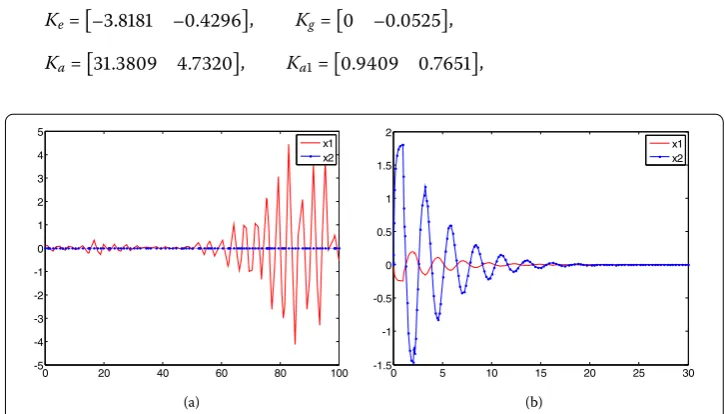
when u(t) = , by solving LMIs conditions in Theorem via the Matlab LMI toolbox, we cannot obtain feasible solutions. That is, the nominal neutral singular system is not stable. The state responses of the system with initial conditionsx(t) = [. ]Tare given in Figure (a). Solving LMIs in Theorem withγ = . via the Matlab LMI toolbox, we can get the feasible solutions:
P–=
. . . .
, Q– =
. –. –. .
.
This solution leads to the following state feedback controller gains:
Ke=–. –., Kg= –.,
Ka=. ., Ka=
. .,
(a) (b)
and the PD state feedback controller is
u(t) = (K–Kg)x(t) +˙ Kgx(t˙ –τ) +Kax(t) +Kax(t–h).
The state responses of the closed-loop system with the initial conditionx(t) = [. ]T is given in Figure (b), which demonstrates the applicability of the proposed method.
Example Consider the uncertain neutral singular system (a) and (b). The parameters
of the system are assumed as follows:
E=
, G=
–.
–. –.
, A=
–
–
,
A=
–
, B=
, B=
, C=I,
H= , Na=Na=
. ., Ne=Ng= .
It is assumed that the uncertain matrix is given asF(t) = [sint sint]T.
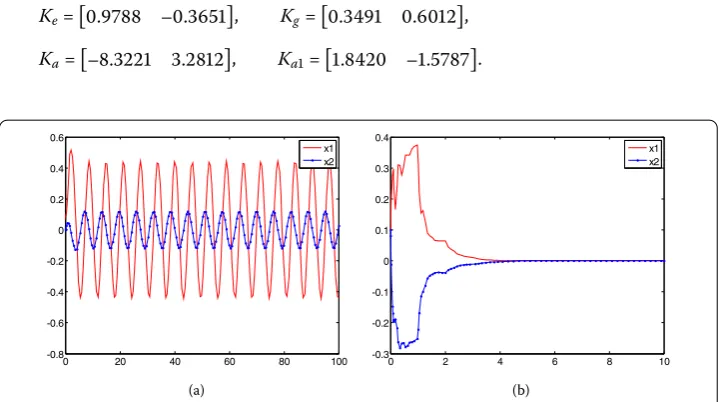
We takeγ = ., whenu(t) = , by solving the LMIs conditions in Theorem via the Matlab LMI toolbox, we cannot obtain feasible solutions. That is, the uncertain neutral singular system is not stable. The state responses of the system with the initial conditions x(t) = [. .]Tare given in Figure (a). By solving LMIs in Theorem via the Matlab LMI toolbox, we can get the feasible solutions:
P–=
. –. –. .
, Q– =
. . . .
.
This solution leads to the following PD state feedback controller gains:
Ke=. –., Kg=. .,
Ka=–. ., Ka=
. –..
(a) (b)
It is assumed that the uncertain matrixEc,Gcin closed-loop system () are given as F(t) = [sint sint]T. For anyt∈[, +∞] and with the above designed controller, the deter-minant of the derivative matrices of the corresponding closed-loop system is
det(Ec–Gc) = .= ,
which implies that the derivative matrixEc–Gcof the closed loop system is invertible. The state responses of the closed-loop system with initial conditionx(t) = [. .]Tis given in Figure (b), which demonstrates the applicability of the proposed method.
6 Conclusions
In this article, we have dealt with theH∞performance analysis and theH∞control
prob-lem for uncertain neutral singular systems with norm-bounded parameter uncertainties. By using the free-weight matrix method and the LMI technique, we have novel criteria which ensure the neutral singular system under consideration to be stable while satisfying a prescribedH∞performance level. Based on this, sufficient conditions for the existence
of PD stateH∞controllers have been proposed. Compared with some existing results, the
obtained PD stateH∞controller can change the derivative matrices. Based on the crite-ria, numerical examples have been provided to illustrate the effectiveness of the proposed method.
Competing interests
The authors declare that they have no competing interests.
Authors’ contributions
The authors read and approved the final manuscript.
Author details
1Institute of Systems Science, Northeastern University, Shenyang, Liaoning 110819, China.2College of Science, Liaoning
University of Technology, Jinzhou, Liaoning 121001, China.3State Key Laboratory of Synthetical Automation for Process
Industries, Northeastern University, Shenyang, Liaoning 110819, China.4School of Information Science and Engineering,
Northeastern University, Shenyang, Liaoning 110819, China.
Acknowledgements
The authors would like to thank the anonymous reviewers for their helpful and constructive comments to improve the quality of this note. This paper is supported by the National Natural Science Foundation of China (No. 61203214 and No. 61273008).
Received: 5 August 2015 Accepted: 10 January 2016 References
1. Ren, J-C, Zhang, Q-L: Non-fragile PD stateH∞control for a class of uncertain descriptor systems. Appl. Math. Comput. 218, 8806-8815 (2012)
2. Doyle, JC, Glover, K, Khargonekar, PP, Francis, BA: State space solutions to standardH2andH∞control problems. IEEE
Trans. Autom. Control34(8), 831-847 (1989)
3. Feng, Z, Lam, J, Gao, H: Delay-dependent robustH∞controller synthesis for discrete singular delay systems. Int. J. Robust Nonlinear Control21(16), 1880-1902 (2011)
4. Masubuchi, I, Kamitane, Y, Ohara, A, Suda, N:H∞control for descriptor systems: a matrix inequalities approach. Automatica33(4), 669-673 (1997)
5. Yang, G-H, Wang, J-L: Non-fragileH∞control for linear systems with multiplicative controller gain variations. Automatica37(5), 727-737 (2001)
6. Chen, Y, Zheng, W-X, Xue, A: A new result on stability analysis for stochastic neutral systems. Automatica46(12), 2100-2104 (2010)
7. He, Y, Wu, M: Delay-dependent robust stability criteria for uncertain neutral systems with mixed delays. Syst. Control Lett.51(1), 57-65 (2004)
8. Fridman, E: New Lyapunov-Krasovskii functionals for stability of linear retarded and neutral type systems. Syst. Control Lett.43(4), 309-319 (2001)
10. Hu, G-D, Liu, M-Z: Stability criteria of linear neutral systems with multiple delays. IEEE Trans. Autom. Control52(4), 720-724 (2007)
11. Muthukumar, P, Rajivganthi, C: Approximate controllability of impulsive neutral stochastic functional differential system with state-dependent delay in Hilbert spaces. J. Control Theory Appl.11(3), 351-358 (2013).
doi:10.1007/s11768-013-2061-7
12. Niculescu, SI, Brogliato, B: Force measurements time-delays and contact instability phenomenon. Eur. J. Control5, 279-289 (1999)
13. Kuang, J-X, Tian, H-J, Shan, K-T: Asymptotic stability of neutral differential systems with many delays. Appl. Math. Comput.217, 10087-10094 (2011)
14. Baštinec, J, Diblík, J, Khusainov, DY, Ryvolová, A: Exponential stability and estimation of solutions of linear differential systems of neutral type with constant coefficients. Bound. Value Probl. (2010). doi:10.1155/2010/956121
15. Shatyrko, AV, Khusainov, DY, Diblík, J, Baštinec, J, Ryvolová, A: Estimates of perturbation of nonlinear indirect interval control system of neutral type. J. Autom. Inf. Sci.43(1), 13-28 (2011). doi:10.1615/JAutomatInfScien.v43.i1.20 16. Shatyrko, AV, Khusainov, DY: On a stabilization method in neutral type direct control systems. J. Autom. Inf. Sci.45(12),
1-10 (2013). doi:10.1615/JAutomatInfScien.v45.i12.10
17. Shatyrko, A, Nooijen, RRP, Kolechkina, A, Khusainov, DY: Stabilization of neutral-type indirect control systems to absolute stability state. Adv. Differ. Equ. (2015). doi:10.1186/s13662-015-0405-y
18. Zhao, Y-X, Ma, Y-C: Stability of neutral-type descriptor systems with multiple time-varying delays. Adv. Differ. Equ. 2012, 15 (2012). doi:10.1186/1687-1847-2012-15
19. Li, H, Li, H-B, Zhong, S-M: Stability of neutral type descriptor system with mixed delays. Chaos Solitons Fractals33(5), 1796-1800 (2007)
20. Chen, W-H, Zheng, W-X: Delay-dependent robust stabilization for uncertain neutral systems with distributed delays. Automatica43(1), 95-104 (2007)
21. Xu, S-Y, Lam, J, Zhou, Y, Sun, M-H:H∞control for neutral systems via non-fragile state feedback controller. In: International Conference on Control, Automation, Robotics and Vision, Kunming, China, 6-9 December, pp. 48-51 (2004). http://hdl.handle.net/10722/46614
22. Xia, H-W, Zhao, P-P: A novel approach toH∞control design for linear neutral time-delay systems. Math. Probl. Eng. 2013, Article ID 526017 (2013). doi:10.1155/2013/526017
23. Mahmoud, MS: RobustH∞control of linear neutral systems. Automatica36, 757-764 (2000). doi:10.1016/S0005-1098(99)00159-4
24. Deng, S-J, Liao, X-F, Guo, S-T: Asymptotic stability analysis of certain neutral differential equations: a descriptor system approach. Math. Comput. Simul.79(10), 2981-2993 (2009)
25. Lan, Q-X, Feng, C-Y: State feedback stabilization of neutral type descriptor systems. In: 2009 World Congress on Computer Science and Information Engineering, pp. 247-251 (2009). doi:10.1109/CSIE.2009.125
26. Yin, S, Zhu, X, Kaynak, O: Improved PLS focused on key performance indicator related fault diagnosis. IEEE Trans. Ind. Electron.62(3), 1651-1658 (2014)
27. Yin, S, Zhu, X: Intelligent particle filter and its application on fault detection of nonlinear system. IEEE Trans. Ind. Electron.62(6), 3852-3861 (2015). doi:10.1109/TIE.2015.2399396
28. Hale, JK: Theory of Functional Differential Equations. Springer, New York (1977). doi:10.1007/978-94-015-8084-7 29. Li, X-G, Zhu, X-J: Stability analysis of neutral systems with distributed delays. Automatica44(8), 2197-2201 (2008) 30. Liu, X-G, Wu, M, Martin, R, Tang, M-L: Stability analysis for neutral systems with mixed delays. J. Comput. Appl. Math.
202(2), 478-497 (2007)
31. Wang, H-J, Xue, A: Delay-dependent robust stability criteria for neutral singular systems with time-varying delays and nonlinear perturbations. In: American Control Conference, pp. 5446-5451 (2009). doi:10.1109/ACC.2009.5160318 32. de Souza, CE, Li, X: Delay-dependent robustH∞control of uncertain linear state-delayed systems. Automatica35(7),
1313-1321 (1999)