Extending Knowledge Management to
Mobile Workplaces
Derballa, Volker and Pousttchi, Key
University of Augsburg
2004
Online at
https://mpra.ub.uni-muenchen.de/3616/
Extending Knowledge Management to Mobile Workplaces
Volker Derballa MAN B&W Diesel AG
Stadtbachstraße 1 86224 Augsburg, Germany
+49 (821) 322-4237 [email protected]
Key Pousttchi
University of Augsburg, Business School Chair of Business Informatics and Systems Engineering
86135 Augsburg, Germany +49 (821) 598-4431
ABSTRACT
Knowledge and Knowledge Management (KM) are evolving into an increasingly eminent source of competitive advantage. How-ever, for the time being, the potential of KM is usually limited to stationary workplaces. This excludes a multiplicity of mobile workers, many of them in charge of knowledge-intensive activi-ties. This paper examines the capabilities and limitations of mo-bile technology usage in order to support KM. After a general overview of KM, the relevant mobile technology is introduced. Subsequently, the theoryof mobile added values is employed to analyze the contributions of mobile technology for supporting KM in the different phases of the KM process. Especially the process of knowledge distribution is qualified to be supported through mobile technology.
Categories and Subject Descriptors
H.1.1 [Models and Principals]: Systems and Information Theory – value of information. H.4.2 [Information Systems Applica-tions]: Types of Systems – decision support. I.2.0 [Articifical Intelligence]: General.
General Terms
Management, Theory
Keywords
Knowledge Management, Mobile Commerce, Mobile Knowledge Management, Mobile Business Processes, Mobile Added Values
1.
INTRODUCTION
Knowledge and Knowledge Management (KM) are gaining more and more attention in the field of management science and prac-tice lately. This development can be observed by an increasing number of publications since the 1990s (e.g.[6, 18]) addressing the question of how knowledge in organizations can be organized and managed. Peter Drucker was one of the first to emphasize the diminishing role of the industrial age’s factors of production. The relevance of labour, capital and land is going to pale in compari-son to knowledge as the eminent source of competitive advantage [8].
Technologies used in KM include databases storing best practices to artificial intelligence tools to support human decision making processes. What those solutions have in common is the fact that they are designed for stationary workplaces and consequently re-quire the corresponding infrastructure, i.e. personal computers and fixed line network access. Thus, they do not cater for business processes in which workers move around inside or outside the premises. Consequently, workers are no longer supported by the
knowledge pool that is available in their organizations once they have to perform a task outside of the office. Organizations with parts of the workforce belonging to one of the following classifi-cations are concerned in that context [25]:
• Specialists, mobile on the premises: e.g. in-house tech-nicians.
• Specialist, mobile outside the premises: e.g. members of the sale force.
• Specialists and executives in companies with mobile operations: e.g. organizations like contracting business or police and armed forces.
• Decision markers: e.g. executive officers with the re-quirement to make timely and well-funded decisions disregarding their current position.
As the aspect of mobility is underrepresented in KM literature, although the importance of mobile business processes is growing (e.g. [11]), we aim to provide a framework for the management of knowledge in mobile settings, i.e. mobile KM. In order to do that, we will resort to the insights gained in the discussion of mobile commerce. As both concepts have not yet been put together, we think that especially regarding the integration of knowledge flows and business processes, substantial benefits can be derived by merging the ideas behind mobile technology and KM.
2.
KNOWLEDGE MANAGEMENT
The majority of recent publications stress the importance of KM substantiating this proposition with the tremendous changes in the context organizations are operating today. The call for action is made by presenting examples like the production of intelligent products and services [23]. As the added value in those products and services is created not mainly by the combination of the clas-sical factors of production, but instead by the expertise embedded in those products, knowledge becomes a vital prerequisite for achieving competitive advantage. This development is aggravated by the fact that necessary knowledge is often not available in one single organization, but has to be sourced and integrated from several internal and external sources. Additionally, the environ-ments and market conditions are influenced by rapid changes, shorter product life cycles and as a result intensify this develop-ment.
The wider context for the growing relevancy of knowledge can be seen in the transition from information paradigm to the knowledge paradigm. It is argued that during the information era relatively stable conditions allowed organizations to make decisions based on information stored in databases, whereas in the knowledge era, the solely processing of information is not sufficient anymore to cope with a dynamic environment [17].
2.1
Knowledge
Before addressing the issue of mobile technology and KM, it is necessary to elaborate a working definition of knowledge. Scien-tific literature is providing a wide range of often contrary ap-proaches. Knowledge is described as “(…) a fluid mix of framed experience, values, contextual information, and expert insight that provides a framework for evaluating and incorporating new ex-periences and information (…)” [6] or as "(...) information that is relevant, actionable, and based at least partially in experience” [16]. Holsapple, for example differentiates between four different perspectives of knowledge including the knowledge versus infor-mation view [13]. That perspective considered as a quasi consen-sus as it is found in the majority of KM literature.
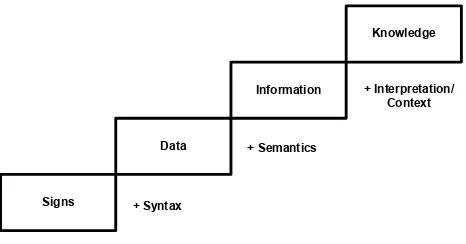
[image:3.595.311.544.105.227.2]One of the authors representing this point of view is North [20]. His knowledgestair, which is used to demonstrate the importance of knowledge as source of competitive advantage, can be referred to for visualizing the characteristics of knowledge. In Figure 1 we therefore isolated the elements conferring the idea of how knowl-edge is developed [20]: Information - derived from signs and data - is the basis for knowledge as soon as it is associated with context respectively other information or is interpreted. For example, starting with signs (e.g. “0123”) and structuring them with syntax will result in data (e.g. “10.23”). Data plus semantics become in-formation (e.g. “10.23 refers to the relative improvement in sales figures in per cent”). For the decision maker such information is useless relatively [24], because he cannot assess whether, as in this example, the increase can be judged as being sufficient, i.e. he cannot judge the value of that information.
Figure 1: Knowledge Stair (cf. North 1999, p. 41) Only in the context with other information or experiences, one is able to determine that an increase of 10.23 percent would be con-sidered as a positive achievement indeed for a company operating in a shrinking or stable market, whereas it would be considered below average for a company operating in markets with high growth rates. In the following, for the purpose of this paper, we use the term knowledge, as presented by the knowledge versus information perspective.
With tacit and explicit knowledge two different modes of knowl-edge representation can be introduced [19]. Tacit knowlknowl-edge is knowledge that is embedded in human actors, routines, etc. and thus cannot be easily shared or distributed. Explicit knowledge on the other hand is coded knowledge; i.e. knowledge that has been explicated from humans and brought e.g. into the form of manuals or lecture notes, so it can be shared easily.
It is argued (e.g. [21]) that knowledge does exist only within hu-man actors. That implies that the explicit representation of knowl-edge - i.e. knowlknowl-edge that has been codified - is referred to as information. As there is a substantial difference between coded knowledge, which has been stored in a best practices database and information, we do not think that this view would be helpful. Fur-ther, it would add even more confusion to the information-knowledge dilemma. Thus, for those information-knowledge artefacts that have been explicated from human actors and stored in some form of repository or are embedded in some form of knowledge repre-sentation, we also use the term knowledge.
2.2
Knowledge Management Concepts
After having defined the knowledge perspective we are referring to, the next step is to provide an overview over the KM process. As it is the case with knowledge, the term KM is used for a wide variety of approaches. [12] e.g., describing KM as a system of activities to permit the utilisation of organizational knowledge by the members of that organization is pursuing a very global ap-proach. The following approach however, regarding KM as a process consisting of creation, validation, presentation, distribu-tion and applicadistribu-tion of knowledge [4], provides us with a frame-work that fits the operational view we are taking on in the case under consideration best. Further, we think that whatever KM ap-proach is used, it essentially comes down to those functions:
Knowledge creation refers to a process in which new knowledge is created by combining and integrating different modes of knowl-edge.
Knowledge presentation refers to the display of knowledge, i.e. different formats, data standards etc.
Knowledge distribution deals with sharing and distributing of knowledge between cooperating organizations and among or-ganization members.
Knowledge application is the term for the use of knowledge in a particular context.
It is obvious, considering the perspectives presented above, that depending on the knowledge definition, there are far reaching consequences arising for the KM process. To take on the systems perspective view would result in the fact that every process deal-ing with useful representations would have to be regarded as KM. However, as those representations - data and information - can serve as an input for the human knowledge creation process, we regard the processes dealing with the objects data, information or knowledge, as KM in the broader sense. KM in narrower sense however, exclusively deals with the object knowledge.
One concept that is often mentioned within the discussion of strategies aiming at the improvement of an organization’s knowl-edge basis is business intelligence (BI). Carefulness has to be ap-plied though, in order to avoid the mistake of considering the solely employment of business intelligence tools as KM. The term Business Intelligence is used to describe tools on the basis of models and methods to analyse available structured data [10]. The focus is rather on data and analysis of data, which is a clear differ-ence to KM. KM on the other hand, comprises not exclusively technological aspects, but to an even greater extent, soft factors like organizational and human elements. Taking this into account, Business Intelligence can be described as a mere tool of KM, i.e. a supporting pillar, but not as an equivalent of KM.
As far as the direction of impact is concerned, with the emphasis put either on technological or social aspects, two main strategies can be differentiated (e.g.[3]). The codification or technical strat-egy implies that knowledge is not solely embedded in humans, but can be provided to knowledge users - after having gone through the process of explication - in codified form. In contrast to that, the personification or social strategy refers to tacit knowledge and leveraging knowledge exchange on the inter-personal level. Be-cause of those differences, the codification strategy is closely linked to establishing knowledge management systems [27]. As examples for such technological solutions knowledge databases or repositories can be cited. The personification strategy on the other hand aims at fostering knowledge creation and exchange trough e.g. cultural factors, team work [19] or face-to-face communica-tion. However, as both strategies cannot be credited to include the absolute truth, we - for the mobile KM framework - are consider-ing both perspectives and pursue a holistic approach.
2.3
KM Techniques
In the field of KM a wide variety of techniques are employed in order to ensure that the KM process is sufficiently supported. The following sections present exemplary applications that will be used later to demonstrate how mobile technology can support as well as improve the KM process.
Expert Finder
Expert finder is a tool that can be used to identify and contact the relevant expert whose help is needed in the course of a problem solving process. It is usually build on a database in which the ex-pert’s profile including a description of his knowledge domain stored.
Virtual Teamwork
Virtual teamwork refers to work conducted by a team consisting of geographically dispersed members usually enabled through IT support.
Lessons Learned Database
Lessons learned refers to a concept that deals with the documenta-tion and preservadocumenta-tion of positive as well as negative experiences which occurred in the course of a problem solving process in or-der to ensure their reutilization respectively their future preven-tion (e.g. [21]).
Case Based Reasoning
Case based reasoning (CBR) is a concept describing a problem solving process based upon the solutions of previous similar prob-lems. For that reason a database is created with past cases includ-ing the respective solution. In order to process a new case a similar case is retrieved from the database and its solution adapted to the new case and reused. The insights gained in that process are then stored (e.g. [5]).
Virtual / Augmented Reality
Virtual reality (VR) refers to an environment simulated by com-puters as a general term whereas augmented reality describes the use of see-through displays to enable computer generated images to be overlaid on top of the user’s view of the real world. This technology can be used to support or assist human actors in cer-tain kinds of knowledge processes through visualization of e.g. instructions.
2.4
Deficits
and fixed line internet access is certainly a substantial achieve-ment, but in this context is not regarded as a truly mobile solution. Analysing business processes with mobile elements it is obvious that - taking the insufficient integration of the mobile workplace into account - for the task of entering knowledge into or retrieving it from repositories, it is usually required interrupting the actual task. A mobile worker can access his company’s knowledge infra-structure not at all or only indirectly using a mobile phone to con-tact colleagues of whom he expects to get some help regarding a certain problem. This leads to a time consuming process, in which workers spend time ineffectively searching for knowledge instead of pursuing their actual task. Further, that results in double work and is exactly what has to be avoided, considering the goal of making access to knowledge as simple as possible.
3.
MOBILE TECHNOLOGY
3.1
Devices
Mobile devices are devices that have been developed for mobile use [25]. Thus the category of mobile devices encompasses a wide spectrum of appliances. Although the laptop is often included in the definition of mobile devices (e.g. [22]), we exclude it here due to its special characteristics: It can be moved easily but is usually not used during that process. For that reason we argue that the laptop cannot be seen as a truly mobile device.
The following types of mobile devices posses the pertinence to be employed in the context of mobile KM:
Tablet PC describes a modification of the laptop, which can be used in stationary as well as mobile settings. PDA refers to a handheld computer with core functionality similar to a personal information manager. Current models include the possibility to establish an internet connection using a modem supported mobile phone, GSM cards, integrated mobile phone technology or can be equipped with wireless LAN cards for medium-range connectivity at high bandwidths. Operating systems are similar to that of con-ventional PCs. Smartphone is a device that can only be roughly defined, as there is no clear delineation. Typical characteristics of Smartphones include mobile phone functionality and an operating system that is similar to that of a PDA. Mobile Phones are mobile devices that are geared primarily at the use of the telephone func-tionality. 2 G mobile phones are usually internet enabled and sup-port Short Message Service. With Java supsup-port, even complex applications can be implemented. Additionally, proprietary de-vices, which have been designed according to the specific needs of an organization, have to be considered as well. However, as those devices are usually derived from the types introduced above, we are not going to specify them further. Limitations for the use in the mobile KM context arise above all due to display sizes and input possibilities as well as bandwidth and transfer modes. With the exception of Tablet PCs, the displays sizes range from few lines only (mobile phone) to a resolution of 240 x 320 or larger (PDA). Regarding the input methods, the possibilities vary from a restricted number of pushbuttons that enable operating simple menus to more sophisticated solutions like hand writing recogni-tion or virtual keyboards.
3.2
Communication Standards
If it comes to communication standards, two main standards are currently available for the transmission of data: 2G (e.g. GSM, IS-136, IS-95) and 3G (UMTS). Whereas the 2G networks are gener-ally capable for transmitting data, they are optimized for voice
transmission. With 2.5 technologies like GPRS and EDGE how-ever, packet transmission is possible, which enables always on operation. Using up to 8 time slots, data speeds of a maximum of 171.2 kbps can theoretically be achieved. However, due to the restricted capacity of current mobile devices and networks, a real-istic downlink speed of approximately 40.2 kbps to 62.4 kbps can be expected. The advent of UMTS will make bandwidth concerns increasingly negligible, enabling transfer rates up to 384 kbps (us-ing UMTS FDD) respectively 2mbps (us(us-ing UMTS TDD), al-though the realistic speed - depending on network capacity - will be located at around 128kbps, as well as further technological im-provements. For mobile devices used within the premises, the bandwidth problem can be neglected, considering the application of wireless LAN technologies. Handheld devices with WLAN connectivity are already in rapid advance in industrial production management, which provides a promising base for in-premises mobile KM.
3.3
Mobile Added Values
In order to verify the contribution mobile technology can make to KM, we are referring to the theory ofinformational added values [14], which has been augmented with mobile added values (MAV) [2]. We state that for the success of mobile offers it is not sufficient to merely make a conventional offer available with new media. Instead, the use of mobile communication technology is only remunerative, if it results in obtaining distinct supplementary IAV, e.g. efficiency added values or effectiveness added values. This depends on the exploitation of certain faculties of the used technology. MAV refer to properties of mobile technology and its utilization. Thus, MAV answer the question: What can "M" do, what "E" cannot? Or: What does “M” have that “E” does not? MAV only represent a potential, and a mobile solution does not have to take advantage of any MAV. But in order to gain supple-mentary IAV, at least one MAV has to be employed; otherwise, the use of mobile technology is not remunerative. In the following we are introducing the MAV ubiquity, context-sensitivity, identi-fying functions and command and control functions:
Ubiquity
Ubiquity is the possibility to send and receive data anytime and anywhere and thus eliminates any spatiotemporal restriction. It is originated not only in the technical possibility, but also in the typical usage of mobile devices that accompany their user nearly anytime and anywhere. It permits the reception of time-critical and private information. Ubiquity effects accessibility of mobile services anytime and anywhere for the user, which affects reaction time and convenience aspects of services. But it affects also the reachability of users, which primarily means to reach a single user anytime, anywhere.
Context-Sensitivity
Another typical attribute is context-sensitivity, which describes the delivery of customized products or services fitting the particu-lar needs of the user in his current situation. This is particuparticu-larly enabled by three features:
text typically uses only one mobile device, resulting in data of high accuracy.
Interactivity allows creating specific services through direct in-formation exchange. Both sides can react without any delay on actions or requests of the other.
Location determination allows creating specific products and ser-vices for the user in his current location or by referencing on the location of other users.
Particularly, combinations of these concepts allow determining a user's context. Typical applications based on the MAV of context-sensitivity are location based services.
Identifying Functions
The ability to authenticate the user as well as the device is already immanent to a mobile network. Together with the aforementioned typical 1:1-attribution of a mobile device to its user this provides a capability to authenticate the actual user with feasibility already sufficient for most applications. Where necessary, further means of authentication on the device, from a personal identification number to biometric identification or mobile signatures can easily be applied.
Command and Control Functions
The last properties to present are command and control functions of mobile devices. Mobile devices can be used as remote control for almost any application or device. For this purpose they use networking capabilities of any range, from the personal or local area network up to the wide area network. If the target is an appli-cation, it has just to be connected to the Internet. If the target is a device (which can be almost any electrical device), control may be realized e.g. using networking capabilities via ubiquitous comput-ing technology or embedded mobile devices.
4.
USAGE OF MOBILE TECHNOLOGY IN
THE KM PROCESS
As stated above, possible benefits of KM are restricted because of the inadequacy to facilitate ubiquitous access to knowledge. Ana-lysing the conventional business process, it is very obvious that there is an ineffective respectively non existing integration of knowledge into business processes that include mobile aspects. The solution is to develop mobile KM processes that take into account the different work settings. Using the potentials of mobile technology, substantial contributions can be made in this area.
4.1
Definition
Regarding mobile KM, several approaches are summarized under this term ranging from fleet management to expert finders (e.g. [9, 15]). Based on that, the following classification aims at combining similar approaches into distinct groups:
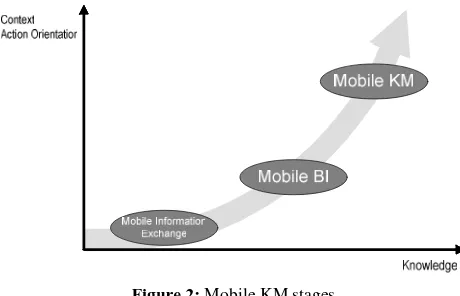
Mobile Information Exchange includes the transfer of data and information using e.g. email as well as the access to operational systems used in an organization to retrieve e.g. sales figures or market data.
Mobile Business Intelligence refers to the access of processed en-terprise data using mobile devices. It involves the technologies introduced earlier (e.g. data mining and data warehousing).
Mobile KM describes a management process in the course of which mobile communication techniques in conjunction with mo-bile devices are employed for the creation, validation, presenta-tion, distribution or application of knowledge. Additionally,
mobile KM must be integrated in the comprehensive KM process introduced earlier.
[image:6.595.310.540.184.332.2]Those groups can be regarded as different evolution stages of mo-bile KM, as depicted in Figure 2. Momo-bile data access as well as mobile BI serve as supporting technologies in the context of mo-bile KM as they represent the input for human knowledge creation and thus can be referred to as mobile KM in the broader sense.
Figure 2: Mobile KM stages
4.2
Special Technological Requirements
For taking KM mobile, it has to meet the special requirements that are associated with mobile technology. In contrast to the area of mobile commerce catering for B2C, mobile KM aims almost ex-clusively at the intra-organizational or the inter-organizational (i.e. B2B) use. That enables the particular organization to choose the most appropriate technology for the desired KM solution and regulate its use. The same is true for an intra-organizational level, where the employed technology can be determined by an agree-ment with the respective business partners. Compared with B2C mobile commerce, that results in a considerable advantage, as an optimal fit between the type of mobile devices and the employed KM solution is ensured. Thus, problems (e.g. displays of insuffi-cient size or insuffiinsuffi-cient processing power) arising due to the het-erogeneity of devices can be avoided. Further, the employment of devices can be intentionally managed in order to ensure the fit of individual user’s KM needs and the particular features of the dif-ferent mobile devices. Where the employment of mobile devices is concerned, every type of device introduced earlier, can be used in the KM process. However, depending on the underlying KM stage particular devices seem to be more appropriate than others.
Mobile Information Exchange
For the retrieval of data and information any kind of mobile de-vice can be used that features the basic capability of displaying text. It has to be taken into account though, that for reading longer textual information, the use of small display devices is not very feasible. Mobile phones thus are suited best for the display of relatively small amount of data and information.
Mobile Business Intelligence
in that context. Consequently, Smartphones as well as PDAs meet the minimum requirements for that mobile KM stage.
Mobile KM
In this context, we are referring to the definition of KM in the nar-rower sense introduced above. The specific requirements for mo-bile devices used, results from the type of KM technique that is taken mobile. For low technology KM solutions like expert finder applications - as long as no graphical visualization is used - even mobile phones can be considered. However, with the growing richness of the KM solution, the requirements regarding display, processing power and entering methods increase dramatically. That is e.g. the case if a lessons learned database includes com-plex graphics in order to visualize the steps that have been suc-cessfully undertaken to fix a certain problem.
4.3
Application of MAV
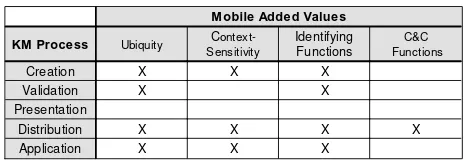
In order to verify the contribution mobile technology can make to KM we are referring to the MAV. Taking into account the two approaches introduced earlier - i.e. the codification and the per-sonification strategy - we have examined each KM process re-garding the mobile added values that can be generated through the use of mobile devices. Table 1 presents an overview of the results:
Knowledge creation is supported through the mobile added value of ubiquity as that aspect allows the creation of knowledge regard-less of spatial and temporal restrictions.
[image:7.595.53.286.430.511.2]This refers to the enabler function mobile technology is inherent when it comes to virtual teamwork and to the mobile access to knowledge repositories.
Table 1: Impact of MAV on the KM process
M obile Added Values KM Process Ubiquity
Context-Sensitivity
Identifying Functions
C&C Functions
Creation X X X
Validation X X
Presentation
Distribution X X X X
Application X X X
Context-sensitivity and identifying functions act as supporting factors in that context. They facilitate the documentation of the knowledge creation process. Using those values it becomes possi-ble to gather information about how the context knowledge was created as well as about the participating users.
Knowledge validation benefits from the aspect of ubiquity as the verification of knowledge becomes possible immediately in the moment an event has occurred that leads to a new judgement of existing knowledge. Furthermore, the MAV identification func-tion enables an accurate documentafunc-tion of the user responsible for the validation.
Knowledge presentation is only supported to a very low degree regarding all four MAV.
Knowledge distribution is improved by the ability of mobile tech-nology to deliver knowledge everywhere (MAV ubiquity), adapted to the relevant context (MAV context-sensitivity), and appropriate for the individual user (MAV identification func-tions). Taking that into account it becomes possible to employ a push approach and deliver the knowledge to the user instead of having the user actively retrieving knowledge. Thus the overall KM process is considerably improved as it is no longer necessary
for knowledge seekers to be actively involved in the process of determining what knowledge is relevant for them. Instead, the relevance can be to some degree be determined by the context. Thus the knowledge seeker is relieved by that burden. Further, to retrieve knowledge, the knowledge seeker has to have a certain understanding of what he is looking for. Without that, it is almost impossible to find that knowledge, which is relevant in a particu-lar context. By switching from pull to push, this problem can be attenuated. In addition the MAV control and command functions enable the control of KMS using mobile devices.
Knowledge application is enhanced indirectly by the fact that mo-bile technologies make it possible to have relevant knowledge delivered to the individual user regardless of spatial and temporal restrictions and thus ensure that “insufficient knowledge in time-of-action” is avoided.
The results of the analysis conducted demonstrate the substantial impact of mobile technologies on the process of knowledge distri-bution. Considering the different roles individual MAVs play in the context of mobile KM an order of relevancy can be identified. The primary MAV is ubiquity as it extends the reach of KM and KMS. The other MAV act as supporting factors with context-sensitivity and identifying functions coming second and control and command functions ranking third.
5.
Mobile KM USE CASES
The following theoretical cases are based on KM tools that have been put in the mobile context. By doing so, the benefit of mobile technology for the area of KM is demonstrated and evaluated ac-cording to the theory of MAV.
5.1
Knowledge Creation through Virtual
Teamwork
Teamwork is conducted in order to solve tasks that cannot be managed by an individual worker. However, it requires the team members to be situated in the same location in order to allow face-to-face communication. Accordingly, in the case of dispersed team members this form of knowledge creation becomes obsolete. Traditionally, in that case the communication is restricted to syn-chronous or asynsyn-chronous modes, using telephone or email. As these media do not allow rich content to be exchanged, the poten-tial to create knowledge is very limited.
With support of mobile technology in combination with video conferencing it becomes possible to work out solutions together as a team communicating richer content and thus creating new knowledge in that process.
MAV: In that context the MAV of ubiquity enables the creation of knowledge in a team situation with locally dispersed members.
5.2
Knowledge Validation in the Case of
Les-sons Learned Database
the selling point put forward in the past is no longer valid for this special customer segment. In case the sales agent will not return to his office for several days or weeks, it is not unlikely that he for-gets to update the lessons learned database confronted with new tasks.
Using mobile technology to access to the lessons learned reposi-tory enables mobile workers immediately after having gained new insights regarding a certain work practice to mark the relevant lesson as no longer valid or to update it. By marking this particu-lar lesson as outdated the update process can be triggered and it can be ensured that other workers are no longer using these les-sons.
MAV: The MAVs involved in this use case are ubiquity, identify-ing functions and command and control functions. Ubiquity en-ables the sales agent to update the database disregarding his location. Using the identifying function it is possible to exactly identify the user who conducted the update. Command and con-trol functions make it possible to remotely operate KM applica-tions, in order to prevent other workers from recurring to the same outdated lessons learned.
5.3
Knowledge Distribution through CBR
It is the task of property agents to evaluate property and act as an intermediate between buyers and sellers. Evaluating property usu-ally requires a visit and taking notes about the characteristics and conditions of the property. Integrating this with the implicit knowledge about the current price level for that type of property and taking into account additional information like price indices as well as soft factors, a sales price is calculated. This process is accomplished mainly by doing mental work but can be automated using artificial intelligence tools. What is not improved by this is the fact that double work is required due to the necessity of enter-ing the notes taken durenter-ing the day.
Accessing this pricing tool with mobile devices can eliminate the double work and thus speed up the work process. Additionally, because property agents can resort to knowledge in the form of this pricing tool, they need less training and are able to evaluate property without having a large amount of implicit knowledge.
MAV: In this use case the MAVs of ubiquity and context-sensitivity improve the KM process. Through context-context-sensitivity, the CBR tool is provided with the location of the user and thus automatically can refer to the relevant price index for that housing area.
5.4
Knowledge Application with VR
To assembly an aircraft is a highly complex process that cannot easily be automated. Thus a large degree of knowledge in combi-nation with experience as well as the access to manuals and in-structions is required for the technicians working in this context. Recurring to VR, which has been taken mobile, would allow technicians to be supported in this process. The use of see-through displays enables computer generated images to be overlaid on top of reality. This way instructions and can be projected on the dis-play and doing so enables technicians with less practice to con-duct that special task.
MAV: The MAV involved here, is again ubiquity, allowing knowledge to be applied in a situation that otherwise could not be supported by knowledge management applications.
6.
CONCLUSIONS AND OUTLOOK
Knowledge as well as the active engagement with knowledge, i.e. KM, is an essential constituent of an organization’s successful strategy to stay ahead of the competition. Taking into account that in more and more business processes, work is conducted by or-ganization members in mobile settings, it is obvious that KM re-stricted on stationary workplaces alone cannot cater for a sufficient support of those knowledge workers. The gaps existing due to the insufficient integration of mobile workers can be filled employing mobile KM. Pointing out that it is not enough to sim-ply put KM applications mobile to reap the benefits of mobile knowledge support, the concept of mobile added values (MAV) was introduced. Using the mobile added values namely ubiquity, context-sensitivity, identifying functions as well as command and control functions enables us to verify and demonstrate the contri-bution mobile technology can bring to KM.
The benefits of mobile technology for KM purposes in the context of mobile workplaces can be grouped into the following catego-ries:
• Operational and process support.
• Social strategy support.
• Technical strategy support.
At an overall level, the operational and process support origi-nates mainly from the application of MAVs and the typical char-acteristics of mobile technology. That includes the potential to integrate KM applications into mobile business processes in order to avoid or reduce the otherwise necessary interruption of the ac-tual task. Because that way the underlying knowledge flows are supported and extra effort for the potential user of the KM appli-cation is reduced or avoided, the acceptance of such systems is positively influenced.
Focusing on the individual KM approaches, for the area of social strategy support, the improvement through the use of mobile technology can be derived from the capability to transfer richer media content in contrast to email and telephone (e.g. video con-ferencing). With richer content transmitted, greater knowledge sharing potential regarding inter-personal exchange can be ex-pected. On the other hand, mobile technology in connection with expert finder systems or virtual meeting support systems (e.g. [26]) can be used to improve the access to and initiate the ex-change with other workers or experts that otherwise could not be contacted at all or only with difficulties. Thus no time consuming search activity needs to be conducted, as expert finder applica-tions can immediately show the availability and location of rele-vant experts.
cially, when it comes to time critical knowledge, this improve-ment, in comparison to stationary KM solutions, can be regarded as being significant. Through use of the MAV context sensitivity, knowledge push is enabled, which implies a major benefit in con-trast to traditional solutions, in which the mobile worker actively has to seek and retrieve knowledge.
Further research is necessary to determine the way KM can be fully integrated in mobile business processes. Introducing the mo-bile KM into organizations can be expected to result in dramatic changes in the mode mobile business processes are conducted. Due to that, potential research question touch a wide variety of disciplines:
As it has to be expected that organizational structure is influenced as well, a framework like the adaptive structuration theory [7] can be used to analyze the effects of technology use for KM purposes on organizational structure. Even if mobile technology possesses the potential of leveraging the integration of KM with mobile business processes resulting in substantially less extra work for the application user, it has to be empirically studied to what de-gree this potential can be realized in practice. For the field of hu-man-computer-interaction (HCI), empirical studies need to be conducted to investigate the usability of mobile devices in the context of different KM technologies. Regarding the development and implementation of mobile KM applications, potential research questions include the integration of those applications with the relevant stationary business applications. It is necessary to proof the reliability of knowledge push capabilities in combination with the MAV context sensitivity in order to determine the accuracy and relevancy of the knowledge transmitted in the particular con-text. Further, legal aspects can exacerbate elements of the outlined use of mobile technology. The MAVs identifying functions and context sensitivity imply extensive possibilities for employers to trace every step of their employees. Finally, field studies that have been conducted in order to proof the feasibility of individual mo-bile KM applications need to be extended and integrated into the context of a holistic mobile KM approach.
7.
References
1. Ackermann, M.S., Pipek, V. and Wulf, V. (eds.). Shar-ing Expertise: Beyond Knowledge Management, Cam-bridge, Massachusetts, 2003.
2. Bazijanec, B., Pousttchi, K. and Turowski, K., An Ap-proach for Assessment of Electronic Offers. in FORTE 2004, (Toledo, 2004).
3. Becker, A., Hinkelmann, K. and Maus, H. Integrations-potenziale für Geschäftsprozesse und Wissensmanage-ment. in Becker, A., Hinkelmann, K. and Maus, H. eds.
Geschäftsprozessorientiertes Wissensmanagement: Ef-fektive Wissensnutzung bei der Planung und Umsetzung von Geschäftsprozessen, Berlin, 2002.
4. Bhatt, G.D. Knowledge Management in organizations: examining the interaction between technologies, tech-niques, and people. Journal of Knowledge Manage-ment, 5 (1). 68-75.
5. Bodendorf, F. Daten- und Wissensmanagement, Berlin, 2003.
6. Davenport, T.H. and Prusak, L. Working Knowledge: How Organizations Manage What They Know, Boston, 1998.
7. DeSanctis, G. and Poole, M.S. Capturing th Complexity in Advanced Technology Use: Adaptive Structuration Theory. Organization Science, 5 (2). 121-145.
8. Drucker, P.F. Post-Capitalist Society, New York, 1993. 9. Fagrell, H. Mobile Knowledge, Gothenburg Studies in
Informatics, 2000.
10. Gabriel, R. and Dittmar, C. Der Ansatz des Knowledge Managements im Rahmen des Business Intelligence.
HMD - Praxis der Wirtschaftsinformatik, 222.
11. Gruhn, V. and Book, M., Mobile Business Processes. in
Innovative Internet Community Systems, Third Interna-tional Workshop, IICS 2003, (Leipzig, 2003), Springer LNCS, 114-133.
12. Hannig, U. Zwei Welten wachsen zusammen. in Han-nig, U. ed. Knowledge Mannagement und Business In-telligence, Berlin, 2002.
13. Holsapple, C.W. Knowledge and Its Attributes. in Holsapple, C.W. ed. Handbook On Knowledge Mana-gement, Berlin, 2003, 165-188.
14. Kuhlen, R. Informationsmarkt: Chancen und Risiken der Kommerzialisierung von Wissen, Konstanz, 1996. 15. Lehner, F. and Berger, S. Mobile knowledge
manage-ment, Universität Regensburg, Lehrstuhl für Wirt-schaftsinformatik III, Regensburg, 2001.
16. Leonard, D. and Sensiper, S. The role of tacit knowl-edge in group innovation. California Management Re-view, 40 (3). 112-132.
17. Malhotra, Y. TOOLS@Work: Deciphering the Knowl-edge Management Hype. Journal for Quality & Partici-pation, 21 (4).
18. Nonaka, I. and Konno, N. The Concept of "BA": Build-ing a Foundation for Knowledge Creation. California Management Review, 409 (3).
19. Nonaka, I. and Takeuchi, H. The Knowledge Creating-Company: How Japanese Companies Create the Dy-namics of Innovation, New York, 1995.
20. North, K. Wissensorientierte Unternehmensführung: Wertschöpfung durch Wissen, Wiesbaden, 1999. 21. Probst, G., Raub, S. and Romhardt, K. Wissen
mana-gen: Wie Unternehmen ihre wertvollste Ressource op-timal nutzen, Wiesbaden, 2003.
22. Scheer, A.-W., Feld, T., Göbl, M. and Hoffmann, M. Das mobile Unternehmen. IM – Information Manage-ment & Consulting, 2. 7-15.
23. Schreiber, G., Akkermans, H., Anjewierden, A., de Hoog, R., Shadbolt, N., Van de Velde, W. and Wiel-inga, B. Knowledge Engineering and Management: The CommonKADS Methodology, Cambridge, Massa-chusets, 2000.
24. Sveiby, K.E. The New Organizational Wealth, San Francisco, 1997.
25. Turowski, K. and Pousttchi, K. Mobile Commerce - Grundlagen und Techniken, Heidelberg, 2003. 26. Wiberg, M., Knowledge management in mobile CSCW:
Evaluation results of a mobile physical/virtual meetinng support system. in 34th Hawaii International Confer-ence on System SciConfer-ences, (Mauii, Hawaii, 2001). 27. Wiig, K.M. Knowledge Management Methods: