Munich Personal RePEc Archive
Multiple bounded discrete choice
contingent valuation: parametric and
nonparametric welfare estimation and a
comparison to the payment card
Vossler, Christian A.
Department of Economics, University of Tennessee
2003
Online at
https://mpra.ub.uni-muenchen.de/38867/
MULTIPLE BOUNDED DISCRETE CHOICE CONTINGENT VALUATION: PARAMETRIC AND NONPARAMETRIC WELFARE ESTIMATION AND A
COMPARISON TO THE PAYMENT CARD
Abstract
Inmultiple bounded discrete choice (MBDC) surveys, respondents indicate how
certain they would be to vote in favor of a policy at different prices by choosing, for
example, among “definitely yes”, “probably yes”, “not sure”, “probably no”, and
“definitely no” response options for each price. In estimating non-market values from
MBDC data, past researchers have made markedly different assumptions with respect to
the assumed correlation of within-respondent decisions (one for each price) and the
correspondence of stated payment certainty to actual behavioral intentions. The first
objective of this paper is to provide guidance for future research efforts by
discriminating between existing models and proposing new estimators that relax some
important statistical assumptions of existing models. Contrary to a previous study,
results in this paper suggest that within-respondent decisions should be treated as being
perfectly correlated. The second objective is to examine whether it is worthwhile to
collect the additional information on payment certainty, as it may place additional
cognitive burden on respondents as well as data analysts. Using data from previous
studies, MBDC is compared with the payment card, a related elicitation approach that
does not gauge payment certainty. This comparison provides strong and systematic
evidence that “definitely yes” and “probably yes” MBDC respondents would vote “yes”
1. Introduction
Over three decades after its introduction, contingent valuation (CV) remains a
popular method for estimating the willingness to pay (WTP) for nonmarket goods,
especially those with a nonuse value component. Accepted practice is to ask a single
dichotomous choice (DC) valuation question, to which respondents simply answer yes
or no as to whether they are willing to pay the offered price for the nonmarket good.
The method is favored on cognitive grounds as answering the valuation question is
similar to voting in an election or making a market purchase. When properly framed,
DC questions also have desirable incentive properties (see Carson, Groves, and
Machina 2000). However, DC is notorious for extracting minimal information on the
respondent’s WTP. Further, researchers caution against assuming respondents are
absolutely certain of their yes or no decision. It is realistic to presume, for example, that
some respondents are indifferent to a yes or no vote (Opaluch and Segerson 1989) and
that subjects have an inherent (and perhaps predictable) randomness in their preferences
(Li and Mattsson 1995).
In order to address concerns about the accepted practice, a laundry list of
alternative elicitation mechanisms have been proposed in attempt to gather more
information on the respondent’s WTP. The double-bounded DC elicitation format and
its variants elicit yes/no answers to a sequence of two or more payment amounts (e.g.,
Cameron and Quiggin 1994). Champ et al. (1997), Johannesson et al. (1999), and
others, ask “yes” DC respondents to indicate how certain they are that they would be
willing to pay the stated price. Other researchers (e.g., Ready, Whitehead, and
Blomquist 1995; Vossler and Kerkvliet 2003) incorporate payment certainty directly
into the valuation question, rather than in a follow-up question. Because of strong
arguments against open-ended questions (see Mitchell and Carson 1987), recent
The multiple bounded discrete choice (MBDC) format, introduced in the recent
literature by Welsh and Poe (1998), is the only format that asks the respondent about
multiple payment amounts while collecting information on payment certainty.
Specifically, for each price, the respondent indicates how certain she would be to vote
in favor of a policy by choosing, for example, among “definitely yes”, “probably yes”,
“not sure”, “probably no”, and “definitely no” response options. As such, within the
realm of discrete choice valuation formats one can regard the MBDC approach as rather
extreme in terms of the amount of information it attempts to elicit on the respondent’s
WTP.
Since the MBDC approach is still in its infancy, important issues such as
incentive compatibility and bid design effects are not yet fully explored.1 However,
along with the potential wealth of information collected from them, there are good
reasons for considering MBDC questionnaires. First, use of MBDC questionnaires
lessens the burden of optimal bid design endemic to single and double-bounded DC
since they present each respondent with a full range of possible payment amounts
(Alberini 1993; Kanninen 1995). Second, the double-bounded DC elicitation format and
its variants present respondents with (unannounced) follow-up bids based on previous
responses. A wealth of research suggests that anchoring, resentment, or other
unintended response effects force the respondent’s underlying WTP distribution to shift
between initial and follow-up DC valuation questions (Cameron and Quiggin 1994;
Herriges and Shogren 1996; Alberini, Kanninen, and Carson 1997; Bateman et al. 2001;
Whitehead 2002). Bateman et al. (in press) demonstrate that changing the choice set
visible to respondents as they progress along a valuation exercise leads to anomalous
behavior. In contrast, respondents behave consistently with economic theory when the
entire choice set is visible throughout the experiment. Drawing from these results, it is
1
unlikely that MBDC questionnaires are plagued with unintended response effects as
they present respondents with all payment amounts at the same time.
While there is yet a solid premise for endorsing the MBDC format, given its
potential advantages and the increasing number of field applications that are using this
approach, further investigation is warranted. The main objectives of this paper are to
thoroughly examine the gamut of statistical methods for analyzing MBDC survey data
and to compare the MBDC approach with the payment card (PC), which can be
regarded as a special case of the MBDC questionnaire that does not collect information
on payment certainty. To meet these objectives, this study makes use of data from three
existing studies that use both elicitation formats.
Given the breadth of elicited information, it is not surprising that several
approaches for estimating WTP from MBDC responses already appear in the literature
(Welsh and Poe 1998; Cameron et al. 2002; Alberini, Boyle, and Welsh 2003; Evans,
Flores, and Boyle 2003). However, these analytical methods are somewhat at odds as
important statistical and behavioral assumptions underlying them differ considerably.
While the behavioral intention of the respondent is an open empirical question, the
objective here is to provide guidance as to the appropriateness of underlying statistical
assumptions and to add attractive estimators to the analyst’s choice set.
In an effort to explore the impact of adding a certainty dimension, MBDC is
compared with the PC, which also presents the respondent with a large set of potential
payment amounts, but does not collect information on payment certainty.2 If MBDC
responses can be predictably parceled into yes and no decisions, then the added
complexity of the MBDC approach arguably yields little benefit. Indeed, to the extent
that respondents have cognitive difficulty with the MBDC format, the much simpler PC
may be preferred a priori.
2
The next section of the paper overviews existing methods for analyzing MBDC
data, and raises important issues with respect to the interpretation and modeling of
responses from this method. Section 3 introduces and provides motivation for
alternative MBDC models. Section 4 briefly describes the data. Statistical assumptions
and model performance is examined in Section 5. Section 6 presents comparisons of
MBDC and PC WTP distributions. Concluding remarks appear in Section 7.
2. Review of Existing Methods for Analyzing MBDC Data
Four models for estimating non-market values from MBDC data appear in the
recent literature: the Welsh-Poe interval model (Welsh and Poe 1998); the Dual
Uncertainty Decision Estimator (DUDE) of Evans, Flores, and Boyle (2003); the binary
choice random effects model (Alberini, Boyle and Welsh 2003); and the ordered choice
model (Cameron et al. 2002; Alberini, Boyle, and Welsh 2003). These models are
distinguishable in terms of (1) the assumed correlation between decisions from the same
individual, and (2) the correspondence between the respondent’s level of payment
certainty and her assumed behavioral intentions.
Welsh and Poe (1998) recode categorical responses into simple yes/no decisions
and model the resulting interval that bounds the respondent’s WTP, employing the
interval data model commonly used for analyzing PC (Cameron and Huppert 1989) and
double-bounded DC (Hanemann, Loomis, and Kanninen 1991) data. Welsh and Poe
(1998) estimate “definitely yes”, “probably yes”, and “not sure” versions of the model.
The name of the model refers to the lowest certainty level recoded as yes. Implicit in
this approach is that one WTP distribution underlies the respondent’s multiple
decisions: i.e., there is perfect response correlation.
Evans, Flores and Boyle (2003) develop the Dual Uncertainty Decision
Estimator (DUDE), which extends the Welsh-Poe interval model by linking categorical
WTP distribution underlies within-subject responses. However, as an alternative to the
simple yes/no recoding of responses, probability weights are assigned to payment
certainty levels. The Welsh-Poe interval model represents a special case of the DUDE
estimator where recoded yes responses receive a probability weight of 1.0 while no
responses receive a weight of 0.0.
Alberini, Boyle, and Welsh (2003) estimate a binary choice probit model with
random effects. Identical to the Welsh-Poe “probably yes” model, Alberini, Boyle, and
Welsh (2003) treat “definitely yes” and “probably yes” as yes, and other responses as
no. However, rather than using the yes/no responses to define the respondent’s WTP
interval, each yes/no decision becomes a separate observation within a panel data
framework. The multiple observations from the same individual are considered random
draws from separate, but correlated WTP distributions: i.e., responses are freely
correlated. A similar assumption underlies the bivariate probit model used for
double-bounded CV data (Cameron and Quiggin 1994).
Cameron et al. (2002) and Alberini, Boyle, and Welsh (2003) estimate ordered
logit and probit models, respectively.The ordered models treat the certainty categories
as ordered response propensities and, from the data, estimate threshold parameters that
define where respondents switch between certainty levels.3 As in the random effects
probit, an observation is created from each of the respondent’s decisions. However, an
underlying model assumption of Alberini, Boyle, and Welsh (2003) is that each
within-respondent decision is a random draw from an independent WTP distribution – as
though different respondents provided them. Cameron et al. (2002) realize the likely
correlation between within-respondent decisions and, as a compromise, they weight
each observation such that the effective sample size is equal to the number of
respondents.
3
Table 1 summarizes the underlying assumptions of existing MBDC models. The
log-likelihood functions for these models are included as Appendix A. I now outline the
four research topics explored in this paper using data from three published studies.
Table 1. Overview of Existing MBDC Models
Model (citation)
Correlation of within-respondent decisions
Correspondence between payment certainty
categories and behavioral intentions
Welsh-Poe
(Welsh and Poe 1998)
Perfect correlation Categorical responses recoded as simple yes and no decisions
DUDE
(Evans, Flores, and Boyle 2003)
Perfect correlation Probability weights assigned to categories
Binary choice random effects (Alberini, Boyle, and Welsh 2003)
Responses are freely correlated
Categorical responses recoded as simple yes and no decisions
Ordered choice
(Cameron et al. 2002; Alberini, Boyle, and Welsh 2003)
Responses are independent
Certainty categories treated as ordered choices. Assumed that the
propensity to vote yes switches from negative to positive within the “not sure” category
A. Assumptions regarding within-respondent decisions
MBDC respondents choose among the payment certainty categories for several
possible payment amounts. Existing models assume that these within-respondent
decisions are perfectly correlated, completely independent, or freely correlated (i.e.,
something between independence and perfect correlation). A natural research question
is which assumption is appropriate. Evidence from double-bounded DC questionnaires
correlated, but can be statistically different due to widely cited response-effects (see
Cameron and Quiggin 1994). It is unclear whether this finding extends to MBDC data,
as respondents see all payment amounts at the same time, rather than in an iterative
manner.
Unlike double-bounded DC, there is no obvious way to test for shifts in the
respondent’s underlying WTP distribution across valuation questions. That is to say, the
price associated with each decision does not vary across respondents and so one cannot
estimate separate WTP functions for each of the respondent’s decisions and then test for
equality of these WTP functions. As an alternative approach, Alberini, Boyle, and Welsh (2003) test whether the correlation coefficient (ρ) in a binary choice random
effects (probit) model is statistically different from zero. Similar to the bivariate probit
model used for double-bounded DC data, the binary choice random effects model
allows within-respondent decisions to be freely correlated and the correlation
coefficient measures the degree of correlation. Failure to reject the hypothesis that the
correlation coefficient is statistically different from zero lends support for treating
within-subject decisions as stemming from independent WTP distributions. Although there is no reliable test of ρ = 1 (see Alberini 1995), a correlation coefficient near 1
provides evidence that within-subject responses can be treated as perfectly correlated.
Alberini, Boyle, and Welsh (2003) estimate the correlation coefficient in a
random effects probit model to be 0.06, which – although statistically different from
zero – suggests that the within-subject response correlation is very small such that
assuming independence is unlikely to significantly distort the standard errors for
estimated model parameters and corresponding WTP estimates. Alberini, Boyle, and
Welsh (2003) appear startled by this result, as they state (footnote 13, p. 50):
This result carries with it serious implications. First, it would suggest that the
Welsh-Poe and DUDE models are inappropriate. Second, and more importantly, it
would imply that the MBDC approach causes considerable response-effects such as
those that plague responses to follow-up DC questions. If separate WTP functions
underlie each of the respondent’s decisions, then there is little hope that valid WTP
estimates can even be derived from MBDC questionnaires. That is to say, decisions
from the individual are random and correspondingly meaningless. Clearly, the issue of
within-subject response correlation warrants further investigation as it has series
implications for the validity of MBDC surveys.
B. On the use of random effects models
A binary choice random effects model conceptually serves as a compromise
between the interval data models that assume, in essence, a perfect correlation between
within-subject responses, and models that assume response independence. However, the
standard random effects model assumes that the random effect is normally distributed.
Further, the degree of correlation between any two WTP decisions from the same
respondent is assumed to be equal (see Greene 2002, p. 690-693). In general,
distributional assumptions play a key role in the estimation of WTP from discrete
choice cross-section data models. It is therefore likely that estimation of WTP from
discrete choice panel models is sensitive to the assumed distribution of the random
effect. The restriction of equal correlation across within-subject decisions seems
problematic. If the respondent’s underlying WTP distribution does differ across
decisions, it is unlikely that such revisions would occur at an equal rate. For instance,
the respondent may “learn” about their underlying WTP as part of the process of
responding to the valuation questions. The effects of a learning process would
C. Estimation of WTP from Ordered Choice Models
The use of ordered choice models (e.g., ordered probit, ordered logit, etc.) has
appeal since the analyst can avoid recoding responses into yes or no decisions, or
assigning probability weights to certainty levels.4 In the absence of information on how
certainty category responses reflect actual behavior, a reasonable expectation is for the
switch between a “yes-ish” and a “no-ish” response to occur somewhere within the “not
sure” interval. Unfortunately, unlike in a binary choice model, you cannot tell where the
“propensity to say yes” passes from negative to positive. As such, the model implies a
fitted interval of WTP and not a point estimate (Cameron et al. 2002). Specifically, the
lower WTP bound is where respondents switch between “not sure” and “probably yes”
and the upper bound is where respondents switch between “not sure” and “probably
no”. To obtain mean and median WTP point estimates, Alberini, Boyle, and Welsh
(2003) restrict the two estimated thresholds that bound the “not sure” category to be
symmetric around zero and thus assume that the propensity to say yes passes from
negative to positive at the midpoint of the “not sure” category. An important research
question is whether this symmetry assumption is appropriate. Without making this
assumption a range of possible values has to be considered, and the range of values
tends to be rather wide for useful policy purposes.
D. Insensitivity of WTP estimates to alternative DUDE Model probability assignments
In their Benchmark DUDE Model, Evans, Flores, and Boyle (2003) average
estimates from three psychology studies and derive subjective probability weights of
4
0.75 and 0.15, respectively to “probably yes” and “probably no” responses.
Probabilities of 1, 0.5, and 0 are assigned to the “definitely yes”, “not sure”, and
“definitely no” categories, respectively. While holding constant the probability weights
for “definitely yes”, “not sure”, and “definitely no” categories, they consider two other
“symmetric” assignments. The Probably DUDE Model assigns weights of 0.6 and 0.4 to
“probably yes” and “probably no” categories, respectively. In the Definitely DUDE
Model, the same categories receive weights of 0.99 and 0.01. Applying these three
DUDE Models to data from the first MBDC field study (Welsh et al. 1995) and
assuming a normal distribution for WTP, they conclude that “within the class of
symmetric (and approximately symmetric) assignments, the parameter estimates from
the DUDE model are relatively insensitive to the specific probability assignment.”
Since the “definitely yes”, “not sure”, and “definitely no” assignments seem defensible,
an interesting research question is whether DUDE models applied to other data show a
similar insensitivity to alternative probability assignments for “probably yes” and
“probably no” categories.
3. New Methods for Analyzing MBDC Data
Indifference Interval Model
The main drawback of the Welsh-Poe and DUDE models is the need to recode
“not sure” responses as either “yes” or “no”, or to assign a probability weight to this
category. Since there is only one study that investigates the criterion validity of MBDC
responses (Vossler et al. 2003b), many researchers may be skeptical about blindly
second-guessing the respondent’s stated intentions. While the ordered choice model
avoids the second guessing of responses, to obtain a WTP point estimate the researcher
has to make some assumption about where in the “not sure” interval the propensity to
say yes passes from negative to positive. However, under the premise that one WTP
the respondent may be “not sure”. In the studies to date, the majority of respondents do
pick one or more of the three intermediate categories, allowing us to define the
individual’s “not sure” price region with reasonable precision.
Let tL denote the highest price the subject responded at least “probably yes” to
and let tU denote the lowest price the subject responded either “probably no” or
“definitely no” to. Then, the transition between “yes” and “no” falls within the interval
[tL, tU]. The likelihood function is analogous to that of the Welsh-Poe model and is
included in Appendix A.
Nonparametric Estimation of Interval Models
Nonparametric estimators are useful as they are robust against misspecification
of the response probability distribution. Nonparametric estimation seems especially well
suited for MBDC data. Only in rare instances do respondents state a higher level of
payment certainty for a higher payment amount. As a result, the cumulative response
propensities are monotone decreasing with respect to price. This is in contrast to DC
data, where it is common that the raw proportion of yes responses is not monotone (see
Haab and McConnell 1997), and a rule for imposing monotonicity must be used to
construct a valid nonparametric cumulative distribution function (cdf). Given the added
parametric structure of the random effects and ordered choice models, nonparametric
estimation is only feasible for MBDC interval data models, which now includes the
Welsh-Poe, DUDE, and Indifference interval models.
Nonparametric estimation involves three steps: (1) estimating the value of the
WTP cumulative density function (cdf) for each bid amount in the survey; (2) defining
or estimating the upper and lower bounds of the cdf; and (3) a rule for interpolating
between estimated discrete points of the cdf. The value of the WTP cdf at each bid can
be estimated nonparametrically using techniques for survival analysis with censored
previously applied to single and double-bounded CV data (e.g., Kriström 1990; Carson,
Wilks, and Imber 1994).
Let k =1,…, K denote the order bids are presented in the MBDC survey, Fk
denote the value of the cdf for the kth bid, and tk denote the value of the kth bid. For the
Welsh-Poe and DUDE models likelihood (recall that the Welsh-Poe model is a special
case of the DUDE model), the following log-likelihood is maximized with respect to
F1,…, FK:
{
}
] ln[ )] ( [ ] ln[ )] ( ) ( [ ] 1 ln[ )] ( 1 [ln 1 1
1 1 1 1 K K i i k k k i i k n i i i n i i i F t WTP P F F t WTP P t WTP P F t WTP P L > = − > − > + − > − = − − = =
∑
∑
[1]where the Pi’s are the probability weights in the DUDE model and take on values of 1
or 0 in the Welsh-Poe model. For the Indifference Interval Model the log-likelihood is:
[
]
∑
= − = n i i i UB LB L 1 lnln [2]
where LBi = Li0 +
∑
=K
k 1 Lik*Fik and UBi =
∑
=K
k 1 Uik*Fik. Lik equals 1 if bid k is the
highest price respondent i chose either the “definitely yes” or “probably yes” category
for, and equals 0 otherwise; Li0 equals 1 if the respondent gave a “not sure”, “probably
no” or “definitely no” response to the lowest bid, and equals 0 otherwise; and Uik equals
1 if bid k is the lowest price respondent i chose either the “probably no” or “definitely
no” category for, and equals 0 otherwise. Hence, to facilitate estimation, a set of dummy
variables is created to identify the upper and lower bounds of the indifference interval
for each respondent.
The likelihood functions [1] and [2] are straightforward analogs to the
associated parametric models, as presented in Appendix A. In order to construct a valid
0. As mentioned above, estimates of Fk will be generally non-increasing in price.
Discussion of the case where Fk-1 = Fk for some k is relegated to a footnote.5
After estimating the Fk, one can construct a valid, nonparametric cdf and
calculate mean and median WTP employing the same methods as for nonparametric DC
models. The majority of previous DC applications use the Turnbull lower-bound
estimator (see Haab and McConnell 1997), where the probability mass in each price
interval is massed at the lower end-point of that interval. Rather than adapt this
explicitly conservative approach, as questioned in Poe and Vossler (2002), I follow the
approach of Kriström (1990). For the cdf to be valid, the upper bound (i.e., the highest
price at which F = 0) and the lower bound (i.e., the lowest price for which F = 1) on
WTP need to be chosen or estimated from the data. In the absence of knowledge
regarding the upper bound, linear extrapolation can be used to estimate it:
Upper WTP Bound (tK+1) =
− − +
− −
K K
K K K K
F F
t t F t
1
1 [3]
To preclude negative WTP, one can assume F = 1 at t0 = $0. Alternatively, linear
extrapolation or other methods are available for estimating the lower WTP bound.6
As an estimate of the cdf between bids (including the upper and lower WTP
bound), Kriström uses linear interpolation, which coincides with the assumption that the
probability mass between bids is uniformly distributed and results in a piecewise linear
cdf. With the cdf constructed in this manner, the calculation for Mean WTP is:
5
If Fk-1* = Fk*, a quick solution is to decrease Fk by a negligible amount by decreasing Pi (WTP > tk) by
0.00001 for one respondent. If Fk = 0, then the corresponding bid should be dropped from the model, and
perhaps used as the upper WTP bound. Since no assumption is made regarding the value of the cdf between any two bids, it can be shown that when all individuals respond to all bids, the solution for (1)
has Fk* = 1/n
∑
−
n
i 1
Pi (WTP > tk), and hence if estimation problems are encountered the data can be
easily checked to determine the source of the problem.
6
Mean WTP = 0.5( )( 1)
0
1 +
= +
− +
∑
KK
k
k k
k t F F
t [4]
where FK+1 = 0 and F0 = 1. Median WTP is the price such that F = 0.5. Since the mean
and median are linear functions of parameter estimates (i.e., the Fk), standard errors and
confidence intervals can be calculated by conventional methods using the maximum
likelihood parameters and covariance matrix. Without assuming normality,
nonparametric bootstrap and simulation techniques are available for generating
confidence intervals (see Poe, Severance-Lossin, and Welsh 1994).
Even if the end goal is to estimate a parametric model, the nonparametric cdf
may be useful in discriminating between parametric distribution functions. For instance,
the nonparametric distribution can be tested against parametric distributions using
standard tests, such as the Smirnov Test (Conover 1980). Further, large differences
between the nonparametric mean and median suggests that an asymmetric parametric
distribution may be appropriate.
Robust Binary and Ordered Choice Models
As discussed in Section 2, estimating a random effects model involves imposing
a rather rigid parametric structure on the data. Alternatively, a robust estimation
approach is available that avoids such structure and is consistent with a random effects
specification under the assumption that within-respondent decisions are freely
correlated. Even if a random effects model is appropriate, a simple cross-section model
that treats all within-respondent decisions as independent observations can be used to
obtain consistent coefficient estimates; however, the estimated covariance matrix is
incorrect (Maddala 1987). White’s (1982) “sandwich” estimator provides a consistent
(uncorrected) variance matrix from the cross-section model, usually estimated by the
inverse of the Hessian matrix. The sandwich estimator is:
V L ln L
ln n
n V V
K
k
ik n
i K
k
ik
robust
′
β ∂ ∂
β ∂ ∂ −
=
∑ ∑
∑
=
=1 =1 1
1 [5]
where lnLikis the value of the (maximized) log-likelihood function for individual i and
bid k. This covariance estimator can be generally applied to discrete choice models. As
such, it serves as a “robust” alternative to both binary and ordered choice random
effects models.
4. Data
In attempt to make general conclusions about the performance of various
modeling approaches, and to corroborate prior findings, this paper analyzes data from
three published studies. To the best of my knowledge, these are the only studies in the
literature that use both MBDC and PC questionnaires. The first dataset (hereafter
referred to as CLASSROOM) comes from a 1994 classroom experiment where students
at Cornell University were asked their annual WTP for reduced fluctuations in Glenn
Canyon Dam releases (Welsh and Poe 1998). The first MBDC field application utilized
an extensive version of this survey (Welsh et al. 1995). Evans, Flores and Boyle (2003)
apply the DUDE model to data from the field application.
The second dataset (POWER, hereafter) comes from a green electricity program
survey conducted in Erie County, New York in 1996. In the survey, Niagara Mohawk
customers were asked how much they were willing to pay per month to join Niagara
Mohawk Power Company’s Green ChoiceTM program, a green electricity program that
would fund a tree planting program and a landfill gas project that could replace fossil
compared MBDC, PC, open-ended, DC, conjoint analysis, and real purchase decisions.
Cameron et al. (2002) and Poe et al. (2002) provide details on the study. While there
were three MBDC survey versions, the focus in this paper is on the base survey version,
which included bids that correspond closely with the PC survey.
The third dataset (ANGLER, hereafter) is from a survey of anglers who held a
fishing license in Maine during 1994. Anglers were asked to value their fishing
experiences for the 1994 open-water season (April 1, 1994 through September 30,
1994). Specifically, consumer surplus was elicited by asking respondents what they
were willing to pay over and above their total trip expenditures. Split samples were
presented with surveys that presented the array of bids in either ascending (lowest bid
first) or descending (highest bid first) order. Responses from the version with bids in
ascending order are used for comparability with the CLASSROOM and POWER
datasets. Results of the study appear in Alberini, Boyle, and Welsh (2003).
5. MBDC Estimation Results and Model Selection
For parametric models, I adopt the framework of Cameron and James (1987) for
estimating the parameters of a WTP function. Suppose WTP or some transformation of
WTP, f (WTP), is a linear function of covariates Xand a random error term ε such that
i i i X
) WTP (
f = β+ε [6]
where i denotes the individual, βis a vector of parameters to be estimated, and ε has
zero mean, a cumulative distribution function (cdf) denoted by F(ε), and variance σ2.
While WTP is not directly observed through responses to discrete choice questions, the
presence of varying bids, coupled with a choice of F(ε) allow direct estimation of β via
maximum likelihood. Choices of f (WTP) and F(ε) jointly define a distribution for
In choosing an appropriate parametric distribution for WTP, I compared
estimated normal, log-normal, logistic, log-logistic, and two-parameter Weibull
response functions with corresponding nonparametric estimates under various
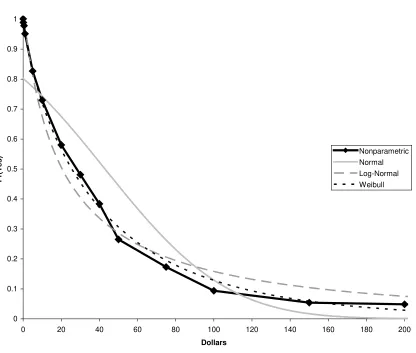
behavioral assumptions. For illustrative purposes, consider Figures 1, 2, and 3, which
display estimated parametric (normal, log-normal, and Weibull) and nonparametric
functions corresponding to the Welsh-Poe “probably yes” model for the three datasets.
In all cases, the normal distribution (the logistic is very similar) noticeably
overestimates the cdf at intermediate bids, and underestimates the cdf for high bids. The
log-normal distribution (the log-logistic is very similar) coincides with the
nonparametric distribution for low to intermediate bids, but overestimates the cdf for
high bids. The Weibull generally approximates the nonparametric cdf well. The
Smirnov Test, which is based on the maximum distance between two cdfs, is used to
test for differences between parametric and nonparametric functions. Using the normal
distribution, the equality of distributions for each of the datasets is rejected at the 5%
significance level. This is somewhat troubling given that in previous analysis of the
datasets, the authors assume either a normal or logistic distribution for ε. The
log-normal is rejected for the POWER dataset only, while the Weibull is never rejected.
Overall, Weibull mean WTP estimates more closely mimic nonparametric estimates
than do estimates from the normal and log-normal distributions. Distribution and
welfare comparisons are qualitatively similar under alternative behavioral assumptions.
Therefore, as a reasonable approximation, all presented parametric models assume a
Weibull distribution. For the Weibull distribution, f (WTP) = ln(WTP) and ε is
distributed extreme value, such that F(ε) = exp[-exp(-ε)].
0 0.1 0.2 0.3 0.4 0.5 0.6 0.7 0.8 0.9 1
0 20 40 60 80 100 120 140 160 180 200
Dollars
Pr
(Ye
s
) Nonparametric
[image:20.612.122.538.109.462.2]Normal Log-Normal Weibull
0 0.1 0.2 0.3 0.4 0.5 0.6 0.7 0.8 0.9 1
0 5 10 15 20 25 30 35 40 45
Dollars
Pr
(Ye
s
) Nonparametric
[image:21.612.118.536.130.532.2]Normal Log-Normal Weibull
0 0.1 0.2 0.3 0.4 0.5 0.6 0.7 0.8 0.9 1
0 200 400 600 800 1000 1200 1400
Dollars
Pr
(Ye
s
) Nonparametric
[image:22.612.120.534.154.535.2]Normal Log-Normal Weibull
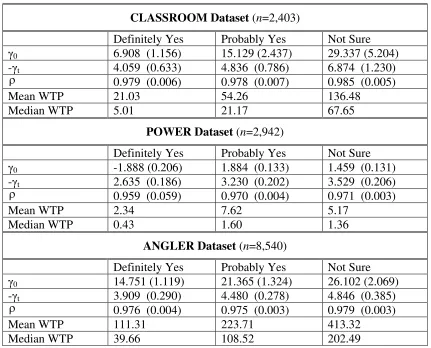
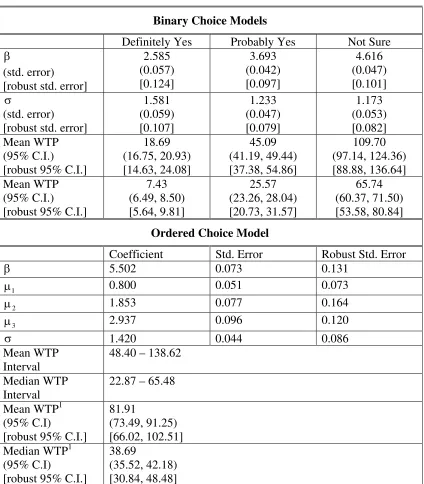
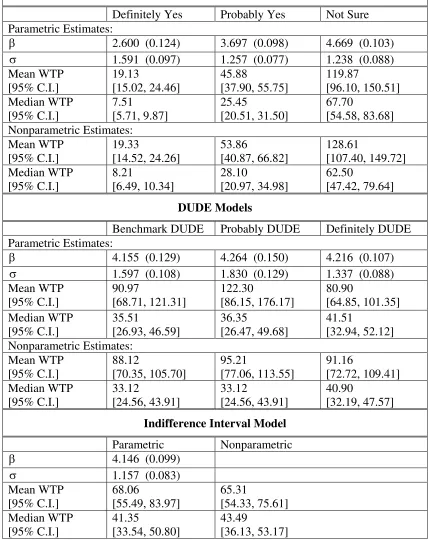
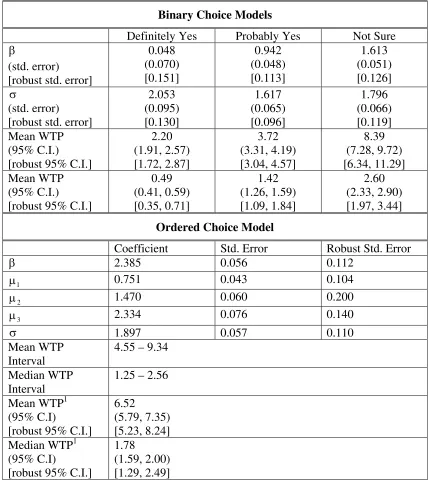
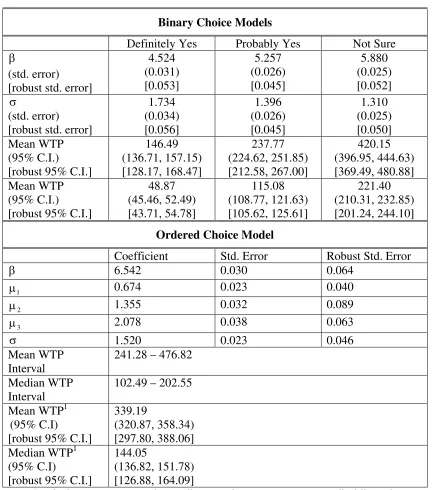
Table 2 presents “definitely yes”, “probably yes”, and “not sure” versions of the
binary choice (Weibull) random effects model for the three datasets. Tables 3a, 4a, and
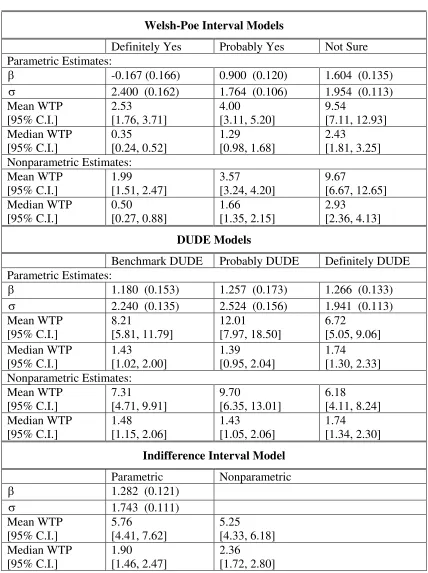
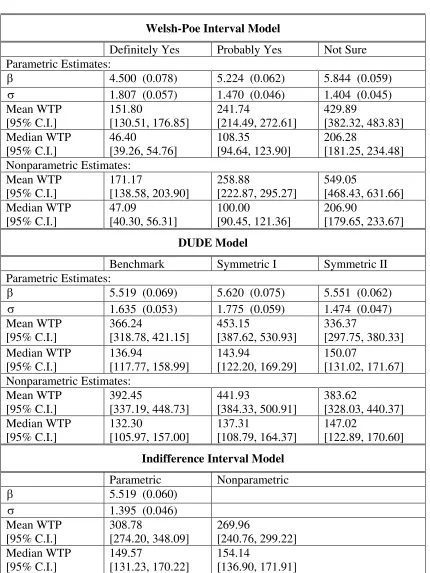
5a present binary choice models for the same three coding schemes, as well as ordered
choice models. Tables 3b, 4b, and 5b present parametric and nonparametric interval
models, including: “definitely yes”, “probably yes”, and “not sure” Welsh-Poe models;
Benchmark, Probably, and Definitely DUDE models; and the Indifference Interval
Model.
Random Effects models are estimated using LIMDEP econometric software. For
this model, coefficients correspond with a reparameterization of the WTP function. See
Appendix A for details. All other models are estimated with user-defined maximum
likelihood routines in LIMDEP. Ninety-five percent confidence intervals for mean and
median WTP point estimates are constructed using 10,000 random draws from the
maximum likelihood coefficient vector and covariance matrix, following the approach
of Krinsky and Robb (1986).
A. Examination of Within-Subject Response Correlation
As shown in Table 2, the correlation coefficient ranges from 0.959 to 0.985 in
the various binary choice random effects models. This result is consistent with the
expectation of negligible response-effects stemming from the presence of multiple bids,
but is in stark contrast to Alberini, Boyle, and Welsh (2003), who estimate ρ = 0.06 for
a probit version of the “probably yes” model using the ANGLER dataset. The
difference in estimated correlation coefficients is not due to our omission of covariates
used by Alberini, Boyle, and Welsh (2003), or the choice of parametric distribution. For
completeness, I estimated a probit version of the “probably yes” random effects model –
with and without covariates – and obtained correlation coefficients of 0.947 and 0.985,
respectively. Estimated models are included as Appendix B. SAS and STATA provide
Table 2. Binary Choice Random Effects Models
CLASSROOM Dataset (n=2,403)
Definitely Yes Probably Yes Not Sure γ0 6.908 (1.156) 15.129 (2.437) 29.337 (5.204)
-γt 4.059 (0.633) 4.836 (0.786) 6.874 (1.230)
ρ 0.979 (0.006) 0.978 (0.007) 0.985 (0.005)
Mean WTP 21.03 54.26 136.48
Median WTP 5.01 21.17 67.65
POWER Dataset (n=2,942)
Definitely Yes Probably Yes Not Sure γ0 -1.888 (0.206) 1.884 (0.133) 1.459 (0.131)
-γt 2.635 (0.186) 3.230 (0.202) 3.529 (0.206)
ρ 0.959 (0.059) 0.970 (0.004) 0.971 (0.003)
Mean WTP 2.34 7.62 5.17
Median WTP 0.43 1.60 1.36
ANGLER Dataset (n=8,540)
Definitely Yes Probably Yes Not Sure γ0 14.751 (1.119) 21.365 (1.324) 26.102 (2.069)
-γt 3.909 (0.290) 4.480 (0.278) 4.846 (0.385)
ρ 0.976 (0.004) 0.975 (0.003) 0.979 (0.003)
Mean WTP 111.31 223.71 413.32
Median WTP 39.66 108.52 202.49
Table 3a. MBDC Binary and Ordered Choice Models, CLASSROOM Dataset (n=2,403)
Binary Choice Models
Definitely Yes Probably Yes Not Sure
β
(std. error) [robust std. error]
2.585 (0.057) [0.124] 3.693 (0.042) [0.097] 4.616 (0.047) [0.101] σ (std. error) [robust std. error]
1.581 (0.059) [0.107] 1.233 (0.047) [0.079] 1.173 (0.053) [0.082] Mean WTP (95% C.I.) [robust 95% C.I.]
18.69 (16.75, 20.93) [14.63, 24.08] 45.09 (41.19, 49.44) [37.38, 54.86] 109.70 (97.14, 124.36) [88.88, 136.64] Mean WTP (95% C.I.) [robust 95% C.I.]
7.43 (6.49, 8.50) [5.64, 9.81] 25.57 (23.26, 28.04) [20.73, 31.57] 65.74 (60.37, 71.50) [53.58, 80.84]
Ordered Choice Model
Coefficient Std. Error Robust Std. Error
β 5.502 0.073 0.131
1
µ 0.800 0.051 0.073
2
µ 1.853 0.077 0.164
3
µ 2.937 0.096 0.120
σ 1.420 0.044 0.086
Mean WTP Interval
48.40 – 138.62
Median WTP Interval
22.87 – 65.48
Mean WTP1 (95% C.I)
[robust 95% C.I.]
81.91
(73.49, 91.25) [66.02, 102.51] Median WTP1
(95% C.I)
[robust 95% C.I.]
38.69
(35.52, 42.18) [30.84, 48.48]
Table 3b. MBDC Interval Data Models, CLASSROOM Dataset (n=185)
Welsh-Poe Interval Models
Definitely Yes Probably Yes Not Sure Parametric Estimates:
β 2.600 (0.124) 3.697 (0.098) 4.669 (0.103)
σ 1.591 (0.097) 1.257 (0.077) 1.238 (0.088)
Mean WTP [95% C.I.] 19.13 [15.02, 24.46] 45.88 [37.90, 55.75] 119.87 [96.10, 150.51] Median WTP [95% C.I.] 7.51 [5.71, 9.87] 25.45 [20.51, 31.50] 67.70 [54.58, 83.68] Nonparametric Estimates: Mean WTP [95% C.I.] 19.33 [14.52, 24.26] 53.86 [40.87, 66.82] 128.61 [107.40, 149.72] Median WTP [95% C.I.] 8.21 [6.49, 10.34] 28.10 [20.97, 34.98] 62.50 [47.42, 79.64] DUDE Models
Benchmark DUDE Probably DUDE Definitely DUDE Parametric Estimates:
β 4.155 (0.129) 4.264 (0.150) 4.216 (0.107)
σ 1.597 (0.108) 1.830 (0.129) 1.337 (0.088)
Mean WTP [95% C.I.] 90.97 [68.71, 121.31] 122.30 [86.15, 176.17] 80.90 [64.85, 101.35] Median WTP [95% C.I.] 35.51 [26.93, 46.59] 36.35 [26.47, 49.68] 41.51 [32.94, 52.12] Nonparametric Estimates: Mean WTP [95% C.I.] 88.12 [70.35, 105.70] 95.21 [77.06, 113.55] 91.16 [72.72, 109.41] Median WTP [95% C.I.] 33.12 [24.56, 43.91] 33.12 [24.56, 43.91] 40.90 [32.19, 47.57]
Indifference Interval Model
Parametric Nonparametric
β 4.146 (0.099)
σ 1.157 (0.083)
Mean WTP [95% C.I.] 68.06 [55.49, 83.97] 65.31 [54.33, 75.61] Median WTP [95% C.I.] 41.35 [33.54, 50.80] 43.49 [36.13, 53.17]
Table 4a. MBDC Binary and Ordered Choice Models, POWER Dataset (n=2,942)
Binary Choice Models
Definitely Yes Probably Yes Not Sure
β
(std. error) [robust std. error]
0.048 (0.070) [0.151] 0.942 (0.048) [0.113] 1.613 (0.051) [0.126] σ (std. error) [robust std. error]
2.053 (0.095) [0.130] 1.617 (0.065) [0.096] 1.796 (0.066) [0.119] Mean WTP (95% C.I.) [robust 95% C.I.]
2.20 (1.91, 2.57) [1.72, 2.87] 3.72 (3.31, 4.19) [3.04, 4.57] 8.39 (7.28, 9.72) [6.34, 11.29] Mean WTP (95% C.I.) [robust 95% C.I.]
0.49 (0.41, 0.59) [0.35, 0.71] 1.42 (1.26, 1.59) [1.09, 1.84] 2.60 (2.33, 2.90) [1.97, 3.44]
Ordered Choice Model
Coefficient Std. Error Robust Std. Error
β 2.385 0.056 0.112
1
µ 0.751 0.043 0.104
2
µ 1.470 0.060 0.200
3
µ 2.334 0.076 0.140
σ 1.897 0.057 0.110
Mean WTP Interval
4.55 – 9.34
Median WTP Interval
1.25 – 2.56
Mean WTP1 (95% C.I)
[robust 95% C.I.]
6.52
(5.79, 7.35) [5.23, 8.24] Median WTP1
(95% C.I)
[robust 95% C.I.]
1.78
(1.59, 2.00) [1.29, 2.49]
Table 4b. MBDC Interval Data Models, POWER Dataset (n=260)
Welsh-Poe Interval Models
Definitely Yes Probably Yes Not Sure Parametric Estimates:
β -0.167 (0.166) 0.900 (0.120) 1.604 (0.135)
σ 2.400 (0.162) 1.764 (0.106) 1.954 (0.113)
Mean WTP [95% C.I.] 2.53 [1.76, 3.71] 4.00 [3.11, 5.20] 9.54 [7.11, 12.93] Median WTP [95% C.I.] 0.35 [0.24, 0.52] 1.29 [0.98, 1.68] 2.43 [1.81, 3.25] Nonparametric Estimates: Mean WTP [95% C.I.] 1.99 [1.51, 2.47] 3.57 [3.24, 4.20] 9.67 [6.67, 12.65] Median WTP [95% C.I.] 0.50 [0.27, 0.88] 1.66 [1.35, 2.15] 2.93 [2.36, 4.13] DUDE Models
Benchmark DUDE Probably DUDE Definitely DUDE Parametric Estimates:
β 1.180 (0.153) 1.257 (0.173) 1.266 (0.133)
σ 2.240 (0.135) 2.524 (0.156) 1.941 (0.113)
Mean WTP [95% C.I.] 8.21 [5.81, 11.79] 12.01 [7.97, 18.50] 6.72 [5.05, 9.06] Median WTP [95% C.I.] 1.43 [1.02, 2.00] 1.39 [0.95, 2.04] 1.74 [1.30, 2.33] Nonparametric Estimates: Mean WTP [95% C.I.] 7.31 [4.71, 9.91] 9.70 [6.35, 13.01] 6.18 [4.11, 8.24] Median WTP [95% C.I.] 1.48 [1.15, 2.06] 1.43 [1.05, 2.06] 1.74 [1.34, 2.30]
Indifference Interval Model
Parametric Nonparametric
β 1.282 (0.121)
σ 1.743 (0.111)
Mean WTP [95% C.I.] 5.76 [4.41, 7.62] 5.25 [4.33, 6.18] Median WTP [95% C.I.] 1.90 [1.46, 2.47] 2.36 [1.72, 2.80]
Table 5a. MBDC Binary and Ordered Choice Models, ANGLER Dataset (n=8,540)
Binary Choice Models
Definitely Yes Probably Yes Not Sure
β
(std. error) [robust std. error]
4.524 (0.031) [0.053] 5.257 (0.026) [0.045] 5.880 (0.025) [0.052] σ (std. error) [robust std. error]
1.734 (0.034) [0.056] 1.396 (0.026) [0.045] 1.310 (0.025) [0.050] Mean WTP (95% C.I.) [robust 95% C.I.]
146.49 (136.71, 157.15) [128.17, 168.47] 237.77 (224.62, 251.85) [212.58, 267.00] 420.15 (396.95, 444.63) [369.49, 480.88] Mean WTP (95% C.I.) [robust 95% C.I.]
48.87 (45.46, 52.49) [43.71, 54.78] 115.08 (108.77, 121.63) [105.62, 125.61] 221.40 (210.31, 232.85) [201.24, 244.10]
Ordered Choice Model
Coefficient Std. Error Robust Std. Error
β 6.542 0.030 0.064
1
µ 0.674 0.023 0.040
2
µ 1.355 0.032 0.089
3
µ 2.078 0.038 0.063
σ 1.520 0.023 0.046
Mean WTP Interval
241.28 – 476.82
Median WTP Interval
102.49 – 202.55
Mean WTP1 (95% C.I)
[robust 95% C.I.]
339.19
(320.87, 358.34) [297.80, 388.06] Median WTP1
(95% C.I)
[robust 95% C.I.]
144.05
(136.82, 151.78) [126.88, 164.09]
Table 5b. MBDC Interval Data Models, ANGLER Dataset (n=622)
Welsh-Poe Interval Model
Definitely Yes Probably Yes Not Sure Parametric Estimates:
β 4.500 (0.078) 5.224 (0.062) 5.844 (0.059)
σ 1.807 (0.057) 1.470 (0.046) 1.404 (0.045)
Mean WTP [95% C.I.] 151.80 [130.51, 176.85] 241.74 [214.49, 272.61] 429.89 [382.32, 483.83] Median WTP [95% C.I.] 46.40 [39.26, 54.76] 108.35 [94.64, 123.90] 206.28 [181.25, 234.48] Nonparametric Estimates: Mean WTP [95% C.I.] 171.17 [138.58, 203.90] 258.88 [222.87, 295.27] 549.05 [468.43, 631.66] Median WTP [95% C.I.] 47.09 [40.30, 56.31] 100.00 [90.45, 121.36] 206.90 [179.65, 233.67] DUDE Model
Benchmark Symmetric I Symmetric II Parametric Estimates:
β 5.519 (0.069) 5.620 (0.075) 5.551 (0.062)
σ 1.635 (0.053) 1.775 (0.059) 1.474 (0.047)
Mean WTP [95% C.I.] 366.24 [318.78, 421.15] 453.15 [387.62, 530.93] 336.37 [297.75, 380.33] Median WTP [95% C.I.] 136.94 [117.77, 158.99] 143.94 [122.20, 169.29] 150.07 [131.02, 171.67] Nonparametric Estimates: Mean WTP [95% C.I.] 392.45 [337.19, 448.73] 441.93 [384.33, 500.91] 383.62 [328.03, 440.37] Median WTP [95% C.I.] 132.30 [105.97, 157.00] 137.31 [108.79, 164.37] 147.02 [122.89, 170.60]
Indifference Interval Model
Parametric Nonparametric
β 5.519 (0.060)
σ 1.395 (0.046)
Mean WTP [95% C.I.] 308.78 [274.20, 348.09] 269.96 [240.76, 299.22] Median WTP [95% C.I.] 149.57 [131.23, 170.22] 154.14 [136.90, 171.91]
Given the very large and statistically significant correlation coefficients, models
estimated under the premise of within-subject response independence are inappropriate.
However, coefficient estimates from ordered or binary choice models where the
responses are pooled but the correlation structure is ignored are consistent (Maddala
1987), and so the concern lies in the estimated standard errors. Tables 3a, 4a, and 5a
report binary and ordered choice model coefficients and WTP estimates. Two sets of
coefficient standard errors and corresponding 95% confidence intervals for WTP are
reported. The first set assumes within-subject independence while the “robust”
estimates are calculated using the “sandwich” estimator, which takes account of
within-subject response correlation. In all cases, robust standard errors and 95% confidence
intervals are noticeably larger, implying that inferences based on uncorrected standard
errors are problematic. For the binary choice models using the CLASSROOM dataset,
for example, the robust standard errors are approximately twice as large as the
uncorrected errors.
B. Monte Carlo and Empirical Evidence on Model Performance
It is clear that that the independence assumption is inappropriate, although the
correlation coefficient estimates do not serve in and of themselves as a basis for
choosing between random effects and interval data models. The correlation coefficients
are very close to 1, but there is no reliable test of ρ= 1 (Alberini 1995). Even if there
were such a test, concerns over distributional and other assumptions imposed in the
random effects model call into question its usefulness.
As an alternative mode of investigation, simple Monte Carlo experiments were
conducted to gain insight into the relative performance of random effects versus interval
data models for analyzing MBDC data under the premise of perfect correlation of
within-respondent decisions. Another feasible alternative is to estimate a binary choice
well. The experiment is set up as follows. Numbers representing underlying WTP
amounts for a sample of 100 individuals are randomly drawn from the normal
distribution. For each individual a set of yes/no indicator variables are constructed by
comparing the individual’s WTP to a set of payment thresholds. Specifically, the set of bids is {0,5,10,15,20,25,30,35,40,45,50,55,60}, there are no response errors, and ρ = 1:
a yes response is recorded if WTP > bid and otherwise a no response is recorded.7
There are 13 bids and so this procedure produces 1,300 total observations. These
observations are used to estimate mean WTP from binary probit and random effects
probit models. The upper and lower WTP bounds for each individual are created by
identifying the two consecutive survey bids that bound the individuals’ WTP.8 An
interval data model estimates mean WTP using the set of WTP bounds for the 100
individuals.
Table 6 presents results from two Monte Carlo experiments. In the first
experiment, individual WTP values drawn from a normal distribution with a mean of
$30 and standard deviation of $30. In the second experiment, the mean is $50 with a
standard deviation of $30. Note that the expected mean WTP in experiment 1 is in the
center of the bid distribution, while the mean and standard deviation of WTP in
experiment 2 is such that many respondents have WTP amounts larger than the highest
bid. This is analogous to a situation of a survey with a poor bid design. There are 500
replications in each experiment.
Several interesting results stem from the experiments. First, the correlation
coefficients average 0.972 and 0.973, respectively, in the two experiments and the range
of values across replications is small (0.960 to 0.984). Second, the mean-squared error
(MSE) is approximately ten times larger for the random effects probit versus the other
7 Other experiments were run where the respondent’s WTP is highly correlated across bids (ρ=0.95).
There was no real difference in results, except for slightly lower random effect probit estimates of ρ.
8
As standard in interval models, the lower bound is -∞ if WTP is less than the smallest bid and the upper
two models. In a Monte Carlo comparison between the interval model and a bivariate
probit for estimating WTP from double-bounded CV data, Alberini (1995) finds that the
latter model is inferior in terms of MSE. Third, in Experiment 2, where the bid design is
relatively poor, WTP from the random effects probit is 6% below the true value on
average and is off by as much as $13.90 (28%) in individual trials. In contrast, both the
interval model and binary probit perform well in terms of accurately estimating mean
WTP, with no evidence of systematic bias. The MSE of the interval model is
approximately 20% smaller than the binary probit, but this is to be expected. Overall, it
appears that the interval model is preferred under the premise that within-respondent
[image:33.612.112.540.393.697.2]decisions are highly correlated.
Table 6. Monte Carlo Results: Performance of the Probit, Random Effect Probit, and Interval Models
Experiment 1: Mean (β) = $30, ρ = 1 (100 individuals, 500 Replications)
Probit Random Effects
Probit
Interval Model
Mean WTP MSE maxβˆ −β
30.07 0.78 3.19
30.43 11.01 9.90
30.07 0.65 2.55 ρ
Std. dev. Range
0.000 0.972
0.003
0.962 – 0.984
1.000
Experiment 2: Mean (β)= $50, ρ = 1 (100 individuals, 500 Replications)
Probit Random Effects
Probit Mean WTP
MSE maxβˆ −β
50.20 2.66 5.58
47.23 22.35 13.90
50.22 2.05 4.66 ρ
Std. dev. Range
0.000 0.973
0.004
0.960 – 0.983
Results from the Monte Carlo experiments do carry over to actual MBDC WTP
estimates. Both the average (0.975) and range of coefficient values (0.959 to 0.985)
estimated with actual MBDC data are strikingly close to the simulated values. While not
a proof, this suggests that actual within-respondent decisions for the three datasets could
be perfectly correlated. Quite generally, coefficient and WTP estimates are very similar
between the binary choice and comparable Welsh-Poe interval models. Random effects
model estimates are in the ballpark of those from comparable models but differ
noticeably in instances. For the POWER dataset, estimated mean and median WTP is
actually larger in the “probably yes” than in the “not sure” model, where more
responses are treated as “yes”. Actual estimation results coupled with the relatively
large MSE observed in Monte Carlo experiments serve to illustrate the routine’s
apparent difficulty in accurately identifying WTP.
C. Comparison of WTP from Ordered Choice and Indifference Interval Models
Both the ordered choice model and the Indifference Interval model can estimate
WTP without the need to recode or second-guess categorical responses. As discussed in
Section 2, to estimate WTP from the ordered choice model the analyst must make the
untestable assumption that the fitted WTP interval corresponding to the “not sure”
category is symmetric. Such an assumption is not necessary for the Indifference Interval
model. The key difference between modeling approaches is that the Indifference
Interval estimator directly models the individual’s “not sure” price interval while the
ordered choice model attempts to estimate the “not sure” interval from the data.
Maintaining the hypothesis that a single underlying WTP distribution drives all
within-respondent decisions, the Indifference Interval Model is presumably the preferable
approach. Therefore, testing for equality of WTP between ordered choice and
Indifference Interval models sheds light on whether the symmetry assumption is
version of the ordered choice model and the indifference model. Since I use simulation
methods to derive the distributions for our WTP point estimates, the method of
convolutions (Poe, Severance-Lossin, and Welsh 1994) is appropriate for testing
between two WTP point estimates. Both mean (CLASSROOM: pc = 0.230; POWER: pp
= 0.503; ANGLER: pa = 0.250) and median (pc = 0.677; pp = 0.783; pa= 0.336) WTP
estimates are not statistically different at the 5% level for all datasets. As such, this
lends qualified support of the “symmetry” restriction needed to identify WTP point
estimates in the robust ordered model. It is likely that in some applications, the
individual’s “indifference interval” is not well defined. This can happen when many
respondents are not willing to pay the first bid amount or otherwise do not choose the
intermediate categories over the range of prices. In such situations, the robust ordered
choice model is preferable.
D. Replication of Evans, Flores, and Boyle
Evans, Flores, and Boyle (2003) find that welfare estimates are insensitive to the
different probability assignments of the Benchmark, Probably, and Definitely DUDE
models. Using the method of convolutions, I conduct pair-wise tests of equality between
mean or median WTP estimates from the different parametric specifications. Using the
method of convolutions, I find that Probably DUDE and Definitely DUDE mean WTP
estimates are statistically different at the 5% significance level for all datasets (pc =
0.050; pp = 0.026; pa = 0.004). However, median WTP is never statistically different
between these same models. In all possible cases, mean and median WTP estimates
from the Benchmark DUDE model are not statistically different than estimates from the
Probably and Definitely DUDE models. Overall, median WTP estimates are insensitive
to alternative “probably yes” and “probably no” DUDE model probability assignments.
However, when the goal is to estimate mean WTP, these same probability assignments
6. Comparing MBDC with the PC
The MBDC elicitation mechanism can be regarded as a PC with payment
certainty as an added dimension. In this section, I examine how respondents behave in
the absence of the payment certainty categories.9 This exploration is deliberately
comprehensive as I consider a multitude of different MBDC models – each with
differing behavioral assumptions, compare both WTP point estimates and estimated
WTP functions, and employ both parametric and nonparametric approaches.
To limit the scope of comparisons, the focus is on the various interval data
models as well as the robust ordered choice model. Note that binary choice models
mimic the Welsh-Poe models. The (parametric) random effects models are ignored for
obvious reasons. PC data are analyzed using the parametric and nonparametric versions
of the interval data model.10 Comparisons are made between estimated nonparametric
and various parametric distributions for the PC data, analogous to those described for
MBDC data in Section 4. Again, I find that the Weibull distribution serves as a
reasonable approximation for the underlying WTP distribution.
Table 7 presents estimated Weibull and nonparametric PC interval models. I
first test for equality between PC and various MBDC parametric WTP functions, using
the likelihood ratio test:
LR = −2
[
lnL1=2 −(lnL1+lnL2)]
~ χ2 (r) [7]where lnL1 and lnL2 are values of the log-likelihood at solution for the independent PC
and MBDC models, lnL1=2is the value of the log-likelihood for a model that pools both
datasets and estimates a common parameter vector (β,σ), and r is the number of
restrictions. Since the sample sizes differ between corresponding PC and MBDC
9
Despite several requests, our efforts to acquire the PC data from the ANGLER study were unsuccessful.
10
samples in the POWER dataset, I use sampling weights such that each sample, rather
than each observation, receives equal weight. The relative error variances are allowed to
differ by data type, as any difference in error variance between data type would distort
estimated parameters of a pooled model. When pooling the ordered choice and PC data,
no symmetry restriction is needed as the PC data allow us to identify all four ordered
[image:37.612.112.537.265.504.2]thresholds (i.e., the normalization µ0= 0 is not imposed; see Cameron 2002).
Table 7. Payment Card Models
Parametric Models
CLASSROOM Data POWER Data
β 3.635 (0.096) 0.938 (0.098)
σ 1.241 (0.074) 1.548 (0.082)
Mean WTP [95% C.I.]
42.71
[35.52, 51.54]
3.51
[2.92, 4.24] Median WTP
[95% C.I.]
24.05
[19.46, 29.66]
1.45
[1.16, 1.81] Nonparametric Models
CLASSROOM Data POWER Data
Mean WTP [95% C.I.]
43.84
[35.65, 52.01]
3.57
[2.87, 4.27] Median WTP
[95% C.I.]
21.58
[17.53, 28.35]
1.36
[1.22, 1.94]
n 188 292
Notes: Standard errors are in parentheses. All estimated parameters are statistically different from zero at the 5% level. The two-parameter Weibull distribution is assumed for parametric models.
Employing a 5% significance level, I fail to reject the hypothesis of equal WTP
functions only when comparing PC and “probably yes” Welsh-Poe interval models [CLASSROOM: χc2(2)=0.205, pc = 0.902; POWER: χp2(2) = 0.060, pc = 0.970]. While
comparisons of welfare estimates are not as clean, I fail to reject both equal mean and
median WTP between PC and “probably yes” models only [means: pc = 0.599, pp =
0.423; medians: pc = 0.713, pp = 0.519]. For the POWER dataset, there are several
the results of LR tests and mean WTP tests, this result is merely coincidental as
underlying response functions fundamentally differ.
To explore the robustness of the findings, the Smirnov Test is used to compare
estimated nonparametric distribution functions.11 Paralleling results for the LR tests, I
fail to reject the hypothesis of equal WTP distributions between PC and “probably yes”
models only and this result holds across datasets. The maximum distances between
these WTP distributions are 6.6% and 8.4%, respectively, for the CLASSROOM and
POWER datasets. Tests of WTP point estimates likewise coincide with the results from
parametric tests, as I only fail to reject equality between PC and “probably yes” MBDC
models for both point estimates.
Overall the evidence is clear – in the absence of the certainty response
categories, otherwise “definitely yes” and “probably yes” respondents will vote yes,
while “not sure”, “probably no”, and “definitely no” respondents will vote no. While
presumption may be that some “not sure” respondents would vote yes and others vote
no, neither the Indifference Interval, ordered choice model, nor any of the DUDE
models match PC response functions or both mean and median WTP estimates.
So, what are the implications of this finding? It does suggest that, when not
given the option, “not sure” respondents tend to vote “no”. This coincides closely with
findings from CV survey comparisons with actual voting behavior (Carson, Hanemann,
and Mitchell 1986; Champ and Brown 1997; Vossler et al. 2003a) and evidence from
pre-election polls (Magelby 1989), where voters who are undecided before an election
overwhelmingly vote “no” on Election Day. If we may extrapolate from these findings,
it may be the case that “not sure” responses are an indication that the respondent would
11
not actually pay the corresponding amount if faced with an analogous real purchase
situation.
In the lone MBDC field validity test (Vossler et al. 2003b), from which the
POWER data comes from, MBDC responses correspond with actual purchase decisions
only when the vast majority of “definitely yes” and “probably yes” responses are treated
as yes, and other responses are treated as no. Consistent with our findings, PC decisions
match actual purchase behavior. If this finding is consistent in future validity studies,
this suggests that virtually nothing is gained by inclusion of the payment certainty
categories. Similarly, PCs are preferred as they reduce the cognitive burden of
respondents as well as data analysts. Clearly, the issue of whether “not sure” responses
reflect actual or fictional uncertainty introduced by the inclusion of such a response
option in a contingent market survey warrants further research.
7. Concluding Remarks
In multiple bounded discrete choice (MBDC) surveys, respondents face multiple
payment amounts for a nonmarket good and indicate their level of payment certainty for
each amount. As it stands, this elicitation mechanism attempts to gather much more
information on the respondent’s WTP than standard DC questions. Making use of three
existing datasets, I explore the issue of data analysis and compare MBDC with the
payment card (PC), which presents the respondent with multiple payment amounts but
does not collect information on payment certainty.
Given the nature of the data, two important issues to consider when analyzing
MBDC responses are how to treat the multiple responses from the same individual and
how payment certainty levels correspond with real behavioral intentions. Contrary to
past research, there is compelling evidence in favor of treating the within-respondent
decisions as perfectly correlated, thus driven by a single underlying WTP distribution.
0.959 to 0.985 using random effects models. Further, empirical WTP estimates and
evidence from Monte Carlo experiments provide support for favoring interval models,
which assume perfect correlation, over random effects models in terms of their ability to
estimate WTP accurately. Thus, overall this study provides strong guidance for model
selection. The set of existing analytic approaches is expanded by introducing
nonparametric interval model estimators, an Indifference Interval model which serves
as a alternative to the ordered choice model used in past research, and a procedure for
correcting the covariance matrix from models that assume within-subject response
independence, so that valid inferences may be drawn from such models.
Comparisons between PC and various MBDC models, which differ largely in
terms of how payment certainty responses are treated, reveal a strong compatibility
between PC and MBDC models that treat “definitely yes” and “probably yes” responses
as yes and all other responses as no. In fact, this finding is consistent across datasets and
holds for both parametric and nonparametric response functions as well as mean and
median WTP estimates. For all other MBDC models, both parametric and
nonparametric response functions are statistically different from corresponding PC
functions. In the lone field validity test of MBDC surveys (Vossler et al. 2003b), this
same recoding of certainty responses into yes/no decisions is needed for correspondence
between survey responses and revealed behavior. Evidence from CV survey responses
and actual voting behavior, as well as pre-election polls suggests likewise that the
majority of “undecided” pre-election respondents vote no in actual elections. Evidence
from field research, coupled with comparisons between PC and MBDC responses,
suggests that all relevant information from the respondent is attainable through PC
surveys. That is to say, the inclusion of the payment certainty categories may be
unnecessary and simply serve to add complication for the respondent as well as the data