http://dx.doi.org/10.4236/ojs.2014.48055
A Multivariate Test for Three-Factor
Interaction in 3-Way Contingency Table
under the Multiplicative Model
Njoku O. Ama
Department of Statistics, University of Botswana, Gaborone, Botswana Email: [email protected], [email protected]
Received 16 June 2014; revised 22 July 2014; accepted 30 July 2014
Copyright © 2014 by author and Scientific Research Publishing Inc.
This work is licensed under the Creative Commons Attribution International License (CC BY). http://creativecommons.org/licenses/by/4.0/
Abstract
Two test statistics that have been commonly used in analysing interactions in contingency table are the Pearson’s Chi-square statistic, χ2, and likelihood ratio test statistic, G2. Both test statistics,
in tables with sufficiently large sample size, have an asymptotic chi-square distribution with de-grees of freedom (df) equal to the number of free parameters in the saturated model. For example under the hypothesis of independence of the row and column conditioned on the layer in an I × J ×
K contingency table, the df is K(I − 1)(J − 1). These test statistics, in large sized tables, will have less power since they have large degrees of freedom. This paper proposes a product effect model, which combines the advantages of the multiplicative models over the additive, for analysing the interaction between the row and column of the 3-way table conditioned on the layer. The derived statistics is shown to be asymptotically chi-square with a small degree of freedom, K − 1, for the I ×
J × K contingency table. The performance of the developed statistic is compared with the Pearson’s chi-square statistic and the likelihood ratio statistic test using an illustrative example. The results show that the product effect test can detect interaction even when some of the main effects are not significant and can perform better than the other competitors having smaller degree of freedom in large sized tables.
Keywords
Contingency Tables, Product Effect, Models, Interaction
1. Introduction
B, and C. The levels can be ordinal or nominal. If n units in a sample are independently and identically distributed (IID); that is, if they constitute a random sample, then the vector of cell counts x′ =
{
n111,n112,,nIJK}
has a multinomial distribution with index n=n+++ and a parameter, πijk , where πijk =P A(
=i B, = j C, =k)
probability that a randomly selected unit falls into the(
i j k, ,)
th cell of the contingency table with variables A, B and C. The probability distribution{ }
πijk is the joint distributionof A, B,and C.Interaction in the 3-way contingency has been tested using the chi-square statistic and the likelihood ratio test statistic with
(
I−1)(
J−1)(
K−1)
degree of freedom [1]-[3]. Grizzle et al. [4], Darroch [5] and Johnson and Graybill [6] have modelled interaction as a product of the marginal effects or components of the ways of classi-fication of the table. Tukey [7] in order to overcome the difficulty in testing for interaction in the two-factorial experiment with one observation per cell modelled the two-factor interaction as a product of the effects of the two factors and developed a one degree of freedom F-test for analysing the interaction between the factors. Drawing an analogy from the two factorial experiments we can view the 2-way contingency table as a two-factorial experi-ment with one observation per cell similar to the Poisson modelling of 2-way contingency table where the cell observations are seen as the mean number of occurrences of the event within a defined infinitesimal interval. The I × J × K contingency table can be viewed as K 2-way contingency table. The present paper argues that the transformation of the contingency table applicable in the likelihood ratio tests [1] [8] is often unnecessary but that the data can be analysed in a manner similar to the Pearson’s chi-square which does not transform the data. A multivariate approach is adopted in analysing the interaction in an I × J × K table, under the product effect model, where the three-factor interaction is defined as a product of the effects of the ways of classification of the table. The advantage of the proposed model is that it gives rise to chi-square tests with smaller degrees of freedom, ir-respective of the size of the table, which is conjectured to have greater power than other tests with larger degrees of freedom. It has been shown [9] [10] that the power of the noncentral chi-square statistics, for a given value of non-centrality parameter and level of significance, increases as the degree of freedom decreases. Our results will be of some practical value to researchers who are involved in analysing mutual independence in higher order tables as their results will be based on small degrees of freedom leaving extra degrees of freedom for further decomposition of other forms of independence in the data. Extension of the proposed method to higher order tables is straightforward.Model for 3-Factor Interaction
Let us assume that we have an I × J × K 3-way contingency, representing respectively the row, column and layer classifications of the table, and that the K-dimensional vector
{ }
nijk K of frequency layers available in the( )
i j, th cell has associated it with a K-dimensional vector{ }
πijk K of unknown cell probabilities such that1
ijk k
π =
∑
. In addition if we assume that{ }
nijk K follows a multinomial probability distribution given by( )
{
}
. 1 2. 1 2
1 2 ! ; ,
! ! !
ij ij ijK
n n n
ij
ijk K ijk ij ij ij ijK ij ij ijK
n
P n n
n n n
π = π π π
(1.1) .
ij ijk k
n =
∑
n is fixed, nijk =1, 2,,nij; 0<πijk <1, πijk =nijk nij.
(
)
.(
)
.
1 ,
,
, ij ijk ijk ijk ijk
ij ijk ijk
n k k
Cov n n
n k k
π π
π π
′
′
− = ′
=
′
− ≠
{
nijk,nijk′}
are independent for all k≠k′.The 3-way contingency table under the multinomial structure described above is similar to the layout of a three-factorial experiment with one observation per cell. In the spirit of [7] and drawing an analogy from the factorial experimental structure, a linear additive model for the observed cell probability in the
(
i j k, ,)
-cell can be written as in (1.2). The interest is in the consideration of models where these probabilities depend on a vectori
x of covariates associated with the
(
i j k, ,)
th individual or group.Under the assumption (1.1), and given the kth layer, we have an identity relation
.. . .. . .. . . ..
ijk k i k k jk k ijk i k jk k
π =π +π −π +π −π +π −π −π +π (1.2) where, π..k, πi k. and π.jk denote respectively the overall probability for the k
th
for the kth layer. Reasoning by analogy from the regular analysis of variance, we get a linear additive model for (1.2) as
( )
ijk k ik jk ijkE π =µ τ+ +β +λ (1.3) where, µk =π..k is the overall probability of an observation belonging to the k
th
[image:3.595.88.530.422.622.2]layer of the 3-way contingency table; τik =πi k. −π..k is the effect of the i
th
row of the table for the kth layer; βjk =π.jk−π..k is the effect of the jth column of the table for the kth layer; λijk =πijk−πi k. −π.jk+π..k is the interaction between the i
th
row and jth column for the kth layer of the table. These parameters are subject to the restrictions:
. . 0; . . . 0
ij ik ij jk ij ijk ij ijk ij ijk
i j i j ij
n τ = n β = n λ = n λ = n λ =
∑
∑
∑
∑
∑
(1.4)and are independent of the kth layer.
The relation (1.3) can be recast in vector notation as
( )
ij ij(
i j ij)
E n =n µ τ+ +β +λ (1.5) Or
( )
ij(
i j ij)
E π = µ τ+ +β +λ (1.6) where,
(
)
(
)
(
)
(
)
( )
(
)
(
)
1 2 1 2 1 2 1 2,
1 2 1
, , , ; , , , ; , , , ; , ,
in the main diagonal
in the off diagonal positions
diag , , , ; ,
K i i i iK j j j jK ij ij ij ijK
ij ij ij ij ij
ij ij ij
ij ij ij ijK ij ij i
n D
Cov n
n
D
µ µ µ µ τ τ τ τ β β β β λ λ λ λ
π π π π
π π π π π π
′
′= = ′= ′=
− ′
=
′ −
′
= =
(
j2,,πijK)
.(1.7)
Estimation of the parameters of this model (1.6) by maximum likelihood proceeds by maximization of the multinomial likelihood (1.1) with the probabilities πijk viewed as functions of the parameters µ..k, τi k. , β.jk,
and λijk in the Equation (1.3) and yields
ˆ ˆ
ˆ ˆ; ˆi ˆi ˆ; j ˆj ˆ; ij ˆij ˆi ˆj ˆ
µ π τ= =π π β− =π −π λ =π −π π− +π (1.8)
where,
(
)
(
)
(
)
(
)
(
)
. .. . . ..1 ..2 .. .1 .2 . . 1 . 2 . 1 2 ... ..1 ..2 .. ... .. . .
ˆ ; ˆ ; ˆ ; ˆ ˆ ,ˆ , ,ˆ ; ˆ ˆ ,ˆ , ,ˆ
ˆ ˆ ,ˆ , ,ˆ ; ˆ ˆ ,ˆ , ,ˆ ; ˆ ; , , ,
ij ij ij i i i j j j K i i i i K
j j j jK ij ij ij ijK K
ij i j
ij i
n n n n n n
n n n n n n
n n n n
π π π π π π π π π π π
π π π π π π π π π
′ ′
= = = = =
′= ′ = ′= ′=
=
∑
=∑
=
. ijk j ijk
n
=
∑
∑
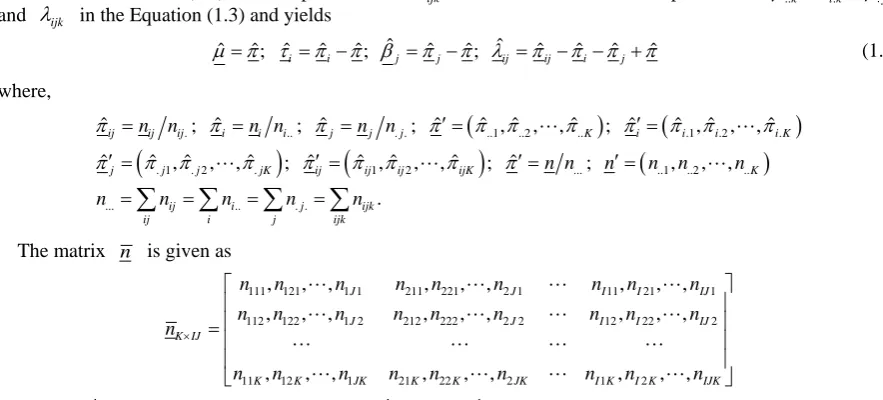
The matrix n is given as
111 121 1 1 211 221 2 1 11 21 1 112 122 1 2 212 222 2 2 12 22 2
11 12 1 21 22 2 1 2
, , , , , , , , ,
, , , , , , , , ,
, , , , , , , , ,
J J I I IJ
J J I I IJ
K IJ
K K JK K K JK I K I K IJK
n n n n n n n n n
n n n n n n n n n
n
n n n n n n n n n
×
=
For the kth layer, the interaction between the ith row and jth column is defined multiplicatively as being propor-tional to the ith row effect and jth column effect and given as
ijk ck ik jk
λ = τ β (1.9) where, ck is an unknown constant for the layer; τik and βjk are respectively the effect of the i
th
interac-tion in the contingency table and for the kth layer response is proportional to the product of the effects of ith row classification and the jth column classification of the table. Darroch [12] has demonstrated the advantages of the multiplicative interaction models over the additive.
2. Development of Test Statistics Based on the Model
λ
ijk=
c
k ikτ
β
jkRewriting (1.9), the model for the two-factor interaction for the kth layer response, in vector notation,
ij cD Dτ β
λ = (2.1) where c=
(
c c1, 2,,cK)
; Dτ =diag(
τ τi1, i2,,τiK)
; Dβ =diag(
β βj1, j2,,βjK)
.The matrix of interaction Λ can be written as
1 11 11 1 11 21 1 11 1 1 21 11 1 21 21 1 21 1 1 1 11 1 1 21 1 1 1 2 12 12 2 12 22 2 12 2 2 22 12 2 22 22 2 22 2 2 2 12 2 2 22 2 2 2
1 1 1 2
, , , , , , , , ,
, , , , , , , , ,
, ,
J J I I I J
J J I I I J
c K IJ
K K K K K K
c c c c c c c c c
c c c c c c c c c
c c
τ β τ β τ β τ β τ β τ β τ β τ β τ β
τ β τ β τ β τ β τ β τ β τ β τ β τ β
τ β τ β
×
Λ =
,cKτ β1K JK cKτ β2K 1K,cKτ β2K 2K, ,cKτ β2K JK cKτ βIK 1K,cKτ βIK 2K, ,cKτ βIK JK
(2.2) From (1.5) or (1.6) the residual after substituting (2.1) becomes
( )
ij ij ij ij(
)
E Z =n λ =n cD Dτ β (2.3)
(
ˆ)
(
ˆ)
ˆ ˆ ˆ ˆ ˆ
ij ij i j ij ij i j
Z =π − µ τ β+ + =n −n µ τ β+ + (2.4)
(
1, 2, ,)
ij ij ij ijK
Z′ = Z Z Z
This gives the least square estimate ˆc of c as
2 2 ˆ
ˆ ˆ
ˆ ˆ
ˆ ˆ ˆ
ˆ ˆ ˆ
ijk ik jk
j
ij i
k ij
ij ik ij ij i i ij j j ij
n
c n
n n n
τ β β
τ
τ β τ τ β β
′ = = ⊗ ′ ′
∑
∑
(2.5)The matrix of sum of squares sum of product (SS-SP) for interaction from (2.3) is
(
)
2 2 ˆ2
ˆ ˆ at the -th diagonal position ˆ ˆ
ˆ ˆ ˆ ˆ at the , th off diagonal position
k ij ij jk ij
c c c
k k ij ik ik jk jk ij
c n k
H
c c n k k
τ β
τ τ β β
′ ′ ′
′
Λ Λ = =
′
∑
∑
(2.6)with expectation
(
)
(
)
2 2 2 2 2 22 2 2 2 2
2 2 2 2 2 ˆ
ˆ ,
ˆ ˆ ˆ
ˆ ˆ ˆ
1 at the -th diagonal position
ˆ ˆ ˆ ˆ
ˆ ˆ ˆ
ˆ ˆ c ik jk
ij ijk ijk ik jk k ik ik jk jk ij ik jk
ij ij ij
ij ijk ijk ik ik jk jk ij
k k ij ij ik ik jk jk
ij
E H
n c n k
n
c c n
n τ β
π π τ β τ τ β β τ β
π π τ τ β β
τ τ β β
′ ′ ′ ′ ′ ′ − + = − +
∑
∑
∑
∑
∑
ik ikˆ ˆjk ˆjk at the(
,)
of diagonal position ijk k
τ τ β β′ ′
′
∑
(2.7)The total sum of squares and cross product (SS-SP) is given as
(
ˆ ˆ)
T T
H =n D −ππ′ (2.8) where,
(
ˆ..1 ˆ..2 ˆ..)
diag , , ,
T K
The expectation of HT is
( ) (
T 1)
E H = n− V
(
)
..
.. ..
1 at the -th diagonal position at the , off diagonal position
k th k k k V k k π
π π ′
− =
′ −
(2.10)
The total SS-SP matrix HT can be partitioned into unit SS-SP, Hu, SS-SP due to the row effect, Hτ,
SS-SP due to the column effect, Hβ, and SS-SP due to the residual, Hz, namely
T u z
H =H +Hτ +Hβ +H (2.11) The unit SS-SP matrix Hu is given by
(
ˆ ˆ)
u ij u ij ij ij
H =
∑
n D −π π′ (2.12) with Du=diag(
π πˆij1,ˆij2,,πˆijK)
.The expectation of Hu is given by
( )
(
)
(
)
(
)
1 at the -th diagonal position 1
at the , off diagonal position ijk ijk
u ij th
ij
ijk ijk
k
E H n
k k
π π
π π ′
− = − ′ −
∑
(2.13)The matrix of SS-SP for the row effect, Hτ, is
(
)
2 .. ..
..
ˆ at the -th diagonal position ˆ ˆ
ˆ ˆ at the , off diagonal position i ik
i i i i
i i ik ik
i
n k
H n
n k k
τ
τ τ τ
τ τ ′
′ = = ′
∑
∑
∑
(2.14)With expectation,
( )
E Hτ =Dτ +Vτ (2.15)
(
1 2)
diag , , , K
Dτ = b b b and
(
)
(
)
(
)
. . .. ..
. . .. .. .. . . .. ..
1 1 at the -th diagonal position
at the , off diagonal position i k i k k k
i
i k i k k k i i k i k k k
i i
k V
n n k k
τ
π π π π
π π ′ π π ′ π π ′ π π ′
− − + − = + + − ′
∑
∑
∑
(2.16)2 .. k i ik
i
b =
∑
n τThe matrix of SS-SP, Hβ, due to the column effect is
(
)
2 . .
. .
. .
ˆ at the -th diagonal position ˆ ˆ
ˆ ˆ at the , off diagonal position
j jk j j j j j
j jk jk j
n k
H n
n k k
β
β β β
β β ′
′ = = ′
∑
∑
∑
(2.17)With expectation,
( )
E Hβ =Dβ +Vβ (2.18)
(
)
21 2 . .ˆ
diag , , , K ; k j jk j Dβ = t t t t =
∑
n β and(
)
(
)
(
)
. . .. ..
. . .. .. . . .. ..
1 1 at the -th diagonal position
at the , off diagonal position
jk jk k k
i
jk jk k k j jk jk k k
j j
k V
n n k k
β
π π π π
π π ′ π π ′ π π ′ π π ′
− − + − = − + + − ′
∑
The matrix of SS-SP for the residual (2.3) is
(
)(
)
(
)
(
)
(
)
(
)
ˆ ˆ
ˆ ˆ ˆ ˆ ˆ ˆ
ˆ
ˆ ˆ ˆ ˆ ˆ ˆ ˆ ˆ ˆ ˆ ˆ ˆ
ˆ ˆ ˆ ˆ ˆ ˆ ˆ ˆ ˆ
z ij ij ij ij ij i j ij i j
ij ij
ij ij ij ij ij i ij ij j ij i ij
ij ij ij ij
ij j ij ij i i ij i j ij j i
ij ij ij ij
H n z z n
n n n n
n n n n n
π π τ β π π τ β
π π π π π π τ π π β τ π π
β π π τ τ τ β β τ
′
′
= = − − − − − −
′ ′ ′ ′
= − − − − − − − −
′ ′ ′ ′
− − + + + +
∑
∑
∑
∑
∑
∑
∑
∑
∑
∑
ij ˆ ˆ .j jij
β β′
∑
(2.20)
With expectation
( )
(
ˆ ˆ)(
ˆ ˆ)
( )
ˆ ˆ( )
ˆ ˆz ij ij ij ij i ij j j
ij ij ij
E H =
∑
n E π −π π −π ′+∑
n E τ τ′ +∑
n E β β′ (2.21) Since the cross-product terms will vanish on taking expectation because of independence and restriction in (1.4)(
)(
)
(
)
(
)(
)
(
)
2 ..
.. ..
ˆ ˆ at the diagonal position ˆ ˆ ˆ ˆ
ˆ ˆ ˆ ˆ at the , off diagonal position
th ijk k
ij ij
ijk k ijk k
E k
E
E k k
π π
π π π π
π π π ′ π ′
−
′
− − =
′
− −
(2.22)
Hence,
( )
z z zE H =D +V (2.23) where,
z
D =Dθ+Dτ+Dβ (2.24) and
(
)
(
)
21 2 ..
diag , , , K , with k ij ijk k ij
Dθ = q q q q =
∑
n π −πz
V =Vθ + +Vτ Vβ, with
(
)
(
)
(
)
(
)
(
)
.. ..
.. ..
1 1 at the diagonal position 1 1 at the , off diagonal position
th
ijk ijk k k
i
ij ijk ijk k k
ij
k V
n n k k
θ
π π π π
π π ′ π π ′
− − − −
=
′
− − + −
∑
∑
(2.25)The hypothesis of no interaction, H0:λijk =0, for all k, implies that either ck =0 or τ =ik 0 or βjk =0
for all k. Hence
0: ij 0 0: 0 or 0: i 0 or 0: j 0
H λ = ⇒H c= H τ = H β = . (2.26) Under the null hypothesis (2.26), in which case πijk =π..k, and reasoning from (2.13) for the
th k layer,
( ) (
u)
.E H = n−IJ V
Similarly, πi k. =π..k; π.jk =π..k (see Section 1.1)
( ) (
1)
;( )
(
1)
,( )
c and( ) (
z 1)(
1)
E Hτ = I− V E Hβ = J− V E H =V E H = I− J− V (2.27)
However, whether or not H0:c=0 is true,
( ) (
T 1)
E H = n− V
where V is as defined in (2.10). Each of the quantities
(
n IJ)
1Hu−
− ,
(
I−1)
−1Hτ,(
J−1)
−1Hβ,(
)(
)
11 1 z
I− J− − H
,
(
n−1)
−1HT and Hc provides an estimate of V and can be employed in the constructionIndependence of HT, Hc, Hτ, Hβ
By appealing to thefollowing theorem [13], it can be shown that the quadratic forms HT, Hc, Hτ and Hβ, are
in-dependent.
Theorem 2.1. Let Y be distributed N
( )
µ,I , the set of positive semi-definite quadratic forms Y B Y′1 ,2
Y B Y′ , , Y B Y′ K are jointly independent if and only if B Bi j =0, the null matrix for all i≠ j.
Theorem 2.2. As nij → ∞, the matrices HT, Hc, Hτ and Hβ are independent.
By theorem 1, the joint independence of HT, Hc, Hτ and Hβimplies pairwise independence.
3. Construction of Test Statistic for the Hypothesis
H
0:
c
= 0
Recall that nijk follows M n
(
ij.,πijk)
. As πijk tends to a constant, say1
K, then nij will follow asymptotic
multivariate normal distribution with mean nijπij and variance, n Vij ij, where Vij is a singular matrix given by
(1.7). Therefore nij has a singular normal distribution.
Under the hypothesis, H0:c=0, the matrix Hc has a pseudo Wishart distribution with parameter 1 and
ij ij ij
V =
∑
n V . The random matrix HT follows the Wishart distribution with parameter(
n−1)
and V and inde-pendent of Hc. They can be used in constructing the determinant based test statistic for the hypothesis H0:c=0
Since the matrix V is nonsingular, by generating the matrix of contrasts, say B and pre- and post-multiplying each of them by B and B transpose, V can be made non-singular.
Let
(
1, 2, ,)
c m m′ ′ mK′
Λ = (3.1)
k
m′ is an IJ column vector of independent variables for the kth response. Also define X′=
(
X X1′, 2′,,XK′−1)
such that1 1 2 2
1 1 K
K
K K K
X m m
X m m
X − m − m
= −
= −
= −
Then
c
X = ΛB (3.2) where
(
)
1
1 0 0 0 1
0 1 0 0 1
0 0 1 0 1
; 1
0 0 0 1 1
d K K
I
− ×
−
−
−
= = −
−
B (3.3)
The matrix B is of full rank,
(
K−1)
and Id is a(
K− ×1) (
K−1)
identity matrix.Certainly,
*
c c c c
H =X X′= Λ ΛB ′ ′B =BH B′ (3.4) is a non-singular transformation of the matrix Hc and so also is the matrix
( ) ( ) *
1 1
T T
K K
BH B H
− × −
′
= (3.5)
The hypothesis
: 0
c
is similarly transformed to
*
: 0
c
H Bc= or * *
: 0
c
H c =
However, [14] and [15] have discussed the equivalence between H0 and * C
H and the invariant property of the Wilks Λ criterion under such transformation as above. Also the quadratic forms *
T
H and * C
H (3.4 and 3.5) are independent Wishart distributed matrices with same degrees of freedom as HT and Hc respectively and
variance-covariance matrix *
V =BVB′. Hence the analogue of the Wilks criterion can be used in testing the hypotheses and is given by
(
)
*
* * , 1,1 , asymptotically T
c
T C
H
W n K
H H
= ≈ Λ −
+ (3.6)
where Λ
( )
; ; defines the Wilks distribution with parameters( )
; ; . It has been shown (see e.g. Kshirsagar, 1972) that(
)
1 2 1
1 K
c i
i
W r
−
=
=
Π
− (3.7) where 2i
r is the square of the ith sample canonical correlation and the root of the determinantal equation
(
)
2 * * *
0
T C C
r H H H
− + + = (3.8) and r2
is related to λ the root of the determinantal equation
(
)
* 1 *1 1
1 T c K K 0
n− −k H −H −I − −λI − = (3.9) by the relation
(
) (
)
2
1
r = λ+ n− +K λ (3.10) Under the null hypothesis, * *
: 0
c
H c = and using (3.9), that is λ=0, r2 1 n K
=
− .
It has been shown, [16], that
2
log c pq
m W χ
− ≈
where pq=K−1, using the notation in this paper. Thus,
(
)
1(
)
(
)
(
)
1
2 2 2
1 1
log log 1 log 1 1 log 1
K K
c i i
i i
m W m r m r m K r
− −
= =
− = −
Π
− = −∑
− = − − − (3.11) under H0.Asymptotically as r2→0,
(
2)
2(
)
2(
1)
log 1 and log c 1
m K
r r m W m K r
n K
−
− = − − = − =
− (3.12)
Hence
(
)
21
1
K m K
n K χ −
− ≅
− (3.13)
The best value of m for the expectation on both sides of (3.13) to be equal is
(
n−K)
. Therefore,*
2 1 * *
T
c K
T C
H W
H H χ −
= ≅
The test rejects the hull hypothesis if Wc≥χK2−1
( )
α at an α-level of significance.4. Illustrative Example
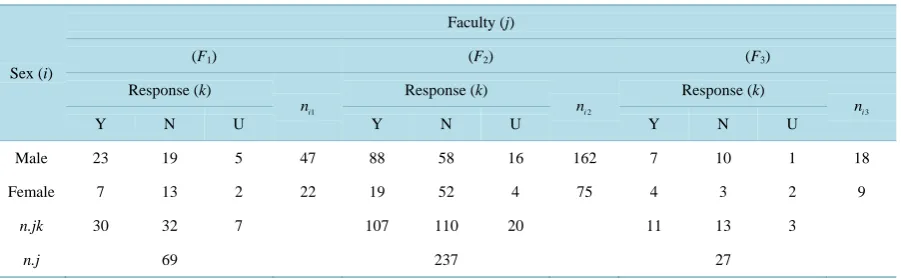
The application of the developed test makes use of data taken from [17] (seeTable 1). The data represent the at-titude of 333 undergraduate students of University of Nigeria towards taking up teaching as a profession after graduation. The students were sampled from three groups of faculties, F1, F2 and F3. The responses Y (yes),
N (no), U (undecided) indicates willing, not willing and undecided respectively. The estimates of the parameters in (1.5) are:
(
)
ˆ 0.4444, 0.4655, 0.0901
µ′ = ; τ1′ =
(
0.07538, 0.0822, 0.006826−)
; τ2′ =(
0.16144, 0.17604, 0.01462−)
;(
)
1
ˆ 0.00966, 0.00170, 0.01136
β′ = − − ; βˆ2′ =
(
0.00703, 0.00133, 0.00570− −)
;(
)
3
ˆ 0.03704, 0.01602, 0.02102
β′ = − ; c′ =
(
3.44857, 111.16428, 267.82464− −)
;(
)
11 0.00251, 0.01583, 0.02072
λ′ = − − − ; λ′ =12
(
0.00183, 0.01248, 0.01042−)
;
(
)
13 0.00963, 0.146101, 0.03836
λ′ = − − ; λ21′ =
(
0.00538, 0.03389, 0.04446)
;
(
)
22 0.00392, 0.02671, 0.02238
λ′ = − − ; λ23′ =
(
0.02062, 0.31268, 0.08232−)
The matrix of SS-SP due to interaction, Hc, is
0.00815 0.08882 0.03952
0.08882 1.38108 0.34844
0.03952 0.3484 0.20826 c
H
−
= − −
−
; 1 0 1 0 1 1 B= −
−
Therefore,
* 0.13737 0.42836
0.42836 2.28622
c
H =
;
* 136.18734 14.28710
14.28710 138.08711
T
H = −
−
;
* 4.351971 2.172384
2.172384 5.652110
Hτ =
;
* 0.159903 0.039964
0.039964 0.016973
Hβ =
;
* * 18944.28795 T c
H +H = ; * 18601.59497
T
H =
Similarly,
* *
20054.2446 T
H +Hτ =
* *
18627.1301 T
H +Hβ =
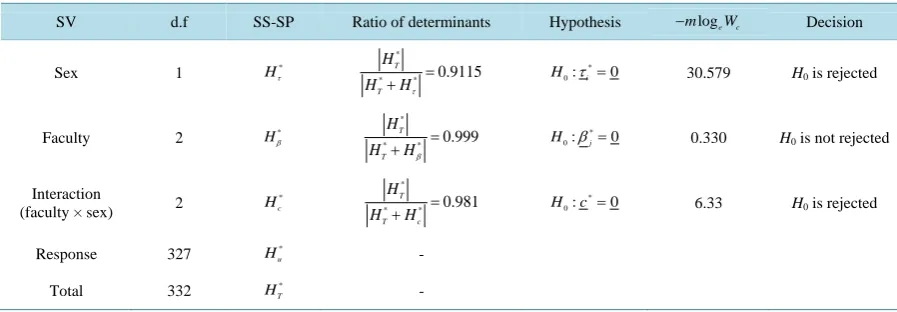
[image:9.595.90.541.581.721.2]These values are summarized in theTable 2.
Table 1. Attitude of university students towards the teaching profession.
Sex (i)
Faculty (j)
(F1) (F2) (F3)
Response (k)
1 i n
Response (k)
2 i n
Response (k)
3 i n
Y N U Y N U Y N U
Male 23 19 5 47 88 58 16 162 7 10 1 18
Female 7 13 2 22 19 52 4 75 4 3 2 9
n.jk 30 32 7 107 110 20 11 13 3
Table 2. Multanova of categorical data for attitude of students towards teaching.
SV d.f SS-SP Ratio of determinants Hypothesis −mlogeWc Decision
Sex 1 *
Hτ
*
* * 0.9115
T
T
H H Hτ
= +
* 0: i 0
H τ = 30.579 H0 is rejected
Faculty 2 *
Hβ
*
* * 0.999
T
T
H H Hβ
= +
* 0: j 0
H β = 0.330 H0 is not rejected
Interaction
(faculty × sex) 2
* c H
*
* * 0.981
T
T c
H H +H =
* 0: 0
H c = 6.33 H0 is rejected
Response 327 *
u
H -
Total 332 *
T
H -
m = 330.
The Pearson’s chi-square for testing the hypothesis of no interaction (independence of the row and column for the kth response), H0:πijk =π πi k. .jk gives the computed value of the test statistic as, X
2
= 8.214 based on 6 d.f while the likelihood ratio test statistic, G2 for testing H0 is calculated as G2 = 7.804. Both test statistics are based on
6 degrees of freedom and show that interaction is not significant.
5. Conclusion
The results of the analysis show that while the effect of the sex and interaction are significant in the data, the effect of faculty is not significant. Thus, the proposed test for interaction based on the product effect model and based on 2 degrees of freedom
(
K−1)
can produce significant results even when one of the factors in the interaction is not significant. The test performs better than the traditional tests—the Pearson’s chi square and the likelihood ratio tests, and could still out perform them in having greater power in larger 3-way contingency tables since it will have smaller degree of freedom. [9] has shown that the power of the non-central chi-square test at a given level of significance and non-centrality parameter increases as the degree of freedom decreases.References
[1] Cheng, P.E., Liou, M. and Aston, J.A.D. (2009) Likelihood Ratio Tests with Three-Way Tables. Institute of Statistical Science, Academia Sinica 2CRiSM, Department of Statistics, The University of Warwick, UK.
http://www3.stat.sinica.edu.tw/library/c_tec_rep/2007-3-20090206.pdf
[2] Agresti, A. (2002) Categorical Data Analysis. 2nd Edition, John Wiley and Sons Inc., Hoboken, 132. http://dx.doi.org/10.1002/0471249688
[3] Christensen, R. (1997) Loglinear Models and Logistic Regression. 2nd Edition, Springer-Verlag, New York Inc., New York.
[4] Grizzle, J.E., Starmer, F. and Koch, G.G. (1969) Analysis of Categorical Data by Linear Models. Biometrics, 25, 489- 504. http://dx.doi.org/10.2307/2528901
[5] Darroch, J.N. (1962) Interactions in Multi-Factor Contingency Tables. Journal of the Royal Statistical Society, B24, 251-263.
[6] Johnson, D.E. and Graybill, F.A. (1972) An Analysis of a Two-Way Model with Interaction and No Replication. Journal of the American Statistical Association, 67, 862-868. http://dx.doi.org/10.1080/01621459.1972.10481307 [7] Tukey, T.W. (1949) One Degree of Freedom for Non-Additivity. Biometrics, 5, 232-242.
http://dx.doi.org/10.2307/3001938
[8] Cheng, P.E., Liou, M. and Aston, J.A.D. (2010) Likelihood Ratio Tests with Three-Way Tables. Journal of the Ameri-can Statistical Association, 105, 740-749. http://dx.doi.org/10.1198/jasa.2010.tm09061
[9] Ama, N.O. (1991) On Multiplicative Models for Interaction in Contingency Tables. Unpublished Ph.D. Thesis, Uni-versity of Nigeria, Nsukka.
[11] Lancaster, H.O. (1969) The Chi-Squared Distribution. Wiley & Sons, Inc., New York.
[12] Darroch, J.N. (1974) Multiplicative and Additive Interaction in Contingency Tables. Biometrika, 61, 207-214. http://dx.doi.org/10.1093/biomet/61.1.207
[13] Graybill, F.A. (1961) An Introduction to Linear Statistical Models. McGraw-Hill, New York.
[14] Mardia, K.V., Kent, J.T. and Bibby, J.M. (1979) Multivariate Analysis. Academic Press, London.
[15] Kshirsagar, A.M. (1972) Multivariate Analysis. Marcel Dekker, Inc., New York.
[16] Bartlett, M.S. (1938) Further Aspects of the Theory of Multiple Regression. Mathematical Proceedings of the Cam-bridge Philosophical Society, 34, 33-40.
http://dx.doi.org/10.1017/S0305004100019897