Permutation Labeling for Some Shadow Graphs
J. Shiama
Assistant Professor Department Of Mathematics Cms College Of Science And Commerce,
Coimbatore -641049, Tamilnadu, India
ABSTRACT
A permutation labeling of a graph G is a bijective assignmentof labels from { 1,2,3, …p} to the vertices of G such that when each edge of G has assigned a weight defined by the number of permutations of f(u) things taken f(v) at a time. Such a labeling f is called permutation labeling of G. A graph which admits permutation labeling is called permutation graphs. In this paper I proved that the shadow graphs of path Pn, star K1,n and path union of shadow graphs of cycle Cn are permutation graphs. Further I proved that the split graphs of path Pn and star K1,n are permutation graphs.
Keywords:
Permutation labeling, Shadow graph, Splitgraph, path union.
1. INTRODUCTION
Throughout this paper we consider simple, finite, connected and undirected graph G = (V(G), E(G)) with p vertices and q edges. G is also called a (p,q) graph. For standard terminology and notation we follow Haray[4] and Gary Chartrand and Pinz zhang[6]. For a detailed survey on graph labeling we refer Gallian [5] .The brief summary of definitions and other information which are necessary for the present investigation are given below. “Graph labeling” at its heart, is a strong communication between” number theory”[3] and “structure graphs” [2,4,6]. In this paper, permutation labeling of graphs are introduced and studied.
Graph labeling , where the vertices and edges are assigned real values or subsets of a set are subject to certain conditions , have often been motivated by their utility to various applied fields and their intrinsic mathematical interest ( logical- mathematical).Graph labeling were first introduced in the mid sixties
An enormous body of literature has grown around the subject, especially in the lat thirty years or so, and is still getting embellished due to increasing number of application driven concepts. Permutations play a major role in combinatorial problems. The new labeling introduced in this
1,2,3, …, p} such that the induced edge function gf : E(G) → N defined as gf(uv)=
𝑓(𝑢)𝑝𝑓 𝑣 𝑖𝑓 𝑓 𝑢 > 𝑓 𝑣
𝑓 𝑣 𝑝𝑓 𝑢 𝑖𝑓 𝑓 𝑣 > 𝑓 𝑢
is injective, where f(u) P f(v) denotes the number of permutations of f(u) things taken f(v) at a time. Such a labeling f is called permutation labeling of G.
Definition 1.2
.The shadow graph D2(G) of a connected graph G is constructed by taking two copies of G say G‟ and G” join each vertex v‟ in G; to the neighbors of the corresponding vertex v” in G”.Definition 1.3
. For a graph G the split graph is obtained by adding to each vertex v a new vertex such that v‟ is adjacent to every vertex that is adjacent to v in G. The resultant graph is denoted as spl(G)Definition 1.4
.Let G1 , G2 , …… Gn , n ≥ 2 be n copies of a fixed graph G. The graph G obtained by adding an edge between Gi and Gi+1 for i = 1,2,…… n-1 is called path union of G.[7]2. MAIN RESULTS
PERMUTATIONS LABELING OF SOME
SHADOW GRAPHS OF PATHS,
CYCLES AND STAR GRAPHS
Theorem 2.1
: D2(Pn) admits a permutation labeling.Proof: Consider two copies of Pn. Let v1 , v2 ,… , vn be the vertices of the first copy of Pn and v1' , v2' ,… , vn' be the vertices of the second copy of Pn. Let G be the shadow graph D2(Pn). Then |V(G)| = 2n and |E(G)| = 4 (n-1). To define f: V(G) → {1,2, … ,2n}
Case (ii) n is odd , n ≥ 3 f(vi) = i ( 1≤ i ≤ n) f(ui) = 3+ i ( 1≤ i ≤ n)
Hence D2(Pn) is a permutation labeling
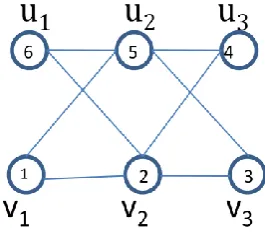
Illustration: 2.2
: ThePermutation labeling of the graph D2 (P3) is shown in Figure-1Fig-1: The Permutation labeling of the graph D2 (P3)
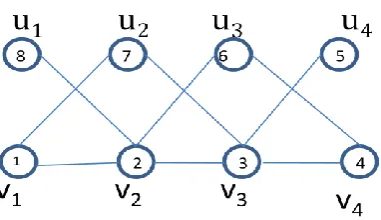
Illustration:2.3
: ThePermutation labeling of the graph D2(P7) is shown in Figure-2Fig-2: The Permutation labeling of the graph D2(P7)
Theorem 2.4
: D2(K1,n) admits a permutationlabeling.
Proof: Consider two copies of K1,n. Let v1 , v2 ,… , vn be the pendent vertices of the first copy of K1,n and v1' , v2' ,… , vn' be the pendent vertices of the second copy of K1,n with v and v‟respective apex vertices. Let G = D2(K1,n). Then |V (G)| = 2n+2 and |E (G)| = 4n. To define f: V(G) → {1,2, … ,2n +2} as follows.
f(v) = 1
f(v‟) = 2 f(vi‟) = 6+ i (1 ≤ i ≤ n)
f(vi) =2+ i (1 ≤ i ≤ n) f(v) = 1 f(v‟) = 2 f(vi‟) = 6+ i (1 ≤ i ≤ n)
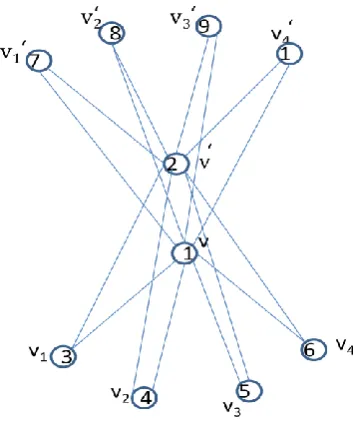
[image:2.595.363.496.86.203.2]
Fig-3: Permutation labeling of the graph D2(K1,4)
Theorem 2.6
: The path union of k copies of D2(cn) is a permutation graph.Proof
: Let D2(C n ) be the shadow graph of cycle. Let G be the path union of k copies G1 , G2 , ….. , Gk of shadow graph D2(C n ) . Let G1 „, G2‟ , ………Gk‟ be the first copy of cycle Cn and G1 “, G2” , ………Gk” be the second copy of cycle Cn in D2(C n ). Let us denote the successive vertices of G1‟by ui1 „, ui2 „, …… uin „ and Gi” by ui1” , ui2”, …… uin”. Let ei = ui1” u (i+1)” be the edge joining Gi and Gi +1 for i = 1, 2,…., k- 1. Define f: V(G ) → {1, 2, …., p } by
f(u1j‟) = i , 1 ≤ i ≤ n f(u1j”) = I + n , 1 ≤ i ≤ n
f(u2j‟) = i+ 2n , 1 ≤ i ≤ n
f(u2j”) = i+ 3n , 1 ≤ i ≤ n
[image:3.595.65.242.75.286.2]Illustration:2.7:
The permutation labeling of a graph G obtained by joining two copies of shadow graphs D2(C 4 )by a path of arbitrary length is shown in figure-4Fig-4:The permutation labeling of a graph G obtained by joining two copies of shadow graphs D2(C 4 )by a path of arbitrary length
Theorem 2.8
: A graph G obtained by joining two copies of shadow graphs D2(C n ) by a path of arbitrary length is a permutation graph.Proof
: Let graphs D2(C n )be the shadow graph of cycle Cn .Let G be a graphobtained by joining two copies of shadow [image:3.595.103.495.350.531.2]Fig-5: The permutation labeling of a graph G obtained by joining two copies of shadow graphs D2(C 5 )by a path of arbitrarylength
in first copy of D2(C n ). Let v1‟ ,v2‟ , …. v k‟ be the vertices of C n‟ and v1” ,v2” , …. v k”be the vertices of C n” in the second copy of D2(C n ) in G. Let w1, w2 , … wk be the vertices of path Pk with u1” = w1 and v1” = wk . We note that |
V(G)| = 4n+ k -2 and | E(G) | = 8n + k – 3. To define f: V(G) → {1 , 2, …., p} by
f(u
i‟) = i , 1 ≤ i ≤ n
f(u
i”) = i + n , 1 ≤ i ≤ n and
f(u
i”) = w
1 ,when i = 1
f(v
i‟) = i+ 3n +1 , 1 ≤ i ≤ n
f(v
i”) = i+ 2n+1 , 1 ≤ i ≤ n
f(v
i”) = w
3, when i = 1 and
Illustration:2.9:
The permutation labeling of a graph G obtained by joining two copies of shadow graphs D2(C 5)by a path of arbitrary length is shown in figure-53. PERMUTATIONS LABELING OF
SOME SPLIT GRAPHS
Theorem 3.1: Spl(Pn) is a permutation graph Proof: Let u1 , u2 ,… , un be the vertices corresponding to v1 , v2 ,… , vn of Pn which are added to obtain Spl(Pn). Let G be the graph Spl(Pn). Then |V(G)| = 2n and |E(G)| = 3(n-1) . To define f: V(G) → {1,2, … ,2n } as follows.
f(vi) = i ( 1≤ i ≤ n) f(ui) = n+ i ( 1≤ i ≤ n)
Hence Spl(Pn) is a permutation graph
[image:4.595.329.520.504.614.2]Fig-7: Permutation labeling of the graph Spl(P7).
Theorem 3.4
: Spl(K 1,n) is a permutation graph.Proof:
Let u1 , u2 ,… , un be the vertices corresponding to v1 , v2 ,… , vn of Pn which are added to obtain Spl(Pn). Let G be the graph Spl(Pn). Then |V(G)| = 2n+2 and |E(G)| = 3n. To definef: V(G) → {1,2, … ,2n+2 } as follows. f(vi) = i ( 1≤ i ≤ n) f(vi‟) = i ( 1≤ i ≤ n) f(v) = 1 f(v‟)
= 2n+2 and all the edges of Spl(K 1,n) have different weights for the
edges. Hence Spl(K 1,n) is a permutation graph.
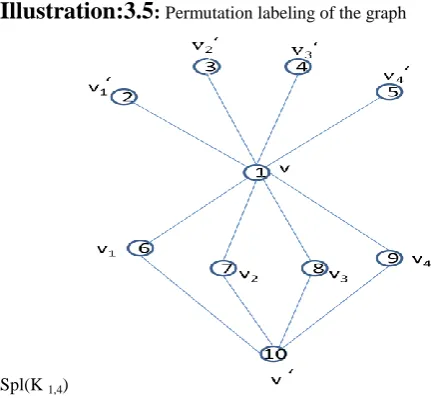
Illustration:3.5
: Permutation labeling of the graphSpl(K 1,4)
Fig-8:Permutation labeling of the graph Spl(K1,4)
4.
CONCLUSION
Finding shadow and split graphs seems to be a useful tool to generate new permutation graphs. Here I investigated shadow graphs of path Pn, star K1,n and path union of
5. ACKNOWLEDGEMENTS
The author is very thankful to the referees for their valuable
comments and kind suggestions.
6. REFERENCES
[1] B.D.Acharya and S.M .Hegde, Arithmetic graphs, J.Graph theory, 14(3) (1990),275 - 299
[2] L.Beineke and S.M.Hegde, Strongly multiplicative graphs , Discuss. Math. Graph theory, 21(2001), 63- 75. [3] D.M.Burton, Elementary Number theory, Second edition,
Wm.C.Brown Company Publishers, 1980.
[4] Frank Harrary, Graph theory, Narosa Publishing House- (2001).
[5] J A Gallian, A dynamic survey of graph labeling, The Electronics journal of Combinatories, 17(2010) # DS6 [6] Gary Chartrnd, Ping Zhang,Introduction to Graph theory,
McGRAW- Hill International Edition
[7] S.C Shee Y.S Ho , “ The cardinality of path union of n copies of a graph “ , Discrete Math, 151 (1996), 221- 229
[8] Suresh Manjanath Hegde , Sudhakar Shetty,
Combinatorial labeling of graphs ,Applied Mathematics E- notes,6(2006), 251-258© Revised 11th September [9] J. Shiama” Square sum labeling for some middle and
total graphs” International Journal of Computer Applications (0975-08887) Volume 37- No.4 January 2012
[10] J. Shiama ”Permutation labeling for some split graphs” Proceedings of the National Conference on Mathematical Modelling and Simulation. NCMS‟12 11th Feb.2012 [11] D B West, Introduction to Graph Theory, Prentice-Hall,
[image:5.595.54.270.419.618.2]