Multi Resolution Analysis using Complex Wavelet and
Curvelet Features for Content based Image Retrieval
Sanjay Patil
Rajarambapu Institute of Technology, Sakharale, Sangli, Maharashtra, India
Sanjay Talbar
SGGS College of Engineering &Technology,
Nanded, Maharashtra, India.
ABSTRACT
In a typical content-based image retrieval (CBIR) system, retrieval results are a set of images sorted by feature similarities with respect to the query image. This paper demonstrates the comparative study of retrieval performance of CBIR system using real dual-tree DWT (R-DT-DWT), complex dual-tree DWT (C-DT-DWT) and Curvelet Transform. The experiments are carried out on Corel database of 1000 images database of 10 different classes with various similarity measures. The overall performance for Canberra distance was found to be better as compared to Minkowski and Manhattan distances. Experimental results indicate that the proposed method gives excellent average precision of 100% for Dinosaur class and 95% for roses class of images. Comparing the results and taking feature vector size into consideration, it may be better to opt for R-DT-DWT rather than C-DT-DWT or Curvelet features for feature extraction. But curvelet features contains more directional information at high frequencies and high frequency components provides better discrimination between images.
Keywords
Real dual-tree discrete wavelet transform (R-DT-DWT), complex dual tree discrete wavelet transform (C-DT-DWT), Curvelet Transform, Similarity measures.
1. INTRODUCTION
A rapid increase in the amount of image data due to internet and availability of large data storage facility made content based image retrieval an active research area. Traditionally, there are two main research approaches in this area. One is keyword-based image retrieval. This approach is to create a set of metadata to describe the images content, namely, keyword annotation. In this keyword based annotations, the system can apply keyword-based information retrieval techniques to retrieve the images. This task is very time consuming and it is very difficult to describe color, texture, shape and object within the image [1]. The second approach is content-based image retrieval which mainly focuses on automatic retrieval and indexing the similar images by recognizing and studying the visual content like color, texture, or shape from the images.
Thus CBIR technique uses low level features such as color, texture, shape etc to represent the images relevant to the query image from the database. In CBIR first database images features are extracted. The extracted features are described by feature vectors. These feature vectors are then stored and distances of these feature vectors are then compared with feature vector of query image which is derived using similar technique. Obviously the distance of a query image with itself is zero if it is in database. The distances are then stored in increasing order and retrieval is performed with the help of indexing scheme.
The main contribution of this paper is to provide comparative analysis of Real tree DWT(R-DT-DWT), complex dual-tree DWT(C-DT-DWT) and Curvelet Transform. The technique makes use of real, complex wavelet and curvelet features which represents the latest research result on multi resolution analysis [2]. The feature extraction method has important role in CBIR systems. The extracted feature is a vector of finite size and dimension of the feature is one of the important parameters which determines the storage requirement, the retrieval accuracy and the computation time. As the size of feature increases, definitely retrieval accuracy improves but it also increases memory size and retrieval time [6].
2. CONVENTIONAL DWT
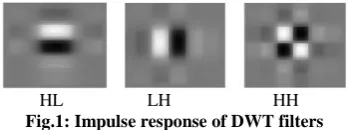
[image:1.595.341.518.478.543.2]The two dimensional DWT implementation decomposes image into three detailed sub-images (LH, HL and HH) corresponding to three different directional orientations (vertical, horizontal and diagonal) and lower resolution sub-image LL. The sub-sub-image LL is now a parent sub-image and further is decomposed into four child images for multilevel wavelet analysis [3]. The impulse response of these three wavelets associated with 2-D wavelet transform is shown in figure 1. The LH and HL wavelets are oriented vertically and horizontally, the HH wavelet has a checkerboard appearance and is oriented diagonally.
HL LH HH Fig.1: Impulse response of DWT filters
3. DUAL TREE DWT
The conventional DWT is very sensitive to shifts in the input signal; it has poor directional selectivity and also lacks the phase information due to real valued coefficients. To overcome these limitations Gabor based approach is an excellent solution but it is computationally complex and also it requires more storage capacity. Simoncelli et al. [7] suggested an approach to increase directional selectivity and shift invariance. All the above stated limitations can be overcome if coefficients can be made complex valued by finding the imaginary part. This is conceptually possible with the help of Hilbert transform. With the help of Hilbert transform, a complex extension of a real signal h (t) can be written as:
( ) ( ) ( )
(1)time/frequency domain (global in nature), it cannot be directly applied to FIR wavelet filter bank and the Hilbert pair filters will be of infinite length (IIR filters). Filters are also required to be orthogonal, symmetric and linear phase. The orthogonality is necessary to preserve the energy in transform domain. The symmetry property of filter makes it easy to handle the boundary problem for finite length signals. Linear phase response of the filter is necessary, to reduce the visually objectionable artifacts caused by nonlinear phase distortion, for the quality of image. However, impulse responses of orthogonal, symmetric and linear phase filters lacks quadrature between real and imaginary part and therefore cannot form a Hilbert pair. Therefore, the development of an invertible analytic (complex) wavelet transform is not as straightforward as expected.
Nick Kingsbury and Selesnik introduced an effective approach for implementation of complex wavelet transform called as complex dual-tree DWT with two almost similar versions [4], [5], [15]. These CWTs employs two conventional DWT filter bank trees working in parallel such that respective filters of both the trees are in approximate quadrature. The filter bank structure of both DT-DWTs is same but the design methods to generate the filter coefficients are different. Both DT-DWTs provide phase information, they are shift-invariant with improved directionality. The limitations of real DWT can be overcome by using complex DWT. Therefore it has approximate shift invariance, good directional selectivity with Gabor-like features, perfect reconstruction with linear-phase, Limited redundancy independent of number of scales (2mfor m-D) and it can be implemented using existing efficient DWT software and hardware.
3.1
Real Dual Tree DWT(R-DT-DWT)
In this implementation two critically sampled separable 2-D DWT filter banks are used in parallel. The filters used for first stage should be different from the remaining stages to have the frequency response to be one sided (analytic) [8]. In this paper for the implementation, Farras filters [9] are used for the first stage and Kingsburry’s Q-shift filters [10] are used for the remaining stages. The real 2-D dual-tree discrete wavelet transform (R-DT-DWT) can be implemented using separable 2-D wavelet transform. Applying both separable transforms to the same 2-D data gives a total of six sub bands: two HL, two LH, and two HH sub bands. Take the sum and difference of each pair of sub bands to get a transform which is two-times expansive and free of the checkerboard artifact as shown in figure 2.
+15o -15o +45o -45o +75o -75o Fig 2: Impulse responses for 2-D R-DT-DWT.
3.2
Complex Dual Tree DWT
(C-DT-DWT)
This approach employs two real wavelet trees; the upper tree gives the real part while the lower tree gives the imaginary part of the complex DWT. These trees are themselves real and use two different sets of perfect reconstruction (PR) filters. But they are designed such that the overall transform is
[image:2.595.319.540.181.271.2]tree into a complex basis function (and it’s conjugate) then we also separate positive frequencies from negative frequencies. The real and imaginary parts of each complex wavelet are oriented at the same angle, and the magnitude of each complex wavelet is an approximately circular bell-shaped function [9]. A set of six complex wavelets can be formed by using wavelets as the real parts and wavelets as the imaginary parts. Figure 3 illustrates a set of six oriented complex wavelets obtained in this way.
Fig 3: Impulse responses for 2-D DT-CWT: First row is interpreted as the real part and the second row as imaginary part of the complex wavelet. The third row shows the magnitude response (same for both, real and
complex wavelets).
4. CURVELET TRANSFORM
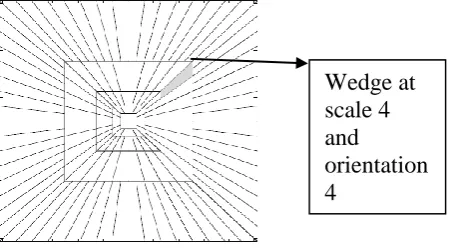
The ridgelet based curvelet transform has some disadvantages, so we have applied advanced technique for feature extraction using curvelet transform. For 2-D curvelet transform E. J. Candes and Dohono[11] introduced commercial software package ‘Curvelab’ which is a collection of matlab and C++ program for the fast discrete curvelet transform in 2-D.There are mainly two implementations, the Unequally Spaced Fast Fourier Transform (USFFT) and Wrapping based FFT. Comparing these two approaches, wrapping based discrete curvelet transform provides good edge capturing capability. Also it is simple and robust. The USFFT uses a decimated rectangular grid tilted along the main direction of each curvelet per scale and per orientations. Here the curvelet coefficients are found by the irregular sampling of the Fourier coefficients of the image. For a given scale the wrapping transform uses two grids decimated mostly horizontally or mostly vertically with image axes. This is implemented using consecutive translations and wrapping technique with lesser computation time as compared with USFFT. If the frequency responses of curvelets at different scales and orientations is combined, we get a rectangular frequency tiling that covers the whole image in the spectral domain. The figure 4 shows the frequency tiling of an image with 5 level curvelets [12].
Wedge at
scale 4
and
[image:2.595.318.543.618.742.2]5. SYSTEM IMPLIMENTATION
The proposed retrieval system has been implemented on an Intel Core2Duo, 32 bit, 2GHz processor using MATLAB R2011a version. The MATLAB is preferred as it is easily supports image processing and linear algebra.
5.1 Image Database Used
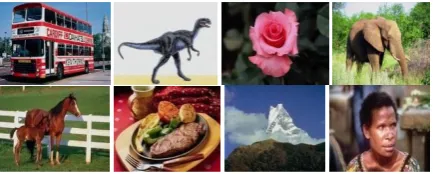
The Corel Database of 1000 color images of 10 different semantic subject each of size 384x256 or 256x384 is used. There are 100 images per subject. The subjects are tribes, dinosaurs, elephants, beaches, mountains, roses, buses, horses etc. Some of the sample database images shown in figure 5.
[image:3.595.57.274.214.301.2]
Fig 5: Sample Database images.
5.2 Image Feature Extraction
Each image in the database is having dimension 384x256 or 256x384. All the images in the database were initially resized to the dimension 64x64. Then each image was decomposed independently using conventional DWT, R-DT-DWT and C-DT-DWT. The analysis was done up to Jth level of decomposition and three different feature sets are computed using above three wavelet transforms. At Jth level the subband image will have size N/2J by N/2J. Then the feature vector can be formed by concatenating the rows or columns of all the sub bands at Jth level. At Jth level of decomposition the feature vector size for conventional DWT, R-DT-DWT and C-DT-DWT will be
, and
respectively. Therefore at fourth level feature vector size for above three wavelet decomposition will be 64,128 and 256 respectively. This means feature vector size of C-DT-DWT decomposition is twice as that of size of R-DT-DWT and four times as that of conventional DWT. In curvelet transform based implementation we have used 4 levels of discrete curvelet decomposition with default orientations. The curvelet coefficients are then stored in each subband. Thus for each curvelet two feature vectors are obtained. Similarly for n number of curvelets, the feature size is 2n. So 2n dimension feature vector is used to represent each image in the database for retrieval. Table I shows feature vector size for different level of decomposition of DWT and scale and no of curvelet subbands used.
Table I
Level of Decomposition(J) First Second Third Fourt
h
Feature Vector Size
DWT 4096 1024 256 64 R-DT-DWT 8192 2048 512 128 C-DT-DWT 16384 4096 1024 256
4 Level Curvelet Transform
Scale 1 2 3 4
Subbands 1 8 16 1
5.3 Similarity Measures
To estimate retrieval efficiency similarity measures plays very important role in this experiment. Different similarity measures will affect retrieval performances of an image retrieval system significantly so, it is important to find best distance metric for CBIR system. The results are quite satisfactory if the query image and database image distance is smaller. If x and y are two d-dimensional feature vectors of database image and query image respectively, then the distance metrics are given by[13],
i. Minkowski distance,
p p
i i MIN
x
y
x
y
d
(
,
)
1 (2) ii .Manhattan distance,
d i i i MANx
y
x
y
d
1
)
,
(
(3)The Manhattan distance was proposed in [14] for computing the dissimilarity scores between color images.
iii. Canberra Distance,
di i i i i C
y
x
y
x
y
x
d
1)
,
(
(4)6. EXPERIMENTAL RESULTS
The performance of CBIR system is measured by using important parameters Precision, Recall and Average precision. Precision and Recall can be used to compare performance of the CBIR system. The precision is defined as,
. (5)
Recall can be expressed as,
(6)
The Average precision is given by,
(7)
Average Precision for image classes is shown in Table II. 4
2J 2J
N N
2 4 2J 2J
N N
2 2 4 2J 2J
N N
Number of relevant images retrieved P I =Total number of images retrieved
R
I
Number of relevant images retrieved
Total number of relevant images
1
1 Nq
avg
k k q
P P I
N
Table II
Image Subject Name
Average Precision in %
R-DT-DWT C-DT-DWT
4-level Curvelet
Tribes 45.50 46.00 44.75
Buses 53.50 54.50 55.00
Dinosaurs 100.00 100.00 100.00
Elephants 66.50 67.00 68.50
Horses 62.50 63.25 65.00
Roses 95.00 95.50 96.00
Mountains 52.00 52.50 54.00
Beaches 51.50 53.00 53.25
Dishes 43.50 44.25 44.50
Monuments 54.50 54.50 56.00
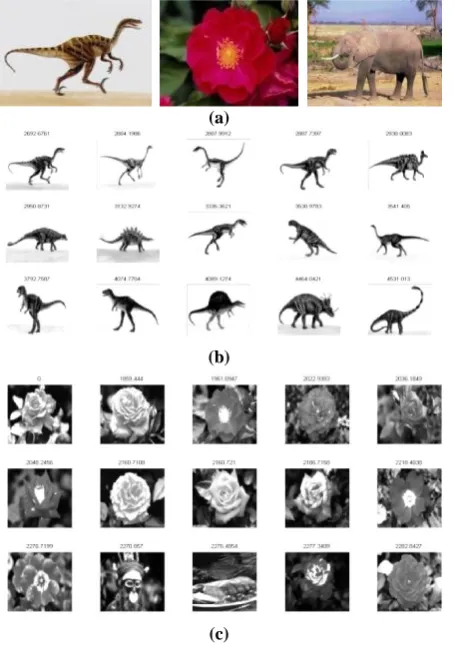
It was observed that the retrieval accuracy is excellent for Dinosaurs and Roses class of the images and it is good for Sunflower and average for remaining classes of the images. Also the performance of retrieval is better for curvelet feature than the dual tree wavelet techniques. But retrieval time is little more for C-DT-CWT due to double feature vector size. The figure 6(a) shows some of the sample query images and figure 6(b), 6(c) and 6(d) shows the 15 top matching images from the database images to the respective query image.
(a)
(b)
(c)
(d)
Fig.6 (a) Query Images, (b), (c), (d) Top 15 matching images to respective query image using C-DT-CWT.
7. CONCLUSION
In this paper we have presented an independent, comparative study of conventional DWT, real dual-tree discrete wavelet transform (R-DT-DWT) and complex dual-tree complex wavelet transform (C-DT-DWT) and Curvelet based image retrieval with three distance metrics (Minkowski, Manhattan and Canberra), at different levels, and in completely equal working conditions. This independent comparative research shows that Canberra distance metric was found to be better as compared to the Minkowski and Manhattan distance. It was observed that similarity measure not affect much on retrieval accuracy. Experimental results indicate that the proposed method gives excellent retrieval accuracy of 100% for Dinosaur class of images. The Roses class gives up to 95% retrieval accuracy. Also, for other classes retrieval accuracy is good. Although C-DT-DWT has the benefit of being both oriented and approximately analytic, the overall performance of R-DT-DWT and C-DT-DWT based features was found equally efficient. Also, the retrieval performance is further improved using curvelet based features.
8. REFERENCES
[1] Y. Rui and T. S. Huang, “Image retrieval: Current techniques, promising directions and open issues,” J. Vis. Commun. Image Represent. vol. 10, no. 4, pp. 39–62,
Apr. 1999.
[2] N. G. Kingsbury. Image processing with complex wavelets. Phil. Trans. Royal Society London A, September 1999.
[3] I.Daubechies, Ten Lectures on Wavelets, SIAM, CBMS series, Philadelphia, 1992.
[4] Nick Kingsbury, “Complex Wavelet for Shift Invariant Analysis and Filtering of Signals”, Journal on Applied and Computational Harmonic Analysis 10, pp 234-253, 2001.
[5] N G Kingsbury, “The dual-tree complex wavelet transform: a new technique for shift invariance and directional filters”, Proc. 8th IEEE DSP Workshop, Bryce Canyon, Aug 1998.
[6] Young Chun, Nam Kim, Ick Jang, “ Content based Image Retrieval using Multiresolution Color and Texture Features” IEEE Transactions on Multimedia, Vol. 10,No.6, Oct 2008.
[image:4.595.49.288.75.252.2] [image:4.595.57.285.370.703.2]March 1992.
[8] I.W. Selesnick, R. G. Baraniuk, and N. Kingsbury. The dual-tree complex wavelet transforms - A coherent framework for multiscale signal and image processing. IEEE Signal Processing Magazine, 22(6):123-151, November 2005.
[9] A.F. Abdelnour and I. W. Selesnick. Nearly symmetric orthogonal wavelet bases. In Proc. IEEE Int. Conf. Acoust., Speech, Signal Processing (ICASSP), May 2001.
[10]N. G. Kingsbury. Image processing with complex wavelets. Phil. Trans. Royal Society London A, September 1999.
[11]E.J. Candes, L. Demonet, D.L. Donoho, and L. Ying, “Fast Discrete Curvelet transforms”, Multiscale modeling and Simulation, Vol. 5, pp 861-899, 2005.
[12]Ishrat J. Sumana, Md. Monirul Ishlam,Dengsheng Zhang and Guojun Lu, “ Content based Image Retrieval using Curvelet Transform” In Proc. of IEEE International Workshop on Multimedia Signal Processing (MMSP08), Cairns, Queensland, Australia, ISBN 978-1-4244-2295-1, pp.11-16, October 8-10, 2008. .
[13]Manesh Kokare, B.N. Chatterji and P.K. Biswas “Comparison of Similarity Metrics for Texture Image Retrieval”, TENCON, 2003.
[14]M. Swain and .D. Ballard, “Color indexing”, International Journal of CompurerVision, Vol.7, No.1, 11-32, 1991.
[15]N G Kingsbury: “The dual-tree complex wavelet transform: a new efficient tool for image restoration and enhancement”, Proc. EUSIPCO 98, Rhodes, Sept 1998.