Journal of Criminal Law and Criminology
Volume 63 | Issue 3
Article 10
1973
Psychotoxic or Psychedelic
G. R. Nakamura
N. Adler
Follow this and additional works at:
https://scholarlycommons.law.northwestern.edu/jclc
Part of the
Criminal Law Commons,
Criminology Commons, and the
Criminology and Criminal
Justice Commons
This Criminology is brought to you for free and open access by Northwestern University School of Law Scholarly Commons. It has been accepted for inclusion in Journal of Criminal Law and Criminology by an authorized editor of Northwestern University School of Law Scholarly Commons.
Recommended Citation
PSYCHOTOXIC OR PSYCHEDELIC?
G. R. NAKAMUJRA AN N. ADLER*
George R. Nakamura Ph.D. is head toxicologist of the Los Angeles County Department of Chief Medical Examiner-Ceroner, Los Angeles, California. He was formerly employed as a forensic chemist with the U. S. Department of Justice, Bureau of Narcotics & Dangerous Drugs and with the U. S. Treasury Department, Internal Revenue Service in the Alcohol, Tobacco & Firearms Laboratory, San Francisco. Dr. Nakamura is the author of a number of papers dealing with forensic drug analyses and has previously contributed to this Journal.
Nathan Adler Ph.D. is a lecturer at the School of Criminology and in the Department of Psychology, University of California, Berkeley. He is also a private consultant and author of a number of papers in the psycho-sociological aspects of drug abuse.
The current epidemic of drug abuse in the search for means to alter consciousness is only one of the many ways of altering or transcending states of awareness (1, 2).1 Many other spiritual exercises in religion, hypnosis, parachute jumping, or rock climbing are a few of the possible examples of the ways known to alter mood and thought and orientation. In the search for the effects of the psychedelic drug "trips," many substances have been explored-nutmeg, furniture polish,, aerosol freezers, airplane glue, and other bizarre agents. The word, "psychedelic," coined by Osmond (5) reifies the "mind-manifesting" process known for millenia and grants a new prestige and a scientific aura for what is a psychotoxic process. Man has inhaled carbonated air emitted from the earth, rotated thongs in the pectoral muscles until they wore out. Yoga, with its transcendental meditation techniques, was an attempt to achieve the psy-chedelic state. Zen Buddhism is construed as a path for "turning-out" without drugs (3). DeRopp (4) devised a parlor game which describes a "pathway to Higher Consciousness Beyond the Drug Experi-ence." Schizophrenics may experience biochemical changes which many of the psychotomimetic drugs are presumed to model. Respiratory failure (anoxia) due to lack of oxygen in body circulation may cause hallucination and so will electric stimu-lation (6).
Osmond (5) originally sought a word in 1957 to
* The authors are indebted to Milton H. Joffee,
Ph.D., National Institute of Mental Health, Division of Narcotic Addiction and Drug Abuse, and E. Leong Way, Ph.D., University of California San Francisco, Department of Pharmacology, for reading the manu-script and suggesting improvements.
I Numbers in parentheses refer to references following
this article.
replace "psychotomimetic" with one which would be "euphonious" and not connote a sick mind but expand and open the mind to man's own nature to increase his understanding and awareness. He indicated that specific beneficial goals could be reached by "unhabitual perception" through psychedelic drugs. The word "psychedelic" was to imply good and beneficial effects ... from the use of compounds like LSD.
LSD was an accidental discovery of an extraor-dinary sort. Its profound and specific hallucino-genic action led to eager research in many labora-tories in hope that such studies with psychotomi-metics would elucidate the psychotic processes. It led also to a popular mechanics and popular medicine by those not qualified. Too many young people have played with the physical and psycho-logical effects with no capacity to control or evaluate the experience and its consequence.
While LSD has not been found to be lethal, its uncontrolled use has subverted many individuals, and has created an abusiveness in which meaning-ful research into its potentials as a psychotherapeu-tic agent is not possible.
The popular cult of psychedelia has been ex-ploited by the mass media to embrace an antimo-nian ideology and hair styles, jewelry, and argot. The ingestion of the drug is only one aspect of the transvaluation of values and a reorientation of the individual who seeks to vitalize his life anew.
PSYCHOTOXIC OR PSYCHEDELIC?
Press and Done (7) in deliberate toluene inhalation.
Visual hallucination and euphoria are among the
desired effects sought by glue-sniffers, and these
subjective responses have been noted in a large
number of medical case reports.
What criteria must a substance fulfill
psycho-pharmacologically to be called a psychedelic? Is
"psychedelic" a valid differentiation scientifically
merited or is it merely a public relation labelling
operation? It appears worthwhile to examine some
of the terms used interchangeably. While
hallucino-gens
2include only those drugs which produce
hallucinations, a more general term describing a
whole range of toxic effects on the cerebrum are
called psychotoxic or psychotogenic. These may
not only include "trips" accommodated by the
exogenous drugs such as mescaline, LSD,
Can-nabis, and barbiturates, but also by a wide range
of anesthetics and commercial organic solvents. A
lack of air and water in toxic amounts may also be
considered psychotoxic.
In comparison to the terms psychotoxic and
psychotogenic, the terms psychotropic and
psycho-active have also been used to cover the spectrum
of drugs and chemicals having an affinity for
cerebral processes without invidious inferences.
"Psychotomimetics" was introduced by Gerard
(9) and applied to those agents reproducing
characteristics of functional psychosis. To be
classed as a psychotomimetic, the drug must only
mimic the syndromes of a psychiatric illness and
"its action must be both readily reversible and of
limited duration" (10).
Psychotomimetic agents have been described as
being capable of effecting changes in perception,
emotion, thought, and ego function (11). These
changes are differentiated from the deliriant effects
elicited by alcohol, morphine, cocaine, and
atropines since these latter compounds tend to
cloud consciousness and exhibits other serious
disability of the autonomic nervous system (12);
the definition of psychotomimetics therefore also
excludes anesthetics, analgesics, and hypnotics.
Ilett and Parfitt (13) categorized the
psychoto-mimetics into four groups: phenylethylamines,
(e.g., mescaline), indoles (e.g., LSD, bufotenine),
piperidines (e.g., phenycyclidine), and cannabinols
(for marihuana).
2See Comprehensive Drug Abuse Prevention and
Control Act of 1970, 21 U.S.C. §§801-966 (1970), in
which 17 hallucinogens, including LSD, mescaline,
marihuana, MDA, DMT, psilocybin, are specifically
listed as controlled drugs.
Osmond (14) defined psychedelic as a compound "like LSD or mescaline which enriches the mind and enlarges the vision. It is this kind of experience which provides the greatest possibility for examin-ing those areas to psychiatry and which has pro-vided men down the ages with experiences they have considered valuable above all others." While psy-chotomimetic refers to psychological changes re-sembling, more or less, experiences like those found in psychotic illnesses, psychedelic implies a benefi-cial change and the description of a positive value; however, the word tells more about attitudes towards drugs than about the effect of the sub-stance.
The net effect from LSD trips, after all the confusional experiences have been swept away, has not elicited any profound revelation. The overt behavioral change produced by LSD trips appears to be minimal or non-existent in most cases. A variety of bizarre, subjective experiences has been described, but there appears to be no new insight or true revelations.
PHARMACOLOGICAL BASIS OF COMPAuSON
Since its discovery by Hofmann in 1943, LSD (lysergic acid iethylamide) has remained the chemical vehicle for "model psychosis." Its effects have been used as a basis for comparison with other substances producing potentials for causing "con-scious alteration."
LSD belongs to a group of substituted indole alkylamines. Others in the group include such psychotomimetics as dimethyltryptamine (DMT), diethyltryptamine (DET), bufotenine, psilocin, psilocybin, harmine, and ibogaine. Current reviews by Hofmann (12) Hoffer and Osmond (14), Down-ing (15, 16), Crossland (17), Jacobson (18), and Cohen (11) more than adequately cover the chemistry and pharmacology of LSD and other indole hallucinogens.
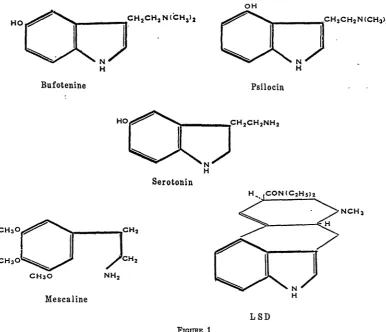
A cursory examination of the basic structure of these compounds would reveal their amazing similarity to serotonin, or 5-hydroxytryptamine (Fig. 1), an endogenous chemical putatively called an "inhibitory transmitter" acting between nerve cells. The presence of serotonin has been theorized to suppress the brain cells from becoming over-excited and resulting in hallucination and other behavioral aberrations.
The specificity of LSD compounds at the nerve receptor sites introduces another dimensional interest to the above hypothesis. The brominated
OH
Bufotenine Psilocin
Serotonin
C0H 2
CH3
O NH2
Mescaline
[image:4.454.42.429.41.373.2]LSD
FIGURE 1
Serotonin, a putative chemical nerve transmitter, compared with hallucinogenic drugs. LSD, psiocin and bufotenine possess the same indole ring structure (in bold lines). Mescaline has structure resembling an indole
ring.
derivative of LSD (2-brom LSD), although having the same serotonin antagonism action, was found to be devoid of psychotomimetic effects. Moreover, the levo-rotatory isomer of LSD is relatively inactive in comparison to the d-form with respect to serotonin inhibition and devoid of psychotomi-metic actions. Only the d-LSD form of LSD com-pounds, therefore, is of interest here.
Also in corroboration to the similarity of the psychotomimetic activity of indoles is the observa-tion that psilocybin and psilocin, the simplest chemical forms of tryptamines indoles yield effects similar to that of mescaline or LSD. The similarity of the effects of LSD and psiocybin or psilocin supported the idea that these two drugs possess perhaps some common metabolic mechanisms in
causing psychic changes.
Psilocybin and psilocin found in psilocybe
mushrooms, which have been used by Mexican Indians in elaborate rituals for at least 3000 years, exert hallucinogenic effects. At high dosage, mystical or religious experiences are reported by subjects. That these experiences are different from what non-Indians report is probably due to a learning process. One visualizes what one is pre-pared to see or hear or experience.
The correlation of chemical structure and psychotomimetic activities of the indoles such as psilocybin and psilocin and LSD with those of the most important phenylethylamine, mescaline, found in the peyote plants are frequently cited in the literature.
schizophrenic-PSYCHOTOXIC OR PSYCHEDELIC?
like reactions and also the strange effect of de-personalization3 with which LSD is characterized. On closer examination, the chemical structure of mescaline, 3, 4, 5-dimethoxyphenylethylamine, re-sembles closely those of indolds (see Figure 1). Hypothesis has arisen that mescaline is a precursor to indolic compounds in its eventual action in the body (13), however, the excretory products from mescaline use has not been shown to contain an indole compound (19).
The alteration of mescaline molecule to a 3-methoxy-4,5-methylene dioxy compound results in MDA, another psychotomimetic which bears resemblance to myristicin. The psychotomimetic effect of nutmeg was suggested by Shulgin (in 20) to be due to myristicin.
Amphetamine is an isopropylphenethylamine whose pharmacological action on the CNS is attributed in part to the free amine. It induces psychotropic effects if taken in large doses, and this response is attributed perhaps to the preven-tion of a putative nerve transmitter called norepi-nephrine from a re-uptake following its release from the nerve cells.
That norepinephrine, which is normally present in the brain, possesses a chemical structure similar to such psychotomimetic drugs as mescaline and amphetamines tempts speculations as to its role in abnormal metabolism in early schizophrenia. For these reasons, the psychotomimetics have been valuable in the study of the biochemical function of the nervous system.
The foregoing brief discussion of the action of, psychotomimetic drugs has been presented so that
a basis of comparison can be made with the effects from the inhalation of solvents used in industrial
and household agents with those of LSD.
The "psychedelic" syndromes of LSD ingestion has been widely documented and reviewed in journals and exploited in popular literatures (14,
19, 22, 23, 24, 25, 26, 27). Since LSD syndrome is
essentially the same as those for mescaline, psilocin, and psilocybin it is used as a point of reference in this discussion.
Table I lists some of the more important sub-jective effects of LSD in man. It is difficult to catalog subjective responses since these are
idio-syncracies and are influenced by the individual set,
3The subject feels that he has two forms, an in-tellectual and emotionless form which is able to ob-serve the second form, a fantastic being of delusion and fantasy (13). Spectator and actor in the self, agent and agency appear fragmented and disintegrated.
by the setting in which the drugs are consumed, by his prior desires, his traits, his mood, and other
accidental factors. The phantasy of his "psyche-delic" experience may largely depend on suggested expectations (4).
MARIUANA
The compilation of bibliography on marihuana, its chemistry, its ethnopharmacology, and its social and legal implications, is a major under-taking (28, 29, 30, 31), so voluminous have been the published papers.
Polemics and partisanship appear still to be dominant, and ideological issues contaminate an objective assessment. Some natural and social scientists claim that the "weed" is merely a mild intoxicant or euphoriant while others find it sufficiently psychoactive to be described as a psychotomimetic associated with some of the effects derived from LSD, mescaline, and psilocy-bin. The various effects are primarily dose-related. The fact that the active chemical constituents,
THC (tetrahydrocannabinol isomers) are non-nitrogenous and structurally unrelated and that no cross-tolerance exists between 1-delta-9 tetra-hydrocannabinol (from marihuana) and LSD in man (32), as the latter with mescaline, suggests that the mechanism of psychotomimetic actions produced by marihuana and LSD are not funda-mentally the same. Like LSD, the hallucinogenic phenomena elicited by Cannabis must be directed, motivated or situation set, as demonstrated in controlled experiments by Weil et al (33).
The problem of characterizing marihuana's pharmacodynamics is in the determination of its active constituents. The tetrahydrocannabinols
(THC) which were only recently synthesized have
been tentatively assigned the principal active role, thus opening the door to controlled studies (34, 35). The delta-i isomer of THC is considered the only important psychotomimetic agent in
mari-huana; the other active THC is called delta-6 THC contained in the marihuana in a quantity ten times less from that of the delta-i isomer. THC is extracted from marihuana as an oily fat-soluble substance. Recent research activities suggest that
THC exerts its action in the animal body as a
more polar metabolite such as hydroxy THC (36). In man, li-hydroxyl THC and possibly other polar metabolites of THC appeared to be present upon administration of THC (37). THC acts in the
Table I
EFFECTS OF LSD EXPERIENCE OBSERVED IN SOLVENT INHALATION*
LSD-type Symptoms Glue Solvents
[
Paint Thinner Gasoline§OMATIC
Dizziness & weakness Nausea
Drowsiness Paresthesia Blurred vision Anesthesia
PERCEPTUAL
Altered shape and color Sharpened sense of hearing Synesthesia (rare)
PSYCHIC
Distorted time & space Difficulty in expressing
thought Depersonalization Dreamlike feeling Visual hallucination Hyperacusis Euphoria
Ideational, delusional misin-terpretation
Altered mood, happy, sad & irritable
Present
Present, with vomit-ting
Present Double visions Indicated Amnesia Present
Sense of lightness, of spinning, moving, floating, and mag-netic pull
Space distortion Present
Not indicated Present
Also auditory & tac-tile
Present Present Micropsia
Grandiosity Loneliness
Present, with vomit-ting
Present
Altered shape only
Same as in glue
Space distortion Present
Not indicated Present
Also auditory & tac-tile
Present Present Micropsia
Grandiosity Loneliness
Present
Present, with vomit-ting
Present Present, rare Present Indicated Amnesia Present
Same as in glue
Space distortion Present
Not indicated Present
Also auditory & tac-tile
Present Present Micropsia Grandiosity Loneliness
* From references 6, 7, 56, 61, 65, 71, 72, 73, 74, 75, 76, 77, 78, LSD syndrome according to 79.
manner of other fat soluble substances such as ether and alcohol but as a steric specific chemical. Hollister et al (38) tested THC in man and observed clinical effects resembling those of psy-chotomimetics such as LSD, but differing in a longer euphoria, a more pronounced dreamlike sequence and a prominent sedation. For these reasons, THC action has been related to that of alcohol as well as to LSD. Unlike alcohol, however, marihuana does not induce hangovers even at high doses. The dosage level used ranged from 30 to 70 milligrams, with a median of 50 milligrams; LSD dosage, to obtain desired euphoric effects, is about 0.02 to 0.2 milligrams. These and other investiga-tions have shown that THC induces effects of both alcohol and LSD, but until more information is
obtained it must be categorized on its own. No other drug agent, nevertheless, has a more intimate association with the "psychedelic" community as has marihuana.
Marihuana ultimately must be evaluated by its active constituents than by the subjective reports of behaviors elicited on smoking crude plant material. Smoking crushed marihuana plant ma-terial is analogous to smoking crushed opium poppy pods, both are chemically crude plant tissue materials containing less than 0.5% active chemical constituents. The concentrated extracts from opium poppy and marihuana on the other hand are what we know as opium and hashish.
PSYCHOTOXIC OR PSYCHEDELIC?
cool surface. In a simulated smoking experiment much of the THC has been shown to be trapped unchanged in the smoking machine (39). One of the present writers, working in a government testing laboratory, has detected large amounts of can-nabinoids in the ashes of burnt cigarettes and in the stems of smoking pipes indicating that much of the active constituents of marihuana are trapped in the smoking paraphernalia, and it is presumed that only about a half of the active material finds its way into the body.
Ecological factors may also determine the strength of marihuana. Plants grown in a warm, humid climate seem to have a greater THC con-tent than those grown in a temperature zone. Two genotypes of marihuana, however, have been suggested (40), one variety is of the "drug type" having a higher THC to Cannabidiol ratio than the "fiber type" having a lower ratio value of THC.
It should also be noted that much of the seized' marihuana examined in laboratories contains stalk, twigs, and seed fragments all of which dilute and attenuate the psychotropic action of marihuana. Mold, mildew growth, and insect infestations are also common. The status of marihuana as a psychoactive agent must await a less ambiguous examination of the active principles derived from information that does not depend on studying the effect of smoking crushed plant materials. The availability of synthetic THC affords a chemically pure product for scientific study and makes possible an assessment of the full impact of the effect of marihuana in man.
NmiG
The active constituent of nutmeg remains a speculative matter. It has been commonly ascribed to myrlsticin which has been characterized as a monoamine oxidase enzyme inhibitor like tranyl-cypromine and iproniazid. Its action is presumed to increase the level of 5-hydroxytryptamine (sero-tonin) in the brain and thus perhaps to exert its narcotic property of inducing stupor (20).
Weil (41) describes reactions from nutmeg ingestion that range from no change to full-blown hallucinogenic experiences like those caused by hashish or LSD. Visual hallucination, distortion of time and space perception, and body image dis-tortions have been reported. Feelings of deperson-alization and unreality have been reported too. Payne (42) reported on 2 male college students who
ingested about 2 tablespoons of grated nutmeg and whose clinical symptoms involved exhilaration and intoxication followed by a persistent feeling of un-reality for 48 to 60 hours. Payne noted that no hallucination appeared evident; "the effect is fairly well known among alcoholic patients and narcotic addicts whose regular supplies are ex-hausted."
Farnsworth (43) suggested that the psychotomi-metic substance must be contained in the volatile oil of nutmeg, but he doubted, based on lack of responses in human experiments, that myristicin is the major psychoactive agent.
At the present time, most writers categorize nutmeg as "a psychedelic" rather than as an intoxicant (44) and have indicated that its action does differ appreciably from that of marihuana (45). Again, we are faced with the situation where the active principles must be isolated and fully characterized.
MORNING GLORY SEEDS
Its abuse was reported by Fink, et al (46) who noted the similarity to the effects induced by LSD. D-Lysergic acid monoethyl amide and d-iso-lysergic acid monoethylamide are the principal components of morning glory seeds and their comparative effects with LSD (d-lysergic acid diethylamide) have been delineated by Barron
(26), Hofman (47) and others. Their
psychotomi-metic effects are somewhat less than those of LSD. INHALANTS AND
Toxic PsycaosEs
The search for euphoria and escape has led sniffing adolescents to sniff glue solvents, gasoline, lighter fluids, shoe polish, lacquer, deodorants, nail polish, laughing gas (nitrous oxide), etc.4
The social background of glue-sniffing is noted in an American Social Health Association leaflet by Winick and Goldstein (48) as well as in a study conducted in the New York slums by Preble and Laury (49). An extensive bibliography on glue-sniffing and other inhalants has been prepared by Kupperstein and Susman (50) who have also included newspaper reports. "Ether drinking" (51) has a historical reference for the "drug abuse" of the 1890's. Cherkins (52) looks back to 1799 when the poets Southey and Coleridge used laughing-4There is a suggestion of the perverted ingestion known as pica to be considered here as drug users persist in a smorgasbord of compulsive promiscuous
and indiscriminate pill-popping.
gas, and Sir Humphrey Davey documented a vivid description of his experience with laughing gas that appears to be similar to that elicited by complex molecules such as LSD and mescaline. It appears, therefore, that much of the acute effects of the inhalants are the consequence of a general CNS depressant.
Case reports (49, 53, 54, 55, 56, 57, 58, 59, 60) and studied works and reviews (6, 7, 61, 62) indi-cate transitory but apparent effects resembling the euphoric, hallucinatory, and other psychic effects of psychotomimetic drugs.
Although Von Oettringen (63) listed a few of these psychic responses obtained from a number of industrial chemicals, ranging from ethanol to extremely toxic carbon tetrachloride, the literature is devoid of the psychopharmacological discussion on industrial solvents. We must therefore rely on the subjective responses reported retrospectively in "glue-sniffing" and other deliberate inhalation of vapor from a limited number of common organic solvents. The factor of anticipation appears to play a dominant role in the individual's quest for the particular desired effect to obtain certain ecstasy or grandiose power through the use of these psychoactive agents.
The common agents of purposeful inhalation include aromatic hydrocarbons (e.g., toluene), hydrocarbons (e.g., hexane), halogenated hydro-carbons (e.g., chloroform), ketones (e.g., acetone), esters (e.g., ethyl acetate), glycols (e.g., ethylene glycol), and alcohol (e.g., ethyl alcohol). In-gredients used in some airplane model cements were listed by Barman, et al (64), Glaser (65), and in the bulletin on "Glue-Sniffing" issued by the National Clearinghouse for Poison Control Centers (66); some of the pathological effects of ingredients tricresyl phosphate, xylene, toluene, and acetone, were described. The active component of lighter fluid is generally naphtha, mixed with other aliphatic hydrocarbons. Ether, chloroform, and nitrous oxide in judicious amounts have been used as anesthetics, however, undesirable side effects have been present. The difficulty of evaluating commercially prepared solvents such as glue, gasoline, and lighter fluid lies in the fact that they are mixtures, and the subjective effects can not be attributed to one particular component.
Ethanol, or ethyl alcohol, may be one of the best inhalants for psychic purposes since it affords euphoria and mental well-being on prescribed dosage without the relatively rapid onset of toxic
and other undesirable side-effects. It is conceivable that other low molecular weight alcohol such as propanol and butanol used in model airplane cements would exert similar psychic effects on the CNS, the higher alcohols with lower vapor pressure would be relatively weaker. Toluene and benzene, common ingredients of glue and rubber cements products, are also shown to induce euphoria. Diplopia (double visions) was added to the list of effects since a number of writers have reported them in glue-sniffing. All in all, the present litera-ture lacks psychopharmacological studies of indi-vidual solvents. A description of the toxic mecha-nism of aromatic hydrocarbons, such as toluene found commonly in glue, deserves some attention here.
Toluene is an example of a simple aromatic hydrocarbon which qualifies as a suitable inhalant since its odor is not disagreeable, and it has suffi-cient vapor pressure to effect a rapid onset of CNS depressant effect.
Contrary to LSD and morphine, the selectivity or specificity of action of the arematic hydro-carbons at the CNS site is dependent on the num-ber of molecules present at the particular moment rather than the type of molecule. Such physical effects as the vapor pressure of the solvents in the cells determine the quality of their action. There-fore, the depressant action of the alkylbenzenes
(e.g., toluene, xylene) have much in common with those of alcohol, ketones, ether, and esters.
Benzene compounds with long alkyl chains, such as having 4 or 5 carbons in the chain, have little or no CNS depressant action because of low volatility. Toluene thus is a fast but short acting agent while such compounds as n-butylbenzene are slow and long acting. Those with a longer chain (e.g., phenyldodecane) are less volatile, like mineral oil, and have no narcotic potency.
PSYCHOTOXIC OR PSYGHEDELIC?
results in severe injury. It appears that narcosis and oxygen depletion go hand in hand. (Narcosis can occur also with adequate oxygenation.)
As in LSD and marihuana experiences, there are the suggestions of sexual stimulation associated with solvent inhalation. Ackerley and Gibson (67) reported autoerotic and homosexual activity in a 10-year old boy while under lighter fluid induced euphoria. Gwozdz (68) reported a bizarre case of the death of a 21-year old male who hanged himself with a plastic bag and cotton saturated with glue over his head during masturbation. One need not assume a pharmacological or physiologic base for aphrodisiac effects. These may be consequences of the lowering of inhibition, the "dissolution" of the superego, or other psychogenic factors.
Glaser (65) discussed a number of materials and techniques used in inducing what he called "in-halation psychosis". He noted that possibly "in some cases, at least, inhalation psychoses may be a deliriant similar to that induced by barbiturates and alcohol". If this is so, it is important to infer that the responses from inhalant experiences differ from the "psychoses induced by LSD and related compounds, which is not felt to be a delirium and which can be differentiated from deliria both objectively and subjectively".
Glaser remarks that in inhalation psychosis, the
LSD and schizophrenic syndromes may occur only
in individuals "whose psyche was in precarious balance prior to delirium". Those symptoms de-scribed by inhalers as auditory, visual, and tactile hallucinations and spatial distortions, macropsia, micropsia, and body image distortions may not develop in all cases.
Gleason et al (69) in Clinical Toxicology of
Commercial Products discuss delirium attributed
to drugs and chemicals and note that certain doses of LSD, mescaline, atropine, quinacrine, and especially the amphetamine group produce a heightening of perception and awareness rather than a reduction of awareness. However, they indicate that "in the late stages of severe poisoning with cerebral exhaustion, these toxic psychoses (from LSD type drugs) are not distinguishable from the delirium induced by the commoner seda-tive drugs".
Acute toxic psychosis is caused by a host of drugs and other noxae including heavy metal poisoning, hormones, oxygen depletion, water in toxic amount as well as glue solvents; they produce one or more of these disorders: mental clouding,
perceptual disturbances, and impaired motor activity. All seems to be characterized by clouding of consciousness and mental disorientation. We are mindful also of the effects of hypoxia in addi-tion to the direct effect of solvent inhalaaddi-tion; Noguchi (70) noted that oxygen is usually excluded
by methods sniffers use. Another possible effect is
that from rising carbon monoxide induced from deep breathing, if there is re-breathing, it was stated.
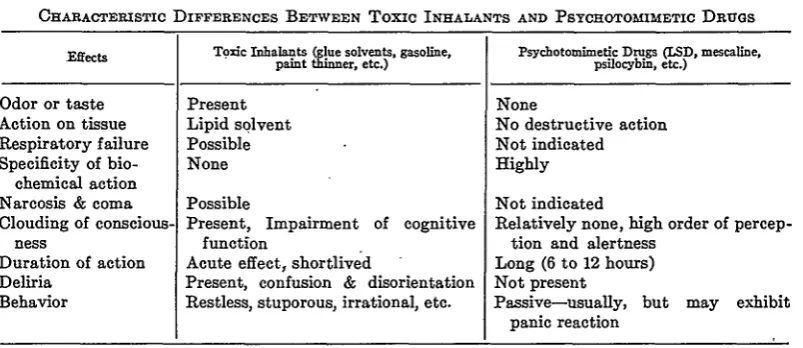
LSD and mescaline appear to be exceptions and are distinguishable because they may model a psychotic state in that there is relatively lower impairment of cognitive functions, consciousness, memory, or comprehension. Remarkable is the highly specific and sensitive nature of LSD reaction since as little as 20 micrograms, or 0.02 gram, can initiate a train of hallucinatory, euphoric, illu-sionary reactions with a minimum of mind-cloud-ing. The LSD effect is long-lived, lasting as long as 12 hours on a single dose.
In short, the toxic inhalants are rapidly absorbed into the bloodstream, the onset of psychic effect is rapid, and lasts as long as solvent effect occurs. Exhilaration, euphoria, and intoxication are the initial "desirable" effects, but these are rapidly displaced by headache, dizziness, impaired motor coordination, nausea, and vomiting. Sustained use may lead to coma and unconsciousness. Doubt-lessly, there is a parallel between inhalants and alcohol drinking with one notable difference being the rapidity with which such solvents as benzene and toluene as well as with general anesthetics in contrast with alcohol reach the CNS. In general, most inhalants act similar to the anesthetics by causing disinhibition and general CNS depression. Table I represents some of the subjective reac-tions observed in glue sniffing, paint thinners, and gasoline and are compared to those from LSD expeiaeces. Since the effects of inhalation psycho-sis are gleaned mostly from case reports which in themselves are dependent on subjective recollec-tions, some of the somatic and psychological responses may have not been accounted for. While there are general agreements, such somatic experi-ences as parasthesia probably went unreported in glue and thinner sniffing. For the subjective re-sponses, the element of expectancy is of profound importance to the extent that it is said that if the subject is skeptical of the drug effects, he may suppress all sensory responses. The adolescents and those from economically impoverished families,
Table II
CHARACTERISTIC DIFFERENCES BETWEEN Toxic INHALANTS AND PsYcaTomrMIMETIc DRUGS
Effects
Odor or taste Action on tissue Respiratory failure Specificity of
bio-chemical action Narcosis & coma Clouding of
conscious-ness
Duration of action Deliria
Behavior
Toxic Inhalants (glue solvents, gasoline, paint thiner, etc.)
Present Lipid solvent Possible None Possible
Present, Impairment of cognitive function
Acute effect, shortlived
Present, confusion & disorientation Restless, stuporous, irrational, etc.
Psychotomimetic Drugs (LSD, mescaline, psilocybin, etc.)
None
No destructive action Not indicated
Highly
Not indicated
Relatively none, high order of percep-tion and alertness
Long (6 to 12 hours) Not present
Passive-usually, but may exhibit panic reaction
seeking escape from reality may, on the other hand, lend themselves to hypersuggestibility of grandiose illusions. This may be why true hallucination is said to be of rare occurrence.
It is of interest to note that the inhalant symp-toms do not include depersonalization, the out-of-the body experience, which is invariably reported in LSD experiments. There appears to be no significant differences in symptoms derived from the inhalation of the three solvents.
Table II shows the distinctions between the effects of psychedelic drugs and of glue solvents, gasoline, and paint thinners. While the two groups share some of the psychic phenomena, the solvents do not exhibit the level of consciousness, the heightened perception, and the hyperalertness of the LSD experiences. Solvent inhalation leads to a state of mental deterioration. These features appear to differentiate the "psychedelic" drugs from the others.
While some LSD effects overlap those of other types of drugs such as the bromides, atropines, barbiturates, and cocaine, LSD appears not to induce other deleterious effects of toxic psychoses. The specific effect of the various chemicals on the brain is poorly understood, but the variety of psychological reactions obtained by drugs of different structural configurations indicate that there are probably specific locations in the brain even on a cellular or molecular basis which certain exogenous agents stimulate or depress. Evidently, LSD affects areas in which the level of conscious-ness is not diminished, i.e., the cognitive function is relatively unimpaired. Other compounds possessing
LSD-like effect may include DMT (dimethyl-tryptamine), DET (diethyl(dimethyl-tryptamine), bufoten-ine, psilocybin, psilocin, and possibly tetrahydro-cannabinol (marihuana).
In contrast, the effect of organic solvents, in-cluding the alcohols, is that of intoxication at first but is followed by degenerative action on the nerve tissues leading to delirium, coma, etc. Gerade (80) has observed endothelial (fat linings) injuries in the kidney, liver, spleen, bladder, and thymus as well as in the brain and spinal cords due to aromatic 'hydrocarbon inhalation. Toxic overdose of the belladonnas, for example, induces symptoms of disorientation and deliria.
[image:10.454.43.445.49.223.2]PSYCHOTOXIC OR PSYCHEDELC?
SUMMARY
1. The meaning of various terms used to describe
psychopharmacological drugs were compared with particular reference to the term "psychedelic", proposed by Humphry Osmond. Terms such as psychotropic, psychotoxic, psychotogenic, psycho-active, psychotomimetic, and hallucinogenic have been used interchangeably to describe the same group of drugs affecting the central nervous system. Psychedelic was introduced
-
in preference to "psychotomimetic", a term which connotes drugs which mimic the ill-effects of psychosis. Psycho-tropic and psychoactive are neutral designations. 2. Some comparisons were made of the effects of glue solvent sniffing and LSD experience based on available literatures. Marked differences in actions were described; the former appear to cause generalized CNS depression. A transient period of intoxication is followed by deliria, coma, and, in some instances, death while the latter evokes a longer period of intensity, alertness, and keen sensory perception. The effects of LSD-type drugs, on the other hand, are induced by a comparatively small dosage; some of the psychic effects are also a result of side effects of toxic doses of other chemi-cals and drug compounds, ranging from bromides to gasoline to glue solvents. These experiences differ from those obtained from LSD in the loss of cognitive function because of their intoxicating action and/or delirium. In this critical confine, LSD and LSD-type drugs appear to be differ-entiated as psychedelics from other chemical agents which elicit similar subjective effects.3. It is questionable whether the use of the term psychedelic in the differentiation of a unique configuration is now applicable. The connotation of psychedelic in the semantic sense is that of bizarre, harmless, and pleasure-giving sensations while the true experiences from drug-taking are fraught with psychotoxic reactions and dangers, both physical and psychic.
REFERENCES
1. Adler, N., Themes for an Exhibition (address given at the Drug Conference Smithsonian Institution, Washington, D.C., kovember 11, 1969).
2. Adler, N., Drug Abuse as the Manipulation of Body Image, Sensibility and Self: The Anti-nomian Personality as Tuned Organism (pre-sented at the Conference on Drug Use and Drug Subcultures sponsored by the Center for Studies of Narcotics & Drug Abuse of NIMH and the Haight-Asbury Research Project of Mt. Zion
Hospital at Asilomar Conference, February 17,
1970).
3. HOFFER, A. ANm OsmoNm, H., THE CHEMICAL BASIS oP CmCAL PSYCHIATRY, (1960). 4. DEROPP, R. S., THE MASTER GME (1969).
5. Osmond, H., A Review of the Clinical Effects of Psychotomimetic Agents, 66 ANNALS, N.Y.
ACA-DEmY OF SCIENCES, 418 (1957).
6. Tolan, E. J., and Lingl, F. A., Model Psychosis
by Inhalation of Gasoline Fumes, 120 Aae J. oF
PsYcmA., 757 (1964).
7. Press, E. and Done, A. K., Solvent Sniffing, 39 Pediatrics, 451 (1967); 39 ibid, 611 (1967).
8. Comprehesive Drug Abuse Prevention and Control Act of 1970, V. 21 U.S.C
§§
801-966 (1970).9. Gerard, R. W., Drugs for the Soul; the Rise of
Psy-chopharmacology 125 SCIENCE, 201 (1957).
10. op cited ref. 3.
11. Cohen, S. Psychotomimetic Agents, ANNUAL
RE-VIEW OF PHARMACOLOGY (1967).
12. Hofmann, A., Psychotomimetic Agents in DRUGS
AFFECTING THE CENTRAL NERVOUS SYSTEM,
169 (1968).
13. Illet, K. F. and Parfitt, R. T., Psychotomimeti
Drugs, 46 AuSRAIAN JOURNAL OF PHARMACY, Supplement No. 28, No. 544 (1965).
14. HOPPER, A. AND OsmoND, H., THE HALLUCINOGENS,
(1967).
15. Downing, D. F., Psychotomimetic Compounds in
PSYCOPHARMACOLOGICAL AGENTS, Edited by M. Gordon, (1964).
16. Downing, D. F., The Chemistry of the Psychoto-mimetic Substances, 16 QUARTERLY REVIEW, 133
(1962).
17. Crossland, J., Psychotropic Drugs and
Neurohu-moral Substances in the Central Nervous System,
5 PROGRESS IN MEDICAL CHEMISTRY, 251 (1967). 18. Jacobsen, E., The Hallucinogens, Chap. 6, PSYCHO-PHA.RMACOLOGY: DIsCussIoN OP PERSPECTIVES. 19. COHEN, SIDNEY, THE BEYOND WrrmN, (1965). 20. WEIL, A. T. The Use of Nutmeg as a Psychotropik
Agent 28 UN. BULLETIn ON NARCOTICS, 15
(1966.
21. ALPERT, R. AND CoHEN, S. LSD, (1966).
22. FREEDMAN, D. X. AND AGHAjANiAN, G. K.,
Ap-proaches to the Pharmacology of LSD-25, 29
LLYoDiA, 309 (1966).
23. MASTERS, R. E. L. AND HOUSTON, 3. THE VARI-ETIES oP PSYCHEDELIC EXPERIENCES (1966).
24. STAFFORD, P. G. AND GOLIGHTLY, B. H., LSD,
THE PROBLEM SOLVING PSYCHEDELIC,
(1967).
25. PoLmAU
3
C AND UHR, L., DRUGS AND PHAN-TASY, (1965).26. Barron, F., Jarvik, M. E., and Bunnell, Jr., S.,
The Hallucinogenic Drugs, 210 SCIENTIFIC AzmR-ICAN, 3 (1964).
27. Smith, D. E., Drug Abuse Papers, University of California, University Extension, Berkeley, 1969. 28. GAMAGE, J. R., A COsREnHENsrvE GUIDE TO THE ENGLISH LANGUAGE LITERATURE ON CANNABIS, (1969).
29. Rajeswaren, P. and Hing Yin Kwan, Recent
Addi-tions to a Bibliography on Cannabis, 13 J. FOR
SCI, 270 (1968).
30.MooRE, L. A., MARIHUANA (CANNABIS) BIBLI-oGRAPHY 1960-1968, (1969).
31. KALANT, 0. J., AN INTERM GUIDE TO THE CAN-NABIS (MARIHUANA) LITERATURE, (1968). 32. Isbell, H., et al, Effects of (-)
9-Trans-Tetrahy-drocannabinol in Man, 11
33. Well, A. T., Zinberg, N. E., & Nelsen, J. M.
Clin-ical and PsychologClin-ical Effects of Marihuana in
Man, 4 THE INTERNATIONAL J. OP THE
ADDIC-TIONS, 427 (1969).
34. Culliton, B. J Pot Facing Stringent Scientific
Ex-amination, 97 ScIENcE NEws, 102 (1970). 35. Marijuana Program Advances at NIMH,
CHEM-ICAL & ENGINEERING NEWS, 30 (July 6, 1970). 36. Methoulam, R., Marihuana Chemistry, 168
ScI-ENCE, 1159 (1970).
37. Lemberger, L., Silberstein, S. D., Axelrod, J., and Kopin, I. J., Marihuana-Studies on the
Disposi-tion and Metabolism of Delta-9-Tetrahydrocan-nabinol in Man, 170 SCIENCE, 1320 (1970).
38. Hollister, L. E., Richards, R. K., and Gillespie, H. K., Comparison of Tetrahydrocannabinol and
Synhexyl in Man, 9 CLINICAL PHARMACOL. THER-APEUTICS, 783 (1968).
39. Miras, D. C., Simos, S. and Kiburis, J.,
Compara-tive Assay of the Constituents from the Sublimate of Smoked Cannabis with that from Ordinary Cannabis, 26 U N BULL ON NARCOTICS, 13
(1964).
40. Waller, C., Supplies for the Marihuana Program, Committee on Problems of Drug Dependence, National Academy of Sciences, 1970.
41. Weil, A. T., Nutmeg as a Psychoactive Drug, from
Ethnopharmacologic Search for Psychoactive Drugs, U.S. Dept. of Health Education &
Wel-fare, National Institute of Mental Health, Pub-lic Health Service PubPub-lication No. 1645 (1967).
42. Payne, R. B., Nutmeg Intoxication, L69 N ENG J
OP MEDICINE, 36 (1963).
43. Farnsworth, N. R., Hallucinogenic Plants, 162 SCIENCE, 1086 (1968).
44. Nowuis, H. H., DRUGS ON THE COLLEGE CAmPUs, (1969).
45. GooDMAN, L. S., AND GImAN, A., THE PHARmA-COLOGICAL BASIS OP THEA TCS, (1969). 46. Fink, P. J., Morning Glory Seed Psychosis, 2
IN-TERNATIONAL J. OP THE ADDICTIONS, 143 (1967)
47. Hofmann, A., Psychotomimelic Agents: in DRUGS AFrECTiNG THE CENTRAL NERvous SYSTEm, 169 (1968).
48. Winick, C. and Goldstein, J., The Clue-Sniffing
Problem, American Social Health Association,
1965.
49. Preblo, E. and Laury, G. V., Plastic Cement: The
Ten Cent Hallucinogen 2 INTERNATIONAL J.
OP THE ADDIcTIONS,2,7 4967).
SO. Kupperstein, L. R. and Susman, R. M. A
Bib-liography on the Inhalation of Glue Fumes and Other Toxic Vapors-A Substance Abuse Prac-tice Among Adolescents, 3 INTERNATIONAL J. oP
TIM ADDICTIONS, 177 (1968).
51. Kerr, N., Ether Drinking, Drug Dependence, Na-tional Institute of Health, July 1969 p. 15.
52. Cherkin, A., Parnassus Revisited, 155 SCIENCE 266 (1967).
53. Lawton, J. J. and Malmquist, C. P., Gasoline
Ad-diction in Children, 35 PSYCHIATRIC
QuAR-TERLY, 555 (1961).
54. Easson, W. M., Gasoline Addiction in Children, 29 PEDIATRICS, 250 (1962).
55. Ackerly, W. C., and Gibson, G., Lighter Fluid
Sniffing, 120 J. PSYCHIATRY 1056 (1964).
56. Winek, C. L., Wecht, C., and Collom, W. D.,
Tol-uene Fatality from Glue Sniffing, 71 PEsN. MED.,
81, (1968).
57. Man, P. L., Case Report of a Paint Thinner Sniffer
(Enamel Reducer), 67 J. KENTUCKY M D. ASSN., 195, (1969).
58. Todd, J., Snffng & Addiction, 4 BRITISHMED. J.
255 (1968).
59. Brozoosky, M. & Winkler, E. G., Glue-Snifing in
Children and Adolescents, 65 N.Y. STATE J. or
MED 1984 (1965).
60. Nylander, I. Thinner Addiction in Children and
Adolescents, 29 PEDIATRICS 273 (1962).
61. Corliss, L. M., A Review of Evidence of Glue Sniffing, 35, J. SCHOOL HEALTH 422 (1965).
62. Chapel, J. L. and Taylor, D. W., Glue Sniffing, 65 MISSOURI MED, 288 (1968).
63. VON OETnNGEN, W. F., PoIsoINo, A GUIDE OP
CLINCAL DIAGNOSIS AND TREATMENT, (1952).
64. Barman, M., et al, Acute and Chronic Effects of
Glue Sniffing, 100 CAL. MED. 19, (1964).
65. Glaser, F. B., Inhalation Psychosis and Related
States, 14 ARcHrvEs GENERAL PSYCHIATRY, 315
(1966).)
66. National Clearinghouse for Poison Control
Cen-ters, Glue Sniffing, (Feb-Mar., 1962)), Public Health Service, Glue Sniffing II, (Jul-Aug.,
1964). 67. See reference 55.
68. Gwozdz, F., The Sexual Asphyxias: Review of
Cur-rent Concepts and Presentation of Seven Cases, 1
FORENSIC Sci. GAzETTE, 2, (1970).
69. GLEASON, M. M., GossELIN, R. E., HODGE, H. C.,
& SMITH, I. R., CLINICAL ToxicoLoGY OP COmIERICAL PRODUCTS, (1969).
70. Noguchi, T. T., Teamwork in Homicide
gation, at the Institute on Homicide
Investi-gation, Ventura, California., June, 1968. 71. Scott, D. F., Davies, D. L, and Malkerbe, M. E.
L., Alcoholic Hallucinosis, 4 INTERNATIONAL J OP THE ADDICTIONS, 319, (1969).
72. Jacobziner, H., and Raybin, H. W., Accidental
Chemical Poisonings, 62 N Y STATE J MD,
3294 (1962). 73. See Ref. 53
74. Easson, W. M., Gasoline Addiction in Children, 29 PEDIATRICS, 250 (1962).
75. Brozoosky, M. & Winkler, E. G., Glue-Sniffing in
Children and Adolescents, 65 N. Y. STATE J.
MED. 1984 (1965). 76. See Ref. 60
77. Chapel, J. L. and Taylor, D. W., Glue Sniffing, 65
MISSOURI MED., 288 (1968). 78. See Ref. 57
79. HOLLISTER, L. E., CHEmcAL PsYCHOSES, (1968).
80. GERARDE, H. W., ToXIcOLOGY AND BIOCHEMISTRY or AROMATIC HYDROCARBONS, (1960).