Date of publication xxxx 00, 0000, date of current version xxxx 00, 0000. Digital Object Identifier 10.1109/ACCESS.2017.DOI
Unlocking the Deployment of Spectrum
Sharing with a Policy Enforcement
Framework
C. GALIOTTO1, G. K. PAPAGEORGIOU2, K. VOULGARIS3, (Member, IEEE), M. M. BUTT4, (Member, IEEE), N. MARCHETTI5, C. B. PAPADIAS6, (Fellow, IEEE) 1,5Trinity College Dublin (TCD), Dublin 2, Ireland (e-mail: {galiotc, nicola.marchetti}@tcd.ie)
2,3,6Athens Information Technology (AIT), Maroussi, Greece (e-mail: {gepa, kovo, cpap}@ait.gr) 4
Electronics and Electrical Engineering Department, University of Glasgow, UK (e-mail: [email protected])
Corresponding author: C. Galiotto (e-mail: [email protected]).
This work has been partially supported by the European Commission FP7 Research Project ADEL (grant agreement No: 619647). This publication has emanated from research supported in part by a research grant from Science Foundation Ireland (SFI) and is co-funded under the European Regional Development Fund under Grant Number 13/RC/2077.
ABSTRACT Spectrum sharing has been proposed as a promising way to increase the efficiency of
spectrum usage by allowing Incumbent Operators (IOs) to share their allocated radio resources with Licensee Operators (LOs), under a set of agreed rules. The goal is to maximize a common utility, such as the sum rate throughput, while maintaining the level of service required by the IOs. However, this is only guaranteed under the assumption that all “players” respect the agreed sharing rules. In this work, we propose a comprehensive framework for Licensed Shared Access (LSA) networks that discourages LO misbehavior. Our framework is built around three core functions: misbehavior detection via the employment of a Dedicated Sensing Network (DSN); a penalization function; and, a behavior-driven resource allocation. To the best of our knowledge, this is the first time that these components are combined for the monitoring / policing of the spectrum under the LSA framework. Moreover, a novel simulator for LSA is provided as an open access tool, serving the purpose of testing and validating our proposed techniques via a set of extensive system-level simulations in the context of Mobile Network Operators (MNOs), where IOs and several competing LOs are considered. The results demonstrate that, violation of the agreed sharing rules can lead to great loss of resources for the misbehaving LOs, the amount of which is controlled by the system. Finally, we promote that including a policy enforcement function as part of the spectrum sharing system can be beneficial for the LSA system, since it can guarantee compliance with the spectrum sharing rules and limit the short-term benefits arising from misbehavior.
INDEX TERMS Spectrum sharing, licensed shared access (LSA), misbehavior detection, mobile network
operators (MNO), policy enforcement framework, system-level simulator, dedicated sensing network (DSN)
I. INTRODUCTION
The increased demand for spectrum, over the past few years, has led to research directions that were considered inconceivable a few decades ago. One of the pursued paths has led to the establishment of spectrum sharing, which was predominantly based on the concept of Cognitive Radio (CR) [1], [2]. Later, more structured sharing frameworks such as Licensed Shared Access (LSA) and Spectrum Ac-cess Sharing (SAS) have been introduced in Europe and in the United States, respectively; these are built on a central
controller that assists different tiers of spectrum users to access common bands, according to some agreed policies [3]. Their major difference lies in the fact that the SAS is designed to ensure coexistence with IOs which are not able to provide any a priori information to a central database, as opposed to the LSA.
across Europe. Among the major concerns is the lack of guarantee that spectrum users can be effectively offered interference-free and QoS-assured access to spectrum. At-tempting to access the spectrum during non-granted slots would inevitably result in harmful interference and QoS performance degradation. To this day, the LSA framework, which is defined by the European Electronic Communi-cations Committee (ECC) report in [4], does not specify how to prevent LSA players from accessing non-granted resources and, currently, interference avoidance relies on the incumbents’ and LSA licensees’ commitment to fully comply with the agreed rules.
Therefore, monitoring violations and preventing misbe-having activity (either intentional or unintentional) is one of the key enablers for the adoption of spectrum sharing by NRAs, as well as the industry.
In this work, we present a novel approach for discour-aging misbehavior in an LSA system,1 where several LOs contend for the same resources. We specifically focus on the misbehavior of LOs trying to access LSA channels during forbidden time slots. Furthermore, we propose a detection mechanism on top of the LSA architecture that can carry out the misbehavior detection and the penalization in a centralized manner. The proposed policy enforcement framework is composed of:
• a Dedicated Sensing Network (DSN) operating in real-time according to a detection algorithm,
• a penalization function that assigns a penalty score for each LO according to its behavior,
• a resource allocation strategy that takes into account the penalty scores.
It should be noted that, to the best of our knowledge, this is the first time that these different components are unified under the context of spectrum sharing in LSA networks.
For the validation of the proposed framework, and due to the lack of a suitable tool, we have developed a system-level simulator for LSA networks that incorporates the function-ality of misbehavior detection. It is implemented in Matlab and is offered as open source code in [5]. Our system-level results demonstrate that penalizing licensee misbehavior, by restricting its access to the shared resources, eradicates potential benefits from misbehaving activity. Therefore, LOs are motivated to fully comply with the agreed sharing rules. The rest of the paper is organized as follows: First, we provide an overview of the related work in Section II. In Section III we present the considered LSA system architec-ture and topology. A description of the policy enforcement approach is provided in Section IV. In Section V we present the basic components of the LSA system-level simulator. Section VI describes our system-level results. Finally, in Section VII, we summarize our findings.
1In principle, the policy enforcement framework can be applied to SAS as well. However, it is not the direction that we followed in this work.
II. RELATED WORK
Spectrum sharing is a broad area of research that has been extensively investigated, in particular after the introduction of Cognitive Radio and Dynamic Spectrum Access (DSA) concepts [6], [7], [8]. However, the proposed work for policy enforcement in spectrum sharing environments is rather limited. A classification of different approaches to policy enforcement has been presented in [9], where the authors distinguish between two main categories. The first category includes theex-anteapproaches, i.e., measures that aim at preventing misbehavior (e.g., device certification or testing to ensure devices follow specific spectrum access procedures). The second category comprise of the ex-post
approach, in which action is taken after the occurrence of misbehavior and implies sanctions such as restrictions to spectrum access. Our proposed policy enforcement belongs to the latter category.
Due to the wide variety of existing spectrum access schemes, each proposed solution needs to be tailored to different system requirements, such as the availability of centralized controller, the hierarchy in terms of spectrum access rights among different tiers of users, cost of imple-mentation, etc. Among all, the solutions to spectrum policy enforcement that most closely relate to our approach are [6], [7], [8].
In [6], the authors consider policy enforcement for dy-namic spectrum leasing, where IOs dydy-namically change the amount of spectrum they are willing to share. This is achieved by modifying the threshold of the tolerable interference, while the LOs adjust their transmit power accordingly. The detection of potential spectrum violations is performed by the IOs via the evaluation of the cross-correlation between the IO’s and the LO’s signals. In case of violation detection by either the IOs or the LOs, a penalty is applied forcing the misbehaving operator to reduce its transmit power, according to the pre-agreed rules.
In [7], the authors consider spectrum sharing between an incumbent and a licensee operator, in the context of CR, where a third entity acts as a moderator or enforcer. The LO’s activity is detected by the IO, while the moderator is in charge of enforcing the sanctions for the licensee, by restricting its spectrum access for some time. The authors model this problem as a game theoretic one and show that, by properly tuning some given parameters, i.e., the cost of violation reporting for the IO and the penalty for the LO, there is no incentive for any of the players to misbehave. In other words, the IO has no incentive to report false interference from the LO, while the LO would not receive any long-term benefits from transmitting on the band currently occupied by the incumbent. However, the study reported in [7] is limited to a game between an incumbent and a licensee operator; in our work, we deal with a more complex scenario with several players, both incumbents and licensees.
A policy enforcement approach for SAS systems has been proposed in [8], where the authors focus on the spectrum
olations occurring at tier-3–Generalized Authorized Access (GAA) users–and potentially harming tier-2–Priority Access License (PAL) spectrum users. In their work, detection is carried out in a “crowdsourced” manner, i.e., is performed by a crowd of user terminals distributed in the network. The authors mainly focus on the detection task, and formulate a game-theoretical analysis of the enforcement cost, in order to reduce the number of undetected violations. The concept of penalization and its consideration for the allocation of resources is not addressed here.
With respect to the aforementioned related work, our paper considers LSA as the underlying spectrum sharing framework and assumes that both detection and penalization are performed by a central entity, i.e., the DSN and the LSA band manager, which are part of the LSA framework managing and controlling the spectrum. From our point of view, this seems like a natural choice, given that LSA is intrinsically centralized. Moreover, it is controlled by an impartial actor that can be trusted by all players (both IOs and LOs). The idea of integrating the penalty in the assign-ment of LSA spectrum to an LO was introduced in [10], where the authors also investigated the short-term and long-term behavior for different penalty functions on the LOs’ throughput. However, there was no misbehavior detection and the results were based on simplified simulations. The current work represents the first attempt that addresses the policy enforcement for LSA in a comprehensive manner, which includes misbehavior detection and penalty assign-ment.
III. PROPOSED LSA NETWORK
In the current section, we describe the components of our proposed network architecture, which is an extension of the original LSA framework defined in [4].
A. SYSTEM ARCHITECTURE AND TOPOLOGY
We refer to both IOs and LOs as LSA players, as they both can potentially access the same resources in the available band. Spectrum sharing among LSA players is managed by the central controller (CC). There, several components in-teract together in order to guarantee that the radio resources are utilized according to the agreed sharing rules.
In the core of this architecture lies the LSA Band Manager (BM), which coordinates the access of incumbents and licensees to the available band. The BM decides on how and to which operator the spectrum is assigned, taking into account: a) the LSA agreements, b) the requirements and demands from incumbents and licensees, and c) information on the current and past usage of the spectrum. The BM is also responsible for enforcing the agreed policies and assigning penalties to misbehaving nodes.
The information on the spectrum usage is retrieved from the LSA repository, which is a database that contains data on the channel availability and history of spectrum usage by incumbents and licensees. In addition, it contains the data
!"#$%&$'& ()!&* +
,-#!&#(-(.$"& $'&()!&/0
1"2345!"(& (%-"#4.((!%
6%$(!2(.$"&7$"!& $'&()!&."2345!"(
/ 8&,-"9& :-"-;!%
[image:3.576.300.537.64.323.2]/ 8& <!=$#.($%>
FIGURE 1. Topology of the proposed network: incumbents and licensees coexist with the DSN, which serves the purpose of monitoring the spectrum. The LOs’ base stations, sensors of the DNS, and IO’s transmitters
communicate to the LSA Repository and LSA Band Manager, where the latter orchestrates the access to the LSA bands.
on the locations and on the transmit power of each IOs’ and LOs’ transmitters, as well as their antenna patterns.
The network architecture also includes the DSN that refines the time and spacial granularity of the spectrum usage database in the LSA repository; in addition, it is used for the sensing of any unauthorized transmissions over the LSA bands, thus enabling misbehavior detection of the LOs. More information on the system’s architecture can be found in [11]. The topology of our network, including IOs, LOs and the DSN, over a specified geographical area of interest, is depicted in Fig. 1.
B. DEDICATED SENSING NETWORK (DSN)
The DSN of our proposed policy enforcement approach is composed of NS Radio Frequency (RF) powered antennas, which are randomly distributed over the area of interest aiming at supervising the LO’s activity. The DSN serves the purpose of sensing and reporting the data regarding the LOs’ spectrum usage to the BM, where such data are further processed for misbehavior detection and penalty enforce-ment. It should be noted that, even though the sensors are distributed in the network, their operation is coordinated and controlled by the BM, which acts as a central entity for the LSA system.
C. RESOURCE SHARING AND POLICY VIOLATION IN LSA
One of the principles that underpins the LSA framework is that both IOs and LOs should have “guaranteed spectrum access and protection against harmful interference” [4]. In other words, spectrum sharing should be orchestrated, by the BM, in such a way that LOs and IOs do not interfere one another, so as to guarantee mutual QoS.
Protection against harmful interference is achieved by making sure orthogonality between LSA players in the spectral, spatial, and temporal domain is maintained.2 For example, LOs do not have exclusive access to specific LSA channels, but each LSA channel in a given area can be used by several LOs over separate time slots or areas in order to maintain orthogonality.3By allowing LOs to transmit within unused IO resource blocks, the overall system spectral efficiency can be increased.
Misbehavior, which we define as an unauthorized trans-mission over any of the LSA channels, can potentially occur over the temporal, spatial, or spectral domain. Such unautho-rized transmissions could be unintentional, e.g., due to faulty hardware, or could be carried out on purpose, to get access to a larger amount of resources than the ones assigned by the BM. In either case, whether intentional or unintentional,4 spectrum violation leads to harmful interference for the other IOs and LOs, resulting in an inability to guarantee QoS. In general, both IO and LO tiers could attempt to access non-granted resources. However, in this paper, we specifically target the LSA licensees’ misbehavior.
IV. POLICY ENFORCEMENT APPROACH
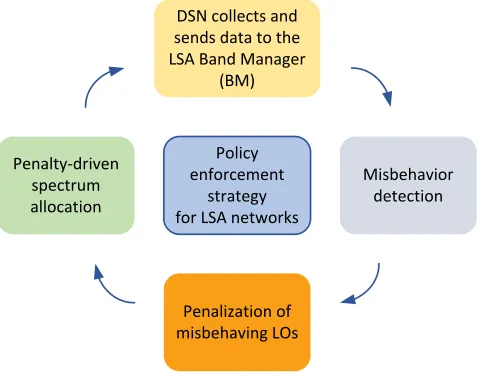
The proposed policy enforcement approach consists of three dominant components: i) a misbehavior detection mecha-nism, which is carried out by the DSN; ii) the penaliza-tion of misbehaving users (LOs); and, iii) the allocapenaliza-tion of resources based on each operator’s penalty. We have particularly focused on the case of LO misbehavior detection during the time slots in which the IOs are active (trans-mitting). In other words, we do not consider misbehavior among LOs (for example, when IOs are inactive). Our policy enforcement process is depicted in Fig. 2. If LOs do not misbehave, resources are allocated according to a Round-Robin (RR) scheduling [12]. However, any other scheduling policy, or combination of policies, could be used, instead. It should be noted that the novelty of our proposed approach lies on the combination of these components for the enhancement of the LSA system, rather than on each individual technique. To the best of our knowledge, this is the first time that such a mechanism is proposed for an LSA network architecture.
2In every time slot, LSA resource blocks can be thought of as blocks on a 3-dimensional grid, which spans over two spatial dimensions and over frequency.
3The non-exclusivity of LSA channels for LOs was proposed in the FP7 Research Project ADEL.
4Distinguishing between intentional or unintentional violation of the spectrum usage is not considered in our proposed framework.
Policy enforcement
strategy for LSA networks
Misbehavior detection Penalty-driven
spectrum allocation
DSN collects and sends data to the LSA Band Manager
(BM)
[image:4.576.299.538.66.252.2]Penalization of misbehaving LOs
FIGURE 2. Block diagram demonstrating the steps of the policy enforcement strategy for LSA networks. The procedure requires cooperation between the DSN and the BM: the former carries out sensing and sends the sensing data to the BM; the latter is responsible for misbehavior detection, assigning penalties and allocating the shared spectrum.
A. MISBEHAVIOR DETECTION
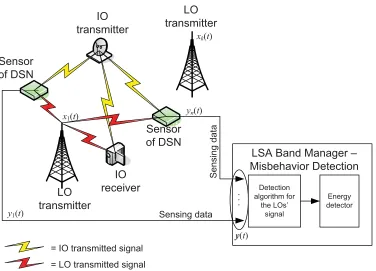
The data collected from the DSN is transferred to the BM, where a centralized process is initialized. A graphical rep-resentation of the misbehavior detection process is depicted in Fig. 3. For the misbehaving activity and its detection, we have assumed the following:
• All the sensors of the DSN monitor the spectrum continuously.
• The licensees misbehave only scarcely, due to the fact that this is an improper activity.5 Thus, the transmitted signal from the LO’s BSs is modeled as a sparse vector (with only a few nonzero locations) and the detection is performed by exploiting the related sparse optimization techniques [13]. In practice, we consider that less than 20% of the LO’s BS are potentially misbehaving at any time.
• The channels hn,k ∈ C between the n-th sensor and
the k-th BS are block fading, frequency flat, and are assumed to be known to the system within a small symbol intervalTS, as also considered in [14]–[16]. • The signal of the IOs is also received at the DSN’s
sensors. However, it is assumed that the IOs do not misbehave, and hence, they are excluded from the detection process.6
The misbehavior detection process is performed in two phases:
a: Phase One
For the misbehavior detection and due to the nature of the task, we have selected a sparse optimization approach.7
5In the sense that it violates the agreed rules. 6The location of the IOs’ BSs is known. 7Other detection schemes may also be applied.
6HQVRU
RI'61
,2
WUDQVPLWWHU
,2
UHFHLYHU
/2
WUDQVPLWWHU
/2
WUDQVPLWWHU
/6$%DQG0DQDJHU±
0LVEHKDYLRU'HWHFWLRQ
6HQVLQJGDWD
6HQVRU
RI'61
6HQV
LQJ
GDWD
ynt
yt
yt
xt
xkt
,2WUDQVPLWWHGVLJQDO /2WUDQVPLWWHGVLJQDO
'HWHFWLRQ DOJRULWKPIRU
WKH/2V¶ VLJQDO
[image:5.576.102.478.66.337.2](QHUJ\ GHWHFWRU
FIGURE 3. Misbehavior detection process. The sensors of the DSN first collect the datayn(t)and then forward them to the LSA band manager. Next, the detection algorithm performs an estimation of possibly unauthorized transmission. The process is concluded by the classification of the LO’s activity (misbehaving or not) according to an energy detection over a small symbol period.
The sparse optimization algorithm operates on the signal and computes an estimate of the transmitted signal, i.e.,
ˆ
xk(t). The transmitted signal at time instance t from the k-th BS (which belongs to a known LO) is denoted as
xk(t)∈C, t= 1, . . . , TS.Since the number of misbehaving (active) licensees,NT, is much smaller than the number of all possibly active BSs over the area of interest, M, the transmission vector containing the signals transmitted from all BSs is modeled as a sparse one, denoted asx∗(t)∈CM.
Moreover, we assume that the status (active/inactive) of the BSs remains unchanged within the sampling period TS. Thus, the sparsity level of the transmission vector is guar-anteed to be kx∗(t)k0 ≤NT M for all t = 1, . . . , TS,
whereNT is the maximum number of LO’s active BSs. The signal sample received at eachn-th sensor is assumed to be of the linear form:
yn(t) =hHnx∗(t) +vn(t), n= 1, . . . , NS, (1)
wherehn := [hn,1, . . . , hn,M]H characterizes the channels
between the n-th sensor and all possible M locations and
vn(t) is the additive noise assumed i.i.d. with zero mean
and bounded variance, uncorrelated with hn,k. In a more
compact form, equation (1) can be cast as:
y(t) =Hx∗(t) +v(t), (2)
where y(t) = [y1(t), . . . , yNS(t)]
T, HH = [h
1 . . . hNS]
andv(t) = [v1(t), . . . , vNS(t)]
T.
For the estimation of the signal,x∗(t), we exploit sparse optimization techniques. Our goal is to solve the following minimization task:
min
x(t)||x(t)||0
s. t. ky(t)−Hx(t)k2≤ε, for allt= 1, . . . , TS. (3)
The cost function in (3) is non-convex and the optimization task is known to be NP-hard [17]. Thus, we will attempt to solve a relaxation of the original task. At eacht= 1, . . . , TS
we solve the Iteratively Reweighted Least Absolute Shrink-age and Selection Operator (IR-LASSO) [18], [19], whose solution is given by:
ˆ
x(i)(t) := arg minx(t)
( 1
2ky(t)−Hx(t)k
2
2+
+µ
M2 X
j=1
wjj(i−1)|xj(t)|
)
,
(4)
w(jji−1)(t) = 1 xˆ
(i−1)
j (t)
+
, i= 1,2, . . . , (5)
wherexˆ(0)(t)is the LASSO solution computed by the
Soft-Thresholding with Exact Line search Algorithm (STELA), which was introduced in [14], and is a small threshold that ensures stability. The optimization task attempts to estimate the unknown sparse vector, iteratively. Usually a few iterations over the index i are sufficient for the
convergence of the method. The method is well studied and enjoys better statistical properties compared to the LASSO solution. For the solution of (3) we employ an algorithm that was proposed in [20]. The scheme is known as the Weighted Soft-Thresholding with Exact Line search Algorithm (WSTELA), which was based on a refinement of the STELA. Our proposed detection method attains a high probability of detection and a low probability of false alarm. In addition, the computational cost of this method is signif-icantly reduced, compared to other popular solvers such as the Alternating Direction Method of Multipliers (ADMM) [21]. More details on the algorithm and its performance in terms of detection can be found in [20].
b: Phase Two
An energy detector operates on the estimated signal and the activity of the LO is classified as non-misbehaving-H0
or misbehaving-H1. In order to successfully detect (by
cor-rectly classifying) an unauthorized transmission from an LO the system should: i) recover the support of the sparse vector
x∗(t)(which reveals the location of the transmitters) and ii) compute a good estimate of the transmitted signal’s values. Instead of applying a standard thresholding technique on the transmitted signal, we perform an energy detection8 on the estimated signal,x(ˆ t), over a small symbol period,TS:
Ek = 1 TS
TS
X
t=1
|xkˆ (t)|2 H1
R
H0
τed(k), (6)
where τed(k) is a model-defined threshold depending on the agreed power transmission levels for each LO. In the simplest scenario, where no transmissions are authorized by the IO’s network, τed(k) is set at the noise level for all LOs. For those BSs that are allowed to transmit, the threshold is set at the power level allocated by the BM. Since the locations of the BSs and the channels between each BS and DSN sensor are known to the LSA BM, and due to the unique mapping between BSs’ indices and LOs, the misbehaving LOs can be directly identified from the respective indices. The detection results, i.e., indicesksuch that Ek > τed(k), and the probabilities of detection and
false alarm are then used for determining the severity of the agreement violation and assigning the penalty.
Remark 1. Another strong advantage of using sparse modelling techniques with respect to non-sparse ones relates to the size of the DSN. The signal can be detected with fewer observations,NS, than the size,M, of the unknown vector, i.e., x∗(t), t = 1, . . . , TS. Thus, it is possible to reduce
the number of required sensors, and, in such way, provide cost benefits as well. However, more sensors lead to better detection results; the probabilities of detection,Pd, and false alarm,Pf a, depend on the number of sensors that are used for the detection. Hence, there is a clear tradeoff between
8Other methods could also be applied, however, we chose the energy detector due to its robustness.
the implementation cost of the DSN and the accuracy of the estimation that we would like to achieve.
B. PENALIZATION OF THE MISBEHAVING LOS
Whenever an LO is detected to misbehave (classified asH1)
a maximum penaltyAmaxis applied. Since the probabilities of detection and false alarm depend on the number of sensors that are used for the detection, we scale the value of the penalty according to the confidence level of the misbe-havior detection. Therefore, we setA= (Pd−Pf a)Amax,
wherePdis the average probability of successful detection
and Pf a is the average probability of false alarm. Once
applied, the penalty value reduces over time, following an exponential decay, as long as the penalized LO does not misbehave again, according to:
Pkn=Ae−(t−tkn)/λ, (7)
where t is the current time, tkn is the time at which the previous misbehavior was detected, λ is the half-life time constant which determines how quickly the penalty decays. However, if subsequent violations of the sharing rules are detected, additional penalties are assigned and added to the current penalty value of the detected LO. Finally, it should be noted that the average probabilities of detection and false alarm also depend on the number of transmitting BSs.
C. PENALTY-DRIVEN RESOURCE ALLOCATION
At the final stage of our policy enforcement strategy, we allocate resources to the LO with the lowest penalty value, if their values are below a predefined threshold. For operators that have equal penalties, the allocation is performed ac-cording to Round-Robin scheduling. If an operator’s penalty value, given by (7), is above the threshold, it is excluded from the sharing process; in other words, only LOs below the defined threshold compete for the available resources. On the other hand, if all players have penalty values above the threshold, the resources remain unallocated.9Hence, our enforcement strategy not only punishes misbehavior but also rewards compliance to the agreed rules.
V. LSA SYSTEM-LEVEL SIMULATOR SETUP
Compared to existing system-level simulators, such as the Vienna LTE System Level Simulator (SLS) [22], our sim-ulator shifts the focus towards the components of the LSA paradigm that are typically absent. The proposed LSA setup includes the IOs, Mobile Network Operators (MNOs) for the role of LOs, an LSA repository and the BM, as well as a DSN. In the following, we describe the system blocks and the models implemented in the LSA simulator and that are functional to our investigation.
9This does not extend to the Incumbent Operator, which preserves its right to access the spectrum regardless of the behavior of the LOs.
A. BLOCK FEATURES IN THE PROPOSED LSA SYSTEM SETUP
In the simulator, we have implemented the following fea-tures of the LSA system blocks.
a: Functionalities of the LSA Band Manager:
• Allocation of the available LSA channels to IOs and MNOs.Several LSA players can request spectrum, which is scarce and needs to be allocated in order to serve the demand and prevent interference. Scheduling takes into account the spectrum availability, the request for access by incumbents and MNOs, the previous usage of spectrum, and possible misbehavior of the MNOs.
• Determining and granting access to the set of BS cells that an MNO can use. Access to spectrum is granted on a geographical basis, i.e., MNOs that are granted resources will be allowed to use only the BSs that are far enough from the active BSs of IOs in order to prevent interference. In addition, only some sectors of a BS might be activated. The BM undertakes the task of determining which BSs and which sectors can be used by the MNOs. The goal is to ensure that the IOs’ experience a satisfactory signal quality.
• Applying policy enforcement.The BM is responsible for the detection of potential misbehavior and applica-tion of a penalty, e.g., by restricting access to spectrum for those players that are found to misbehave. The penalty attributed to each MNO is applied during the scheduling procedure, prioritizing MNOs with lower, or zero, penalty.
b: LSA Repository
The repository keeps logs of all the spectrum activities occurring in the LSA band and, in particular, records of current geographical usage of every channel for each operator. In addition, it contains the data on the location of the transmitters, the transmit power, and the antenna patterns. All this information is utilized so that we can estimate the potential interference generated by transmitters on unintended receivers. The LSA repository is accessed by the LSA BM. The data required to build the database are retrieved from the spectrum users (incumbents and licensees).
c: Dedicated Sensing Network (DSN)
The DSN of our proposed policy enforcement approach is composed of 50 sensors, which are randomly distributed over the area of interest where MNO’s BSs are deployed. For the detection cycle we have used a value of TS = 10
symbols.
B. SYSTEM-LEVEL SIMULATOR ARCHITECTURE
In this section, we describe the modules of the system-level simulator and how they interact with one another. A
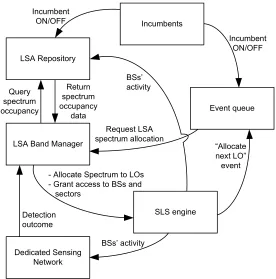
graph-ical representation of the proposed simulator architecture is provided in Fig. 4.
As observed from Fig. 4, the functioning of the simulator is triggered by an event queue, which keeps records of the different modules’ activities and operates as a timer for the LSA BM (which also sets the timer for the entire simulator). The possible events that are logged in the queue are: (i) the incumbent activation; and (ii) the allocation of the next LO on the LSA band. The former event is generated by the incumbent module — which implements the IOs and generates their activity, i.e., it switches them on and off. The latter event occurs when the allocation period of the LO on the LSA band is over and another LO needs to be allocated on this band.
The LSA Band Manager module is triggered by the event queue and allocates the LSA spectrum to the LOs. In addition, the LSA BM grants LOs access to the LSA spectrum on a sector-basis. The data regarding spectrum occupancy can be fetched from the LSA Repository module, which stores the information on the IO and LO activity over the LSA spectrum. It should be noted that this allocation takes into account the current availability of the spectrum (which depends on the IOs’ activity), its past usage and the policy enforcement penalty.
Whenever the LSA BM block schedules an LO, the System-Level Simulator (SLS) engine module produces the results in terms of throughput, band occupancy and misbehavior of the LOs. Finally, the Dedicated Sensing Network module retrieves data regarding the BSs’ activity from the SLS engine block and performs the misbehavior detection; the outcome of this process is then fed to the LSA BM for policy enforcement purposes.
C. NETWORK LAYOUT
As a specific application for the incumbent, we assume a system for video surveillance.10 In the simulator, we model each IO as a transmitter and a set of 10 receivers uniformly distributed over a circular area, which we call protection zone. This zone is the area within which the incumbent receivers should be guaranteed a given signal quality. The incumbent transmitters, which transmit on a given channel and all with the same fixed power, can either transmit or remain in a stand-by (or idle) state: the ratio of the IOs’ activity is defined by its duty cycle. With reference to Fig. 4, the modeled IO is implemented in the incumbent module. The LOs are implemented in the SLS engine module (see Fig. 4). We assume that each MNO transmits over an exclusively licensed band and over a 5MHz LSA channel, which is shared between the IOs and several MNOs. We assume that two MNOs operate in the same band, where, up to five IOs—distributed across the network—can be active. The LSA MNOs (licensees) are modelled as three-sector macro-sites, whose BSs are deployed in a hexagonal grid.
10The LSA framework includes several and various types of users of the LSA band, which range from military services, radar systems, amateur radio users, and wireless cameras, etc. [4].
LSA Band Manager LSA Repository
SLS engine Incumbents
Event queue
“Allocate next LO” event
Incumbent ON/OFF
Request LSA spectrum allocation Incumbent
ON/OFF
Query spectrum occupancy
Return spectrum occupancy
data
- Allocate Spectrum to LOs - Grant access to BSs and sectors
Dedicated Sensing Network
BSs’ activity Detection
outcome
[image:8.576.149.425.63.342.2]BSs’ activity
FIGURE 4. Modules of the LSA system-level simulator and their interfaces.
We consider a scenario of 19 sites, arranged in three concentric rings. Each sector is served by a directional antenna and the transmit power is 43dBm per LSA channel [23].
We model the signal propagation with Extended Hata model and Rayleigh small-scale fading. In order to limit the computational complexity associated with the physical layer (PHY), we assume a given cell spectral efficiency value, i.e., whenever a cell is active, its cell spectral efficiency is constant.
VI. SYSTEM-LEVEL RESULTS
In this section, we present our results from system-level sim-ulations using the proposed policy enforcement mechanism for an LSA network. The values of the main parameters used for the simulation results are reported in Table 1.
First, we compute and present the average probabilities of detection and false alarm for several misbehaving BSs. Next, we present the allocation of resources according to our policy enforcement approach. Finally, we depict the sensitivity of the penalty threshold on the allocation of resources.
Fig. 5 shows the probabilities of detection and false alarm for the proposed detection algorithm, i.e., the WSTELA solver for the IR-LASSO task, while we vary the number of misbehaving BSs. Our method achieves successful detection with probability above 90% for up to 30 misbehaving BSs out of a total of 57 BSs, while it keeps the probability of false alarm below 10%. It should be noted that for the
0 5 10 15 20 25 30
Number of misbehaving BSs 0
10% 20% 30% 40% 50% 60% 70% 80% 90% 100%
P
ro
b
a
b
il
it
y
Detection False alarm
FIGURE 5. Average probabilities of detection and false alarm, while varying the number of LO’s misbehaving BSs.
regularization parameter µ in (4) we have used the cross-validation technique in order to find the best values for both algorithms STELA and WSTELA.
As discussed in Section V-C, the BM may choose to block the allocation of resources for operators whose penalty score exceeds a certain threshold value. If all operators’ scores ex-ceed the defined threshold, the LSA resources would remain unallocated. While this approach leads to an underutilisation of the available LSA resources, it strengthens the incentives
[image:8.576.303.520.402.575.2]125 250 375 500
Simulation time
0 10% 20% 30% 40% 50% 60% 70% 80%
S
h
a
re
o
f
L
S
A
re
so
u
rc
es
MNO1 MNO2
Unallocated resources
Pmb(2)= 0.1
Pmb(2)= 0.05
Pmb(1)= 0
Pmb(2)= 0.01 Pmb(1)= 0.05
Pmb(2)= 0.2
Pmb(1)= 0.3
[image:9.576.48.258.74.242.2]Pmb(1)= 0.2
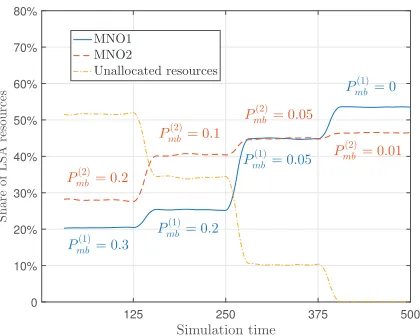
FIGURE 6. Change of LSA resource share over time due to changes in the behavior of the two MNOs. The probability for MNO1 isPmb(1)and for MNO2 is Pmb(2)and changes every 125 simulation steps.
for MNOs to comply with the LSA rules.
[image:9.576.308.518.74.243.2]Fig. 6 shows the allocation of resources to two competing MNOs over time due to variations on their behavior. The probability of misbehaving, i.e., Pmb(i), i= 1,2, for the two operators varies every 125 simulation steps as follows: for MNO1Pmb(1) changes from 0.3 in the first 125 steps, to 0.2, then 0.05 and finally 0 (i.e. full compliance with the LSA rules); for MNO2 the Pmb(2) changes from 0.2 to 0.1, then 0.05, and finally 0.01. The penalty threshold during this simulation was set to 10. Our policy enforcement algorithm always benefits the MNO that complies more with the LSA rules. We emphasize to the fact that misbehavior does not lead to complete exclusion from the LSA resources. How-ever, the share of the resources allocated to each misbehav-ing MNO is such that, even if misbehavior led to short-term gains (from unauthorized transmissions), the MNO would encounter a significant loss over the allocated resources on the long-term compared to being under full compliance with the agreed rules. In the case where MNO1 fully complies
TABLE 1. Simulation parameters
Parameter Value
Incumbent duty-cycle 10%
Number of IUs 5
Number of receivers per incumbent trans-mitter
10
Incumbent TX power 20dBm over 20MHz, corresponding to 14dBm over 5MHz
Incumbent radius 50m
LSA licensees BS 43dBm TX power per sector, serving a three-sector site with directional antennas
Sites 19 per operator (3 sectors each site)
MNOs 2
MNO cell spectral effi-ciency
2.23bps/Hz [23, See 2x2 SUMIMO Rel. 8 -FDD in 3GPP - Tables 10.1.1.1-1, 10.1.1.2-1] Sensors of DNS 50
0
10 20 30 40 50 60 70 80 90
100 110 120 130 140 150 160 170 180 190 200 Penalty threshold
0 10% 20% 30% 40% 50% 60% 70% 80%
S
h
a
re
o
f
L
S
A
re
so
u
rc
es
MNO1 MNO2
Unallocated resources
FIGURE 7. Changing the penalty threshold further penalizes misbehaving MNOs but can lead to lower utilization of available LSA resources.
with the rules while MNO2 misbehaves with probability 0.01 (time period 375 to 500 in Fig. 6), the allocation algorithm makes sure that all the available resources are fully utilised, while the complying MNO is further rewarded for its behavior. Similarly, when both MNOs misbehave with the same probability (0.05), they both receive equal share of the available resources, but approximately 10% of the LSA resources remain unallocated by the BM.
The level of the penalty threshold is key to policy making. Fig. 7 shows the average allocation of resources to two MNOs who misbehave with probability 0.3 for MNO1 and 0.2 for MNO2, for different values of the penalty threshold. The same figure shows the share of resources that remain unallocated for the defined threshold. It is observed that, lower values of the penalty threshold lead to MNOs being severely penalised for not adhering to the LSA rules. With lower values of the threshold then each MNO has incentives to comply with the LSA rules, regardless of what other MNOs do. This is attributed to the fact that by increasing its own level of compliance it gains access to a larger amount of resources that would otherwise remain unallocated. At the same time, however, a lower threshold may lead to the LSA resources being underutilised. On the other hand, higher values of the threshold lead to “competitive” incentives where each MNO has incentives to misbehave less than other MNOs sharing the same resources. As depicted in Fig. 7, it is observed that, higher threshold values lead to better utilization of the LSA resources; however, lower thresholds create a better set of incentives against misbehavior from the licensees, which leads to better overall policy outcomes.
VII. CONCLUSION
In this paper, a policy enforcement strategy for LSA is presented. In order to guarantee the reliability of the system and moreover provide QoS to its users, we propose a policy enforcement mechanism that is built within the sharing
[image:9.576.36.297.575.728.2]network architecture. The general concept is to penalize misbehaving activity from the licensees based on spectrum sensing information provided by a Dedicated Sensing Net-work (DSN).
The three key components on which the proposed policy enforcement strategy is built on are: a) the DSN and a misbehavior detection algorithm, attaining low probabilities of misdetection and false alarm (below 10%), b) a penal-ization function that calculates a penalty score for each LO, and, c) a resource allocation algorithm that allocates the shared resources taking into account the penalty scores of the licensees. To the best of our knowledge, this is the first time that such a mechanism is proposed in LSA networks. Furthermore, we provide an open source simulation tool for spectrum sharing in LSA networks, which performs the entire policy enforcement procedure.
Through our system-level results we demonstrate that: a) misbehaving occurrences can be successfully detected by our proposed mechanism, b) the allocation of resources can change from the static model of equal allocation to both misbehaving and non-misbehaving LOs to a more dynamic one that takes penalty scores into account and c) the severity of the penalty can be centrally controlled (thus it is fair for all operators) by the central controller.
We recognize that cases of severe misbehavior may require regulatory intervention, including financial penalties and license revoking–an approach that is currently followed by NRAs for illegal transmissions and harmful interference management. However, regulatory intervention is typically time-consuming and incurs significant costs to the NRA. Our proposed solution provides distinct advantages over the existing mechanisms because of its near real time response and shifting of responsibility of misbehavior detection to the industry as well. We believe that our policy enforcement strategy could unlock the deployment of spectrum sharing architectures, such as LSA, for next generation wireless systems.
ACKNOWLEDGEMENT
Dr. K. Voulgaris carried out this research work while at Athens Information Technology. At the time of this publi-cation he has moved to the European Investment Bank as a technical expert within the JASPERS department.
REFERENCES
[1] J. Mitola and G. Q. Maguire, “Cognitive radio: making software radios more personal,” IEEE Personal Communications, vol. 6, no. 4, pp. 13–18, Aug 1999.
[2] J. M. III, “Cognitive Radio An Integrated Agent Architecture for Software Defined Radio,” Ph.D. dissertation, Royal Institute of Technology (KTH), Electrum 204, SE-164 40, Kista, Sweden, May 2000. [Online]. Available: https://web.archive.org/web/20120917062752/ web.it.kth.se/~maguire/jmitola/Mitola_Dissertation8_Integrated.pdf [3] M. D. Mueck, S. Srikanteswara, and B. Badic, “Spectrum Sharing:
Li-censed Shared Access (LSA) and Spectrum Access System (SAS),” 2015. [4] European Conference of Postal and Telecommunications Administrations (CEPT), “ECC Report 205 - Licensed Shared Access (LSA),” Technical Report, Feb. 2014.
[5] [Online]. Available: https://github.com/g-carlo/LSA_pol_enforcement_ SysSim
[6] M. Maruenda-Hernández, F. Pérez-González, and S. K. Jayaweera, “A subspace-based policy enforcement method in dynamic spectrum leasing schemes,” in Communication Technology (ICCT), 2011 IEEE 13th Inter-national Conference on. IEEE, 2011, pp. 1118–1123.
[7] V. Kumar, J. M. J. Park, and K. Bian, “PHY-Layer Authentication Using Duobinary Signaling for Spectrum Enforcement,” IEEE Transactions on Information Forensics and Security, vol. 11, no. 5, pp. 1027–1038, May 2016.
[8] A. Dutta and M. Chiang, ““See Something, Say Something” Crowd-sourced Enforcement of Spectrum Policies,” IEEE Transactions on Wire-less Communications, vol. 15, no. 1, pp. 67–80, Jan 2016.
[9] M. B. H. Weiss, W. Lehr, M. Altamimi, and L. Cui, “Enforcement in Dynamic Spectrum Access Systems,” in 2012 TRPC Conference, Mar. 2012.
[10] M. M. Butt, C. Galiotto, and N. Marchetti, “Fair and regulated spectrum allocation in licensed shared access networks,” in 2016 IEEE 27th Annual International Symposium on Personal, Indoor, and Mobile Radio Commu-nications (PIMRC), Sept 2016, pp. 1–6.
[11] “FP7 Research Project ADEL - no: 619647 - ADEL deliverables,” 2014-2017. [Online]. Available: http://www.fp7-adel.eu/deliverables.html [12] L. Kleinrock, “Analysis of A time-shared processor,” Naval Research
Logistics (NRL), vol. 11, no. 1, pp. 59–73, 1964.
[13] A. M. Bruckstein, D. L. Donoho, and M. Elad, “From sparse solutions of systems of equations to sparse modeling of signals and images,” SIAM review, vol. 51, no. 1, pp. 34–81, 2009.
[14] Y. Yang and M. Pesavento, “A novel line search method for nonsmooth optimization problems,” in 23rd European Signal Processing Conference (EUSIPCO 2015). IEEE, 2015, pp. 1726–1730.
[15] Y. Yang, M. Zhang, M. Pesavento, and D. P. Palomar, “An online parallel algorithm for spectrum sensing in cognitive radio networks,” in 48th Asilomar Conference on Signals, Systems and Computers. IEEE, 2014, pp. 1801–1805.
[16] S.-J. Kim and G. B. Giannakis, “Optimal resource allocation for mimo ad hoc cognitive radio networks,” IEEE Transactions on Information Theory, vol. 57, no. 5, pp. 3117–3131, 2011.
[17] S. Theodoridis, Machine learning: a Bayesian and optimization perspec-tive. Academic Press, 2015.
[18] R. Tibshirani, “Regression shrinkage and selection via the lasso,” Journal of the Royal Statistical Society. Series B (Methodological), pp. 267–288, 1996.
[19] B. A. Johnson, Q. Long, Y. Huang, K. Chansky, and M. Redman, “Model selection and inference for censored lifetime medical expenditures,” Bio-metrics, vol. 72, no. 3, pp. 731–741, 2016.
[20] G. Papageorgiou, K. Voulgaris, and C. Papadias, “Sparse modeling meth-ods for misbehavior detection in lsa networks,” in Global Wireless Summit (GWS 2016), 2016. IEEE, 2016.
[21] S. Boyd, N. Parikh, E. Chu, B. Peleato, and J. Eckstein, “Distributed optimization and statistical learning via the alternating direction method of multipliers,” Foundations and Trends® in Machine Learning, vol. 3, no. 1, pp. 1–122, 2011.
[22] M. Rupp, S. Schwarz, and M. Taranetz, The Vienna LTE-Advanced Simulators. Singapore: Springer-Verlag, 2016.
[23] 3rd Generation Partnership Project (3GPP), “Further Advancements for E-UTRA Physical Layer Aspects (Release 9),” Mar. 2010, 3GPP TR 36.814 V9.0.0 (2010-03).
Carlo Galiottoreceived his M.Sc. in Telecommu-nications Engineering from University of Padova, Italy, in 2009, and his Ph.D. in Electronic and Electrical Engineering from CONNECT - Centre for Future Networks and Communications, in Trinity College Dublin, Ireland, in 2017. He spent more than 2 years as a researcher at Aalborg Uni-versity, Denmark, from 2009 until 2011, where he worked on passive RFID systems and on radio resource management for heterogeneous cellular networks. Currently, his work focuses on the study of performance and issues of extremely dense networks and small cells as well as spectrum sharing for 5G systems.
George K. Papageorgiou received the M.Sc. degree in Applied Mathematics and the Ph.D. degree in Signal Processing from the National and Kapodistrian University of Athens, Greece, in 2012 and 2016, respectively. From 2007 to 2015 he has been teaching mathematics in several educational institutions. Since 2016, he has been working as a Researcher at the Broadband Wire-less and Sensor Networks (B-WiSE) Laboratory of Athens Information Technology (AIT). His research activities include signal processing with applications to wireless networks, compressed sensing, adaptive filtering, distributed networks, mathematical modeling and optimization, nonlinear approximation, and information theory. Dr. Papageorgiou has been involved in several European funded projects (ADEL, SANSA, 5G BLUESPACE), as well as research projects funded by the industry. He has also participated in over-the-air demos, one of which received the “Best Booth” award at the EuCNC 2016 conference in Athens (FP7 project ADEL).
Konstantinos Voulgaris holds a Ph.D. degree in Telecommunications Research from the Uni-versity of London - King’s College (2009), an M.Sc. degree in Computers, Communications and Human Centred Systems from the University of Birmingham (2000), and a B.Sc. in Physics from the University of Patras (1999). He has over 15 years of professional experience across engi-neering, research, and regulatory policy-making roles in sector-leading organisations including Motorola, T-mobile, Bell Labs, and Ofcom. He has participated in multiple FP-6, FP-7, and H2020 EU-funded research projects in the areas of IoT, Spectrum Sharing, and Satellite Communications. His interests lie in the research areas of radio resource allocation and cross-layer interactions in wireless communications systems, as well as technology innovation and strategic policy making.
M. Majid Buttreceived PhD and MS degrees in telecommunication from Norwegian University of Science and Technology, Norway and Christian Albrechts University, Kiel, Germany, respectively. He is an Assistant Professor at University of Glasgow, UK. Before that, he has held senior researcher positions at Trinity College Dublin, Ireland and Qatar University. He is recipient of Marie Curie Alain Bensoussan postdoctoral fel-lowship from European Research Consortium for Informatics and Mathematics (ERCIM). He held ERCIM postdoc fellow positions at Fraunhofer Heinrich Hertz Institute, Germany, and University of Luxembourg. Dr. Majid’s major areas of research interest include com-munication techniques for wireless networks with particular focus on radio resource allocation, scheduling algorithms, cooperative communications, cross layer design, energy harvesting and green communication techniques. He has authored more than 40 peer reviewed conference and journal publications in these areas. He is a senior member of IEEE and serves as an associate editor for IEEE Access journal and IEEE Communication Magazine since 2016.
Nicola Marchettiis currently Assistant Professor in Wireless Communications at Trinity College Dublin, Ireland. He performs his research under the Trinity Information and Complexity Labs (TRICKLE) and the Irish Research Centre for Future Networks and Communications (CON-NECT). He received the PhD in Wireless Com-munications from Aalborg University, Denmark in 2007, and the M.Sc. in Electronic Engineering from University of Ferrara, Italy in 2003. He also holds an M.Sc. in Mathematics which he received from Aalborg Univer-sity in 2010. His collaborations include research projects in cooperation with Nokia Bell Labs and US Air Force Office of Scientific Research, among others. His research interests include Adaptive and Self-Organizing Networks, Complex Systems Science for Communication Networks, PHY Layer, Radio Resource Management. He has authored in excess of 100 journals and conference papers, 2 books and 7 book chapters, holds 2 patents, and received 4 best paper awards.
Constantinos B. Papadiasis the Scientific Di-rector of Athens Information Technology (AIT), in Athens, Greece, where he is also Head of the Broadband Wireless and Sensor Networks (B-WiSE) Research Group. He is also Adjunct Professor at Aalborg University. He received the Diploma of Electrical Engineering from the Na-tional Technical University of Athens (NTUA) in 1991 and the Doctorate degree in Signal Process-ing (highest honors) from the Ecole Nationale Supérieure des Télécommunications (ENST), Paris, France, in 1995. He was a researcher at Institut Eurécom (1992-1995), Stanford University (1995-1997) and Bell Labs (as Member of Technical Staff from 1997-2001 and as Technical Manager from 2001-2006). He was also Adjunct Professor at Columbia University (2004-2005) and Carnegie Mellon University (2006-2011). He has published over 190 papers and 3 books and has received over 7500 citations for his work, with an h-index of 40. He has also made standards contributions and holds 12 patents. He was a member of the Steering Board of the Wireless World Research Forum (WWRF) from 2002-2006, a member and industrial liaison of the IEEE’s Signal Processing for Communications Technical Committee from 2003-2008 and a National Representative of Greece to the European Research Council’s IDEAS program from 2007-2008. He has served as member of the IEEE Communications Society’s Fellow Evaluation and Awards Committees, as well as an Associate Editor for various journals. He has contributed to the organization of several conferences, such as IEEE Globecom 2014 (Workshops Chair), IEEE CTW 2016 (General Chair), the IEEE ICC 2017 (Workshops Chair) and the upcoming IEEE SPAWC 2018 (General Chair). He has acted as Technical Coordinator in several EU projects such as: CROWN in the area of cognitive radio; HIATUS in the area of interference alignment; HARP in the area of remote radio heads and ADEL in the area of licensed shared access. His distinctions include the Bell Labs President’s Award (2002), the IEEE Signal Processing Society’s Young Author Best Paper Award (2003), a Bell Labs Teamwork Award (2004), his recognition as a “Highly Cited Greek Scientist” (2011), two IEEE conference paper awards (2013, 2014) and a “Best Booth” Award at EUCNC (2016). He was a Distinguished Lecturer of the IEEE Communications Society for 2012-2013 and is a Fellow of IEEE.