ANALYSIS OF NON UNIFORM SURFACE CURRENT DISTRIBUTION ON THICK AND THIN WIRE ANTENNA
RAIS RABANI BIN ABD. RAHMAN
A project report submitted in partial fulfillment of the requirement for the award of the
Degree of Master of Electrical Engineering
Faculty of Electrical and Electronics Engineering UniversitiTun Hussein Onn Malaysia
ABSTRACT
ABSTRAK
CONTENTS
TITLE i
DECLARATION ii
DEDICATION iii
ACKNOWLEDGEMENT iv
ABSTRACT v
CONTENTS vii
LIST OF FIGURES xi
LIST OF SYMBOLS AND ABBREVIATIONS xiii
CHAPTER 1 INTRODUCTION 1
1.0 Antenna Parameter 1
1.1 Radiation Efficiency 2
1.1.2 Directivity and Gain 3
1.1.3 Antenna Bandwidth 3
1.2 Surface Current Distribution 4
1.3 Background of Study 5
1.4 Statement of Problem 5
1.5 Objective of Study 6
1.6 Scope of Study 6
CHAPTER 2 LITERATURE REVIEW 7
2.0 Chapter Overview 7
2.1 Mathematical foundation 7
2.2 PocklingtonIntegral Equation 8
2.3 The Method of Moments 10
2.4 Helix Antenna 14
2.5 Previous Research 17
2.5.1 Effect of Wire End, In Thin Wire Analysis 17
2.5.2 Analysis of Coil-Loaded Thin-Wire 17
2.5.3 Approximate Surface-Current 18 Distributions of Rectangular
Dipole Antennas
2.5.4 Complete Surface Current Distribution 19 In A Normalmodehelical Antenna
Using AGalerkin Solution With Sinusoidal Basis Functions.
CHAPTER 3 METHODOLOGY 20
3.0 Chapter Overview 20
3.1 Software Simulation 20
3.2 Research Work Stage 21
3.3 Methodology Flow Chart 22
CHAPTER 4 RESULTS AND ANALYSIS 23
4.1 Two Turn Helical Antenna at 300MHZ 24
4.1.1 Radiation Pattern (E-theta) on 25 Two Turn Helical Antenna at 300MHZ
4.1.2 Radiation Pattern (E-phi) on Two Turn 25 Helical Antenna at 300MHZ
4.2 Three Turn Helical Antenna at 300MHZ 26
4.2.1 Radiation Pattern (E-theta) on Three 27 Turn Helical Antenna at 300MHZ
4.2.2 Radiation Pattern (E-phi) on Three 28 Turn Helical Antenna at 300MHZ
4.3 Four Turn Helical Antenna at 300MHZ 29
4.3.1 Radiation Pattern (E-theta) on Three 30 Turn Helical Antenna at 300MHZ
4.3.2 Radiation Pattern (E-phi) on Three 31 Turn Helical Antenna at 300MHZ
4.4 Two Turn Helical Antenna at 900MHZ 32
4.4.1 Radiation Pattern (E-theta) on Three 33 Turn Helical Antenna at 900MHZ
4.4.2 Radiation Pattern (E-phi) on Three 34 Turn Helical Antenna at 900MHZ
4.5 Three Turn Helical Antenna at 900MHZ 35
4.5.1 Radiation Pattern (E-theta) on Three 36 Turn Helical Antenna at 900MHZ
4.5.2 Radiation Pattern (E-phi) on Three 37 Turn Helical Antenna at 900MHZ
4.6 Four Turn Helical Antenna at 900MHZ 38
4.6.1 Radiation Pattern (E-theta) on Three 39 Turn Helical Antenna at 900MHZ
4.6.2 Radiation Pattern (E-phi) on Three 40 Turn Helical Antenna at 900MHZ
CHAPTER 5 CONCLUSION 43
5.0 Conclusion 43
5.1 Future Works 44
REFERENCES 45
APPENDIX A 47
APPENDIX B 51
APPENDIX C 54
LIST OF FIGURES
1.0 Power Reflection Coefficients 9
2.0 Integral Equation Formulation 11
2.1 Basic Function of Current distribution Construction 14
2.2 Basic Helix Antenna Configurations 15
2.3 Basic Helix Antenna Configurations 16
2.4 Radiation Pattern of Helix Antenna 22
3.0 Methodology Flow Chart 22
4.0 Surface Current Distribution of two turnsHelical Antenna at 24 300MHZ
4.1 Radiation Patterns (E-theta) of two turnHelical Antenna at 25 300MHZ
4.2 Radiation Patterns (E-phi) of two turnHelical Antenna at 26 300MHZ
4.3 Surface Current Distribution of three turnsHelical Antenna at 27 300MHZ
4.4 Radiation Pattern (E-theta) of three turns Helical Antenna at 28 300MHZ
4.5 Radiation Pattern (E-phi)of three turns Helical Antenna at 29 300MHZ
4.6 Surface Current Distribution of four turnsHelical Antenna at 30 300MHZ
4.7 Radiation Pattern (E-theta) of four turnsHelical Antenna at 31 300MHZ
4.9 Surface Current Distribution oftwo turnsHelical Antenna at 33 900MHZ
4.10 Radiation Pattern(E-theta) oftwo turnsHelical Antenna at 34 900MHZ
4.11 Radiation Pattern(E-phi) of two turnsHelical Antenna at 35 900MHZ
4.12 Surface Current Distribution ofthree turnsHelical Antenna at 36 900MHZ
4.13 Radiation Pattern(E-theta) of three turns Helical Antenna at 37 900MHZ
4.14 Radiation Pattern(E-phi) ofthree turns Helical Antenna at 38 900MHZ
4.15 Surface Current Distribution of four turnsHelical Antenna at 39 900MHZ
4.16 Radiation Pattern (E-theta) of four turnsHelical Antenna at 40 900MHZ
LIST OF SYMBOLS AND ABBREVIATION
D - Directivity
E - Electric Field Intensity
G - Gain
λ - Wavelength
C - Circumference of a Helix
RL - Loss Resistance
Rr - Radiation Resistance
Γ - Reflection coefficient
𝑃𝑎 - Radiated Power
𝐸𝑧 - Electric Field in z domain
𝑉𝑔 - Feed Gap
𝜌 - Wire Radius
𝐼𝑧 - Current Distribution
𝐶𝑛 - Current expansion coefficient
S - Spacing between turns
𝐷 - Diameter of base support
CHAPTER 1
INTRODUCTION
An antenna is defined as a “transmitting or receiving system that is designed to radiate or receive electromagnetic waves” [1]. An antenna can be any shape or size. A list of some common types of antennas is wire, aperture, microstrip, reflector, and arrays. Each antenna configuration has a radiation pattern and design parameters, in addition to their benefits and drawbacks. Common antenna types such as wire antenna, microstrip antenna, aperture antenna and others have their own benefits and drawbacks. When we design antennas, it is vital to be able to estimate the current distribution on its surface. From the current distribution, we can calculate the input impedance, gain and the far-field pattern for the antenna.
1.0 Antenna parameters
An antenna or aerial is an electrical device design to transmit or receive radio waves or more generally any electromagnetic waves. Antenna is used in system such as radio and television broadcasting, point to point radio communication, radar, space exploration. Physically an antenna is an arrangement of conductors that generate a radiating electromagnetic field in response to an applied alternating voltage and associated alternating electric current or can be placed in an electromagnetic field so that field will induce an alternating current in the antenna voltage between its terminals.
The impedance can be real for an antenna tuned at one frequency but generally would have a reactive part at another frequency.
The electric field is in a plane orthogonal to the axis of a magnetic dipole. This dependence of the plane of the radiated electromagnetic wave on the orientation and types of antenna in terms polarization. A receiving antenna requires the same polarization as the wave that it is to intercept. By combining field from electric and magnetic dipoles that have common centre, the radiated field can be elliptically polarized.
The operating bandwidth of an antenna may be limited by pattern shape, polarization characteristic and its impedance performance. There are two fundamental types of antenna which with reference to a specific three dimensional usually horizontal or vertical plane are either omni-directions antenna or directional antenna. The omni-directional antenna radiated equally in all directions while directional antenna radiates more in one direction than in the one.
1.1 Radiation Efficiency
Radiation efficiency is the “ratio of total power radiate by an antenna to the net power accepted by the antenna from the connected transmitter. Only 50% of the power supplied through the transmitter network is used to transmit. In the best case scenario, the maximum power accepted by the transmitting antenna is 50% of the total power supplied and occurs when the generator impedance and the antenna are matched, usually to 50Ω. The efficiency of an antenna is given by Equation 1.1
𝐸 = 𝑃𝑟𝑎𝑑𝑖𝑎𝑡𝑒𝑑𝑃 =(𝑅𝑟 + 𝑅L)𝐼𝑅𝑟𝐼2 2 =(𝑅𝑟 + 𝑅𝐿) =𝑅𝑟 1
1 + 𝑅𝐿𝑅𝑟 (1.1)
1.1.2 Directivity and Gain
Directivity is defined as “the ratio of radiation intensity, in a given direction, to the radiation intensity that would be obtained if the power accepted by the antenna where radiating isotropic ally [5]. In other words it’s the ratio of the radiation intensity of an antenna to one that radiates equally in all direction. This is similar to that of antenna gain but antenna gain takes into account the efficiency of the antenna while directivity is the losses gain of an antenna. Directivity can be calculated using the Poynting Vector, P, which tells you the average real power per unit area radiated by an antenna in free space [6]. The equation for the directivity of an antenna is given by Equation 2.
𝐷 = 𝑃𝑃
0, 𝐷|𝑑𝐵 = 10𝑙𝑜𝑔10
𝑃
𝑃0, 𝑃0 =
𝑃𝑎
4𝜋𝑟2 (1.2)
Pa is the total power radiated by the antenna and r is the distance between the two antennas. The antenna gain takes into account loss so the gain of an antenna will always be less than the directivity. Knowing the directivity of the antenna, the total power radiated by the antenna, and the received power which takes into account loss, the antenna gain can be calculated using Equation 1.3.
𝐺 = 𝐷𝑃 𝑃𝑎
𝑎𝑐𝑐𝑒𝑝𝑡𝑒𝑑 𝑏𝑦 𝑡ℎ𝑒 𝑎𝑛𝑡𝑒𝑛𝑛𝑎≤ 𝐷 (1.3)
1.1.3 Antenna Bandwidth
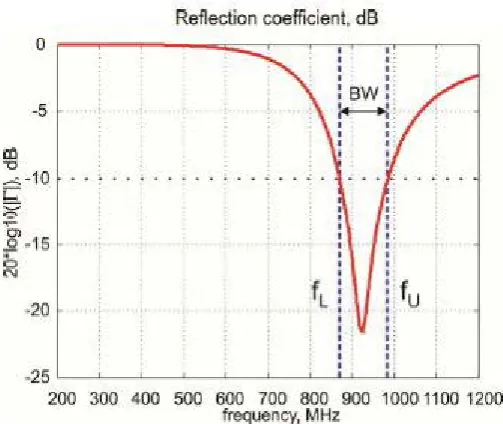
coefficient Γ. Γ is usually plotted in as the power reflection coefficient by using Equation 1.4.
|𝛤|𝑑𝐵 = 20𝑙𝑜𝑔10|𝛤| = 10𝑙𝑜𝑔|𝛤|2 (1.4)
[image:14.595.192.444.279.491.2]Figure 1 displays an example of a power reflection coefficient graphed in terms of frequency.
Figure 1.0: Power Reflection Coefficients
fL represents the lowest frequency that satisfies the 90% power, and f U represents the highest frequency that follows the criteria. The average of fL and fc will give you the center frequency fc and the bandwidth or commonly referred to as fractional bandwidth.
1.2 Surface Current Distribution
of parallel wires was equal, which means that the cross sectional distribution of surface current remain constant along the wires [3]. These earlier studies were restricted to simple geometries. Tuluyathan used a more general treatment but still neglected the possibility of a circumferential component in the surface current [5]. It is intuitively obvious that such component must be present when there is significant displacement current flow in the inter wire capacitance.
Most of the methods used for analysis of wire antenna of arbitrary shape including the possibility of closely parallel wire assume a uniform surface current distribution across the cross section [8]. Hence, surface resistive losses and reactive effects that may be augmented by the non-uniform surface current will not be correctly predicted.
1.3 Background of Study
The analysis of radiation and scattering from the straight thin wire antenna is one of the most important problems in antenna theory. The excitation of the straight thin wire can be regarded as a standard canonical problem. Furthermore, this configuration itself is one the practical interest in the design of the antenna arrays same as in wire grid modeling. In a numerical sense, this relatively simple geometry is very convenient for testing newly developed numerical techniques.
1.4 Statement of Problem
1.5 Objective of the Study
The principle objectives of the research are depicted as follows.
1.5.1 To design a helix antenna using NEC Software Simulation with matching feeding network in the UHF-Band frequency spectrum. 1.5.2 Analyze the different of thin and thick wire antennas to its surface
current distribution.
1.5.3 To optimize the performance of the helix antenna in term of surface current distribution between antennas of different antenna thin and thick dimensions.
1.6 Scope Of The Study
The study will focus on wires that are closely parallel to each other, in particular the normal-mode helical antenna and spiral antenna. The investigation will consider the surface current distribution which has a vital part in contribution to the efficiency, Q-factor and resonant frequency of an antenna.
1.7 Significant of Study
CHAPTER 2
LITERATURE REVIEW
2.0 Chapter Overview
In this chapter, several topics on core theories behind the research will be discussed. Section 2.1 provides information on mathematical foundation on method of moments in antenna fundamental design which has been used in the research. Later,
a Pocklington Iintegral Equation i s discussed in section 2.2 in more details. In section
2.3, researches that have been done previously by others which closely related to this
research are revealed and discussed.
2.1 Mathematical Foundations
Moment’s technic, as applied to problems in electromagnetic theory, was
introduced by Roger F. Harrington (Harrington 1967). Throughout the history of physical
science, natural behaviors have been represented in terms of integral-differential
equations. In many instances, behaviors are described in terms of simple differential
equations.
𝑑𝑦𝑑𝑡 =𝑣 (2.1)
where the function x(t) is defined over the domain or t. The differential operator then yields
the function x(t) which also defined over the domain of t. In other instances, where the
function v(t) is known over the domain of (t), specific values of x may be derived from
� 𝑣𝑡1 (𝑡)𝑑𝑡 (2.2) 0
For example, if v(t) = k, then x = kt1. A special case arises when the function v(t) is unknown and values of x are known at only discrete values of t. this type of problem is generally referred to as an integral equation problem where the task is to determine the function v(t) with boundary conditions described by values of x at specific values of t. the task of determining the current distribution on a wire antenna resulting from an arbitrary excitation may be readily stated in terms of an integral equation problem. The formulation begins with the development of an integral expression which defines the electric field resulting from an arbitrary current distribution on the wire. This integral expression will employ a function which relates the electric field at an arbitrary observation point to the current at an arbitrary source point. The integral equation problem then employs the integral expression to relate known electric field boundary conditions to an unknown current distribution on the wire.
The method of moments applies orthogonal expansions to translate the integral equation statement into a system of circuit like simultaneous linear equations. Basic functions are used to expand the current distribution. Testing functions are used to invoke the electric field boundary conditions. Matrix methods are then used to solve for the expansions coefficients associated with the basic functions. The current distribution solution is the constructed from the expansion coefficients. The antenna’s radiation characteristics and feed point impedance are then derived from the calculated current distribution [10].
2.2 Pocklington integral Equation
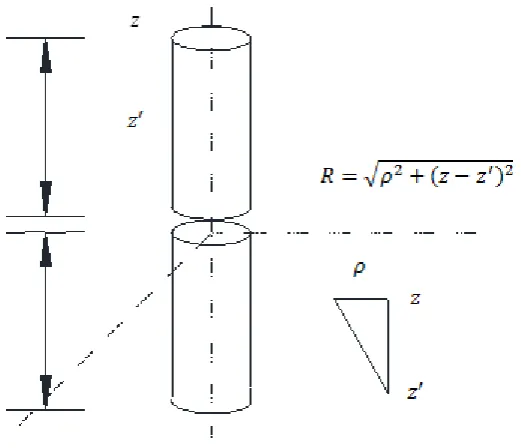
along the z axis. Elemental current segments are located at coordinate z’. Field observation pointsb are located at coordinate’s z. A feed gap is positioned at z=0. The electric field along the surface of the wire and in the feed gap, which establishes the boundary conditions for the problem, is defined as follows:
𝐸𝑧 = 0 (2.3)
On the surface of the wire.
𝐸𝑧 = ∆𝑧𝑉𝑔 (2.4)
[image:19.595.204.465.490.714.2]At the feed gap,𝑉𝑔, the antenna excitation, is normally set to 1.0V for input impedance calculations. Δz is commonly set equal to the diameter of the wire. However, it is possible to study the impact of the feed gap dimensions on antenna input impedance by varying the value of Δz.
With the conditions presented in Figure 1, Pocklington’s equation may be written as:
∫ 𝐼𝑧(𝑧′)�𝜕
2
𝜕𝑧2+𝑘2�
𝜚−𝑗𝑘𝑅
4𝜋𝑅 𝑑𝑧′= 𝑗𝜔𝜀𝐸𝑧(𝑧) (2.5) 𝑙
2 �
−𝑙�2
Where,
𝑅 =�𝜌2+ (𝑧 − 𝑧′)2 (2.6)
The variable R represents the distance between the current source and field observation points. The variable 𝜌 specifies the radius of the wire. The current distribution 𝐼𝑧(𝑧′) is defined along the length of the wire from 𝑧= 𝑙
2 to 𝑧= −𝑙
2. The
kernel 𝜕2
𝜕𝑧2+𝑘2denotes the wave equation differential operator on the free space function. The constant k specifies the free space wave number. 𝐸𝑧(𝑧) represents the electric field generated by the current on the wire. With the specific excitation applied, as modeled through the appropriate boundary conditions, radiation characteristics and feed point impedances are determined from knowledge of the antenna’s current distribution𝐼𝑧(𝑧′). Of the many techniques available to solve such integral equations problems, the method of moments is one of the related filed popular approaches.
2.3 The Method of Moments
functions, yielding values which are loosely defined as impedances. The current expansions coefficients, the orthogonal projections of the electric field boundary conditions, and these impedances are gathered into a system of simultaneous linear equations. This system of equations is solved to yield the current expansion coefficients. The original current distribution is then determined by the introducing these coefficients back into the basic function expansion.
The solution procedure begins by defining the unknown current distribution
𝐼𝑧(𝑧′) in terms of an orthogonal set of basic functions. Two categories of basic
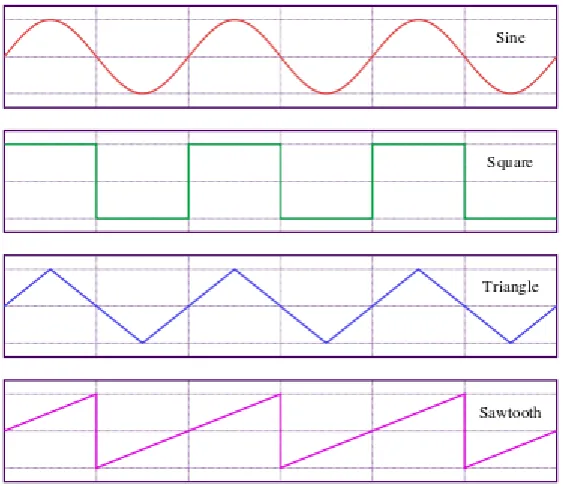
[image:21.595.179.461.384.629.2]functions exist. Sub domain basic functions, significantly more popular in industry, subdivide the wire into small segments and model the current distribution on each segment by a simple geometrical construct, such as a rectangle, triangle or sinusoidal arc. The amplitudes of these construct represent the expansion function coefficients. These simple constructs, illustrated in Figure 2.1, often overlap to maintain continuity of the current distribution along the wire.
Figure 2.1: Basic Function of Current distribution Construction (en.wikipedia.org)
impedances, therefore impractical. The introduction of the redefined current distribution reduces the integral equation to the form:
� 𝐶𝑛𝐺𝑛(𝑧) =𝐸𝑧(𝑧) 2.6 𝑁
𝑛=1
Where
𝐺𝑛(𝑧) =𝑗4𝜋𝜔𝜀 � 𝐹1 𝑛(𝑧′) 𝑙/2
−𝑙/2
�𝜕𝑧𝜕22+𝑘2�𝑒−𝑗𝑘𝑅
𝑅 𝑑𝑧′ 2.7
𝐶𝑛 = current’s expansion coefficient 𝐹𝑛(𝑧′) = basic function
The boundary conditions are now enforced through the use of an inner product operator with a set of orthogonal testing function. Each testing function is applied to both sides of the integral equation, the inner product then enforces the boundary condition at the location described by the testing function. This operation may be thought of as simply enforcing the boundary condition at a single point on the wire. After each testing function operation, the integral equation will be stated as:
� 𝐶𝑛 𝑁
𝑛=1
〈𝐻𝑚(𝑧),𝐺𝑛(𝑧)〉 =〈𝐻𝑚(𝑧),𝐸𝑧(𝑧)〉 2.8
where the fractional equation represent the inner product operator,
〈𝐻𝑚(𝑧),𝐺𝑧(𝑧)〉=∫−𝑙𝑙//22𝐻𝑚(𝑧)𝐺𝑛(𝑧)𝑑𝑧 2.9
formulating the orthogonal set of testing functions. The first approach, the point matching or location technique, defines the testing function in terms Dirac delta function given by:
𝐻𝑚(𝑧) =𝜕)𝑧 − 𝑧𝑚 2.10
Where 𝑧𝑚 are specific points on the wire which the boundary conditions are enforced. 𝑧𝑚 are usually selected to correspond with the midpoint of each basis function. The second approach, Galerkin’s technique, although more complicated from a computational perspective, enforces the boundary condition more rigorously than the point matching technique. However, this more difficult approach is required for simple wire antenna problems. The entire boundary condition is enforced by applying the complete set of testing functions. This operation yields a set of integral equations.
[𝑧𝑚𝑛𝛪𝐼𝑛] = [𝑉𝑚] 2.11
Where
𝑧𝑚𝑛 =∫−𝑙𝑙//22𝐻𝑚(𝑧)𝐺𝑛(𝑧)𝑑𝑧 2.12
𝐼𝑛 = 𝐶𝑛 2.13
𝑉𝑚= ∫−𝑙𝑙//22𝐻𝑚(𝑧)𝐸𝑛𝑧(𝑧)𝑑𝑧 2.14
This circuit like set of simultaneous linear equations will yield the value of
𝐶𝑛.
[𝐼𝑛] = [𝑍𝑚𝑛]−1[𝑉𝑚] 2.15
2.4 Helix Antenna
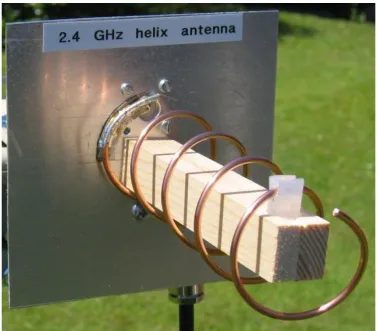
A helix antenna is defined as an antenna whose configuration relates to a helix [1]. The helix antenna is relatively light weight because it is constructed using a metal conductor wire, a center support the helix structure, and is usually attached to a ground plane at the base. An example of a helix antenna is seen in Figure 2.2. The lossless gain of a Helix Antenna is given by
𝐺 = 15𝑁 �𝐶𝜆�2�𝑆𝜆�2 2.16
[image:24.595.130.508.374.705.2]Where, C is the circumference of helix. Circumference is the linear distance around the outside of a closed curve or circular object. S is the spacing between turns and N is the number of turns of a helical antenna.
The gain is dependent of the number of turns, the circumference of the helix, the spacing between turns, and the wavelength. Designers can increase the gain of the antenna by adding additional turns which will increase the length of the antenna. Another key characteristic is the input impedance of the antenna. This can be obtained using,
𝑅 = 140𝐶𝜆 2.17
The resistance of the antenna is dependent of the circumference of the helix and the wavelength. By making the circumference smaller and closer to the wavelength, the antenna will have a smaller input resistance but a smaller achievable gain. By changing the circumference, designers can match the impedance of the transmitter to the generator resistance. Figure 2.3 shows a basic configuration of a helix antenna.
Figure 2.3 Basic Helix Antenna Configurations (Sergey Makarov, 2011)
pitch ϴ= tan−1 𝑆
𝜋𝐷 2.18
𝐴𝑛𝑡𝑒𝑛𝑛𝑎𝐿𝑒𝑛𝑔𝑡ℎ =𝑁𝑆 2.19
𝑇𝑜𝑡𝑎𝑙𝑤𝑖𝑟𝑒𝐿𝑒𝑛𝑔𝑡ℎ=𝑁𝑥𝐿𝑒𝑛𝑔𝑡ℎ𝑜𝑓 1 𝑡𝑢𝑟𝑛 2.20
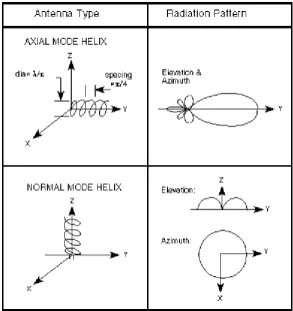
[image:26.595.172.466.405.717.2]There are two operational modes for a helix antenna that is axial mode, and normal mode. In normal mode the spacing between helixes and the diameter of the helixes are small in comparison with the wavelength. The radiation pattern is along the helical direction and it is similar to that of a dipole. In axial mode, the antenna functions like a directional antenna and the spacing between elements is λ/4. The antenna radiates at the top of the helix along the axis of the antenna. The radiation pattern of both operation modes can be seen in Figure 2.4.
2.5 Previous Research
2.5.1 Effect of Wire End, In Thin Wire Analysis.
Most of the methods for thin wire analysis are based on the solving integral equation by using method of moments. In connection with that, special care is devoted to the effect of wire ends. Improper treatment of wire ends results in a very large total electric field in the vicinity of these discontinuities .In the case of electrical thin wire this large electric field usually has little effect on the current distribution away from the wire ends, as well as on the radiation characteristics. However, neglecting the end effect in the case of electrically thicker resonant structures can lead to significant numerical instabilities. A rigorous treatment of the end effect must include precise approximation of the surface current and charge distribution at the wire ends, taking into account the exact shape of the ends. Such treatment requires a number of extra terms in order to approximate these currents and charges and evaluation of a new type of quasisingular integrals. This implies an increase in the computer storage requirements and execution time presents a new, simple and almost rigorous treatment of effect of rationally symmetrical end, which can be easily included into algorithms developed without introducing additional unknowns. Further, it shows how the ends of the simple shape can be successfully modeled by conical (flat) ends, in which case evaluation of a new type of quasisingular integral for each particular end is avoided. Extensive numerical results confirm the suggested treatment and show some less known properties of errors of wire analysis performed by various methods. The quality and efficiency of thin-wire analysis can be significantly improved by including simple and almost rigorous treatment of effect of conical (flat) end, which can be successfully used for modeling of ends of simple shapes.
2.5.2 Analysis of Coil-Loaded Thin-Wire
generator in the integral equation for the current distribution. When the coil is of finite length, however, the correct current distribution may not be obtained. Recently, the contribution from the coil was expressed by two deltas function generators located at coil ends and the current on the coil was approximated by a linear function. Although this method gives better result than the former approximate method does. The deviation of the calculated current distribution from the measured one is observed as the number of turns and length of coil increase. Pocklington’s integral equation with the more accurate expression for the electric field on the surface of coil is formulated and its numerical solutions are compared with the measured results. The coil-loaded wire antenna is numerically analyzed and the good agreements between the numerical and measured current distribution and input impedance are obtained for the different numbers of turns in the coil. The application of the integral equation formulated here to an arbitrary wire-antenna structure is almost straightforward. Therefore the method suggested here is useful for the analysis and design of the coil-loaded wire antenna.
2.5.3 Approximate Surface-Current Distributions of Rectangular Dipole Antennas
length, and the same wire diameter. The performance properties of the, Minkowski Island fractal loop and the Koch fractal monopole are compared with those of other non-Euclidean geometry antennas.
2.5.4 Complete Surface Current Distribution In A Normal mode helical Antenna Using A Galerkin Solution With Sinusoidal Basis Functions.
CHAPTER 3
METHODOLOGY
3.0 Chapter Overview
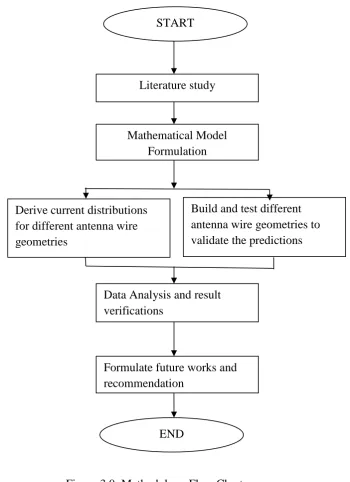
Milestones for the project completion are discussed in this chapter. Figure 3.0 illustrates the project methodology flowchart. Regardless of the literature, the methodology involves modeling, simulation, and experimental work. The diagram in Figure 3.0 clarifies that the methodology is mainly divided into two main tasks; first the modeling and testing different antenna wire geometries and derive current distributions for different antenna wire geometries.
3.1 Software Simulation
3.2 Research Work Stages
The research work will be carried out in throughout a few stages. The stages include review and establish the requirements and importance of the subject that is the surface current distribution on thick and thin wire antennas. In order to learn how to apply two orthogonal basis functions on curved surfaces, the best numerical techniques should be explore and established so it can offer the solution for the simulation.
The application of the approximated kernel and improvement of efficiency of integral equation method will be investigated throughout the development of the research. Before modeling process is introduced, the mathematical model of the surface resistive losses will be estimated. In order to discuss the effect of surface current distribution bring a critical contribution towards antenna performance, Q-factor, and efficiency, the variations of the non-uniform currents subject to antenna size is predicted.
3.3 Methodology Flow Chart
Figure 3.0: Methodology Flow Chart START
Literature study
Mathematical Model Formulation
Build and test different antenna wire geometries to validate the predictions Derive current distributions
for different antenna wire geometries
Formulate future works and recommendation
Data Analysis and result verifications
CHAPTER 4
RESULTS AND ANALYSIS
4.0 Chapter Overview
4.1 Two Turn Helical Antenna at 300MHZ
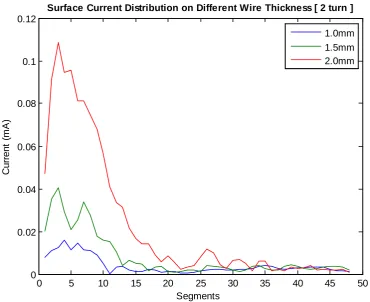
[image:34.595.129.500.373.675.2]Figure 4.0 shows the current distributions of two turn helical antenna resonate at 300MHz. Graph are plotted from NEC simulation results analysis from currents and locations section. From the figure we could clearly see that the current at surface are not uniform from the initial segments towards the end of the design. At wire thickness of 1mm, the peak current is 0.0160mA and approaching zero towards the end of the segments. At wire thickness of 1.5mm, the peak current is 0.0404mA and a relatively higher than 1mm antenna thickness. The current distribution of 2.0mm wire thickness antenna is the highest recorded peak value at 0.1086mA. Clearly here, the higher amount of wire thickness will result in the higher current distributions. Throughout along the wire antenna, the current on its surface are approaching zero, similar to all the three wire antenna of different thickness.
Figure 4.0: Surface Current Distribution of two turn Helical Antenna at 300MHZ
0 5 10 15 20 25 30 35 40 45 50
0 0.02 0.04 0.06 0.08 0.1 0.12 Segments C u rre n t (m A )
Surface Current Distribution on Different Wire Thickness [ 2 turn ]
REFERENCES
[1]. Balanis. Constantine A., Antenna Theory: Analysis and Design, 3rd ed.
Hoboken, United States of America: Wiley-Interscience, 2005.
[2]. Sergey Makarov, Selected Lectures - Antennas. Worcester, United States of America: John Wiley & Sons Inc, 2011.
[3]. Smith G. 1972, “The proximity effect in systems of parallel conductors”, J. Applied Physics, vol. 43, No. 5 pp. 2196-2203.
[4]. Olaefe G.O., 1998, “ Scattering by two cylinders”, Radio Sci., 5, 1351-1360.
[5]. Tulyathan p. And Newman E. H., 1990, “The circumferential variation of the axial component of current in closely spaced thin-wire analysis”, IEEE Trans. Antennas and prop., AP-27 46-50.
[6]. Rawle R. D., 2006, “The method of moments: A numerical technique for wire antenna design”, High Frequency Design, Smiths Aerospace. US.
[7]. E.H Newman and k. Kingsley 1996, “ An introduction to the method of moments”, in Elesevier Science Publishers B.V 0010- 4655/91.
[8]. Djordjevic A.R., et al, 1990, “Analysis of wire antennas and scatterers”, Artech house, Boston, USA
[9]. Leonard L. Tsai1 978, “Moment Methods in Electromagnetics for Undergraduates”, in IEEE Transactions on Educations Vol E-21, No. 1
[11]. 4NEC2 Antenna Modelr and Optimizer. “4NEC Antyenna Modeler and Optimizer, N.P., n.d Web.2011.
[12]. Zwi Altman and Raj Mittra 1996,. “Combining an Extrapolation Technique with the Method of Moments for Solving Large Scattering Problems Involving Bodies of Revolution”, in IEEE Transactions on Antennas and Propagation vol.44,
No. 4.
[13]. Gerald J. Burke, Edmund K. Miller and Andrew J. Poggio, “ The Numerical Electromagnetics Code (NEC) – A Brief History.,” U.S department of Energy by University of California, Lawrence Livermore National Laboratory”
[14]. W.-Y.Yin, L.-W. Li,T.-S. Yeo and M.-S.Leong, 2001,.”Electromagnetics Fields of a thin circula loop antenna above a grounded multi layered chiral slabs: the non unuiform current excitation”. in Progress in Electromagnetics Research, PIER
30, 131-156.
[15]. David C. Yates 2004,.”Optimal transmission Frequency for Ultralor Power Short Range radio Links” in IEEE Transaction on circuits and systems Vol 51. No. 7.
[16]. A.J Parfit and D.W Griffin 1989,.”Analysis of the single wire fed dipole antenna”,. Department of Electrical and Electronic Engineering, The University of
Adelaide, South Australia.
[17]. J. Sosa Pedroza, A. Lucas-Bravo, J. Lopez-Bonilla 2006,. “Cross Antenna: An experimental and Numerical Analysis”,.in Apeiron, Vol.13, No. 2.
[18]. S. Ghosh, A. Chakrabarty, and S. Sanyal 2005,.”Loaded Wire Antenna as EMI Sensor”., in Progress in Electromagnetic Research, PIER 54, 19-36.
[19]. H. Mimaki and H. Nakano, “ Double pitch Helical Antenna”, in IEEE