1
Chapter 1
A Binary Programming Mathematical
Approach for Serving Healthy and Palatable
Secondary School Menu
S.F. Sufahani1, Z. Ismail2, S.L. Kek3
1 Department of Mathematics and Statistics,Faculty of Science, Technology and Human Development, Universiti Tun Hussein Onn Malaysia, Parit Raja, 86400 Batu Pahat, Johor, [email protected]
2 Departmentof Mathematics, Faculty of Science, Universiti Teknologi Malaysia, Skudai, 81310 Johor Bahru, Johor, [email protected]
3 Department of Mathematics and Statistics, Faculty of Science Technology and Human Development, Universiti Tun Hussein Onn Malaysia, Parit Raja, 86400 Batu Pahat, Johor, [email protected]
2 Keywords.Binary Programming, Mathematical Modeling, Menu Scheduling, Decision Making, Optimization.
1
Introduction
The goal of this study is to find a well balance menu by minimizing the cost while maximizes the variety type of food and reducing the process time to find optimal solution. The caterer in the secondary schools normally provides 6 meals per day within a restricted budget but with a lack of variety. Menu scheduling was first formulated by Stigler in 1945 in order to learn the complications which relates to human nutrition [9] and this problem has attracted many further research until now [1, 2, 3, 4, 5, 6, 7, 8]. In this paper, the awareness of menu scheduling was expanded with the application of Malaysian food and Malaysian school children aged 13-18. We used the mathematical approach to solve the problem. We used Binary Programming through Matlab with LPSolve programming language in order to produce optimal solutions.
2
Data
The data for nutrients‟ requirement, nutrients‟ values, nutrients‟ boundaries and meal list for school children aged 13 to 18 years old was obtained from the nutritionist of the Ministry of Health Malaysia and also in the Nutrient Composition of Malaysian Foods Handbook [10]. An interview session was held with the school authorities, caterers and Ministry of Malaysian Education in order to get the daily budget which is USD 3.99 per day per student for each secondary school in Malaysia.
3
Model Formulation
3 extend the list until one week menu just with a single run and within seconds. In total there are 426 type of food in this study or 426 variables (xi) where i=1,2,…,426,and divided into 10 types of food groups. There
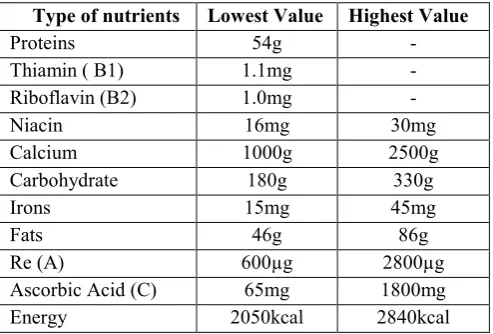
[image:3.595.131.378.239.406.2]are specific numbers of requirement from each food group as shown in Table 2 and the total number of food needed per day is 18 foods.
Table 1. Boundaries values for the 11 Nutrients
Type of nutrients Lowest Value Highest Value
Proteins 54g -
Thiamin ( B1) 1.1mg -
Riboflavin (B2) 1.0mg -
Niacin 16mg 30mg
Calcium 1000g 2500g
Carbohydrate 180g 330g
Irons 15mg 45mg
Fats 46g 86g
Re (A) 600µg 2800µg
Ascorbic Acid (C) 65mg 1800mg
Energy 2050kcal 2840kcal
Table 2. Number of food requirement in one day
Food groups Requirement in one day Cereal Based Meals Two including one plain rice
Beverages Six including two plain water
Fruits, Vegetables Two each
Rice Flour Based, Cereal Flour Based, Miscellaneous, Fish and Seafood, Chicken and Meat, Wheat Flour Based
One each
The goal is to minimize the total cost Z
426
1 i i i
Z c x
(1)whereciis the cost of each food xi. The daily budget is USD 3.62. The daily
constraints
426
1 j i i
LB n x UB
4 whereLB (lower bound) and UB (upper bound) are the vector values for each nutrient, nj. Each nutrient has its lower and upper bound values apart
from Thiamin (B1), Riboflavin (B2) and Protein where it only have lower bound values (refer Table 1). By referring to Table 2, the constraints for food requirements can be written as follows
426
1
i k
i
x f
,k= 1,2, …,10. (3)and the total food requirement per day is 18 dishes. Each food groups has different number of requirement per day. The 426 parameters are in binary or zero one forms
{0,1}
i
x
(4)Each food can only be serve once (1 is chosen and 0 is otherwise) in a day or in a week except for except for plain rice and plain water. If the user prefers a week, the program will consider different available variables each time running for each day. This research is a NP-hard problem where it involves more than 400 variables, more than 40 constraints and more than 400 parameters. Binary programming along with Matlab with LPSolve was used to build up the model. By using a 2.26GHz personal computer, optimal feasible solution was obtained within less a second. The solution was fast generated compared to other techniques would have taken more processing time [2, 5, 6, 7, 8].
4
Results
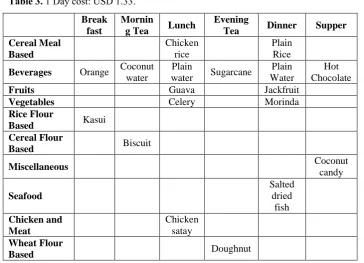
5 Table 3. 1 Day cost: USD 1.33.
Break fast
Mornin
g Tea Lunch
Evening
Tea Dinner Supper Cereal Meal
Based
Chicken rice
Plain Rice Beverages Orange Coconut
water
Plain
water Sugarcane
Plain Water
Hot Chocolate Fruits Guava Jackfruit
Vegetables Celery Morinda Rice Flour
Based Kasui Cereal Flour
Based Biscuit
Miscellaneous Coconut candy
Seafood
Salted dried fish Chicken and
Meat
Chicken satay Wheat Flour
Based Doughnut
Table 4.One day generated nutrient values
Nutrients Value Generated
Proteins 91.0g
Thiamin ( B1) 1.53mg Riboflavin (B2) 2.03mg
Niacin 23.5mg
Calcium 1037g
Carbohydrate 318.5g
Irons 20.3mg
Fats 55.5g
Re (A) 1010µg
Ascorbic Acid (C) 270.1mg
[image:5.595.124.294.442.624.2]6
4
Conclusions
The model was solved using binary programming through Matlab with LPSolve programming languages and focused on school children aged on 13 to 18 years old. It met all the nutrients and food groups constraints which set by the researchers in the beginning of the research and gives a better solution. The total cost for one day is less than USD 3.92. Healthier and variety foods can be served as the cost has been minimized. This model can also be implemented for other menu planning problems for instance sports, chronic illness patients, militaries, universities, hospitals and nursing homes.
References
1. Balintfy, J.L. (1975). A Mathematical Programming System for Food Management Applications, INTERFACES, Vol. 6, No. 1, pp. 2.
2. Dantzig, G.B. (2002). Linear Programming, Operation Research, Vol. 50, No. 1, pp. 42-47.
3. Florencio, C.A. (2001). A Human Rights Approach to Nutritional Well-being,
Malaysian Journal of Nutrition, Vol. 7, pp. 61-65.
4. Leung, P.S., Wanitprapha, K., & Quinn, L.A. (1995). A Recipe-Based, Diet-Planning Modelling System, British Journal of Nutrition, Vol. 74, pp. 151-162.
5. Sufahani, S. & Ismail, Z. (2014). A New Menu Planning Model for Malaysian Secondary Schools using Optimization Approach. Journal of Applied Mathematical Sciences 8(151):7511-7518.
6. Suliadi Sufahani, Zuhaimy Ismail. (2015). Planning a Nutrition and Healthy Menu For Malaysian School Children Aged 13-18 Using “Delete-Reshuffle Algorithm” in Binary Integer Programming, Journal of Applied Sciences, 15(10) 7, pp. 1239-1244.
7. Suliadi Sufahani, Zuhaimy Ismail, Maselan Ali. (2016). Mathematical Optimization Method on Diet Planning for School Children Aged 13-18 Using DRRA Approach, Wulfenia Journal, 23(1), pp.103-112.
8. Suliadi Sufahani, Zuhaimy Ismail, Maselan Ali. (2016). A New Diet Scheduling Model for Malaysian School Children Using Zero-One Optimization Approach, Global Journal of Pure and Applied Mathematics, 12(1), pp. 413-419.
9. Stigler, G.L. (1945). The Cost of Subsistence, Journal of Farm Economics,
27, pp. 303-314.