Original Research Article
Pattern of burn injury among patients admitted in a Tertiary Care
Hospital of Jharkhand
Mithelesh Kumar, Erum Yasmin*, Chandramani Kumar, Vivek Kashyap
INTRODUCTION
In this contemporary world with many advances in medical care, one of the highly preventive injury, burn, account for an estimated 180 000 deaths annually and hence exist as a global public health problem. The majority of these occur in low- and middle-income countries and almost two thirds occur in the WHO African and South-East Asia regions. Burns are among the leading causes of disability-adjusted life-years (DALYs) lost in low and middle-income countries.1 In the world second most populous country, India, over 1 000 000 people are moderately or severely burnt every year with one death every 4 minutes due to burnand the
most common cause being household injury.2 Unsafe stoves, open fire cooking, cylinder explosion and interpersonal violence besides other factors make women the most vulnerable group. Burns are also a significant cause of mortality and morbidity among infants and children being dependent on their caretaker as they are unable to recognize the hazardous situations leading to burn injury. It is the fifth most common cause of non-fatal childhood injuries.1 The elderly population also remains at higher risk for burn injury due to several pre-disposing factors associated with increased age such as reduced reaction time, decreased mobility, incorrect assessment of risks, impaired senses and higher incidence of pre-morbid conditions such as chronic debilitating
ABSTRACT
Background: Burn despite being easily preventable is a critical health problem worldwide. With effective managements there is decline in burn cases in developed countries but trend is still rising in developing countries like India. This study was conducted to know the socio-demographic profile and pattern of burn injury in patients admitted in burn unit of tertiary care hospital.
Methods: A hospital based cross sectional study was conducted for a period of six months using semi-structured questionnaire for data collection. The patient or accompanying person was interviewed after taking consent. Clinical assessment was done to find% of total body surface area (TBSA) involved and most severely affected body part.
Results: A total of 123 patients were admitted in burn unit. Female (72.3%) predominance was found with most common age group being 21-40 years. Majority was Hindus (72.4%), residing in rural area (79.7%) and married (60.2%). Accidental burn was in 92.7%, mostly occurring at home (91%). Flame burn was common in female and electric burn in male. Burn injury mostly involved up to 30% of TBSA (44.7%) with upper limb (39%) most severely injured. Only 35% were admitted on the same day of injury. Infection (57.7%) and amputation (7.3%) were two common complications. There were 12 (9.8%) deaths during the study period.
Conclusions: Most vulnerable were female with flame burn due to unsafe cooking practices. Infection was the most common complication. Death was more in those who delayed admission in hospitals.
Keywords: Burn injury, Pattern, Health seeking behavior, Hospital
Department of Preventive and Social Medicine, Rajendra Institute of Medical Sciences, Ranchi, Jharkhand, India
Received: 19 April 2018
Accepted: 25 May 2018
*Correspondence:
Dr. Erum Yasmin,
E-mail: [email protected]
Copyright: © the author(s), publisher and licensee Medip Academy. This is an open-access article distributed under the terms of the Creative Commons Attribution Non-Commercial License, which permits unrestricted non-commercial use, distribution, and reproduction in any medium, provided the original work is properly cited.
diseases, alcoholism, effect of medication, senility, and neurological and psychological disorders. The outcome of the burn depends on factors enumerated as degree of heat, duration of exposure, extent of surface area, type of flame, site, age, and sex. Outcome can be recovery, recovery with complications (contracture, physical deformities, loss of confidence, social cut-off) and death. The high cost incurred in burn care and indirect costs like loss of wages etc. contribute to socioeconomic impact of burn. Also those who survive with disability and disfigurement often live with stigma and rejection.1 Hence burn is not only functional but also a psychological challenge.
The rate of burn varies widely. There are not only regional differences but it also varies within a country. Despite of rising cases in India, data on burn victims and outcome is limited from this part of the world. There are even lesser studies from eastern India. Dowry deaths and witchcraft are the two major social evils still persisting in the current scenario of Jharkhand. Hence we conducted a study to know the socio-demographic profile and pattern of injury of burn victims at our institution so that magnitude of the problem in our society is known, and proper preventive strategies are planned.
METHODS
This was a hospital based cross sectional study. Over a six month period from 16th May to 15th November 2017 all patients admitted to burn unit of Rajendra Institute of Medical Sciences (RIMS) were included in the study. A semi-structured questionnaire was used for data collection. The variables to describe their socio-demographic profile were age, sex, religion, occupation, residence, marital status, income and education. Socioeconomic status was classified according to Modified B G Prasad Classification 2017. Assessment of their burn profile included mode of burn, cause, place and type of cloth worn during the incident. Clinical assessment through physical examination of part of body injured was done. Wallace “Rule of Nine” in adults and “Lund and Browder” chart was used for defining the extent of burn in terms of total body surface area (TBSA) affected. The outcome and complication details were retrieved from patient medical record folder. Either the patient or the accompanying person was interviewed after taking consent. The data were entered in MS excel sheet and was analyzed in SPSS. Chi-square test was used as test of significance and p value less than 0.05 was considered as significant.
RESULTS
A total of 123 patients were admitted in burn unit of surgery ward during study period. There was female predominance with 72.3% (n=89) and males were only 27.7% (n=34). The most common age group was 21-40 years (62.6%). Majority were Hindu (72.4%). More than 50% were married, the number being 74 (60.2%) and rest
unmarried. The burn victims residing in rural was 98 (79.7%) and the working population was 70 (56.9%) with 53 (43.1%) unemployed. Among employed 32(45.7%) were in private jobs, 13 (18.6%) self-employed, 11(15.7%) government employee, 8 (11.4%) farmers and 6 (8.6%) electrician. About 62.6% (n=77) belonged to lower class and only 1% (n=1) to upper class. Nearly half (49.6%) had attained primary education while 32.5% were illiterate (Table 1).
Table 1: Socio-demographic profile of burn patients (n=123).
S.no Characteristics Frequency Percentage (%)
1
Gender
Males 34 27.7
Females 89 72.3
2
Age
0-20 years 12 9.7
21-40 years 77 62.6
41-60 years 21 17.1
>60 years 13 10.6
3
Religion
Hindu 89 72.4
Muslim 15 12.2
Christian 3 2.4
Sarna# 16 13
4
Residence
Rural 98 79.7
Urban 25 20.3
5
Type of Family
Joint 22 17.9
Nuclear 101 82.1
6
Marital status
Married 74 60.2
Unmarried 49 39.8
7
Education
Illiterate 40 32.5
Primary education 61 49.6
Secondary
education 9 7.3
Higher secondary
& above 13 10.6
8
Employment
Employed 70 56.9
Unemployed 53 43.1
9
Socioeconomic status*
Class 1 1 1
Class 2 3 2.4
Class 3 9 7.3
Class 4 33 26.8
Class 5 77 62.6
Table 2: Pattern of burn injury (n=123).
Characteristic Frequency Percentage (%)
Place
Home 112 91
Workplace 11 9
Mode
Accident 114 92.7
Homicidal 9 7.3
Cause
Flame 80 65
Electricity 10 8.1
Kerosene oil/petrol 12 9.8
Scald/hot water 21 17.1
Type of cloth worn
Cotton 40 32.5
Synthetic 52 42.3
Woolen 18 14.6
Others 13 10.6
% of TBSA involved
0-30% 55 44.7
31-60% 43 35
61-90% 16 13
>90% 9 7.3
Severely affected body site
Trunk 45 36.6
Upper limb 48 39
Lower limb 11 8.9
Head & neck 1 1
Others 18 14.6
Day of presentation
Same day 43 35
2-4 days 33 26.8
5-7 days 28 22.8
>7 days 19 15.4
Complications
Infection 71 57.7
Amputation 9 7.3
No complication 43 35
Outcome
Discharged 56 45.5
Left against medical
advice (LAMA) 55 44.7
Death 12 9.8
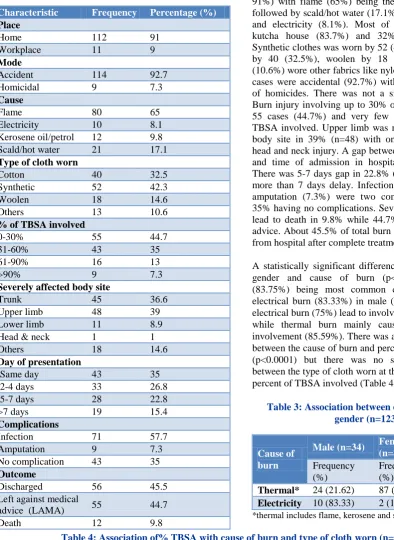
Most of the burn incidents took place at home (n=112, 91%) with flame (65%) being the most common cause followed by scald/hot water (17.1%), kerosene oil (9.8%) and electricity (8.1%). Most of them were living in kutcha house (83.7%) and 32% were overcrowded. Synthetic clothes was worn by 52 (42.3%), cotton clothes by 40 (32.5%), woolen by 18 (14.6%) and rest 13 (10.6%) wore other fabrics like nylon, silk etc. Maximum cases were accidental (92.7%) with only 9 (7.3%) cases of homicides. There was not a single case of suicide. Burn injury involving up to 30% of TBSA was found in 55 cases (44.7%) and very few (7.3%) had >90% of TBSA involved. Upper limb was most severely affected body site in 39% (n=48) with only 1% having severe head and neck injury. A gap between the time of incident and time of admission in hospital was also detected. There was 5-7 days gap in 22.8% (n=28) and 15.4% had more than 7 days delay. Infection (57.7%) followed by amputation (7.3%) were two complications seen with 35% having no complications. Severe burn and infection lead to death in 9.8% while 44.7% left against medical advice. About 45.5% of total burn cases were discharged from hospital after complete treatment (Table 2).
A statistically significant difference was found between gender and cause of burn (p<0.0001) with flame (83.75%) being most common cause in female and electrical burn (83.33%) in male (Table 3). Most of the electrical burn (75%) lead to involvement of >60% TBSA while thermal burn mainly caused <60% of TBSA involvement (85.59%). There was a significant difference between the cause of burn and percent of TBSA involved (p<0.0001) but there was no significant association between the type of cloth worn at the time of incident and percent of TBSA involved (Table 4).
Table 3: Association between cause of burn and gender (n=123).
Cause of burn
Male (n=34) Female
(n=89) P value
Frequency (%)
Frequency (%)
p<0.0001
Thermal* 24 (21.62) 87 (78.38)
Electricity 10 (83.33) 2 (16.67)
*thermal includes flame, kerosene and scald
Table 4: Association of% TBSA with cause of burn and type of cloth worn (n=123).
Variables % of TBSA
0-60% >60% P value
Cause
p<0.0001
Thermal* 95 (85.59) 16 (14.41)
Electricity 3 (25) 9 (75)
Type of cloth worn
p=0.71
Cotton and synthetic 74 (80.43) 18 (19.57)
Others# 24 (77.42) 7 (22.58)
Table 5: Relationship of outcome with other variables (n=123).
Variables Outcome
Discharged (%) LAMA (%) Death (%) P value
Admission timing
p<0.0001
Same day 4 (9.30) 37 (86.05) 2 (4.65)
Delay 52 (65) 18 (22.5) 10 (12.5)
Complication
p=0.01
Present* 43 (53.75) 28 (35) 9 (11.25)
Absent 13 (30.23) 27 (62.79) 3 (6.98)
*complications include infection and amputation.
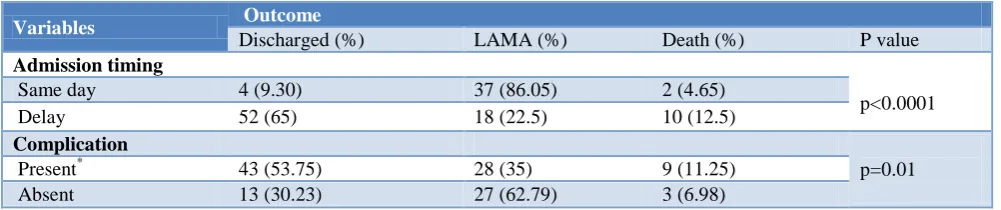
The association between outcome and complications as well as between outcome and day of presentation to hospital was found to be statistically significant with p=0.012579 and p<0.00001 respectively (Table 5). Death was higher in those who showed delay in admission.
DISCUSSION
There is relative lack of published information about burn injuries in Jharkhand. Present study with a relatively small sample size has revealed pattern of burn injuries among reported cases from a tertiary care hospital of Ranchi, Jharkhand. In this study, female to male patient ratio was found to be 2.6:1 indicating increase vulnerability of female to burn. Female predominance has been reported in other studies done in different regions of India; male predominance was found in some studies of other countries.3-7 Earlier studies done on deceased burn patients from this institute had also reported higher percentage of female victims.8,9 Another study done by Goswami et al, in Jamshedpur revealed slight female preponderance of burn patients.10 Substantially higher female preponderance in present study might be due to small study sample size. Larger population of Jharkhand resides in rural areas where females are mostly housewives engaged in household works. Unsafe cooking practices like chullas and use of kerosene lamps are common in rural areas which expose them to flame burn and kerosene burn. These could be other reasons for higher number of female patients reporting to hospital. Most common affected age group in this study was 21–40 years which is consistent with findings of many other epidemiological studies on burn from different part of India.11-16 In this study we found that 91% of incident took place at home which was similar to the findings of study conducted by Lal et al in Delhi.4 In most of the studies majority of burn victims were illiterate but in our study nearly half of the patients had attained primary education.4,5 However, our study finding about literacy status of patients was similar to the observation of study by Zopate et al in Central India.17
In present study, majority of patients had <30% TBSA involvement due to burn injury followed by 30-60% TBSA involvement. Goswami et al reported similar finding in their study from a different area of Jharkhand.11 Kumar et al in their study reported >40% of TBSA involvement in majority.3 In our study, we found
that upper limb and trunk was the most common site of burn injury among reported patients. This finding was similar to that of Lal et al from Delhi.4 Majority of patients in our study suffered from accidental burn injuries. Few were homicidal cases and there was no suicidal burn case. This finding was in contrast to that reported by Kumar et al from Lucknow where suicidal cases were highest.18 The reason here may be under reporting of the suicidal cases. Similar could be the scenario with homicidal cases being reported as accidental cases in our study. Similar finding has been reported in another study by Shanghavi et al earlier.19 Although about one third patients came to our tertiary hospital on same day after contracting burn injury; majority applied home remedies like turmeric, crushed peepal root etc., few went to quacks and other to local practitioners. Poor awareness about burn injury and distantly located tertiary care hospital could be reasons behind this. Late presentation of burn patients to hospital usually make the situation worse as they present with multiple infections. The present study revealed that thermal injuries mostly taking place at home is highest with majority of patient belonging to lower class. The rural population is more vulnerable and show delay in seeking health care leading to complications. These findings propose the need to educate people about safe handling of appliances at home, the target group being females.
Our study also has some limitations. The major limitation is that this is a single center study with a small sample size. Multi-centric study with larger sample size will give better picture about the epidemiology of burn injury in the state. Only limited information gathered on homicidal and suicidal burns in this study.
ACKNOWLEDGEMENTS
The authors thank all the participants and staff of burn unit for their support. We are grateful for the expert help of faculties and also acknowledge critical manuscripts review by multiple colleagues.
Funding: No funding sources Conflict of interest: None declared
REFERENCES
1. World Health Organization. Fact Sheet: burns; 2018. Available at http://www.who.int/mediacentre/ factsheets/fs365/en/. Accessed on 3 March 2018. 2. Directorate General of Health Services. Health
Programmes: National Programme on Prevention and Management of Burn Injuries; 2017. Available
at http://dghs.gov.in/content/1357_3_National
ProgrammePreventionManagement.aspx. Accessed on 3 March 2018.
3. Kumar P, Chaddha A. Epidemiological Study of Burn Cases And Their Mortality Experiences Amongst Adults From A Tertiary Level Care Centre. Indian J Community Med. 1997;22(4):160-7.
4. Lal P, Rahi M, Jain T, Ingle GK. Epidemiological Study of Burn Injuries in a Slum Community of Delhi. Indian J Community Med. 2006;31(2):96-7. 5. Bhardwaj SD, Sinha U. An epidemiological survey
of burn injuriesin rural area, Bhopal: A cross-sectional Study. Indian J Burns. 2012;20(1):62-5.
6. Hosseini SN, Rashtchi V, Kamali K, Moghimi MH.
Epidemiology and Outcome of 2,590 Burned Patients in Northwest Iran. Annals Burns Fire Disasters. 2017;30(2):85-90.
7. Duci SB, Arifi HM, Selmani ME, Mekaj AY, Buja ZA, Hoxha ET, Hamza AR. A retrospective study of 69 patients admitted at the intensive care unit University Clinical Center of Kosovo during the period 2008-2012. Indian J Burns. 2014;22(1):88-92.
8. Korah MK, Guria J, Mahto T, Bhengra A. Burn Deaths: A Study on Female Victims in Ranchi,
Jharkhand. IOSR J Dental Medical Sci.
2016;15(11):9-11.
9. Prasad CS, Shubhendu K, Gawasker SP, Singh NK.
Profile of Burn Injuries Among Autopsies Conducted in Dept. of Fmt, Rims, Ranchi. IOSR J Dental Med Sci. 2017;16(8):53-7.
10. Goswami P, Singodia P, Sinha AK, Tudu T. Five-year epidemiological study of burn patients admitted in burns care unit, Tata Main Hospital, Jamshedpur, Jharkhand, India. Indian J Burns. 2016;24:41-6. 11. Sawhney CP, Ahuja RB, Goel A. Burns in India:
Epidemiology and problems in management. Ind J Burns. 1993;1:1-4.
12. Ahuja RB, Bhattacharya S. Burns in the developing world and burn disasters. BMJ. 2004;329:447-9. 13. Ahuja RB, Bhattacharya S. An analysis of 11,196
burn admissions and evaluation of conservative management techniques. Burns. 2002;28:555-61. 14. Ahuja RB, Bhattacharya S, Rai A. Changing trends
of an endemic trauma. Burns. 2009;35:650-6. 15. Chahaun N, Kumar S, Sharma U. Profile of acute
thermal burn admissions to intensive care unit of a tertiary burn care center in India. Indian J Burns. 2012;20:68-71.
16. Bhardwaj SD, Sinha U. An epidemiological survey of burn injuries in rural area, Bhopal: A cross-sectional study. Indian J Burns. 2012;20:62-5. 17. Zopate PR, Tirpude BH, Murkey PN. Pattern of
burn injury in the rural part of central India. Indian J Burns. 2011;19(1):42-8.
18. Kumar S, Ali W, Verma AK, Pandey A, Rathore S.
Epidemiology and mortality of burns in the Lucknow Region, India--a5 year study. Burns 2013;39(8):1599-605.
19. Sanghavi P, Bhalla K, Das V. Fire-related deaths in India in 2001: a retrospective analysis of data. Lancet. 2009;373:1282–8.