Journal of Chemical and Pharmaceutical Research, 2015, 7(2):861-865
Review Article
ISSN : 0975-7384
CODEN(USA) : JCPRC5
Fermentation parameters and condition affecting Levan production
and its applications
J. Mariya Divya and K. R. Sugumaran*
Bioprocess Engineering Lab, School of Chemical and Biotechnology, SASTRA University Thanjavur, Tamil Nadu, India
_____________________________________________________________________________________________
ABSTRACT
Levan an exopolymer is used for drug delivery in medicinal applications. It is a water soluble biopolymer produced by microbial cells both under anaerobic and aerobic conditions which have stronger adhesive properties. This review focuses on the biosynthesis of levan, factors influencing levan production and its applications.
Keywords: Levan, Production and Applications.
_____________________________________________________________________________________________
INTRODUCTION
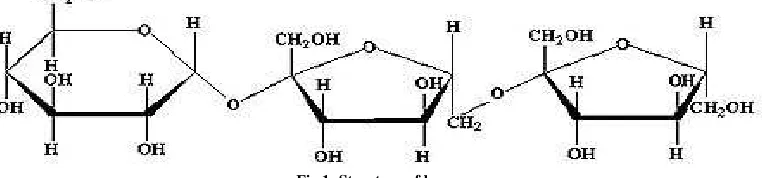
[image:1.595.109.490.589.678.2]Polysaccharides are either produced from plants, algae or from microorganisms such as bacteria, yeast and fungi. In recent years, microbial polysaccharides have wide variety of applications in food, cosmetics, medicine, pharmaceuticals and chemical industries. Levan, a microbial polysaccharide commonly referred as polyfructose, is composed of ß-(2, 6)-fructosyl-fructose units linked by glycosidic bonds [1]. It was produced from sugar juice as an undesirable byproduct which was first proposed by Lippmann, 1881. A strain of Bacillus sp was used to produce levan from sucrose [2]. The production of levan will be in plenty upon usage of sucrose-rich substrates catalyzed by the enzyme levansucrase [3]. Levan is non-toxic, non-transparent suspension and reflect visible light [4]. Many types of microorganisms like Bacillus subtilis, Bacillus polymyxa, Acetobacterlevanicum, Pseudomonas fluorescens, and Aspergillus versicolarare capable of producing levan [5]. Levan is used as emulsifier, stabilizer and thickener.
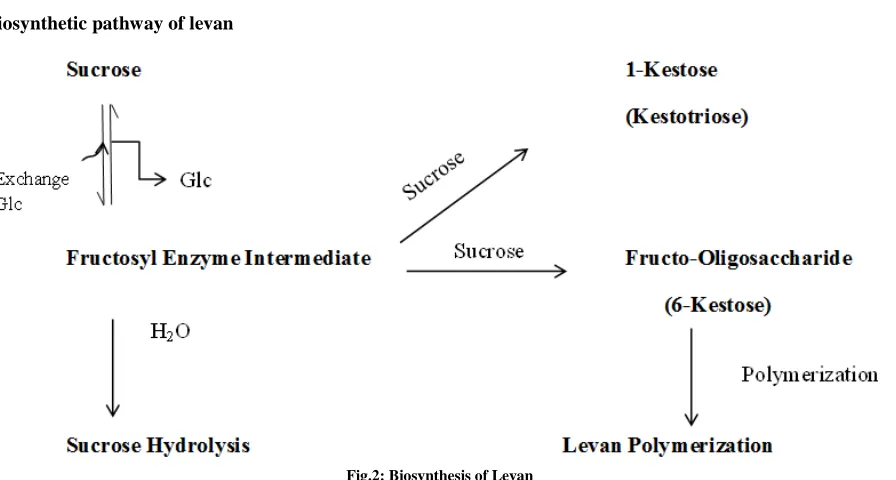
Biosynthetic pathway of levan
Fig.2: Biosynthesis of Levan
Levan synthesis requires levansucrase, an extracellular enzyme, which increases the productivity of levan when sucrose is provided as a substrate [2]. The levansucrase enzyme catabolizes the sucrose and converts fructose into levan. This reaction is termed as “transfructosylation” [6]. Levan production can be inhibited by sugars like glucose, lactose, D-xylose, L-arabinose, maltose [2].
Properties
High molecular weight levan was soluble in both water and oil. Compared to cold water levan was completely soluble in hot water [7]. Levan was insoluble in most of the organic solvents except Dimethyl Sulfoxide [8]. It has low intrinsic viscosity. Studies reported that, viscosity of levan in water from 0.07-0.18 dL/g and also in DMSO the viscosity range was between 0.20-0.29 dL/g [9]. In a study proposed that, levan from Microbacterium levaniformis has the intrinsic viscosity of 0.38 dL/g at 25°C which was greater than levan from other species [10]. It has good thermo stability with a melting point of 225°C [11].
Production of levan from microbial sources
[image:2.595.104.489.549.627.2]Fig. 3 explains fermentation and downstream processing of levan recovery from microbial system
Table 1: Summary of levan production
S.No Microorganism Substrate Mode of fermentation Production (g/Lt) Ref.
1. Bacillus subtilis sucrose Batch 70.6 [3]
2. Bacillus lentus Sucrose Batch 36.6 [4]
3. Bacillus licheniformis sucrose Batch 26 [5]
4. Zymomonas mobilis sucrose Batch 40.2 [6]
5. Halomonas sp. Sugar beet molasses _ 12.4 [12] 6. Microbacterium levaniformis Date syrup _ 48.9 [13] 7. Paenibacillus polymyxa Date syrup _ 24 [14]
Now-a-days usage of low cost substrates cuts down the production cost of polymers. Levan from Halomonas was produced using molasses as a substrate instead of sucrose and the yield of levan was 12.4 g/L [12]. Date syrup was used as an alternative source for levan formation (10.48 g/L) using Microbacterium levaniformis [13]. However, production of levan (24 g/L) from Paenibacillus polymyxa was investigated using date syrup [14]. Sugar cane syrup and molasses were used for levan and the yield was found to be 2.533 g/L from molasses which was lower than that from sugar cane syrup 15.456 g/L [15].
Fig.3: Schematic Representation of Levan Production [13]
Levan-producing microorganism
Growth: 37°C, 48 h, 120 rpm
Inoculum
fermentor
Fermentation Broth Production
Cell Removal
Precipitation
Separation
Washing and Drying
Levan Polymer
Cells
Ethanol
Ethanol Production Fermentation Media
Factors influencing levan production Carbon sources
Carbon sources used for levan production included sucrose, glucose, fructose, galactose, maltose, mannose, raffinose and mannitol [16]. Carbon sources enhance the growth of cell and increases the levan productivity. Sucrose gave the higher yield of levan among most carbon sources. When the sucrose concentration was increased above 300g/L, levan production decreased [17]. Sucrose concentrations from 50 to 200g/L increased the yield of levan from 15.5 to 22.8g/L. But addition of glucose and fructose decreased the production from 27.1g/L to 12.4g/L and 13.1g/L in the case of glucose and fructose respectively [18].
Nitrogen sources and phosphorous salt
Various nitrogen sources used for production of levan were peptone, ammonium chloride, ammonium sulfate and urea [16]. In addition to nitrogen sources, phosphorous salts and metal ions also enhanced the yield of production.
There was no significant influence of Ca2+, Na+ and K+ on levan production but magnesium ion effectively increased
Initial pH
Initial pH played a major role in increased cell growth and production. Maximum concentration of levan was produced at pH 6. Negligible levan production was found at pH 4 and decrease in the yield of levan was observed at pH 7. Results showed the formation of levan between pH 5 and 6 [18]. In a study, it was reported that production decreased when the pH values were greater or lesser than pH 6. The optimum pH range for formation was between 5.0 and 6.5 [17].
Temperature
Temperature is one of the significant factors for polymer production. After 24hrs of incubation the highest levan
production was obtained at 37°C. Increase in temperature above 47°C reduced levan production. The suitable
temperature for levan synthesis was 37°C [17]. The maximum concentration of levan (27.2 g/L) from Zymomonas
mobilis occurred at 25°C. Negligible concentration of levan was obtained between the temperatures 35°C and 40°C. Yield of levan was high at low temperatures. It was reported that maximum amount of levan concentration was
achieved at 7°C [18].
The schematic flow sheet of levan production is shown in fig.
Applications
Studies reported that levan was used in the fields of food, medicine, pharmaceutical and chemical industries. In the area of medicine, levan can be used as an immune modulator, a blood plasma substitute, prolongator, anti- tumor agent [6] and anti hyperlipedemic agent [17]. Levan was applied as both capping agent and reducing agent for synthesis of silver and gold nanoparticles [19]. Levan derivatives can be used in the treatment of AIDS and also as an inhibitor for muscle proliferation. A variety of diseases, caused by fishes due to certain stress factors, can be prevented by Immuno-stimulating ability of levan [20]. It can be used as cell-proliferating and skin moisturizing agents. It does not cause skin irritation [18]. In food industries, levan was used as a sweetener [2], emulsifying, encapsulating agent and a texture forming compound [6]. Other than these applications levan is used in the form of additive, smoothner, equilibrator, enveloper and aromatic enhancer [3].
CONCLUSION
Distinctive properties of levan increase its requirement in many fields like food, medicine and cosmetics. Increasing demand and production cost of levan triggers the researchers to cut down the cost of levan production by using the low cost agro-wastes as substrates.
REFERENCES
[1] M Bekers; D Upite; E Kaminska; J Laukevics; M Grube; A Vigants; R Linde, Process Biochem., 2005, 40, 1535-1539.
[2] YW Han, Adv. Appl. Microbiol., 1990, 171–194.
[3] I Shih; L Chena; J Wub, Carbohydr. Polym., 2010, 82, 111-117.
[4] KA taleb; MA Monem; MYA Dra, British Microbiol. Res. J., 2015, 5, 22-32.
[5] AE Ghaly; F Arab; NS Mahmoud ; J Higgins, American J. Biotechnol. Biochem., 2007, 3, 47-54.
[6] S Silbir; S Dagbaglib; S Yegina; T Baysala; Y Goksungur, Carbohydr. Polym., 2014, 99, 454-461. [7] SK Gupta; P Das; SK Singh; MS Akhtar; DK Meena; SC Mandal, world aquaculture, 2011, 42(1), 62. [8] M Ullrich, Norfolk UK, Horizon Scientific Press, 2009.
[9] J Ehrlich; SS Stivla; WS Bahary; SK Garg; LW Long; E Newbrun, J. dental res., 1974, 54(4), 290-297. [10] IY Bae; IK Oh; S Lee; SH Yoo; HG Lee, Int. J. Biol. Macromol., 2008, 42(1).
[11] I Vina; A Karsakevich; S Gonta; R Linde; N Bekers, Wiley Online Library, 1998, 18(2), 167-174.
[12] F Kucukasi; H Kazak; D Guney; I Finore; A Poli; O Yenigun, B Nicolaus; ET Oner, Appl. Microbiol.
Biotechnol. , 2011, 89 (6), 1729-1740.
[13] MM Nasab; B Layegh ; L Aminlari; B Hashemi, World Academy Science, Eng. Technol., 2010, 4, 1022-1028. [14] SN Radhi; SS Hasan ; SB alden, Dept. Biol., University of Baghdad, 2013, 166-172.
[17] J keith; B Wiley; D Ball, S Archidiacono; D Sorfass; J Mayer; D Koplan, Biotechnol. Bioeng, 1991, 38, 557-560.
[18] V Senthilkumar; P Gunasekaran, Ind. J. Biotechnol., 2005, 4, 491-496.
[19] KBA Ahmeda; D Kallab; KB Uppulurib; V Anbazhagan, Carbohydr. Polym., 2014, 4, 112, 539-545.