PATTERN RECOGNITION FOR MANUFACTURING PROCESS VARIATION USING STATISTICAL FEATURES ARTIFICIAL NEURAL
NETWORK
ABDUL AZIZ BIN ABDULLAH
A thesis submitted in fulfillment of the requirement for the award of the Master of Mechanical Engineering
Faculty of Mechanical and Manufacturing Engineering Universiti Tun Hussein Onn Malaysia
v
ABSTRACT
vi
ABSTRAK
vii
TABLE OF CONTENTS
TITLE i
DECLARATION ii
DEDICATION iii
ACKNOWLEDGEMENT iv
ABSTRACT v
ABSTRAK vi
TABLE OF CONTENT vii
LIST OF TABLES ix
LIST OF FIGURES x
LIST OF APPENDICES xi
CHAPTER 1 INTRODUCTION 1
1.1 Research Background 1
1.2 Problem Statement 2
1.3 Objective of Study 2
1.4 Research Scope 2
CHAPTER 2 LITERATURE REVIEW 4
2.1 Introduction 4
2.2 Process Variation 5
2.3 Statistical process Control (SPC) 7
2.4 Shewhart Control Charts 11
2.5 Control Limits 14
viii
2.7 Pattern Recognition in SPC 15
2.8 Artificial Neural Network in Pattern Recognition 16
CHAPTER 3 METHODOLOGY 19
3.1 Research Flow Chart 20
3.2 Project Methodology 21
3.3 Modelling Of Bivariate Process 21
3.4 Input Representation 24
3.5 Data Generator 25
3.6 Step in Development of Statistical Feature in ANN
Based CCPR 26
3.7 Causes of Variations in Manufacturing Process
of the Product 26
3.8 Problem Situation and Solution 29
CHAPTER 4 RESULTS AND DISCUSSIONS 32
4.1 Introduction 32
4.2 Simulation Process Analysis Using Artificial Neural
Network 32
4.2.1 Analysis of Data Generator 34 4.2.2 Training for Basic Data Analysis Based
on Artificial Neural Network 36
4.2.3 Data Manipulator 37
4.3 Performance Result And Discussion In Hard Disk
Drive 38
4.4 Result Summary 47
CHAPTER 5 CONCLUSION AND RECOMMENDATIONS 49
5.1 Conclusion 49
5.2 Recommendation 49
REFERENCES 51
ix
LIST OF TABLES
Table 2.1 Types of charts 12
Table 3.1 Seven possible conditions of bivariate process mean shifts 24 Table 4.1 Analysis of Data Generator for Features-Based ANN 34 Table 4.2 Summary of data manipulator characteristic for 50 data sets. 38
Table 4.3 Total sources of variation in HDD 38
Table 4.4 Inspection result for ARL0, Normal Pattern (N (0, 0)) 39 Table 4.5 Outputs of the scheme for ARL0, Normal Pattern (N (0, 0)) 40 Table 4.6 Inspection result based on loading error case. 41 Table 4.7 Outputs of the scheme for the loading error case 42 Table 4.8 Inspection result based on off-setting tool case. 43 Table 4.9 Outputs of the scheme for the off-setting tool case 44 Table 4.10 Inspection result based on pneumatic clamping problem
case.
45
Table 4.11 Outputs of the scheme for the pneumatic clamping problem case
46
Table 4.12 Summary of the best result for ARL1 47
Table 4.13 Value of ARL1 based on previous study 48
x
LIST OF FIGURES
Figure 2.1 Chance and assignable causes of variation. 7 Figure 2.2 Basic statistical process control tools specification 8
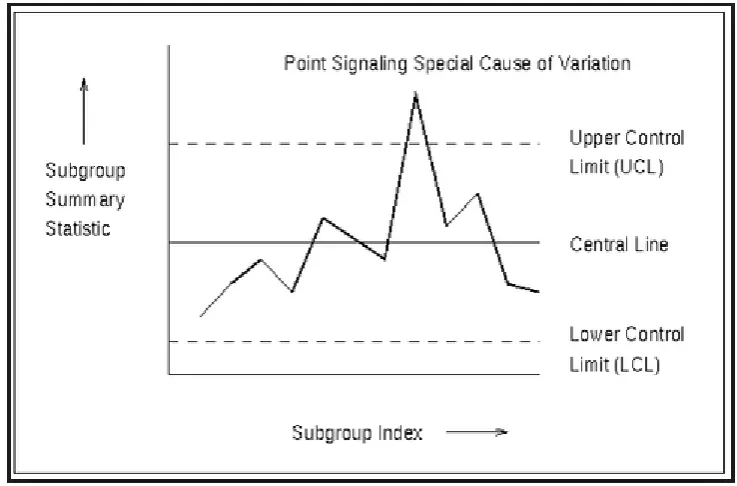
Figure 2.3 Nine control chart patterns 10
Figure 2.4 Shewhart Control Chart 11
Figure 2.5 Shewhart Charts 13
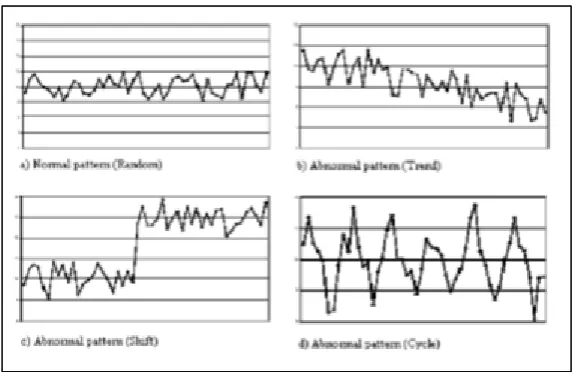
Figure 2.6 Typical normal and abnormal patterns 17
Figure 3.1 Research flow chart 20
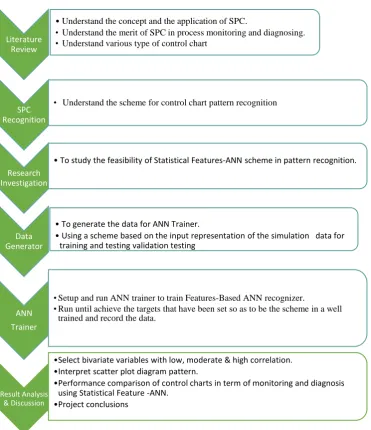
Figure 3.2 showed the overview of project methodology in this research 21 Figure 3.3 Bivariate stable process patterns with different data
correlation
22
Figure 3.4 Conceptual diagram for the statistical features-ANN recognizer
22
Figure 3.5 Shewhart Control Scatter Diagram Chart and 23 Figure 3.6 Development and Implementation Stages of ANN-Based 26 Figure 3.7 Independent and Joint Monitoring (Montgomery, 2005) 28 Figure 3.8 Process variation due to loading error and offsetting tool 29 Figure 3.9 Manufacturing process of hard disc drive (HDD) 30 Figure 3.10 Sources of variation in bivariate process 31 Figure 3.11 Process variations when loading errors and offsetting tool 31 Figure 3.12 Pneumatic clamping problem due to low pressure 31
xi
LIST OF APPENDICES
Appendix Title Page
A Gantt chart Master Project 1 53
B Gant chart Master Project II 54
CHAPTER 1
INTRODUCTION
1.1 Research Background
2
1.2 Problem Statement
In manufacturing, process monitoring and diagnosis is critical towards continuous quality improvement. This becomes more challenging when it involving two correlated variables. Process monitoring refers to the identification of process status either it is within in-control or out-of – control. Process diagnosis refers to the identification of the source variables of out-of-control process. The traditional statistical process control charts (SPC) were known to be effective in monitoring aspects. Nevertheless, they are lack of diagnosis. In recent years, the artificial neural network (ANN) has been developed to solve this problem (Montgomery, 2001). Thus, this study focuses on the an integrated ANN model that is called Statistical Features- ANN.
1.3 Objective of Study
The objectives of this research are:
i. To design a Statistical Features-ANN pattern recognition scheme for monitoring and diagnosis manufacturing process variation.
ii. To evaluate the performance of the scheme in actual manufacturing process application.
1.4 Research Scope
The scopes can be summarized as:
3
ii. Bivariate process variable are dependent to each other based on linear cross correlation (ρ )
iii. In a statistically out-of-control condition, predictable bivariate process patterns are limited to upward shift only.
iv. Magnitude of mean shifts in the source variables are limited within ± 3 standard deviations based on control limits of Shewhart control chart.
CHAPTER 2
LITERATURE REVIEW
This chapter provided the reviews of the concept of SPC control chart monitoring and diagnosis. The traditional SPC chart(s) role for monitoring the existence of unnatural variation in bivariate process, whereas an ANN model roles for diagnosing the sources of variation. In that case, an ANN model is utilized only when necessary, that is, when an out-of-control signal is triggered. An ANN model is continuously utilized, for triggering out-of-control signal and then, for identifying the sources of variation. In conclusion, explanation on why the Statistical Feature - ANN model recognizers was chosen to improve the monitoring and diagnostic in manufacturing process.
2.1 Introduction
In the production HDD, the production process is carried out continuously. Therefore, at regular time intervals, samples of data will be taken to investigate the variation and validate the pattern recognition on the production of HDD.
5
and improving capability through the reduction of variability. SPC is one of the greatest technological developments of the twentieth century because it is based on sound underlying principles, is easy to use, has significant impact, and can be applied to any process. Its seven major tools are the histogram or stem-and-leaf plot, the check sheet, the Pareto chart, the cause-and-effect diagram, the defect concentration diagram, the scatter diagram, and the control chart.
2.2 Process Variation
Process variation is known to be a major source of poor quality. Traditionally, statistical process control (SPC) was used to monitor and identify process variation. Advances, variation reduction efforts as such process monitoring and diagnosis should be critically applied towards quality improvements (Masood & Hassan, 2012).
Variation may be defined as any unwanted condition or as the difference between a current and a desired end-state. Both product performance and manufacturing processes exhibit variation. Wear and tear, vibration, machine breakdown, inconsistent raw material and lack of human operators‟ skills are the common sources of variation in manufacturing process (Masood & Hassan, 2012) . To manage and reduce variation, the variation must be traced back to its source. Variation occurs in all natural and man-made processes. If variation cannot be measured, it is only because the measurement systems are of insufficient precision and accuracy. Process variance reduces the capacity of the industries because processes become either under- or over-utilized. Process variance reduces the ability to detect potential problems and increases the difficulty of discovering the root cause of problems.
6
statistical control. In other words, the chance causes are an inherent part of the process. Other kinds of variability may occasionally be present in the output of a process. This variability in key quality characteristics usually arises from three sources: improperly adjusted or controlled machines, operator errors, or defective raw material. Such variability is generally large when compared to the background noise, and it usually represents an unacceptable level of process performance. We refer to these sources of variability that are not part of the chance cause pattern as assignable causes of variation. A process that is operating in the presence of assignable causes is said to be an out-of-control process.
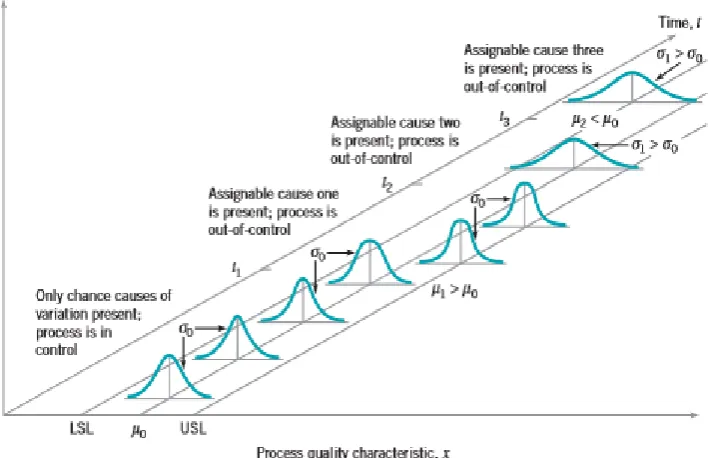
These chance and assignable causes of variation are illustrated in Fig. 2.1. Until time t1 the process shown in this figure is in control; that is, only chance causes
of variation are present. As a result, both the mean and standard deviation of the process are at their in-control values (say, μ0 and σ0). At time t1 an assignable cause
occurs. As shown in Fig. 2.1, the effect of this assignable cause is to shift the process mean to a new value μ1 > μ0. At time t2 another assignable cause occurs, resulting in
μ = μ0, but now the process standard deviation has shifted to a larger value σ1 > σ0.
At time t3 there is another assignable cause present, resulting in both the process
mean and standard deviation taking on out-of-control values. From time t1 forward,
7
Figure 2.1 : Chance and assignable causes of variation.
A major objective of statistical process control is to quickly detect the occurrence of assignable causes of process shifts so that investigation of the process and corrective action may be undertaken before many nonconforming units are manufactured. The control chart is an on-line process-monitoring technique widely used for this purpose. Control charts may also be used to estimate the parameters of a production process, and, through this information, to determine process capability. The control chart may also provide information useful in improving the process. Finally, the eventual goal of statistical process control is the elimination of variability in the process. It may not be possible to completely eliminate variability, but the control chart is an effective tool in reducing variability as much as possible.
2.3 Statistical Process Control (SPC)
8
successful adoption by Japanese firms, Statistical Process Control has now been incorporated by organizations around the world as a primary tool to improve product quality by reducing process variation. Dr. Shewhart identified two sources of process variation: Chance variation that is inherent in process, and stable over time, and Assignable, or Uncontrolled variation, which is unstable over time - the result of specific events outside the system. Dr. Deming relabeled chance variation as Common Cause variation, and assignable variation as Special Cause variation.
Control charts are the most widely applied SPC tools used to reveal abnormal variations of monitored measurements. Common causes are considered to be due to the inherent nature of normal process. Assignable causes are defined as abnormal shock to the processes, which should be identified and eliminated as soon as possible. When an abnormal variation is signaled by control chart, quality practitioners or engineers search for the assignable causes and take some necessary correction and adjustments to bring the out-of-control process back to the normal state. In many quality control settings, the manufacturing process may have two or more correlated quality characteristics and an appropriate approach is needed to monitor all these characteristics simultaneously. The usual practice has been to maintain a separate chart for each characteristic. However, this could result in some fault out-of-control alarms when the characteristics are highly correlated.
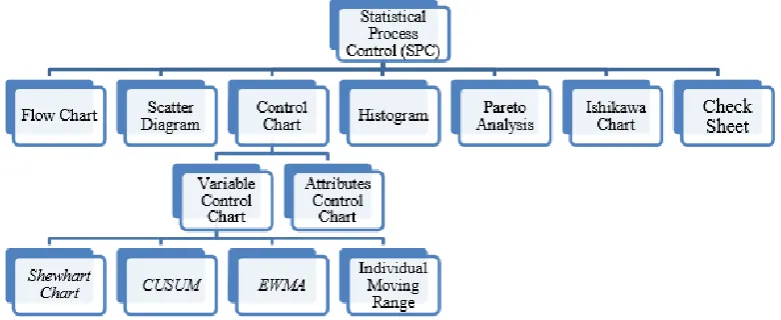
[image:16.595.129.520.575.735.2]SPC is a technique used in a manufacturing environment to ensure quality parts are produced. Montgomery (2013) highlighted statistical process control is one of the most effective tools of total quality management whose main function is to monitor and minimize process variations. There are many ways to implement process control. Key monitoring and investigating tools include, as shown in Fig. 2.2.
9
10
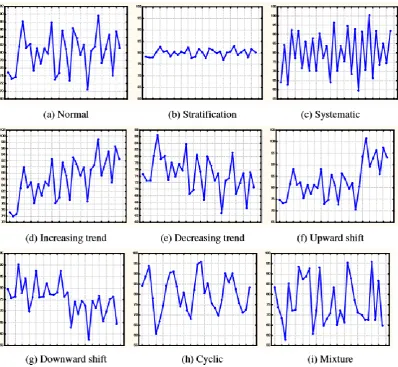
Figure 2.3 : Nine control chart patterns
11
2.4 Shewhart Control Charts
A control chart is a graphical and analytic tool for monitoring process variation. The natural variation in a process can be quantified using a set of control limits. Control limits help distinguish common-cause variation from special-cause variation. Typically, action is taken to eliminate special-cause variation and bring the process back in control. It is also important to quantify the common-cause variation in a process, as this determines process capability.
[image:19.595.209.465.611.742.2]The Control Chart platform provides a variety of control charts, as well as run charts. To support process improvement initiatives, most of the control chart options display separate control charts for different phases of a project on the same chart. Control charts, also known as Shewhart charts (after Walter A. Shewhart) or process-behavior charts, in statistical process control are tools used to determine if a manufacturing or business process is in a state of statistical control. If analysis of the control chart indicates that the process is currently under control (i.e., is stable, with variation only coming from sources common to the process), then no corrections or changes to process control parameters are needed or desired. In addition, data from the process can be used to predict the future performance of the process. If the chart indicates that the monitored process is not in control, analysis of the chart can help determine the sources of variation, as this will result in degraded process performance (McNeese & William, 2006). A process that is stable but operating outside of desired (specification) limits (e.g., scrap rates may be in statistical control but above desired limits) needs to be improved through a deliberate effort to understand the causes of current performance and fundamentally improve the process (Wheeler & Donald J., 2000).
12
The control chart is one of the seven basic tools of quality control (Nancy R. Tague, 2004). Typically control charts are used for time-series data, though they can be used for data that have logical comparability (i.e. you want to compare samples that were taken all at the same time, or the performance of different individuals), however the type of chart used to do this requires consideration (A Poots & T Woodcock, 2012). A control chart is a graphical and analytic tool for monitoring process variation. The natural variation in a process can be quantified using a set of control limits. Control limits help distinguish common-cause variation from special-cause variation. Typically, action is taken to eliminate special-special-cause variation and bring the process back in control. It is also important to quantify the common-cause variation in a process, as this determines process capability.
[image:20.595.149.561.400.629.2]To support process improvement initiatives, most of the control chart options display separate control charts for different phases of a project on the same chart, as shown in Table 2.1.
Table 2.1 : Types of charts
13
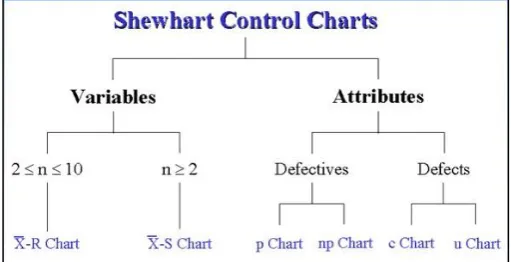
with non-normal data (Staufer & Rip, 2010). Second, attribute charts derive the measure of dispersion directly from the mean proportion (by assuming a probability distribution), while Individuals charts derive the measure of dispersion from the data, independent of the mean, making Individuals charts more robust than attributes charts to violations of the assumptions about the distribution of the underlying population (Wheeler & Donald J., 2000). It is sometimes noted that the substitution of the Individuals chart works best for large counts, when the binomial and Poisson distributions approximate a normal distribution. i.e. when the number of trials n > 1000 for p- and np-charts or λ > 500 for u- and c-charts.
[image:21.595.146.515.318.561.2]The most common use method in current industries is control chart or Shewhart Charts. These control charts are constructed by plotting product‟s quality variable over time in sequence plot as shown in Figure 2.5.
Figure 2.5 : Shewhart Charts
14
deviation of w is σw. Then the center line, upper control limit and lower control limit as shows in equation (2.1).
UCL = μw + Lσw
Center Line = μw (2.1)
UCL = μw –Lσw
2.5 Control Limits
Control limits, also known as natural process limits, are horizontal lines drawn on a statistical process control chart, usually at a distance of ±3 standard deviations of the plotted statistic from the statistic's mean. A point falling within the control limits means it fails to reject the null hypothesis that the process is statistically in-control, and a point falling outside the control limits means it rejects the null hypothesis that the process is statistically in-control. Therefore, the statistical Type I error α (Rejecting the null hypothesis H0 when it is true) applied in Shewhart control chart means the process is concluded as out-of control when it is truly in-control. Same analog, the statistical Type II error β (failing to reject the null hypothesis when it is false) means the process is concluded as in-control when it is truly false.
2.6 Average Run Length
The Average Run Length is the number of points that, on average, will be plotted on a control chart before an out of control condition is indicated (for example a point plotting outside the control limits).
The performance of control charts can also be characterized by their average run length. Average run length is the average number of points that must be plotted before a point indicates an out-of-control condition (Montgomery, 1985). We can calculate the average run length for any Shewhart control chart according to:
15
Where P or Type I error is the probability that an out-of-control event occurs. Therefore, a control chart with 3 sigma control limits, the average run length will be
(2.3)
This means that if the process remains in-control, in average, there will be one false alarm every 370 samples.
2.7 Pattern Recognition in SPC
Pattern recognition is the science of making inferences from perceptual data, using tools from statistics, probability, computational geometry, machine learning, signal processing, and algorithm design (Masood & Hassan, 2010). The techniques of pattern recognition have been successfully used in many areas such as applications in engineering, science, medicine, and business. In particular, advances made during the last half century, now allow computers to interact more effectively with humans and the natural world examples such as speech recognition, word recognition and finger print identification (Wen & Dwayne 1994). The effectiveness of the use of SPC control charts depends largely on recognizing out-of control conditions in terms of patterns, pattern recognition is an important issue in SPC, as unnatural patterns exhibited by control charts can be associated with specific assignable causes adversely affecting the process. Traditional Shewhart control charts signal only a simple decision, such as within or outside the control limits, based on the most recent observation (Wen & Dwayne, 1994).
16
Today, control chart pattern recognition has become an active area of research. Zorriassatine, Tannock & O‟Brian (2003) provided a useful review on the application for CCPR. However, it is still limited research and updated review on ANN-based CCPR schemes. There were several pattern recognition approaches done by several researchers. Swift (1987), done a research on SPC control chart pattern recognition using a dichotomous decision tree approach. Swift & Mize (1995) and Cheng (1995), used of expert systems. Expert system also known as rule-based that contain information explicitly. If required, the rules can be modified and updated easily. While the performance of this system was promising, it was reported that the template-matching is currently computationally too expensive to implement in a real-time application scheme (Cheng, 1997).
2.8 Artificial Neural Network in Pattern Recognition
17
Figure 2.6 : Typical normal and abnormal patterns
El-Midany et al (2010) documented, two approaches in applying ANNs to control charts analysis, they are generally:
1. Uses of ANN to detect deviation in mean and/or variance.
2. Uses of ANN to identify abnormal patterns using trained recognizer. Since late 1980s, control chart pattern recognition (CCPR) has become an active area of research. A useful review on the application of ANN for CCPR was provided by Zorriassatine and Tannock (1998). Since then much progress has been made in which the performance of ANN-based CCPR schemes have been enhanced through feature-based and wavelet-denoise input representation techniques, modular and integrated recognizer designs, and multivariate process monitoring and diagnosis. However, there is a lack of updated critical review on such issues.
18
unknown distribution and incomplete as found in CCPs (Schalkoff, 1997; Haykin, 1999).
CHAPTER 3
METHODOLOGY
This chapter focuses on the method or process of this study. The appropriate method is necessary in carrying out this study in order to ensure the quality of the produced results and its reliability. Accurate planning allows the data and information collected analyzed easily.
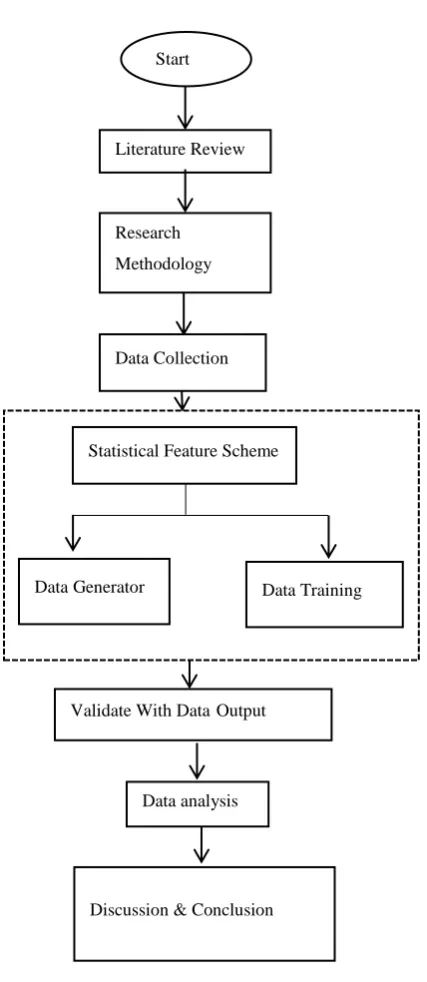
This chapter explains the working procedures to complete the whole project. Methodology also indicates the procedural steps that need to be follow to ensure that the project will be completed on time. All procedures and methods have been listed down to give a guideline on project progress and to ensure the project completed as planned. All the activities were listed on the Gantt chart as shown in Figure A.1 (in Appendix A). Figure 3.1 illustrated the explanation on the methodologies in Statistical Features-ANN scheme in monitoring and diagnosis of bivariate process variation in mean shifts.
20
3.1 Research Flow Chart
[image:28.595.220.434.170.662.2]Figure 3.1 illustrated the methodology flow chart of research study that will be carried out.
Figure 3.1: Research flow chart
Data analysis Research
Methodology
Data Collection
Statistical Feature Scheme
Data Generator Data Training
Validate With DataOutput Literature Review
Start
21
[image:29.595.153.525.125.556.2]3.2 Project Methodology
Figure 3.2: Overview of project methodology in this research
3.3 Modeling Of Bivariate Process
Bivariate process is the simplest case in MQC when only two process variables are being monitored dependently. Let X1i = (X 1-1,…, X1-24) and X 2i = (X 2-1,…, X 2-24)
represent data streams for process variable 1 and process variable 2 based on Literature
Review
• Understand the concept and the application of SPC.
• Understand the merit of SPC in process monitoring and diagnosing. • Understand various type of control chart
SPC Recognition
• Understand the scheme for control chart pattern recognition
Research Investigation
• To study the feasibility of Statistical Features-ANN scheme in pattern recognition.
Data Generator
• To generate the data for ANN Trainer.
• Using a scheme based on the input representation of the simulation data for training and testing validation testing
ANN Trainer
• Setup and run ANN trainer to train Features-Based ANN recognizer.
• Run until achieve the targets that have been set so as to be the scheme in a well trained and record the data.
Result Analysis & Discussion
•Select bivariate variables with low, moderate & high correlation. •Interpret scatter plot diagram pattern.
•Performance comparison of control charts in term of monitoring and diagnosis using Statistical Feature -ANN.
22
observation window - 24 samples. Observation windows for both variables start with samples ith = (1,…, 24). Then, it is followed with (ith +1), (ith + 2), …., and so on.
In a statistically stable state, samples for both process variables are identically and independently distributed with zero mean (μ0 = 0) and unity standard deviation
(σ0 =1). They yield random patterns when separately plotted on the Shewhart control
[image:30.595.157.524.262.381.2]charts and yield an ellipse pattern when plotted on a scatter diagram. Scatter diagram can indicate a measure of degree of linear relationship between two variables, i.e., cross correlation of data. Increasing the values of correlation will result in slim ellipses, as shown in Figure 3.3
Figure 3.3 Bivariate stable process patterns with different data correlation
Depending on process, the bivariate samples can be in low correlation (ρ = 0.1 – 0.3), moderate correlation (ρ = 0.4 – 0.6) or high correlation (ρ = 0.7 – 0.9). Data correlation (ρ) shows a measure of degree of linear relationship between two variables.
[image:30.595.150.456.535.716.2]23
Shewhart Control Chart Scatter Diagram
Low Correlation Low Correlation
Moderate Correlation Moderate Correlation
[image:31.595.107.533.68.695.2]High Correlation High Correlation
24
3.4 Input Representation
Input representation (input data) was an approach to represent the pattern of input signals to an ANN identifier. Generally, the occurrence of assignable causes over X1i and/or X2i can be identified by common causable patterns such as upward and downward shifts, upward and downward trends, cyclic, systematic, and mixture. This study concerns on upward-shift and downward-shift patterns. Seven possible conditions of bivariate process mean shifts with positive correlation were considered, as summarized in Table 3.1.
1. Normal (0,0): Both X1i and X2i are stable
2. Up-shift (1,0): X1i in upward-shift, X2i remain stable
3. Up-shift (0,1): X2i in upward-shift, X1i remain stable
4. Up-shift (1,1): Both X1i and X2i in upward-shifts
5. Down-shift (1,0): X1i in downward-shift, X2i remain stable
6. Down-shift (0,1): X2i in downward-shift, X1i remain stable
[image:32.595.148.562.463.745.2]7. Down-shift (1,1): Both X1i and X2i in downward-shifts
51
REFERENCES
A.Fryman, M. (2002). Quality And Process Improvement. Delmar Thomson Learning.
Allen, Theodore T. (2006). Introduction To Engineering statistics and six sigma: statistical quality control and design of experiment system. London Springer.
Bertrand L.Hansen And Prabhakar M.Ghare (2006), Quality Control and Application. NEW DELHI Prentice-Hall Of India.
Cheng, C. S. (1997). A Neural Network Approach for the Analysis of Control Chart Patterns. International Journal of Production Research. Vol. 35 No. 3. pp. 667 – 697.
Dale H.Besterfield, P. D., P.e (1994). Quality Control, Prentice Hall Career & Technology Englewood Cliffs,New Jersey 07632.
El-Midany, T. T., El-Baz, M. A. and Abd-Elwahed, M. S. (2010). A Proposed Framework for Control Chart Pattern Recognition in Multivariate Process Using Artificial Neural Networks. Expert Systems with Applications. Vol. 37. pp. 1035 − 1042.
Gauri, S. K. and Chakraborty, S. (2006). Improved Recognition of Control Chart Patterns Using Artificial Neural Networks. International Journal of Advanced Manufacturing Technology. Vol. 36. pp. 1191 – 1201.
Guh, R. S. and Tannock, J. D. T. (1999). Recognition of Control Chart Concurrent Patterns Using a Neural Network Approach. International Journal of Production Research. Vol. 37 No. 8. pp. 1743 − 1765.
52
Jamal Arkat , S. T. A. N. (2006). Artifical Neural Networks in Applying MCUSUM Residuals Charts For AR(1) Processes. Journal of Quality Technology.pp. 1889-1901.
Kourti, T. and MacGregor, J. F. (1995). Statistical Process Control Of Multivariate Processes. Journal of Quality Technology. Vol. 3.NO.3 pp. 404 – 414.
Masood, I. and Hassan, A. (2010). Issues in Development of Artificial Neural Network-Based Control Chart Pattern Recognition Schemes. European Journal of Scientific Research.vol.39,pp.336-335.
Masood, I. and Hassan, A. (2010). Pattern Recognition For Bivariate Process Mean Shifts Using Feature-Based Artifical Neural Network. International Journal of Advanced Manufacturing Technology.DOI 10.1007/s00170-012-4399-2.
Masood, I. and Hassan, A. (2012). A Scheme For Balanced Monitoring And Acccurate Diagnosis Of bivariate Process Mean Shifts. .Phd Thesis, Falcuty of mechanical Engineering Malaysia, Universiti Teknologi Malaysia.
Montgomery, D. C. (2001). Introduction to Statistical Quality Control. 4th.ed. USA John Wiley and Son Inc.
Montgomery, D. C. (2005). Introduction to Statistical Quality Control. 5th. ed. USA John Wiley & Sons, Inc.
Montgomery, D. C. (2009). Introduction to Statistical Quality Control. 6th ed.USA John Wiley & Sons, Inc.
Nelson, L.S. (1985). Interpreting Shewhart X-bar Control Chart. Journal of Quality Technology. Vol. 17 No. 2. pp. 114 − 116.