Journal of Chemical and Pharmaceutical Research, 2014, 6(2):785-789
Research Article
CODEN(USA) : JCPRC5
ISSN : 0975-7384
The allelopathic effect of ginseng root exudates on rice seeds
Yujia Song*
1,2and Huiqing Liu
21
Jilin Academy of Environment Science, Changchun, China
2
School of Urban and Environment Sciences, Northeast Normal University, Changchun, China
_____________________________________________________________________________________________ABSTRACT
In this study, the laboratory bioassay and matrix pot experiment were conducted with the deionized water as the controls (CK), for the goal of studying on the impact of ginseng root extraction solution at low concentration(10g/mL), medium concentration(20g/mL) and high concentration(40g/mL) on parameters of rice seed, including the germination, biomass of the seedlings, root activity, the conductivity and net photosynthetic rate. Results presented that: compared with the control group, after the treatment with ginseng root extraction solutions of different mass concentrations, the germination rate, seedling height and biomass of the seedlings of rice seeds were improved to different degrees. Among them, with the rise of mass concentration of extracts, the germination rate of rice seeds gradually increased. Treatment groups of medium and high mass concentration presented significant differences from that of CK (P<0.05). When the mass concentration of root soil extracts was 40g/mL,
the fresh weight and dry weight of a single plant was the largest, as 14.22mg and 1.66mg respectively. Extracts of different mass concentration did not impose an obvious impact on the seedling height, yet greatly inhibiting the seedling growth. Extracts of low mass concentration remarkably improved the root activity, while extracts of high mass concentration reduced the root activity; extracts of different mass concentrations significantly lowered the absolute conductivity of rice leaves; net photosynthetic rate of leaves after the treatment with extracts of low and medium mass concentration was increased. Meanwhile, extracts of high mass concentration slightly inhibited the net photosynthetic rate of leaves. Thus, it can be concluded that ginseng root extraction solution plays a certain role of promotion in the early germination and growth of rice, and presented the dose-related response as promoting at low concentrations and inhibiting at high concentrations for root activity and net photosynthetic rate.
Key words: Rice, ginseng, seed, Allelopathic effect
_____________________________________________________________________________________________
INTRODUCTION
The allelopathic effect refers to the process that living plants release secondary metabolism products to the environment through approaches such as leaching and volatilization of the aerial parts, root secretion as well as the decomposition of plant residues, which will produce harmful or beneficial effects on surrounding plants directly or indirectly, and hence affect the growth and development of surrounding plants or plants of later crop [1,2]. The allelopathic effect extensively exists in the agro-ecosystem, and it is particularly evident in the successive cropping obstacle of crops, thus playing a key role in the interspecies relation construction, the collocation of plant species, and its yield in the agricultural production [3-7]. Decomposed residues of tobacco significantly inhibit the lettuce seed germination and seedling growth, and present the double effects of concentration as promotion at a low concentration and inhibition at a high concentration [8]. The asparagus root remainders can inhibit the germination and radicle growth of asparagus and other crops, and the rise of its concentration enhances inhibitory effects [9].
problems such as reduced yield, weakened quality and high incidence of diseases in the continuous cropping of ginseng. Under severe situations, it may lead to the total crop failure. However, to eliminate successive cropping obstacle by crop rotation requires the duration of 10 to 30 years. So far, although the formation and the mechanism of successive cropping obstacle of ginseng is not clarified, according to the fruitful findings of existing research, it can be inferred that factors such as the accumulation of soil-borne pathogens, the variation of microbial flora, the deterioration of the physical and chemical properties of soils, and the reduction of soil fertility can be attributed to the situation [10]. In addition, the discovery of substantial allelochemicals in root exudates, tissue extracts and the leaching substances has provided new approaches in the study of the formation and the mechanism of successive cropping obstacle of ginseng.
One of the effective ways to overcome the successive cropping obstacle is the crop rotation of ginseng and food crops, and the common ways of crop rotation include that between ginseng and rice, and that between ginseng and corns and so on [11]. Among them, the paddy field - dry farmland rotation of ginseng and rice has been the commonly used model. Compared with farmland rotation - farmland rotation, this model has shorter interval (generally, 4 to 5 years are taken as a circle of rotation). With the planting of rice in the crop rotation, the micro-environment of soils can be modified in a relatively fast period, and the plant diseases and insect pests of ginseng can be effectively avoided. Besides, irrigation facilities of paddy fields can be efficiently used [12]. However, in the ginseng - rice rotation system, there is no study on the allelopathic factors. To this end, we selected rice as the receptor in the experiment and analyzed the impact of soil extracts from ginseng-grown lands on the early growth of rice, so as to identifying the allelopathic effect among species in the crop rotation. The intention of our study was to provide a scientific basis for further studies of the ginseng - rice rotation system.
EXPERIMENTAL SECTION
The preparation of extraction solution of ginseng farm soils (herein referred to as the Solution): the ginseng farm
soils were collected from a ginseng farm in Changchun City of China in March 2013. The land has been used in the continuous cropping of ginseng for 3 years, and the soils were black soils. The samples were dried in the shade in our laboratory, and filtered through the sieve with the pore diameter of 0.25mm. 200g of samples were taken and added with 300mL of the deionized water, and treated with the overnight vibrating extraction in a thermostated shaker (RPM of 60r/min). The solution was extracted for 3 times, and each time the extraction lasted for 24 hours. After the filtering, the filtrates were combined to prepare the mother solution with the mass fraction of 40%. Via the trial test, the Solutions at the low concentration (10g/mL), medium concentration (20g/mL) and high concentration (40g/mL) were prepared for later tests. All Solutions were placed in the refrigerator for further use.
The cultural methods of rice seeds: Test rice seeds were purchased from Changchun Municipal Seed Company. Full
rice seeds were selected, washed, sterilized with 1g/L HgCL2 for 20min, and soaked at 25°C for 48h. After the
treatment, the seeds were placed in the petri dish with the diameter of 10 cm, which was placed with the bilayer filter paper on the bottom. In each dish, 50 seeds were uniformly placed. Dishes were then covered and placed in an incubator at 25°C for the germination in the shade. The treatment groups were provided with the Solution of 10, 20, 40g/mL, 5mL/dish. CK was provided with the isometric deionized water. During the germination, the dishes were kept moist, with the bottom without hydrops as an adequate condition. 2 days later, the germination rate was assayed. Seeds through the same treatment were sowed in a large petri dish filled with glass sands after the high-temperature sterilization, and treated with light-dark cycles for 12h/12h. Other conditions were the same with the treatment groups. 4 – 5 days later, we applied cotton ropes to measure the seedling height, root length, and the fresh weight of the overground part and underground part of seedlings. The seedlings were then dried in the dry oven at 70°C to constant mass. After that, we measured its dry mass.
Pot experiment: Germinated rice seeds from Section 1.2 were taken and sowed in the foam boxes with glass sands.
50 strains in a box were regarded as one treatment group. The planting space was 3Cm×4Cm. Boxes were covered and placed in the artificial climate chamber (25°C). 1/2Hoagland nutrient solution was applied to keep the base moist. To the germination, the covers were removed and the boxes were treated with light-dark cycles for 12h/12h. When the seedlings had 4 leaves, the Solution at 10, 20 and 40g/mL, 5mL/plant. CK provided with the isometric deionized water. 48 hours after the treatment, we conducted the assay of physiological indicators. The above treatment was repeated for 3 times. The tests were arranged according to randomized blocks. The boxes were moved periodically to maintain the uniformity of light.
The assay of physiological indicators of rice seedlings: rice seedling leaves were cut and immersed into the
deionized water, and were kept in vacuum for 1h. DDS-11C conductometer was used to measure the
photosynthesis analyzer (USA) measured the net photosynthetic rate of leaves between 10: 30 and 11: 30. Each indicator was measured repetitively for 3 times, and the average value was taken.
Experimental data processing: Allelopathic effect index (RI) was calculated with Williamson equation [13]: RI=1
-C/T(T≥C) or RI=T/C-1(T<C), where C was the measured value of the control group and T was the measured
value of the treatment group. RI>0 indicates promotion while RI<0 inhibition. The data was expressed with “mean
± standard errors”( ±SE). One-way ANOVA was applied with SPSS 17.0, and LSD was adopted to verify the significance of difference among treatment groups.
RESULTS AND DISCUSSION
Impact of the Solution on rice seed germination and seedling growth: Table 1 shows that the Solutions of different
mass concentrations have promoted the germination of rice seeds and the extension of seedling height (all RI values were positive), yet inhibiting the growth of rice seedling (all RI values were negative). Compared with CK, the germination rate corresponding to 10, 20 and 40g/mL was raised by 5.5%, 6.4% and 8.0%. Among them, treatment groups with the Solutions of medium and high mass concentrations showed statistical difference from CK (P<
0.05); After the treatment with the Solutions of low, medium and high mass concentrations, the rice seedling height increased by 0.14, 0.15 and 0.20 cm respectively. Yet, no statistical difference from CK was found. After the treatment, the root length of rice seedlings was reduced. Among them, the group treated with the Solution of 40g/mL showed statistical difference from CK. This may stem from the allelochemicals in soils, which were firstly contacted by roots of rice. Hence, the sensitivity of roots to environmental factors was larger than seedlings.
Table 1. Changes of germination rate and length of root and shoot in rice after treated with extract from old ginseng soil
Extract concentration(g•mL-1) Germination rate Shoot height Root length
Vale RI RI RI
0(CK) 0.826±0.02 0 1.23±0.07 0 3.50±0.20 0
10 0.872±0.01 +0.053 1.38±0.06 +0.102 3.24±0.16 -0.072
20 0.880±0.01*
+0.061 1.39±0.09 +0.109 3.15±0.22 -0.102
40 0.892±0.07*
+0.072 1.43±0.03 +0.138 2.91±0.11*
-0.168
Note: In RI column, +indicates promotion, - indicates inhibition; ﹡and ﹡﹡indicate significant differences among the treatments at 0.05 and 0.001 level respectively. The same as below.
[image:3.595.67.546.592.661.2]Table 2 shows that the Solutions of different mass concentrations have promoted the increased biomass of the aboveground and underground parts of rice seedlings, and the biomass increased as the level of mass concentration rose. The treatment with the Solution of low mass concentration slightly promoted the dry mass of the aboveground and underground parts of rice seedlings. Except the treatment with the Solution of medium mass concentration which lead the maximized underground dry mass and its slight declining, dry and fresh mass of aboveground parts and the fresh mass of underground mass treated with the Solutions of medium and high mass concentration showed significant difference from CK. The increase amplitude of aboveground biomass of rice seedlings was significant larger than that of underground part, indicating that the impact of the Solution was greater on the growth of the underground part than that of the aboveground part. For rice treated with the Solution of 0, 10, 20 and 40g/mL concentration, the fresh biomass of single plant reached 10.84, 11.34, 13.25 and 14.22mg respectively, and the dry biomass of single plant reached 1.33, 1.41, 1.57 and 1.66mg.
Table 2. Change of biomass of above ground and under ground in rice after treated with extract from old ginseng soil
Extract
concentration(g•mL-1)
Aboveground dry quality
Undergiound dry quality
Aboveground fresh quality
Underground fresh quality
Vale(mg) RI Vale(mg) RI Vale RI RI
0(CK) 0.70±0.02 0 0.65±0.02 0 5.18±0.25 0 5.68±0.29 0
10 0.77±0.04 +0.016 0.66±0.01 +0.046 5.43±0.23 +0.044 5.94±0.23 +0.093
20 0.87±0.03*
+0.099 0.71±0.02*
+0.193 6.41±0.27*
+0.172 6.85±0.11*
+0.199
40 0.98±0.04*
+0.073 0.69±0.02 +0.269 7.08±0.22*
+0.205 6.76±0.06*
+0.162
The impact of the Solution on the conductivity of rice leaves and net photosynthetic rate: Plasma membrane is the
most sensitive to changes in the environment. Under the adversity stress, the membranal permeability would be increased. The larger the amplitude, the more serious the damage becomes. The membranal permeability was often expressed by EC. EC value of the rice seedling leaves treated with the Solution of different mass concentrations, net photosynthetic rate and its RI were listed in Table 3. As can be observed in Table 3, the absolute EC and relative EC of rice leaves 48 hours after the treatment showed a declining trend. The absolute EC had highly significant differences from CK (P<0.001). Meanwhile, the relative EC of rice leaves treated with the Solution of low mass
different mass concentrations lowered the membranal permeability of rice leaves, indicating that the membranal functions were not affected and the treatment with the Solution did not form adversity stress. Besides, it can also be seen from Table 3 that the treatment with the Solutions of low and medium mass concentrations can slightly promote the photosynthesis of rice seedlings. When the mass concentration was 10 - 20g/mL, as the mass concentration of the Solution increased, the net photosynthetic rate of leaves gradually increased. When the mass concentration was 40g/mL, the net photosynthetic rate of rice leaves declined by16.9% than CK, yet not showing significant differences from CK.
Table 3. Changes of seedlings EC and net photosynthesis rate in rice after treated with extract from old ginseng soil
Extract concentration(g•mL-1) Absolute EC Relative EC Net photosynthesis rate
Vale(µS•cm-1) RI Vale(%) RI Vale(
µmol•m-2•s-1) RI
0(CK) 19.601±0.22 0 0.19±0.07 0 10.81±0.95 0
10 8.532±1.08**
-0.566 0.08±0.02*
-0.577 11.22±0.12 +0.035
20 8.901±1.25** -0.546 0.13±0.02 -0.318 12.31±0.88 +0.123
40 8.566±0.97**
-0.562 0.08±0.04 -0.527 8.99±0.76 +0.169
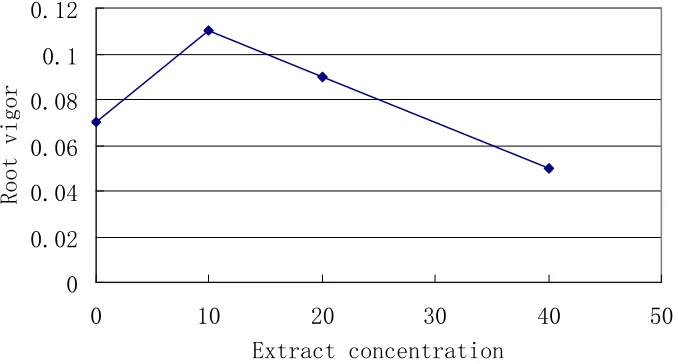
The impact of the Solution on root activity of rice seedling: 48h after the treatment with the Solution of different
mass concentrations, the variation of root activity of rice seedlings was shown in Figure1. As shown in Figure1, with the mass concentration of the Solution increased, the root activity of rice showed a changing trend of rising before declining. The root activity under the treatment of the Solution with low mass concentration was the highest, followed by that under the medium mass concentration. Compared with CK, the two all presented promotion effects, and the root activity of the two was higher than CK by 63.6% and 28.7%; when the mass concentration was 40g/mL, the promotional role of the Solution was gradually weakened, and the root activity was lower than CK. At this moment, the Solution presented the slight inhibitory role, and led to a 16.6% decrease than CK. This indicated that after the treatment, the root activity of rice presented typical dose-related response as promotion at low concentration and inhibition at high concentration.
0
0.02
0.04
0.06
0.08
0.1
0.12
0
10
20
30
40
50
Extract concentration
R
o
o
t
v
i
g
o
r
Figure 1. Changes of rice root vigour after treated with different concentration extracts from old ginseng soil
CONCLUSION
[image:4.595.139.478.385.567.2]plants and the external environment. In this study, it was found that treatments with the Solution efficiently reduced the permeability of organelle membrane of rice leaves, and protected the completeness of the cell membrane structure, so that the stability of membrane function was improved, which became conducive to the later growth and development of rice. Allelochemicals in ginseng farm soils had similar impact on the different physiological metabolism process of seedlings. This may be attributed to the complexity of allelochemical composition in the ginseng farm soils. Thus, based on all physiological indicators, the allelopathic effect of the previous crop of ginseng on the follow-up crop of rice showed greater supplementing effect than restriction.
Acknowledgment
It is a project support by the National Natiural Science Foundation of China(40871005)
REFERENCES
[1] Shoutian L; Jianmin Z; Huoyan W; Xiaoqin C. Chinese Journal of Eco-agriculture, 2002, 10 : 68-70.
[2] M Vimal; P P Vijaya; P Mumtaj and M S Seema Farhath. Journal of Chemical and Pharmaceutical Research,
2013, 5: 248-253.
[3] Fei Y; Zhenming Y; Limei H. Acta Ecologica Sinica, 2000, 20: 692-95.
[4] Czarnota M A; Rimando A M; Weston L A. Journal of chemical ecology, 2003, 29: 2073 - 2083. [5] Oleszek W; Jurzysta M. Plant and soil, 1987, 98: 67 - 80.
[6] Jennings J A; Nelson C J. Agronomy Journal, 1998, 90: 54 - 58. [7] Yu J Q; Matsui Y. J. Chem Ecol, 1994, 20: 21 - 31.
[8] Zhenping M; Jiheng Z; Jun L; Xiaohua D; Guangting Y; Lina N; Lin W; Jieyu C. Asian Journal of
Ecotoxicology, 2011, 6 : 422-28.
[9] Jinglei, L., Lanchun, N., Fengliang, L., Jingtao, P., Juan, L., Xiaoyu, Y. and Hua, T. Journal of Agricultural
University of Hebei, 2010, 33 : 43-45.
[10] Yuansen H; Cuixiang L; Guoying D; Yafeng L; Xincheng J. Ecology and Environment, 2007, 16 : 954-57. [11] Zilong Z; Wenquan W. Jounal of Agriculture Science and Technology, 2009, 11 : 19-23.
[12] Mingyuan G. Ginseng Research, 1999, 11 : 4-5.
[13] Williamson G B; Richardson D. Journal of Chemical Ecology, 1998, 14 : 181-87.
[14] Qian L; Jing C; Zaimin J; Shuoxin Z. Journal Northwest A&F University, 2011, 39 : 89-94. [15] Tiffany L; W Sang; W P; Jorge M V. Current Opinion in Plant Biology, 2004, 7 : 472-79. [16] Narwal S S. Allelopathy Journal, 2010, 25 : 51-72.