Journal of Chemical and Pharmaceutical Research, 2014, 6(12):178-185
Research Article
CODEN(USA) : JCPRC5
ISSN : 0975-7384
Optimization of additives for recycling evaluated answer scripts –Microscopic
view with Raman fingerprints
Jeyajothi Kalimuthu
‡*,
S. Rajiv
†,
A. P. Aruna
†and Kumaran Shanmugam**
‡Department of Chemical Engineering, Periyar Maniammai University, Vallam, Tamil Nadu, India †
Nanotechnology Division, Department of Electronics and Communication Engineering, Periyar Maniammai University, Vallam, Tamil Nadu, India
†Periyar Technology Business Incubator, Periyar Maniammai University, Vallam, Tamil Nadu, India
*
٭
Department of Biotechnology, Periyar Maniammai University, Vallam, Tamil Nadu, India_____________________________________________________________________________________________
ABSTRACT
Evaluated answer scripts of students should be preserved for few years as document. These answer scripts should be destroyed/recycled after the storage period. Periyar Maniammai University has a recycling unit to process the evaluated answer scripts and generate paper, cardboards and office files for its own use. We have optimized four types of recycling process by adding different additives in our recycling process. In this research work, we have produced recycled paper in first process without any additives , in second process using four additives such as Starch, PAC, alum and Rosin, in third process using Corn flour with added additives, in fourth process,using Cotton with added additives. All the four types of recycled paper surface were imaged using scanning electron microscope and Raman signature were measured using Raman Spectrophotometer.
Keywords: Evaluated Answer Scripts, Paper recycling, Alum, Starch, PAC, Rosin, Conflour and Cotton.
_____________________________________________________________________________________________
INTRODUCTION
EXPERIMENTAL SECTION
PMU is buying the answer scripts (A3 and A4 sheets) from open market. The Controller of Examination Office will be storing the front page of the evaluated answer sheets till the students complete the courses. The remaining pages are disposed to recycling unit along with unnecessary office papers and damaged files. This paper recycling unit process has been mentioned in flow chart 1.
Chopping Process
Answer Scripts are chopped to reduce the size; this chopper can handle 20 kg/batch with 20-30 minutes. This Chopper has 3 hp motor, 1430 rpm, four blades (stainless steel) with 2.8 cm, 2.5 breadths and 0.5 cm thickness. In some samples, we have added 5 kg/ batch of 100 % cotton cloth to improve the fiber content in paper, this process time has taken 1 hour/batch to chop separately [12].
Beating Process
In this operation, chopped papers are made into pulper liquid by grinding process. For this process, 2 hours/batch and 400 litres of water are required, for cotton added pulper 1 hour/batch is required . For this process, motor capacity of 4 hp, 940 rpm, 42 pin type blades (stainless steel), 36 cm with 1.5 cm breath and 0.5 mm thickness is utilized. These pins can rotate clockwise as anticlockwise directions depending upon the requirements. PMU’s answer script has metal pins and were removed manually. This process required man power, hence, now these metal pins can be removed by beating with the help of the small modification of the beater at the bottomside. Based on the requirements, we have optimized using 1500 gm of Rosin, 2500 gm of Alum, Caustic Soda 120 gm, 500 gm of Starch and 5 gm of bleaching powder per batch [12].
VAT operation
Based on the requirement, we convert pulping liquid into wet paper of different sizes and thickness of GSM from 200 to 450. Each paper can be dried within a few minutes. For this process, 150 litres of water is required for each batch. This equipment is made up of wooden frame size of 87 cm length and 60 cm breath with cotton cloth as mesh.
Hydraulic press
This process is to reduce the moisture level in wet paper, and in this process, stainless steel framed with 90 cm length and 75 cm breath (vertically aligned) is used. This operation is carried out manually and takes about 10 minutes. After discharge of water, percentage of moisture level in the paper is calculated.
Solar press
Calendaring
This process is to smoothen the surface of recycled paper and sizing the edges to get uniform structures. This calendaring machine with 2 hp motor has two rollers, 1400 rpm with 28 cm radius, 56 cm diameter and weight of 250 kg. Sheet used for calendaring is 91 length, 62 cm, 10 papers with ten rotations at a time, this process takes 10 min.
Cutting
The process is carried out with 2 hp, 1400 rpm, paper size cutting machine of 77 cm length and 54 breadth for making office and of 75 cm length and 45 cm breadth for making bags. Process recycled papers are made into different shapes using paper creaser.
Recycle Paper product
Finally, recycled papers are made into files and folders for office use, bags, bag for giving gifts and various size sheets.
Fig. 1 Flow chart of optimized paper recycling process Chopping Process
Beating Process
VAT operation
Pressing Process
Drying Process
Calendaring Process
Cutting Process
RESULTS AND DISCUSSION
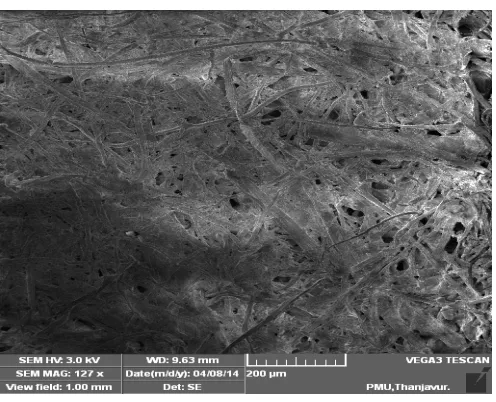
[image:4.595.170.442.167.352.2]We have imaged the surface of the answer scripts (raw paper) using Scanning Electron Microscope (SEM). Fig. 1 shows the SEM image of raw answer script, surface of the paper has uniform fibres, uniform pores and aggregates. SEM images of paper reveal the degree of fiber relationship and the amount of external fibrillation. SEM image shows the collapse of individual fibers and, sometimes, their internal fibrillation are also observed.
Fig. 1 SEM image of answer script (raw material)
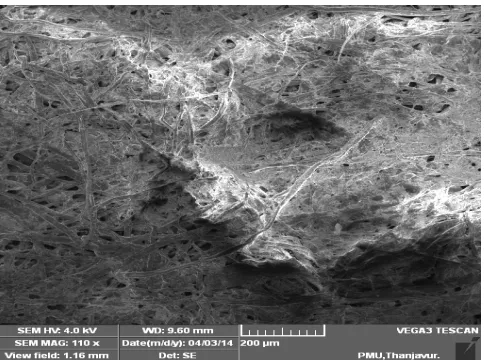
[image:4.595.186.428.434.614.2]Fig. 2 shows the SEM image of recycled paper (without any additives), surface of the paper has more pores, with various sizes of fibers are observed when compared to raw paper. Increase in thickness of fibers, increase in number of pores and rough surface is due to manual recycling process. In few places, more uneven pore structure and uneven surface and aggregates of fiber structures are also observed.
Fig. 2 SEM image of recycled paper (without any additives)
Fig. 3 SEM image of recycled paper (with additives)
Fig. 4 SEM image of recycled paper (Cornflour with additives)
[image:5.595.179.434.538.728.2]Fig. 4 shows the surface of recycled paper with Corn flour as one of the additives in recycling process and the surface has been imaged. In this image, there are many even pores and very few uneven pores on the surface. Corn flour gives binding power to the recycled paper, this result shows that a better retention and good runnability are achieved [15]. Therefore, modified starches not only improve paper qualities, but also increase productivities [15]. As an adhesive in surface sizing, corn flour is used to improve paper surface strengths and dimensional stability [15]. From this image, it is clear that this paper allows for better smoothness and gloss for high quality printing as cornflour provides typical binder for pigments of coating [14,15].
Fig. 5 shows the SEM image of the recycled paper with cotton shows that the paper has long fibers with increased strength and longevity [16]. This is due to the fact that the cotton’s cellulose chains are longer when compared with other additives [17]. Raman spectra can be obtained in solid samples by scattering of light by photons and molecular vibrations, non-destrucitve [13,18].
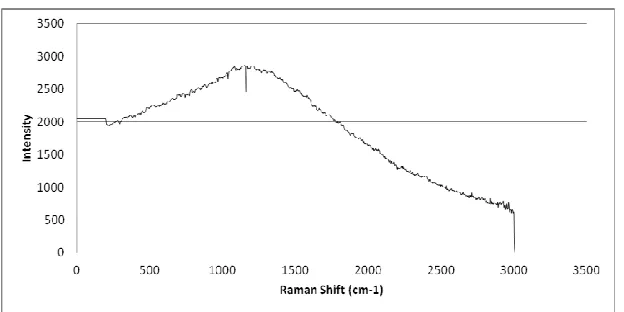
Fig. 6 shows the Raman spectrum of answer script (raw material) at 550 cm-1 Raman band confirms the presence of
[image:6.595.133.483.269.447.2]cellulose material and other types of starch [19]
[image:6.595.152.464.505.661.2]Fig. 6. Raman spectrum of answer script (raw material)
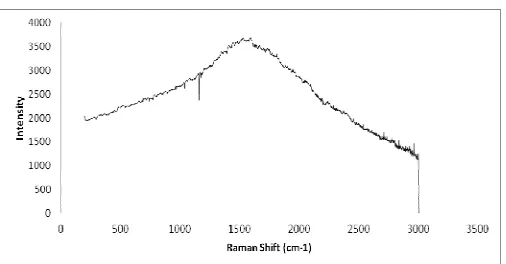
Fig. 7. Raman spectrum of recycled paper (without any additive) at Raman vibrations at 1500 cm-1 due to double bond in the aromatic ring stretching and confirms the reduction of Cellulose and other starch materials [20]
Fig. 7. Raman spectrum of recycled paper (without any additive)
Fig. 8. Raman spectrum of recycled paper (with additives)
Fig. 9. Raman spectrum of recycled paper (with additives and Conflour) at 1660 cm-1 Raman band confirms C=C
stretch duet to Cornflour, Cellulose and other food materials [21]
Fig. 9. Raman spectrum of recycled paper (with additives and conflour)
[image:7.595.192.421.480.614.2]Fig. 10. Raman spectrum of recycled paper (with additives and cotton) at 710 cm-1 Raman vibration due to the alkanes the stretching and confirm the presence of native cellulose and cotton material [22]
Fig. 10. Raman spectrum of recycled paper (with additives and cotton)
CONCLUSION
We have optimized the paper recycling process for the evaluated answer scripts with various additives. As part of green initiative in our campus, researchers can add appropriate available materials as additives in their recycle process.
Acknowledgments
REFERENCES
[1] Gran M. Cost benefit implications of paper recycling policies. Published in What is Determining International Competitiveness in the Global Pulp and Paper Industry. Proc 3rd Int Syrup, September 13-14, 1994, Seattle, Washington. University of Washington, College of Forest Resources, Centre for International Trade in Forest Products, 1994;SP-17:19.
[2]. Stig Bystr6m, Lars L6nnstedt. Conservation and Recycling, 1997, 21, 109-127. [3]. Tomas Ekvall. Journal of Cleaner Production,1999, 7, 281–294.
[4]. Virtanen Y, Nilsson S.Environmental Impacts of Waste Paper Recycling. London: Earthscan Publications
Limited. 1993.
[5]. Baumann H, Ekvall T, Eriksson E, Kullman M, Rydberg T, Ryding S-O, Svensson G, Steen B. iljo¨ma¨ssiga
skillnader mellan återvinning/återanva¨ndning och fo¨rbra¨nning/deponering. FoU No. 79, Malmo¨: REFORSK,
1993 (in Swedish).
[6]. Finnveden G, Person L, Steen B. Återvinning av mjo¨lkkartong—En LCA- studie av skillnader imiljo¨
belastning. Stockholm: Swedish Environmental Protection Agency, Report 4301.1994 (in Swedish).
[7]. Zieldefinition und Rahmenfestlegung zum Forschungsvorhaben O ¨kologisher Vergleich graphischer
Papiere. Heidelberg: IFEU, 1995 (in German).
[8]. Pajula T, Karna. A. Life-cycle scenarios of paper. Proc. First Ecopapertech. Helsinki, 1995,191–203.
[9]. Vinoth Raja V. B.Tech Pre Final Project Thesis submitted for B.Tech Chemical Engineering,Periyar
Maniammai University,2013.
[10]. S.C.G. K. Daniel, J. Abirami, K. Shanmugam, K. Nehru, M. Sivakumar. Microbicidal tissue paper using green synthesized silver nanoparticles. Current Nanosci.2014
(in press – DOI 10.2174/1573413710666140909211129)
[11]. S.C.G.Kiruba Daniel, N. B. Basheer, M. Harshiny, K. Nehru, M. Sivakumar and K. Shanmugam. J. Exp.
Nanosci., 2014, 9, 197 209,
[12]. G. Turrell, J. Corset, eds. Raman Microscopy: Developments and Applications. Elsevier Academic Press,
1996
[13]. Mona a. Nassar, Ahmed. M. Youssef. carbohydrate polymers, 2012, 89(1), 269–274.
[14]. P. Cinelli, E. Chiellini, J.W. Lawton, S.H. Imam. Polymer Degradation and Stability, 2006, 91(5), 1147–1155. [15]. David Ravnjak, Janja Zule, and Adolf Može. Acta Chim. Slov, 2003, 50, 149−158.
[16]. Mohammad H. Ekhtera, P. Rezyati Charani, O. Ramezani, and M. Azadfallah. Bioresources, 3 (2), 383-402.
[17]. Willes H Weber, Roberto Merlin. Springer Science and Business Media, 2000, 492 pages.
[18]. Pigorsch, Enrico, Matthias Finger, Steffen Thiele, and Eike Brunner. Applied spectroscopy 2013,67, 59-65. [19]. Pienpinijtham, Prompong, Xiao Xia Han, Sanong Ekgasit, and Yukihiro Ozaki. Analytical chemistry,2011, 83(10): 3655-3662.
[20]. Ghosh, Prabal K., and Digvir S. Jayas. Sensing and Instrumentation for Food Quality and Safety 2009, 3, 3-11. [21]. Himmelsbach, David S., John W. Hellgeth, and David D. McAlister. Journal of agricultural and food
chemistry, 2006,54 (20), 7405-7412.