project: an evaluation study
Slocock, B, Maguiness, H and Smith, SO
Title The West Johnstone digital inclusion project: an evaluation study
Authors Slocock, B, Maguiness, H and Smith, SO
Type Monograph
URL This version is available at: http://usir.salford.ac.uk/1078/
Published Date 2004
USIR is a digital collection of the research output of the University of Salford. Where copyright permits, full text material held in the repository is made freely available online and can be read, downloaded and copied for noncommercial private study or research purposes. Please check the manuscript for any further copyright restrictions.
Digital Inclusion Project:
An Evaluation Study
Dr Simon Smith
Hugh Maguiness
Brian Slocock
School of Social Sciences, University of Paisley
Co-funded by Renfrewshire Council's Better Neighbourhood
Services Fund and the School of Social Sciences,
University of Paisley
School of Social Sciences, University of Paisley,
High Street Paisley. PA1 2BE
Executive Summary ... 2
1. Introduction ... 3
The Community ... 3
The Digital Inclusion Project ... 3
The Policy Context ... 5
2. The Evaluation ... 8
Research and Methodology ... 8
Summary of Findings ... 8
Progress Against BNSF Local Outcome Agreement Targets ... 8
Further Exploration of the Quantitative and Qualitative Findings ... 11
Public access & take-up of learning opportunities at the CLC ... 11
Home use ... 13
Role of children and situation of lone parent households ... 14
Community organisations ... 15
Renfrewshire Council and public services ... 15
Project development ... 16
The User Groups ... 17
The technicians’ group... 17
The community digital video group ... 18
The website group ... 18
The community newsletter group ... 19
Role within the DIP and impact within the community... 19
Potential for development ... 20
3. Recommendations and Suggestions ... 22
The Community Learning Centre ... 22
Home use of computers and the internet ... 22
Website, video and newsletter user groups ... 23
The Website ... 23
DIP organisation and management... 23
Community organisations ... 24
Schools ... 24
Renfrewshire Council and public services ... 25
Executive Summary
This evaluation was carried out by a team from the School of Social Sciences, University of Paisley, who conducted a survey of 100 participating households and several forms of qualitative research between February and May 2004
The findings indicate that the project has been very successful with regard to its key objectives, especially those concerned with the use of internet facilities and the acquisition of skills by local residents: 77% of project participants make use of their computers on at least a daily basis, and 87% consider themselves to have at least basic computer skills. The results have been somewhat less successful in areas such as participation in the design of online public services, the use of computers to
communicate with public agencies, and involvement in the community website. In the first case, this is largely due to circumstances outwith the control of the project; in the second it reflects particular preferences on the part of users of public services; while the third area is one which needs addressing in the future development of the project.
The evaluation indicates that most of the targets due to be achieved by the project by April 2005 have already been met.
The evaluation team had recommendations to make in the following areas:
Community Learning Centre: Priority should be given to supporting established and emerging group activities and providing structured training
Home use of computers and the internet: Some unmet demand for informal mentoring could be met through the DIP or Renfrewshire Digital Buddies
Website, video and newsletter user groups: Further development should involve fostering “communities of interest” to enrich local content and increase the
involvement of young people
The Website: Key issues are to increase “in house” technical competence in the interests of long-term sustainability, to generate more local content from community members outwith the website group, and to further develop the site as an influential forum for discussion of community issues
DIP organisation and management: Looking beyond the current funding phase, the project may want to expand membership by offering services to other households and community organisations, and could develop an intermediate labour market function based on the skills and capacities acquired thus far
Community organisations: More could be done to involve community
organisations in the project, to promote them via the website and newsletter, and to use information technology to map and match community assets
Schools: To take advantage of the developing skills of local people, schools could be more innovatory in the use of computers in the curriculum and in their
communication strategies, while school representatives (including pupils) could usefully be invited to become active partners in the DIP
1. Introduction
The Community
West Johnstone is a community in Renfrewshire situated four miles west of Paisley. The Social Inclusion Partnership (SIP) is comprised of four housing schemes: Howwood Rd, Tannahill flats and (on the other side of the Glasgow-Ayr railway) Cartside and
Sandyflats. It is one of eleven SIP areas in Renfrewshire (Paisley Partnership). According to the 2001 census it had a population of 2,180 housed in 919 houses and flats, of which 194 were owner-occupied, 553 rented from the council, 82 rented from Linstone Housing Association (Sandyflats) and 91 privately rented. However around a hundred properties have been or are due to be demolished as part of a regeneration process, so the present (and projected) population of the area is slightly lower. There are 241 lone parent households (26.2% of the whole community, substantially above the Scottish average of 10.5%). The unemployment rate of 8.5% is not particularly high (although it was more than twice the national average) but the rate of economic activity among persons aged 16 to 74 was just 50.2%, well below the average for Scotland (65.0%); 37.8% of adults were classified as “other economically inactive”, against just 16.9% for Scotland as a whole, which is probably indicative of a large number of people with long-term health problems. (Census 2001).
The Digital Inclusion Project
The Digital Inclusion Project (DIP) arises from a successful application made by Renfrewshire Council to the Better Neighbourhood Services Fund (BNSF), a Scottish Executive fund which in 2001 selected twelve “pathfinder” councils to develop projects for innovatory local services with a strong element of community participation and consultation. Renfrewshire’s application was for a package comprising four “Learning Neighbourhoods” projects (community schools, youth strategy and sport, community learning and development and digital inclusion) targeting one or more of four SIP areas (Ferguslie Park, Shortroods, Foxbar and Johnstone West) with an overall aim of
“addressing the negative culture” of these neighbourhoods and responding to the needs of people disconnected from mainstream society. Of £3 million awarded to
Renfrewshire under this initiative about £800,000 has been allocated to the DIP over three years.
The Project commenced in April 2002, and between June and September PCs with broadband internet access were installed in 300 households in the West Johnstone SIP area. They were allocated according to a standard banding system, prioritising young people, the unemployed, lone parents, schoolchildren referred by other agencies, older people and people with disabilities or special needs.
Management of the project is based in the local Community Learning Centre (CLC) with oversight initially by the Renfrewshire Chief Executive’s department, later involving the Council’s Modernising and Improvement Group and Modernising
Government Community Planning Group). The Project began with two principal aims in mind, corresponding to two of the guiding principles of Renfrewshire’s Community Plan - Social Inclusion and Modernising Government:
to act as “a learning laboratory where residents trial existing electronic services and identify and design additional public services that they would wish to use electronically.” (BNSF application, section 2)
The Project is also informed by the principle of lifelong learning embedded in Renfrewshire’s Community Learning Strategy (BNSF application, section 6). This aspect became more prominent between the initial draft of the proposal and the project’s integration with the wider Learning Neighbourhoods proposal, and the DIP became more of a lifelong learning/community capacity initiative rather than an ICT initiative. Conversely the “action research” element of the project stressed in the initial proposal (DIP as “a critical opportunity … to learn more about public preferences for online services” - BNSF application, section 2) has had less emphasis in day-to-day
management than planned, whereas its integration with the range of services delivered through the Community Learning Centre (CLC) has taken on greater importance. Due to this, the emphasis has shifted back slightly from intervention in private and family life towards public provision and collective action in the community.
The selection of West Johnstone for this pilot project was conditioned in part by the strong record of the CLC as a well-used information technology and community centre providing learning and training opportunities to local adults and young people based on an established relationship with Reid Kerr college. Another important consideration was the residential and demographic profile of the area: a relatively small, compact area (meaning the anticipated demand for computers could be nearly, if not fully, met); a relatively stable community compared with other SIP areas; the type, standard and tenure of its housing stock; and the presence of large numbers of young families and lone parent families - two of the key target groups identified. The project was also seen as timely since a number of other new initiatives were planned for the area, such as the implementation of the New Community School Approach (although delays have meant that the new school will not now be completed until 2006). However the area was not the only candidate for this kind of support: more or less concurrently Renfrewshire Council submitted an unsuccessful bid to the SE’s Digital Communities initiative on behalf of Foxbar.
In contrast to some of the English Wired Up Communities, where relatively low take-up and usage has been blamed primarily on charging arrangements set in order to meet the requirements of a range of sponsoring partners, the funding structure of the DIP made it possible to put in place highly favourable, relatively long-term financial arrangements with, above all, three years’ free broadband internet access. Initially, promotional literature and contracts signed by residents made participation conditional on undertaking some ICT training and participating in the piloting of on-line public services, which perhaps hindered recruitment (although the ultimate level of demand was fortuitously almost exactly equal to the supply of equipment). In practice, the Council has not been as proactive in creating opportunities for consultation and
feedback from the community as had been intended and the conditionality with respect to training was never enforced. Computer usage has therefore developed in a relatively unsteered environment in which beneficiaries are able to draw on the range of services and resources available through the CLC, but are not required to do so. Local schools have also tended not to set new kinds of homework tasks involving computers and the internet, in order to avoid differentiating between students with access to computers and those without. At the end of the three-year BNSF-funded phase of the project residents will acquire ownership of equipment (except the modem, supplied by NTL) and whatever remains of the project can be expected to have a substantially different focus, largely dependent on the extent to which residents, through the Residents’ stakeholders group, take ownership of the project and how, and with what success, they decide to take it forward. As far as the funders are concerned, the project is “not intended to be sustainable in its own right” (BNSF application, section 19).
The Policy Context
Concern with social exclusion from the “information society” has been an important theme of UK and European public policy since the mid-1990s. In 1996 the House of Lords Select Committee on Science and Technology raised concerns about the issue, and in the same year the Department of Trade and Industry (DTI) launched an “IT For All” initiative designed to complement its earlier small-business oriented Information Society Initiative. (IBM/SDF 1997: 7-10). In 1998, the UK Government formulated a strategy for “neighbourhood renewal”, which included access to information technology as an issue, and an Action Team was established under DTI leadership to “develop a strategy to increase the availability and take-up of communications and information technology for people living in poor neighbourhoods.” (Social Exclusion Unit, 1998).
dynamics are those concerned with learning, social inclusion, community development and democratic participation” (Ducatel, Webster & Herrmann 2000: 17).
The Scottish Executive formulated a digital inclusion strategy in 2001, Connecting Scotland’s People (Scottish Executive 2001). In line with European thinking, this stresses community learning and involvement and cross-sectoral partnership in addition to more “basic” issues of awareness, access and IT literacy. One approach strongly encouraged in this strategy is to “develop a critical mass of ICT and web users in geographic communities and in the social networks of disadvantaged individuals” (Scottish Executive, 2001: 13, 21, 22). Two pilot digital communities - in Bellsmyre, West Dumbartonshire and Argyll and Bute - were set up to try and achieve these objectives. Also in 2001 the Executive launched its Better Neighbourhood Services Fund (BNSF) “to improve services in some of the most deprived areas of Scotland”, under which the establishment of the West Johnstone DIP was funded, conceived within this same policy approach.
Renfrewshire Council’s own information age strategy, Reaching Renfrewshire
(Renfrewshire Council, 2003), highlights two key themes relevant to the DIP. Under the theme of modernising government, the authority aims to exploit the possibilities of ICT to “create public services focused more on the needs of the citizen rather than the convenience of the providers” and to “reconnect citizens with local and national
government”. Under the theme of community leadership the authority identifies ICT as a tool which can help in meeting its responsibilities for community planning, enhancing the leadership role of councils within local communities. The context for these goals is a UK-wide target of full electronic access to public services by 2005. The Council has therefore committed itself to extending community learning centres in local (especially deprived) communities and completing the equipment of all main libraries with ICT access, while recognising that public access “does not fully compensate for regular personal access” and therefore proposing to examine measures to “equalise home access to ICT in deprived areas” (Reaching Renfrewshire section 9.7).
Aside from these two policy documents, the West Johnstone project proposal makes reference to Renfrewshire Council’s Community Plan and Community Learning Strategy, as ICT is seen as a means of promoting many of the key features of a learning neighbourhood, goals that are further elaborated in the BNSF Local Outcome
Agreement.
Meeting these cross-cutting policy goals necessitates a more comprehensive type of initiative than those which characterised the early phase of public measures to tackle the digital divide. What is required is a combination of public internet access provision backed up by qualified support, on the one hand, and a step-change in the degree of home access on the other. The latter needs to be underpinned by efforts to stimulate participation, mobilise “local champions”, and generate on-line content relevant to people’s lives. The key assumption of such a strategy is that participation in the information society is a community endeavour and positive social outcomes from
projects such as the DIP will require complementary interventions in different spheres of community life (home, school, community centre) and the cooperation of the various partner organisations involved.
In the influential PAT 15 report Closing the Digital Divide: Information and
the ideal unit for such a set of interventions was identified as the neighbourhood, and the vision proposed to guide policy action was for “neighbourhoods where ICTs help
stimulate and sustain community activity, the fostering of self and mutual help, the ownership of local issues, and the generation of common purpose” (DTI 2000: section 2.5). The small scale of the West Johnstone SIP area makes it an ideal case for the piloting of policy tools which seek to stimulate and channel the inherent socialising functions of relatively coherent, well-integrated neighbourhoods.
Situating digital inclusion policies in a broader community development context has two key implications for policy evaluation. Firstly, projects can be expected to contribute to a wide range of outcomes such as educational achievement, crime, health and
2. The Evaluation
Research and Methodology
This evaluation was carried out by a team from the School of Social Sciences, University of Paisley. Data was collected between February and May 2005, using a range of social science techniques. A sample survey was conducted of 100 households from the DIP, who were interviewed in their homes by interviewers drawn from the local community. For comparative purposes, use was made of data collected by the DIP management team at earlier points: in particular the baseline survey carried out at the start of the project and a survey carried out six months into the life of the project (referred to below as “the six-month survey”); the evaluation survey questionnaire was designed in part to replicate the key data gathered in these earlier surveys. In addition, the team’s lead researcher spent extended periods in West Johnstone, using a number of other data collection methods, including interviews with managers and technicians from the project; analysis of attendance records of classes associated with the DIP; visits to local schools within the DIP area; several periods of participant observation in the DIP user groups and other activities at the CLC related to the project; and the organisation of focus groups of DIP participants.
Summary of Findings
The quantitative findings of the evaluation research – particularly those deriving from the sample survey – are summarised in the following table, where our findings are compared with the original targets set for the project.
Progress Against BNSF Local Outcome Agreement Targets
OUTCOME INDICATOR TARGET: APRIL 05
FINDINGS OF EVALUATION SURVEY: APRIL 20041
Increased online access to a range of public information and services
% of project participants regularly accessing online public services
75% 77% use computer at least daily - 49% several times daily; 53% state that the internet has improved their awareness of local events; 35% state that the internet has improved connections with community organisations; and for 32% the internet is one of the two main sources of news about West Johnstone.
40% use internet to access at least one public service; 6% report receiving emails from public services
% of project participants regularly contributing to design and content of online public services
25% Uncertain: 12% have actually takenpart in
consultations– but only 17% were approached to take part; a further 42% would take part if asked
1 Evidence from questionnaire survey carried out in March-April 2004, unless otherwise indicated by
OUTCOME INDICATOR TARGET: APRIL 05
FINDINGS OF EVALUATION SURVEY: APRIL 2004
Increased skills and confidence in using ICT
% of project participants with “reasonable IT & computer skills”
75% 87% reportbasic or higher computer skills, with 65% possessing moderate or advanced skills (while 71% stated that they had no skills before joining the project); 28% state that they fix technical problems with the computer themselves
% of project participants undertaking follow-up computer based learning
25% 38% report attending computing courses beyond initial instruction.
180 adults and 47 children from DIP households are registered for IT classes at CLC Aug 2002-Mar 2004: 205 households involved
% of project participants skilled to provide support and training to others
5% 9% report advanced computer skills (compared with 4% describing their skills as advanced before the project ); 2% are acting as “Digital Buddies” mentors; 19% of households state that they can turn to friends or neighbours for technical support with the computer.
Improved home-school links % pupils participating in project accessing online study & homework materials
60% 77% access study materials at home, 65% at least once a week; a similar proportion use the computer in other ways for
homework. 34% of households with school age children have children attending after school clubs Increased citizenship and community involvement % project participants accessing community website
75% 31% report accessing the community website % project participants regularly contributing to content of community website
25% Uncertain: 2.9% report “adding content”
but respondents may not have realised that comments on the photo gallery or
messageboard counted as content
16 project members attended website review day 9/3/04
% housebound participants communicating regularly on-line
50% 69.5% of those suffering from long term
illness, health problems or disability use email at least 5 times per week
with just under half using it several times daily (only 6% state that the computer is used less than once a month). They use the technology in a variety of ways and for a variety of purposes including communication with public services and community
organisations, and a significant number of users feel that their internet connection is of considerable value in providing them with local information and linking them to the local community.
87% of participants consider themselves to have at least basic computer skills, with 65% describing themselves as having “moderate” or “advanced” skills (compared with a figure of 26% at the start of the project). Over 38% of respondents state that they have undertaken some form of IT training beyond the initial induction programme (with evidence from the Community Learning Centre indicating that the actual figure is much higher than this). Among school students, some 77%% are accessing study materials at home and using their computers for school assignments.
These figures exceed the Targets due to be achieved by April 2005 and confirm the success of the project in these areas.
There have been significant, but less successful, results in other areas. Only 12% of participants report having participated in consultations relating to the design of online public services: although its seems that the problem here lies not with the project but with the shortage of opportunities for such participation: only 17% had been invited to participate (thus 70% of those contacted volunteered to take part) and a further 42% indicate that they would be prepared to participate in this way if asked.
The specific use of computers to communicate with public services is also more limited than envisaged in the original project agreement, but nevertheless 40% of respondents confirm that they used their computers for this purpose. The target of 75% will be difficult to reach in the near future. In large part this seems to be because the internet is simply not the preferred mode of executing such business (most participants preferring either telephone or face-to-face communications); but again we might want to inquire to what degree this outcome results from the public authorities themselves not being fully geared to such a mode of communication (less than 6% of our respondents indicate that they have ever received email from a public service).
Further Exploration of the Quantitative and Qualitative Findings
This summary review of the key quantitative indicators paints the following initial picture of the project’s results:
A successful distribution of IT resources to households who previously had limited access to them and little prospect of acquiring them
A high rate of adoption of the technology by those to whom resources were distributed, with a diverse range of uses, in which access to public services plays a subordinate role
Limited pro-active involvement in the development of IT-based public services, but largely reflecting limited opportunities to do so
A highly significant diffusion of IT skills to participants through the Community Learning Centre
A high rate of use of the educational resources afforded by the internet
connection by school students, with a significant number of students stimulated to participate in after-school computer clubs
A low rate of overall uptake, but an active and important core of participants, in community-oriented resources such as the website
This data gives us a reasonably clear idea of what the current situation is and suggests some very significant changes since the project’s launch. But it does not give us a real sense of the impact on participants’ lives of access to this new technology or of the factors which have influenced (and will continue to influence) the particular pattern of its usage. We will here try to shed some light on these questions through a more nuanced exploration of both the quantitative and qualitative data which the evaluation process generated, with respect to five key aspects of the Digital Inclusion Project - public access and learning opportunities (via the Community Learning Centre), home use patterns, community organisations, public services and project development.
Public access & take-up of learning opportunities at the Community Learning Centre
According to the baseline survey conducted when computers were installed in summer 2002, 32.2% of residents who received computers through the DIP previously had access to a PC, 13.5% at home and 18.7% at another location. In April 2004, not only do all DIP residents have home access (as a result of the project), but the percentages of people who told us they use computers elsewhere have also increased: at a friend’s or relative’s house (34.3%), at school or college (26.5%), at the CLC (24.5%), at a library (5.9%) or at an internet café (2.0%). This suggests that providing home access to computing and the internet, together with the growing provision of training, learning and interest-based programmes at the CLC and in local schools, has increased usage in a variety of locations. People are integrating computer use into their activity patterns in different places and throughout the day, and we can reasonably infer from the qualitative evidence we have gathered (through focus groups and participant observation) that this has generated an increase in social interaction, both in the framework of institutions like the CLC and schools, and among neighbours and extended families.
suggesting that access to computers by itself is a significant contributor to confidence, boosted still further by participation in training). However it is interesting to note that similar proportions of those who attended non-IT courses at the CLC and courses of any kind elsewhere reported significant increases in confidence, suggesting that involvement in any form of learning in a structured environment with a learning group, rather than the acquisition of particular skills, is the critical factor in boosting confidence.
One of the key issues for the project as a lifelong learning initiative is how to provide appropriate support for both users and non-users of the CLC. With this in mind we asked people what type of training support they preferred, and whether they felt this was available to them at present. Only 11 people (10.8%) said the training they need is not available, which is itself very positive feedback about the effectiveness of the CLC in meeting training needs: six of these wanted one-to-one mentoring at home and five some form of on-line self-help service (no one who expressed a preference for
classroom or drop-in types of training/learning support felt this was unavailable). There are a number of paths to lifelong learning, and computer ownership is potentially enabling for those who for various reasons cannot or choose not to use community facilities like the CLC. But some who would like to follow this path feel prevented from doing so by perceived unavailability of appropriate support.
We can get a better picture about the extent of this “self-learning” in West Johnstone from answers to a question about e-learning. Among those respondents who claimed to be engaged in some form of e-learning, most tend to be frequent users of the CLC (in fact they are statistically more likely to take part in several activities there). However a significant minority of e-learners claim they do not use the CLC at all. In other words involvement in community learning activities at the CLC is the path most likely to lead people into forms of e-learning, although an “independent” path is also viable.
A similar trend is observable among children, comparing attendance at after-school clubs and use of the computer for homework (see Table 1 below). Children attending after-school computer clubs at the CLC are much more likely to be using the computer for homework: over 90% of those who attend after-school clubs use the computer for general homework tasks at least once a week; among non-attenders, only 44% use their computer this frequently and 37% never use the computer for homework at all. The differences are somewhat less stark when we look at children’s use of the computer to “access study materials”: (we believe this was understood as information-searching on the internet, whereas “homework tasks” were interpreted as things like word-processing and preparation of work for presentation). This may be because information-searching is a skill more readily acquired through independent home use, whereas the use of
[image:14.595.89.516.667.748.2]application software often require more structured support of the sort that is received in the after-school clubs.
Table 1: Children’s use of computers for homework:
By attendance at After-School Clubs
Use for general homework tasks
A certain level of saturation has been reached in terms of basic IT training, as the analysis of the CLC enrolment records demonstrates (see Appendices for further details).2 Whereas 67% of respondents to the second survey felt that the DIP would encourage them to take up further training, only 22.5% now say that they would like further IT training, the reasonable assumption being that this is because the majority of residents have already completed a basic IT course, usually through the CLC. As mentioned, most of the unmet demand is for non-centre-based learning such as home mentoring and online self-help: no one who prefers classroom-based or drop-in learning felt this was unavailable to them. If the DIP is to help meet this need, a strategy needs to be developed for guiding people towards the Digital Buddies scheme and suitable online learning services. However the overall take-up of training to date compares favourably with the evaluation of the English Wired Up Communities (Devins et al 2003: 45-7): in spite of the absence of conditionality from the DIP, around two thirds of households have seen someone undertake ICT training in the period since the project started, mostly at the CLC. Such a high proportion was only reached in three of the six Wired Up Communities, and in two of these - East Manchester and Blackburn - attendance at introductory courses was a condition of participation. In the remaining three
neighbourhoods - mostly rural areas - just 20-40% of residents had undertaken training within the first 6-9 months (by which time the majority of DIP participants who have used the CLC to improve their ICT skills had already started training). The comparison suggests that the resources of West Johnstone CLC have been structured and well-marketed in relation to the needs of most DIP participants.
Home use
Compared with the six-month survey which was conducted between February and April 2003, there seems to be some decline in the number of people using their computer on a daily basis: 93% said they used the computer daily after six months, but only 77.2% said so after about 20 months. And whereas the remaining 7% in the six-month survey said they used their computer at least once a week, today there are 11.9% who use their computer less than once a month. It seems that while the majority of users are maintaining or intensifying their usage (nearly half of respondents use the computer
several times a day), a small minority, having tried out the computer and the internet, do not see them as very relevant to their lives. In fact this is a perfectly natural process and conforms to observed patterns across a range of developed countries: the continual expansion of the “networked society” hides the fact that large numbers of people are constantly moving out of as well as into computer and internet use, often in connection with lifecycle events rather than in rejection of technology per se. For example, 8-11% of US internet users drop out each year (Katz et al 2001), a figure very close to ours for those not using DIP computers. However the findings in West Johnstone actually compare favourably with those in other Wired Up Communities in deprived English neighbourhoods: on average a quarter of respondents in the six projects evaluated by Devins et al (2003: 44-5) had not accessed the internet at all after 6-9 months, compared with a figure in West Johnstone of only 15.7% not using the internet after 20 months (broadly unchanged from the six-month survey). Technological factors were cited as partly responsible in some English cases: the lowest rates of access were in Brampton, where set-top box technology was used, and in Kensington, where recycled computers
2 A volume of Appendices containing more detailed quantitative and qualitative data gathered in the
were distributed. Cost was another factor - Kensington residents had to pay market rates for internet access. The decision to go for new PCs and free internet access in West Johnstone appears to be vindicated because it has maximised the chances of
inexperienced and unskilled users gaining enough confidence in their equipment or valuing it enough to start using the internet regularly, while the small minority of non-users is what we would expect the “drop-out” rate to be in any case.
Meanwhile those residents who have continued to use their computer regularly show signs of broadening and deepening the use-value they gain from it. The three dominant uses identified in the six-month survey - the internet, e-mail and games - remain just as popular, but a further 20% of all households now use their computer for word
processing, and 33% of households now use their computer for making voice calls (a facility not available to residents at the time of the earlier questionnaire). Additionally, there is some evidence of a growing sophistication of internet use, with a further 10-15% of households now buying goods and services online and a further 5% using online banking.
Role of children and situation of lone parent households
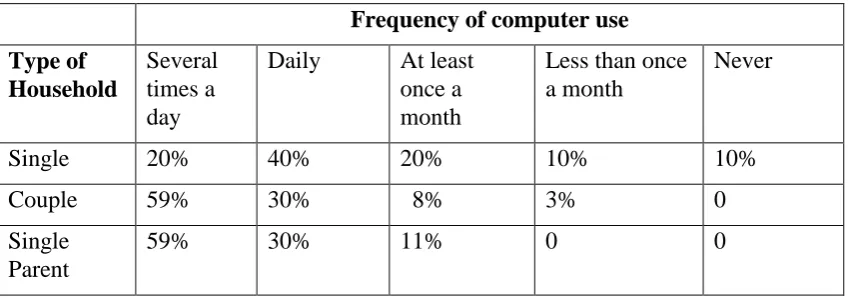
[image:16.595.81.506.568.717.2]One of the most significant findings relating to home use is the strong association between the presence of children in the household and a series of measures of computer, internet, e-mail and voice mail use. Families with children tend to use their computers more, and for a wider range of applications, than adult-only households. It is also worth noting the “scores” for lone parent households, as these were prioritised in the allocation of computers in the project, since they are particularly vulnerable as a group to social exclusion. Some 89% of lone parent households use the computer daily or several times a day, a score identical to that of couple households and above the overall average of 82%. Lone-parent households make extensive use of the full range of computer-based facilities: 83% use three or four of e-mail, internet, word-processing and entertainment applications (overall average 71%); 53% report more than five different types of internet use (from a list of 11), compared with 45% for the whole sample; 53% also report receiving e-mails from organisations or mailing lists, the only household category where this was a majority, and well above the overall average of 43.6%; finally, the data suggests that lone parent households who use e-mail send on average a larger number of e-mails per week than all e-mail using households.
Table 2:Frequency of Computer use by type of Household
Frequency of computer use Type of
Household
Several times a day
Daily At least
once a month
Less than once a month
Never
Single 20% 40% 20% 10% 10%
Couple 59% 30% 8% 3% 0
Single Parent
59% 30% 11% 0 0
children), single people and adults living with parents: 41.4% said they used the CLC then. In 2004 only 32.1% of lone parents use the CLC, compared with 40.5% of couples, 22.7% of single adults living alone, and 28.6% of adults living with parents. The slight increase in overall usage of the CLC due to the DIP has been due to recruitment from other types of household, especially single people living alone; in fact possessing a home computer may have benefited some lone parents by enabling them to reduce their dependence on community facilities, allowing them to access some services more easily from home - as indicated by their relatively intense use of their computers for
communication and informational purposes.
Families with different numbers of children do not show any major differences in the type or range of computer use reported, but they do appear to use the computer in a different way socially, as is indicated by the simple fact of the computer’s location. As a rule computers are kept in the child’s bedroom in one-child families; with two children there is an even split between families who keep the computer in a child’s or children’s bedroom and families who keep the computer in a common room (generally the living room); with three or more children the computer is almost always in the living room. Adult-only households, by contrast, tend to keep the computer in an adult’s bedroom. This use of space tells us a number of things: children are seen as the prime
beneficiaries of computer use where present; but with greater numbers of children parents feel a greater need to supervise usage, either to prevent conflicts, to ensure appropriate use, or because they may themselves join in when their children are using the computer.
The potential significance of location for family sociability is shown by responses to a question about the perceived impact of the computer on family interaction: 66.7% of those households who say they now spend more time together keep the computer in the living room, whereas 64.3% of households who state they spend less time together keep the computer in a bedroom (although more than half of households state that the
computer has had no impact in this respect).
Community organisations
Survey findings reveal a positive feedback between the DIP and feelings of community involvement as well as with more quantifiable measures of civic activity. For example, the more e-mails people estimate they send and receive per week, and the more voice calls they make, the more likely they are to say their contacts both within and outwith the local community have increased since the DIP began. Since there is in turn a
correlation between these measures and the number of community groups members of a household belong to, we would suggest that the mechanism whereby the DIP leads to increased social and/or business contacts is through existing community groups and networks as “gateways”: people with good established networks make the greatest gains - at least initially - from acquiring computer-mediated communication. Conversely, community organisations may have much to gain from the electronic networking of the community in terms of recruitment and involvement, although our survey does not indicate directly the extent to which this is occurring.
Renfrewshire Council and public services
advice (13.7% each); 8.8% of people have used the internet/e-mail to write to the council. However people remain much more inclined to contact the council by phone: for example, 44.1% of people have requested housing repairs through the customer service centre, and 32.4% have submitted general queries through the call centre. When asked which informational channels they prefer to use when contacting the council, 50.0% said by phone, 35.7% in person, and only 11.2% use the website or e-mail as their first preference.
A profile of those respondents who say they access one or more public services online reveals that they tend to be more intensive e-mail users, more likely to use the CLC and DIP services such as the fault report line and the community website, and more likely to be members of several community groups or organisations. In other words there is a correlation between willingness to try out online public services and measures of computer use, social networking and civic activity. However unless there are strong proactive measures on the part of the service providers themselves or intermediary organisations, socially excluded groups are unlikely to be reached in this way even if they have home computers, and even though they make quite considerable use of them for other purposes. On the other hand, the selective and supplementary nature of the take-up of online services so far may simply reflect the fact that most services are readily and conveniently accessible by traditional means.
Project development
One of the major issues facing the project is the response of participants once BNSF funding for the DIP ends. If free internet access were continued in the future, 94.0% of households would remain in the project. However if free access were to end there are a number of different responses that households are likely to make. A large group (40.8%) of households are undecided about what to do; of those who have decided, the majority will keep or upgrade the computer and pay for continued broadband access (23.5% of all households); another 12.2% of households expect to switch to cheaper dial-up access, 16.3% to keep the computer but discontinue internet access, and just 7.1% plan to get rid of the computer. However of those planning to disconnect, over 60% state that they would access the internet elsewhere, most likely at the CLC, at a friends’ house, at school/college or at a library; and 25.5% of households indicated their willingness to work through the residents’ group to explore future options.
These figures suggest the vast majority of households value the project highly, but that cost is a major factor in deciding whether they can afford to have a home computer and especially home internet access. The dominance of the cost factor is corroborated by the absence of a correlation between measures of internet and e-mail use and future
intentions - intensive e-mail users, for example, are no less likely to say they will disconnect or downgrade once free internet access ends. If people are using an internet connection for e-mail, then presumably they value it, so we can conclude that cost is the main (prohibitive) factor in their decision about the future. A secondary factor, however, may be that there is a high degree of satisfaction with the level of public internet access provision in the area, and a small number of people may have decided they could live without a home internet connection, even if they want to keep the computer (Paisley Partnership ranks 12th out of the 33 SIP regions in Scotland in terms of publicly
with populations of over 20,000, it stands out along with West Dumbartonshire and Dundee as the regions with the best level of public provision).
The User Groups 3
In addition to a general expansion of course- and club-based activities taking place at the Community Learning Centre (CLC) due to the impact of the DIP, four new user groups or communities of interest have been established which are particularly closely associated with the project: a technicians’ group; a community digital video group; a website group; and a community newsletter group. The technicians’ group and the community digital video group are course-based groups which meet on Sunday afternoons, with tutors provided by Reid Kerr College and, in the case of the digital video group, with the additional support of one sessional staff member. The website group and community newsletter group have a committee or board structure, which meets on an ad hoc basis, generally with the support of one or both project staff members and, in the case of the website group, with occasional participation from representatives of Communities Internet, a voluntary organisation supporting community websites across Renfrewshire and Inverclyde.
Although the user groups are not in any way limited to DIP participants, as a rule people from households which received computers have become involved. The DIP itself can be regarded as the main channel for recruiting members, augmented by informal
interpersonal networks among friends and neighbours. However in general members did not know each other well before the group started, and the opportunity to meet new people in the context of a shared interest was an important motivating factor for many. Membership of all these groups has been stable over time, with a strong commitment evident from the community members involved, and they have proved to be of particular importance in deepening the impact of the project on the local community and have played an important role in realising its objectives. For that reason, we want to review their development and current functioning in detail in this section.
The technicians’ group
The technicians’ group currently comprises about ten local residents. It began in its present form in September 2003 when the “A+” certificate course, an internationally recognised technical qualification, was offered at the CLC for people seeking to take a career in IT. Eight local residents, mostly from DIP households, initially registered for an individual study programme, supplemented by three-hour meetings with the tutor each Sunday. The organisation of these sessions varies, but usually involves a mixture of instruction and hands-on experience. In addition they provide an important forum for “swapping notes” on problems encountered as a DIP technician during the week.
This group stands on a somewhat different footing from the others, since important motivations for participation are provided by the qualification successful A+ students will receive and the offer of part-time paid work as a DIP technician (10 hours per week at £7 per hour). However the social context of the group also plays an important role, especially as not all participants have in mind a career in IT, and some choose to work as DIP technicians on a voluntary basis. Most participants have previous experience in some aspect of computers, and all feel they learn as much from each other as from the study programme itself. The website messageboard hosts a technicians’ forum, designed
3 This section is based upon interviews with members of the technicians group and participant observation
to be a space for offering mutual advice, coordinating work and bouncing ideas around. Thus far it is an under-used resource, partly because a messageboard is not the best medium to obtain instant assistance or advice, which is the kind of situation in which technicians tend to contact one another most often in the course of their work.
The community digital video group
The community video group also currently involves about ten local people. It was set up in August 2003, when the DIP arranged support for a course on digital film-making with the Creative Arts Department of Reid Kerr College. Classes take place each Sunday afternoon at the CLC, when the group learn about and get practical experience in all stages of the filmmaking process and plan their ongoing work. Some equipment has been purchased by the DIP, with further equipment loaned by Reid Kerr So far the group has completed one film, about the DIP itself, which won a Scottish Arts Council award at the Adult Learners’ Week awards in May 2004, and has received two
premieres, one at Reid Kerr in front of councillors, council officers and a local MSP, and one at the CLC for the community. The second project of the group will be a selection of youth activities in the area, and members have recently been filming youth groups and events.
The website group
The website group was started in November 2002 and has met at varying intervals, depending on the need to coordinate work on developing the community website. Much of this can be done individually and coordinated by e-mail or telephone contact. There are three core members of the group, all local residents, who each take responsibility for different aspects of the website’s development. For these leading members the group has provided an opportunity to combine studying website development (they have enrolled on courses such as Dreamweaver at the CLC) with a creative project which is also a service to the community. Thus ideas for improvements or new features can be prompted by the acquisition of new skills, the discovery of new software, suggestions from Communities Internet, or by their own and other residents’ reflection on what would boost the attractiveness and usefulness of the website to local people. With this in mind a website review day was held in March 2004 and the resulting feedback has informed changes to the design of the site (see Appendices for further details). Learning and development often occurs through problem-solving.
One set-back which has affected the website was the damage caused by a virus in March 2004 to its most popular feature, the photo gallery, which had built up an archive of old photos of Johnstone, complete with a growing volume of comments and recollections from local residents. After the site was attacked it was disabled for some time and some of the data could not be recovered. This has naturally caused some disillusionment among residents who had taken a strong sense of ownership and pride in the gallery (the more so as it attracted visits and comments from many ex-residents around the world).
The community newsletter group
Work on the newsletter started with the DIP itself in August 2002, and the group meets several times prior to each subsequent editorial deadline. The leading role in the
newsletter group is taken by one person, not a local resident but a former community worker in the area, who is paid a small fee to assume editorial responsibility for the community newsletter (there have been four issues to date). About five local residents regularly take part in meetings and contribute articles or photos.
Many of the articles to date have been solicited from local community organisations and public service providers to publicise their activities. There is a strong focus on the activities of the local primary schools, there are articles profiling “community
champions” or introducing new community workers, and in the Spring 2004 issue there were two features raising controversial topics affecting the neighbourhood (vandalism and the planned new community school). Most of the work is coordinated by the paid editor, with a varying roster of voluntary contributors depending on the main themes of each issue of the newsletter.
Role within the DIP and impact within the community
The primary benefits of all groups, with the partial exception of the DIP technicians, accrue to the participants themselves in terms of their professional, personal and social development. However each group has attained an impressive level of visibility within the neighbourhood of West Johnstone, evinces a strong identification with the DIP and the CLC, and has begun (whether consciously or intuitively) to rethink their aims in terms of contributing to community development, and more specifically, providing a service to DIP members and other local residents. The website and newsletter supply practical information such as local contacts, services or transport information, and have been contributory factors in raising awareness of and participation in learning
opportunities at the CLC (74% of survey respondents feel better informed about the CLC compared with before the DIP started). They have adopted a common graphic design format to aid “branding” identification, and publicise one another: a panel on the back of the newsletter advertises the website, and the newsletter is available from the website or by e-mail subscription (21% in our survey said they get the newsletter this way). The extent to which both have come to be valued as sources of local news is indicated by the 55% and 32% of survey respondents who said they get their local news from the newsletter and website respectively (45% cited word-of-mouth, but just 5% and 2% cited newspapers and TV/radio respectively). As yet the video group’s productions are not available for download from the website, but this is planned in future.
The newsletter, website and video groups provide an informational and, especially, a
developing into a third self-publishing arm, with the aim of chronicling life in West Johnstone and publicising opportunities for participation in activities and events in the locality.
The DIP technicians fulfil a more direct service function specifically for DIP members. According to our survey, 31% of project participants call out DIP technicians if they have a problem with their computer, although some people seem to be unaware that local residents, organised as a voluntary group, are employed as technicians, as opposed to council staff. Technicians provide a more sustainable technical support service than is feasible either through DIP staff members or through commercial companies because they are local residents, because they work either voluntarily or on a flexible part-time basis, and because they provide a valuable type of informal mentoring to residents. They spend time with some of the families they visit, bringing internet tips for children, showing them the community website and encouraging them to use it as their
homepage, and offering basic advice about maintenance and general use of computers. The informality of the relationship between technicians and residents helps to build up trust in a neighbourhood where, as one technician put it: “if we wore suits we wouldn’t get into some of these houses”. However the relationship does not work smoothly in all cases: technicians complain about the ingratitude of some residents, their unreliability about keeping appointments, and their exaggerated expectations about levels of service, producing elements of a dependency culture. At present resources are frequently
stretched and the backlog of repair work can itself provoke further residents’ complaints.
Potential for development
The three “informational” groups have already developed into effective forces for community self-representation, “narrativising” the experience of West Johnstone “from below” in a way that was scarcely conceivable prior to the DIP. Expanding this role means principally enrolling more people and better networking, especially for the website and newsletter groups: technically, both are “up to speed”, but they would become content-richer if they could foster new communities of interests around topics such as local history, art, poetry, etc. and work more closely with existing local
organisations and hobby groups, publishing their records and publicising their activities. The video group provides exciting possibilities for chronicling local life in a visually accessible format, which would be especially attractive to children. The group is already large and vibrant enough to be self-sustaining but needs to achieve a higher visibility and also develop and maintain a system for working with existing local groups and services so that the compilation of a video record of events, celebrations and concerns in West Johnstone becomes a matter of routine.
One way for all three groups to expand is to set up youth sections or committees.
adults, who treat the internet as an open public space (Lazarus & Mora 2000). Many children and young people from DIP households have practised basic website design skills at school or college, and used them to produce personal webpages, but the best way of harnessing this talent for the development of the community website has still to be found. It may well be that previous attempts have not given young people enough autonomy and control over their own “patch” of the website.
The development of the website itself is following a number of avenues. Experience to date has emphasised the popularity of competitions (especially for children) and of the photo gallery, where people can add their own comments, and the exchange of
knowledge is two-way. An art and poetry gallery is next on agenda, following positive feedback from the website review day and interest from the local art group which meets at the CLC: this would serve a similar purpose. The lack of local information on the website was a dominant criticism at the website review day, which suggests there is still untapped potential for hosting communities of interest and existing community
organisations (a local history section and an announcements board are planned and local organisations have been invited to submit their minutes for a “community documents” section). The communication facilities of the website are also under-used, a problem which has being tackled by a pioneering on-line question time with local councillors in the West Johnstone chatroom: if this becomes an established event it could boost usage of both the chatroom and messageboard (where discussion would be archived and left open for further contributions) by establishing politically or community-relevant
discussion threads, where hitherto computer-related issues and a limited amount of local “gossip” have predominated.
The technicians’ group is the most obvious expression of a fledgling intermediate labour market within the DIP. Already it is valued highly by those technicians of school age as a source of income and work experience, and opportunities could expand as the project as a whole needs to become more self-reliant when central funding ends. Although 31% of respondents said they call out DIP technicians if they have a problem with their computer, 48% said they turn to staff at the learning centre (respondents could give more than one answer). Since a sustainable project in future needs to rely more on the “endogenous” potential of trained local residents, working either as volunteers or
through an intermediate labour market model, reliance on council employees needs to be reduced. This would also help produce a change in residents’ attitudes to the project so that they regard it not as a form of collective provision (by the council) but as a resource and network owned and staffed by community members. The technicians have a role to play in educating residents that the sustainability of the project relies on their own activity, and in so doing they can help overcome the vestiges of a dependency culture which leads to an over-reliance on formal technical support and a tendency among some residents to neglect their own responsibility both to maintain the equipment in
3.
Recommendations and Suggestions
The Community Learning Centre
This is a resource highly valued by a large section of the local community, usage of which has increased as a direct result of the opportunities made available through the DIP and the added publicity the DIP has given it; conversely, centre users demonstrate the greatest increases in skills and confidence with computers. As well as a wide range of training courses and learning opportunities, it also has an important function as a meeting-place for formal and informal groups. As with all community facilities there is a potential conflict between the goal of supporting existing groups and activities and the goal of attracting the maximum number of new users. Comparative research supports our analysis that there exists a threshold in terms of “reach” and - given that a) a high proportion of DIP households have already been through basic computer training at the CLC and b) the overall level of skills reported by DIP participants is high even among “home learners” - this justifies placing more emphasis on the long-term community capacity-building benefits to be achieved by supporting established and emerging group activities and, where appropriate, providing structured training. This would be in
keeping with the shift in emphasis in digital inclusion strategies away from drop-in provision of services towards more targeted or structured forms (for example to the unemployed or to registered learners) captured by the 2004 Digital Inclusion Audit of public internet access in Scottish SIP areas. With 89% of Scottish centres providing drop-in access the greater need is arguably to increase provision of formal and informal classes, which are currently offered by only around 50-60% of centres. The Audit saw the lack of availability of activities which demand a high level of user support (such as web-design, creative media and hardware skills training) as a priority issue for digital inclusion, and these are all areas where the CLC, within the context of the DIP, has a strong record in creating and sustaining community learning. While supporting this development, our findings point to the equal importance of accommodating user-led group activities even where formal training is not involved. In spite of pressures on space, every effort should therefore be taken to make the CLC available as a base to all the communities of interest emerging from the DIP because this facilitates their constant interaction and cooperation: even computer-based activities take place in “real” spaces and require a comfortable, friendly and supportive environment.
Home use of computers and the internet
Homes have valuable properties as learning environments, providing freedom to
Website, video and newsletter user groups
Building on the successful establishment of these groups, further development could involve fostering “communities of interest” to enrich local content - for example, recruiting more people with knowledge and information resources rather than technical skills; working more intensively with existing community groups to document and chronicle West Johnstone life; and rethinking attempts to involve young people (which have not had much success to date), acknowledging their desire to control their own space (they should have as much editorial freedom as is feasible).
The Website
The interactive and communicational features of the Website (messageboard, chatroom, communities of interest) suffer from lack of “critical mass” due to the small size of the community / user base. One issue for future development is therefore whether to expand the target audience, for example by re-branding it as an all-Johnstone website, or
whether to retain the current focus in order to avoid diluting community identification with the site. What geographical area (and what non-geographical communities) should the website serve? Which decision-makers constitute the target audience for the
website? A related need is to generate more local content from users, partly in order to lower the burden on website group members. The redesign of the website currently underway takes this into account: community pages and community documents sections should generate rich local content by themselves if the relevant local community groups can be fully engaged. The first on-line question time on 18 June 2004, about estate regeneration plans and the new community school, was judged a big success by all sides involved, and further editions are planned. More discussion of community issues and problems on the website would be encouraged by the knowledge that councillors, officers, school heads and other local community leaders are among its regular readers and contributors, and more events like the on-line question time, together with
preparatory publicity/information and follow-up discussion threads on the
messageboard, would lend the website more political influence and give it an opinion-forming, agenda-setting function within the neighbourhood and beyond. Encouraging greater active usage (“writing” as well as “reading”) might also require greater
devolution of control to user groups beyond the website group itself: community groups and especially youth groups might be more inclined to contribute to the website if they had more options for uploading content themselves. This brings with it problems, but they are not insurmountable. Over time, more technical competence is being developed “in-house” and reliance on support from Communities Internet is decreasing: this trend should be supported in the interests of long-term sustainability.
DIP organisation and management
a. Size, sustainability and membership: Moving forward, the question of who belongs to the DIP, what geographical area and which communities it serves is open to modification. One option is to regard the project as simply a service to those households who acquired computers in 2002; however other types of affiliation (for other local households with computers, for community groups, for organisational partners) could also be considered, and might increase project sustainability.
potentially marketable. Their development and exploitation will be an important part of the post-BNSF development of the project, both as an incentive structure for continued and expanded participation, and as a step towards greater financial and servicing self-reliance.
c. The relationship between endogenous (self-reliant) and exogenous (externally-supported) development strategies: In the short to medium-term the growth of
endogenous development potential is a priority, since the project needs to become more self-sustaining and avoid “grant dependency”. Endogenous development is closely connected with community identity (who “owns” the project) and community capacity (who “runs” the project). In the longer-term exogenous strategies will become more relevant as and when the project decides it needs to seek new sponsors and partners (for example sourcing additional technical support from the voluntary sector).
Community organisations
a. Networking: Coordination between the project and existing community
organisations needs to be improved - a number of active community organisations still do not have a significant presence on the website, for example, and may not be fully aware of the mutual benefits of cooperation. Community groups were not eligible to receive computers initially, and may have felt the project did not concern them. In future it might be relevant to consider what advantages could be provided to community organisations through the DIP (training, free internet access, asset-mapping (see below), informational services, etc.). This could be one way to expand usage of and benefit from the project among socially excluded groups, who may find it easier to participate in various ways through existing community groups.
b. Asset-mapping: one of the unexploited potentials of the DIP, and in particular the website, is “asset-mapping” and “asset-matching” – identifying and matching
community capacities, and in the process identifying missing capacities which must be “bought in” or “sourced” externally, through the development of partnerships with other actors. This could be a useful exercise to undertake both at the level of the DIP itself and as a service by the DIP to the local community. It should be a priority task for 2004-05 before BNSF funding ends, as it must inform any future development strategy. Potential partners identified through asset-mapping should be involved in a dialogue and offered a stake in the DIP which provides benefits on both sides.
Schools
(for example on the steering committee) to encourage a two-way flow of information, clarify the objectives of all sides, and generate new ideas.
Renfrewshire Council and public services
Our survey shows that most people still prefer to use the telephone rather than the internet or e-mail to access public services. It may be that the potential for transferring council services on-line has been over-estimated, that services need to be more actively marketised and incentivised, or that more attention needs to be paid to the design of online public services: there is every indication that people find council services easily accessible via the call centre, in particular, and transferring some of this custom on-line is unlikely unless it has particular attractions or greater convenience as a mode of communication. One possible way to expand take-up among socially excluded groups might be to enable systems of intermediation and advocacy, whereby target groups access on-line services indirectly, through community organisations they are used to dealing with.
Whereas the role of the internet in service delivery may be essentially selective and supplementary, it could be better suited to play a central role in areas like community planning. Here the Council could build on the potential of the West Johnstone website, and a range of pilot actions would be feasible given a more active approach. Issues and processes such as the use of public space, the development of community services, regeneration planning, community learning and development planning, and the
implementation of the area development framework could be invigorated through user-friendly presentation and consultation through either the West Johnstone or the
Renfrewshire website and via a combination of on-line and off-line planning days, events and discussion fora.