Copyright © 2017, Scholarly Research Journal for Interdisciplinary Studies A STUDY OF SOCIO-ECONOMIC EFFECT UPON ICT LEARNING
Himanshu Tripathi
Research Scholar, College of Education, Alagappa University, Tamil Nadu
With the rapid advancement of information and communication technology, almost all of the higher education institutions have equipped themselves with new technological tools. This study is an attempt to study the socio-economic effect upon learning through BLOGS. For this study, the survey research design method was used and 150 students from four Arts and Science College in Trivandrum district of Kerala were included as participants. A blog upon Indian Economy was created covering common subject matter ‘Indian Agriculture’. An achievement test was conducted upon both the groups. The data so obtained is analysed using an independent sample t-test. Later, scores were co-related to various socio-economic dimensions of students. Findings of the study revealed a significant impact of socio-economic background in the perceived learning of students through BLOGS.
Keywords: ICT, BLOGS, Socio-Economic, Indian Agriculture
1. Introduction:
Blogs provide opportunities for people to publish their thoughts, opinions and feelings
in an online environment. There is no need for special technological skills to develop, update
and publish entries while using blogs. Blogs generally share the following features:
individual ownership, posted updates displayed in reverse chronological order and the
archival of old posts. Blogs have some features that distinguish it from a web page. It allows
for easy creation of a page, easy filtering of content for presentation by date or category, and
it allows the blog and functional features of blogs allow them to be used creator to invite and
add other authors to the blogs (Nedeva & Nedev, 2010). The technological for different
purposes (reflective thinking, collaboration, interactivity, etc.) as an educational tool. Blogs
have been widely used as one of the Web 2.0 tools in both higher education and the K-12
settings and it can be seen as one of the major tools for sharing knowledge (Hsu & Lin,
2008). It should not be considered as a tool that is used just for providing information online,
rather, it can be considered as a tool for learning in an educational context (Hall & Davison,
2007). Goktas and Demirel (2012) find that integrating blogs as a tool for learning can
positively influence the learners’ Information and Communication Technology (ICT)
perception as well as the acquisition of ICT competencies. Blogs can be used to enhance
Scholarly Research Journal's is licensed Based on a work at www.srjis.com
Copyright © 2017, Scholarly Research Journal for Interdisciplinary Studies
reflective thinking because blog posts are sequenced chronologically and allow users to see
how their thinking has changed over time (Ellison & Wu, 2008). Reflection can be defined as
an internal change brought on by thinking or writing, and by exchanging ideas and reflecting
together with others (Clarke, 2003). It helps students to express themselves and to practice
valuable knowledge and skills. There is a need to study and check the effectiveness to use
blogs while teaching. There is need to check how it can be used in a pedagogically sound way
in the actual classroom.
This study is performed upon undergraduate Economics students in Trivandrum
district to know:
2. Research Questions:
(i) How do students perceive learning with blogs in Economics learning?
(ii) What are the factors with emphasis upon Socio-Economic factors affecting student’s
learning with blogs?
Hypothesis1: There is no difference in the achievement level of boys and girls in learning
through ‘BLOGS’.
Hypothesis2: There is no difference in the achievement level of students from urban and
rural areas in learning through ‘BLOGS’.
Hypothesis3: There is no difference in the achievement level of students from state board
schooling and central board schooling in learning through ‘BLOGS’.
Hypothesis4: There is no difference in the achievement level of students with reference to
different income levels of their parents in learning through ‘BLOGS’.
Hypothesis5: There is no difference in the achievement level of students with reference to
different educational levels of their parents in learning through ‘BLOGS’.
3. Sample:
150 students (85 female and 65male) were selected randomly from four Arts and Science
College in Trivandrum district of Kerala. All students were from first year of graduation in
Economics. Out of these, two were government colleges and the other two were private
colleges.
4. Tools:
Tools used in the research to collect information about the sample were mostly based upon
the survey method like interview schedule, questionnaire, group discussion, achievement test
Copyright © 2017, Scholarly Research Journal for Interdisciplinary Studies 5. Methodology:
Initially a Likert test was administered upon the sample to know their inclination towards use
of ‘BLOGS’ to study Economics. Afterwards a common topic is chosen from the subject
Indian Economy. During interaction with students it is found that college students are mostly
inclined in studying ‘Indian Agriculture’- a topic in Indian Economy. Students are divided
into the control and experimental group. Out of the sample one government and a private
college students were taught by means of conventional resources provided by the college
(control group). Later students from one government and a private college were taught
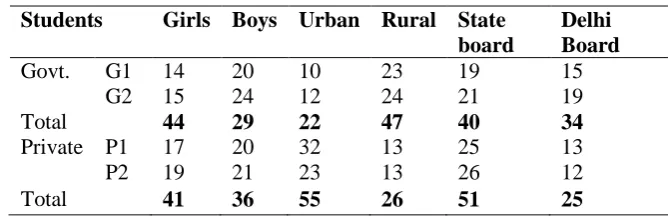
through ‘BLOGS’ (experimental group). 91 have studied in state board while 59 passed their
+2 in schools running on Delhi Board (CBSE/ICSE). An achievement test was also
conducted to know the effectiveness of the usage of ‘BLOGS’ in teaching and learning
Economics at college level. Out of 150 students 85 were girls and 65 boys. Among them 77
[image:3.595.128.464.379.487.2]were from urban area and 73 from rural area
Table 1: Details of Students
Students Girls Boys Urban Rural State
board
Delhi Board
Govt. G1 14 20 10 23 19 15
G2 15 24 12 24 21 19
Total 44 29 22 47 40 34
Private P1 17 20 32 13 25 13
P2 19 21 23 13 26 12
Total 41 36 55 26 51 25
Tools and Technique:
Likert Scale:
Most of the participants are between the age of 20 and 25. In Likert scale we found
41.6 percent students expressed their inclination towards usage of blogs in teaching and
learning process. 32.4 percent expressed that blogs cannot replace class lectures, 37.9 percent
believe that blogs can replace class lectures and 29.7 percent were neutral on this issue.
114 of the students (76 percent) stated that they had not used blogs before this course.
88 of them (58.6 percent) stated that their level of expertise with blogs was at the
intermediate level, 49 of them (32.6 percent) at the advanced level, and 8 of them (5.3
percent) at the expert level. We can say that students perceive learning with blogs in
Economics in a positive manner and are highly motivated to integrate technology in
Copyright © 2017, Scholarly Research Journal for Interdisciplinary Studies Table 2: Achievement Test Scores
*at .01 level
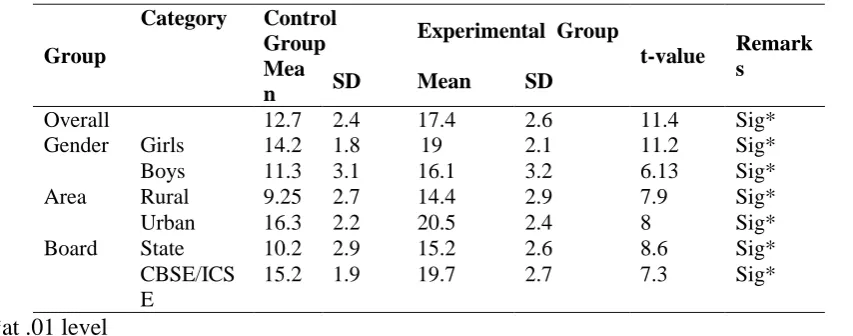
A common standardized achievement test was conducted upon controlled and
experimental group. A t-test was conducted to compare the means of the two groups. The
t-test was used to compare the effect of gender upon use of ‘BLOGS’ as well as the economic
condition of the students upon use of the ICT tool in teaching- learning process. There is
significant difference in attainment of knowledge in Indian Agriculture between the control
and experimental group post teaching through ‘BLOGS’. The mean of the experimental
group is 17.4 which is better than the controlled group (12.7).
Hypothesis 1: There is no difference in the achievement level of boys and girls in learning
through ‘BLOGS’.
There is a significant difference in achievement by the girls of the experimental group
who has an excellent mean of 19. Same is the case of the boys from experimental group who
are a head of the control group boys with mean of 16.1.
Hypothesis 2: There is no difference in the achievement level of students from urban and
rural areas in learning through ‘BLOGS’.
There is a significant difference in achievement between the group having rural and
urban background. In control and experimental group students from rural background are
unable to attain more marks in achievement test than students belonging to urban region.
Urban region students in both the groups maintain their marks with mean more than 15.
Hypothesis 3: There is no difference in the achievement level of students from state board
schooling and central board schooling in learning through ‘BLOGS’.
There is a significant difference in the achievement level of students from state board
schooling and central board schooling in learning through ‘BLOGS’. In both the groups
Group
Category Control
Group Experimental Group
t-value Remark
s Mea
n SD Mean SD
Overall 12.7 2.4 17.4 2.6 11.4 Sig*
Gender Girls 14.2 1.8 19 2.1 11.2 Sig*
Boys 11.3 3.1 16.1 3.2 6.13 Sig*
Area Rural 9.25 2.7 14.4 2.9 7.9 Sig*
Urban 16.3 2.2 20.5 2.4 8 Sig*
Board State 10.2 2.9 15.2 2.6 8.6 Sig*
CBSE/ICS E
Copyright © 2017, Scholarly Research Journal for Interdisciplinary Studies
students who did their schooling from state board are unable to perform better than those who
studied in schools based on CBSE/ICSE board.
Hypothesis 4: There is no difference in the achievement level of students with reference to
different income levels of their parents in learning through ‘BLOGS’.
Table 3: Family Income Impact
Income Category Total
students*
Interest* Mean**
< Rs.15000 Low Income 18 17 13.2
Rs.15000- 25000
Lower Middle
Income
26
Rs.25000- 35000
Middle 27 39 15.1
Rs.35000- 45000
Upper Middle
Income
14
Rs.45000-55000
High 9 44 23.9
>Rs.55000 Rich 6
*In percentage **Experimental Group
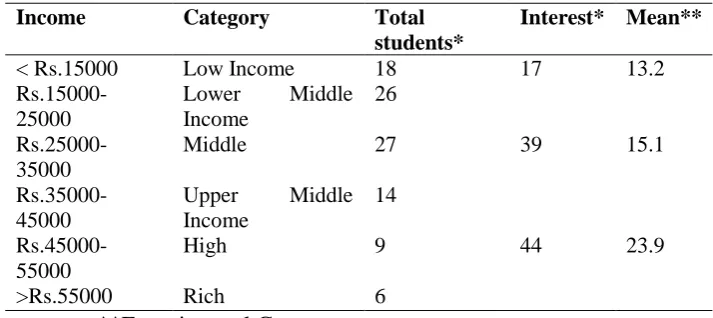
Above table shows that their family income was categorized into six categories to
know the effect of economic status on use of ICT in Higher Education. 44 percent of students
belonging to family of high income group are more interested in usage of ‘BLOGS’ while
teaching-learning process. Only 17 percent from low income are interested in using ICT in
education. It may be on their part of unaffordability of technological aids used for learning
through ‘BLOGS’.
Students whose parents are considered to be in high income group within the
experimental group perform better in the achievement test (23.9).
Hypothesis 5: There is no difference in the achievement level of students with reference to
[image:5.595.118.475.194.353.2]different educational levels of their parents in learning through ‘BLOGS’.
Table 3: Parental Education Impact
Parents Qualification Category Mean*
Primary, Secondary, HSE, ITI, Diploma Low Educated 12.2
Graduation, PG, Professional Course Highly Educated 16.8
Technical, M Phil, PhD Very High 23.2
*Experimental Group
There is a significant difference in the achievement level of students with reference to
different educational levels of their parents in learning through ‘BLOGS’. From the table we
can easily analyze that students within the experimental group, whose parents are technically
Copyright © 2017, Scholarly Research Journal for Interdisciplinary Studies 6. Conclusion:
The results of this study show that ‘BLOGS’ are seen as a good tool for teaching and learning. There is a positive relationship between use of ‘BLOGS’ and achievement in
learning. But varied socio-economic backgrounds of students leave its impact upon their
achievement. There is significant difference in the attainment of knowledge and application
of the content taught with ‘BLOGS’ between the control and experimental group. But
students with sound socio-economic background achieved more than those having weak
background. The socio-economic condition of a student affects in attaining the knowledge
through ICT (Blogs here). In reference to the socio economic status, it is learnt that students
from rural background studying in government colleges, having low income parents or
studied in schools of state board failed to perform better than the rest of the category.
Whereas, students from urban background with high income parents, studying in private
colleges or studied in CBSE/ICSE schools are performing better in subject matter taught
through ‘BLOGS’. Urban students have more interest in using ICT for study purpose. They perform better after learning through ‘BLOGS’. The economic status and parent’s qualification have a positive impact on learning through ‘BLOGS’. Parents who are very high
qualified generally motivate their wards in usage of ICT in education. Interestingly, girls are
more motivated in learning through ‘BLOGS’ than boys in the experimental group.
During group discussion it has come to the notice that Blog discussions helped
students to share their knowledge and experiences with others. Also important to note, that
majority of them acknowledge that other student’s comments on their blog posts are
important and blog discussion helped them to understand other’s point of view. Student found
support for peer feedback on their blog post. Though majority of them said that Blogs should
be user-friendly. This might be the reason that the user-friendliness of a blog had a significant
effect on the perceived learning of the learners. The study shows how Blogs have succeeded
in converting the mind of teachers to use it in their future occupational roles as ICT teachers.
It might be expected that as they compose their own blog entries about instructional design,
teachers have the opportunity to reflect on their individual experiences and understanding.
This, in turn encourages them to modify their own beliefs and behavior in relation to the
subject studied. But, teachers do not have control over the socio-economic background of
students. Still, efforts can be made by the School/College leaders in overcoming its
Copyright © 2017, Scholarly Research Journal for Interdisciplinary Studies
suggested that more factors accounting for socio-economic background can be included in
order to study their effect upon ICT learning.
7. References:
Churchill, D. (2009). Educational applications of Web 2.0: Using blogs to support teaching and learning. British Journal of Educational Technology, 40(1), 179-183.
Clarke, M. (2003, December). Reflections: Journals and reflective questions a strategy for professional learning. Paper presented at the NZARE/AARE Conference, NZealand. Ellison, N. B., & Wu, Y. (2008). Blogging in the classroom: A preliminary exploration of student
attitudes and impact on comprehension. Journal of Educational Multimedia and Hypermedia, 17(1), 99-122.
Hall, H., & Davison, B. (2007). Social software as support in hybrid learning environments: The value of the blog as a tool for reflective learning and peer support. Library & Information Science Research, 29, 165-187.