iii
THE DEVELOPMENT OF AN ASSESSMENT FRAMEWORK FOR VOCATIONAL EDUCATION TRAINING PROGRAMMES IN THE NOSS BASED TRAINING SYSTEM (NBTS) AND THE NATIONAL DUAL TRAINING
SYSTEM (NDTS)
RUMINAH BINTI MUHAMMAD ZAIN
A thesis submitted in
Fulfillment of the requirement for the award of the Doctor of Philosophy
Faculty of Technical and Vocational Education Universiti Tun Hussein Onn Malaysia
v
ABSTRAK
vi
ABSTRACT
vii
APPRECIATION
I express my sincere appreciation to my thesis supervisor, Associate Professor Wan Azlinda bin Wan Mohamed and Dr Kahirol bin Salleh for guidance and encouragement during this research.
viii
CONTENT
TOPIC i
PENGAKUAN ii
ABSTRAK v
ABSTRACT vi
APPRECIATION vii
CONTENT viii
LIST OF TABLE xiii
LIST OF FIGURE Xiv
LIST OF ABBRAVIATION xv
ANNEX
CHAPTER 1 INTRODUCTION
1.1 Introduction 1
1.1.1 An Overview of TVET System 1
1.1.2 TVET in Malaysia 4
1.1.2.1 Malaysian Qualification Framework
(MQF) 6
1.1.2.2 TVET Player 8
1.1.3 Skills Training in Malaysia 12 1.1.3.1 NOSS based Training System (NBTS) 12 1.1.3.2 National Dual Training System (NDTS) 21 1.1.3.3 Similarities and Differences of NBTS
and NDTS 28
1.1.4 The Needs for a Common Assessment
Framework for NBTS and NDTS 28
1.1.4.1 Workload 29
1.2.1.2 Public Acceptance 30
1.2 The Problem Statement 30
1.2.1 Malaysian Public Perception on TVET
Qualification 31
1.2.2 The Criticism Against the Assessment System 32
1.3 Purpose and Objective 33
1.4 The Research Question 33
1.5 The Significance of the Study 34
1.6 Research Scope 34
1.7 Research Assumption 35
1.8 Research Theoretical Framework 35
1.9 The Research Framework 36
1.10 Definition of Terms 38
1.11 Overview of Chapters 40
1.12 Summary of the Chapter 41
CHAPTER 2 LITERATURE REVIEW
ix
2.2 Assessment Model 43
2.2.1 Purpose of Assessment 44
2.2.2 Types of Assessment 45
2.2.3 Methods and Procedure of Assessment 47 2.2.4 Characteristic of Assessment Tools 49 2.2.4.1 Power of Discrimination 50 2.2.4.2 Objectivity of Scoring 50
2.2.4.3 Validity 51
2.2.4.4 Reliability 51
2.2.5 Assessment Tools 52
2.3 TVET Model 54
2.3.1 Australia 54
2.3.2 Germany 57
2.3.3 United Kingdom 61
2.3.4 Previous Study on Assessment Framework 62 2.3.4.1 An Assessment Framework for the
Community College 62
2.3.4.2 Framework for Self Assessment 64 2.3.4.3 Vocational Education Training (VET)
Policy Framework 67
2.3.4 Mapping of the Assessment Framework
Dimension 70
2.4 Dimension of Assessment Framework 72
2.4.1 Assessment framework 73
2.4.2 Assessment Policy 75
2.4.2.1 Authority 75
2.4.2.2 Qualification Structure 75
2.4.2.3 Quality Assurance 77
2.4.2.4 Standard and Curriculum 77 2.4.2.5 Training Delivery Approach 80
2.4.3 Assessment Process 81
2.5.3.1 Competency and Standards 82
2.5.3.2 Rules of Evidence 86
2.5.3.3 Designing Gathering Evident
Technique 87
2.5.3.4 Having Confidence in the Assessment
Decision 91
2.5.3.5 Documenting the Process 94 2.5.3.6 Planning and Conducting Assessment
Activities 94
2.5 Summary of the Chapter 96
CHAPTER 3 RESEARCH METHODOLOGY
3.1 Introduction 98
3.2 Research Design 98
3.2.1 Research Location 99
3.2.2 Research Population and Sampling 100
3.2.3 Data Collection Method 101
x
3.3.1 Comparison Chart Table 104
3.3.2 Questionaire 106
3.3.3 Interview Protocol 107
3.4 Data Collection 108
3.5 Data Analysis 109
3.5.1 Factor Analysis 110
3.5.1.1 Measurement 112
3.5.1.2 Correlation Matrix 112 3.5.1.3 Factor Analysis versus Principles
Components Analysis 113
3.5.1.4 Number of Factors to be Retained 114
3.5.1.5 Factor Rotation 114
3.5.1.6 Factor Loadings and Factor Scores 115 3.5.2 Parallel Analysis (PA) and Minimum Average
Partial (MAP) 116
3.5.3 Structural Equation Model (SEM) 117
3.6 Pilot Test 118
3.6.1 Validity and Reliability 119
3.7 Summary of the Chapter 120
CHAPTER 4 DATA ANALYSIS AND RESULTS
4.1 Introduction 122
4.2 Descriptive Analysis 123
4.2.1 Respondent Profile 123
4.3 Research Question 1: Similarities and the differences of
NBTS and NDTS 126
4.3.1 Findings from the Comparison Chart/Mapping
Table 126
4.3.2 Finding from Questionaire 131 4.3.2.1 Personnel Involved in the Skills
Training 131
4.3.2.2 Curriculum 133
4.3.2.3 Policy 134
4.3.2.4 Training Delivery 135
4.3.2.5 Assessment Process 135
4.3.2.6 Output 136
4.3.3 Finding of Structured Interview 137 4.3.4 Conclusion of Finding Research Question 1 140 4.4 Research Question 2: Dimension of Assessment
Framework 141
4.4.1 Validity and Reliability 141 4.4.2 Finding from Exploratory Factor Analysis (EFA) 142 4.4.3 Finding from Parallel Analysis and MAP 150 4.4.4 Conclusion of Finding Research Question 2 151 4.5 Research Question 3: Developed a Model of
Assessment Framework of Skills Training 152 4.5.1 Finding from Descriptive of EFA 152
4.5.2 Finding from the SEM 158
[image:7.612.135.539.70.718.2]xi
4.6 Summary of the Chapter 162
CHAPTER 5 SUMMARY, DISCUSSION AND CONCLUSION
5.1 Introduction 164
5.2 Summary of the study 165
5.2.1 Contribution to the body of knowledge in TVET 166 5.2.2 Is the Developed Assessment Framework
Applicable for the both NBTS and NDTS 168 5.3 Discussion of Research Findings 168 5.3.1 Demographics and Background of Respondents 168 5.3.2 Comparison of the NBTS and NDTS 170
5.3.2.1 Reconciliation, Update and Adjustment
of NDTS 172
5.3.2.1 Reconciliation for Not Similar
Dimension 177
5.3.3 Identify and Validate the Dimension of
Assessment Framework 177
5.3.4 An Assessment Framework Model 179
5.3.4.1 Related Policy 180
5.3.4.2 Assessment Process 183
5.4 The Research Limitation 186
5.5 Recommendation and Suggestions 186
5.5.1 Research Question 186
5.5.2 Further Research on the Arising Questions
During the Research 187
3.7 Conclusion 188
REFERENCES 189
ANNEX Annex A 200
xii
LIST OF TABLE
Table 1.1 Simplified The Similarities and Differences of NBTS and NDTS
28
Table 2.1 Type of Test, Function and Examples of Test Instrument
46
Table 2.2 AQF Qualification by sector of accreditation sources by Australia Guideline CBA
55
Table 2.3 Framework for Self Assessment (Ed. G Loacker, (2000)
65
Table 2.4 Mapping dimension of Assessment Framework from Australia, Germany, Europe and Malaysia.
70
Table 3.1 State by Regional / Zone 101
Table 3.2 Numbers of Items in the Questionnaire 107 Table 3.3 Summary of Data Analysis Technique by
Research Questions and Variables
109
Table 3.4 Cronchbar Alpha of Pilot Test – Part 2 119 Table 3.5 Cronchbar Alpha of Pilot Test – Part 3 119
Table 4.01 Result of Demographic 124
Table 4.02 Summary of Findings from the Comparing NBTS and NDTS from Document Analysis
126
Table 4.03 Personnel Involved in Training 132
Table 4.04 Standard and Content 133
Table 4.05 Policy 134
Table 4.06 Training Delivery 135
Table 4.07 Assessment Process 136
Table 4.08 Output 137
Table 4.09 The Finding From the Structured Interview Verified the Similar Dimension of NBTS and NDTS
138
Table 4.10 The Finding From the Structured Interview Verified the Not Similar Dimension of NBTS
xiii
and NDTS
Table 4.11 Reliability Coefficients (Cronbach’s Alpha) Before EFA Process
142
Table 4.12 Factorial Loadings for the Rotated Factors 145 Table 4.13 Name and Item for Each Factor/Dimension 146 Table 4.14 Reliability Statistic (Cronbach’s Alpha) After
EFA Process
150
Table 4.15 New Dimension and Sub Dimension of Assessment Framework
155
Table 4.16 Results of the Goodness of Fit –Indices of the Assessment Framework Models
161
Table 5.1 Summary of the Study 165
Table 5.2 Reconciliation and Selection Plan For The Different Dimension From Survey
xiv
LIST OF FIGURE
Figure 1.1 Chronology of Skills Training in Malaysia (Sources : Eleven Malaysian Plan (Malaysia, 2015)
4
Figure 1.2 Qualifications in MQF According to Education and Training Sectors (MQA, Malaysia 2006)
7
Figure 1.3 NOSS Based Training System (NBTS) Elements 13 Figure 1.4 National Dual Training System (NDTS) Elements 21 Figure 1.5 Theoritical Framework for Common Assessment
Framework for NBTS and NDTS in Malaysia
36
Figure 1.6 The Research Framework of the Study 37 Figure 2.1 The Dual Structure of Vocational Training (BiBB-
Vocational Training Regulations and the Process Behind Them)
58
Figure 2.2 The Assessment Planning and Implementation Process. (Worldwide Instructional Design System (WIDS)
64
Figure 2.3 Policy Framework (Final Report of the Joint Steering Committee of the NQC and the COAG Skills and Workforce Development Subgroup - June 2009)
68
Figure 2.4 National Skills Qualification Framework (MLVK, 2006a)
76
Figure 2.5 The Planning and Conducting of An Assessment Activity. (Sources WA Book Australia 2003)
82
Figure 2.6 Components of Standards (Sources WA Book) 84 Figure 2.7 Components of Competency Standards (Sources
WA Book)
84
xv
(Sources WA Book)
Figure 2.11 Process Used to Determine Evidence Gathering techniques (Sources WA Book)
88
Figure 2.12 Factors Maximising Confidence In Assessment Decisions (Sources WA Book)
91
Figure 2.13 Steps in Planning and Conducting an Assessment Activity (Sources WA Book)
94
Figure 3.1 Data Collection Plan 102
Figure 3.2 The Flow Diagram That Represents the Steps in Factor Analysis (Rietveld & Van Hout (1993)
111
Figure 4.1 Screen Plot of Number of Dimension Result from EFA
144
Figure 4.2 Screen Plot of Number of Dimension Result from Parallel Analysis
151
Figure 4.3 The Proposed Model of Common Assessment Framework for NBTS and NDTS
159
Figure 4.4 SEM - An Assessment Framework Model for NBTS and NDTS
160
Figure 5.1 Developed Model of Assessment Framework for Skills Training in Malaysia
xvi
LIST OF ABBREVIATION
AERA American Educational Research Association ADTEC Advance Technology Center
ANTA Australian National Training Authority APA Accreditation of Prior Achievement AOL Action Oriented Learning
AQF Australian Qualification Framework AQF Qualification and Credit Framework AQTF Australian Quality Training Framework AT Apprenticeship Training
CWP Core Work Processes CC Core Curricula COS Course of Study
CU Competency Unit
CRT Criterion-Referenced Test CBA Competency Based Assessment CTE Career and Technical Education DSP Dual Training System Project DACUM Developing A Curriculum
DEST Department of Education, Science and Training DSD Department of Skills Development
DTS Dual Training System (DTS) GLC Government Linked Organization HRD Human Resource Department ITI Industrial Training Institutes ITAB Industry Training Advisory Bodies ILB Industry Lead Body
xvii
LG Learning Guide
LWA Learned and Work Assignment MoHE Ministry of Higher Education MoA Ministry of Agriculture MoYS Ministry of Youth and Sports
MTUN Malaysian Technical University Network MCE Malaysian Certificate of Education MSC Malaysia Skills Certificate
MSD Malaysian Skills Diploma
MSAD Malaysian Skills Advanced Diploma MQF Malaysian Qualification Framework MoHR Ministry of Human Resource MoE Ministry of Education
NCME National Council on Measurement in Education NITTCB National Industrial Training Trade Certificate
Board
NSQF National Skills Qualification Framework NRT Norm-Referenced Test
NOSS National Occupational Skills Standard NIER National Industry Expert Registry NCVER National Centre for Vocational Education
Research
NMIT Northern Melbourne Institute of TAFE NVQ National Vocational Qualifications
NITTCB National Industrial Training Trade Certificate Board
NDTS National Dual Training System NVTC National Vocational Training Council OA Occupational Analysis
OCWP Occupational Core Work Process OE Occupational Education
xviii
PC Performance Certificate
PTQF Philippines Training Qualification Framework QCA Quality and Curriculum Authority
RTO Registered Training Organization RPL Recognition of Prior Learning SQ Scottish Quality
SME Small and Medium Enterprises
SDAC Skills Development Advisory Committee SDFC Skills Development Fund Corporation SCID Systematic Curriculum and Instruction
Development
SRL Self Reliance Learning
TVET Technical and Vocational Education and Training TVE Technical-Vocational Education
TE Technical Education
TAFE Technical and Further Education TAC Technical Advisory Committee
TESDA Technical Education and Skills Development Authority
UNESCO United National Educational, Science and Cultural Organization
UniKL Kuala Lumpur University
UTHM University Tun Hussein Onn of Malaysia UTEM University Technical of Malacca
UMP University Malaysia Pahang UniMAP University Malaysia Perlis
VET Vocational Education and Training (VET) VE Vocational Education
xix
LIST OF ANNEX
A Survey : Questionaire ANNEX A
CHAPTER 1
INTRODUCTION
1.1 Introduction
This chapter presents an overview of Technical and Vocational Education and Training (TVET) in Malaysia and focuses on two approaches of skills training in Malaysia namely; NOSS based Training System (NBTS) and National Dual Training system (NDTS) which are coordinated and monitored by the Department of Skills Development (DSD)). This chapter also describes the problem statement, aim and purpose of the study, research questions, significance of the study, scope, assumption, conceptual and research framework as well as the various operational definitions used in the research.
1.1.1 An Overview of TVET System
2
that includes its definition, purpose, and the mission are described in the following paraghraphs.
TVET is known to embrace the concept of technical education and vocational training. In terms of specific education, it attempts to prepare students for the world of work; Wenrich &Wenrich (1974) described the TVET system as follows:
Vocational education can be described as a specific branch of educationfocused mainly on preparing its students for the world of work thatis specialized, family business or simply to upgrade their currentskills (pg 16).
In the world of work and workers, the TVET system includes semi-skilled, skilled, high level technicians or industrial supervisors. Besides preparing its students for the world of work, TVET plays an important role in facilitating education and training for individuals to embark on continuous (lifelong) learning (Wenrich & Wenrich, 1974).
Cantor (1989) stated that the TVET system can be defined as education that facilitates learning program most relevant to work and thus focuses on equipping its students with skills that are suitable and according to the requirements of the profession. Corson (1993) further explained that TVET assists individuals to actively understand the world of work that the industry and workplace constantly require.
The United National Educational, Scientific andCultural Organisation (UNESCO) and International Labour Organisation (ILO) (2002) defined TVET as a research effort in the field of science and technology aimed at providing individualswith practical skills, attitude and understanding towards specific professions as narrated below:
3
Gray and Herr (1998) lent the words Workforce Education TVET system, and offered the following definition:
Workforce education caters for students at pre graduate level organized by various institutions, corporate bodies, or government organizations whose objective is to provide them (students) better chance at acquiring job opportunities or simply to solve their skills deficiency at workplace. (pg. 4)
The above definition literally suggests that TVET does not necessarily deal with only kinetic or psychomotor or hands-on capability, but also caters to wider competency areas that support efficiency and effectiveness at the workplace. Thus, TVET deals with all work domains that prepares individuals to contribute effectively at a workplace Finch & Crunlkilton, 1999; Wenrich & Wenrich, 1974).
According to Evans and Herr (1978), the objectives of TVET are: (1) to cater for the need of work as required by society. (2) to provide work options for its students and(3) to motivate workplace learning among the learners. Thorogood (1992) further added that the objectives of TVET are: (1) to develop the apprentices with the needed work skills that will continue to help and support their life, (2) to assist the apprentices in securing their choice profession by providing them with the skills that are required by the job, (3) to train the skilled workers needed for the development of an industry, (4) to increase the productivity of an economic sector and (5) to upgrade the life quality of the society.
Basically, TVET seeks to attain two missions, the first is to equip individuals with the skill capability to compete in the job market and to foster the economic development and international competitiveness of the nation by catering for the needs of a highly productive and skilled workforce.
4
addition, the countries can reduce its reliance on external labor population by increasing the number of skilled workers internally/locally.
1.1.2 TVET in Malaysia
[image:20.612.117.521.356.592.2]TVET development in Malaysia started 40 years ago with the establishment of two public institutions in 1964 namely the National Youth Skills Institute (IKBN) Dusun Tua and Industrial Training Institute (ILP) Kuala Lumpur. Currently, more than 500 public TVET institutions provide multiple programmes at all levels of education as shown in Figure 1.1 which shows the chronology of skills training in Malaysia.Continuous promotions of TVET have resulted in an increased intake of students from 113,000 in 2010 to 164,000 in 2013.
Figure 1.1: Chronology of Skills Training in Malaysia (Sources: Eleven Malaysian Plan (Malaysia, 2015))
5
that skills training became an increasingly recognisable and distinct component within the education and training system in Malaysia, rather than merely been regarded as part of the VET component. Based on a review of historical developments in the field of VET in Malaysia, it appears that skills training had emerged as a visible and distinct component of Malaysia’s education and training system by the late 1970s.
During the period from the Razak Report of 1956 up to the Cabinet Report of 1979, Othman, (2003) observed that the Malaysian VET system had progressively assumed a distinct structure, which was dominated by three different streams or pathways, distinguishable in terms of producing the country’s workforce, namely: higher education; technical and vocational education; and skills training. One was a pathway that led to higher education (thus, called the ‘academic’ pathway), whilst VET was segregated into two distinct streams namely the technical and vocational education stream, as well as the skills training stream which is the responsibility of the Department of Skills Development (DSD) a department under the Ministry of Human Resource. The skills training stream has two systems of accreditation which are known as NBTS and the NDTS. Both training systems will be described in details later after examining the scenario of involvement and role of the government and industries in Malaysia towards skills training.
6
During the 10 MP, mainstreaming and broadening access to quality TVET were undertaken to address industry needs for skilled workers. Measures were also undertaken to improve public perception towards TVET. Transforming TVET is one of the game changers in the Eleventh Plan to meet the demand of industry and contribute towards economic growth in view of globalisation, knowledge economy, technology advancement and global labour mobility. Focus will be given to transform the TVET delivery system and increase its attractiveness as a choice for another education pathway. A MBOT will be established to recognise the professionalism of TVET practitioners that will enable them to demand higher wages.The initiative was continued in the 11MP (Malaysia, 2015) where emphasis is given to the transforming TVET to meet industry demand.
1.1.2.1 Malaysian Qualification Framework (MQF)
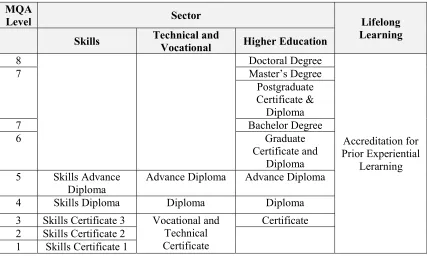
Malaysian Qualification Framework (MQF) is an instrument that classifies qualifications based on a set of criteria that is approved nationally and at par with the international practices. It clarifies the earned academic levels, learning outcomes of study areas and credit system based on student academic load. These criteria are accepted and used for all qualifications awarded by the recognised higher education providers. Hence, MQF unites and links all national qualifications. MQF also provides educational pathways in which it links qualifications systematically. MQF has three sectors. They are skills, technical & vocational, and higher education. Lifelong learning is the pathways which enable individuals to progress towards higher education through the transfer of credits and accreditation of prior learning, from the formal, informal and non formal education without taking into account the time and place (MQA Malaysia 2006). All the sectors are bounded with the eight levels as shown in the figure 1.2.
7
with competencies to carry out a task or work which usually is in a form of “manual” skills, and being conferred without considering the waysthe skills were acquired.
MQA
Level Sector Lifelong
Learning
Skills Technical and Vocational Higher Education
8 Doctoral Degree
Accreditation for Prior Experiential
Lerarning
7 Master’s Degree
Postgraduate Certificate &
Diploma
7 Bachelor Degree
6 Graduate
Certificate and Diploma 5 Skills Advance
Diploma Advance Diploma Advance Diploma
4 Skills Diploma Diploma Diploma
3 Skills Certificate 3 Vocational and Technical Certificate
Certificate 2 Skills Certificate 2
[image:23.612.114.541.147.404.2]1 Skills Certificate 1
Figure 1.2: Qualifications in MQF According to Education and Training Sectors (MQA, Malaysia 2006)
The criteria and standards for Skills Certificate are known as National Occupational Skills Standard (NOSS) and it was developed by the National Vocational Training Council (NVTC) which is also known as the Department of Skills Development (DSD) since 2006 under the Ministry of Human Resource. NOSS isa document that outlines the competencies that should be possessed by skilled workers in Malaysia for a specific field and level of occupation.The criteria and Standard for Skills Certificate are being articulated with higher level qualifications to enable holders progress from the level of semi skills, to skilled workers, right up to supervisory, executive and managerial functions.
8
ethics and attitudes in order to ensure that the students will be able (a) to use the knowledge, b) to evaluate and make decision, (c) to become confident and entrepreneurial in generating their own career (d) to become responsible as a member of society (e) to possess study skills in adapting the ideas, process and new procedures for career development (f) to acquire team skills, to communicate efficiently and to transmit information, ideas, problems and resolutions effectively to experts and non experts alike. Advanced Diploma is a specific qualification, which recognizes that an individual has knowledge, practical skills, managerial abilities and more complex responsibilities and is higher than what is expected at the diploma levels in the field of undertaken employment.
1.1.2.2 The TVET Player
TVET has always been a government driven initiative in Malaysia since inception. The Malaysian government, however, expects the momentum will eventually become industry driven. Thus, local industries especially the Small and Medium Enterprises (SMEs) are expected to take very active roles in forming their own lead bodies for every sectors which will serve to formulate and continue innovating standards that will gurantee the pushing of their products and services to reach the quality sought after by the international market. Such scenario will ideally position the government for the role of support and in providing infrastructures, systems and processes that will further facilitate and improve the commercial and business expectations and convenience for Malaysian industry owners. The following paragraphs will discuss TVET activities that were mainly initiated by government Ministries and Agencies.
9
The seven ministries includes the Ministry of Human Resource (MoHR), Ministry of Education (MoE), Ministry of Youth and Sports (MoYS), Ministry of Regional and Rural Development (MoRRD), Ministry of Agriculture and Agro-Based Industry (MoA), Ministry of Works (MoW) and Ministry of Defence (MINDEF. There are 574 public training institutions under these ministeries (DSD, 2015). These institutions continue to offer programmes that were introduced since their establishment and do not specialise based on their niche areas. In addition, there are 813 private institutions registered with the DSD (DSD, 2015) and 12 state skills development centres conducting TVET programmes with varying quality and standards. The Malaysian Technical University Network (MTUN) comprising four public universities, namely Universiti Malaysia Perlis, Universiti Malaysia Pahang, Universiti Teknikal Melaka and Universiti Tun Hussein Onn Malaysia, offers degree qualication for TVET. Universiti Kuala Lumpur (UniKL) and German-Malaysia Institute (GMi) also provide private TVET higher education.
10
the task to coordinate the TVET activities that are offered to students by various ministries and agencies in the country.
Skills training is not only designed to provide educational alternative for Malaysian students, but equally important to develop the skilled workforce that will cater for the local industry needs. It has become the government’s policy on human capital development to create Malaysian k-workers with quality TVET training that will continually alignwith the requirement of the local industry in order to produce products and services capable of competing in the global market. Thus, TVET is seen both in the light of providing job capabilities for Malaysian youths, as well as economic well being for the country and the local industry. Again the big task of elevating TVET to this position is very much on DSD’s shoulder. The main agencies that are responsible for producing semi-skilled and skilled workers includes; the Human Resource Department (HRD) under MoHR, Department of Technical Education under MOE and MoYS.
TVET’s role is also shared by the Human Resource Department (HRD) within the same Ministry of Human Resource. HRD focuses in organising and conducting skills training covering Level 1 to 5. There are 33 skills training institutes under the HRD, these includes; the Japan Malaysian Training Institute (JMTI), 8 Advance Technology Centre (ADTEC) and 24 Industrial Training Institutes (ITI).
MOE through its Department of Technical & Vocational Education caters for skill training at level 1 and 2 during form 4 and 5 in the high school. The ministry organises their skills training programs mainly at several technical and vocational schools in the country. However, since 2012 the MOE introduced Vocational Colleges by upgrading technical and vocational schools in order to upgrade training to Diploma level.
11
The MOHR provides funding for skill training activities organised by the accredited centres, through the Skills Development Fund Corporation (SDFC). Referring to the Skill Development Fund Act (Malaysia, 2004), the SDFC provide loans to the trainees who undergo skills training atthe public and private institutes.
The government continually expect bigger roles from the industry in the form of sponsorships, supplying training aids and providing workplace training exposure. The industry is also expected to actively involve in the recruitment and selection of potential trainees, conducting workplace training, and eventually providing appropriate job positions for the successful trainees. The cost of training is always expensive especially when sophisticated and current technology machinery is required. Thus, the government always welcome assistance from the industry to allow the trainees the priviledge of guided exposure in learning to use such machinery.
Nevertheless, industries always have a special role to play in the development of TVET. Industry owners are instrumental partners in the curriculum development of the skills training programs. Their continuous feedback ensures that the work standards conform with the industry needs, and that follow-up training addresses their skills requirements. After all it is the industry that will end up as the eventual employer for the individuals who graduated from the skill training programs. The DSD has also taken the initiative to form a special committee called the Skills Development Advisory Committee (SDAC) to assist in providing vital information related to required industry standards, giving indication whether or not skill training programs conducted conform with the industry needs, as well give advise on skill areas that are in demand. The committees were set up for almost every sectors of the industry. The DSD is also responsible for identifying job titles and skills requirements. Industry experts are also indispensible as external assessors during the student’s assessment process in various accredited centres.
12
Eleven Malaysian Plan (Malaysia, 2015). To achieve this target the two methods of training NBTS and NDTS need to be updated and strengthened. Let us explore in details these skill training systems in terms of methods and approaches.
1.1.3 Skills Training in Malaysia
The skills training system in Malaysia has evolved through time. Orginally the skills’ training was regulated by National Industrial Training Trade Certification Board (NITTCB), secondly, by the National Vocational Training Councils (NVTC) from1989 and now by the DSD from 2006. The main goal of skill training is basically to handle the capacity of the growing number of youths each year, particularly school leavers. Basically Vocational Education and Training (VET) in Malaysia is conducted, monitored and certified by the DSD. The mission is to develop the country’s human capital to the level of k-workers capable of bringing the Malaysian industry to compete successfully at the international market.The NBTS was introduced to respond to the rapid changes of new technology, and promote skills training to higher levels (4 and 5) and consequently upgrade skilled workers to a position of technician and higher (MLVK, 1994). Afterwards, a new approach of training which is industry driven was introduced in 2005 known as the NDTS, and its focus was to facilitate the Malaysian skills training. Therefore, currently the DSD coordinate and monitors these two skill training system concurrently.
1.1.3.1 NOSS based Training System (NBTS)
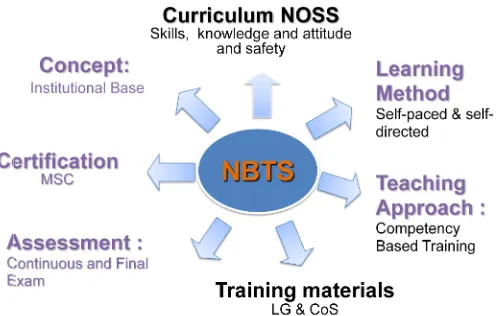
1993). Elements in NBTS learning method and teachi etc. as shown in figure 1.
Figure 1.
a. Concept
The NBTS searched for flexible lear seventeen years ago. This skill
is conducted in the training experience and have problem industry when they were employed. collaborate with industry
their levels and programmes.
b. Standard
The NITTCB’s main activity is to establish the National
determining the quality and type of skills that need to be possessed by skilled workers in NBTS are concept, curriculum, training approach which contains teaching approach, training materials, assessment and certification figure 1.3.
Figure 1.3: NOSS Based Training System (NBTS) Elements
The NBTS searched for flexible learning and certification of skill This skill training system is institute-based, where is conducted in the training centre. Graduates from this system
problems with adapting to the technological environment in the ustry when they were employed. To reduce this gap, training centre
laborate with industry to conduct on-the-job training for the student depending and programmes.
main activity is to establish the National Trade Standard (NTS) by determining the quality and type of skills that need to be possessed by skilled workers in 13
training approach which contains ng approach, training materials, assessment and certification
: NOSS Based Training System (NBTS) Elements
ning and certification of skill training about where 100% training lacks workplace the technological environment in the centres are expected to for the student depending on
14
industry in accordance to the current industrial development. A trade standard was used as the basis for curriculum development and trade certification. As technology changes work practices in industry may also change, therefore the NTS is subject to review from time to time in accordance twith the technological development that occurs in industries.
In order to fulfil and facilitate the learning process of NTS, the board develops training materials i.e. standardised printed training materials to assist training agencies in implementing their own training programmes especially in skill development. Training materials consist of training syllabus, equipment guide list and training module. Training syllabus consist of instructional topics of subject to be covered in the training in order to attain the level of skill in the trade standards. Equipment guide list contains necessary tools and equipment that have to be provided in any workshop for skill training. This document can be used as a reference by training agencies in planning their workshop facilities.
During the period 1989-1990 no new NTS was developed except for some of the NTS trade that was being reviewed. Since that time, 53 trade of NTS have been developed constituting 9 fields that are Automotive, Building, Woodwork, Electronics, Mechanical, Printing, Dressmaking, Measurement and Inspection and Plan Drawing. In line with the new system the curriculum and standard use also changed from NTS to NOSS. NOSS is develop by using Developing a Curriculum (DACUM) approach. According to MLVK, (2006a) NOSS is defined as a specification of the competencies expected of a skilled worker who is gainfully employed in Malaysia for an occupational area and level and the pathway to achieve the competencies. The characteristics of the NOSS are, it should be develop based on the industrial occupational needs; followed the career structure in the occupational fields and developed by industry expert/practitioner.
15
experimental Project Branch, Canada Department of Manpower and Immigration and General Learning Corporation (Finch 1999). DACUM may be defined as ‘a single sheet skills profile that serves as both a curriculum plan and an evaluation instrument for occupational training programmes (Adams, 1999). However, it has been expanded in scope to encompass course and program development for the first phases of five Systematic Curriculum and Instruction Development (SCID) phases. The other four phases include design, instructional development, training implementation and program evaluation.
The development of DACUM has two stages; the first stage is developing an occupational profile and the second stage is the task analysis (MLVK, 2006e). The development of the DACUM profile involves a committee of ten to twelve experts from aspecific field. The function of this committee is to participate in all development activities organised when the members are together. Time spentto complete a DACUM profile generally ranges from two to four days. A coordinator who is an outsider of the committee works with the group to facilitate the development process. The facilitator will guide the group through a series of steps:
Reviewing a written description of the specific condition; Identifying general areas of competence within the occupation;
Identifying specific skills or behaviors for each general area of competence; Structuring the skills into a meaningful learning sequence; and
Establishing levels of competence for each skill as related to realistic work situations.
16
The second stage of DACUM development is the task analysis. Task analysis is defined as the process whereby tasks performed by the workers employed in a particular job are identified and verified. The worker’s job consists of duties and tasks he/she actually performed in a large segment out of the total work done, example of duties could be organising and planning, typing, maintaining equipment and tools. On the other hand, task is work activity that forms a significant aspect of a duty. Each task has a definite beginning and ending point and usually consists of four or more distinct steps.
The development of the task analysis involves the committee reviewing the relevant literature, developing the occupational inventory, selecting worker sample, administering the inventory, and analysing the collected information. Firstly, they review the literature to examine the occupational area to determine the extent to which the analysis has already been conducted; secondly they develop a list of potential tasks and equipment associated with the occupational area.
Developing the occupational inventory from the equipment and work lists gleaned from the literature review where duplicate items will be deleted and if required, relevant items will be added. Lists are then incorporated into the inventory that will eventually be completed by incumbent workers. Selecting a worker sample is carried out by using appropriate sampling technique to ensure that the result from the worker sample can be generalised to the population.
17
c. Training Approach
NBTS adopted the CBT as a training approach in the introduction of the accreditation system (MLVK, 1993). The CBT approach emphasises what a person can actually do in the workplace as a result of being educatedand trained in the training institute (Australia, 2002). It uses the self-paced concept where students are allowed to proceed with new topics at their own speed and time, rather than progressing at the same time as other students undertaking the same study. The CBT is a student centreed approach with features such as; i) achieved competencies should be identified, announced, verified and predefined; ii) competency encompasses skills, knowledge and attitude/safety; iii) the method and criteria for assessment should be explaiedn and announced clearly at the beginning of the process; iv) the learning program will be tailored for individual development and assessment would be based on each competency and v) trainees can increase the program intensity based on their capabilities to achieve the targeted predefined levels of competencies. In order to support the student centreed approach the training materials such as Learning Guide (LG) needs to be developed and the institute needs to have a resource for references which can be utilized by the students.
d. Training Materials
18
e. Assessment
Assessment is an important element or process to know whether the student has achieved the performance standard required competency in each module of the programme. The assessment process was changed in line with the enhanced and upgraded roles and function of the DSD as a regulated skills training body in Malaysia. The assessment method began with terminal examination and later was changed to the competency based assessment due to challeges in administration and resources.
During the initial period of the DSD which was formerly known as NITTCB, the method of assessment for student’s competencies was the terminal examination. Terminal examination was the centralised examination for skills training. The examination was conducted twice a year for all occupation across all training providers who conduct the specific courses.Normally the exam was carried out at the end of the programme and certified as ‘Basic’, ‘Intermediate’ and ‘Advance’. The examination was managed and conducted by the NITTCB as the secreteriat of skills training. The panel examination was appointed consisting of a chief examiner and three to five examiners from the various public and private agencies for conducting the examination at the Skills Training Institute. The result of the training fully depended on examinations because there was no mark carried from the coursework. Trainees were considered to have failed if they did not pass in both the theory and practical parts of the examination. However, the trainees were allowed to resit only the failed paper in the next examination. Every trainee must pass the basic level before he/she was permitted to take the intermediate level.
19
done, a new system was introduced in the assessment process which is called the competency based assessment (CBA).
The CBA is a process of collecting evidence and making judgements on whether the desired competence level has been achieved (Australia, 2002). In Philiphines the competency assessment is administered by TESDA through its Accredited Assessment Centres and Assessors in order to assess individuals’ skills, knowledge, attitude and work values relative to a specific competency or standard set by industry (Philiphine, 2004). The assessment was conducted with multiple methods depending on the trade or competency the trainees acquired. The objectives of the assessment are: 1) To fulfill the skills characteristic which are set in the NOSS occupation; 2) To develop responsibility among the assessment personal quality assurance commitment; 3) To develop competitive spirit among the trainees and to strive better results; 4) To develop a competitive and skilled workforce; 5) To establish a transparent, fair, valid and comprehensive assessment system.
20
On 1st June 2006 the assessment system introduced a final examination in addition to the existing assessment (MLVK, 2006b). It was done in response to the complaint that the assessment was not sufficiently effective since trainees who were awarded the MSC level 2 and 3 could not perform their job at the workplace. The Technical Advisory Committee (TAC) which consisted of various experts from the industry required that the final test papers must reflect and fulfill industrial needs. The assessment process is conducted by the assessors, internal verifiers, external verifiers and the accredited centre assessment panel. The role of external verifiers was also increased. Instead of just acting as external verifiers for the continuous assessment, they also function as examinersfor the final examinations, and assisted by assessors and internal verifiersat the respective accredited centres.
The competency components to be assessed are different for all levels. At Level 1, 2and 3 trainees needed to pass 40% of the course workand 60% from final examination of core abilities assessment. At level 4 or Diploma level and level 5 or advanced diploma level, the components consisted of 40% course work, 40% final examination on core abilities, and 20% final project on the job assessment.
f. Certification
Considering the upgrading of assessment system, the grading was changed to excellent competent, competent and not yet competent. Trainees who were excellent competent and competent in all modules were awarded the Malaysian Skills Certificate (MSC) level, 1, 2 and 3, level 4 or known as the Malaysia Skills Diploma (MSD) or level 5 known as the Malaysian Skills Advanced Diploma (MSAD) upon completing the training. Whereas those who did not completed the modules were awarded the Performance Certificate (PC) which states the completed duties of the trainee.
evidence of workplace training, work project and test existing skilled workers gain qualific
training.
1.1.3.2National Dual Training System (NDTS)
The government of Malaysia which commenced in 2005
2010 (MLVK, 2005a). The NDTS has evolved from the
(DSP) which was formulated with the purpose of strengthening technical education and vocational training in Malaysia by incorporating the dual training system practiced in Germany (DSP, 2001).
Design of a Dual Vocation consultants from 1997-1999
[image:37.612.189.464.447.605.2]concept, curriculum, training approach which contains learning method and teaching approach, training materials,
Figure 1.4
evidence of workplace training, work project and testimonials. The initiative allowed existing skilled workers gain qualifications without going through formal education or
al Dual Training System (NDTS)
The government of Malaysia decided on 19th May 2004 to implement the 2005. The aim was to produce 31,500 skilled workers by
The NDTS has evolved from the Dual Training
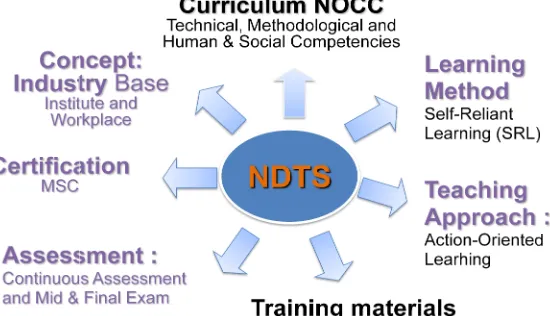
ulated with the purpose of strengthening technical education and vocational training in Malaysia by incorporating the dual training system practiced in The DSP started with a study known as ‘Basic Study on the Design of a Dual Vocational Training Scheme in Malaysia’, undertaken by German 1999 (Blumenstein, 1999). Components in the NDTS includes concept, curriculum, training approach which contains learning method and teaching approach, training materials, assessment and certification as shown in figure 1.4
Figure 1.4: National DualTraining System (NDTS) Elements
21
imonials. The initiative allowed ations without going through formal education or
May 2004 to implement the NDTS to produce 31,500 skilled workers by the year Dual Training System Project ulated with the purpose of strengthening technical education and vocational training in Malaysia by incorporating the dual training system practiced in ‘Basic Study on the ndertaken by German the NDTS includes concept, curriculum, training approach which contains learning method and teaching
figure 1.4.
22
a. Concept
NDTS is expected to address skills which are needed in the workplace, and to assist in coping with the increasing complexity and rapid technology changes in the work process. The dual-training concept means that training is conducted in two venues, at industry shop floors and at participating training institutes. The NDTS apprenticeship training system is organised using dual approaches that combine workplace education and vocational training from training institutions. Training at workplace (70%) takes place under dynamic conditions and with machines and facilities according to the standard of technology presently in use. Apprentices were released for a specific period of time to attend TEVT training centres (30%) that provides support and supplement knowledge and skills related to their chosen occupations (MLVK, 2005a).
The NDTS apprenticeship training is based on three basic competencies that are inculcated and developed during the training program, namely: 1) Technical competence (comprises of knowledge and skills in the technical field); 2) Learning and methodological competence (comprises of lifelong learning, problem solving activities when planning, executing and monitoring workplace assignments); and 3) Human and social competence (comprises of social integration when working in teams and development of personalities (MLVK, 2005a). The scheme offers two types of programmes: 1) The day-release programme and 2) The block-release programme. The day-release programme dictates that apprentices are trained at the industry for five days a week and two days at the training institute. The block-release programmeenabled the apprentices to undergo training for about five months in industries and about two months at the vocational training institutes (MLVK, 2005a). It was hoped that with 500,000 companies and industries, the government will produce more k-workers in a short term with limited budget.
23
could adapt to rapid technological and workplace changes, and to nurture creativity, innovativeness and thinking skills among trainees (Malaysia, 2006a). It is a dual system where the training is conducted in institutes and industries. The principles are spelt out in the Third Outline Perspective Plan, 2001- 2010 (Malaysia, 2001b) as: to ensure that the school curriculum remains relevant to industry and include work-based learning components, a mechanism will be set up to link schools with industries (Malaysia, 2001a).
b. Standard
The National Occupational Core Curriculum (NOCC) is the foundation for the NDTS implementation of training and assessment in industries and training institutes. The NOCC is defined as the documented training structure to be carried out by the industry and the training institution comprising of practical and theoretical knowledge of changing technologies, to produce k-worker (MLVK, 2005a). The curriculum identifies skills and training needed to produce knowledgeable workers. It is a detailed framework, which was developed based on studies and analysis of industrial needs.
NOCC is developed by work process analysis approach. Work process analysis approach was explained through objectives in a scientific orientation in vocational educational sciences and comprises of three objectives. They should help to identify the competencies for the coping and shaping of occupational work tasks; access the most important coherences for competency development; and determine the work process knowledge for the shaping of business and work processes.
24
and new coherence manner in which the crucial importance of the context (coherence) and application are already emphasised (CEDEFOP, 2004).
The implication for research methods is that skills themselves have to be surveyed and decoded. As mentioned by Rauner (2004) the vocational educational research is all about the decoding of knowledge and skills incorporated in occupational work, organized in specialized domains. Competency development and the principles of personality: It is a central assumption that competencies develop in the course of dealing with occupational work tasks and problem. Work process analysis contribute to the accessibility of coherence and conditions “which allow for a support of the transition of one development level to another” (Rauner, 1999).
Work process knowledge and situation principle: Work process knowledge creates immediate coherence between the knowledge of corporate work organisation and specialised theoretical knowledge. Transfer activities are not required. It is the acting relevant knowledge of this coherence. It is closely linked to own work experience and knowledge of corporate world, it is means to understand the entire work process which involves the respective person complete with its product related, technical, work organisational, social and system oriented dimension (Kruse, 1986).
c. Training Approach
In terms of training delivery: action-oriented teaching, self-reliant learning (SRL) as well as learn and work assignments (LWA) have been adopted as the fundamental teaching and learning approaches (MLVK, 2005a). According to Ngan, (GMI, 2005) the action-oriented teaching is a way in which human beings set goals and create a plan in their mind before bringing it into various steps of action.
189
REFERENCES
Adam, S., Blumenstein, G., Boehm, U., Ebeling, U., Gronwald, D., Schade, E. (1999). CURRENT a Guide to Curriculum Revision and Development. Bremen.
American Educational Research Association (AERA), (1999). Standard for Educational and Psychological Testing. American Educational Research Association, American Psychological Association and National Council on Measurement in Education. Washington, D.C: American Psychological Association.
ANTA (2002). Australia National Training Authority 2002. Annual National Report of the Australia Vocational Education and Training System 2011- Vol 3, ANTA Canberra.
Ary, D., Jacob, L.C., & Razavieh, A. (1990). Introduction to Research in Education. (Fourth Edition). Forth Worth: Holt, Rinehart and Winston. Inc.
AQTF, (2007). Australian Quality Training Framework - Standards for Registered Training Organisations. Australia.
Australia, D. o. T. G. o. (2002). Guidelines for Competency Based Assessment in VET in Western Australia. (CBA). Western Australia.
Australia, WA, D. o. E. a. T. (2008). Guideline for assessing competence in VET (2nd Ed). Perth.
Baker, T.L. (1994). Doing Social Research 2nd Edn., New York: McGraw-Hill Inc. Becker (2004). Handlungsorientierte Fachinterviews. In Roauner, F. (Ed.).
190
BiBB (2006). BiBB- Vocational Training Regulations and the Process behind Them. Germany: Bonn.
BiBB (2005). The Examinations Field of Action: Interim Evaluation and Future Prospects. Germany: Bonn.
Black, P. and Wiliam, D. (1998). Assessment and classroom learning. Assessment in Education, 5(1): 7-74.
Blumenstein, G., Borgel, H., Greinert, W., Grunwald, E., Jarck, K. & Kaloo, U. (1999). Basic Study on the Design of a Dual Vocational Training Scheme in Malaysia. Deutsche Gesellschaft fur Technische Zusammenarbeit (GTZ). Final report, May 1999.
Cantor, Leonard (1989). Vocational Education and Training in the Developed World. London: Routledge.
Corson, D. J. (1993). Discursive Bias and Ideology in the Administration of Minority Group Interests. Language in Society, 22(2): 165-191.
CEDEFOP (2004). The Vocational Education & Training System in Ireland – Short Description, CEDEFOP Panorama series 83, Office for the official publication of the European Comunities, Luxembourg.
Colardyn, D. & Bjorvold. J. (2005). The Learning Continuity: European Inventory on Validating Non-Formal and Informal Learning, National Policies and Practices in Validationg Non-Formal and Informal Learning. CEDEFOP Panorama series; 117 Luxembourg: Office for Official Publications of the European Communities. Community College (2004). An Assessment Framework for the Community College
Measuring Student Learning and Achievement as a Means of Demonstrating Institutional Effectiveness.
Community College (2014). An Assessment Framework for the Community College Measuring Student Learning and Achievement as a Means of Demonstrating Institutional Effectiveness.
191
Creswell, J. W. (2009). Research Design: Qualitative, Quantitative, and Mixed Methods Approaches (3rd ed.). Thousand Oaks, CA: Sage Publications. Crisp. B. R. Green Lister, P. and Dutton, K (2005) Integrated Assessment. New
assessment methods. Evaluation of an innovative method of assessment. Critical incident analysis. Dundee: Institute
Dillman, D. A., Smyth, J. D., & Christian, L. M. (2009). Internet, Mail, And Mixed-Mode Survey: The tailored design method (3rd ed.). Hoboken, NJ: John Wiley & Sons.
DSCF (2006). An Introduction to Assessment, To Support the CAF Training: A Handbook to Support Practitioners.
DSP (2001). The Dual System Project: Think dual – go dual in training. Getting Malaysia Ready for the K-economy. Kuala Lumpur: DSP, Malaysia / GTZ, Germany.
DSD (2006). National Occupational Core Curricular for Automotive Mechatronic Industry. Department of Skills Development, Putrajaya.
DSD (2006a). Learn and Work Assignment for Automotive Mechatronic Industry. Department of Skills Development, Putrajaya.
DSD (2009). Panduan Pakar Industri Negara. Department of Skills Development, Putrajaya.
DSD (2012). Kod Amalan Pentauliahan Program Kemahiran (KPPK). 2 nd Edition. Department of Skills Development, Putrajaya.
DSD (2012a). Pembangunan Curriculum Competency Unit. Department of Skills Development, Putrajaya.
DSD (2013). Department of Skills Development Annual Report 2013. Department of Skills Development, Putrajaya.
DSD (2015). Department of Skills Development Annual Report 2015. Department of Skills Development, Putrajaya.
192
Fabrigar, L. R., Wegener, D. T., Mac Callum, R. C. & Strahan, E. J. (1999). Evaluating the Use of Exploratory Factor Analysis in Psychological Research. Psychological Methods, 4, 272 - 299.
Field, A. (2000). Discovering Statistics Using SPSS for Windows. London, UK: Sage Publications.
Finch, C. & Crunkilton, J.R. (1999). Curriculum Development in Vocational and Technical Education. Boston, MA: Allyn & Bacon.
Gray, K. C. & Herr, E. L. (1998). Workforce education: The basics. Needham Heights, MA: Allyn & Bacon.
Gliem, J., & Gliem, R. R. (2003). Calculating, interpreting, and reporting Cronbach’s Alpha reliability coefficient for Likert-Type scales. Midwest Research to Practice Conference in Adult, Continuing, and Community Education, 82 - 88. Gliner, J.A., Morgan, G.A., & Leech, N.L. (2009). Research Method in Applied
Settings: An Integrated Approach to Design and Analysis (2nd ed.). New York, NY: Routledge.
GMI (2005). Courses for Instructor of Vocational Training Institutes on Implementation of NDTS. German Malaysian Institute, Kuala Lumpur, Malaysia.
Grollmann, P., Tutschner, R. & Witting, W. (2005). Trends and Development of Practice-Oriented Assessment in Germany. In P. Grollmann & M.L. Stenstrom (Eds.) Quality Assurance and Practice-Oriented Assessment in Vocational Education Educational and Training: Country Studies. Universitat Bremen. Institut Technik und Buildung. ITB-Arbeitspapiere 55, 77-103.
Habing, B. (2003). Exploratory Factor Analysis. Website:
http://www.stat.sc.edu/~habing/courses/530EFA.pdf (accessed 10 May 2004). Hair, J. F. et al. 2010. Multivariate Data Analysis 7th ed. New Jersey Pearson
Prentice Hall.
193
Teachers’ Learning Curriculum Innovations and Knowledge Application (pp 128 - 137). UPM Press ISBN 978-967-344-090-0.
Hayton, J.C., Allen, D. G. & Scarpello, V. (2004). Factor Retention Decisions in Exploratory Factor Analysis: A Tutorial on Parallel Analysis. Organizational Research.
Hoepfner, H.D., & Koch, H. (2004a). Self-Reliant Learning In Technical Education And Vocational Training (TEVT). Kuala Lumpur: Dual System Project, Malaysia/GTZ, Germany.
Hoefpner, H.-D. & Koch, H. (2003, P.17-31). Self-reliant Learning in Technical Education and Vocational Training (TVET). BOBB Berlin, Dual System Project GTZ, Kuala Lumpur, Malaysia.
Loose, G. S. & Yusoff Md. Sahir (2006). Re-Engineering Dual Training - Malaysian Experience. Bremen, Peter Lang.
International Labour Organization (ILO) (2002). Decent Work and the Informal Economy. Report VI, International Labour Conference, 90th Session, Geneva, 2002.
Jackson, D. A. (1993). Stopping Rules in Principal Component Analysis: A Comparison of Heuristical and Statistical Approaches. Ecology, 74(8), 2204 - 2214.
Jamaica, N. (2006). Assessment in Competency - Based Education. Jamaica.
Jessop, G. (1991) Outcomes: NVQs and the Emerging Model of Education and Training. London, UK: Falmer Press.
Johanson, G. & Brooks, G. P. (2009). Initial Scale Development: Sample Size for Pilot Studies. Educational and Psychological Measurement, 70(3), 1-7. doi: 10.1177/0013164409355692.
Johnson, B. & Christensn, L. (2008). Educational Research: Quantitative, Qualitative, and Mixed Approaches (3rd ed.). Thousand Oaks, CA: Sage Publications.
194
Koch, H.-D. H. a. H., Ed. (2004). Self-reliant Learning in Technical Educational and Vocational Training (TVET). Kuala Lumpur, Malaysia.
Krejcie, R. V., & Morgan, D. W. (1970). Determining Sample Size For Research. Educational and Psychological Measurement, 30, 607-610.
Kruse (1986). Von der Notwendigkeit des Arbeitsprozess-Wissens. In: Schweitzer, J. (Ed.): Bildung fur eine menschliche Zukunft. Weinheim und Munchen: Juventa. In Loose, G Spottle, G., Yusof, M. S. (2000). Re-Engineering Dual T Training – The Malaysian Experience. Franfrut 2008.
Ledesma, Ruben Daniel and Pedro Valero-Mora (2007). Determining the Number of Factors to Retain in EFA: An easy-to-use computer program for carrying out Parallel Analysis. Practical Assessment Research & Evaluation, 12(2). Available online: http://pareonline.net/getvn.asp?v=12&n=2.
Loacker, Ed., G. (2000). Self Assessment at Alverno College Faculty, Alverno College revised 2004.
Malaysia, Government (2001a). The Eight Malaysian Plan, 2001-2005. Kuala Lumpur: Malaysia National Printing Press.
Malaysia, Government (2001b). The Third Outline Perspective Plan, 2001 – 2010. Kuala Lumpur: Economic Planning Unit, Prime Minister’s Department, Malaysia.
Malaysia, Government (2001c). Report of the Cabinet Committee on Training: Training for Industrial Development – Challenges for the Nineties. Kuala Lumpur: Malaysia National Printing Press.
Malaysia, Government (2006a). The Nine Malaysian Plan, 2006-2010. Kuala Lumpur: Malaysia National Printing Press.
Malaysia, Government (2005). The Ninth Malaysian Plan, 2005-2010. Kuala Lumpur: Malaysia National Printing Press.
Malaysia, Government (2010). The Ten Malaysian Plan, 2011-2015. Kuala Lumpur: Malaysia National Printing Press.
195
Malaysia, Government (2004). Laws of Malaysia Act 640 by Skills Development Fund Publisher’s Copyright Percetakan Nasional Malaysia Berhad.
Manson, E. J. and Bramble, W. J. (1997). Research in Education and the Behavioral Sciences: Concepts and Methods. Los Angeles: A Time Mirror Company. MLVK (1992). Laporan program ’attachment’ di agensi-agensi persijilan di United
Kingdom untuk mempelajari sistem ’accreditation’. [Report on the attachment programme at certification agencies in United Kingdom for examining the accreditation system]. Kuala Lumpur: MLVK.
MLVK (1993). Panduan pelaksanaan Persijilan Kemahiran Malaysia Melalui Sistem Pentauliahan (Edisi pertama). [Guidelines for the implementation of Malaysian Skill Certification through the accreditation system. (1st ed) ]. Kuala Lumpur: MLVK.
MLVK (1994). Panduan Pelaksanaan Persijilan Kemahiran Malaysia Melalui Sistem Pentauliahan [Guidelines for the implementation of Malaysian Skills Certification through the accreditation system]. Kuala Lumpur: Majlis Latihan Vokasional Kebangsaan (MLVK) [National Vocational Training Council], Malaysia.
MLVK (2001). National Skills Certification in Malaysia, National VocationalTraining Council Kuala Lumpur: Malaysia National Printing Press.
MLVK (2005). National Workforce. Retreat Paper by General Director En Wan Seman bin Wan Ahmad. Retreat paper EPU: Isu dan Cabaran Latihan Kemahiran. MLVK. (2005a). Implementation of the National Dual Training System – Guides and
Rules. (2nd ed.). Putrajaya: MLVK.
MLVK (2006). Implementation of the National Dual Training System – Assessment Guides. Putrajaya: MLVK.
MLVK (2006a). Nota Kursus: Kursus Induksi Persijilan Kemahiran Malaysia PP-PPD.
196
MLVK (2006c). Course of Study in Motor Mechanic Vehicle. Majlis Latihan Vokasional Kebangsaan, Kuala Lumpur: Malaysia National Printing Press. MLVK (2006d). Recognition of Prior Learning Guidelines. Majlis Latihan
Vokasional Kebangsaan, Kuala Lumpur: Malaysia National Printing Press. MLVK (2006e). Report from the DACUM Session during the NOSS Development.
NVTC Putrajaya.
MLVK (2006g). Learning Guide in Motor Mechanic Vehicle. Majlis Latihan Vokasional Kebangsaan, Kuala Lumpur: Malaysia National Printing Press. Mohd. Majid Konting (2000). Kaedah penyelidikan pendidikan. Edisi Ke-5. Kuala
Lumpur: Dewan Bahasa & Pustaka. Kementerian Pendidikan Malaysia.
Mueller, J. (2008). The Authentic Assessment Toolbox: Enhancing Student Learning Through Online. North Central College Naperville, IL 60540.
NASDA (2006). National Skills Development Act (Act 652). Percetakan Nasional Berhad. Malaysia.
NQC (2009). VET PRODUCTS FOR THE 21ST CENTURY, Final Report of the Joint Steering Committee of the NQC and the COAG Skills and Workforce Development Subgroup - June 2009. NQC and COAG, Australia.
NVTC (2006). Core Abilities in Skills Training, Department of Skills Development, Putrajaya.
NVTC (2007). National Dual Training System – Handbook on social skills and Social Values in Technical Education and Vicational Training Second Edition. Ampang Press Sdn. Bhd.
O’Connor, B.P. (2000). SPSS and SAS programs for determining the number of components using parallel analysis and Velicer’s MAP test. Behavior Research Methods, Instruments, & Computers, 32, 396-402.
Othman, A. (2003). The Role of the NVTC in the Management of Vocational Training in Malaysia, Batu Pahat. Penerbit KUiTTHO.
197
Pang C.L. (2005). A Historical Account of Skills Training in Malaysia. Putrajaya : Department of Skills Development.
Philippine (2004). National Qualification Framework-Philippine. Philiphine. Punch, K.F. (2000). Introduction to social research: quantitative and qualitative
Approaches. London: Sage publications.
Rami, J. (2005). Introduction. In P. Grollmann & M.-L. Stenstrom (Eds.) Quality Assurance and Practice-Oriented Assessment in Vocational Education Educational and Training: Country studies. Universitat Bremen. Institut Technik und Buildung. ITB-Arbeitspapiere 55, 104-129.
Rauner, F. (1999). School-to-work transition; The Example of Germany. In Stern, D & Wagner, D. (Eds) Conventional Perspective on the School-to-work Transition. New Jersey: Hampton Press.
Rauner, F. (2004). Qualifikationsforschung und Curriculum – Ein Aufzukklarender Zusammenhang. In: Rauner, F. Qualifikationsforschung und Curriculum. Bielefeld. W. Bertelsmann, pp 9.42. In: Loose, G., Spottle, G, Yusoff, M. S. (2000). Re-Engineering Dual Training – The Malaysian Experience. Frankfrut 2008.
Rietveld, T. & Van Hout, R. (1993). Statistical Techniques for the Study of Language and Language Behaviour . Berlin – New York: Mouton de Gruyter.
Schmidt, H. & Alex, L. (1997). The Dual System of Vocational and Training critical thinking in Germany, In doing Business with Germany: Roderick Millar and Jonathan Reuvied (eds.) London 1997.
Straka, G.A. (2004). Measurement and Evaluation of competencies. In PDescy & M. Stevens, J (1992), Applied Multivariate Statistics For The Social Sciences 2nd Edition.
New Jersey: Lawrence Erlbaum Associates, Publishers.
Sulaiman N. R. (1996). Analisis data dalam Penyelidikan Kuala Lumpur: DBP.
Thorogood, J. (1992) Pathfinder 13: Continuous Assessment and Recording, London,
Cilt.