Managing Human Resources
Training and Development,
Performance Management,
Rewards and Compensation, Health
& safety and Grievance
By
Rajitha Silva
MBA (AUS), PG Dip.(UK), BBA (COL)The Scope of Training
• Training
– Effort initiated by an organization to foster
learning among its members.
– Tends to be narrowly focused and oriented toward
short-term performance concerns.
• Development
– Effort that is oriented more toward broadening an
Phase 1: Conducting the Needs
Assessment
• Organization Analysis
– An examination of the environment, strategies, and
resources of the organization to determine where training emphasis should be placed.
• Task Analysis
– The process of determining what the content of a
training program should be on the basis of a study of the tasks and duties involved in the job.
• Person Analysis
– A determination of the specific individuals who need
Phase 2: Designing the Training
Program
• Instructional Objectives
– Represent the desired outcomes of a training
program
• Performance-centered objectives
– Provide a basis for choosing methods
and materials and for selecting the means for assessing
whether the instruction will be successful.
Phase 3: Implementing the Training
Program
Importance of training outcomes Type of trainees
Choosing the instructional method
Nature of training
Training Methods for
Non-managerial Employees
• On-the-Job Training (OJT) • Apprenticeship Training • Cooperative Training,
Internships, and Governmental Training
• Classroom Instruction • Programmed Instruction • Audiovisual Methods
• Computer-based Training and
E-Learning
Training Methods for Management
Development
• On-the-Job Experiences
• Seminars and Conferences • Case Studies
• Management Games • Role Playing
On-the-Job Experiences
• Coaching • Understudy Assignment • Job Rotation • Lateral Transfer • Special Projects • Action Learning • Staff Meetings • Planned Career ProgressionsBehavior Modeling
• Behavior Modeling
– An approach that demonstrates desired behavior
and gives trainees the chance to practice and role-play those behaviors and receive feedback.
– Involves four basic components:
• Learning points
• Model
• Practice and role play
Phase 4: Evaluating the Training
Program
Criterion 4: Results assessment Criterion 2: Extent of learning
Measuring program effectiveness
Criterion 1: Trainee reactions
Deming’s Benchmarking Model
1. Plan: conduct a self-audit to identify areas for benchmarking.
2. Do: collect data about activities.
3. Check: Analyze data.
4. Act: Establish goals, implement changes,
Performance Appraisal Programs
• Performance Appraisal
– A process, typically performed annually by a
supervisor for a subordinate, designed to help employees understand their roles, objectives, expectations, and performance success.
• Performance management
– The process of creating a work environment in
which people can perform to the best of their abilities.
Performance Appraisal
Appraisal Programs
Administrative Developmental
Compensation Ind. Evaluation Job Evaluation
EEO/AA Support
Training Career Planning
Reasons Appraisal Programs
Sometimes Fail
• Lack of top-management
information and support
• Unclear performance standards
• Rater bias
• Too many forms to complete
• Use of the appraisal program for
Strategic
Relevance Individual standards directly relate to strategic goals. Criterion
Deficiency Standards capture all of an individual’s contributions.
Criterion
Contamination Performance capability is not reduced by external factors. Reliability
(Consistency) Standards are quantifiable, measurable, and stable.
Performance Standards
Characteristics
360-Degree Performance Appraisal
System Integrity Safeguards
• Assure anonymity.
• Make respondents accountable. • Prevent “gaming” of the system. • Use statistical procedures.
Training Performance Appraisers
Recency errors
Leniency or strictness errors
Common rater-related errors
Error of central tendency
Similar-to-me errors
Rater Errors
• Error of Central Tendency
– A rating error in which all employees are rated about
average.
• Leniency or Strictness Error
– A rating error in which the appraiser tends to give all
employees either unusually high or unusually low ratings.
• Recency Error
– A rating error in which appraisal is based largely on an
employee’s most recent behavior rather than on behavior throughout the appraisal period.
Rater Errors
• Contrast Error
– A rating error in which an employee’s evaluation is
biased either upward or downward because of comparison with another employee just
previously evaluated.
• Similar-to-Me Error
– An error in which an appraiser inflates the
evaluation of an employee because of a mutual personal connection.
Performance Appraisal Methods
Trait Methods Graphic Rating Scale Mixed Standard Scale Forced-Choice EssayTrait Methods
• Graphic Rating-Scale Method
– A trait approach to performance appraisal
whereby each employee is rated according to a scale of individual characteristics.
• Mixed-Standard Scale Method
– An approach to performance appraisal similar to
other scale methods but based on comparison with (better than, equal to, or worse than) a standard.
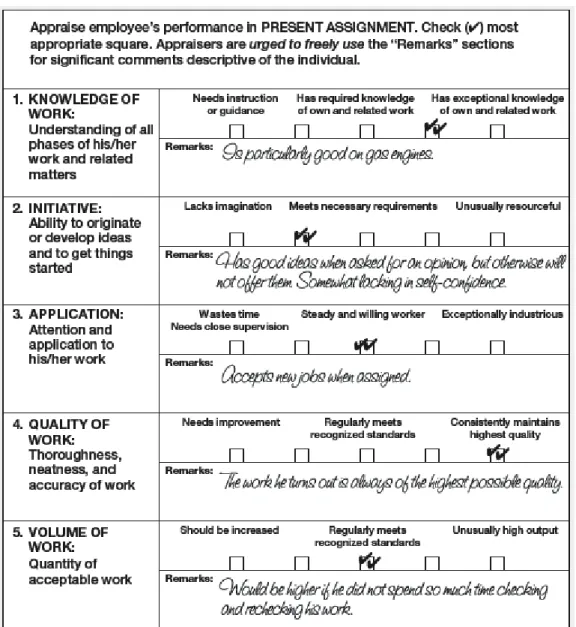
Highlights in HRM 2
Graphic Rating Scale with
Provision for Comments
Trait Methods
• Forced-Choice Method
– Requires the rater to choose from statements
designed to distinguish between successful and unsuccessful performance.
– 1. ______ a) Works hard _____ b) Works quickly
– 2. ______ a) Shows initiative _____ b) Is responsive to customers
– 3. ______ a) Produces poor quality _____ b) Lacks good work habits
• Essay Method
– Requires the rater to compose a statement
Behavioral Methods
Behavioral Methods
Critical Incident
Behavioral Checklist
Behaviorally Anchored Rating Scale (BARS)
Behavior Observation Scale (BOS)
Behavioral Methods
• Critical Incident Method
– Critical incident
• An unusual event that denotes superior or inferior employee
performance in some part of the job
– The manager keeps a log or diary for each employee
throughout the appraisal period and notes specific critical incidents related to how well they perform.
• Behavioral Checklist Method
– The rater checks statements on a list that the rater
believes are characteristic of the employee’s performance or behavior.
© 2007
Thomson/South-Western. All rights reserved. 8–30
Behavioral Methods
• Behaviorally Anchored Rating Scale (BARS)
– Consists of a series of vertical scales, one for each
dimension of job performance; typically developed by a committee that includes both subordinates and
managers.
• Behavior Observation Scale (BOS)
– A performance appraisal that measures the frequency
of observed behavior (critical incidents).
– Preferred over BARS for maintaining objectivity,
distinguishing good performers from poor performers, providing feedback, and identifying training needs.
Results Methods
• Productivity Measures
– Appraisals based on quantitative measures (e.g., sales
volume) that directly link what employees accomplish to results beneficial to the organization.
• Criterion contamination • Focus on short-term results
• Management by Objectives (MBO)
– A philosophy of management that rates performance
on the basis of employee achievement of goals set by mutual agreement of employee and manager.
The Balanced Scorecard
• The appraisal focuses on four related categories
– Financial, customer, processes, and learning
• Ensuring the method’s success
Translate strategy into a scorecard of clear objectives. Attach measures to each objective.
Cascade scorecards to the front line.
Provide performance feedback based on measures. Empower employees to make performance
improvements. Reassess strategy.
Definition-Compensation/ Reward
“Salary or wage is a form of compensation paid to an employee for the contribution
made by him through the process of offering his service to the organization’.
Compensation
This refers to all form of financial returns, tangible services & benefits employee receives as a part of an employment relationship. It covers
• Internal equity – Within the organization • External equity – Within the industry
• Individual equity – Unique individual
commitments
Definition – Reward/Incentive
“An incentive scheme is a plan or program to motivate individual or group performance. An incentive program is also frequently built on monitory rewards (Incentive pay or monitory bonus), but may also include a variety of non monitory rewards or prizes”.
Reward Management Alignment
Organizational Values & anticipated business outcome
Market Situation Rewarding Policy Organizational
“7 Criteria” for effectiveness in
Compensation
• Adequate
• Equitable – For efforts • Balance – Reasonable • Cost effective • Incentive providing • Acceptable to employees • Secure or stable 37
Basic objectives of Sound Reward System
• Attract competent employees • Retain employees • Motivate employees • Inspiring employees • Job satisfaction • Rewarding employees • Industrial relation 38
Job Evaluation - Definition
“Job evaluation is a process of systematic determination of the relative worth of a
specific job within a plant or the organization”.
Model of Total Reward
(Towers Perrin Model)
PAY * Base pay * Contingent Pay * Cash Bonus * long-term incentives * Shares * Profit Sharing BENEFITS * Pensions * Holidays * Healthcare * Other perks * Flexibility LEARNING & DEVELOPMENT
* Work Place Learning and Development
* Training
* Performance Management * Career Development
WORK ENVIRONMENT
* Core Values of the Organization * Leadership
* Employee voice * Recognition * Achievement
* Job Design and Role Development * Quality of working life
* Work-Life Balance
Employee Benefits
Statutory Benefits
◦ Unemployment ( ETF)
◦ Workers' compensation ( Compensation Formula)
◦ Social Security ( EPF)
◦ Disability (occupational) (Workmen Compensation Act)
Company Benefits
◦ Medical
◦ Savings
◦ Allowances
Pay for Time Not Worked -- These programs are designed to protect the employee's income flow when not actively engaged at work. Away from work (vacation, company holidays, personal days).
Types of Incentive Plan
• Measured day work • Piece work
• Standard hour plan • Gain sharing plan
• Group incentive plan
• Employee stock ownership • Profit sharing plan
Wages boards Ordinance
Shop and Office Employees’ Act
Maternity Benefits ordinance
Employees’ Provident Fund Act
Workman’s Compensation Ordinance Termination of Employment ( Special
provisions)
Regulations of Compensation
Health and Safety
• Health
A state where physical and mental
problems, which impair general & special activities of a n employee.
• Safety
Protection of employees’ physical health from the danger of accident.
Occupational Hazards
“Hazard is the potential for harm”.
• Health Hazard
• Physical (Noise , Vibration , heat , Radiation ,poor
lighting , Poor Ventilation )
• Chemical ( Dust ,Fumes , Gases , Poison , Toxic )
• Biological (Bacteria, Fungus , insects )
• Psychological (Boredom, Monotony , Frustration
Occupational Hazards
• Safety Hazard – Electricity – Fire – Chemical – Uncovered machinery • Occupational diseases – Skin diseases – Lung diseases – Respiratory diseases – Poisoning – Eye fatigue – AsthmaUses of Health and Safety
• To protect employee.
• To improve the Productivity.
• To Comply with the Country law. • To improve Goodwill.
• To Satisfy the Customer / buyers
Requirements.
Health and Safety Policy
This contains own statement of general policy on health and safety at work and the
organization and arrangements in place for putting that policy into practice.
Industrial Accidents
• An unplanned, unexpected event that
interferes with or interrupts normal activity & potentially leads to personal injury or
equipment damage.
• Near Misses
An undesired event which under slightly
different circumstances could have resulted in harm to people, environment, damage to
Unsafe Acts
• Operating without authority
• Working on moving machinery
• Working on machinery without guards
• Working without personnel protective
equipments
• Wearing dangling cloths
• Horse play
• Unsafe lifting carrying, moving and placing
Unsafe Condition
• Unguarded machinery • Defective machinery
• Inadequately guarded machinery • Bad house keeping
• Inadequate illumination • Inadequate ventilation • Heat
Relevant Legislations
• Factories Ordinance -
• Workman Compensation Ordinance -
• Shop & office employee act -
• Wagers Board ordinance -
• Maternity benefit ordinance -
• Employment of woman & young person and
children -
• National Institute of Occupational Safety &
53
Grievance
“Sense of injustice”
“If there is any discontentment or sense of injustice, expressed or implied felt by the
employee in connection with his employment in the organization”.
54 Identification of Grievances - Employee behavior - Job outcome - Industrial Accident - Wastage - Employee satisfaction
Reasons for grievances
• Perception • Communication • Unintentional mistakes • Purposive discrimination • Legitimate rational action
55
Handling Grievances
• Open door policy • Ombudsman
• Inspector general method • Grievance committee
56
Disciplinary Procedure
• Pre-show cause stage (Primary inquiry)- There
should be a complain in written & need to prepare statements of witnesses
(To check nature of prima-facie)
• Issue of show cause letter & suspension • Acceptance of letter of explanation
• Disciplinary inquiry • Action
57