http://dx.doi.org/10.4236/ajps.2014.51023
Development and Characterization of SSR Markers in
Proso Millet Based on Switchgrass Genomics
Santosh G. Rajput, Tammy Plyler-Harveson, Dipak K. Santra
*Panhandle Research and Extension Center, University of Nebraska-Lincoln, Scottsbluff, USA. Email: *[email protected]
Received November 24th, 2013; revised December 25th, 2013; accepted January 11th, 2014
Copyright © 2014 Santosh G. Rajput et al. This is an open access article distributed under the Creative Commons Attribution Li-cense, which permits unrestricted use, distribution, and reproduction in any medium, provided the original work is properly cited. In accordance of the Creative Commons Attribution License all Copyrights © 2014 are reserved for SCIRP and the owner of the intel-lectual property Santosh G. Rajput et al. All Copyright © 2014 are guarded by law and by SCIRP as a guardian.
ABSTRACT
Proso millet (Panicum miliaceum) has high water use efficiency (WUE), a short growing-season, and is highly adapted to a semi-arid climate. Genomic resources for proso millet are very limited. Large numbers of DNA markers and other genomic tools in proso millet can readily be developed by using genomic resources in related grasses. The objectives of the present report were to 1) test and characterize switchgrass SSR markers for use in proso millet, and 2) elucidate repeat-motifs in proso millet based on new SSR marker analysis. A total of 548 SSR markers were tested on 8 proso millet genotypes. Out of these, 339 amplified SSR markers in proso millet. This showed that 62% of the switchgrass SSR markers were transferable to proso millet. Of these 339 markers, 254 were highly polymorphic among the 8 proso genotypes. The resolving power of these 254 polymorphic SSR markers ranged from 0.25 - 14.75 with an average of 2.71. The 254 polymorphic SSR markers amplified 984 al-leles in the ranges of 50 bp to 1300 bp. The majority of the SSR markers (221 of 254) amplified dinucleotide re-peats. Based on SSR marker analysis, AG/GA was the most abundant repeat-motifs in proso millet. Switchgrass genomic information seems to be the most useful for developing DNA markers in proso millet. Markers devel-oped in this study will be helpful for linkage map construction, mapping agronomic traits and future molecular breeding efforts in proso millet.
KEYWORDS
Millet; Minor Crops; Comparative Genomics; Molecular Breeding
1. Introduction
Proso millet (Panicum miliaceum L.) is reported to have been domesticated about 10,000 years ago in central and Eastern Asia and made its way from China to the Black Sea region of Europe by 5000 BC [1]. German-Russian immigrants introduced proso millet to North America in 1875 [2]. Proso millet is known as common millet, millet, and hog millet in the United States of America (USA); broomcorn millet in China; common millet in Japan, Korea, and other Pacific Asian countries; “hersey” millet in Germany; and French white in France [3]. It is cur-rently grown in Asia, Australia, North America, Europe, and Africa [3-5].
Proso millet is the most suitable rotational crop in ma-
jority of dryland wheat producing areas in semi-arid High Plains of the USA [6]. It is grown mostly in Colo-rado, Nebraska, and South Dakota and to a lesser extent in North Dakota, Montana, Wyoming, Kansas, Oklahoma, Texas, Minnesota, Wisconsin, Iowa, Michigan, North Ca- rolina, Georgia, and Florida [7]. Proso millet is highly diversified, has excellent nutritional properties and could become an important crop for food diversification [8]. It is used primarily for human consumption in Asia. In the USA, it is grown primarily for birdseed and livestock [8,9].
A very limited number of DNA markers are reported in proso millet. A few RAPD and AFLP markers were reported in proso millet for genetic diversity analysis [10-12]. Among all PCR-based markers, microsatellites or simple sequence repeat (SSR) markers are the most
informative and useful because they are co-dominant, multi-allelic, highly reproducible, abundant and are evenly distributed in the plant genome [13,14]. Hu et al. (2009) [15] identified 46 SSRs markers from rice, wheat, oat and barley for genetic diversity analysis in proso millet. Cho
et al. (2010) [16] developed 25 SSR markers from proso millet BAC library. To date only about 100 SSR markers are available, which is inadequate for proso millet genet-ic and breeding research. But unfortunately, developing SSR markers is expensive and a time-consuming task for any crop [17,18]. Comparative genomics has great po-tential to speed up development of genomic tools in mi-nor crops such as proso millet using genome resources of other major crops such as rice, maize, sorghum and fox-tail millet [19]. SSR markers developed in related species were successfully used in sorghum, and bermudagrass [20,21].
Switchgrass, where enormous genomic resource is available, is taxonomically the closest species to proso millet [22]. A detailed genome map consisting of more than 2000 SSR markers is available in switchgrass [23- 25]. Therefore, switchgrass genomic data are the most suitable for developing DNA markers for proso millet in a rapid and inexpensive way. The objectives of this report were to 1) test and characterize switchgrass SSR markers for using in proso millet, and 2) elucidate repeat-motifs in proso millet based on the new SSR marker analysis.
2. Materials and Methods
2.1. Plant Materials and SSR Markers
A set of 8 proso millet genotypes were used for testing efficacy of the switchgrass SSR markers. Plants were grown in 4-inch pots filled with Sunshine Mix 2 Basic Professional Growing Mix (Westco, Morill, NE, USA) in a greenhouse at the University of Nebraska, Panhandle Research and Extension Center, Scottsbluff. Leaf tissues of 21-day-old plants were used for DNA extraction.
A total of 548 SSR markers (540 genomic & 8 EST) of switchgrass were used [23,25] These SSR markers are evenly distributed throughout the switchgrass genome. Primers of these SSR markers were synthesized from MWG Biotech (Huntsville, AL) based on sequence re-ported by Wang et al. 2011 [25]. These 548 SSR markers were tested on 8 proso millet genotypes (Earlybird, Huntsman, Panhandle, Horizon, Plateau, PI436625, PI436626 and PI 463473) to determine potential poly-morphic markers. Polypoly-morphic SSR motif repeats were analyzed based on the data published by Wang et al. 2011 [25] and Okada et al. 2010 [24].
2.2. DNA Extraction and SSR Marker Analysis
Genomic DNA was isolated by micro prep CTAB DNA isolation method using about 100 mg leaf tissues [26].
DNA quality and quantity were checked on a 0.8% aga-rose gel using 0.5XTBE buffer and visualized under UV transillumination. Concentration of DNA in each sample was determined comparing intensity of bands of Lambda/ HindIII DNA markers. PCR consisted of 10 ulreaction volume containing 1× reaction buffer, 1 U Taq polyme-rase, 200 uMdNTPs, 2 mM MgCl2, 5 pmoles primers, 20
ng DNA. PCR cycle was: initial denaturation of 5 min at 94˚C; followed by 39 cycles of 45 s at 94˚C, 50 s at 55˚C, and 45 s at 72˚C and a final 10 min extension at 72˚C. PCR was done using BioRad S1000 Thermal cycler. PCR amplified products were separated in a 2% agarose gel using 0.5XTBE buffer and visualized under UV tran-sillumination after staining with ethidium bromide @0.5 ug/ml. Markers (>50 bp) were scored manually using gel image and band size was determined considering 25 bp size difference between the bands. A SSR marker was considered polymorphic if two DNA bands of different sizes were observed at least in two genotypes. DNA bands of different sizes were considered different alleles and DNA bands of same size were considered as the same allele. Resolving power (Rp) of each SSR marker was calculated by following formula Rp = ∑ Ib and Ib = 1
− [2 × (0.5 − p)] where Ib is the allele informativeness
and p is the proportion of accessions sharing the I allele [27]. The NCBI nucleotide database was searched for homology analysis with nucleotide sequences in other crops using primers sequences of the polymorphic SSR markers.
3. Results and Discussion
3.1. Switchgrass SSRs in Proso Millet
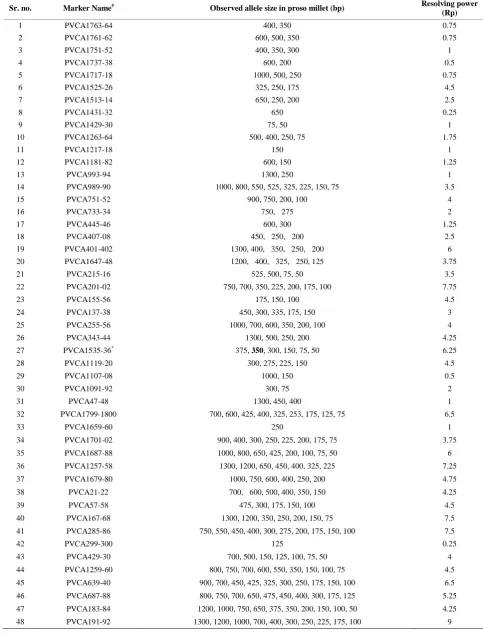
er (Rp) values) are given in Table 1. We consider that the 339 SSR markers covered most of the proso millet genome since these markers were selected from most of the chromosomal regions of switchgrass. Lack of ampli-fication of the proso millet genome by 38% of 548 switchgrass SSR markers could be due to insertion and/ or deletion present in SSR motifs, or point mutations and/or deletions in flanking repeats [28].
Approximately 98% of the polymorphic markers were genomic SSR markers and only 2% were EST SSR
[image:3.595.202.399.221.435.2]markers. This is similar to other reports in proso millet and in switchgrass [16,25]. High percentages of transfe-rability of switchgrass markers into proso millet supports the utilization of cross species SSR markers as a useful resource for developing markers in minor crops where very limited or no work has been done at the molecular level. Similar results were obtained in other crops such as sorghum, bermudagrass, napiergrass, finger millet and other grasses [20,21,29,30]. Such high level of transfera-bility is probably because many genomic regions are
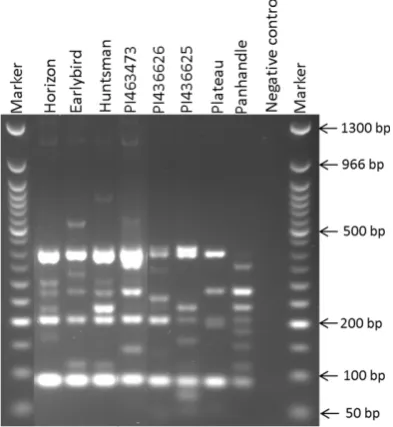
Figure 1. Polymorphic profile of switch grass SSR marker PVCA 21-22 in 8 proso genotypes (M = 50 bp NEB DNA Ladder,
NC = Negative control).
[image:3.595.133.443.475.719.2]Table 1. Characteristics of switchgrass SSR markers, which were polymorphic in proso millet.
Sr. no. Marker Name# Observed allele size in proso millet (bp) Resolving power
(Rp)
1 PVCA1763-64 400, 350 0.75
2 PVCA1761-62 600, 500, 350 0.75
3 PVCA1751-52 400, 350, 300 1
4 PVCA1737-38 600, 200 0.5
5 PVCA1717-18 1000, 500, 250 0.75
6 PVCA1525-26 325, 250, 175 4.5
7 PVCA1513-14 650, 250, 200 2.5
8 PVCA1431-32 650 0.25
9 PVCA1429-30 75, 50 1
10 PVCA1263-64 500, 400, 250, 75 1.75
11 PVCA1217-18 150 1
12 PVCA1181-82 600, 150 1.25
13 PVCA993-94 1300, 250 1
14 PVCA989-90 1000, 800, 550, 525, 325, 225, 150, 75 3.5
15 PVCA751-52 900, 750, 200, 100 4
16 PVCA733-34 750, 275 2
17 PVCA445-46 600, 300 1.25
18 PVCA407-08 450, 250, 200 2.5
19 PVCA401-402 1300, 400, 350, 250, 200 6
20 PVCA1647-48 1200, 400, 325, 250, 125 3.75
21 PVCA215-16 525, 500, 75, 50 3.5
22 PVCA201-02 750, 700, 350, 225, 200, 175, 100 7.75
23 PVCA155-56 175, 150, 100 4.5
24 PVCA137-38 450, 300, 335, 175, 150 3
25 PVCA255-56 1000, 700, 600, 350, 200, 100 4
26 PVCA343-44 1300, 500, 250, 200 4.25
27 PVCA1535-36* 375, 350, 300, 150, 75, 50 6.25
28 PVCA1119-20 300, 275, 225, 150 4.5
29 PVCA1107-08 1000, 150 0.5
30 PVCA1091-92 300, 75 2
31 PVCA47-48 1300, 450, 400 1
32 PVCA1799-1800 700, 600, 425, 400, 325, 253, 175, 125, 75 6.5
33 PVCA1659-60 250 1
34 PVCA1701-02 900, 400, 300, 250, 225, 200, 175, 75 3.75
35 PVCA1687-88 1000, 800, 650, 425, 200, 100, 75, 50 6
36 PVCA1257-58 1300, 1200, 650, 450, 400, 325, 225 7.25
37 PVCA1679-80 1000, 750, 600, 400, 250, 200 4.75
38 PVCA21-22 700, 600, 500, 400, 350, 150 4.25
39 PVCA57-58 475, 300, 175, 150, 100 4.5
40 PVCA167-68 1300, 1200, 350, 250, 200, 150, 75 7.5
41 PVCA285-86 750, 550, 450, 400, 300, 275, 200, 175, 150, 100 7.5
42 PVCA299-300 125 0.25
43 PVCA429-30 700, 500, 150, 125, 100, 75, 50 4
44 PVCA1259-60 800, 750, 700, 600, 550, 350, 150, 100, 75 4.5
45 PVCA639-40 900, 700, 450, 425, 325, 300, 250, 175, 150, 100 6.5
46 PVCA687-88 800, 750, 700, 650, 475, 450, 400, 300, 175, 125 5.25
47 PVCA183-84 1200, 1000, 750, 650, 375, 350, 200, 150, 100, 50 4.25
Continued
49 PVCA199-200 750, 700, 450, 400, 250, 225, 175, 125, 100, 75 8.25
50 PVCA951-52 1000, 650, 600, 550, 375, 350, 300, 275, 250, 100, 75, 50 4.75
51 PVCA1055-56 900, 400, 350, 300, 250, 200, 150 5.25
52 PVCA1105-06 650, 600, 500, 400, 275, 250, 175, 150 3
53 PVCA1221-22 1000, 750, 700, 400, 350, 300, 275, 250, 225, 200, 175, 150, 125,100,75, 50 8.75
54 PVCA1267-68 950, 600, 125, 100 1.75
55 PVCA1279-80 900, 550, 500, 350, 325, 250, 150 7
56 PVCA1387-88 1300, 650, 500, 375, 350, 300, 225, 175, 150, 125, 100, 75, 50 14.75
57 PVCA1421-22 500, 250, 125, 100, 75 1.5
58 PVCA1449-50 275, 250, 225, 200, 50 2.5
59 PVCA1479-80 1300, 900, 550, 300, 200, 175, 75, 50 3
60 PVCA1555-56 650, 600, 400, 375, 225, 200, 150, 100 9.25
61 PVCA1565-66* 650, 600, 350, 325, 300, 275, 250, 225, 150, 100 9.25
62 PVCA1571-72 1100, 900, 850, 800, 750, 650, 625, 550, 400, 350, 325, 175, 150, 125, 75 7.25
63 PVCA1573-74 500, 400, 325, 300, 250, 200, 175, 150, 100 6
64 PVCA1651-52 900, 700, 525, 450, 400, 325, 300, 275, 250, 100, 75, 50 5.5
65 PVCA1731-32* 750, 600, 500, 425, 400, 350, 300, 325, 300, 225, 175, 150, 125, 100, 75, 50 10.5
66 PVCA1-2 700, 250 0.75
67 PVCA109-10 700, 325, 300, 200 1.5
68 PVCA161-62 500, 400, 150 1.75
69 PVCA231-32 700, 500, 300, 150 2.75
70 PVCA259-60 600, 500, 300, 150 3.25
71 PVCA271-72 500, 325, 250, 100 1.25
72 PVCA275-76 1300, 750, 300, 200, 150, 100 4.25
73 PVCA297-98 500, 350, 300, 250 1.25
74 PVCA301-02 750, 250, 200 3
75 PVCA345-46 700, 350 0.5
76 PVCA347-48 325, 200, 150 1
77 PVCA445-46 175, 125, 100 1.5
78 PVCA495-96 800, 300, 150 1
79 PVCA533-34 700, 500, 400 0.75
80 PVCA541-42 750, 700, 350, 200, 150 2.75
81 PVCA557-58 550, 500, 300 1.25
82 PVCA571-72 400, 300 0.75
83 PVCA579-80 700, 650, 600, 500, 200 2.75
84 PVCA609-10 750, 650, 450, 350, 150 4.75
85 PVCA615-16 500, 300, 150, 100 2.25
86 PVCA669-70 500, 200, 150, 75 3.25
87 PVCA683-84 750, 650 1
88 PVCA705-06 1300, 750, 700, 350, 150 2.25
89 PVCA723-24 425, 300, 250, 150 1.25
90 PVCA985-86 200, 75 0.25
91 PVCA1065-66 300, 100 1.25
92 PVCA1077-78 700, 350, 300 2.5
93 PVCA1083-84 500, 200, 100, 75 3.75
94 PVCA1149-50 1300, 75 1
95 PVCA1191-92 1300, 500, 250 2
96 PVCA1209-10* 600, 500, 400, 350, 300, 250 3.5
97 PVCA1251-52 500, 450, 400, 300 1.5
Continued
99 PVCA1333-34 400, 225 2.5
100 PVCA1347-48 400, 225 4.25
101 PVCA1353-54 350, 300, 150 2.5
102 PVCA1355-56 500, 300, 250, 125, 75 6.25
103 PVCA1383-84 650, 300, 200 1
104 PVCA1385-86 700, 500, 450 1
105 PVCA1403-04 800, 750 0.75
106 PVCA1409-10 600, 350, 200, 175, 100 6
107 PVCA1413-14 300, 150 1.25
108 PVCA1455-56 700, 125 2.75
109 PVCA1477-78 400, 250, 200, 150 2.75
110 PVCA1511-12 750, 500, 400, 200, 100 4.5
111 PVCA1531-32 600 0.5
112 PVCA1533-34 350, 150 0.75
113 PVCA1541-42 600, 500, 400, 200 1
114 PVCA1557-58 600, 500, 400, 200 3.25
115 PVCA1591-92 600, 400, 300, 200 1.25
116 PVCA1593-94 500, 300, 150, 100 3.25
117 PVCA1631-32 400, 350, 100 1.25
118 PVCA1667-68 400, 250, 200, 50 1.75
119 PVCA1685-86 700, 100 1
120 PVCA1691-92 500, 300 0.5
121 PVCA1705-06* 700, 350, 150, 100 2.75
122 PVCA1753-54 700, 500, 150 1
123 PVCA1759-60 200, 75 0.75
124 PVCA1769-70 600, 250, 150, 100 1
125 PVCA1781-82 250, 200 1.25
126 PVCA1783-84 600, 500, 250, 150 1.5
127 PVCA1811-12 300, 250, 125, 75 5.5
128 PVCA1813-14 400, 150 1.5
129 PVCA1819-20 700, 600, 550, 450, 400, 300, 150 5.5
130 PVCA1827-28 1300, 500, 300, 150 5.75
131 PVCA1835-36 1300, 550, 150, 100 1.75
132 PVCA1851-52 200, 175, 125 2.5
133 PVCA1853-54 300, 250, 200, 150, 100 6
134 PVCA1867-68 400, 300, 150 2.75
135 PVCA1869-70* 325, 250 2.25
136 PVCA1881-82 325, 250, 150 1.75
137 PVCA1883-84 350, 100 0.5
138 PVCA1915-16 300, 250, 150 2.25
139 PVCA1925-26 700, 400, 300, 150, 100, 5.5
140 PVCA1937-38 400, 350, 250, 100 3.5
141 PVCA1939-40 700, 500, 450, 250, 3.25
142 PVCA1941-42 400, 300, 200, 150, 4.75
143 PVCA1947-48 400, 300 1.75
144 PVCA1955-56 600, 500, 400, 350 1.5
145 PVCA1957-58 325, 300 1.75
146 PVCA1963-64 200, 175 2
147 PVCA1997-98 600, 400, 300 1
Continued
149 PVCA2005-06 300, 200, 100 1
150 PVCA2009-10 300, 200 1
151 PVCA2013-14 200, 150, 100 1
152 PVCA7-8 350, 325 2
153 PVCA17-18 300, 150, 100, 50 2.5
154 PVCA19-20 100, 50 3
155 PVCA37-38 300, 200, 100, 50 3
156 PVCA145-46 700, 500, 300, 250, 100, 50 5
157 PVCA151-52 250, 150 0.25
158 PVCA225-26 75, 50 0.75
159 PVCA243-44 600, 500, 400, 300, 200 3
160 PVCA285-86 600, 500, 150, 100, 50 2
161 PVCA309-10 750, 700, 550, 500, 200, 100 2.75
162 PVCA341-42 250, 200, 100, 3.25
163 PVCA347-48 350, 300 1
164 PVCA349-50 700, 500, 150, 100 3.25
165 PVCA405-06 700, 650, 600, 500, 450, 300, 125 6.5
166 PVCA411-12 650, 600, 300, 100, 50 5.5
167 PVCA415-16 200, 150 0.25
168 PVCA425-26 150, 100, 75 2.25
169 PVCA765-66 550, 450, 400, 100 2
170 PVCA797-98 150, 100 2
171 PVCA863-64 350, 300, 200, 150, 100 5.25
172 PVCA931-32 150, 75 2
173 PVCA1037-38 250, 225 2
174 PVCA1045-46 175, 150, 50 2.5
175 PVCA1187-88 650, 300, 200, 150, 100 2.5
176 PVCA1197-98 450, 350 1.7
177 PVCA1271-72 250, 200 2
178 PVCA1337-38 350, 250 2.25
179 PVCA1387-88 300, 225, 75 3.5
180 PVCA1401-02 275, 225 2
181 PVCA1405-06 275, 250, 200 0.5
182 PVCA1485-86 200 1.25
183 PVCA1549-50 325, 300 2
184 PVCA1589-90 500, 225, 150, 75 2.25
185 PVCA1605-06 225, 200 1.5
186 PVCA1627-28 225, 200 2
187 PVCA1669-70 350, 300 1.5
188 PVCA677-78 325, 300 2
189 PVCA1741-42 200, 175 2
190 PVCA1883-84 250, 175 2.25
191 PVCA2059-60 300, 225, 100 1.5
192 PVCA2123-24 200, 175, 150 3.75
193 PVCA2143-44 325, 300 1.5
194 PVCA2197-98 225, 200, 175, 150 4.5
195 PVCA2199-2200 300, 275 2
196 PVCA2207-08 550, 500, 325, 200 3.75
197 PVCA2239-40 200, 175 2
Continued
199 PVCA2279-80 200, 175 2
200 PVCA2361-62 250 1
201 PVCA2393-94 200, 175 2
202 PVCA2437-38 150, 125 2
203 PVCA2461-62 250, 200 2
204 PVCA2471-72 200, 175 2
205 PVCA2473-74 150, 100 1.75
206 PVCA2503-04 250, 200 2
207 PVCA2527-28 200, 175 2
208 PVCA2615-16 350, 325 2
209 PVCA2623-24* 700, 150 1.75
210 PVCA2647-48 400, 250, 200 3.25
211 PVCA2721-22 250, 225 2
212 PVCA2847-48 600, 500, 300, 200 1.25
213 PVCA2979-80 200, 150, 100 1.25
214 PVCA3119-20 500, 400, 200 3.25
215 PVCA3205-06 250, 225 2
216 PVCA3327-28 300, 250 2.5
217 PVCA3053-54 200 0.5
218 PVCA23-24 225, 200 0.75
219 PVCA247-48 150 1.75
220 PVCA249-50 300, 250, 200, 150 1
221 PVCA251-52 200 0.75
222 PVCA253-54 550, 500, 450, 150 3.25
223 PVCA259-60 750, 700, 600, 400, 250, 150, 100 4
224 PVCA261-62 300, 200 2.25
225 PVCA271-72 175, 100 0.5
226 PVCA275-76 650, 550, 500, 450, 400, 350, 200 3.5
227 PVCA281-82* 700, 350, 300, 150 1
228 PVCA283-84 1300, 600, 400, 350, 250, 200, 100 6
229 PVCA287-88 900, 800, 650, 400, 350, 150 4.75
230 PVCA297-98 600, 400, 300, 200 3
231 PVCA299-300 750, 700, 500, 450, 400, 150 4.25
232 PVCA301-302* 800, 650, 250 1.25
233 PVCA307-08 900, 800, 650, 450, 400, 350, 300, 150 3.5
234 PVCA337-38 150 0.75
235 PVCA343-44 600, 300, 200 2
236 PVCA345-46 450, 200 0.5
237 PVCA351-52 900, 650, 150 0.75
238 PVCA357-58 700, 550, 150 1
239 NFSG-105 200, 175 3
240 NFSG-26 150, 125 3
241 SWW-177 200, 175 2
242 SWW-108 175, 150 0.5
243 NFSG-50 175, 150 0.5
244 NFSG-125 175, 150 2
245 SWW-2945 600, 350, 300, 250 1.5
246 SWW-2906 275, 50 1
247 NFSG-36 500, 225, 175 1.5
Continued
249 NFSG-288 175, 150 2
250 NFSG-246 100, 50 0.25
251 NFSG-145 250, 225 2
252 SWW-1394 250, 200 2.25
253 NFSG-133 175, 150 0.75
254 NFSG-132 325, 300 1.75
#Data published by Wang et al. 2011 [25] and Okada et al.2010 [24]. *Amplified allele (marked bold) size in proso millet = allele size in switchgrass [25].
conserved and syntenic between switchgrass and proso millet, which suggests amplification of either ortholog-ous or paralogus genes [31].
Most of the polymorphic markers (181 out of 254) produced 2, 3 or 4 alleles and 73 markers have produced 1, 5, 6, 7 or 8 alleles. Total numbers of alleles amplified by each SSR marker on the set of 8 lines ranged from 1 to16. Highest alleles (16) were amplified by marker PVCA 1221-22. High frequency of SSR markers with 2 alleles also indicates diploid nature of proso millet ge-nome. These indicate that proso millet genome is not 100% tetraploid but rather partially tetraploid and par-tially diploid although proso millet was reported as allo-tetraploid [32]. Amplification of multiple loci by a few SSR markers might be due to the multiple primer binding sites throughout the genome or within a single locus, which may be due to gene duplication or duplicated ge-nomic regions [17]. This is in agreement with previous reports on proso millet, potato, and zoyagrass species [15, 27,33].
The 254 polymorphic SSR markers amplified a total of 984 alleles (amplified DNA markers) among the set of 8 proso millet genotypes. Sizes of alleles by the switch-grass SSRs in proso millet ranged from 50 bp to 1300 bp with varied number of bands of each size. Amplified DNA bands in ranges of 50 - 200 bp, 200 - 400 bp, 400 - 600 bp, 600 - 800 bp, 800 - 1000 bp, >1000 bp were 377 (38%), 325 (33%), 138 (14%), 98(10%), 23 (2%) and 23(2%), respectively. When SSR marker sizes in proso millet were compared with expected switchgrass sizes, only 9 markers (PVCA1535-36PVCA1565-66,
PVCA1731-32, PVCA1209-10, PVCA1705-06, PVCA1869-70, PVCA2623-24, PVCA281-82,
PVCA301-302) showed exact matches with that of switch- grass and majority of marker sizes were different in pro-so millet. This high level of differences indicates signifi-cant genome reorganization in proso millet after speciation during evolution which was reported in wheat [34].
3.2. SSRs and Possible Association with Abiotic
Stresses
We found that eight SSR markers are part of the mRNA, UniGenes or genomic sequences in other crops (Table 2).
The SSR marker PVCA1017-1018 has 100% sequence similarity with the mRNA sequence involved in gluta-thione metabolism in sorghum. Another SSR marker PVCA723-724 is located on the rice BAC clone from where Sub-1 gene was cloned. Glutathione metabolism in sorghum and Sub-1 gene in rice were reported to be as-sociated with drought and flood tolerance, respectively [35,36]. It is likely that, these genes are still present in the proso millet genome and are showing different mechan-ism for drought tolerance. This evolutionary conservation for these genes provides a valuable source for further marker development for abiotic stresses in proso millet.
3.3. Repetitive DNA in Proso Millet
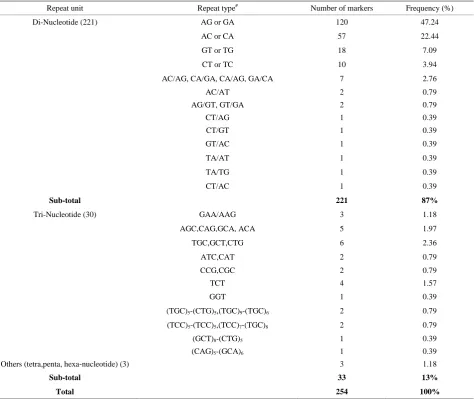
Repeat motifs of the 254 polymorphic SSR primers in proso millet were analyzed to elucidate the type of repe-titive DNA in proso millet. Of the total 254 polymorphic markers 221 (87%) were di-nucleotide repeats and the remaining 33 (13%) were tri- and other composite re-peats (Table 3). Of all these repeat-motifs, 196 were perfect (77%) and 58 were compound (23%) repeats. Of the 221 di-nucleotide motifs, the most abundant repeat- motif was AG/GA (47%) followed by AC/CA (22%) repeat motif in proso millet. Together the AG/GA and AC/CA repeat motif contributed 69% of all the poly-morphic markers in proso millet. The third most abun-dant di-nucleotide repeats in proso millet were GT/TG and CT/TC repeats, which together was 11%. All the remaining di-nucleotide repeats accounted for 7% of all the repeats.
A high level of di-nucleotide repeats in polymorphic SSRs in proso millet matches with other reports where (CA/GT) n and (CT/AG)n were predominant repeat motifs
Table 2. Eight switchgrass SSR markers, which are polymorphic in proso millet and their possible functional association in other crops based on sequence similarities available in NCBI data base.
SSR markers Crop Accession No. Sequence type
(gDNA/mRNA)
Putative protein /gene/location
PVCA275-276 Sorghum XM_002466569.1 mRNA Hypothetical protein
PVCA275-276 Oat JN390967.1 mRNA Lipoxygenase
PVCA429-430 Wheat GU985444.1 gDNA Mitochondrion
PVCA495-496 Maize BT065995.2 mRNA Uncharacterized
PVCA723-724 Rice DQ453964.1 gDNA Sub1 locus
PVCA1017-1018 Sorghum XM_002465397.1 mRNA Hypothetical protein (predicted to be involved in glutathione metabolism)
PVGA1119-1120 Barley AK373276.1 mRNA Predicted protein
PVCA579-580 Arabidopsis CP002687.1 gDNA
Peroxidase 38 Tetratricopeptide repeat domain-containing protein Myosin heavy chain-like protein
Table 3. 254 polymorphic SSR markers and their type and repeat-motifs, and its relative frequency in proso millet.
Repeat unit Repeat type# Number of markers Frequency (%)
Di-Nucleotide (221) AG or GA 120 47.24
AC or CA 57 22.44
GT or TG 18 7.09
CT or TC 10 3.94
AC/AG, CA/GA, CA/AG, GA/CA 7 2.76
AC/AT 2 0.79
AG/GT, GT/GA 2 0.79
CT/AG 1 0.39
CT/GT 1 0.39
GT/AC 1 0.39
TA/AT 1 0.39
TA/TG 1 0.39
CT/AC 1 0.39
Sub-total 221 87%
Tri-Nucleotide (30) GAA/AAG 3 1.18
AGC,CAG,GCA, ACA 5 1.97
TGC,GCT,CTG 6 2.36
ATC,CAT 2 0.79
CCG,CGC 2 0.79
TCT 4 1.57
GGT 1 0.39
(TGC)5-(CTG)5,(TGC)9-(TGC)6 2 0.79
(TCC)5-(TCC)5,(TCC)7-(TGC)8 2 0.79
(GCT)8-(CTG)5 1 0.39
(CAG)5-(GCA)6 1 0.39
Others (tetra,penta, hexa-nucleotide) (3) 3 1.18
Sub-total 33 13%
Total 254 100%
#
[image:10.595.64.539.325.724.2]4. Conclusion
To the best of our knowledge, this is the first report of such a large set (339) of SSR markers for proso millet using cross species genomic resources. This will help to advance proso millet genomic research and will ulti-mately lead to genetic improvement of this crop.
Acknowledgements
This research was funded by the Nebraska Wheat Board and Cross Road Coop and Friends of Proso Millet Re-search Fund. Partial funding for D.K. Santra was from Hatch project (NEB-43-105) and the graduate research assistancefor S.G. Rajput was from the Agronomy and Horticulture Department of the University of Nebras- ka-Lincoln.
REFERENCES
[1] A. Lawler, “Bridging East and West: Millet on the Move,” Science, Vol. 325, No. 5943, 2009, pp. 942-943.
http://dx.doi.org/10.1126/science.325_942
[2] G. W. Wiegrefe, “How to Prduceproso Millet (A Farmer’s Guide),” Pierre, South Dakota, 1990.
[3] D. D. Baltensperger, “Progress with Proso, Pearl and Other Millets,” In: J. Janick and A. Whipkey, Eds., Trends in New Crops and New Uses, ASHS Press, Alexandria, 2002, pp. 100-103.
[4] E. A. Oelke, E. S. Oplinger, D. H. Putnam, B. R. Durgan, J. D. Doll and D. J. Undersander Millets, “Alternative Field Crops Manual,” University of Wisconsin, Cooperative Extension and University of Minnesota, Center for Alter- native Plants & Animal Products and Minnesota Exten- sion Service, 1990.
[5] M. Brink and G. Belay, “Cereals and Pulses,” Plant Re- sources of Tropical Africa, 2006, pp. 122-125.
[6] D. J. Lyon, P. A. Burgener, K. L. De Boer, R. M. Harve- son, G. L. Hein, G. W. Hergert, T. L. Holman, L. A. Nel- son, J. J. Johnson, T. Nleya, J. M. Krall, D. C. Nielsen and M. F. Vigil, “Producing and Marketing of Proso Millet in Great Plains,” 2008.
http://ianrpubs.unl.edu/live/ec137/build/ec137.pdf [7] USDA-NASS Quick Stats.
http://quickstats.nass.usda.gov/results/962608D8-F138-3 CC7-9705-068D2A399631
[8] D. K. Santra and D. Rose, “Alternative Uses of Proso Millet,” University of Nebraska-Lincoln NebGude G2218, 2013.
[9] AGMRC, 2012.
http://www.agmrc.org/commodities__products/grains__oi lseeds/proso-millet/
[10] H. K. M. Ribu and K. W. Hilu, “Detection of Interspecific and Intraspecific Variation in Panicummillets through Random Amplified Polymorphic DNA,” Theoretical and Applied Genetics, Vol. 88, 1994, pp. 412-416.
[11] D. Karam, P. Westra, S. J. Nissen, S. M. Ward and J. E. F.
Figueiredo, “Genetic Diversity Among Proso Millet (Pa- nicum miliaceum L.) Biotypes Assessed by AFLP Tech- nique,” Planta Daninha, Vol. 22, No. 2, 2004, pp. 167- 174.
http://dx.doi.org/10.1590/S0100-83582004000200001
[12] D. Karam, P. Westra, S. J. Niessen, M. W. Sarah and J. E. F. Figueiredo, “Assessment of Silver-Stained AFLP Mark- ers for Studying DNA Polymorphism in Proso Millet (Panicum miliaceum L.),” Revista Brasileira de Botanica, Vol. 29, No. 4, 2006, pp. 609-615.
[13] W. Powell, M. Morgante and C. Andre, “The Comparison of RFLP, RAPD, AFLP and SSR (Microsatellite) Mark- ers for Germplasm analysis,” Molecular Breeding, Vol. 2, No. 3, 1996, pp. 225-238.
http://dx.doi.org/10.1007/BF00564200
[14] P. K. Gupta and R. K. Varshney, “The Development and Use of Microsatellite Markers Fore Genetic Analysis and Plant Breeding with Emphasis on Bread Wheat,” Euphy- tica, Vol. 113, No. 3, 2000, pp. 163-185.
http://dx.doi.org/10.1023/A:1003910819967
[15] X. Hu, J. Wang, P. Lu and H. Zhang, “Assessment of Genetic Diversity in Broomcorn Millet Panicum milia- ceum L.) Using SSR Markers,” Journal of Genetics and Genomics, Vol. 36, No. 8, 2009, pp. 491-500.
http://dx.doi.org/10.1016/S1673-8527(08)60139-3
[16] C. Young-II, J.-W. Chung, G.-A. Lee, K.-H. Ma, A. Dixit, J.-G. Gwag and Y.-J. Park, “Development and Characte- rization of Twenty-Five New Polymorphic Microsatellite Markers in Proso Millet (Panicum miliaceum L.),” Genes & Genomics, Vol. 32, No. 3, 2010, pp. 267-273. http://dx.doi.org/10.1007/s13258-010-0007-8
[17] M. C. Saha, J. D. Cooper, M. A. RoufMian, K. Chek- hovskiy and G. D. May, “Tall Fescue Genomic SSR Markers: Development and Transferability across Mul- tiple Grass Species,” Theoretical and Applied Genetics, Vol. 113, No. 8, 2006, pp. 1449-1458.
http://dx.doi.org/10.1007/s00122-006-0391-2
[18] L. Zane, L. Bargelloni and T. Patarnello, “Strategies for Microsatellite Isolation: A Review,” Molecular Ecology, Vol. 11, No. 1, 2002, pp. 1-16.
http://dx.doi.org/10.1046/j.0962-1083.2001.01418.x
[19] S. H. Dwivedi, H. Upadhyaya, S. Senthilvel, C. Hash, K. Fukunaga, X. Diao, D. K. Santra, D. Baltensperger and M. Prasad, “Millets: Genetic and Genomic Resources,” Plant Breeding Review, Vol. 6, 2012, pp. 247-375.
[20] S. L. Dillon, P. K. Lawrence and R. J. Henry, “The New Use of Sorghum bicolor-Derived SSR Markers to Evalu- ate Genetic Diversity in 17 Australian Sorghum Species,” Plant Genetic Resources: Characterization and Utiliza- tion, Vol. 3, No. 1, 2005, pp. 19-28.
http://dx.doi.org/10.1079/PGR200454
[21] C. C. Tan, Y. Q. Wu, T. Charles, A. Michael, T. Chuck and T. Samuels, “Development of Simple Sequence Re- peat Markers for Bermuda Grass from Its Expressed Se- quence Tag Sequences and Preexisting Sorghum SSR Markers,” Molecular Breeding, Vol. 29, No. 1, 2012, pp. 23-30. http://dx.doi.org/10.1007/s11032-010-9521-2 [22] E. C. Bess, A. N. Doust and E. A. Kellogg, “A Naked
lopmental Study of Panicum Section Bulbosa (Paniceae: Poaceae),” International Journal of Plant Sciences, Vol. 166, No. 3, 2005, pp. 371-381.
http://dx.doi.org/10.1086/428701
[23] L. Liu, Y. Wu, Y. Wang and T. Samuels, “A High-Den- sity Simple Sequence Repeat-Based Genetic Linkage Map of Switchgrass,” Genes Genomes and Gentics, Vol. 2, No. 3, 2012, pp. 357-370.
[24] M. Okada, C. Lanzatella, M. C. Saha, J. Bouton, R. Wu and C. M. Tobias, “Complete Switchgrass Genetic Maps Reveal Subgenome Collinearity, Preferential Pairing and Multilocus Interactions,” Genetics, Vol. 185, No. 3, 2010, pp. 745-760.
http://dx.doi.org/10.1534/genetics.110.113910
[25] Y. W. Wang, T. D. Samuels and Y. Q. Wu, “Develop- ment of 1,030 Genomic SSR Markers in Switchgrass,” Theoretical and Applied Genetics, Vol. 122, No. 4, 2011, pp. 677-686.
http://dx.doi.org/10.1007/s00122-010-1477-4
[26] J. J. Doyle and J. L. Doyle, “A Rapid DNA Isolation Procedure from Small Amount of Fresh Leaf Tissue,” Phytochemical Bulletin, Vol. 19, 1987, pp. 11-15. [27] A. Prevost and M. J. Wilkinson, “A New System of Com-
paring PCR Primers Applied to ISSR Fingerprinting of Potato Cultivars,” Theoretical and Applied Genetics, Vol. 98, No. 1, 1999, pp. 107-112.
http://dx.doi.org/10.1007/s001220051046
[28] J. Yu, M. La Rota, R. Kantety and M. Sorrells, “EST Derived SSR Markers for Comparative Mapping in Wheat and Rice,” Molecular Genetics and Genomics, Vol. 271, No. 6, 2004, pp. 742-751.
http://dx.doi.org/10.1007/s00438-004-1027-3
[29] A. L. S. Azevedo, P. P. Costa, J. C. Machado, M. A. Ma- chado, A. V. Pereira and F. J. da Silva Lédo, “Cross Spe- cies Amplification of Pennisetumglaucum Microsatellite Markers in Pennisetumpurpureum and Genetic Diversity of Napier Grass Accessions,” Crop Science, Vol. 52, No. 4, 2012, pp. 1776-1785.
http://dx.doi.org/10.2135/cropsci2011.09.0480
[30] M. L. Wang, N. A. Barkley, J.-K. Yu, R. E. Dean, M. L. Newman, M. E. Sorrells and G. A. Pederson, “Transfer of Simple Sequence Repeat (SSR) Markers from Major Ce- real Crops to Minor Grass Species for Germplasm Char- acterization and Evaluation,” Plant Genetic Resources: Characterization and Utilization, Vol. 3, No. 1, 2005, pp. 45-57. http://dx.doi.org/10.1079/PGR200461
[31] R. K. Varshney, A. Graner and M. E. Sorrells, “Genic Microsatellite Markers in Plants: Features and Applica- tions,” Trends in Biotechnology, Vol. 23, No. 1, 2005, pp.
48-55. http://dx.doi.org/10.1016/j.tibtech.2004.11.005 [32] H. V. Hunt, H. M. Moots, R. A. Graybosch, H. Jones, M.
Parker, O. Romanova, M. K. Jones, C. J. Howe and K. Trafford, “Waxy Phenotype Evolution in the Allotetrap- loid Cereal Broomcorn Millet: Mutations at the GBSSI Locus in Their Functional and Phylogenetic Context,” Molecular Biology and Evolution, Vol. 30, No. 1, 2013, pp. 109-122. http://dx.doi.org/10.1093/molbev/mss209 [33] H. W. Cai, M. Inoue, N. Yuyama, W. Takahashi, M. Hi-
rata and T. Sasaki, “Isolation, Characterization and Map- ping of Simple Sequence Repeat Markers in Zoysiagrass (Zoysiaspp.),” Theoretical and Applied Genetics, Vol. 112, No. 1, 2005, pp. 158-166.
http://dx.doi.org/10.1007/s00122-005-0118-9
[34] M. Feldman, B. Liu, G. S. Segal, A. Abbo, A. Levy and J. M. Vega, “Rapid Elimination of Low-Copy DNA Se- quences in Polyploid Wheat: A Possible Mechanism for Differentiation of Homoeologous Chromosomes,” Ge- netics, Vol. 147, No. 3, 1997, pp. 1381-1387.
[35] Y. Chi, Y. Cheng, J. Vanitha, N. Kumar, R. Ramamoor- thy, S. Ramachandran and S.-Y. Jiang, “Expansion Me- chanisms and Functional Divergence of the Glutathione S-Transferase Family in Sorghum and Other Higher Plants,” DNA Research, Vol. 18, No. 1, 2011, pp. 1-16.
http://dx.doi.org/10.1093/dnares/dsq031
[36] T. Fukao, E. Yeung and J. Bailey-Serres, “The Submer- gence Tolerance Regulator SUB1A Mediates Crosstalk between Submergence and Drought Tolerance in Rice,” Plant Cell, Vol. 23, No. 1, 2011, pp. 412-427.
http://dx.doi.org/10.1105/tpc.110.080325
[37] A. Cuadrado and N. Jouve, “Similarities in the Chromo- somal Distribution of AG and AC Repeats within and between Drosophila, Human and Barley Chromosomes,” Cytogenetic and Genome Research, Vol. 119, No. 1-2, 2007, pp. 91-99. http://dx.doi.org/10.1159/000109624 [38] C. S. Reddy, B. A. Prasad, B. P. M. Swamy, K. Kaladhar
and N. Sarla, “ISSR Markers Based on GA and AG Re- peats Reveal Genetic Relationship among Rice Varieties Tolerant to Drought, Flood or Salinity,” Journal of Zhe-jiang University Science, Vol. 2, 2009, pp. 133-141. [39] L. Cardle, L. Ramsay, D. Milbourne, M. Macaulay, D.
Marshall and R. Waugh, “Computational and Experi- mental Characterization of Physically Clustered Simple Sequence Repeats in Plants,” Genetics, Vol. 156, 2000, pp. 847-854.