A critique of the practice and methodology of operational
research
JONES, Graham C.
Available from Sheffield Hallam University Research Archive (SHURA) at:
http://shura.shu.ac.uk/18566/
This document is the author deposited version. You are advised to consult the
publisher's version if you wish to cite from it.
Published version
JONES, Graham C. (1993). A critique of the practice and methodology of operational
research. Doctoral, Sheffield Hallam University.
Copyright and re-use policy
See
http://shura.shu.ac.uk/information.html
rr':' 3:ty
IS PaiK Library
" ■ . J Î:i.-y i l l ÜMD
101 389 108 2
TPburiS'
Sheffield City Polytechnic Library
ProQuest Number: 10697190
All rights reserved
INFORMATION TO ALL USERS
The qua lity of this reproduction is d e p e n d e n t upon the qua lity of the copy subm itted.
In the unlikely e v e n t that the author did not send a c o m p le te m anuscript and there are missing pages, these will be noted. Also, if m aterial had to be rem oved,
a n o te will in d ica te the deletion.
uesL
ProQuest 10697190
Published by ProQuest LLO (2017). C o pyright of the Dissertation is held by the Author.
All rights reserved.
This work is protected against unauthorized copying under Title 17, United States C o d e M icroform Edition © ProQuest LLO.
ProQuest LLO.
789 East Eisenhower Parkway P.Q. Box 1346
A CRITIQUE OF THE PRACTICE AND METHODOLOGY OF OPERATIONAL RESEARCH
GRAHAM C JONES
A thesis submitted in partial fulfilment of the requirements of
Sheffield Hallam University for the degree of Doctor of Philosophy
ABSTRACT
The findings of a research project, conducted at Sheffield City Polytechnic between 1987 and 1992, are presented. The research was aimed at describing the work and methodology of operational research practitioners in the UK, and at promoting effectiveness in OR practice.
In-depth interviews were conducted with a small sample of OR practitioners, most of whom are employed as internal consultants. Interview findings were juxtaposed with the results of extensive literature study. Comparisons are made between contemporary OR practice and portrayals of OR in literature, and also with other types of consultancy within the management sciences. The development of a simple but powerful framework, for underpinning description of OR practice, is described.
In this thesis, operational research is portrayed as grounded in relationships with clients who are continually engaging in executive decision making. Problems are experienced as clients attempt to formulate theories about their environment, and proposals for action. OR practitioners aim to contribute insight to problem-handling processes. This is done principally by the provision of information, plus implications for action. OR practitoners also contribute information technology, and aim to enhance clients' intellectual processes by passing on problem-handling skills. Various types of technology are used as instruments in this process. OR practitioners utilise a 'structured approach' to situations. Extensive use is made of descriptive models; technology is also used for computation and to aid communication with clients. In the long term, OR work involves analysis of clients' problems, data management, development and maintenance of appropriate technology, and promotion of continuing consulting relationships.
ACKNOWLEDGEMENTS
I am grateful to everyone who has supported me in any way during this research. In particular, thanks are due:
To Jim, my 'supervisor', for letting me do it my way, and for patience during my more reflective periods;
To my examiners, for their constructive comments during my first examination;
To Bob, Peter, John, Geoff, Paul, Jonathan, Bernard, Don, David, Anne, John, Gary, Ian, Mike, Tony, Steve and David, who provided most of the data;
CONTENTS
Chapter 1 : INTRODUCTION 1
1.1 OR Practice 4
1.2 OR as a Discipline 9
1.3 OR Methodology 10
1.4 OR Literature 14
1.5 OR Culture 16
1.6 Aims of This Research 18
Chapter 2 : RESEARCH METHODOLOGY 23
2.1 Choice of Research Methods 23
2.1.1 Fieldwork 24
2.1.2 Literature study 26
2.2 The Nature of Scientific Research 27
2.2.1 A Christian view of truth 28
2.2.2 Scientific knowledge 30
2.2.3 Social science and metaphysics 33 2.2.4 Implications for this research 35
2.3 Details of Fieldwork 37
2.3.1 Interview methodology 38
2.3.2 Pilot study 40
2.3.3 Survey design 44
Chapter 3 : O.R. PRACTITIONERS 47
3.1 Conceptual Framework Underpinning Interviews 47
3.2 The Sample of OR Practitioners 52
3.4 Motivations for Practicing OR 58
3.5 Structure of The Thesis 59
Chapter 4 : THE SOCIAL CONTEXT OF O.R. INTERVENTION 63
4.1 Clients 64
4.1.1 Problem ownership 65
4.1.2 Sponsorship 67
4.1.3 Participation and stakeholding 69
4.2 Decision Making 71
4.2.1 Strategic decision making 74
4.2.2 The process of strategy formulation 77
4.2.3 Complex decision processes 78
4.2.4 An integrated model of decision making 79
4.2.5 Conflict 81
4.3 Institutional Context of OR 85
4.4 Summary 8 7
Chapter 5 : THE NATURE OF PROBLEMS IN O.R. PRACTICE 89
5.1 Problem Ownership 90
5.2 Decision Making 92
5.3 Coping with Complex Situations 94
5.4 Contemporary Debate on the Nature of Problems 96 5.4.1 Technical .. human problems 96
5.4.2 Uncertainty 101
5.4.3 The Gap mentality 104
5.4.4 Unitary, pluralist and coercive 106 problem contexts
5.4.5 Objectivity .. subjectivity 108
5.5 Problem Dynamics 111
Chapter 6 : PROBLEM-HELPING CONSULTANCY 115
6.1 Processes of Problem Handling 116
in Organisations
6.2 Solutions of Problems in OR Practice 118 6.3 The Nature of Consulting Relationships 120 6.4 Consultants' Contribution to Problem Solving 124 6.4.1 Understanding through information 124 6.4.2 Enhancing intellectual processes 127 6.4.3 Enhancing social processes 129 6.4.4 Dynamics of problem helping 131
6.5 Solution Leverage and Focus 134
6.6 Summary 138
Chapter 7 : O.R. EXPERTISE AND TECHNOLOGY 141
7.1 Expert Knowledge 142
7.2 Expert Skills and Technology 144
7.2.1 Technology maketh OR ? 145
7.3 Techniques in Contemporary OR Practice 147
7.4 Techniques in This Study 151
7.4.1 Computer software 153
7.4.2 Expert skills and other tools 155
7.5 Summary 160
Chapter 8 : RELATIONSHIPS AND PROJECTS 161
8.1 Relationships with Clients 162
8.1.1 Consultant understands client 163 8.1.2 Client understands consultant 166 8.1.3 Enjoyment, maintenance and development 167
of relationships
8.2 Senior Clients and Sponsors 172
8.3 Hosts, Stakeholders and Informants 173
8.4 Dealing with Conflict 175
8.6 The Research of Conway and Holland 182
8.6.1 Conway's research 183
8.6.2 Holland's research 188
8.7 Aids to Strategic Marketing in OR 192
8.8 Summary 195
Chapter 9 : APPLICATION OF O.R. TECHNOLOGY 197
9.1 Technology and OR Process 197
9.1.1 Inquiry 200
9.1.2 Description 202
9.1.3 Analysis 204
9.1.4 Presentation 206
9.1.5 Negotiation and choice commitment 207
9.2 Choice of Technology 209
9.2.1 Critical features of the 210
project context
9.2.2 ORers' needs and preferences 211
9.2.3 Choices within projects 212
9.2.4 Features of appropriate technology 213
9.2.5 Appropriate OR technology 215
9.3 Technology and Reality in Problem Helping 218 9.3.1 Structure, object and subject systems 218
9.3.2 Structure and process 221
9.4 Summary 222
Chapter 10 : FRAMEWORKS FOR DESCRIBING O.R. PRACTICE 225
10.1 The Emerging Framework 226
10.2 Science 230
10.2.1 Technology 234
10.2.2 The Process of OR 235
10.3 Scholz's Conceptual Framework 240
10.5 OR as Articulate Intervention 245
10.6 OR as Organisational Actor 248
10.7 Methodological Paradigms 250
10.8 Summary 253
Chapter 11 : PROFESSIONAL EFFECTIVENESS AND 255 EDUCATION IN O.R.
11.1 Methods of Evaluating Operational Research 255 11.1.1 Assessing the impact of OR 256 11.1.2 Other approaches to evaluating OR 260 11.2 Choosing a Method for Promoting Effectiveness 261
11.3 The Work of Argyris and Schon 262
11.4 Professional Education 264
11.5 Professional Learning Environments 266
11.6 OR Practice and Process 267
11.6.1 Design and delivery of the module 269 11.6.2 Summary of the "Practice and 270
Process" material
11.7 Evaluation of the P&P Module 275
11.8 Improvements to P&P 278
11.9 General Recommendations for Educational 280 Programmes
Chapter 12 : CONCLUSIONS 285
The Nature of OR Practice 285
12.1.1 OR and problems in a social context 286 12.1.2 OR as a consultancy practice 287
12.1.3 OR as problem-helping 288
12.1.4 OR technology and its role 291 12.1.5 General characterisations of OR 293 12.1.6 Relevance of this research in a 293
Methodological Development 295
12.2.1 Publication of findings 295
12.2.2 Further research 296
12.2.3 Education and training resources 298
Reflections 299
12.3.1 The impact of fundamental assumptions 301
REFERENCES 307
APPENDICES : Al
A - Research Project Calendar Al
B - Analysis of Representation A5
C - "Where Angels Fear To Tread" All D - "OR Practice, Systems Methodologies, and A13
Chapter 1
INTRODUCTION
Operational research is variously portrayed as a mathematical or scientific approach to problem solving or the achievement of efficiency, or as a collection of mathematical techniques. Whilst these portrayals convey valuable truths about operational research (OR), they fail to highlight a significant aspect of OR:
In 1984, the OR Society of Great Britain commissioned extensive research into the practice of OR. The Commission (ORS, 1986) commented that "practically all OR in practice is done on behalf of someone or some organisation other than the practitioner". In other words, OR is a social activity.
Moreover, it is a consultancy activity. This is probably regarded as a truism by most people who consider themselves to be operational researchers, with only a small, academically-based minority earnestly believing that OR can be an individual, intellectual, experience. Nevertheless, OR methodology does not reflect this essentially social nature of OR practice.
In 1987, I began a research project, based at Sheffield City Polytechnic (SCP), in which I intended to investigate and
From the perspective whereby OR as viewed as a consultancy activity, the 'problem-solving' and 'mathematical' aspects of OR demand to be interpreted in their social context. A basic framework which has been developed during, and which underpins, this research can be summarised as follows:
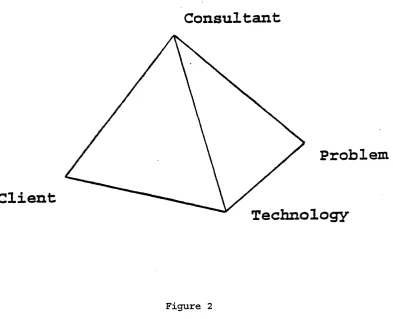
OR involves acting as a consultant (of sorts), to a client (of sorts), to address or to help with a problem (of sorts), with the aid of models,
techniques and technology (which are often mathematically based).
It is my thesis that :
OR practice can be accurately described with reference to this framework,
that the adoption of this perspective can yield
significant insight into the nature of the practice and its methodology,
and that this insight (and also the framework itself) can help to make OR practice more effective, particularly through the development of education and training
programmes.
This thesis contains a description of OR practice which is different from most 'traditional' portrayals of OR in a number of striking ways. The nature of the most significant findings is summarised below:
OR is portrayed, not as a private puzzle-solving activity, but as a socially-complex occupation, grounded in
relationships with other social actors.
The problems with which OR practitioners are concerned are not intellectual curiosities, but are difficulties which arise in the experience of clients, who are continually engaged in executive decision-making processes.
to deal with their problems. There are a variety of ways in which ORers may equip their clients by contributing to their problem-handling processes.
OR models and techniques are not the essence of OR per se; neither are they necessarily mapped onto problematic situations in order to produce solutions. In the context of problem helping, models and techniques are instruments
which OR practitioners may use for a variety of purposes. In particular, models may be used to aid the consulting process, as well as the problem-handling process.
The models and techniques which are commonly used in contemporary OR practice are markedly different from the techniques that are described, or prescribed, in much OR literature and in many OR courses.
Although administered on a 'project' basis, OR practice does not involve a stream of unrelated problem helping experiences. Instead, projects have technical, geographic, psychological and political connections to other, past or present, projects.
In the long-term, OR is concerned with problem helping, but also with engineering situations in which problems are less likely to arise. Consequently, not all OR projects
necessarily involve helping clients with 'new' problems.
My chief purpose in conducting this project has been to describe OR in a way which gives an accurate reflection of the, essentially social, nature of OR practice. As the summary in the preceding paragraphs illustrates, this involves
reinterpreting myths about OR. It is hoped that, by adopting more powerful myths, the OR community can develop
methodologies to equip practicing operational researchers for their socially-complex work. The intention of this research has been to promote more self-aware and, ultimately, more
Before considering this project's aims in greater detail, I shall attempt to give tighter definition to some of the key terms that are used in this thesis. The need for such definition is illustrated below by an extract from an interview with an OR practitioner during the research project:
Q: "As far as you're concerned, what is OR?"
A : (pause)
"Well, I take the line that OR is what OR people do."
(leans back, looking smug)
Q: (determinedly)
"OK, what do you do then?"
A: (looks out of window)
"Well .. a lot of what we do isn't really OR."I
This low-key exchange involved a number of different uses of the term "OR". In this introductory chapter, I shall consider, often from a historical perspective, the various concepts to which the name OR is commonly attached. In particular, I shall explain what I mean by "OR practice" and "OR methodology". I shall then describe the aims of this research project.
1.1 OR Practice
associated with the development of radar for military purposes. This involved the establishment of a team of (civilian) scientists, whose specific tasks were to conduct
research into operational matters, and to give advice to RAF officers in authority. The term "operational research" was coined to distinguish this work from other research concerned with the development of military equipment (Keys, 1991b).
Before long, there were operational research groups in several branches of the armed forces. Members of these groups were drawn from various scientific disciplines (though many were reputable physicists), and their work broadened into "the general method of science employed to study any problems which may be of importance to an executive" (Waddington, 1973). Their work involved much observation and collection and analysis of data, and attempts to understand the relationships between various factors in military operations, in order to advise military commanders.
At the end of world war II, the idea of using 'operational' researchers was transferred to the newly nationalised industries, whose complex operations presented fresh management problems. Small groups, dedicated to operational research, were set up within industrial research organisations. Many members of these groups had formerly been wartime operational researchers. Many groups practiced under the "operational research" banner, although some (such as the Field Investigations Group in the NCB) used other names.
As Keys (1991b) notes, "the first use of a label is clearly not necessarily equivalent with the introduction of the activity it is applied to". In other words, it is possible that 'operational research' - or "OR" - may have been
economic benefit; Taylor was a machinist whose ideas about increasing industrial productivity and prosperity (at the beginning of this century) became known as "scientific management". As the scientific management movement took root in the US, Taylor and his colleagues operated as consultants,
giving advice to managers within many different organisations.
Keys remarks that "the only essential change which occurred in the consultancies which included scientific management techniques in their portfolio when OR appeared was an increase in the sophistication of their techniques". There is, however, another major difference between the US management consulting and the kind of support provided by the early operational researchers :
"The OR scientist certainly did not share the military manager's knowledge and experience of war; equally, the commander's knowledge of science was usually slight" (Beer, 1967).
The champions of scientific management gave advice which stemmed from, their experience. By contrast, operational researchers offered their skills, as scientists, but claimed no particular experience of operations or their management. In OR, the difference in background, perspective and culture, between 'manager' and 'consultant', was greater. The use of research for direct operational benefit was "an outrageous idea" (Ackoff, 1979b) . [Indeed, 'OR' may seem to be an oxymoron.] This idea has remained a feature of OR throughout its post-war development. Typically, those employed in OR consultancy groups are not, and never have been, managers themselves.
organisations, in industry, business, defence, national and local government, and in the community.
The nature of the work done by OR groups has also changed. This is partly because of technological developments : the 1960s witnessed greater application of mathematics and modern statistical techniques, whilst the information technology revolution has had a profound effect on OR and many other aspects of organisational life since the 1970s. The effect of these developments was, initially, to extend ORers' repertoire of techniques. Bryant (1989) considers that an apparent failure of industrial OR to live up to its promises, coupled with a general loss of faith in the virtue of rational, controlling management, led to OR becoming "a narrow functional specialism directed in the main at relatively paltry tactical problems", and relying on "an arbitrary set of logico-mathematical techniques appropriate to solving the recurrent problems of large organisations".
The precise way in which OR has developed from its wartime practice need not concern us here. My purpose in this section has been to explain that the term "OR" originally corresponded to OR practice, whereby scientists acted as consultants to managers.
"the group was to be split up into two quite different kinds of people, those who were concerned with solving the problem and those who were responsible for the actual techniques to be used. .. a dismal failure, . . in operational research it is impossible to dissociate the technician from the problem-solver, . . everyone is an operational research worker"
Almost without exception, persons employed in OR practice are employed to do OR. It is therefore meaningful to talk about the work that is done by such persons as "OR practice". Members of OR groups undoubtedly each have a 'niche' within the group's overall practice. Most obviously, each group has a leader - or leaders - and group members all have their particular strengths and weaknesses in both technical and social aspects of the work. However, there is a sense in which all these people, with the possible exception of OR group managers, may be considered to be 'doing OR'.
I have dwelt on the origins of the term "operational research", but it is important to note that not all of the persons and groups who engage in this kind of activity actually use the same name. The title which is given to a group reflects the particular role that it has in its organisation, the intentions of its founder, and also the connotations that the name "OR" has in that organisation. Some groups have deliberately avoided the name because of some perceived negative connotations. Whilst operational research per se played a timely role in Britain's armed forces, it may be that other organisations, at other times, construe a need for a slightly different kind of skill or activity, and so may use another name.
The final point in the paragraph above is an important one, because it calls into question the (so far) cosy association between the concept "OR" and the work of individuals or groups. If organisational actors can do (or use)
to situations, which transcends the workaday practice of OR consultants. We may, then begin to talk about OR in abstract terms - as a discipline in its own right. The next section is dedicated to considering what it involves to view OR in these terms.
1.2 OR as a Discipline
For the first twenty years of OR practice in the UK, people were employed as full-time, dedicated, operational researchers without previously having a formal education in 'OR'. Not until the late 1950s did universities start to offer OR courses. Consequently, OR workers leamt their craft 'on-the-job', receiving training which was tailored to their organisation's particular circumstances. However, OR was already recognised to have "techniques of its own, suited to its own special material and problems" (Blackett, 1943), and began to be regarded as a discipline.
Despite being regarded as a discipline in its own right, OR has retained its inter-disciplinary nature - being commonly viewed as being at the interface of 'scientific research' and 'management problems'. Consequently, universities and colleges have never found a comfortable and obvious position for an 'OR' department within their organisational structure. OR is now taught, on first and further degree programmes and a variety of other courses, as a branch of mathematics or statistics, as an application of computing or computer systems engineering, or as a management/planning-related activity.
intended to be used, is often overlooked. Some of the people who teach OR on academic courses have several years experience of practicing OR behind them. Others have little or (in a few cases) no experience. There are, therefore, many ways in which the academic discipline 'OR' may be different from the practical consulting activity of the same name.
There is another 'arena' in which OR is propagated as a discipline; In 1948, the OR Club was formed, later to become the OR Society of Great Britain. Within the Society, and its many sub-groups, about 3 000 people share ideas and argue their own points of view about various aspects of OR. Much of this activity is aimed at improving the practice (or teaching, or whatever) of individual members. However, since these members have quite diverse backgrounds, there is a sense in which the life of the OR Society encourages both its members and any interested onlookers to believe that there is 'something' called OR which would continue, in some shape or form, even in their absence. Moreover, the Society is actively involved in promoting OR as a career, and also provides a forum for collective public relations exercises by OR practitioners and groups. Similar organisations, carrying out similar activities, exist in many other countries.
1.3 OR Methodology
with their scientific backgrounds, should develop a
methodology - a science of method.
We can use the term 'OR methodology' to describe a system of principles which guide and inform an individual OR worker in an ongoing process of method choice. However, the motivation for establishing OR as a discipline is the belief that there is sufficient commonality between workers' guiding principles that it is worthwhile sharing and debating these principles. It is, therefore, meaningful to talk about OR methodology which belongs to the entire OR community.
An individual ORer's methodology can be defined in terms of theories of action (Argyris and Schon, 1974), consisting of a vast number of 'advice statements' saying, 'in this kind of situation, if you want to achieve such-and-such, do this
-given these assumptions'. It is important to recognise that practitioners may behave according to one theory, yet may believe and talk about a different theory. Clearly, OR practice is effected by theories in use (Argyris and Schon). It is also affected by espoused theories : As a practitioner pays conscious attention to particular ways of working, his repertoire of methods grows to reflect his intentions; as he reflects upon his behaviour, his espoused theories begin to reflect his theories in use. It is the degree of conscious, critical attention which is the key to learning to behave according to an espoused theory. For an individual OR worker, methodological development involves reflection upon practice
and the imagination to develop theories which are better, in some sense.
Methodological development which spans the community of OR workers depends upon the interaction of these workers, and of their espoused theories of action. Through the combination of experience and reflection, they may be able to assemble a
nature, because it will not necessarily coincide with individual practitioners' own views.
The development of a jointly owned 'science' of OR practice and methods may be developed with the assistance of dedicated scientists, whose programmes of research would require the collaboration of OR groups and practitioners. This 'science' would be concerned, not merely with making
'objective' observations of OR practice, but with discovering the meaning that ORers attribute to what is going on, and to what they are doing. In other words, their theories of action would be studied, as well as just their behaviour.
The obvious base for these scientists of OR is in the academic OR departments which are committed to teaching OR. Where this practice is adopted, universities and colleges can ensure that they are properly preparing students for their future adventures in OR practice. Regrettably, this practice is rare, particularly in the UK. This does not, however, prevent a collective view of the nature of OR from being formed; rather, this view is established through myth and story telling instead of through scientific research.
Since the mid-1970s, it often been acknowledged that, as Pidd (1985) remarked, "there is a distinct shortage of theory which gives appropriate guidance for actually doing OR" . Sevan (1976) considered that the OR community's problem was its lack of a sufficiently critical attitude. It has subsequently been argued (Bryant, 1988, Jones, 1988a) that individual practitioners' failure to reflect upon their own practice, and to attempt to describe it, is a major stumbling block to methodological development.
which it could identify shortcomings in the old theories. In 1977, the OR Society organised a seminar entitled "The King Is Dead: Long Live The King?" Similarly, Dando and Bennett (1981) suggested that OR might be experiencing a "Kuhnian crisis". This term denotes a point, during the development of a science, at which the established paradigm - or system of theories - struggles to retain its credibility, and eventually becomes superseded by a new paradigm which seems more credible. Another period of 'normal science' follows.
From this perspective, OR's dominant paradigm determined that OR was, and should be practiced according to some variation on the following stepwise procedure :
1. Work out what the problem is ;
2. Construct a mathematical model of the situation; 3. Experiment with the model, to find the best way of
handling the situation;
4. Try this out, and monitor the results.
The origins of this idea are betrayed by part 3., in which the ORer supposedly conducts (scientific) experiments. This process describes (or prescribes) a way in which the scientists who became the first ORers could have utilised their scientific skills in their new practice.
In 1984, Conway remarked that, during the 1970s and 1980s,
"there have been a considerable number of contributions to the methodology and practice of Operational Research. Most of them, however, do not look at the process overall but instead concentrate on one particule: aspect of the process" (Conway, 1984) .
An interesting feature of the work cited above is that the few empirical studies, such as those by Conway, and Woolley and Pidd, have suggested that many critical aspects of practicing OR cannot adequately be described or debated within the stepwise science-based framework. In particular, the consultancy nature of OR practice is completely disguised. Given that consultancy was an essential feature of early OR practice, it . seems that Dando and Bennett may have been optimistic when they suggested that OR had already reached a Kuhnian crisis. It might be more accurate to say that OR has never had a period of 'normal science' , and that its methodology is still at a primitive stage of development.
1.4 OR Literature
In my discussion of OR methodology, I have made numerous references to published research. Within two' years of the formation of the OR Club, the first issue of its journal - OR Quarterly - was published. Although the journal - now called the Journal of the OR Society - has always been keen to publish practical case studies, it has mainly become an outlet for academic work. This includes some case studies and results of empirical research, but as Rivett (1981) so abruptly put it,
"Those who know OR as it is practiced will comprehend that the Journal has virtually no relationship with what is happening up and down the country".
The 'Kuhnian crisis' debate was based largely on an assessment of OR as portrayed in literature. The following, enlightening, remarks were made by John Lawrence, a former editor of the Journal :
In other words, not only can the literature not be relied upon to reflect the nature of OR practice, but it cannot be relied upon to reflect OR methodology either. The content of the literature also depends upon the policies and whims of the authors and editorial staff.
However, as Lawrence points out, OR's literature does have an influence upon other aspects of the "profession". It provides the principal medium through which theories of action are expressed, and through which methodological debate is pursued. On both sides of the Atlantic, a 'new breed' of journals are now published (notably OR Insight, Interfaces and Omega) in a conscious attempt to retain an authentic expression of OR practice and methodology through literary artefacts.
Another literary outlet for OR methodology is through books, although the OR community has generated surprisingly few of these in over fifty years of practice. Most OR books are, in fact, university textbooks. One of the earliest of these, by Churchman, Ackoff and Arnoff (1957), is now regarded as a 'classic', and most subsequent textbooks have a similar structure and content. It is worth noting that this book was based on academic OR courses in the US, where OR was adopted as a relatively narrow specialism amongst other management sciences. In this way, the pattern which so many UK writings have followed was set long before UK universities had established research programmes into OR practice.
It is likely that more authentic characterisations of contemporary OR are contained in intra-organisational literature such as internal reports and bulletins. This type of literature gives a local picture of how OR practice is seen (or how ORers wish their practice to be seen) by those who are clients of OR, or who administer OR. It is not, however, likely to describe OR workers' experience or their methodology.
1.5 OR Culture
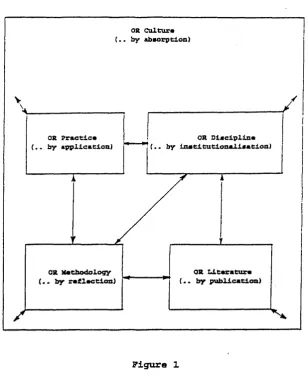
In summary, there are several components to the OR 'profession' , each of which lay some claim to the "OR" label. These are OR practice (individual and corporate), OR methodology (individual and community), the 'OR' approach to situations and the academic discipline 'OR', plus various literary artefacts. These components are set against a the background of a general OR culture - i.e. the collective wisdom, experience, attitudes and habits of members of the OR community. Ideas about the nature and method of OR may be dissipated from one of the components to the others either directly, through the various channels described above, or osmotically, as vague impressions that are part of the OR culture.
The OR Pro£asalost Showiag how Ideas ars absorbed inco tbs various eosponentts at thm pro£aaslca
OR Culture (.. by 2d)sorpeion)
OR Practice (.. by applicatioa)
OR Methodology
by reflection) {.. by publication)OR Literature OR Discipline *(.. by institutionaliaation)
Figure 1
[image:29.617.132.441.87.479.2]Q: "As far as you're concerned, what is OR?"
[what meaning do you attribute to the term 'OR'?]
A: "Well, I take the line that OR is what OR people do."
[the only reasonable use of the term "OR" is in reference to OR practice]
Q: "OK, what do you do then?"
[tell me about OR practice]
A: "Well, a lot of what we do isn't really OR."
[a lot of OR practice is quite different from OR as portrayed in the textbooks]
The addition of the parts in brackets confirm that this was actually a perfectly sensible conversation. However, the ease with which the 'objective' listener may construe the answers as plain nonsense demonstrate that OR's verbal artefacts are a lexical minefield.
1.6 Aims of This Research
My own position within the OR community is that of an academically-based researcher. In short, I have attempted to carry out scientific research into the nature of OR practice and methodology in the UK. In this section, I shall describe my aims in more detail.
practice has been studied, attention has been limited to certain aspects of OR, whilst the overall nature of the activity has remained untouched.
OR Practice
My aims in this research have been dominated by two overwhelming concerns, with regard to OR practice: Firstly, I have sought to investigate and describe OR practice in such a way that individual practitioners are 'centre stage'. This is a different approach to that adopted by Keys (1991a), for example. My reasons for this choice are that I consider individual actors to be the basic elements of social life, and also to be the primary (perhaps the only) mediators in the process of methodological development. Consequently, if research into OR practice is to have any effect on practice, it must be possible to make its findings 'actionable' or, in some other way, accessible by OR practitioners.
Secondly, I have sought to investigate and describe OR practice as a whole. By this, I mean that I have been concerned with OR practitioners' working lives as holistic experiences. It is, of course, necessary to examine a breadth of OR work in different settings, if general statements about the nature of OR are to be made. However, in this particular research project, I have considered the holistic quality of singular statements, rather than the quantity of them, to be my priority. By investigating individual ORers' practice, I have hoped to be able to make a tentative contribution to the OR community's understanding of its (collective) practice
have received received little attention in OR literature. I have hoped to offer a fresh perspective on OR practice by-describing it as a consultancy activity. The nature of the work done by people who are not consultants, but who use 'an OR approach' to their own situations has not been investigated during this research.
There are two other early research aims which have received little attention. It was originally my intention to compare
OR work in various different settings, and also to compare OR with the practice of other 'management service' activities, such as management consultancy, organisation development, organisation and methods, computer software consultancy etc. Both of these types of comparison require extensive fieldwork. As I shall explain in the following two chapters, these aims have largely been sacrificed in an attempt to fully describe
'normative' OR. In other words, in the trade-off between in-depth analysis and sophisticated inference on the one hand, and large-scale but superficial comparisons on the other, I have chosen the former approach in this research. This is not because I think it is necessarily a 'better' research method, in some absolute sense, but because it seems more appropriate to the present degree of understanding of OR practice.
However, I have made extensive use of ideas and frameworks from a variety of management sciences in my attempt to describe OR.
OR Methodology
systems of principles which guide and inform their practice -as well -as to discover the practice itself.
As with OR practice, by investigating individual ORers' methodologies, I am making a tentative contribution to the OR community's corporate methodology - i.e the science of OR practice which transcends the practice and methodology of individual ORers. In attempting to contribute to this science, I shall necessarily examine contemporary research work, and other general statements that are being made about contemporary OR. I have aimed to relate my own research findings to these wider general statements. Public domain literature, such as papers published in journals, has been a major source of data for this part of the study.
A description of OR practice and methodology is necessarily underpinned by a conceptual framework. It is possible to make
some interesting statements about OR with respect to existing frameworks. However, this does constrain the originality of the research findings. I have, therefore, attempted to develop a framework, for describing OR practice, which is sufficiently simple and robust to be applied to a variety of approaches within OR, but which is sophisticated enough to underpin novel and critical debate. The development of this framework has been an integral part of the research process. I have attempted to construct a framework from everyday language and concepts; my intention here has been to make a contribution to methodological development which is accessible
by a wide range of OR workers. I have explicitly considered the suitability of frameworks that have been developed previously.
perhaps the best way of improving the effectiveness of OR is
promote learning by OR practitioners. In general, this can be done by encouraging ORers to engage in critical reflection upon their work, by offering scientific knowledge of the subject, along with some untried ideas, to help to focus this reflection.
Chapter 2
RESEARCH METHODOLOGY
This chapter covers a wide range of issues which can be considered to be part of the methodology used in this research. The first section of the chapter gives an overview of the research methods that I have chosen to use, and the reasons behind these choices.
The second section (parts 2.2.1 to 2.2.3) explains my
assumptions, concerning the nature of truth, knowledge and science, which lie behind, and which undergird, this research project. The following two sections (2.3 and 2.4) are concerned with the implications that these epistemological considerations have for social science in general, and for this study in particular.
Section 2.5 describes the conduct of a pilot study, and the role that this study had in developing the research methodology. The final section is concerned with practical aspects of designing and conducting a survey.
2.1 Choice of Research Methods
2.1.1 Fieldwork
I decided that fieldwork should be carried out using in-depth, unstructured interviews with OR practitioners. There are a number of reasons for this :
1. As I was interested in investigating practitioners' working lives as wholes, I needed a method by which these experiences could be compressed into a few days, or even a few hours. Observations would only have provided 'snap shots' of OR practice, rather than a 'full-length feature film. This practical consideration limited my repertoire to interviews (of various kinds) and questionnaires.
2. In any case, as Popper (1963, 1968) and Whewell (1840, 184 7) have argued, observation is both selective and theory-ridden; an observer sees what he expects to see, and interprets raw sensual experience in a way that makes 'sense' to him. Observations are appropriate when the observer is confident that he properly understands what he is observing.
3. My research aims extended beyond finding out how ORers spend their days at work; I have also aimed to interpret
their work, in order to understand how their days' work constitutes a vibrant consultancy practice. Snap-shots taken by observation would be extremely difficult to interpret, and would be potentially quite uninteresting. As one practitioner, who was interviewed during the research, said:
"what people would see if they came into our office would be pretty much the same as they'd see in any other office - they'd see people using computers and drinking cups of tea".
interpret ORers' activities. However, this approach entails difficult decisions about how research subjects should be selected; for instance, should these people be recommended by OR practitioners, or approached by some other means? (Folding and Lockett, 1982, Wedley and Ferrie, 1978) . I am particularly concerned with ORers'
rationales, which can only be discovered by studying them.
It is possible that a broader perspective of OR could be obtained by supplementing study of OR practitioners with a survey of clients and other persons but it has not proved feasible to extend this particular project to include this sort of survey.
5. Within the practical constraint in 1., above, lengthy unstructured interviews are more suitable than structured interviews or questionnaires where a researcher is interested in eliciting the meanings that the research subjects attribute to situations. By using unstructured interviews, I have given OR practitioners opportunities to
define for themselves the salient aspects of their practice and methodology.
A 'pilot study' was carried out between April and August 1987, principally to raise issues that might need to be addressed before a more formal survey was designed. The pilot study is described in detail in section 2.5. At the same time as this study was being conducted and analysed, I undertook to consider epistemological and methodological issues relevant to the study of OR practice using in-depth interviews. I also considered how a (reasonably) representative sample of OR practitioners could be obtained. These issues are discussed in sections 2.4, 2.6, and 3.2. The main body of fieldwork was done between November 1988 and April 1989.
organising meetings and conferences. [See Appendix A for details of this involvement, and for the chronological details of the research process.]
2.1.2 Literature study
Although the science of OR practice seems to be quite primitive, there is a considerable amount of literature in which OR practice is described, or prescribed, in some way. Early in 1987, I began to explore the availability of suitable frameworks for underpinning description of OR practice. These frameworks include those that have traditionally been used for this purpose, and also those that have been used in other disciplines. Potential frameworks are summarised in chapter 3, and more thoroughly reviewed in chapter 10. In view of my desire to study OR as a social activity, those disciplines that seemed most likely to offer suitable frameworks included organisation theory, organisation development, systems science and various types of consultancy. The branch of OR known as 'soft' OR appears to have relatively well-developed theories of practice (although some would disagree with this assessment, eg Keys, 1989a). I examined much soft OR literature, and considered the suitability of its language for OR in general.
I have surveyed the Journal of the OR Society (formerly OR Quarterly) since 1965, as it is the major UK publication bearing the name "OR". In presenting my findings, I shall make extensive reference to papers published in this journal. Other publications which have proved particularly useful include the journals Omega, Management Science, Interfaces and OR Insight. There have, until recently, been very few books dealing with OR practice, but I shall refer to these also, where appropriate. The majority of my literature sources have originated in the UK, although I have utilised literature from elsewhere (particularly the US) where this appears to have an influence on OR methodology in the UK.
2.2 The Nature of Scientific Research
I stated in the opening chapter that my aim has been to conduct scientific research into OR practice. Moreover, I take it as axiomatic that OR is a social activity, and I have attempted to study and describe it in a way that reflects this social nature. In other words, I consider myself to be involved in social science.
In this section, I shall elaborate on the meaning of this, by explaining my assumptions about the nature of truth, knowledge and science. These assumptions are rooted in Christian faith, and could be described as 'Christian supernaturalist' views. I shall discuss my assumptions at some length, and there are various reasons for this. The main reason is that this written discussion represents lengthy thought processes through which I have struggled to establish whether or not a Christian supernaturalist social science is actually possible and, if it is possible, what it should be like. My main purpose, here, is to argue that Christianity does offer a
A secondary reason for this discussion is that these assumptions have some implications for the practice of social science. I shall indicate, later in this chapter, how my research methods were affected by the stance I have adopted. I hope to show that my methods and judgments are consistent with the stance that I have adopted. I acknowledge that other researchers, within the OR community or beyond, and readers of this thesis, may adopt many different stances. If other people experience any difficulties in understanding my methods and judgments, I hope that I have enabled them to trace my arguments to particular assumptions about the way the world is. In the final chapter of the thesis, I shall offer some reflections on the ways in which alternative assumptions might have affected the outcome of the research.
2.2.1 A Christian view of truth
There has, historically, been a strong relationship between science and Christianity. This is because Christian doctrine asserts that God is supremely purposeful, orderly and intelligent, and that he created, and maintains the world. It follows that the world itself is orderly, in some sense. Consequently, scientific theories, 'laws', or general statements, may be regarded as descriptions of "habits of God" (Forster and Marston, 1989). Facts are of prime importance in the search for experience of truth, because they are 'pegs' on which God has chosen to hang truth.
This belief inspired many scientists, such as Galileo, Kepler, Bacon, and Boyle, from the sixteenth century onwards. Indeed, it is interesting to note that some contemporary scientists (eg. Fred Hoyle) have recognised that the world is apparently
purposive, and that this implies the existence of a purposeful mind (Davies, 1992, Forster, 1991).
phenomena of nature proceed alike from the divine Word" (here, the "Word" is logos - the revelation and agent of God) . Science and faith have often been separated into two provinces of thought. Francis Bacon (1734) developed the idea of "two books" - containing theology (knowledge about God), and science (knowledge about nature).
However, the distinction between the 'two books' has degenerated into what Payne (1990) calls "the terrible schism within the heart of man". The schism exists partly because believers have insulated matters of faith from the attention of inquiring minds. It is also partly because a popular view of science has developed which assumes that religious beliefs and experience, feelings, values and choice have nothing to do with the proper pursuit of knowledge, which is science i.e. that truth is vested entirely in facts.
Consider, for instance, the conventional use of the notions of 'truth' and 'facts' in courtroom proceedings: oaths are pledged to "tell the whole truth", and subsequent inquiry focusses on establishing 'the facts' of the matter. Truth and facts are assumed to be equivalent. This assumption is formalised in 'correspondence theories' of truth which basically state that a theory is true if it conforms to the facts.
In contrast, Christian doctrine points towards a more holistic understanding of truth and knowledge. In Payne's rhetoric,
"Christian epistemology is unique in that our way of knowing is rooted in Christ's incarnational Presence.
How can we know truth? . . We know Ultimate Reality, not by theological ideas about it, .. but by union with it".
Experience tells us that factual statements can be made (in a courtroom, for instance) which convey untruth, and that the truth (or otherwise) of a statement lies partly in its
interpretation - in the sense of the message. Facts, and scientific theories, are not the only tools for representing and expressing truth. For instance, Plato wrote of the use of
myths, whose message is that "this or something like it is true" (Plato, in Phaedo).
"The purpose of myth", Forsyth (1952) explains, "is to express in an imaginative or figurative way, truths that are difficult or even impossible to state in any precise of definite terms."
A balanced Christian view of truth, then, is that much truth is vested in facts, but not all truth. Scientific theories provide a useful focus for social debate about truth, in a way that many other kinds of knowledge cannot, since they are based on facts. Other social institutions can serve the same purposes, but are often less reliable. Truth, itself, is
transcendent, and independent of scientific theories, and all other social institutions.
2.2.2 Scientific knowledge
Science is traditionally concerned with establishing objective
knowledge; Popper (1972) explicitly stated this as the aim of science. Objective knowledge is, literally, knowledge without a knower - knowledge which exists independently of a knowing subject. Since knowledge must be possessed by somebody, scientists' aim is to 'objectify' knowledge through its joint acceptance by society as a whole. Thus 'scientific' knowledge becomes part of what Popper calls "World 3", established as an institution which is fairly robust to changes in the population.
"whose vantage point may be inadequately triangulated" (Bryant, 1989). For knowledge to be objectified, science must be open. By this, I mean that scientists must clearly articulate and express their "conjectures" about the world, and subject them to testing by the rest of society. This idea is characteristic of Popper's 'falsification' view of science
(Popper, 1963) ,
However, it is a truism that scientific study is done by interested people. Although some early discoveries in physics may have been naive, in the sense of being concerned with knowledge about the world for its own sake, the motivation for the development of a scientific discipline is often the desire to change the world. People attempt to understand the world, or part of it, so that they can influence or control it. Lyon (1975) traces the roots of sociology back to the need to contend with the social implications of the industrial revolution. My interest in studying the practice of operational research developed from an introduction to the subject within a university degree course, followed by three months' experience as an OR analyst in the retail business. I did not enjoy the latter experience, and I wanted to find out what how OR was practiced elsewhere. I wanted to make sense
of my own experience. However, I also sensed an opportunity to influence the development of the profession.
There has been much debate about the processes by which scientific theories are developed and exchanged, and about the relationship between theories and truth. In general, science is recognised as a critical and creative process by which
(i) theories {"general statements" - Chalmers, 1982) are developed from the experience of a collection of facts
("singular statements"),
(ii) theories 'frame' the experience of facts. Following Popper (1968), I regard observation statements as
"interpretations of the facts . . in the light of theories".
General statements describe "transfactual tendencies" (Chalmers, 1982) , and are thought to be relevant to experiences other than those on which they were based. I consider this dialectic to be a reasonable description of both natural and social science. In the case of social science, the place of "facts", in (i) above, is taken by the singular experiences of a researcher. Social science's special problems of interpretation may be included in (ii), above.
The PhD and scientific progress
The CNAA (Council for National Academic Awards) regulations for research degrees state that a Doctorate of Philosophy should be awarded for a 'critical investigation' resulting in "an independent and original contribution to knowledge" (CNAA, 1989) . The magnitude of this contribution is undefined, but is suggested by what is expected to be achievable within given time constraints (Ziman, 1987). It is not clear what "independent" means in this context.
The processes by which scientific progress is made are often described in a piecemeal fashion (Chalmers, 1982). It is often taken for granted that each individual research project must comprise a thorough and conclusive testing of a hypothesis against (factual) experience. However, I have defined science as an open social endeavour. From this perspective, it is unclear whether such endeavour should