Behaviour of Al 7075 reinforced with SiC
using Chill casting
Vishwanath Banakare 1, Dr. S. M. Jigajinni 2, Dr. G. B. Rudrakshi 3
P.G. Student, Department of Mechanical Engineering, Basaveshwar Engineering College, Bagalkot, Karnataka, India1 Associate Professor, Department of Mechanical Engineering, Basaveshwar Engineering College, Bagalkot,
Kanataka, India 2
Professor, Department of Mechanical Engineering, Basaveshwar Engineering College, Bagalkot, Kanataka, India3
ABSTRACT: In the present work, metal matrix composite has been developed using chill casting. Al 7075 is used as matrix material and SiC is as reinforcement material. In addition liquid nitrogen is used for the chilling effect. The matrix material Al 7075 is heated up to 740°C and reinforcement material is added in the weight ratio of 2% and 3%. This mixture is stirred manually for 2-3 minutes continuously at 740°C and specimens are prepared with and without chilling effect. Liquid nitrogen is made to pass through the mould made of stainless steel at the time of metal pouring. Micro structural behaviour of MMC is analysed to study the size, shape and behaviour of Al dendrites, without and with the addition of liquid nitrogen to the wall of mold. Increasing addition level of SiC from 0 to 3% (without and with chilling effect) to Al 7075 shows significant improvement in the toughness of the material. Mechanical properties such as impact test, hardness test and tensile test were conducted.
KEYWORDS: chill casting, liquid nitrogen, SiC, Stir casting
I. INTRODUCTION
The material like low weight, high strength is more preferably used in aerospace industries and automobile industries. For this low weight and high strength characteristic material like aluminium, magnesium, titanium, and copper were used. It is important that no single alloy can be used for this purpose. Because alloys are characterised as low strength and poor machinability, so in order to avoid these characters it’s necessary to add reinforcement material to the matrix material, which improves strength and machinability of alloy. But care should be taken to select the suitable reinforcement material for the matrix material used in the work, because the surface energy of matrix material should be less than that of reinforcement material. Usually all the metals have surface energy greater than or equal to the existing fibres hence it is not possible to metal reinforced with long fibres. It’s also observable that production cost of MMC is less than that of metal counterpart. Main advantage of preparing metal matrix composite is the increased wear resistance property, lower operational cost and good machinability. Cost for preparing metal matrix composite depends on the matrix material and reinforcement material used and also depends on the process used to manufacture the metal matrix composite. Further it can be possible to reduce the cost of MMC by selecting the proper process and material of required characters with the minimum cost.
Previously in chill casting the solid chills were used, these solid chills can be used internally or externally that is, internally chill means the solid chills of same material as the matrix material is used to mix in the molten metal, after few seconds it will melt and produce chilling effect to its surrounding, whereas externally chills are used in the sand casting, where these chills were mixed in the sand and as molten metal is poured in the mould these solid chills will melt and produce cooling sense to its surrounding area.
grade of ceramic. Because of its property like low density, high strength, low thermal expansion, high hardness, high thermal shock resistance and low thermal conductivity it is applicable in, solution box covers, turbine component, bearings, seals and hot gases flow liners.
II. LITERATURESURVEY
Jie Dong et al,. (2004): Jie dong and his team tries to analyse the microstructure and grain boundary segregation of Al-Zn-Mg-Cu alloy using chill casting and with and without using low frequency electromagnetic field. He compared the mechanical properties such as surface quality, hot tearing tendency and tensile properties. And he found that the above all superior under low frequency electromagnetic casting. And it produces equiaxed – uniform surface. Under this condition average grain size varies from 25-45 micro meters. It is observed that 15-25 Hz is optimum frequency range
to use.
In the year 2009 Joel Hemanth conduct experiment on chill casting. Where he used solid chills of un-reinforced aluminium using conventional casting methodology and size of solid chills varies from 30-100 micro meters. And reinforcement material is added in the ratio of 3%, 6%, 9% and 12% and he subjected it for mechanical-thermo and scanning electron magnification and he observed that the mechanical properties, thermal properties toughness, hardness, strength wear resistance were increased.
Raghavendra N and V. S. Ramamurthy. (2015): In the year 2015 Ragavendra N and his team developed a hybrid MMC using stir casting in order to improve the wear rate of this hybrid MMC at lower cost. In this work they have considered aluminium7075 as matrix metal, Al2O3 (alumina) and SiC are primary and secondary reinforcement
material respectively. In stir casting process, the furnace is heated up to melting point of aluminium 7075 that is 7300. after heating secondary reinforcement material SiC is added 3% wt ratio of aluminium, where as Al2O3 is added in the
ratio of 3%, 6%, 9% and 12%. After that it is stirred 2-3 minutes continuously at temperature of 7500c. Finally this metal is poured into mould carefully to achieve directional solidification. Pin-on disc wear test is conducted under the condition of 300, 600, 900 and 1200 rpm with varying load 1kg, 2kg, 3kg and 4kg and sliding distance of 1km, 2km, 3km and 4km. During analysis he found that wear resistance decreases with increase in % of reinforcement material and also wear rate increases with increase in sliding distance. The addition of SiC is not only increase wear resistance, but it also reduces noise and vibration at higher speed.
W.J. Fleming and J.M. Temis (2002) this work is done to study the plasticity characters of aluminium metal matrix composite reinforced with SiC Under cyclic loading condition. This test is conducted continuously under large loading and response produced in ordered condition with cyclic loading. This result used in finite elemental simulation and it is found that damage occurs on the interface of Al-SiC because of continuous loading those results in composite failure. Jie Dong et al,. (2004) jie dong and his team tries to analyse the microstructure and grain boundary segregation of Al-Zn-Mg-Cu alloy using chill casting and with and without using low frequency electromagnetic field. He compared the mechanical properties such as surface quality, hot tearing tendency and tensile properties. And he found that the above all superior under low frequency electromagnetic casting. And it produces equiaxed – uniform surface. Under this condition average grain size varies from 25-45 micro meters. It is observed that 15-25 Hz is optimum
frequency range to use.
S. Kumar and V.Balasubramanian (2010): in this work s. Kumar and team developed physical model to study the abrasive characters of Al-7075 reinforced with SiC. During this they consider five parameters, central composite, and design to optimize result. This model is developed using surface technology. And analysis conducts on reinforcement material size, load applied, abrasive size and sliding speed using various techniques.
Sunday ARIBO (2011) studied the effect of temperature on the mechanical properties of metal matrix composite of Al 6063 reinforced with 15% SiC. And this composite material is prepared by using stir casting technique. Mechanical properties such as tensile test, impact test, hardness are tested at room temperature and elevated temperature of 1000c, 2500c, and 4000c.finally researcher observed that yield strength, hardness, ultimate tensile strength increase with increase in temperature, where as impact energy decreases with increase in temperature. In previous studies the chilling effect achieved through the solid chills, these solid chills can be used as internal chills and external chills. But in case of internal chills care should be taken during selection of solid chills, because as internal chills melt in the molten metal and provides chilling effect to its surrounding area. Material should be same as matrix material, where as it is not so important in case of external chilling. As it melts in sand itself and produces cooling effect surrounding to the component. But it is important to note that, the early formed micro segregation will propagate under rapid cooling condition, hence hardness number decreases in chilled cast component in comparison with without chilled cast component.
III.EXPERIMENTAL DETAILS
Consider the design of mold Fig.3.1 which is symmetric in nature and is made of mild steel. The front plate of mold is of 25 mm in thickness and side and back plates are of 10 mm. As molten aluminium shrinks, it is necessary to provide the shrinkage allowance of 16% that is 0.16 mm allowance need to provide. The mold produce three components at a time, where first one is for both hardness and microstructure, which is 30 mm in diameter and 50 mm in length, second one is of 20 mm in diameter and 125 mm in length used for tensile test, finally last one is used for impact strength which is 10*10 and 85 mm in length. These symmetric parts are needed to clamp using core-pin arrangement which is provided.
Fig 2.1: Detailed design of mould
The large piece of aluminium 7075 is cut into small pieces of known weight. These small pieces of aluminium 7075 were taken in a cleaned crucible and placed in the furnace and then furnace is switched on. Heating is continued for 2-3 hour, till it reach melting point of aluminium 7075(740°C). As soon as it reaches the melting point, it is necessary to add the C2Cl6 (solid hexa chloroethane) to remove the gas which is present in the molten metal and it is
also important that the removal of slag which will float on the surface of molten metal. During removal of gas and slag temperature of molten metal will fall down. Hence molten metal is once again heated in the furnace for two more minute.
The molten metal is mixed with the reinforcement material silicon carbide. In the weight ratio of 0%, 2% and 3% and is stirred for 3-4 minutes at temperature 740°C and 1 minute at temperature 750°C. Inner cavity of the mold is covered with the gear oil SAE 90 which is used as this mixture is poured into slot provided in the mold for three various components at single time, simultaneously the liquid nitrogen is continuously passed into the mold through the channel arrangement provided and is maintained up to 2-3 minutes after the completion of molten metal pouring in the mold. After few minutes the material is taken out from the mold and these components are machined as per the required dimensions. And these specimens are subjected to micro structural analysis and mechanical properties analysis such as tensile test, impact test and hardness test. These results were compared with component of without chilling effect of same composition.
IV.RESULTS AND DISCUSSION
Comparison of microstructure for Al 7075 alloy with different addition level of SiC (with and without chilling effect)
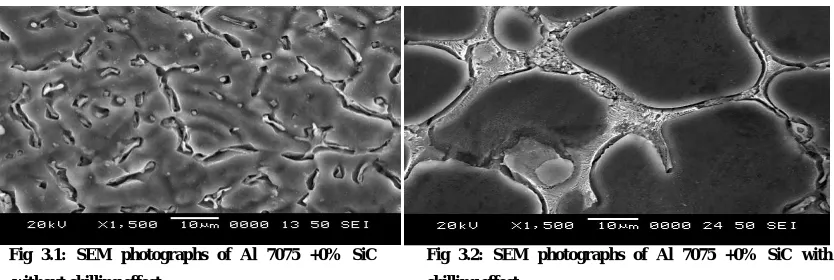
Fig 3.1: SEM photographs of Al 7075 +0% SiC
without chilling effect
Fig 3.2: SEM photographs of Al 7075 +0% SiC with
chilling effect
Fig 3.3: microstructure of Al 7075+2%SiC without
chill cast
Fig 3.4: microstructure of Al 7075+2%SiC with chill cast
Theabove micro structural images of Al 7075 + 2% SiC of without chilling effect and with chilling effect shows the finer grain size this results in the increase in the mechanical properties such hardness, impact strength and tensile strength compared to cast component. becuase of rapid solidification, the amount of solute rejection is more in case of with chill cast component therefore the grain size larger then the components of without chilling effect. In figure (3.3) it is observed that the finer microstructure and compact arrengment of graines compared to the figure (3.4). this indicates that the change in the physical properties of a material, in such a way that hardness, impact strength and tensile sterngth is increased in case of without chill cast component compared to with chill cast component.
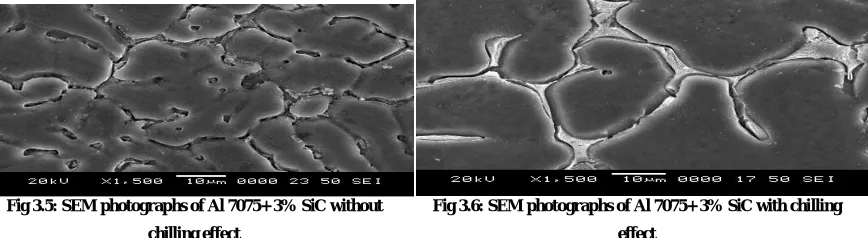
Fig 3.5: SEM photographs of Al 7075+ 3% SiC without
chilling effect
Fig 3.6: SEM photographs of Al 7075+ 3% SiC with chilling
effect
From above figure it is observed that the grain size of the material is found to be larger than the without chill cast component of same composition because of rapid cooling condition. In the figure white dendrite shows the distribution of SiC through the entire component. Fig (3.5) shows the microstructure of specimen at for without chilling effect and fig (3.6) shows the microstructure of same specimen of with chilling effect at. Because of rapid solidification the rejection of solute from the solidified alloy is more hence it forms the micro segregation. And this micro segregation will propagate under rapid cooling condition. Hence mechanical properties such as hardness, toughness and tensile strength were decreased in comparison with the component of without chilling effect.
Mechanical properties for without chilling effect
Table 3.1: Mechanical properties for without chilling effect
Sl no. Composition of material Hardness number
Impact strength
Tensile strength Ultimate
strength
Braking strength
1 Al 7075(250gm) 71 0.04 218.25 204.1
2 Al 7075 (300gm)+2% SiC 84 0.12 274.14 256.45
3 Al 7075 (300gm)+3% SiC 91 0.18 293.57 287.92
Mechanical properties for with chilling effect
Table 3.2: Mechanical properties for with chilling effect
Sl no. Composition of material Hardness number
Impact strength
Tensile strength
Ultimate strength
Braking strength
1 Al 7075(250gm) 69 0.02 203.39 185.7
2 Al 7075 (300gm)+2% SiC 74 0.06 226.38 208.34
3 Al 7075 (300gm)+3% SiC 85 0.08 265.29 248.37
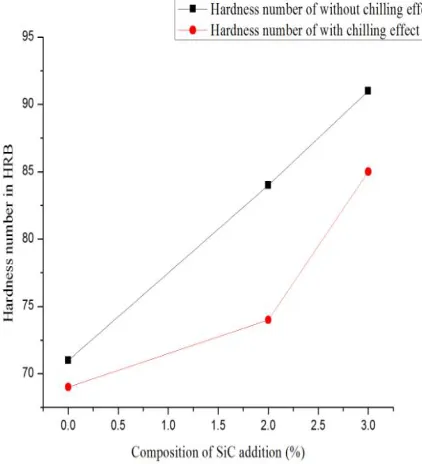
The Fig.3.7 and 3.8 shows the comparison of hardness number and impact strength of without and with chilling effect
at different addition levels of reinforcement material SiC respectively.
In comparison of hardness for both with chill cast component and without chill cast component, initially matrix material is of low hardness as because of larger grain size. Addition of 2% SiC into the matrix material Al 7075 reduces the grain size hence small increase in the hardness is found as mentioned in the above table. The hardness is increased to optimum level when the 3% SiC added into the matrix material, because it forms the finer grain size. In case of chill casting, under rapid cooling condition rejection of solute is more from the solidified alloy that forms the micro segregation. And also grain size is larger in case of chill cast component compared to without chill cast component. Hence it is important to note that, the early formed micro segregation will propagate under rapid cooling condition, hence hardness number decreases in chilled cast component in comparison with without chilled cast component.
In comparison of hardness for both with chill cast component and without chill cast component, initially matrix material is of low hardness as because of larger grain size. Addition of 2% SiC into the matrix material Al 7075 reduces the grain size hence small increase in the hardness is found as mentioned in the above table. The hardness is increased to optimum level when the 3% SiC added into the matrix material, because it forms the finer grain size. In case of chill casting, under rapid cooling condition rejection of solute is more from the solidified alloy that forms the micro segregation. And also grain size is larger in case of chill cast component compared to without chill cast component. Hence it is important to note that, the early formed micro segregation will propagate under rapid cooling condition, hence hardness number decreases in chilled cast component in comparison with without chilled cast component.
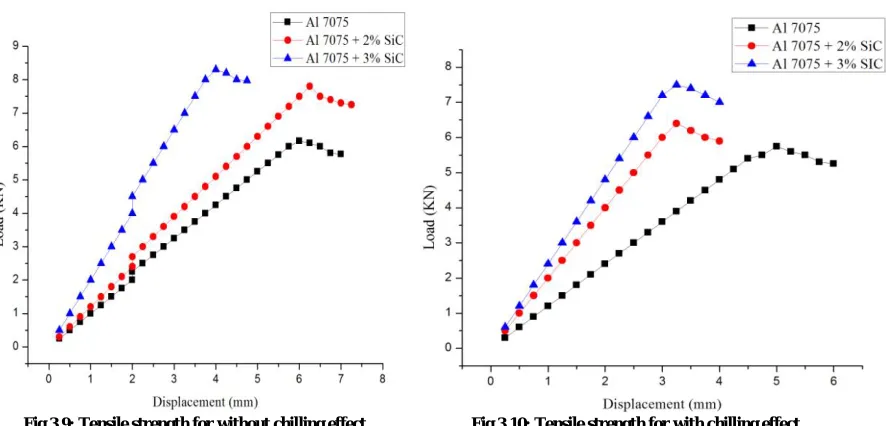
Fig.3.9 and 3.10 shows the tensile strength for without chilling and with chilling effect at different addition levels of reinforcement material SiC respectively.
Fig 3.9: Tensile strength for without chilling effect Fig 3.10: Tensile strength for with chilling effect
solidified alloy that forms the micro segregation. This rejected solute can be observed in the SEM photographs. And also grain size is larger in case of chill cast component compared to without chill cast component. Hence it is important to note that, the early formed micro segregation and blow holes which are formed during rapid solidification will propagate under rapid cooling condition, hence tensile strength decreases in chilled cast component in comparison with without chilled cast component.
V. CONCLUSIONS
The metal matrix composite material is prepared using chill casting by passing liquid nitrogen of -195.6o temperature through the pipe channel arrangement provided in order to check the mechanical properties of Al 7075 and also machinability property, as it’s having poor machinability property.
The metal matrix composite were prepared by both with chilling effect and without chilling effect for the addition of reinforcement material SiC in the range 0%, 2% and 3% in order to compare the results.
As the components primarily being with defects like blow hole and porosity they will propagate under the rapid cooling condition. And also because of rejection of solute from the solidified alloy into the liquid phase, forms the micro segregation and it will propagate under rapid cooling condition and reduce the mechanical properties of the material.
Because of these two above reasons it is to conclude that the impact strength, hardness and tensile strength are decreased in case of with chilled component in comparison with the without chilled component.
Grain size is found to be larger in case of with chilled component. Hence the mechanical properties may not be possible to increase under rapid cooling condition.
REFERENCES
[1]. Jie Dong, Jianzhong Cui, Fuxiao Yu, Chunyan Ban, And Zhihao Zhao “Effect of low-frequency electromagnetic casting on the castability, microstructure, and tensile properties of direct-chill cast al-zn-mg-cu alloy”. Metallurgical and Materials, Springer publication, volume 35a, august (2004) 2487-2494
[2]. Joel Hemanth “Quartz (SiO2) reinforced chilled metal matrix composite (CMMC) for automotive applications” Materials and Design Journal,
Elsevier publication (2009) 323–329.
[3]. Raghavendra N and V S Ramamurthy “Tribological characterization of al7075/al203/sic reinforced hybrid particulate metal matrix composite developed by stir casting process” International Journal of Recent advances in Mechanical Engineering (IJMECH) Vol.4, No.3, August (2015).113-127
[4]. W.J. Fleming a, J.M. Temis “Numerical simulation of cyclic plasticity and damage of an aluminium metal matrix composite with particulate SiC inclusions” International Journal of Fatigue 24 (2002) 1079–1088.
[5]. S. Kumar and V. Balasubramanian, “Effect of reinforcement size and volume fraction on the abrasive wear behaviourofaa7075al/sicp p/m composites—a statistical analysis” Tribology international 43, Elsevier publication, (2010) 414–422.
[6]. Ravinder Kumar, Suresh Dhiman “A study of sliding wears behaviors of Al-7075 alloy and Al-7075 hybrid composite by response surface methodology analysis” Materials and Design 50, Elsevier publication (2013) 351–359.
[7]. Sunday Aribo, Joseph Ajibade Omotoyinbo, Davies Oladayo Folorunso “High Temperature Mechanical Properties of Silicon Carbide Particulate Reinforced Cast Aluminum Alloy Composite” Leonardo Electronic Journal of Practices and Technologies ISSN 1583-1078. [8]. Y. Sahin A, K. Ozdin “A model for the abrasive wears behaviour of aluminium based composites” Materials and Design 29, Elsevier