How to cite this paper: Mohapatra, R.C. (2016) Study on Laminar Two-Dimensional Lid-Driven Cavity Flow with Inclined Side Wall. Open Access Library Journal, 3: e2430. http://dx.doi.org/10.4236/oalib.1102430
Study on Laminar Two-Dimensional
Lid-Driven Cavity Flow with
Inclined Side Wall
Ramesh Chandra Mohapatra
Mechanical Department, Government College of Engineering, Keonjhar, India
Received 21 February 2016; accepted 7 March 2016; published 11 March 2016 Copyright © 2016 by author and OALib.
This work is licensed under the Creative Commons Attribution International License (CC BY).
http://creativecommons.org/licenses/by/4.0/
Abstract
In this present work, a computational code is developed to solve a laminar two-dimensional lid driven cavity flow with inclined side wall. SIMPLE (Semi-Implicit Method for Pressure-Linked Eq-uation) algorithm based on finite volume method on staggered grid has been used. Differed QUICK (Quadratic Upstream Interpolation for Convective Kinematics) schemes have been implemented for all calculations. The results are presented for inclination angle β = 30˚, 45˚ and Re = 100, 1000 and are compared with Demirdzic et al. benchmark solution. By comparison, it is found that the results are in very good agreement with the benchmark solution for Re = 100. But the results are close to the benchmark solution for Re = 1000.
Keywords
Laminar, Reynolds Number, Lid-Driven Cavity, Benchmark, Inclined Side Wall
Subject Areas: Mechanical Engineering
1. Introduction
approxima-OALibJ | DOI:10.4236/oalib.1102430 2 March 2016 | Volume 3 | e2430 walls using SIMPLE algorithm. It is similar to driven cavity flow, but the geometry is a parallelogram rather than a square. In this case the skewness of the geometry can be easily changed by changing the skew angle. It is a perfect test case for body fitted non-orthogonal grids and yet it is as simple as the cavity flow in terms of pro-gramming point of view. The deferred correction scheme of Hayase et al. [8] uses a first order upwind scheme with a third order correction.
2. Lid-Driven Cavity Flow with Inside Side Wall
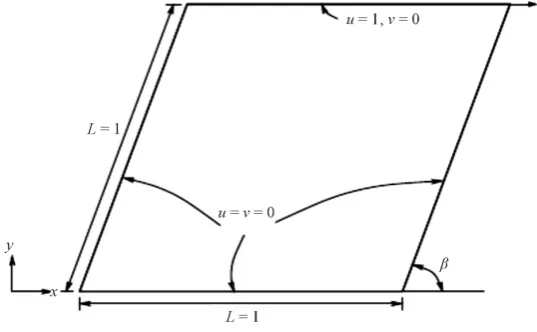
We consider the steady flow inside an inclined cavity whose upper lid is moving at constant velocity U. This classical problem has become a standard benchmark for assessing the performance of algorithms to solve the incompressible Navier-Stokes equations. The benchmark solution of Demirdzic et al. [7] provide a tool to check the accuracy of present solution in handling complex flows in a non-orthogonal grid. The domains of calcula-tions are a parallelogram with angle = 45˚ and =30˚. In both cases, lid velocity U = 1, cavity length L = 1 and Pr = 0.71. The geometry and the corresponding boundary conditions are shown in Figure 1.
3. Results and Discussions
To test the implementation of the non-orthogonal differencing schemes the code is used to solve the problem of two dimensional lid-driven cavity flow with inclined side wall provided as a benchmark test case by Demirdzic et al. [7]. The results are shown for Reynolds number 100 and 1000 for wall angle β = 45˚ and β = 30˚, using the deferred QUICK scheme of Hayase et al. [8]. The solution field is calculated using a mesh of 81 × 81 for Re = 100 and 101 × 101 for Re = 1000 and uniform grids are employed. The value of pressure under-relaxation factor αp is taken as 0.05 for Re = 100 and 0.01 for Re = 1000. The pseudo time step ∆τ is used as 0.01 for Re = 100
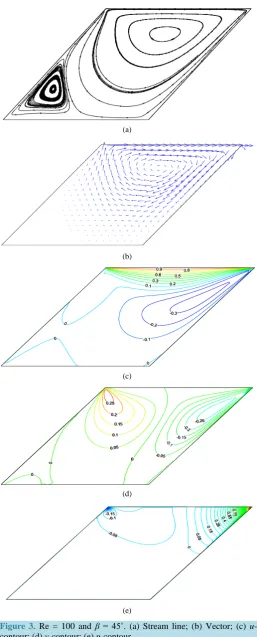
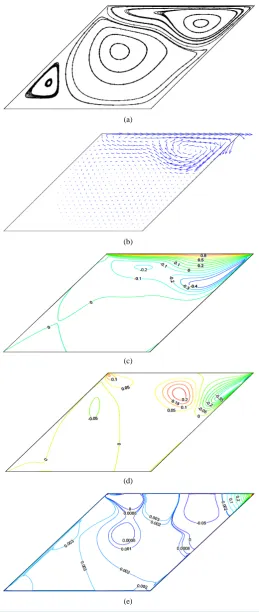
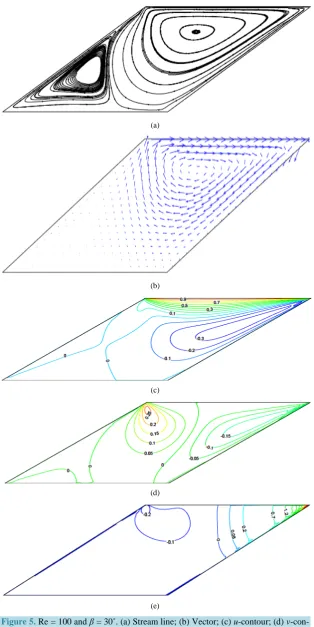
[image:2.595.178.447.542.708.2]and 1000. The u velocity profile along the vertical centerline of the cavity and v velocity profile along the hori-zontal centerline is shown in Figure 2 with the benchmark solutions of Demirdzic et al. [7] being included for comparison. The results are in good agreement with the benchmark solution for Re = 100. But the results are close to the benchmark solutions for Re = 1000. If the mesh size is increased, then solutions may match with the results of Demirdzic et al. for Re = 1000. Figure 3 to Figure 6 show the stream line and other contours for Re =100 and Re = 1000 and also for β = 30˚ and β = 45˚ respectively. It is seen from these contour figures that the solution obtained are very smooth without any wiggles in the contours. As Re increases from 100 to 1000, the
OALibJ | DOI:10.4236/oalib.1102430 4 March 2016 | Volume 3 | e2430 (a)
(b)
(c)
(d)
(e)
[image:4.595.185.443.78.717.2]OALibJ | DOI:10.4236/oalib.1102430 5 March 2016 | Volume 3 | e2430 (a)
(b)
(c)
(d)
(e)
[image:5.595.184.444.83.697.2]OALibJ | DOI:10.4236/oalib.1102430 6 March 2016 | Volume 3 | e2430 (a)
(b)
(c)
(d)
[image:6.595.157.472.81.709.2](e)
OALibJ | DOI:10.4236/oalib.1102430 7 March 2016 | Volume 3 | e2430 (a)
(b)
(c)
(d)
[image:7.595.162.465.79.702.2](e)
OALibJ | DOI:10.4236/oalib.1102430 8 March 2016 | Volume 3 | e2430 SIMPLE algorithm for complex geometry using non-orthogonal grid was described. To test the code it was used to solve the problem applied to lid driven cavity with inclined side wall and results were compared with the benchmark solution of Demirdzic et al. [7]. The results for Re = 100 and β = 45˚ & 30˚ were in good agreement with the benchmark solution. But u velocity along vertical centerline for Re = 1000 & β = 45˚ and v velocity along horizontal centerline for Re = 1000 & β = 30˚ did not match with the benchmark solution for 101 × 101 mesh size.
References
[1] Patankar, S.V. (1980) Numerical Heat Transfer and Fluid Flow. Hemisphere Publishing Co., New York.
[2] Ghia, U., Ghia, K.N. and Shin, C.T. (1982) High-Re Solutions for Incompressible Flow Using the Navier-Stokes Equa-tions and a Multigrid Method. Journal of Computational Physics, 48, 387-411.
http://dx.doi.org/10.1016/0021-9991(82)90058-4
[3] Van Doormall, J.P. and Raithby, G.D. (1984) Enhancements of the Simple Method for Predicting Incompressible Fluid Flows. Numerical Heat Transfer, 7, 147-163.
[4] Maliska, C.R. and Raithby, G.D. (1984) A Method for Computing Three Dimensional Flows Using Non-Orthogonal Boundary-Fitted Co-Ordinates. International Journal for Numerical Methods in Fluids, 4, 519-537.
http://dx.doi.org/10.1002/fld.1650040606
[5] Ostrach, S. (1988) Natural Convection in Enclosures. Journal of Heat Transfer 50th Anniversary Issue, 110, 1175- 1190. http://dx.doi.org/10.1115/1.3250619
[6] Thompson, J.F., Warsi, Z.U.A. and Mastin, C.W. (1985) Numerical Grid Generation. North Holland.
[7] Demirdzic, I., Lilek, Z. and Peric, M. (1992) Fluid Flow and Heat Transfer Test Problems for Non-Orthogonal Grids: Bench-Mark Solutions. International Journal for Numerical Methods in Fluids, 15, 329-354.
http://dx.doi.org/10.1002/fld.1650150306
[8] Hayase, T., Humphrey, J.C. and Greif, R. (1992) A Consistently Formulated QUICK Scheme for Fast and Stable Con-vergence Using Finite-Volume Iterative Calculation Procedures. Journal of Computational Physics, 98, 180-118. http://dx.doi.org/10.1016/0021-9991(92)90177-Z
Nomenclatures
Re: Reynolds number Pr: Prandtl number Nu: Nusselt numberβ: Volumetric expansion coefficients αp: Pressure under-relaxation factor
SIMPLE: Semi-implicit method for pressure-linked equation
![Figure 2. Comparison with u and v velocity with Demirdzic et al. [7]. u: velocity along vertical centre-line; v: velocity along horizontal centre-line](https://thumb-us.123doks.com/thumbv2/123dok_us/7989640.759026/3.595.94.538.76.695/figure-comparison-velocity-demirdzic-velocity-vertical-velocity-horizontal.webp)