http://dx.doi.org/10.4236/ajc.2015.34011
How to cite this paper: Tang, J. Q. (2015). Analysis on the International Situation and Evolution of Research: Quantitative Analysis on the SSCI Theses from 2005 to 2014. Advances in Journalism and Communication, 3, 100-109.
http://dx.doi.org/10.4236/ajc.2015.34011
Analysis on the International Situation and
Evolution of Research: Quantitative Analysis
on the SSCI Theses from 2005 to 2014
*
Jingqian Tang
Library of Jinan University, Guangzhou, China
Received 7 December 2015; accepted 24 December 2015; published 30 December 2015
Copyright © 2015 by author and Scientific Research Publishing Inc.
This work is licensed under the Creative Commons Attribution International License (CC BY). http://creativecommons.org/licenses/by/4.0/
Abstract
Bibliometrics and descriptive statistical analysis on the research papers published on the 74 kinds of journals of journalism and communication included in SSCI from 2005 to 2014 will be con-ducted through key variables, like annual distribution, regional distribution, research institution-al distribution, authors distribution, frontier of research, knowledge base and its evolution, sub-ject impact index, etc. From the qualitative and quantitative perspective, we will reveal the inter-national posture of journalism research and the interinter-national prestige and potential problems in studies of journalism and communication in Mainland China to promote the internationalization process of domestic journalism and communication research.
Keywords
Journalism and Communication, SSCI, Document Statistics and Analysis, Internationalization
1. Introduction
Journalism and communication is one of the most popular research directions in the humanities and social sciences and the internationalization of the research results is a major problem. In recent years, concerning Chi-na’s journalism and communication studies, the vision, and the scope of it has expanded, but the depth is insuf-ficient and the academic level is not high enough. Some scholars believe that strengthening method training and grasping the international theory research is the key to improving the academic level of China’s journalism and communication studies (Liao et al., 2014). Therefore, it is urgent to establish the international awareness of the
*This paper is one of the results of Jinan University Degree and Graduate Education Teaching and Research project “Scientific research
research on journalism and communication, to understand and master the research orientation, the research trends and the development trend of the international mainstream academic journals and representative results. However, the wave of big data is coming, mastering and using correctly the empirical research methods to deal with the mass of information is a challenge for the journalism and communication researchers. Science Citation Index Social (SSCI) is generally considered to be an important tool for collecting data from various fields of so-cial science. The number and level of the papers published in the journals included in the SSCI can reflect the degree of internationalization (Liu & Liu, 2009). Journalism and communication science is an important subject of SSCI, which is helpful to promote the development of domestic journalism and communication, and to pro-mote the international progress of the academic achievements and academic journals. Some scholars had carried on the analysis of the study of journalism and communication in China on the basis of SSCI. For example, Li Wu, Huang Pei and other scholars take the research papers of journalism and communication included in the SSCI, A&HCI and CPCI-SSH as the study subject, to dissert on the foreign new media research progress from several perspectives by using mapping knowledge domain (Li, Huang, & Li, 2013; Liu et al. 2013; Li, 2013). The analysis and discussion undoubtedly have given us great help to understand some part of the present inter-national situation of the research on journalism and communication science. However, there are still shortcom-ings on the aspects such as the holistic overview of journalism and communication studies, especially the study of the frontier, knowledge base and the whole evolution characteristics, and the effect of journalism and com-munication research on other disciplines, etc. In view of this, this paper takes research papers published on 74 kinds of journal of journalism and communication studies included in SSCI from 2005 to 2014 as research object. We try to answer the following questions: 1) what kinds of form features do journalism and communication study papers included in SSCI take on? What are the evolution characteristics of them? 2) What major issues do journal-ism and communication study papers included in SSCI concern? What is the frontier area, the knowledge base and the evolution of the research? 3) What are the implications of these papers on the research field of social science?
2. Data Sources and Analysis Methods
2.1. Data Sources
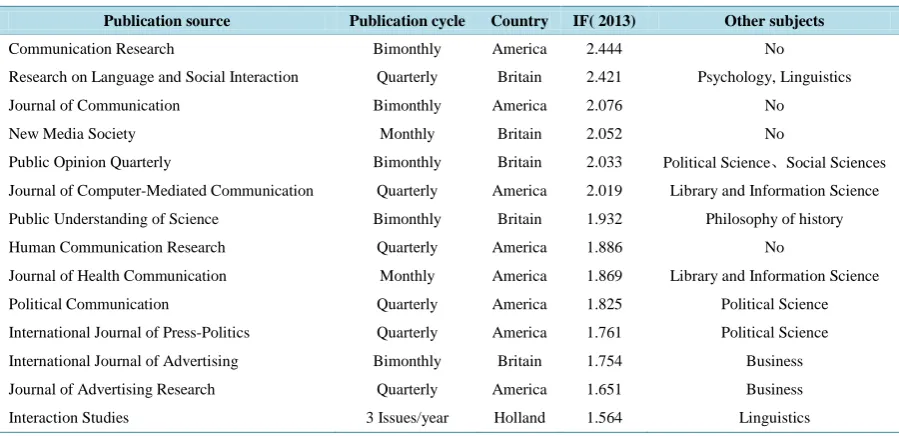
[image:2.595.87.537.506.724.2]JCR data show that there are 74 kinds of journal of journalism and communication included in the SSCI (38 in Britain, 25 in the United States, 4 in Holland, 3 in Germany, 1 in Spain, 1 in Switzerland, 1 in Australia, 1 in Slovenia). Concerning the research field they are involved, in addition to the research of journalism and com-munication, these journals are also involved in psychology, business, linguistics, library and information science, political science and other fields (Table 1). Retrieve simultaneously in the two fields of Publication Name and Published Year in SSCI. The preliminary retrieval results include 30,100 records and there are 20,647 of re-
Table 1. Journals of journalism and communication included in SSCI (IF > 1.5).
Publication source Publication cycle Country IF( 2013) Other subjects
Communication Research Bimonthly America 2.444 No
Research on Language and Social Interaction Quarterly Britain 2.421 Psychology, Linguistics
Journal of Communication Bimonthly America 2.076 No
New Media Society Monthly Britain 2.052 No
Public Opinion Quarterly Bimonthly Britain 2.033 Political Science、Social Sciences
Journal of Computer-Mediated Communication Quarterly America 2.019 Library and Information Science
Public Understanding of Science Bimonthly Britain 1.932 Philosophy of history
Human Communication Research Quarterly America 1.886 No
Journal of Health Communication Monthly America 1.869 Library and Information Science
Political Communication Quarterly America 1.825 Political Science
International Journal of Press-Politics Quarterly America 1.761 Political Science
International Journal of Advertising Bimonthly Britain 1.754 Business
Journal of Advertising Research Quarterly America 1.651 Business
search papers, 6878 of book reviews, others are conference abstracts, editorial material, communication and news, etc. After above retrieval, 20,647 of sample papers are obtained excluding editorials, news, biographies, book reviews, conference abstracts and other types of documents.
2.2. Methods and Tools
This paper will carry on analysis of the basic characteristics, research frontier, knowledge base, discipline influ-ence and other aspects of the papers in journalism and communication included in SSCI in order to answer the above questions. 1) For the basic characteristics of the papers, we select the annual distribution, national/re- gional distribution, research institutions, the authors distribution and other variables of sample papers to carry on statistical analysis by using Online Analyzer of SSCI database; 2) For the research frontier of the papers, we se-lect the author key words of sample papers (Author Keyword field in SSCI database) to carry on data processing and statistical analysis by using Endnote, Excel and Citespace. 3) For the knowledge base of the papers, we se-lect the reference literature (References Cited field in SSCI database) of sample papers and use Citespace soft-ware to carry on the visual analysis, and use Excel and Endnote to carry out data processing and statistical anal-ysis; 4) For the discipline influence of the papers, we select literature from sample papers(Citing Articles field in SSCI database) to carry on citation analysis to reveal the impact of journalism and communication studies in-cluded in SSCI on other social sciences field.
3. Data Analysis
3.1. Basic Features of Journalism and Communication Research Papers
The total number of journalism research papers published on 74 kinds of journals during 2005-2014 is 20,647 and the annual distribution and change trend is shown in Figure 1. The data shows that the annual output of the research papers in the field of journalism and communication studies is stable and the average output is about 192 every year in the 10 years. These papers are from 115 countries/regions respectively, showing a trend of fo-cus on a small number of countries/regions. The total number of papers of the top 10 countries is 18,317 which ac-counts for 88.72% of the total. Among them, a total of 10,903 papers of the United States accounted for 52.81% of the total (see Table 2), which is the most. It is worth noting that, although the data in Table 2 shows that China (not including Taiwan) ranks ninth place with 586 papers, but there are only 183 published papers, of which the first author or the corresponding author are from mainland China. The number of papers published by the author from Hong Kong is 259 and from Macao District is 20. There are 124 papers for cooperation. This indicates that the international visibility and influence level of the research achievement of journalism and communication in the Mainland China is very low and the research level is not only significantly behind the western developed countries, such as the United States and other western countries, but also there is a big gap behind Hong Kong. One of the important obstacles may be the language problem: English in the SSCI papers accounted for the absolute advantage. In the sample papers there are 20,245 ones are written in English, ac-counting for 98.05% of the total. In addition, China has not yet any kind of periodical of journalism and com-munication studies to be collected by SSCI, which also greatly restricted the pace of the research results of Chi-na’s journalism and communication studies to the world.
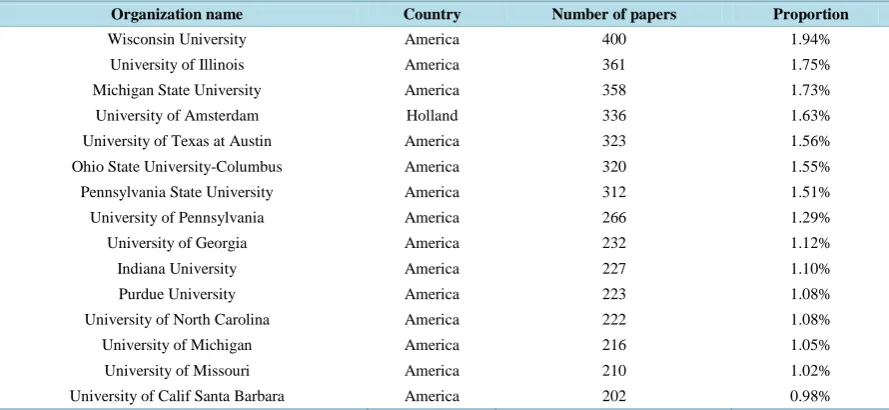
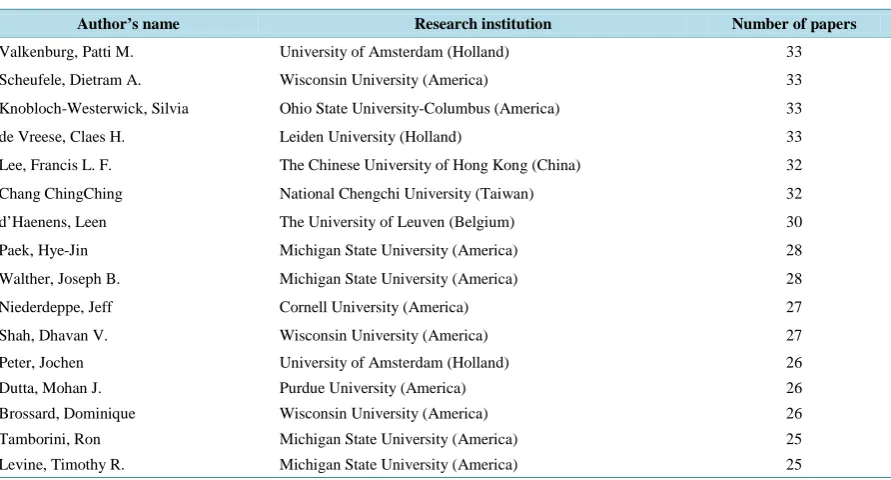
The research status of representative writers group in a certain subject field reflects the trend of the research in this field. We can grasp the depth and breadth of the research field of journalism and communication by ana-lyzing those representative writers group. From the ranking of the number of papers published by the Research Institute (see Table 3), we can see there are 9 American universities published more than 200 papers, which in-dicates that the United States occupies the leading place in the research field of the international journalism and communication. From the number of papers published by the author (see Table 4), we can see there are 16 people published more than 25 papers, among whom 10 are from the United States, 3 from Holland, 1 each from Hong Kong, Taiwan and Belgium. There is no doubt that these scholars, especially from the United States, are the leading figures in the study of journalism and communication, and have an immeasurable effect on the pro-motion of its research.
3.2. Frontier and Knowledge Base of Journalism and Communication Research Papers
Figure 1.Annual distribution of the journalism and communication papers.
Table 2. Countries/regions distribution of the journalism and communication papers (Top 10).
Countries/Regions Number of papers Proportion Cumulative ratio
America 10,903 52.81% 52.81%
Britain 1694 8.21% 61.01%
Australia 1384 6.70% 67.72%
Holland 925 4.48% 72.20%
Canada 730 3.54% 75.73%
Germany 631 3.06% 78.79%
Spain 598 2.90% 81.68%
China (including Hong Kong, Macao) 586 2.84% 84.52%
Korea 490 2.37% 86.89%
Belgium 376 1.82% 88.72%
Table 3. Research Institute distribution of the journalism and communication papers (number of papers > 200).
Organization name Country Number of papers Proportion
Wisconsin University America 400 1.94%
University of Illinois America 361 1.75%
Michigan State University America 358 1.73%
University of Amsterdam Holland 336 1.63%
University of Texas at Austin America 323 1.56%
Ohio State University-Columbus America 320 1.55%
Pennsylvania State University America 312 1.51%
University of Pennsylvania America 266 1.29%
University of Georgia America 232 1.12%
Indiana University America 227 1.10%
Purdue University America 223 1.08%
University of North Carolina America 222 1.08%
University of Michigan America 216 1.05%
University of Missouri America 210 1.02%
[image:4.595.93.538.509.714.2]Table 4. Authors distribution of the journalism and communication papers (number of papers > 25).
Author’s name Research institution Number of papers
Valkenburg, Patti M. University of Amsterdam (Holland) 33
Scheufele, Dietram A. Wisconsin University (America) 33
Knobloch-Westerwick, Silvia Ohio State University-Columbus (America) 33
de Vreese, Claes H. Leiden University (Holland) 33
Lee, Francis L. F. The Chinese University of Hong Kong (China) 32
Chang ChingChing National Chengchi University (Taiwan) 32
d’Haenens, Leen The University of Leuven (Belgium) 30
Paek, Hye-Jin Michigan State University (America) 28
Walther, Joseph B. Michigan State University (America) 28
Niederdeppe, Jeff Cornell University (America) 27
Shah, Dhavan V. Wisconsin University (America) 27
Peter, Jochen University of Amsterdam (Holland) 26
Dutta, Mohan J. Purdue University (America) 26
Brossard, Dominique Wisconsin University (America) 26
Tamborini, Ron Michigan State University (America) 25
Levine, Timothy R. Michigan State University (America) 25
academic community. The key words and their frequency distributions are often used to reveal the subject areas of their research (Chen, 2006). If we take a series of related issues and concepts concerned by the highly cited papers lately published in the last several years as the latest developments in the field, then the references of the frontier study form their knowledge base (Persson, 1994). Therefore, through statistics and analysis of the highly cited papers and keywords of the references of these papers published during 2005-2014, we reveal the frontiers, knowledge base and the evolution process of the journalism and communication research
3.2.1. Analysis of the Frontier Areas of Journalism and Communication Research Papers
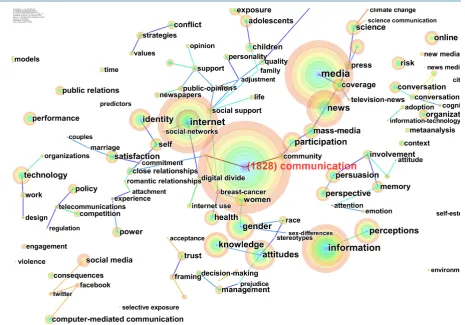
Statistics indicates that during 2005-2014 there are 14,389 SSCI papers quoted more than once in journalism and communication research, which accounted for 69.69% of the total number of the sample papers. The highest cited times of a single paper was 659. The total number of keywords in these 14,389 papers was 36,038 (the av-erage number of keywords in each paper is 2.5). After classification, summarization and eliminating numbers, symbols and words that means nothing substantive to the journalism and communication study area, the results of using Citespace software to do visualization analysis are shown as Figure 2. In particular, the keywords with frequency more than 600 times are in Table 5. After using Citespace to further analyze the link between high frequency keywords, we found that (Figure 2): communication, media, Internet, information, has been the re-search hotspots of journalism and communication in recent ten years. In recent years, the main focus of the fron-tier areas of journalism and communication research is on the following areas: 1) the study mainly on news ports. The study mainly concerns the application of mass-media in the news reports, the media of the news re-ports, press and the news reports of journalism and communication in the field of natural science, such as cli-mate change, etc.; 2) in social support area, the study mainly concerns stress, adjustment of personality and quality, physical and mental health of family, children, adolescents and women, etc., such as depression, breast- cancer, et al.; 3) The study on interpersonal relationship including close relationship and romantic relationship, etc.; 4) through analysis of the sharp changes of key words We can find the new research areas of journalism and communication , such as the application of Twitter, Facebook and other social media and computer media on journalism and communication.
3.2.2. Analysis of the Knowledge Base of Journalism and Communication Research
Figure 2. Relation map of high frequency keywords from high cited papers.
Table 5.High frequency keywords from high cited papers (frequency > 600).
Keywords Frequency Keywords Frequency
Business 2048 Television 822
Linguistic 1854 Language & Linguistic 820
Information Science & Library Science 1842 Culture Studies 810
Media 1595 Model 805
Film, Radio, Television 1418 Impact 710
Psychology, Social 1344 Gender 669
Internet 1256 Health Policy & Services 647
Sociology 1210 Discourse 642
Information 1084 Management 640
Political Science 998 Telecommunications 623
Behavior 914 Knowledge 619
News 902 Perceptions 603
[image:6.595.87.538.441.625.2]Figure 3.Relation map of high frequency documents of the journalism and communication papers.
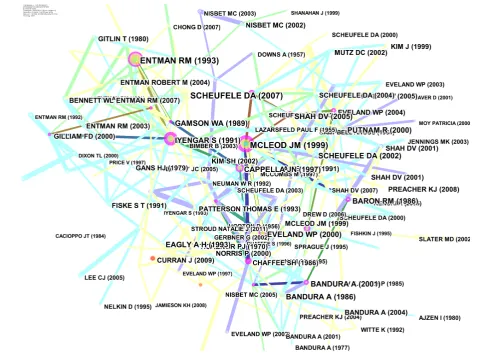
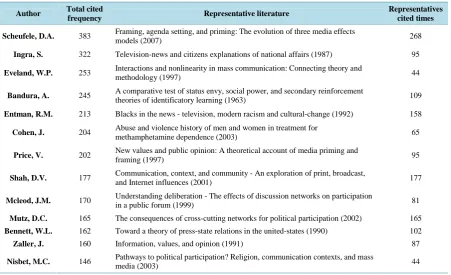
context and community. For example, Scheufele, D.A. discusses the evolution of the following three models: framework, agenda setting and prediction (Scheufele & Tewksbury, 2007). Another example, Iyengar, S. studies the impact of television news on the citizen cognition of international affairs (Iyengar, 1987). 3) Concerning the relationship between the reference and the cited (see Figure 3 and Figure 4), these core reference documents still have a guiding significance on today’s journalism and communication study and are the focus of the fol-low-up study. And there is also an academic inheritance relationship between these core reference documents which shows a clear knowledge accumulation effect.
4. Influence of Journalism and Communication Papers by Subject Category
Figure 4. Relation map of high frequency authors of the journalism and communication papers.
Table 6. High frequency authors and their representative literatures of journalism and communication papers (Top 20).
Author Total cited
frequency Representative literature
Representatives cited times Scheufele, D.A. 383 Framing, agenda setting, and priming: The evolution of three media effects
models (2007) 268
Ingra, S. 322 Television-news and citizens explanations of national affairs (1987) 95
Eveland, W.P. 253 Interactions and nonlinearity in mass communication: Connecting theory and
methodology (1997) 44
Bandura, A. 245 A comparative test of status envy, social power, and secondary reinforcement
theories of identificatory learning (1963) 109
Entman, R.M. 213 Blacks in the news - television, modern racism and cultural-change (1992) 158
Cohen, J. 204 Abuse and violence history of men and women in treatment for
methamphetamine dependence (2003) 65
Price, V. 202 New values and public opinion: A theoretical account of media priming and
framing (1997) 95
Shah, D.V. 177 Communication, context, and community - An exploration of print, broadcast,
and Internet influences (2001) 177
Mcleod, J.M. 170 Understanding deliberation - The effects of discussion networks on participation
in a public forum (1999) 81
Mutz, D.C. 165 The consequences of cross-cutting networks for political participation (2002) 165
Bennett, W.L. 162 Toward a theory of press-state relations in the united-states (1990) 102
Zaller, J. 160 Information, values, and opinion (1991) 87
Nisbet, M.C. 146 Pathways to political participation? Religion, communication contexts, and mass
[image:8.595.89.541.447.722.2]Continued
Norris, P. 139 “To entertain, inform, and educate”: Still the role of public television (2001) 45
Prior, M. 138 Post-Broadcast Democracy: How Media Choice Increases Inequality in Political Involvement and Polarizes Elections (2007) 138
Chaffee, S.H. 122 Political knowledge and the campaign media of 1992 (1994) 96
Cappella,
J.N. 113
Argument repertoire as a reliable and valid measure of opinion quality: Electronic
dialogue during campaign 2000 (2002) 56
Ajzen, I. 109 Attitudes, personality and behavior (1988) 103
Petty, R.E. 108 Mass media attitude change: implications of the elaboration likelihood model of
persuasion (2002) 41
Zillmann, D. 106 Female responses to provocation after exposure to aggressive and erotic films
[image:9.595.87.539.246.563.2](1978) 20
Table 7. Distribution of journalism and communication citing articles (Top 20).
Subject category Citation quantity Proportion
Psychology 8999 21.036
Communication 8769 20.498
Business Economics 5166 12.076
Public Environmental Occupational Health 3024 7.069
Computer Science 2922 6.83
Social Sciences Other Topics 2913 6.809
Linguistics 2388 5.582
Sociology 2306 5.39
Information Science Library Science 2289 5.351
Government Law 2227 5.206
Education Educational Research 2102 4.914
Health Care Sciences Services 1648 3.852
Engineering 1282 2.997
Environmental Sciences Ecology 1202 2.81
Psychiatry 735 1.718
Biomedical Social Sciences 677 1.583
Family Studies 675 1.578
General Internal Medicine 651 1.522
Public Administration 579 1.353
Substance Abuse 552 1.29
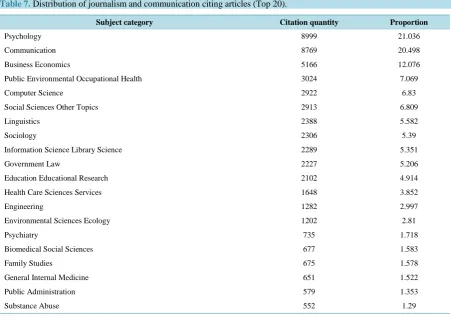
tensive and the interdisciplinary study of the journalism and communication is becoming more and more po-werful.
5. Discussion
communication shows the characteristic of problem-solving orientated and the micro application based, which pays great attention to the guiding role of the research on the educational practice, and has a relatively clear knowledge accumulation and academic inheritance path; 4) The influence of journalism and communication studies on other subjects is increasing, which shows the interdisciplinary characteristics of social science re-search from another side.
Through comparative analysis of domestic journalism and communication studies, we find the following phenomena and problems: 1) The international visibility and international level of the domestic journalism and communication studies are relatively low and the number of papers written by the authors from mainland China is only 183 among 14,389 samples. Although it may be related to the factors such as periodical source and lan-guage barrier, the key lies in the theory of the research itself is not strong and the depth of the research is not enough. 2) Domestic journalism and communication studies tend to take a more macro perspective and many research papers have been staying at the basic study on the theory of journalism and communication, business knowledge and development model, without reflecting the practical application of journalism and communica-tion. Furthermore, the specific practice of journalism and communication in the business, economic and social livelihood and other areas needs to be strengthened. 3) The achievements of the domestic journalism and com-munication studies are more simple repetition and show obvious characteristics of knowledge fragmentation. Their theoretical foundation is weak and their effect on the knowledge accumulation and development of the journalism and communication is not obvious. 4) In the 20,647 journalism and communication research papers, only 234 papers were co-authored by Chinese authors and foreign authors, which showed deficiency in interna-tional cooperation and exchange. In order to change this situation, the researchers of journalism and communi-cation need to establish the international awareness, to track and learn from the advanced research results and methods, to optimize the main content, structure and discipline distribution, to strengthen international coopera-tion and academic exchanges, and to strive to improve the internacoopera-tional status of domestic journalism and com-munication studies and academic visibility on the basis of focusing on the specific situation in China.
References
Chen, C. M. (2006). Citespace II: Detecting and Visualizing Emerging Trends and Transient Patterns in Scientific Literature.
Journal of the American Society for Information Science & Technology, 57, 359-377.http://dx.doi.org/10.1002/asi.20317
Iyengar, S. (1987). Television News and Citizens’ Explanations of National Affairs. American Political Science Review, 81,
815-831.http://dx.doi.org/10.2307/1962678
Li, W. (2013). The Publication Trends of the International Journal of Journalism and Communication: Measurement
Analy-sis on the SSCI Articles. Publishing Research, 1, 85-89.
Li, W., Huang, P., & Li, X. J. (2013). International Research Advance of New Media Based on Mapping Knowledge
Do-main. Journal of Beijing University of Posts and Telecommunications (Social Sciences Edition), No. 2, 18-24.
Liao, S. Q., Shen, Q., Liu, C. Y. et al. (2014). Journalism and Communication Studies of China Mainland from 1998-2012.
Journalism Bimonthly, 6, 70-82.
Liu, L., & Liu, N. C. (2009). Bibliometric Analysis of SSCI Publications of China from 1978-2007. Information Science, 10,
1590-1594.
Liu, Z. X., Liu, N. H., Ma, K. et al. (2013). Review of Journalism and Communication Research in China of the Year:
Anal-ysis Based on 9 Kinds of CSSCI Journals. Modern Communication (Journal of Communication University of China), 3,
41-48.
Persson, O. (1994). The Intellectual Base and Research Fronts of JASIS 1986-1990. Journal of the American Society for
In-formation Science, 45, 31-38.http://dx.doi.org/10.1002/(SICI)1097-4571(199401)45:1<31::AID-ASI4>3.0
Scheufele, D. A., & Tewksbury, D. (2007). Framing, Agenda Setting, and Priming: The Evolution of Three Media Effects