S T U D Y P R O T O C O L
Open Access
The effect of changing stool collection processes
on compliance in nationwide organized screening
using a fecal occult blood test (FOBT) in Korea:
study protocol for a randomized controlled trial
Hye Young Shin
1, Mina Suh
1, Hyung Won Baik
1,2, Kui Son Choi
1, Boyoung Park
1, Jae Kwan Jun
1*, Chan Wha Lee
3,
Jae Hwan Oh
4, You Kyoung Lee
5, Dong Soo Han
6and Do-Hoon Lee
7Abstract
Background:Colorectal cancer (CRC) screening by fecal occult blood test (FOBT) significantly reduces CRC mortality, and compliance rates directly influence the efficacy of this screening method. The aim of this study is to investigate whether stool collection strategies affect compliance with the FOBT.
Methods/Design:In total, 3,596 study participants aged between 50 and 74 years will be recruited. The study will be conducted using a randomized controlled trial, with a 2 × 2 factorial design resulting in four groups. The first factor is the method of stool-collection device distribution (mailing vs. visiting the clinic) and the second is the type of stool-collection device (sampling kit vs. conventional container). Participants will be randomly assigned to one of four groups: (1) sampling kit received by mail; (2) conventional container received by mail; (3) sampling kit received at the clinic; (4) conventional container received at the clinic (control group). The primary outcome will be the FOBT compliance rate; satisfaction and intention to be rescreened in the next screening round will also be evaluated. The rates of positive FOBT results and detection of advanced adenomas or cancers through colonoscopies will also be compared between the two collection containers.
Discussion:Identifying a method of FOBT that yields high compliance rates will be a key determinant of the success of CRC screening. The findings of this study will provide reliable information for health policy makers to develop evidence-based strategies for a high compliance rate.
Trial registration:CRIS: KCT0000803
Date of registration in primary registry: 9 January, 2013.
Keywords:Colorectal cancer, Colorectal neoplasm, Early detection of cancer, Fecal occult blood test, Randomized control trial, Factorial design
Background
Colorectal cancer (CRC) is a major health care concern worldwide, with a high incidence and mortality rate. About 1.23 million new cases of CRC and 608,000 asso-ciated deaths were estimated worldwide in 2008 [1]. In developed western countries, CRC mortality and inci-dence are decreasing, while the inciinci-dence remains high
in Asian countries such as Japan, China, South Korea, and Singapore [2,3]. In Korea, CRC caused 25,782 new cases (35.9 per 100,000) and 7,645 (10.4 per 100,000) deaths in 2010 [4].
Based on reports that CRC screening by a fecal oc-cult blood test (FOBT) significantly reduces CRC mor-tality [5-8], several countries have implemented FOBT screening at the national or regional level [9]. In England, the National Health Service Bowel Cancer Screening Program (NHSBCSP) adopted a biennial guaiac-based FOBT for those aged 60 to 75 [10]. In * Correspondence:[email protected]
1
National Cancer Control Institute, National Cancer Center, 323 Ilsan-ro, Ilsandong-gu, Goyang, Gyeonggi-do 410-769, Republic of Korea Full list of author information is available at the end of the article
Korea, the National Cancer Screening Program (NCSP) offers annual fecal immunochemical testing (FIT) to people aged 50 years or older [11].
Although a FOBT is relatively simple, inexpensive, and noninvasive compared to colonoscopy, the rate of FOBT screening varies from 20% to 71% among coun-tries [9]. In Korea in 2012, the rate of FOBT screening was only 25.7% [12]. Several barriers, including health system, provider, and patient factors, contribute to the low rate of FOBT screening [13-16]. In Korea, the system-related barriers to an efficient screening process have been reported to be the requirement for two con-secutive clinic visits to receive the stool device and sub-mit the sample, and the use of a stool container that has a short, thick sampling probe to collect stool sam-ples [17]. To overcome these barriers, two interven-tions are being considered. The first is to distribute stool-collection devices by mail, which requires only one clinic visit to submit the sample. The second is to provide a stool sampling kit consisting of a small test tube including a longer, thinner sampling probe that is easier to poke into the stool to collect stool specimens. Through these interventions, this study will determine the most effective strategy to increase compliance and satisfaction in FOBT screening. This determination is based on the assumption that changing the stool-collection process (especially as regards the type of stool-collection device) will not affect the results of FOBTs, but may affect compliance and satisfaction. We will therefore compare the rates of positive FOBT re-sults between the two stool devices to validate our assumptions.
Methods
Trial design
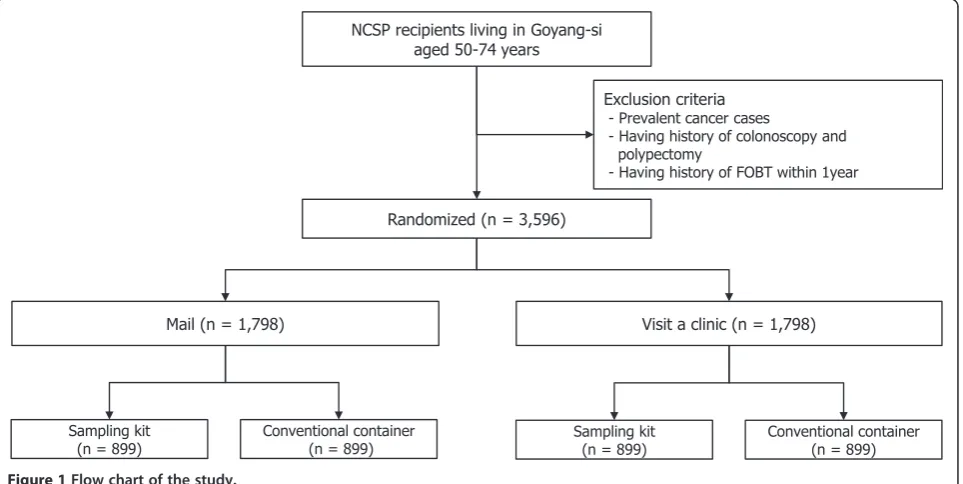
The study will be conducted using a 2 × 2 factorial ran-domized control trial (RCT) design resulting in four groups. The first factor is the two methods of distribut-ing stool devices (maildistribut-ing vs. visitdistribut-ing a clinic), and the other is the two stool devices (sampling kit vs. conven-tional container). Thus, the study will be composed of four groups from two factors (allocation ratio1:1:1:1): (1) sampling kit received by mail; (2) conventional container received by mail; (3) sampling kit received at the clinic; (4) conventional container received at the clinic (control group) (Figure 1).
Participants
Individuals aged 50 to 74 years living in Goyang will be recruited from February 2013 to February 2015. The National Cancer Center (NCC) in Goyang has sufficient resources to screen all NCSP recipients living in the Goyang urban area. The study will take place at the NCC Center for Cancer Prevention and Detection. Invi-tation letters including a brief description of FOBT screening and the purpose of the study will be mailed to target participants, and those who want to participate in the study will provide verbal consent via telephone. After study staff confirms that they meet the study criteria, eli-gible participants will be randomly allocated to one of four groups. Written informed consent will be obtained from all participants upon visiting the clinic to submit stool specimens within two weeks after receiving a stool device. Exclusion criteria include: a prior diagnosis with any cancer including colorectal cancer; a history of colonoscopy or
NCSP recipients living in Goyang-si aged 50-74 years
Randomized (n = 3,596)
Exclusion criteria
- Prevalent cancer cases
- Having history of colonoscopy and polypectomy
- Having history of FOBT within 1year
Mail (n = 1,798) Visit a clinic (n = 1,798)
Sampling kit (n = 899)
Conventional container (n = 899)
Sampling kit (n = 899)
[image:2.595.59.541.484.726.2]Conventional container (n = 899)
polypectomy; or a history of a FOBT more recent than one year. Ethical approval has been obtained from the Institu-tional Review Board at the NCC (NCCNCS-12-683).
Interventions
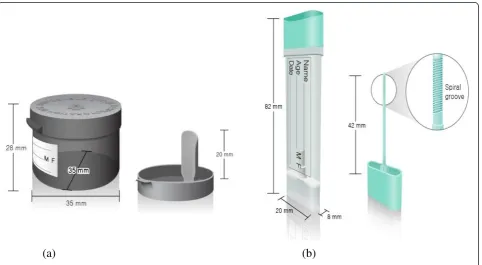
There will be four groups: sampling kit received by mail, conventional container received by mail, sam-pling kit received at the clinic, and conventional con-tainer received at the clinic (control group). Sampling kits are being purchased from Eiken Chemical Co., Ltd., Tokyo, Japan. Compared to the currently used conventional container, the new sampling kit is thinner and smaller, with a thin (4.2 cm long) sampling probe attached to the cap that allows easier insertion into the stool. The tip of the sampling probe has a spiral groove to collect stool specimens (Figure 2). The sampling probe with the collected stool (approximately 10 mg) may then be reinserted into the kit. These stool speci-mens are analyzed in an OC-SENSOR DIANA machine (Eiken Chemical Co., Ltd., Tokyo, Japan) designed for quantitative immunochemical FOBTs and the sampling kits fit this equipment. Stool specimens in conven-tional containers are transferred to sampling kits for immunochemical FOBTs at the laboratory because the conventional containers do not fit the analyzer. Mailed sampling kits or conventional containers will include an instruction leaflet. All participants who receive stool devices will be instructed in methods of stool col-lection via telephone or face-to-face by research staff.
Outcome measures
The primary outcome will be compliance with FOBT screening; compliance will be defined as the proportion of individual participants who submit stool specimens to the National Cancer Center within two weeks following receipt of collection devices. The secondary outcome will be participant satisfaction and intention to be rescreened in the next screening round as assessed by questionnaire at the clinic. The questionnaire will use a five-point Likert scale (1 = strongly disagree, 2 = disagree, 3 = uncer-tain, 4 = agree, 5 = strongly agree) with three dimensions: satisfaction with each process, from receiving stool de-vices to submission of specimens at the clinic; overall satisfaction with the entire process; and intention to be rescreened. The tertiary outcome will be the rates of positive FOBT results using sampling kits vs. conven-tional containers. Positive results are defined as those ex-ceeding 100 ng/mL blood. All participants who undergo FOBT will be informed of the screening results via mail within three weeks, and those whose results are positive will be recommended to undergo colonoscopy. Colonos-copy or further biopsy for abnormal lesions will be per-formed by highly qualified colonoscopists upon provision of written consent at the NCC. Histopathological results will allow comparison of the detection rates of advanced adenoma or cancer between sampling kits and conven-tional containers. All outcomes of the study will be ex-plained to respondents upon interview and prior to obtaining written informed consent.
[image:3.595.59.542.455.720.2](a)
(b)
Sample size calculation
Study participants will be divided into two groups ac-cording to the method of receiving the stool-collection device. To determine the sample sizes of two groups, we will establish the null hypothesis (H0) and alternative
hy-pothesis (H1) using the difference p1-p2, where p1is the
expected compliance rate in the group receiving collec-tion devices by mail and p2is the expected compliance rate in those receiving them at a clinic.
H0:p1¼ p2ðδ¼p1−p2¼0Þvs: H1:p1>p2ðδ¼p1−p2>0Þ
The expected compliance rate of participants visiting a clinic is based on that observed in 2010 by the NCSP, which was 30.8%, and the compliance rate of participants receiving stool devices by mail is estimated at 36% based on the assumption that the rate will be at least 5% greater.
N¼
Zα
2
ffiffiffiffiffiffiffiffiffiffiffiffiffiffiffiffiffiffiffiffiffiffiffiffiffiffiffiffiffi
rþ1
ð Þp 1ð −pÞ
p
þZβ ffiffiffiffiffiffiffiffiffiffiffiffiffiffiffiffiffiffiffiffiffiffiffiffiffiffiffiffiffiffiffiffiffiffiffiffiffiffiffiffiffiffiffiffirp1ð1−p1Þ þp2ð1−p2Þ
p
n o2
r pð 1−p2Þ2
Based on the above formula, 1,398 people will be needed in each group to detect the differencep1-p2in the propor-tions using a two-tailed test and 80% power (1-β) at a 5% significance level. However, continuity correction tests will be needed to estimate very closely approximate values, and thereby a sample size of 1,438 in each group will be re-quired. Finally, to allow for a 20% loss to follow-up, we will enroll an additional 350 participants per group, resulting in a final total for each group of 1,798 participants; thus, a total of 3,596 participants will be enrolled in the study.
Randomization
After providing verbal consent by telephone, those who are eligible will be allocated to one of four groups by a computer-generated randomization program using the SAS 9.2 statistical software (SAS Institute, Inc., Cary, NC, USA). The sequence will be generated by simple randomization. Participants will be subjected to different trial conditions depending on the number they are allocated.
Statistical analysis
Compliance rates for FOBT screening will be compared among the four groups by a chi-square test. The satisfac-tion and intent to rescreen using a FOBT will be assessed by analysis of variance (ANOVA). The rates of positive FOBTs and the rates of advanced adenoma or cancer de-tected by colonoscopy using the different stool devices will also be analyzed by a chi-square test. The adjusted odds ra-tios (ORs) and 95% confidence intervals (CIs) of each out-come will be calculated using multiple logistic regression. All data will be analyzed using the SAS software, version 9.2 (SAS Institute, Inc., Cary, NC, USA).
Study integrity
This study will use a randomized study design to evaluate whether distribution using mail delivery and an improved stool-collection device increase FOBT screening compli-ance. Participants will be recruited through letters of invi-tation and randomly assigned to one of four groups (three interventions and one control group). Participants will be included only if they submit a stool sample to the NCC in person within two weeks after receiving a stool device, and these participants will be rewarded with small gifts. To maintain consistency in data collection, we will assign two well-trained research staff members to oversee data man-agement, supervise all steps, and train assistant staff throughout the study duration.
Data management
All information collected will be covered by the Personal Information Protection Act. Participants’personal infor-mation such as name, identification number, and contact number will be not used until they have signed a con-sent form. Research staff will manage all information to ensure confidentiality under the personal data regula-tions. Participants’identifiable data will be retained only until the end of the study. Any information will be elimi-nated upon participant request.
Discussion
All Koreans aged 50 years or older are screened for CRC using a FOBT by the National Cancer Screening Program (NCSP). The success of this program relies on the rate of compliance, which has not been satisfactory. Likely fac-tors contributing to low compliance include the time-consuming nature of the stool-collection process and its inconvenience. Therefore, this study will evaluate two modifications to the stool-collection process to increase compliance, which relies on two assumptions. First, the time savings and convenience of the mailing intervention increase the accessibility of FOBT screening. Second, the sampling kit reduces the inconvenience and embarrass-ment involved in stool sampling.
A potential limitation of this study is that it is limited to an urban area. The NCSP covers all of Korea, whereas we will carry out the study in one city, with a population of almost 1 million. This population may not reflect the characteristics of those residing in rural areas or small cit-ies, who are in greater need of screening and have less ac-cess to health care. However, mailing of stool-collection devices has been shown to be effective in increasing com-pliance in FOBT screening [18], and may have an even greater effect in rural areas or small cities.
NCSP’s population and resources will enable generalization of the study outcomes to the Korean population. The cost-effectiveness of CRC screening, FOBT compliance and de-tection rates of adenoma or cancer will also be estimated for the general population. Finally, this study will provide information for policy makers to develop evidence-based strategies for use across the health care system. Further-more, application of the Consolidated Standards of Reporting Trials (CONSORT), which require that check-lists and flow diagrams be included in publications of trial results [19], will provide more reliable and valid evi-dence to health policy decision makers.
Trial status
The trial started in February 2013.
Abbreviations
ANOVA:analysis of variance; CI: confidence interval; CONSORT: Consolidated Standards of Reporting Trials; CRC: colorectal cancer; FIT: fecal
immunochemical test; FOBT: fecal occult blood test; NCC: National Cancer Center; NCSP: National Cancer Screening Program; NHSBCSP: National Health Service Bowel Cancer Screening Program; OR: odds ratio; RCT: randomized controlled trial.
Competing interests
The authors declare that they have no competing interests.
Authors’contributions
JKJ conceptualized and designed this study. KSC, DSH, and YKL assisted in the development of the study design and study materials. HYS, HWB, DHL, CWL, and JHO will implement this study from enrolling participants to gathering data and BYP and MNS will perform the statistical analysis from the collected data. JKJ and HYS are responsible for the drafting of the manuscript. All authors are responsible for revision of the manuscript and approval of the final version.
Acknowledgements
The study was approved by the Institutional Review Board of the National Cancer Center of Korea (IRB number: NCCNCS-12-683), and was funded by a grant from the National Cancer Center, Korea (Grant number: 1231270–1). The funding body has had no role in study design, study setting, analysis, or writing of the manuscript.
Author details
1
National Cancer Control Institute, National Cancer Center, 323 Ilsan-ro, Ilsandong-gu, Goyang, Gyeonggi-do 410-769, Republic of Korea.
2
Department of Health Education and Management, Health Science College, Ewha Womans University, 52, Ewhayeodae-gil, Seodaemun-gu, Seoul 120-750, Republic of Korea.3Center for Cancer Prevention & Detection, National Cancer Center Hospital, National Cancer Center, 323 Ilsan-ro, Ilsandong-gu, Goyang, Gyeonggi-do 410-769, Republic of Korea.4Center for Colorectal Cancer, National Cancer Center Hospital, National Cancer Center, 323 Ilsan-ro, Ilsandong-gu, Goyang, Gyeonggi-do 410-769, Republic of Korea.
5Department of Laboratory Medicine and Genetics, Soonchunhyang
University Bucheon Hospital and Soonchunhyang University College of Medicine, 170, Jomaru-ro, Wonmi-gu, Bucheon-si, Gyeonggi-do 420-767, Republic of Korea.6Department of Gastroenterology, Hanyang University Guri Hospital, 153, Gyeongchun-ro, Guri, Gyeonggi-do 471-701, Republic of Korea.7Department of Laboratory Medicine, Center for Diagnostic Oncology, National Cancer Center Hospital, National Cancer Center, 323 Ilsan-ro, Ilsandong-gu, Goyang, Gyeonggi-do 410-769, Republic of Korea.
Received: 1 August 2014 Accepted: 11 November 2014 Published: 26 November 2014
References
1. Ferlay J, Shin HR, Bray F, Forman D, Mathers C, Parkin DM:Estimates of worldwide burden of cancer in 2008: GLOBOCAN 2008.Int J Cancer2010, 127:2893–2917.
2. Siegel R, Naishadham D, Jemal A:Cancer statistics, 2013.CA Cancer J Clin
2013,63:11–30.
3. Rasool S, Kadla SA, Rasool V, Ganai BA:A comparative overview of general risk factors associated with the incidence of colorectal cancer.Tumor Biol
2013,34:2469–2476.
4. Jung KW, Won YJ, Kong HJ, Oh CM, Seo HG, Lee JS:Cancer statistics in Korea: incidence, mortality, survival and prevalence in 2010.Cancer Res Treat2013,45:1–14.
5. Allison JE, Sakoda LC, Levin TR, Tucker JP, Tekawa IS, Cuff T, Pauly MP, Shlager L, Palitz AM, Zhao WK, Schwartz JS, Ransohoff DF, Selby JV:Screening for colorectal neoplasms with new fecal occult blood tests: update on performance characteristics.J Natl Cancer Inst2007,99:1462–1470. 6. Jin P, Wu ZT, Li SR, Li SJ, Wang JH, Wang ZH, Lu JG, Cui XJ, Han Y, Rao J,
Sheng JQ:Colorectal cancer screening with fecal occult blood test: a 22-year cohort study.Oncol Lett2013,6:576–582.
7. Lindholm E, Brevinge H, Haglind E:Survival benefit in a randomized clinical trial of faecal occult blood screening for colorectal cancer.Br J Surg2008,95:1029–1036.
8. Bretthauer M:Colorectal cancer screening.J Intern Med2011,270:87–98. 9. Power E, Miles A, von Wagner C, Robb K, Wardle J:Uptake of colorectal
cancer screening: system, provider and individual factors and strategies to improve participation.Future Oncol2009,5:1371–1388.
10. Damery S, Smith S, Clements A, Holder R, Nichols L, Draper H, Clifford S, Parker L, Hobbs R, Wilson S:Evaluating the effectiveness of GP endorsement on increasing participation in the NHS Bowel Cancer Screening Programme in England: study protocol for a randomized controlled trial.Trials2012,13:18.
11. Kim Y, Jun JK, Choi KS, Lee HY, Park EC:Overview of the National Cancer screening programme and the cancer screening status in Korea.Asian Pac J Cancer Prev2011,12:725–730.
12. Suh M, Choi KS, Lee YY, Jun JK:Trends in cancer screening rates among Korean men and women: Results from the Korean National Cancer Screening Survey, 2004–2012.Cancer Res Treat2013,45:86–94. 13. O’Malley AS, Beaton E, Yabroff KR, Abramson R, Mandelblatt J:Patient and
provider barriers to colorectal cancer screening in the primary care safety-net.Prev Med2004,39:56–63.
14. Worthley DL, Cole SR, Esterman A, Mehaffey S, Roosa NM, Smith A, Turnbull D, Young GP:Screening for colorectal cancer by faecal occult blood test: why people choose to refuse.Intern Med J2006, 36:607–610.
15. van Dam L, Korfage IJ, Kuipers EJ, Hol L, van Roon AH, Reijerink JC, van Ballegooijen M, van Leerdam ME:What influences the decision to participate in colorectal cancer screening with faecal occult blood testing and sigmoidoscopy?Eur J Cancer2013,49:2321–2330.
16. Koo JH, Leong RW, Ching J, Yeoh KG, Wu DC, Murdani A, Cai Q, Chiu HM, Chong VH, Rerknimitr R, Goh KL, Hilmi I, Byeon JS, Niaz SK, Siddique A, Wu KC, Matsuda T, Makharia G, Sollano J, Lee SK, Sung JJY, Asia Pacific Working Group in Colorectal Cancer:Knowledge of, attitudes toward, and barriers to participation of colorectal cancer screening tests in the Asia-Pacific region: a multicenter study.Gastrointest Endosc2012, 76:126–135.
17. Park B, Choi KS, Lee YY, Jun JK, Seo HG:Cancer screening status in Korea, 2011: results from the Korean National Cancer Screening Survey.Asian Pac J Cancer Prev2012,13:1187–1191.
18. Rawl SM, Menon U, Burness A, Breslau ES:Interventions to promote colorectal cancer screening: an integrative review.Nurs Outlook2012, 60:172–181. e13.
19. Moher D, Schulz KF, Altman DG:The CONSORT statement: revised recommendations for improving the quality of reports of parallel group randomized trials.BMC Med Res Methodol2001,1:2.
doi:10.1186/1745-6215-15-461