Comparative study on economic performance within the
2 area of the CFA zone
Li Fangli*, Kouame Henri Michel Ahi**
* School of finance and economics, Jiangsu University ** School of finance and economics, Jiangsu University
DOI: 10.29322/IJSRP.9.10.2019.p9439
http://dx.doi.org/10.29322/IJSRP.9.10.2019.p9439
Abstract: The influence of services activity in the Economic development regarding export, import foreign direct investment and unemployment is examined with individual states members of the CFA FRANC zone which are divided into two subgroups. This study is implemented for the 14 countries members of the Franc CFA zone during the period 1991-2017. We, then, compare the standard gross development product model and its modification by isolating the evolution of services effect. The results through the Robust Least Square (RLS) estimation development estimates the economic flow with turning points of import, export and unemployment regarding per-capita GDP.However, the casualty support a unidirectional relationship going from either the GDP with bidirectional causality with GDP in Robust technique and it became fundamental in order to reduce the economic performance. The granger casualty test support that Unemployment does not granger casualty on export but vice versa of export, like import does not Granger casualty on export.
Although the different tests on the chosen variables on the long run shows a sustainable positive effects in both subgroups therefore in the entire CFA zone.
Keywords: Economic development, unemployment, import and export, FDI, RLS
I. INTRODUCTION
his paper aim to compare the economic performance of the WAEMU area to the CEMAC area, which are the two subgroup of the CFA franc zone.
The CFA franc zone regroup 14 Sub-Saharan African countries, divided into the Central African Economic and Monetary Community (CEMAC) and the West African Economic and Monetary Union (WAEMU). The CFA franc is the name of the currency in vigor within the CFA zone. Although we have the West African CFA franc (XOF) and the Central African CFA franc, the currencies have an identic value to deal with others currencies. (Bimonte & Stabile, 2017) The CFA franc has longtime been attached with the French franc before being attached to the euro. Unfortunate political ties circumstance led to the devaluation of the CFA franc currency in 1994 without the consent of the CFA zone countries which put the peg of 655.96 CFA francs to 1 euro till today. However, the monetary collaboration with France is set on specifics values: an unlimited convertibility guarantee from the French Treasury, fixed parities, free transferability inside the region and pooled foreign exchange reserves (at the Central Bank of West African States (BCEAO) and the Bank of Central African States (BEAC)).
Subsequently, the regime of exchange rate is fixed and the level of inflation is very low in the CFA franc zone compare to others African countries. This is reflected in Credendo’s maximum short-term political risk classification of category 5/7 for the CFA countries.
1) WAEMU in the CFA franc zone
WAEMU in the CFA zone: The western African countries of the WAEMU are: Côte d’Ivoire, Senegal, Mali, Burkina Faso, Benin, Niger, Togo and Guinea-Bissau. Most of these countries are oil importer and are basically one or two natural resources based economic.
Cote d’Ivoire the most developed countries of the WAEMU is an agriculture based economic especially the economy of the country is rely on export of cocoa.
In the WAEMU, the flow of foreign investment is relatively low despite the availability of natural and human resources, this issue might be related to the lack of infrastructure and monetary and fiscal policies in this part of the continent. The Challenge remain to promote the private sector to ease the public sector which support almost alone the weight of the economy.
Relatively the economic performance of the countries members of the WAEMU has been surprisingly positive recently at a point where this area become one of the most dynamic in Sub-Saharan Africa and these countries estimate their economic to progress of 5% yearly.
2) CEMAC as part of the CFA franc zone
The Central African Economic and Monetary Community (CEMAC), is the second subgroup of the CFA zone. The member’s countries of the CEMAC are: Cameroon, the Central African Republic (CAR), Chad, Equatorial Guinea, Gabon and the Republic of Congo. The XAF is the name of the CFA franc in this part of the zone.
In contrary of the WAEMU this part of the zone is not an agriculture based economic, this region is mainly focused on oil and natural energy.
Hence the quick fall of oil price between 2014 and 2016 coupled with the political instability of some countries members drove the macroeconomic environment of the CMAC close to the catastrophe. Such as most of the countries of the region redrew their deposit form the central bank of the CEMAC (BEAC) to finance their national expenses.
Equatorial Guinea, Congo and Gabon, three countries that fully rely on oil for their development were the most impacted by the oil price problem. While Chad and Congo are considered to be over indebted and suffer serious demographic and commercial troubles due to the instability and conflict that was shaking the countries. In such situation it’s almost impossible to attract investment or to develop appropriate monetary and fiscal [policy that can impact positively the trade.
However, Equatorial Guinea strong of his liquidity, was able to not sink completely like the others ones in this tumult but was nether less engaged in a preventive program with the IMF to support its economy in the short term.
According to (Coulibaly, 2014) without consolidation plans and reforms undertake to support these countries, the hope to see the regional economy improved again would remained impossible. In fact, Equatorial Guinea and Congo and Cameroon used to be the most important and most active contributor to the foreign exchange reserves, but since 2017 their reserves have been almost exhausted. Today, only Cameroon remain is by far the region’s major reserves contributor as its economy is most varied than the neighbor countries of the CEMAC.
The deterioration of the economy in the area was so deep that their needed a significant financial assistance from the International Monetary Fund (IMF) in the form of a consolidation program to dynamite the economy in this region.
II. LITERATURE
The CFA franc it’s a very controversial currency because of its origin and many are those who believe that the use of this currency it’s a system use by France to keep enslaved their former African colonies and limit their development.
Hence it’s important to recall that the CFA franc currency was a developed by France to trade with its colonies during the colonization, given this situation it’s hard to not see even now in the functioning mechanism of the currency, the weight of the arrangement between the CFA zone countries and the republic of France.
As saying before the system of pooled reserved and the convertibility of devise by the French treasury give a full control of that institution over the two central banks of the CFA zone of the CFA zone.
The WAEMU and the CEMAC have each of them they central bank that monitor and supervise the economic development in their respective area and so in the CFA zone in general.
When the CMAC zone was struggling due to the crisis of oil the central bank played a mediation role between the concerned countries and the IMF.
However it’s obvious that the CEMAC countries need to diversify more their activities to not be that much dependent on oil which for now only Cameroon seems to be leading the track of diversification in this region.
An observation of the data collected show the evidence that the development in the WAEMU is positive compare to the CEMAC zone.
But there again its seems like the CEMAC countries mostly oil based are more vulnerable to external shocks like it was the case regarding the international downfall of oil price.
Some progress need to be noticed since the deep of the crisis in 2016 to now and all let think that with appropriate fiscal policies and economic diversification plan a rise of the economic can be register for the incoming years.
Indeed the CFA zone countries need to be more involve regarding Importation and FDI because there is clearly a positive effect on these variables of the GDP of the CFA countries.(see table 3)
The WAEMU countries despite being agriculture based economies in general are focusing more nowadays on the private sector to support the flow of FDI and create a positive effect on employment which can also contribute to the acceleration of their economic growth. Even though the economies of the CEMAC countries remains fragile they still be a hope of economic growth in the near future as we already noticed.
The development concept of zone 1 and zone 0 is based on the economic performance and individual country development is trend to improve the federal investment. The long run covariance is existing import and export and training performance of country economic development. Since then, large number of employment policies tested existence of per-capita income of the country. When using panel data as a gross domestic product one can observe the evaluation of economy in the long run. One-word 1970, countries development policies indicating import and export of the state and gradually transition from the boat agriculture and industrial sectors to tertiary sector as for development. This research paper focusses that perspectives of economic development along with the growth level of country. The 14 underdeveloped countries of South Africa in the period of 1990-2017 in two zones.
The objective is to check how changes in the productive structure in 14 countries affect the standard development model. Specifically, we study the role of services on Economic performance in relation to the rest of economic activities. The hypothesis is that the changing GDP structure of a country towards service activities leads to an ever-decreasing environmental impact. The percentage contribution of services sector to total GDP for 14 countries grew from 39 percent to 67 percent during the sample period.
However, it is important not to only observe the percentage change given that the services sector also uses energy to be into operation, but the quality of that change as well. In other words, a more information-based services and a less material economy would reduce the levels of Economic performance. This is usually assumed in the development but not proved as such.
III. DATA, MODEL AND RESULTS:
The research empirical model is based on panel data of 14 countries members of the CFA FRANC zone in the period of 1990-2017. The data on Economic performance were collected from the source of World Bank. (Harvey & Cushing, 2015; Miron, Miclaus, & Vamvu, 2013) GDP without services are measured in constant dollars of 2011 stemming from the individual countries GDP growth level. We employed the GDP growth regarding import, export, and unemployment issues of the countries and how they impact on economic growth of the country. (Gnangnon, 2013)The Robust statistically technique have been used to elaborate the idea of growth and their significance.(Hui, Lo, & Fong, 2016; Lo, Hui, Fong, & Chu, 2015; Remus Constantin, 2013; Zhao & Kim, 2009) The descriptive statistics is indicating in Table 1 the mean deviation with Kurtosis in 364 number of observations.
The highest mean value is indicating highly influence of GDP in different states, like the export mean is indicating positive significant effects on GDP compare to import and unemployment. They influence the long-term relationship between the GDP and FDI, and creating the short-run relationship with unemployment. (Coleman, 2010; Coulibaly, 2014; Gnangnon, 2013)
Table 1: Covariance
Table-2 indicating the covariance relationship among the explanatory variables. The statistically analysis have determined the affiliation of FDI and import, which is 56%, shows that significant and reject the null hypothesis also the unemployment with import only regard with 15%.
Figure 1: Covariance.
[image:4.612.39.248.396.567.2]
Table 3 is indicating test of equality among the explanatory variables with 4 degree of freedom, the probability of F-test 569.24 within 161.01 source of variance. (Kitamura, 2012) The mean valuation of GDP refers that the mean deviation of 0.53 and FDI 0.598 so therefore the count observation is analyzed that FDI and import have creating positive significant impact on GDP and reject the null hypothesis.
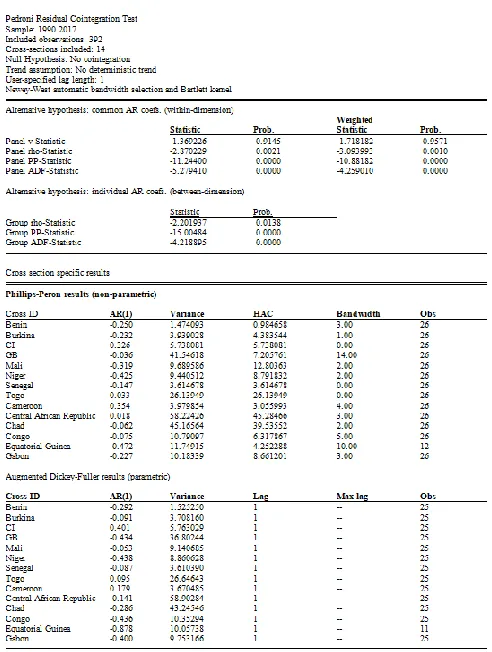
Table 3: Pedroni residual Cointegration
Table 4 is representing the padroni cointegration of individual states with rho, PP and v statistics with -5.14 statistically ADF test and reject the null hypothesis.
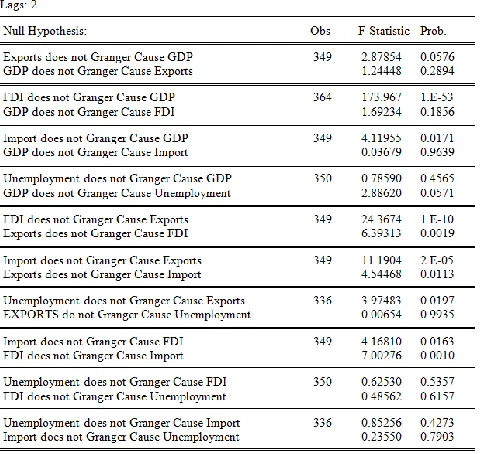
Table 5 is refereeing the granger causality among explanatory variables and the development does not either exists which is logical given that it is a long-run concept with unemployment in the short-run contributes to more Economic Performance Fig 3. Furthermore, effects to change the development policies by different impact of variables. Unemployment does not granger casualty on export but vice versa of export, like import does not Granger casualty on export. However, the evolution of per capita economic performance, per capita GDP without services and per capita services GDP.(Cook & Devereux, 2011; Dohwa, 2012) There is a certain co-movement among the three series. Nevertheless, for the last years of the period it is interesting to see how per capita economic performance drops at a faster rate meanwhile both per capita GDPs smoothly decrease and eventually start to rise.
Figure 2: Strength of Countries by GDP
[image:6.612.42.274.468.600.2]Figure 1. Evolution of per capita economic performance per capita GDP without services and per capita services GDP. All the three variables are expressed in terms of 2011 indices.
Table 1. Modified Augmented Dickey-Fuller (MADF) test
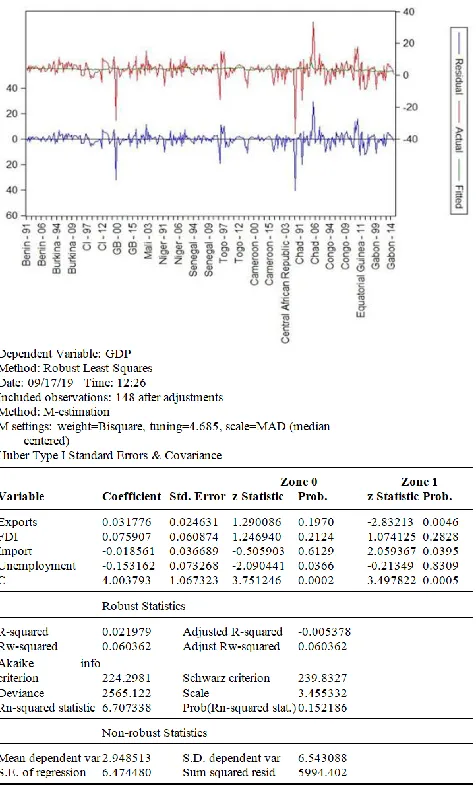
Figure 4: Zone 0 & 1
[image:7.612.34.260.513.665.2]performance diminish 1.8%. However, the casualty support a unidirectional relationship going from either the GDP with bidirectional causality with GDP in Robust technique and it became fundamental in order to reduce the economic performance.
IV. CONCLUSION
The present research demonstrates the influence of economic flow of member’s countries of the CFA franc zone on the evolution of Economic performance with import, export, unemployment and FDI. To this end we focus on a different approach of the gross development product model where the added value of services is isolated from total GDP. This analysis has been implemented for 14 countries in the period between 1991-2017. The result shows that evolution of services with GDP and unemployment factors.
The individual zones strategies directly effect on the growth of countries with explanatory variables, this research paper has designated the economic performance and change factors in different zones. Furthermore, the long run sustainability effects explore between expanding variables and shows positive effects in both zone.
ACKNOWLEDGMENT
I would like to acknowledge the supervisory work of my supervisor Li Fangli (Professor) regarding methodology and interpretation. This research was financed by the University principally school of finance and economics.
REFERENCES
[1] Bimonte, S., & Stabile, A. (2017). Land consumption and income in Italy: a case of inverted EKC. Ecological Economics,131,36-43. doi:https://doi.org/10.1016/j.ecolecon.2016.08.016
[2] Coleman, S. (2010). Inflation persistence in the Franc zone: Evidence from disaggregated prices.Journal of Macroeconomics,32(1),426-442. doi:https://doi.org/10.1016/j.jmacro.2009.08.002
[3] Cook, D., & Devereux, M. B. (2011). Cooperative fiscal policy at the zero lower bound. Journal of the Japanese and International Economies,25(4),465-486. doi:https://doi.org/10.1016/j.jjie.2011.09.002
[4] Coulibaly, I. (2014). Competitiveness and growth within the CFA franc zone: Does the switch to the Euro matter? International Economics,139, 1-18. doi:https://doi.org/10.1016/j.inteco.2014.02.001
[5] Dohwa, K. (2012). International relocation, difference in production costs, and welfare: An analysis based on a two-country model. Japan and the World Economy,24(1),27-35. doi:https://doi.org/10.1016/j.japwor.2011.12.002
[6] Girardin, E., & Marimoutou, V. (1997). Estimating the credibility of an exchange rate target zone. Journal of International Money and Finance,16(6),931-944. doi:https://doi.org/10.1016/S0261-5606(97)00039-9
[7] Gnangnon, S. K. (2013). Structural vulnerability and excessive public indebtedness in CFA Franc Zone countries. Economic Modelling,35,816-832. doi:https://doi.org/10.1016/j.econmod.2013.08.022
[8] Harvey, S. K., & Cushing, M. J. (2015). Is West African Monetary Zone (WAMZ) a common currency area? Review of Development Finance,5(1),53-63. doi:https://doi.org/10.1016/j.rdf.2015.05.001
[9] Hui, C.-H., Lo, C.-F., & Fong, T. P.-W. (2016). Swiss franc's one-sided target zone during 2011–2015. International Review of Economics&Finance,44,54-67. doi:https://doi.org/10.1016/j.iref.2016.03.004
[10] Ismailov, A., & Rossi, B. (2018). Uncertainty and deviations from uncovered interest rate parity. Journal of International Money and Finance,88,242-259. doi:https://doi.org/10.1016/j.jimonfin.2017.07.012
[11] Kitamura, Y. (2012). Informational linkages among the major currencies in the EBS market: Evidence from the spot rates of the Euro, Yen and Swiss franc. Japan and the World Economy, 24(1), 17-26. doi:https://doi.org/10.1016/j.japwor.2011.12.003
[12] Lee, B.-J. (2013). Uncovered interest parity puzzle: Asymmetric responses. International Review of Economics & Finance, 27, 238-249. doi:https://doi.org/10.1016/j.iref.2012.10.004
[13] Lo, C. F., Hui, C. H., Fong, T., & Chu, S. W. (2015). A quasi-bounded target zone model — Theory and application to Hong Kong dollar. International Review of Economics & Finance, 37, 1-17. doi:https://doi.org/10.1016/j.iref.2014.10.010
[14] Miron, D., Miclaus, P., & Vamvu, D. (2013). Estimating the Effect of Common Currencies on Trade: Blooming or Withering Roses? Procedia Economics and Finance,6,595-603. doi:https://doi.org/10.1016/S2212-5671(13)00177-9
[15] Remus Constantin, B.-V. (2013). The Imperative of Addressing the Contemporary Crisis of Economics with Spiritual Intelligence. Procedia Economics and Finance,6,19-24. doi:https://doi.org/10.1016/S2212-5671(13)00108-1
AUTHORS
First Author – Li Fangli, Professor, School of finance and economics, Jiangsu University, [email protected] Second Author – Kouame Henri Michel Ahi, PhD student School of finance and economics Jiangsu University,