ISSN 2250-3153
The Implementation of Amnesty in Uganda:
Limitations And Prospects
Innocent MURAMUZI*Michael MAWA**Maximiano NGABIRANO***
*Nkumba University-Kampala Uganda **Uganda Martyrs University-Kampala Uganda ***Uganda Martyrs University-Kampala Uganda
DOI: 10.29322/IJSRP.9.09.2019.p93117
http://dx.doi.org/10.29322/IJSRP.9.09.2019.p93117
Abstract
Peacebuilding is a process of trying to restore cordial normal relations between people or groups of people especially after a
conflict. It requires the reconciliation of differences, apology and forgiveness of past harm and the establishment of a co-operative
relationship between groups after the conflict. Peacebuilding is a foundation for sustainable peace but this foundation needs a lot of
resources including time as well as the support of all stakeholders in a country to have a common vision for the future if they are to
achieve sustainable peace.
This paper aimed to determine the limitations faced by amnesty seekers in Uganda and the prospects thereof to end conflicts and
wars peacefully and the attainment of sustainable peace. The paper is based on a larger study that was conducted to assess the
contribution of amnesty in ending conflicts and wars. This study was guided by the desire to end conflicts and wars through the use
of amnesty. The study adopted both quantitative and qualitative study design. A questionnaire was used to collect data from one
thousand respondents spread throughout the five districts in Uganda that were sampled; each district from Uganda’s five regions. In
addition, one-on-one interviews were held with several key informants like reporters, Resident District Commissioners of the
sampled districts, staff of NGos that were involved in the receiving of reporters, some sections of the security apparatus, lawyers
and religious leaders.
The results showed that peacebuilding through peaceful means like granting of amnesty can easily encourage peacebuilding and
the achievement of sustainable peace in a country. The findings are beneficial to academicians, policy makers, NGO’s, peace
negotiators and politicians as far as they will be painting a green picture in the use of peacebuilding mechanisms like amnesty to
build peace if conflicts and wars are to end and sustainable peace is acheived. The mission behind this study was to establish the
limitations faced by amnesty seekers in Uganda and what could be done to remove such limitations so that amnesty seekers in and
outside Uganda can easily access amnesty.
KEYWORDS: Amnesty, Peacebuilding, Sustainable peace, Good governance, Conflict, Conflict resolution
Introduction
It is widely acknowledged that amnesty granted during conflicts and wars has the potential to end them peacefully. The
reasons usually advanced to corroborate such an assertion include that amnesty is cheaper than conflict and war and that amnesty
is more realistic and inclusive than other conflict resolution mechanisms. Therefore, with the enactment and promulgation of the
Amnesty Act (2000)1 in Uganda, it was highly anticipated that all armed rebellions would cease. However, there are still rebels in
the bush todate. But as is shown hereafter, amnesty in Uganda has not achieved its intended objective which was to end conflicts
and wars peacefully because of the limitations encountered by amnesty seekers in the country and outside. This paper aimed to
determine the limitations faced by amnesty seekers in Uganda and the prospects thereof to end conflicts and wars peacefully and
the attainment of sustainable peace. The paper is based on a larger study that was conducted to assess the contribution of amnesty
ISSN 2250-3153
It is no longer a big debate as to whether amnesty can lead to peaceful conflict resolution and sustainable peace. The debate is
currently zeroing on how amnesty can best be employed to just achieve that; conflict resolution and sustainable peace (Mertus &
Helsing, 2006)2. As for Carey (2012)3, peace can only be sustainable if there is sustained political progress which itself requires
peace agreements, institutionalised efforts to peacemaking and negotiations that are held in good faith. This paper intended to
assess the limitations that seekers of amnesty face in accessing amnesty in Uganda and the prospects of having amnesty end
conflicts and wars, and achieve sustainable peace.
Despite being abhorred by conflict and war victims and their families, amnesty remains a feasible peaceful conflict resolution
mechanism todate because it lays a firm foundation for the prevention of renewed war (Wallensteen, 20154; Lessa & Payne, 20125;
US Army, 20156). Other conflict resolution mechanisms have the potential to end conflicts and wars, but do not emphasize laying
down the infrastructure badly needed to prevent the rebirth of conflict and war. This is the main reason why the international
community needs to be supportive of amnesty processes worldwide even if such processes do not entirely respect international law.
For the sake of ending deadly conflicts and wars; as well as preparing a ground to prevent future conflicts and wars (Ambos, Large
& Wierda, 2009)7, amnesty needs to always be given a chance.
The study adopted both quantitative and qualitative study designs. A questionnaire was used to collect data from one thousand
respondents spread throughout the four districts in Uganda and Kampala City. Each of the four sampled districts represented a
region in Uganda. Kampala City was also included in the sampled districts becauses it houses most national organisations whose
members were part of the sample population. In addition, one-on-one interviews were held with several key informants like
reporters, Resident District Commissioners of the sampled districts, staff of NGos that were involved in the receiving of reporters,
some sections of the security apparatus, lawyers and religious leaders.
Findings
Below is a discussion of the findings on the limitations of amnesty seekers in Uganda and the prospects of amnesty as a
peaceful conflict resolution mechanism.
Knowledge of any Applicant of Amnesty
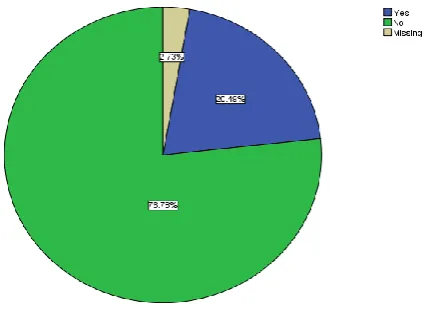
When the respondents were asked if they knew anyone who has ever applied for amnesty, the responses in the chart below
[image:2.595.187.404.544.703.2]were given.
Figure 1: Knowledge of any Applicant of Amnesty
Source: Field Data, 2014/2015
A majority of the respondents said that they did not know of anyone who has ever applied for amnesty. This is understandable because amnesty seekers are not many across the country. Additionally, amnesty seekers don’t usually want to be known in
society since applying for amnesty means that one was a rebel; a scenario that is not good for the public to know since it attracts
ISSN 2250-3153
disarmament, demobilisation and reintegration programmes are meant to resettle the returnees to their local communities, stigma
among returnees remains a big challenge. This is because of the heinous acts committed on the members of the local community
hence the amnesty beneficiaries have to keep their status as reporters or people who have ever applied for amnesty a top secret.
This view got a whole 76.78% of all respondents’ views.
This was pointed out by Andrew Awali; the Deputy Resident District Commissioner Gulu district who in an interview
lamented on the social hibernation of the returnees as they fear retribution from the community members (Interview held with the
Respondent on January 15, 2015). This situation was witnessed during the study where on several occasions difficulties were
encountered while trying to meet with reporters. Many of the reporters claimed they have never been rebels, others said it was
mistaken identity, others argued that may be they shared a name with a reporter but all this was as a result of fear of being
identified by the public as a former rebel. After a thorough introduction that the study was purely academic and not government
espionage on former rebels, the reporters would open up and give out some information. Betancourt, Agnew-Blais, Gilman, Williams & Ellis (2013)9 report that whereas several studies have been done to show the importance of demobilisation and
resettlement programmes on returnees, less has been done on the role of stigma on returnees on long term psychosocial
adjustment in the wider community.
Only a tiny section of the total respondents agreed that they knew someone who has ever applied for amnesty and this response
got only 20.49%. Even in this case, the information was largely from public administrators involved in the implementation of the
amnesty Act (2000) like the amnesty commission staff, resident district commissioners and their deputies and staff as well as
local government officials. During the personal interviews, a majority of the interviewees claimed that they did not know anyone
who has ever applied for amnesty in their areas. The exception was in Katakwi district where a group of respondents in an FGD
agreed that they knew reporters in their villages. Unfortunately, these reporters did not apply for amnesty for fear of insecurity
reprisals from the community and because also of the poor resettlement package given to reporters which even takes long to be
given but yet the process of reporting takes a lot of time and money since the amnesty commission offices responsible for
Katakwi district amnesty affairs are in Mbale district which is far away from Katakwi district. Annan, Brier & Aryemo (2009) emphasize that proper handling of returnees may prepare them to be stigma free and be able to live amicably with the rest of the
community members; a situation that may not have been done in Uganda.
Whether the Amnesty Seeker Succeeded in getting Amnesty or Not
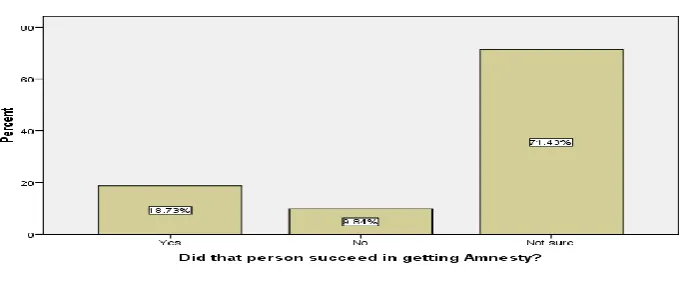
On the question of whether the amnesty seekers they knew who applied for amnesty succeeded in getting amnesty or not, the
[image:3.595.132.477.577.718.2]following were the views of the respondents in the figure below.
Figure 2: Whether the Amnesty Seeker Succeeded in getting Amnesty or Not
Source: Field Data, 2014/2015
A majority of the respondents revealed that they were not sure if the amnesty applicants they knew got amnesty or not and this
view got a whole 71.43%. This amount of limited knowledge of whether the amnesty seekers succeeded in getting amnesty in
ISSN 2250-3153
intended objective of ending armed rebellion in Uganda because a majority of the population are largely ignorant about amnesty.
The entire amnesty application process is done in secrecy. This is because the applicants of amnesty and their families want to
keep it to themselves as they fear condemnation, reprisals and stigma from the public (Annan, Brier & Aryemo, 2009; Betancourt,
Agnew-Blais, Gilman, Williams & Ellis, 2013). From the records of World Vision Gulu region offices, it was reported that by 2008, World Vision Gulu office alone had received over 15,000 reporters who were later handed over to Amnesty Commission
demobilisation and resettlement team in Gulu for rehabilitation and resettlement but tracing a few of them for an interview was a
real tug of war even when you had the contacts of reporters from offices like that one of the resident district commissioner
(Interview held with Harriet Aloyo Nyeko, the Programme Manager World Vision Gulu Office on January 16, 2015).
Only a small fraction of 18.73% of all respondents agreed that the amnesty seekers they knew actually got amnesty and this is
really a paltry figure since 26,390 reporters have since the promulgation of the amnesty Act (2000) got amnesty (Amnesty
Commission report, 2013)10. Even in this event of some of the respondents having knowledge of any beneficiary of amnesty, it
was largely those that were directly involved in the implementation of the amnesty process like police officers, criminal
investigation officers, resident district commissioners and their deputies and a few members of district local government staff. In addition, only a mere 9.84% said that the amnesty seekers they knew didn’t get amnesty. This however is puzzling because one
cannot tell why an amnesty seeker did not get amnesty but since these responses were got from a questionnaire and not an
interview, no further information could be got about it.
Challenges Faced by Amnesty Seekers in Uganda
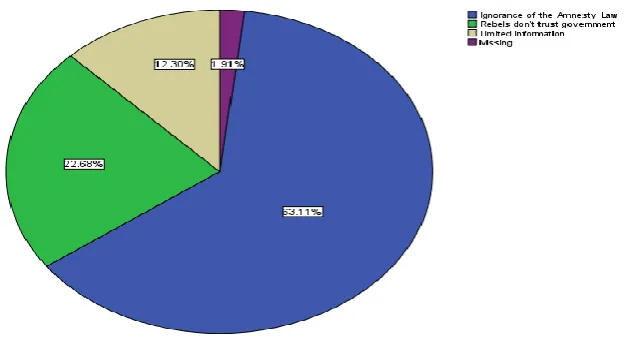
Despite the fact that the Amnesty Act (2000) has been in existence since 2000, it does not automatically mean that all is well
[image:4.595.149.462.434.610.2]for amnesty seekers in Uganda as several challenges were cited by the respondents as shown in the figure below.
Figure 3: Challenges Faced by Amnesty Seekers in Uganda
Source: Field Data, 2014/2015
It was reported by a majority of the respondents that the biggest challenge to amnesty seekers in Uganda was the ignorance
of the amnesty law. This view had the support of the majority of all respondents 63.11%. More than half of all respondents of the
study were of the view that this was the greatest challenge to amnesty seekers in Uganda. Therefore, if the majority of the
respondents themselves were ignorant of the amnesty law while they are free within the country, one wonders how the rebels in
the deep jungles of DRC and CAR would really get the information about the amnesty law given the geographical and limited
information impediments involved therein. Hayner (2001)11, Bois-Pedain (2007)12 as well as Freeman (2009)13 state that
ignorance of the amnesty law is a great challenge to both victims as well as claimants of amnesty as amnesty opportunities are
ISSN 2250-3153
may be ignorant and unable to identify the real wrong doers while on the side of the claimants of amnesty, they may never benefit
from the amnesty law because they are unaware of it; such situations completely exacerbate the amnesty process altogether.
Therefore, if such a challenge is well addressed by availing more information especially to the rebels still remaining in the
bush as well as to victims or their surviving family members amnesty would go a long way in encouraging more rebels to
abandon rebellion and come and report; hence making amnesty to achieve its intended objective of ending armed rebellion in Uganda using peaceful means. In an interview with Silver Emoruoit; the Executive Director of Katakwi Children’s Voice; a
Non-governmental Organisation involved in receiving and rehabilitating former child soldiers and reporters, it was reported that all of
the child soldiers and almost all of the reporters had no knowledge of the Amnesty Act (2000) (Interview held with Respondent
on January 14, 2015). For Freeman (2009), the existing opportunities for both victims or their family members and the reporters
may be lost because of the ignorance of the amnesty law. This surely may have been a great challenge to the amnesty seekers in
Uganda.
The other challenge faced by amnesty seekers in Uganda as identified by the respondents was that the rebels didn’t trust government. This view raised 22.68% of all respondents’ views. And; when added with ignorance of the amnesty law, the two
greatly contributed to the reasons why there are still some rebels who have not exploited the use of the amnesty Act (2000) to
their own advantage. This rebel mistrust of government was rooted in the fact that whereas the government of Uganda was
pursuing peaceful means to achieve peace and end armed rebellion in the country; it was still showing support to its international
obligations under the 1998 Rome Statute to surrender senior rebel commanders to face justice at the ICC. Abidi (2002)14 as well
as the International Institute for Democracy and Electoral Assistance (2003)15 state that the lack of trust between the government
of Uganda and the rebel leaders may largely be blamed for the failure of amnesty in Uganda. This is because neither the rebels
nor the government of Uganda trusted the other; a situation that may have greatly limited the success of the amnesty process
todate. A view echoed by Shelton (1999)16 who reinforces the importance of trust in any peaceful conflict settlement as a
condition sine quo non if success is to be realised.
In such a quandary, one should not expect total commitment by the rebels and their senior commanders towards the
amnesty process. This was evidenced when the rebel leaders did not turn up to sign the Juba Peace Agreement which they greatly
participated in and which it was hoped would mark the end of LRA armed rebellion in Uganda but in vain (Abidi, 2002).In South
Africa, Lincoln (2011)17, states that the Truth and Reconciliation Commission was also faced with challenges of mistrust; a factor
that nearly led to the total failure of the entire amnesty process. Just as the International Institute for Democracy and Electoral
Assistance (2003) states, reconciliation and justice are twin notions but cannot usually be achieved when there is mistrust. In an
interview with a respondent in Katakwi Town Council, it was reported that many of the reporters tell them that they could not
believe and trust government efforts of ending the conflict using peaceful means through amnesty until they received it (Name
withheld, Interview held with the Respondent on January 14, 2015). This means that there could be some rebels still in the bush
with the desire to abandon rebellion but are not convinced that amnesty in Uganda is for real.
Another challenge faced by amnesty seekers in Uganda as raised by the respondents was the lack of enough information to
rebels about the authenticity of the amnesty process in Uganda. This was because of the very nature of where rebels live and the
very way they receive information. There was little information received by the rebels from their rebel commanders who usually fed them only on information that is to the rebel leaders’ advantage. As Hamber (2009)18 as well as Doxtader & Villa-Vicencio
(2003)19 report, absence of relevant and timely information in any amnesty process is the foundation of the failure of the entire
amnesty process. This was further corroborated by a reporter in Gulu town who said in an interview that he heard about amnesty
law upon his escape from the bush and never before (Name withheld, Interview held with the Respondent on January 15, 2015).
The view that limited information to rebels was another challenge to amnesty seekers in Uganda got 12.30% of all respondents’
views. It should be noted however that the option of geographical limitation was not considered at all by any respondent as a
ISSN 2250-3153
How to Solve the Challenges Faced by Amnesty Seekers in Uganda
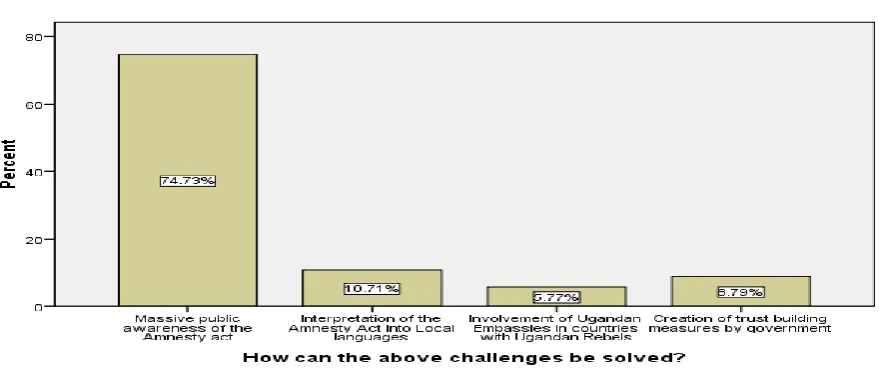
On the question of how to solve the challenges faced by amnesty seekers in Uganda so that they could easily access amnesty,
[image:6.595.57.497.155.340.2]the respondents’ views are shown below.
Figure 4: How to Solve the Challenges Faced by Amnesty Seekers in Uganda
Source: Field Data, 2014/2015
It is believed that information is power. Therefore, if the majority of the citizens have enough information about a national
law, it is highly likely that that law would be well implemented. But this was not the case with the amnesty Act (2000). As
reported with the case of the South African Truth and Reconciliation commission, availability of accurate information both to the
victims as well as to the claimants of amnesty is a strong foundation to a successful amnesty process (TRC, 2003)20. For this case,
it was largely agreed by a majority of the respondents that massive public awareness needs to be created about the amnesty
commission and its activities and particularly the Amnesty Act (2000) since it had earlier been reported that a majority of the
respondents were ignorant about the amnesty Act (2000). This view raised 74.73%. It is hoped that if massive public awareness
campaigns were put in place, a majority of the Ugandans would support the amnesty activities from an informed point of view.
This may even encourage the remaining rebels in the bush who would get a chance of knowing about the amnesty process
and would eventually abandon rebellion. These massive public awareness campaigns need to be revived to exploit this chance if
armed rebellion is to end especially by encouraging rebels still in the bush to come and report. To justify this need for increased
mass sensitisation campaigns about the amnesty Act (2000) was seen when an Internal Security Organisation officer of one of the
sampled districts who was greatly involved in the implementation of the amnesty process did not really know what amnesty is
(Name withheld). It is reported that is it the duty of amnesty commissions to avail relevant and necessary information about the
amnesty process to both victims or their families and amnesty claimants for the amnesty process to achieve its purpose (Llewellyn
& Philpott, 2014)21.
The other solution to solve the challenges faced by amnesty seekers in Uganda was the interpretation of the Amnesty Act
into major local languages. Juta and Company (1996)22 underscore the importance of an amnesty Act into languages
understandable by all stakeholders; let it be the victims or the would-be beneficiaries to ensure a smooth implementation of
amnesty. The Ugandan constitution guarantees interpretation of national laws into major local languages to enable citizens to be
informed about the laws that govern them but this is largely not the case. Accordingly, the Amnesty Act (2000) has
been translated into seven major local Ugandan languages namely; Luganda, Runyoro-Rutoro- Runyankore-Rukiga, Lusoga,
Lugbara (Ministry of Finance, Planning and Economic Development, 2005)23. However, this is a tiny fraction of the languages
spoken in Uganda. The printing of the amnesty Act (2000) in major local languages was greatly hindered by limited finances
ISSN 2250-3153
Report, 2013) despite it being translated into local languages mentioned above. A view, that got 10.71% support of all
respondents.
In an interview with Moses Draku the spokesperson of the amnesty commission, he said that their greatest challenge in the
printing of the amnesty Act (2000) into local languages is financial limitations (Amnesty Commission Report, 2013) since they
have the manuscript already interpreted in major local languages but cannot afford to print them because of insufficient financial
resources at the disposal of the amnesty commission (Interview held with the Respondent on January 10, 2015). This view was
repeatedly echoed by many respondents. Among them were the staffs of the amnesty commission or those familiar with its
activities like government workers, reporters and workers of Non-Governmental Organisations. The chairman of the amnesty
commission Justice P.K.K. Onega cited limited financing as the only hindrance to have the amnesty Act (2000) to be printed into
major local languages for the benefit of the majority of Ugandans that are not comfortable with the English language since the
Amnesty Act (2000) is already translated into seven major local languages (Interview held with Respondent on January 12, 2015).
The other solution proposed by respondents to solve the challenges faced by amnesty seekers in Uganda was the creation of
trust building measures by government; meaning that apart from enacting the amnesty Act, government still needs to do more by
creating an environment and doing actions that create more trust and confidence in the public and the rebels to believe that the
amnesty process in Uganda was in good faith and not a ploy to arrest senior rebel leaders and hand them over to the International
Criminal Court to face trial (Pensky, 2008)24. This situation has been compounded by the recent handing over of Dominic
Ongwen to the ICC where he is facing trial over war crimes and crimes against humanity; a situation that must also apply to other senior rebel commanders including Joseph Kony in case they surrendered. This view raised 8.79% of all respondents’ views and
largely holds water in explaining why senior rebel leaders are still reluctant to embrace the amnesty process in Uganda. In the
words of Walter Okiring Elakas; the resident district commissioner Katakwi district, more confidence building measures like
blanket amnesty to all rebels inclusive of the rebel leaders may greatly make a difference (Interview held with Respondent on
January 14, 2015).
The other solution raised by the respondents that could be of help in averting the challenges faced by amnesty seekers in
Uganda was the involvement of Ugandan embassies in countries where Ugandan rebels are operating from. This in addition to the
involvement of international agencies like the UN and African Union would bring more trust to the rebels to surrender (Cobban,
200725; Cobban, 201626). This was so because these rebels operate in several countries like South Sudan, DRC, Central African
Republic and therefore accessing amnesty offices in Uganda is impossible. But if there is an amnesty liaison desk in Ugandan
embassies in countries where these rebels operate, it may be geographically feasible to access information and apply for amnesty in the Ugandan embassies in the countries affected. This view got 5.77% of all respondents’ views but can be a contributory
factor in solving the problem faced by amnesty seekers trying to access amnesty in Uganda. Respondents’ Advice to Amnesty Seekers in Uganda
The respondents were further asked what advice they may give to amnesty seekers in Uganda and their views were
summarised as follows.
ISSN 2250-3153
Source: Field Data, 2014/2015
When the respondents were further asked what advice they could give to amnesty seekers in Uganda, a majority of the
respondents said that they could advise them to apply for amnesty. This view was raised by 61.48% of the total respondents
meaning that it is a practicable pierce of advice. Salborn (2010)27 reports that applying for amnesty in the case of the Northern
Uganda conflict was a requirement for a successful return, resettlement and reintegration of former rebels. For Leonard (2008)28
as well as Davis & Tremmel (2014)29, a written application for the grant of an amnesty signifies the willingness and acceptance to
abandon armed rebellion. It meant that all other pieces of advice would not work if the rebels still in the bush do not give up
rebellion. When they give up rebellion, then all other pieces of advice may consequently follow. In addition, applying for amnesty
means giving up armed rebellion; which means ushering in peace; a situation desired by everyone.
The other pierce of advice given by the respondents to amnesty seekers in Uganda was to always use consensus-oriented
methods of conflict resolution. For Leonard (2008) as well as Palacios (2006)30, consensus is a useful tool in conflict situation
including even after enacting an amnesty law. This means that in future, whenever conflicts arise since conflicts are part of human
life, one should always opt for peaceful conflict resolution mechanism like negotiation to avoid situations that may induce an individual to think of opting for war as a solution to every conflict. This view raised 16.94% of all respondents’ views. Quite
often than not, there are conflicts that do not really necessitate violence and war. But unfortunately, human nature is intricate to
predict because small conflicts have ended up becoming big violent conflicts because human beings are hard to predict as some
prefer war hoping they will achieve something during the war while other are simply bellicose.
The other advice suggested by the respondents to amnesty seekers in Uganda was to always avoid situations that cause conflict. A culture of making peace as every one’s business should be inculcated among citizens so that it becomes incumbent on
every national both the leaders and the led to promote peace. Ray (2012)31 emphasizes that dialogue should always be built
around the counterinsurgency doctrine, arguing that the main strategy towards this aim should be preventing people from feeling
alienated. Whereas Cortright (1997)32 detests the use of conflict preventive measures which he calls appeasers, bribes and
concessions, which really are what he calls them; but compared with the effects of deadly conflict, let those appeasers, bribes and
concessions be what they are because they are cheap, peaceful and undestructive to the state and community fabric. Even if
Bredel (2003)33 compares asking politicians to prevent conflict with asking teenagers to save for pension, conflict prevention was,
ISSN 2250-3153
could be appeased and they don’t make trouble at all, then what else would citizens want? Even though this appeasement policy
to conflict causers may be addictive and repetitive, it is cheaper in all aspects as it ensures sustainable peace since it prevents the
outbreak of conflicts.
Avoiding situations that bring about conflict by both the leaders and the citizens is a preventive measure to conflict because if
all of us tried to avoid situations that bring about conflict and war, then we shall have invested a great deal in preventing conflict
and war (Ellington, 2013)34. This is an investment that requires limited resources like commitment but has bulky and
immeasurable returns like ensuring stable peace, spending less or no money at all and ensuring sustainability of peace, political
stability and development. This view got 11.75% of all respondents’ views meaning that if endeavours that lead to conflict
prevention were pursued, the world would be a better place to dwell in for everyone. As the Council of Europe (1982)35 states,
prevention is better than cure. It is better, cheaper and effortless to prevent a conflict than to grant amnesty after a conflict; a view
also held by International Peace Update (1999)36 that stresses that conflict prevention is cheaper than amnesty. If sustainable
peace and development are to be attained the world over, an effort to prevent conflict is the way to go.
Lastly, still on the advice that was given to amnesty seekers in Uganda, the respondents further proposed that giving up
rebellion totally was another good option in addition to the options already given above. This view is more or less like the first
option of applying for amnesty because you cannot apply for amnesty without giving up rebellion and you cannot give up
rebellion and fail to apply for amnesty. This view got 9.29% of all respondents’ views and if well followed, armed rebellion in
Uganda would swiftly come to an end. This view is corroborated by Jeffery (2014)37 who contends that abandoning rebellion was
a condition for applying for amnesty in Uganda. Admittedly, a feeling of being tired of armed rebellion is a precursor that a rebel
is in for a peaceful resolution of conflict and; amnesty comes in handy in the circumstances.
Conclusion
Amnesty seekers in Uganda face a lot of limitations while trying to apply, access and enjoy amnesty in Uganda. Among them
are limited or no information about amnesty, lack of trust between them and the government, long distances to go to amnesty
commission offices as they are only in the regions of the country as well as stigma from the communities they once terrorised.
The pierces of advice as proposed by the respondents like abandoning rebellion, applying for amnesty, developing a culture of
peace, use of peaceful conflict resolution mechanisms as well as the development of trust building measures between them and
the government could go a long way in maintaining peace and keeping conflict and war at bay. If this could be done, then the
potential to have amnesty as a panacea to conflict and war will reign.
REFERENCES [1] The Amnesty Act(2000). Kampala: Uganda.
[2] Mertus, J. & Helsing, J. W., (eds.), (2006). Human Rights and Conflict: Exploring the Links between Rights, Law and Peacebuilding. Washington D. C.: United States Institute of Peace Press.
[3] Carey, H. F., (2012). Privatizing the Democratic Peace: Policy Dilemmas of NGO Peacebuilding. New York: Palgrave Macmillan.
[4] Wallensteen, P., (2015). Understanding Conflict Resolution. (4th ed.). Los Angeles: Sage Publications Ltd.
[5] Lessa, F. & Payne. L. A., (eds.), (2012). Amnesty in the Age of Human Rights Accountability: Comparative and International Perspectives. Cambridge: Cambridge University Press.
[6] United States Army (2015). Military Review. Ohio: The Ohio State University.
[7] Ambos, K., Large, J. & Wierda, M., (2009). Building a Future on Peace and Justice. Peace and Development Studies on Transitional Justice. Springer.com
[8] Annan, J., Brier, M. & Aryemo, F., (2009). From “Rebel” to “Returnee” Daily Life and Reintegration for Young Soldiers in
Northern Uganda. Available at: http://jar.sagepub.com/content/24/6/639.short
[9] Betancourt, T. s., Agnew-Blais, J., Gilamn, S. E., William D. R. & Ellis, b. h., (2013). Past Horrors, Present Struggles. The role of stigma in the association between war experiences and psychosocial adjustments among former child soldiers in Sierra Leone. Social Science & Medical Medicine, Volume 70, Issue 1, January 2010-17-26. Conflict, Violence and Heath.
ISSN 2250-3153
[11] Hayner, P. B., (2001). Unspeakable Truths: Transitional Justice and the Challenge of Truth Commissions. (2nd ed.). New
York: Routledge.
[12] Bois-Pedain, A., (2007). Transitional Amnesty in South Africa. Cambridge: Cambridge University Press.
[13] Freeman, M., (2009). Necessary Evils: Amnesties and the Search for Justice. Cambridge: Cambridge University Press. [14] Abidi, S. A. H., (ed.), (2002). Living Beyond Conflict: For Peace and Tolerance. Kampala: ABETO.
[15] International Institute for Democracy and Electoral Assistance (2003). Extracted from Reconciliation after Violent Conflict. Available at: Web: www.idea.int
[16] Shelton, D., (1999). Remedies in International Human Rights Law. Oxford: Oxford University Press.
[17] Lincoln, J., (2011). Transitional Justice, Peace and Accountability: Outreach and the Role of International Courts. London: Routledge.
[18] Hamber, H., (2009). Transforming Societies after Political Violence. Truth, Reconciliation and Mental Health. Ulster: Springer.
[19] Doxtader, E. & Villa-Vicencio, C., (2003). Through Fire with Water: The Roots of Division and the Potential for Reconciliation in Africa. Cape Town: ABC Press.
[20] The South African Truth & Reconciliation Commission (2003)
[21] Llewellyn, J. J. & Philpott, D., (2014). Restorative Justice, Reconciliation and Peacebuilding. Oxford: Oxford University Press.
[22] Juta and Company (1996). The South African Law Reports, Volume 4.
[23] Ministry of Finance, Planning and Economic Development (2005). Kampala: Uganda.
[24] Pensky, M., (2008). Amnesty on trial: impunity, accountability and the norms of international law. Available at:
http://www.ethicsandglobalpolitics.net
[25] Cobban, H., (2007). Amnesty After Atrocity? Healing Nations after Genocide and War Crimes. No City: Available at: www.Amazon.com
[26] Cobban, H., (2016). Amnesty After Atrocity? Healing Nations after Genocide and War Crimes. Abingdon: Routledge.
[27] Salborn, E., (2010). Requirements for Successful Return and Resettlement After Long Term Internal displacement. A Case study of Northern Uganda. Grin Verlag.
[28] Leonard, B., (ed.), (2008). Measuring Stability and Security in Iraq. A Report to the Department of Defence. (No City): No Publisher.
[29] Davis, J. M. Jr. & Tremmel, G. B., (2014). Parole, Pardon, Pass and Amnesty Documents of the Civil War: An Illustrated History. Jefferson: McFarland & Company.
[30] Palacios, M., (2006). Between Legitimacy and Violence: A History of Colombia, 1875–2002. Durham: Duke University Press.
[31] Ray, D. B., (2012). The final Countdown: A Historic opportunity to deliver an Arms trades treaty that saves lives. Oxford: Oxfam.
[32] Cortright, D., (1997). The Price of Peace: Incentives and International Conflict Prevention. Lanham: Rowman & Littlefield Publishers.
[33] Bredel, R., (2003). Long-Term Conflict Prevention and Industrial Development: The United Nations and its specialised Agency, UNIDO. Martinus Nijhoff Publishers.
[34] Ellington, S., (2013). A Call for a New Counterinsurgency Theory. ASPJ Africa & Francophonie - 2nd Quarter 2013.
[35] Council of Europe (1982). 34th Ordinary Session. Strasbourg: European Union.
[36] International Peace Update (1999). Women's International League for Peace and Freedom. Volumes 64-65.
[37] Jeffery, R., (2014). Amnesties, Accountability, and Human Rights. Philadephia. University of Pennsylvania Press.
ACKNOWLEDGEMENT
I would like to recognise all persons who contributed to the realisation of this PhD project. My supervisors Assoc. Professor Dr.
Michael Mawa & Assoc. Professor Dr. Marximiano NGABIRANO for their concrete advice and guidance throughout the whole
research project. To my parents, Mr. & Mrs. Peter & Josephine Mpamizo, your endless struggle to enable me see the light from a
blackboard is indelible. Msgr. Rev. Fr. John K. Barugahare for his unforgettable intervention in my academic life. The Late Rev.
Fr. Valentine Muyambi for the support and encouragement rendered during our postgraduate studies and the PhD project itself,
ISSN 2250-3153
moral and spiritual support towards this research project. I would like to appreciate the patience and endurance of my family
members who not only missed my presence in the home, but sometime missed certain basics in sacrificing for the realisation of
this work. My wife Bridget Atwine Katagata Muramuzi, Conrad Musimenta Muramuzi, Colline Mukama Muramuzi and Conran
Murungi Muramuzi; to you all; thank you!
AUTHORS
Innocent MURAMUZI, PhD. Nkumba University-Kampala Uganda [email protected]
Max NGABIRANO, Assoc. Prof. Uganda Martyrs University-Kampala Uganda. [email protected]