ISSN 2250-3153
Effect of Multimedia Instructional Approach on Mid
Basic II Pupils’ Interest and Retention in Basic Science
Samuel, Ruth Iwanger
1
Department of Science, Technology and Mathematics Education, Faculty of Education, Nasarawa State University, Keffi, Nigeria
DOI: 10.29322/IJSRP.8.11.2018.p8339 http://dx.doi.org/10.29322/IJSRP.8.11.2018.p8339
Abstract
This study investigated the effect of multimedia instructional approach on the interest and retention of mid basic II pupils in Basic Science. The sample for study comprised Eighty-five mid basic II Basic Science pupils from two intact classes purposively selected from two private co-education schools in Federal Capital Territory, Abuja, Nigeria. Two research questions guided the study and two null hypotheses were tested at 0.05 level of significance. Two instruments were used for data collection namely; Pupils’ Interest in Basic Science rating scale (PIBS) and Basic Science Retention Test (BSRET). The reliability of PIBS was determined using Cronbach
Alpha and the coefficient obtained was 0.79 while Kuder-Richardson formula 21 (K-R21) was used to determine the reliability of
BSRET and the reliability coefficient was found to be 0.80 implying that the instruments were reliable enough for the study. Descriptive statistics were used to answer the research questions while Analysis of Covariance (ANCOVA) was used to test the research hypotheses at 0.05 alpha level of significance. The findings of this study revealed significant differences in the interest and retention of male and female mid basic II pupils taught Basic Science concept using Multimedia Instructional Approach. Based on the findings, it was recommended that; Basic Science teachers should incorporate multimedia instructional approach which has been found to increase pupils interest and enhance retention.
Keywords: Basic Science, Instructional Approach, Interest, Multimedia and Retention.
INTRODUCTION
The success of any educational enterprise in this modern age of advanced technology is in terms of technologies and or media
employed to ensure maximum cognitive development or advancement of learners. Multimedia aids in education could be define as the
various electronic and technological devices employed by the teacher/ learner to enhance the interest, acquisition and retention of
knowledge. These include print media like newspapers, magazines, journals and books. Electronic media include; Television, Radio,
Slide, CD Rom, Projectors, CDs, DVDs and interactive media like cell phones and the internet. Multimedia combines five basic types
of media into the learning environment: text, video, sounds, graphics and animation, thus providing a powerful new tool for education
(Nwanekezi & Kalu, 2012).
Researches have shown that the quality of learning can be significantly enhanced when ICT is used as an intellectual multi-tool
adaptable to learner’s needs (Furo, 2015; Nwafor & Okoi, 2016; Gambari & Yusuf, 2017). Gyang (2008) referred to this as: critical
thinking, information skill, higher level conceptualization and problem solving. It has been observed that average school age child
spends much time watching television; playing video games and exploring other electronic media devices, including the cell phones.
These exploration and manipulation have been found to stimulate interest and create enabling environments for learning to take place
ISSN 2250-3153
Moreover, Akbiyik and Akbiyik (2010) are of the view that critical thinking, decision making, reflective thinking and creative
thinking are various forms of cognitive learning outcomes of multimedia aids.
The basic school stage is the formative stage of an individual. At this stage, audio and visual impressions made on a child in the
process of teaching and learning leaves a long-lasting effect on the educational development of the child. Children are naturally
curious and inquisitive about their environment. They are observant, persistent and enjoy entertaining learning experiences
(Nwanekezi & Kalu, 2012).
Basic Science education’s purpose is to train pupils to acquire proper understanding of basic principles as well as application. It is
also aimed at developing appropriate scientific skills and attitudes as a prerequisite for future scientific activities. To achieve these
objectives, active participation and collaborative learning activities become imperative and these need functioning instructional media
to make Basic Science instruction effective (Osokoya, 2013; Oni, 2014; Samuel, 2017).
Interest is considered to be the feeling of an individual towards a particular object or an activity. It means that a child will develop
interest in any object or activity that is found to be attractive or stimulating. Therefore, in a classroom situation, the learner will be
attentive during a lesson only if the instruction is appealing to the learner (Nwachukwu, 2013; Danjuma, 2015).
Retention is the ability to hold, keep or recall past experience and reproduce a learnt concept when the need arises (Bukunola &
Idowu, 2012). It is an important variable in learning because only a learnt experience is recalled, learning cannot be said to have taken
place if there is no proper retention. The ability of students to recall past learnt Basic Science concepts as an objective of the Basic
Science teaching and learning process may likely enhance achievement in the subject. For so long, researchers have been keen on
knowing what could be done by teachers to enhance maximum retention of knowledge or skills long after they have been acquired
whether in the classroom or outside the classroom (Azuka, 2012).
The use of multimedia instructional approach in teaching Basic Science at the basic school level helps to expose them to have a better
understanding of the concepts taught. It therefore has become pertinent to find out how the application of multimedia affects the
interest and retention of mid basic pupils in Basic Science.
Purpose of the Study
The purpose of this study is to investigate the effect of multimedia instructional approach on the interest and retention of mid basic II
pupils in Basic Science. Specifically, the study sought to:
1. determine the effect of multimedia instructional approach on the interest of mid basic II pupils in Basic Science.
2. determine the effect of multimedia instructional approach on the retention of mid basic II pupils in Basic Science.
Research Questions
The following research questions guided the study:
1. What is the mean interest scores of male and female pupils taught Basic Science using multimedia instructional approach?
2. What is the mean retention scores of male and female pupils taught Basic Science using multimedia instructional approach?
Hypotheses
ISSN 2250-3153
1. There is no significant difference in the mean interest scores of male and female pupils taught Basic Science using
multimedia instructional approach.
2. There is no significant difference in the mean retention scores of male and female pupils taught Basic Science using
multimedia instructional approach.
Scope of the Study
The study focused on the effect of multimedia instructional approach on teaching mid basic II Basic Science pupils in Abuja, Nigeria.
The content scope was; Reproductive system in mammals.
METHODOLOGY
Quasi experimental research design was employed for the study. The sample for study comprised Eighty-five mid basic II Basic
Science pupils from two intact classes purposively selected from two private co-education schools in Federal Capital Territory, Abuja,
Nigeria. The schools were purposively sampled based on equivalence in laboratories, ICT facilities and manpower. The schools were
randomly assigned to experimental groups (taught using Multimedia Instructional Approach (n = 40)), and the control group (taught
using Guided Discovery (n = 45)).
Two instruments were used for data collection namely; Pupils’ Interest in Basic Science rating scale (PIBS) and Basic Science
Retention Test (BSRET). PIBS contained 10 items designed to determine students’ interest in Basic Science. PIBS was rated using a
four-point rating scale. The options were; Strongly agreed (SA) = 4 points, Agree (A) = 3 points, Disagree (D) = 2 points and Strongly
Disagreed (SD) = 1 point. Basic Science Retention Test (BSRET) was a 15-item instrument with options A – D in reproductive
system in mammals. The test was validated by experts in Science and Technology Education and were trial tested. The reliability of
PIBS was determined using Cronbach Alpha and the coefficient obtained was 0.79 while Kuder-Richardson formula 21 (K-R21) was
used to determine the reliability of BSRET and the reliability coefficient was found to be 0.80 implying that the instruments were
reliable enough for the study.
RESULT
Descriptive statistics of mean and standard deviation were used to answer the research questions while Analysis of Covariance
(ANCOVA) was used to test the research hypotheses at 0.05 alpha level of significance.
Research Question One
What is the mean interest score of male and female pupils taught Basic Science using multimedia instructional approach?
[image:3.612.30.502.659.733.2]The data used to answer this research question is presented in Table 1.
Table 1
Means and Standard Deviation of Male and Female Pupils’ Interest Using Multimedia Instructional Approach
Male Female
Group Type of Test X SD N X SD N
ISSN 2250-3153
Posttest 30.42 2.30 21 27.98 3.01 19
Guided Discovery Pretest 12.01 3.00 25 11.07 3.23 20
Posttest 21.15 2.87 25 17.52 2.76 20
[image:4.612.33.496.55.109.2]
Table 1 reveals that male pupils had a higher mean interest score than their female counterparts.
Research Question Two
What is the mean retention score of male and female pupils taught Basic Science using multimedia instructional approach?
[image:4.612.32.496.310.437.2]The data used to answer this research question is presented in Table 2.
Table 2
Means and Standard Deviation of Male and Female Pupils’ Retention Using Multimedia Instructional Approach
Male Female
Group Type of Test X SD N X SD N
Multimedia Pretest 19.50 2.95 21 17.75 2.76 19
Posttest 32.26 3.30 21 28.43 2.01 19
Guided Discovery Pretest 15.10 2.10 25 13.17 2.23 20
Posttest 25.25 2.57 25 22.52 2.43 20
Table 2 shows that male pupils had a higher mean retention score than their female counterparts.
Hypothesis One
There is no significant difference in the mean interest score of male and female pupils taught Basic Science using multimedia
[image:4.612.32.514.623.726.2]instructional approach.
Table 3
Result of Analysis of Covariance of Male and Female Pupils’ Interest Taught Basic Science Using Multimedia Instructional
Approach
Source of Variation Sum of Square Df Mean Square F-calculated F-critical
Covariance Pre-interest 1543.02 1 39.62
Mean Effects 2535.22 2 2421.72 15.04
Multimedia*Gender 25975.84 3 25975.84 10.03 1.89
ISSN 2250-3153
Total 84070.63 85
Table 3 revealed a significant difference in the interest of male and female pupils taught Basic Science concept using multimedia
instructional approach. The calculated F-value was 10.03 as against the critical F-value of 1.89 at 0.05 level of significance.
Therefore, the hypothesis was rejected, since the calculate F-value was greater than the critical F-value.
Hypothesis Two
There is no significant difference in the mean retention score of male and female pupils taught Basic Science using multimedia
[image:5.612.35.517.294.415.2]instructional approach.
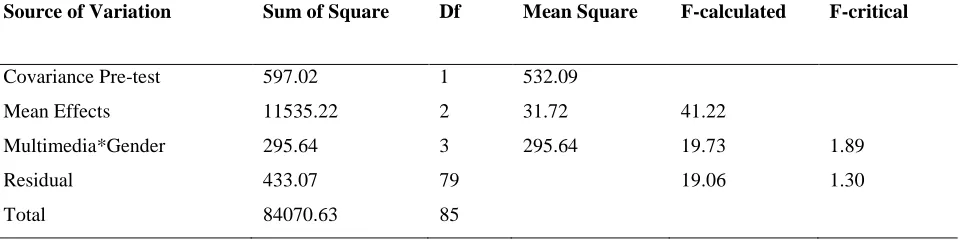
Table 4
Result of Analysis of Covariance of Male and Female Pupils’ Retention Taught Basic Science Using Multimedia Instructional Approach
Source of Variation Sum of Square Df Mean Square F-calculated F-critical
Covariance Pre-test 597.02 1 532.09
Mean Effects 11535.22 2 31.72 41.22
Multimedia*Gender 295.64 3 295.64 19.73 1.89
Residual 433.07 79 19.06 1.30
Total 84070.63 85
Table 4 revealed a significant difference in the retention of male and female pupils taught Basic Science concept using multimedia
instructional approach. The calculated F-value was 19.73 as against the critical F-value of 1.89 at 0.05 level of significance.
Therefore, the hypothesis was rejected, since the calculate F-value was greater than the critical F-value.
Discussion
The findings of this study revealed that the use of Multimedia Instructional Approach had significant effect on pupils’ interest in
Basic Science. The pupils taught using Multimedia Instructional Approach had significant interest than those taught using the Guided
Discovery Method. This result is in agreement with the findings of (Furo, 2015; Nwafor & Okoi, 2016; Gambari & Yusuf, 2017) who
reported that students taught science using audio and visual assisted instruction develop significant interest than those taught without.
In relation to retention, the findings of this study revealed that the use of Multimedia Instructional Approach had significant effect on
pupils’ retention in Basic Science. This result is in agreement with the findings of (Nwanekezi & Kalu; 2012 and Akbiyik & Akbiyik;
2010) who reported that pupils taught Basic Science using multimedia assisted instruction retain higher than those taught without.
Conclusion
The findings of this study revealed significant differences in the interest and retention of male and female mid basic II pupils taught
ISSN 2250-3153 Recommendations
Based on the findings of this study, the following recommendations were made:
1. Basic Science teachers should incorporate multimedia instructional approach which has been found to increase pupils interest
and enhance retention.
2. Government should ensure adequate provision of media aided instructional materials for the effective teaching and learning
of Basic Science.
References
Akbiyik, C & Akbiyik, G. (2010). Different multimedia presentation types and student’s interpretation achievement. www.waset.org/journals/waset/v66-54.pdf.
Azuka, B.F. (2012). Improving the memory of students in mathematics classroom towards better performance. The Journal of the
Mathematics Association of Nigeria, 37(1), 65-72.
Bukunola, B.A.J. & Idowu, O.D. (2012). Effectiveness of cooperative learning strategies on Nigerian junior secondary students’
academic achievement in Basic Science. British Journal of Education, Society and Behavioural Science, 2(3), 307-325.
Danjuma, G.S. (2015). Effects of collaborative and competitive learning strategies on upper Basic II students’ interest and achievement in Basic Science. Unpublished Ph.D Thesis, University of Nigeria, Nsukka.
Furo, P. T. (2015). Computer assisted instruction and students’ interest as determinant of ss 2 chemistry students’ achievement in
chemical equilibrium in rivers state. IOSR Journal of Applied Chemistry, 8(1), 50-56.
Gambari, I.A. & Yusuf, O.M. (2017). Relative effectiveness of computer-supported Jigsaw II, STAD and TAI cooperative learning
strategies on performance, attitude and retention of secondary school students in Physics. Journal of Peer Learning 10:76-94.
Nwachukwu, C.O. (2013). Achievement and interest of Chemistry students exposed to cooperative and competitive learning. Unpublished Ph.D thesis. Nnamdi Azikiwe university, Nigeria.
Nwafor, C. E., & Okoi, O. O. (2016). Effects of computer assisted instruction on junior secondary
school students’ achievement in basic science. International Journal of Scientific and Engineering Research. 7(10), 1940-1957.
Nwanekezi, A. U., & Kalu, N. E. (2012). Effect of multimedia on primary school pupils’ retention and interest in Basic Science
concepts. African Research Review, An International Multidisciplinary Journal, Ethiopia, 6(2).
Oni, J.O. (2014). Teacher method of teaching and student academic achievement in Basic Science and Technology in junior
secondary schools in South-West, Nigeria. Journal of Education and Social Research, 4(3), 397-402.
Osokoya, M.M. (2013). Teaching methodology in basic science and technology classes in South-West Nigeria. Asian Journal of
Education, 1(4), 206-214.
Samuel, I.R. (2017). Assessment of basic science teachers’ pedagogical practice and students’ achievement in Keffi Educational