UNIVERSITI SAINS ISLAM MALAYSIA Journal of Islamic Social Sciences and Humanities ةيناسنلإاو ةيملاسلإا ةفاقثلا ةلجم
56
Submission date: 04/05/2019 Accepted date: 25/08/2019
CORRELATION STUDY BETWEEN LEARNING STYLE AND MULTIPLE INTELLIGENCE AMONG MUSLIM GIFTED AND TALENTED
Kajian Korelasi antara Gaya Belajar dan Kecerdasan Pelbagai di Kalangan Pelajar Muslim Pintar Berbakat
Amirah Zainun, Afiqah Che Endut, Amira Aisha Ainuddin Wahid, Abdul Razzak Khan Rustum Ali Khan and Ahmad Faiz Yazid
Kolej PERMATA Insan, Universiti Sains Islam Malaysia
a
[email protected], [email protected], [email protected],
d
[email protected], [email protected]
Abstract
The current study aimed to identify the correlation between learning style and Multiple Intelligence among Muslim gifted and talented students. The study also attempts to investigate the most dominant learning style practice by Muslim gifted and talented along with the most dominant intelligence among them. To achieve this aim, the Multiple Intelligence Self Inventory (MISI) and Malay Version of Visual Aural Read or write and Kinesthetics (VARK) instruments were administered towards 165 Muslim gifted and talented students aged 14 to16 years old. Data were analyzed descriptive and inferentially and presented in a percentage frequency table. The results of the study showed that there are insignificant correlation between Multiple Intelligence and learning style among Muslim Gifted and Talented. Additionally, the study also discovered that the most dominant learning style practiced by Muslim Gifted and Talented students is Kinesthetics (48.10%) and the most dominant intelligence among Muslim Gifted and Talented students is Spiritual Intelligence (43.67%). The study concluded with suggestion of developing a module on teaching methodology for Muslim gifted learners.
Abstrak
Kajian ini bertujuan untuk mengenal pasti korelasi antara gaya belajar dan kecerdasan pelbagai di kalangan pelajar muslim pintar dan berbakat. Kajian ini juga akan mengkaji amalan gaya belajar yang paling dominan di kalangan pelajar muslim pintar dan berbakat serta kecerdasan pelbagai yang paling dominan di kalangan mereka. Untuk mencapai matlamat ini, instrumen Self Inventory Multiple Intelligence (MISI) dan Versi Melayu Instrumen Aural Read or Write and Kinesthetics (VARK) telah ditadbir kepada 165 pelajar muslim pintar dan berbakat berusia 14 hingga 16 tahun. Data dianalisis secara deskriptif dan secara inferens seterusnya dibentangkan dalam jadual frekuensi peratusan. Hasil kajian menunjukkan bahawa tidak terdapat korelasi yang ketara antara Kecerdasan Pelbagai dan Gaya Belajar di kalangan pelajar muslim pintar dan berbakat. Selain itu, kajian ini juga mendapati bahawa gaya belajar yang paling dominan diamalkan oleh pelajar-pelajar muslim pintar dan berbakat adalah Kinesthetics (48.10%) dan kecerdasan yang paling dominan di kalangan pelajar muslim pintar dan berbakat adalah kecerdasam Siritual (43.67%). Kajian ini disimpulkan dengan mencadangkan pembangunan modul mengenai kaedah pengajaran untuk pelajar muslim pintar dan berbakat dengan menggunakan dapatan dari kajian ini.
Kata kunci: gaya belajar, kecerdasan pelbagai, pelajar muslim pintar dan berbakat.
INTRODUCTION
58
Malaysia in order to investigate their learning style and multiple intelligences and the students involved are students who memorizing Al-Quran. Some of the Muslim students whose involved in memorizing Al-Quran usually are related to reading and writing learning style and also high in spiritual intelligence and this study is about to discover and reveal the most dominant component among all the domains contain in both Multiple Intelligence and learning style.
The objectives of this research attempts to:
i. To investigate the most dominant learning style practice by Muslim gifted and talented students.
ii. To identify the most dominant multiple intelligence among Muslim gifted and talented students.
iii. To determine the relationship between learning style and multiple intelligence among Muslim gifted and talented students.
LITERATURE REVIEW
Muslim Gifted and Talented students
Gifted and talented students refers to an individual who are born with extraordinary abilities and the abilities refers to the characteristics that inherited naturally which associated with the genetic kinship (Simonton, 2005). In the context of this research, Muslim gifted and talented refers to gifted and talented students who aedheres to Islamic religion. According to Nielsen, 2002; Assouline, Nicpon, & Whiteman, 2010; Sattler, 2008, Gifted learners have special characteristics that make them unique individuals. Typically they have been identified as having superior linguistic abilities, a distinct capacity to understand and explain complex concepts on a variety of topics, and to develop expertise in a particular area or topic, all of which that reflects a maturity beyond their years. The innate abilities are in multiple domains and can be seen from high performing actions and behaviors, particularly those involving cognitive skills. These cover the skills of reasoning, planning and problem solving (Yusof, Ishak, Hamdan, Hassan, Radzi, & Tengku Muda, 2017). As stated by Gagné (2005) an individual is thought to be gifted and talented when he or she has unique cognitive abilities and capabilities to use them skillfully. In short, gifted and talented learners are the ones that have potentials to be efficient and successful.
Learning style
individual to convey these knowledge to other individuals, thus making a new step in developing learning material to be spread throughout the society.
Individual learning style refers to style or learning methods that is used in the process of understanding a certain matter. Psychologically, learning style is the way the student concentrate, and their method in processing and obtaining information, knowledge, or experience (Jantan & Razali, 2002). Lebar and Mansor (2000) state that, learning style refers to a preferred strategy and technique utilized by individuals specifically when studying. This consisted of individual’s ability to receive and process information, not focused only on learning skills. Whereas Mok (2003), defines learning style as learning approaches as preferred by student. The various learning style concepts and definitions leads to different view among researchers and they each investigates and observes from various aspects such as psychological and environmental aspects.
There are many different approaches and endorsement of learning styles, and they propose different constructs (Denig, 2004). Each learner has a primary learning style and can be taught how to study and concentrate capitalizing on that style. However, most learners also have a secondary style, which can be used to reinforce initial learning effectively (Houwer, Barnes-Holmes, & Moors, 2013). These primary and secondary learning styles can be combined to enable individuals to master new and difficult information. Reid (1995) however presented three learning styles: Sensory Learning styles, Cognitive Learning styles and Affective Learning styles. Sensory learning styles also known as VAK/VARK model which refers to the learning through visual, auditory, reading/writing preference and kinesthetic that each one receives and processes the information.
In summary, learning styles are styles or individual learning technique that act with its environment, to process, interpret and obtain information, experiences or desirable skills. Learning styles also take into consideration of individual factors such as sex, age, and personality as well as heritage, breed, and environment influence, namely influence from parent’s education, culture, community, and school (Othman & Amiruddin, 2018).
Multiple Intelligence
60
multiple types of human intelligence, each one representing different ways of how people process information.
As stated by (Wechsler, 1944), intelligence is the aggregate or global capacity of oneself to act purposefully, to think rationally and to deal effectively with his environment. (Gardner, Multiple Intelligences - The Theory in Practice, 1993) defines intelligence as the ability to solve problems or to create fashion products that are valued within one or more cultural settings. This definition challenged the traditional psychological view of intelligence as a single capacity that drives logical and mathematical thought (Razmjoo, 2008). Gardner states that based on his theory (1983), it is misleading to think of humans as possessing but a single intellectual capacity, which almost always amounts to an amalgam of linguistic and logical-mathematical skills (Gardner, The Three Faces Of Intelligence, 2001). He went on saying that it makes more sense to conclude that human beings have relatively autonomous mental capabilities. Both Howard Gardner and Robert Sternberg advocate that intelligence should not be reduced to a single overarching construct (Denig, 2004). Therefore, (Gardner, 1983) proposed the theory of multiple intelligences that differentiates intelligence into specific (primarily sensory) ‘modalities’, rather than seeing intelligence as dominated by a single general ability. According to Gardner, there are at least eight relatively autonomous but interconnected intelligences: linguistic, logical-mathematical, visual-spatial, bodily kinesthetic, musical, interpersonal, intrapersonal, and naturalist. He later suggested that existential and moral intelligences may also be worthy of inclusion. As stated by (Hanafin, 2014), Gardner has based his claims for the existence of at least eight intelligences on psychological, neuropsychological, neurobiological, historical and evolutionary evidence as well as on findings from psychological experimental tasks. Although the groups of intelligence are differentiated in such detail, Gardner is against the idea of labelling learners to a specific intelligence. Gardner maintains that his theory should "empower learners", not restrict them to one modality of learning (McKenzie, 2005). (Visser, Ashton, & Vernon, 2006) states that according to a 2006 study, each of the domains proposed by Gardner involves a blend of the general G-factor, cognitive abilities other than g, and, in some cases, non-cognitive abilities or personality characteristics.
METHODOLOGY Research Design
Participants
Muslim gifted and talented students from Kolej PERMATA Insan aged 14 to 16 years old has participated in this study. 14 years old students were in Foundation 2, 15 years old were in Foundation 3 and 16 years old were in Level one. All of the participants has been identified as gifted since they were 13 years old after undergoing UKM 1 and UKM 2 IQ test.
Research Instruments
In measuring the Multiple Intelligence among Muslim gifted and talented, Multiple Intelligence Self Inventory (MISI) Malay version has been used. The survey question consist of 50 questions in measuring 10 components of multiple intelligence which are Verbal-Linguistic Intelligences, Interpersonal Intelligences, Intrapersonal Intelligences, Logical Mathematics Intelligences, Spatial Visual Intelligences, Kinesthetic Intelligences, Music Intelligences, Naturalist Intelligences, Moral Intelligences, and Spiritual Intelligences. The inventory are using Likert scale that uses five level of scale: Never, Rarely, Sometime, Very Often and Always The second survey instrument used to measure learning style for this research is Malay Version of Visual Aural Read or write and Kinesthetic (VARK) translated by Ahbul Zailani Begum which consist of 16 items in measuring four domain (Visual Aural Read or write and Kinesthetic).
Data Collection
In performing data collection procedure, 165 of Muslim gifted and talented students from Kolej PERMATA Insan has been assemble in a hall and they were given an oral description on the objectives of the survey where the session is divided into two session. The first session is the multiple intelligences survey distribution and the second session is learning style survey distribution. After familiarizing the candidates with the survey procedure, multiple intelligences questionnaire was distributed for the first phase of the procedure. After answering the multiple intelligence survey for 20 minutes, the students were explained on how to calculate the result and the interpretation of each multiple intelligences domain. Afterwards, the second session is conducted where learning style questionnaire is distributed and students were given 20 minutes to answer the survey and the interpretation of the survey were explained right after.
Data Analysis
62
measurement of learning style (VARK) with Multiple Intelligences Self Inventory (MISI). The correlation test was also carried out to determine the relationship between Multiple Intelligence and learning styles and it has been presented in a table form for clearer understanding.
Results
The findings of this study are divided into two types of statistics namely descriptive and inference statistics. Descriptive statistic looks at the dominance of learning style and multiple intelligence of Muslim gifted and talented students accordingly while inference statistics looks at the correlation between multiple intelligence with components of learning style.
Dominance of VARK Learning style
The finding shows that 52 (32.91%) of Muslim gifted and talented students is dominant in visual learning style. 45 students (28.48%) are dominant in audio learning style and 19 students (12.03%) are dominant in reading learning style. Kinesthetics’ style of learning dominance is the highest with 76 (48.10%) Muslim gifted and talented students preferring the learning style.
Table 1. Percentage frequency table of learning style
N Learning style Frequency Percentage
158 Visual 52 32.91
Audio 45 28.48
Reading 19 12.03
Kinesthetics 76 48.10
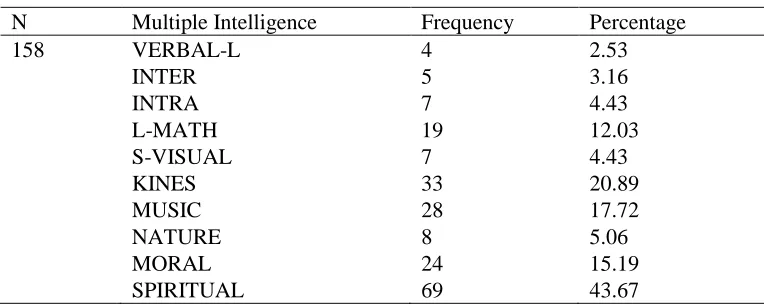
Dominance of Multiple Intelligence
Table 2. Percentage frequency table of multiple intelligence
N Multiple Intelligence Frequency Percentage
158 VERBAL-L 4 2.53
INTER 5 3.16
INTRA 7 4.43
L-MATH 19 12.03
S-VISUAL 7 4.43
KINES 33 20.89
MUSIC 28 17.72
NATURE 8 5.06
MORAL 24 15.19
SPIRITUAL 69 43.67
Relationship between Multiple Intelligence with VARK Learning style
To meet the objective (iii) of this research, correlation analysis was used to obtain the correlation coefficient of the relationship between the variables studied.
Table 3. Correlation between Multiple Intelligence with Learning style
Visual Audio Reading Kinesthetics
Multiple Correlation, r -0.053 0.070 0.087 -0.029
Intelligence N 158 158 158 158
Meanwhile, Table 3 is the result of correlation test which shows that there is no significant relationship between multiple intelligence and visual component (r = -0.053), audio component (r = 0.070), reading component (r = 0.087) and kinesthetics component (r = -0.029).
Thus, this study found that Muslim gifted and talented students had insignificant correlation between multiple intelligence with each component of VARK learning style.
DISCUSSION
64
there are no correlation between multiple intelligences and the learning styles that they use. Data shows that multiple intelligences and visual component (r = -0.053), audio component (r = 0.070), reading component (r = 0.087) and kinesthetics component (r = -0.029). Meanwhile the most dominant learning style among students in Kolej PERMATA Insan is kinesthetics learning style, with statistics of 48.10% (76 individuals) of the students using this method to study and process information effectively. The reading learning style is only used by 19 (12.03%) of the students, making it the lease preferred method to be used in learning. In terms of multiple intelligences, the spiritual component among Muslim gifted and talented students are the highest with 69 (43.67%) students. This is affected by the learning materials that were delivered to the students, as the students in Kolej PERMATA Insan applied religious aspects in their academic syllabus. The insignificant correlation is due to the diverse and multiple fields that the students majored in. This is supported by Gardner (1999), which states an intelligence is a ‘‘biopsychological potential to process information that can be activated in a cultural setting to solve problems or create products that are of value in a culture’’. Hence, further studies is needed to clarify this matter.
CONCLUSION
In conclusion, this study has come out with the results where there are no correlation between Multiple Intelligence and learning style among Muslim Gifted and talented which contradict as what presumed before. Based on the results it can be conclude that the diversity and exposure that has been given to these Muslim Gifted and Talented students has broaden the way they discover and adapting knowledge. The study also found out that kinesthetics learning style is the most popular way of learning among these gifted learners. It also can be prove by the classroom learning session where the lecturers need to conduct the syllabus in a fun and active yet interactive way of teaching to get students involved and understand better. As for the highest score of intelligence which is spiritual, it’s obviously proven by the passion and interest of the students in memorizing al-Quran and the application of Islamic lifestyle in their daily lives. The results from this study eventually can be broaden by proposing a future study specifically developing a module on teaching methodology for Muslim gifted and talented students where it can help these students in coping with their abilities in learning and developing their intelligences.
REFERENCES
Denig, S. J. (2004). Multiple Intelligences and Learning styles:. Teachers College Record, 106 (1) (2004), 96-111.
Gagné, F. (2005). From Gifts to Talents: The DMGT as a Developmental Model. In R. J. Sternberg, & J. E. Davidson (Eds.), Conceptions of Giftedness (2nd Edition ed., pp. 98- 119). New York: Cambridge University Press.
Gardner, H. (1983). Frames of Mind: The Theory of Multiple Intelligences. New York: Basic Books.
Gardner, H. (May, 2001). The Three Faces Of Intelligence. pp. 139–142.
Gardner, H. (1993). Multiple Intelligences - The Theory in Practice. New York: Basic Books.
Gardner, H. (1999). Intelligence reframed: Multiple intelligences for the 21st century. New York: Basic Books.
Hanafin, J. (2014). Multiple Intelligences Theory, Action Research, and Teacher Professional Development: The Irish MI Project. Australian Journal of Teacher Education , 126-142.
Houwer, J. D., Barnes-Holmes, D., & Moors, A. (2013). What is learning? On the nature and merits of a functional. Psychonomic Society .
Husin, M., Shukor, A., & Jusoh, A. (2011). Gaya Pembelajaran Dan Persekitaran Yang Mempengaruhi Murid Sukar Belajar Dalam Mata Pelajaran Pendidikan Islam. Jurnal Penyelidikan Dedikasi , 98-111.
Jantan, R., & Razali, M. (2002). Psikologi Pendidikan Pendekatan Kontemporari.
Kuala Lumpur: McGraw Hill Education .
Lebar, O., & Mansor, N. H. (2000). Pencapaian pelajar mengikut gaya belajar dan bentuk
pentaksiran. Paper presented at the education seminar Universiti Pendidikan Sultan Idris, Unpublished presented papers.
McKenzie, W. (2005). Multiple Intelligences and Instructional Technology: Second Edition. Washington, DC, United States: International Society for Technology in Education.
Mok. S. S. (2003). Ilmu pendidikan Untuk KPLI: Psikologi Pendidikan & Pedagogi. Jaya Subang. Kumpulan Budiman Sdn. Bhd.
Nadeak , B. (2015). Correlation between Knowledge, Experience and Common Sense, with Critical Thinking Capability of Medical Faculty’s Students at Indonesia Christian University. Journal of Education and Practice , 45-55. Nielsen, M. E. (2002). Gifted students with learning disabilities: Recommendations for identification and programming. Exceptionality, 10(2), 93-111. http://dx.doi.org/10.1207/S15327035EX1002_4
Othman, N., & Amiruddin, M. (2018). The Learning styles and Multiple Intelligences. International Education Studies , 38-47
66
Reid, J. M. (1995). Learning styles in the ESL/EFL Classroom. USA: Brooks/Cole/Thomson Learning. Beijing: Foreign Language Teaching and Research. 2002.
Simonton, D. K. (2005). Giftedness and Genetics: The Emergenic- Epigenetic Model and Its Implications. Journal for the Education of the Gifted, 28(3/4), 270-286
Sulaiman Alrabah1, S.-h. W. (2018). The Learning Styles and Multiple Intelligences of EFL College Students in Kuwait . International Education Studies; Vol. 11, No. 3; 2018 , 11 (3), 38.
Wechsler, D. (1944). The Measurement of Adult Intelligence. Baltimore, MD: Williams & Wilkins.
Visser, B. A., Ashton, M. C., & Vernon, P. A. (2006). g and the measurement of Multiple Intelligences:. Elsevier Inc. , 507-510.