Anthropology Honors Theses Department of Anthropology
5-7-2016
Queer Subjectivity, Transmedia, and Embodiment
in the Carmilla Fandom
Stephanie Skinner
Follow this and additional works at:https://scholarworks.gsu.edu/anthro_hontheses
This Thesis is brought to you for free and open access by the Department of Anthropology at ScholarWorks @ Georgia State University. It has been accepted for inclusion in Anthropology Honors Theses by an authorized administrator of ScholarWorks @ Georgia State University. For more information, please [email protected].
Recommended Citation
Skinner, Stephanie, "Queer Subjectivity, Transmedia, and Embodiment in the Carmilla Fandom." Thesis, Georgia State University, 2016.
QUEER SUBJECTIVITY, TRANSMEDIA, AND EMBODIMENT
IN THE CARMILLA FANDOM
by
STEPHANIE SKINNER
Under the Direction of Cassandra White, PhD
ABSTRACT
This study examines the ways in which individuals mediate the institutionalization and
embodiment of queer identities in the Carmilla fandom by manipulating transmedia networks.
The research conducted expands upon Boellstorff’s (2015) methodology for virtual communities
and Spitulnik’s (1993) theory of “media power”. Data was collected using three strategies: 1)
quantitative surveys of 436 individuals, 2) five interviews, and 3) participant observation in the
Carmilla fandom through social media. While Marxist and critical theorists assert that mass
media is contextualized as needing to fulfil the needs of the dominant class through institutional
legitimation, I propose that an inverse can be recognized in GSRM online communities, whereby
to GSRM representation. By examining Carmilla: The Series’ unconventional mediums and
driven narrative, this study hopes to gain a perspective into the importance of
queer-normative representation in mass media and acknowledge ways in which minority online
communities manufacture and reinforce identity.
QUEER SUBJECTIVITY, TRANSMEDIA, AND EMBODIMENT
IN THE CARMILLA FANDOM
by
STEPHANIE SKINNER
An Undergraduate Honors Thesis Submitted in Partial Fulfillment of the Requirements for the
Degree of Bachelor of Arts
in the College of Arts and Sciences
Georgia State University
Copyright by Stephanie Skinner
QUEER SUBJECTIVITY, TRANSMEDIA, AND EMBODIMENT
IN THE CARMILLA FANDOM
by
STEPHANIE SKINNER
Department Chair: Kathryn Kozaitis
Thesis Advisor: Cassandra White
Electronic Version Approved:
Department of Anthropology
College of Arts and Sciences
Georgia State University
ACKNOWLEDGEMENTS
I would like to express my deepest gratitude to my thesis advisor, Dr. Cassandra White,
for her encouragement and support in pursuing this research. It is only through her class,
ANTH3100: Sex, Culture, and Sexuality during my junior year, that my research was able to
TABLE OF CONTENTS
ACKNOWLEDGEMENTS ... vi
LIST OF TABLES ... ix
LIST OF FIGURES ... x
LIST OF ABBREVIATIONS ... xi
INTRODUCTION ... 1
REVIEW OF RELATED LITERATURE ... 3
Mass Media, Computer-Mediated Communication, and Online Communities... 3
Participatory Culture, Fandoms, and Transmedia Narratives ... 8
Queer Subjectivity and Representation in Online Spaces... 13
DATA ... 18
So, Who’s Carmilla? ... 18
Quantitative and Qualitative Analysis ... 19
METHODS ... 24
RESULTS ... 25
Who’s Who in the Carmilla Fandom? ... 25
Participatory Culture and Embodiment ... 26
DISCUSSION ... 27
CONCLUSION ... 30
Implications for Future Research ... 30
LIST OF TABLES
Table 1 Gender Demographics in the Carmilla Fandom ... 20
Table 2 Sexuality Demographics in the Carmilla Fandom ... 20
LIST OF FIGURES
Figure 1 “Creampuff World Domination” completed in Google Maps by @Carmilla-Feels-HQ
(Tumblr Handle) ... 19
LIST OF ABBREVIATIONS
AO3 Archive of Our Own
CMC Computer-mediated communication
F2F Face-to-face
GPS Global position systems
GSRM Gender, sexuality, and romantic minorities
IRL In-real-life
OTW Organization for Transformative Work
P2P Peer-to-peer
PCs Personal computers
POV Point-of-view
Introduction
Despite the little recognition she received while pursuing anthropology under Franz Boas,
Zora Neale Hurston became the foremost figure on native anthropology in her book Mules and
Men. As a queer woman, I was ecstatic when I discovered a new web series airing on YouTube
that acknowledged my identity through queer-normative narrative. Carmilla, a Canadian web
series based off the novella of the same name by Joseph Sheridan Le Fanu, is a modern
adaptation that uses transmedia storytelling through social media (e.g. Tumblr and Twitter) and
additionally story content (i.e. “Silas Confidential” on Wattpad). I would hardly consider myself
an active participant of the fandom—my routine mainly consists of reading others’ posts and
reblogging content. However, the Carmilla fandom is close knit—there are individuals who
essentially act as community leaders, the producers and actors engage with the community, and
new members are welcomed in open arms as ‘creampuffs’.
“[T]here are no new ideas. There are only new ways of making them felt” (Lorde 1977).
One of my participants, Sarah (name changed to protect informant confidentiality), mentioned
something very similar during our interview, and it occurred to me, the profoundness: because
there is an assertion that individuals of my generation— the “millennials”— are entitled,
sensitive, and self-absorbed (Wright 2013), and that the constant “connectivity” is somehow a
detriment to our character (Eldeib 2010). What is often mischaracterized as narcissism or
proliferate political correctness is instead the need for representation and community that is
shaped through discussion and discourse conducted in online spaces through social media
(Alexander 2002), especially for gender, sexuality, and romantic minority (GSRM) individuals
"They're fans, but they're not silent, couchbound consumers of media. The culture talks to
them, and they talk back to the culture in its own language" (Grossman 2011). Because Carmilla
was uninhibited by the restraints of a mainstream network show, the producers were able to
authenticate the facets of identity that are rarely afforded to queer characters in mainstream
media. In addition, the Carmilla fandom has a large participatory network of social media role
play, fan fiction, and fan art. The visual ways in which thoughts and ideas of queerness are
dispersed through the fandom mean that even as a passive interactor, ideologies of identity are
still produced and reproduced. Most important, the Carmilla fandom allows individuals the
ability to mediate queer identity in a way that does not compromise their offline social life.
While geographic locality has been prudent to understanding the societal institutions of
computer-mediated communication (CMC) and online communities, it is also important to
recognize the internet as a transnational entity incorporating a locus of social, economic, and
political identity that is in a constant state of flux. While early anthropological literature
(Spitulnik 1993) focused on such Marxist and critical theorist approaches to explaining the
socioeconomic culture of online communities, my research has adapted this model and applied
an anthropological lens to literature in media and communication studies, and fandom studies. In
addition to Marxist, critical, and social practice theory, queer theory is also discussed. The
methods employed to collect data includes both qualitative interviews and participant
observation in the Carmilla fandom, and quantitative interviews distributed on Tumblr and
completed through Survey Gizmo.
In order to apply and analyze the research questions at hand, certain methodological
measures must be taken. First, I will review the relevant literature used to guide the research. I
that, I will detail the methods I used to collect the data. Then, based on the literature and methods
described, I will apply it to hypotheses and research questions that have guided the research.
Next, I will detail the findings of the data observed and collected, and how this may or may not
relate back to the literature and hypotheses. After which, I will return to the main research
questions and interpret the findings of the research. Finally, the conclusion will ascertain the
methodological limitations and bias of the study that could compromise the data, and the broader
implications the data could have on future research.
Review of Related Literature
In order to adequately explore the discursive context of media, participatory culture, and
queer subjectivity, the following literature was reviewed and organized into three distinctive
sections: 1) Mass Media, Computer-Mediated Communication, and Online Communities, 2)
Participatory Culture, Fandoms, and Transmedia Narratives, and 3) Queer Subjectivity and
Representation in Online Spaces.
Mass Media, Computer-Mediated Communication, and Online Communities
As Debra Spitulnik notes in her Annual Review of Anthropology article, “Anthropology
and Mass Media” (1993), anthropological discourse over mass media and communicative
practices in online spaces is few and far between. While this is often convoluted by discussions
of what constitutes tangible and imaginative domains of study, we must understand that mass
media’s electronic medium “are at once artifacts, experiences, practices, and processes
(1993:293). Therefore, mass media and its cultural products are inexplicably tied up in language
and intertextuality— associations between literary, media, or cinematic texts (Haastrup 2014)—
and the “construction of communities” (Spitulnik 1993:294). Because mass media and social
concern for “media power” which determines individual interpretation, participation, and
representation of a collective community. Media power has been assessed from two schools of
thought. The first, proposed by Bennett (1982, as referenced by Spitulnik 1993:295) involved
theories of “mass society” and the effect mass media has on legitimizing hegemonic institutions,
leading to cultural homogeneity, and denigration of “working class consciousness”. This is
further exemplified by the use of quantitative data to support media ratings and commodify
audiences and audience identity (Spitulnik 1993:299). The second school of thought elaborated
on the role of media power in the production and reproduction of cultural attitudes and beliefs of
media audiences, where individuals actively interpret media, but is independent of class
(Bourdieu 1984, as referenced by Spitulnik 1993:297). I intend to provide an empirical praxis of
Anderson’s (1983, as cited by Spitulnik 1993:295) theory of mass mediated collectivity, where
individuals have a sense of community regardless of variegated interpersonal communication.
Like Spitulnik, Rheingold also asserts the complication of mass media commodification
in the public sphere through computer-mediation communication (CMC) (1993). Nevertheless,
while our perceptions of society are dependent on the internality and externality of mass media
we consume, it is also affected by our CMC use. CMC also has the ability to create
“many-to-many” communication, but Rheingold states that this can present as a challenge to community
building. Ultimately, he believes that political change is only possible through CMC’s ability to
challenge hegemonic institutions in communications media (1993). Rheingold also places
concern on whether online spaces and groups (such as fandoms) could constitute a community.
Rheingold cites Marc Smith’s concept of “collective goods” (1992), where a community consists
of three social goods: social network capital, knowledge capital, and communion. Simply put,
capital”— the communal knowledge shared by members in the community— is interpreted,
produced, and reproduced through “communion”. Some individuals come to virtual communities
for community, some for knowledge, and for others— both. And some individuals have a natural
proclivity for online communities. These “symbolic analysts” as mentioned by Robert Reich
(1992, as cited by Rheingold 1993) included: writers and journalists, freelance artists and
designers, independent television producers, researchers, etc. Like myself, Rheingold asserts
himself as both a native informant and as “[an] uncredentialed social scientist” (1993), and the
views of both the observer and performer are key to understanding the cultural beliefs and
products constructed in online spaces.
Similarly, Wilson & Peterson also argue that online communities vary in characteristics
and purpose, but all are “linked by an interest in markets or exchange networks for goods and
information” (2002:449). Like Spitulnik (although occurring almost a decade later), Wilson &
Peterson contest the lack of anthropological research online communities and the Internet, stating
that, “anthropologists have positioned media as peripheral to culture” (Dickey 1997 as stated by
Wilson & Peterson 2002). While they cite Rheingold’s “revitalization of citizen-based
democracy” through CMC, they also reference Castells (1996) who proposes that CMC and the
Internet have brought about a new information age (Wilson & Peterson 2002:451). The lack of
formal methodological approaches to research of media and the Internet has also made it difficult
to discern what is ‘here to stay’ and what has become insignificant, especially when new users
begin with the latest technology. Variable shelf lives of CMC technology also introduced
problems with terminology phenomena. Here, Wilson & Peterson elaborate on the Internet as an
all-encompassing infrastructure that includes the Web, email, social media, and mass media,
2001:143 as cited by Wilson & Peterson 2002:452). Praxis involving power dichotomies and
minority relations should be kept in mind as media processes and products continue to evolve
(Spitulnik 1993, as referenced by Wilson & Peterson 2002:455). While some scholars contest the
tangibility of CMC and online communities, Wilson & Peterson find this division unnecessary,
but that issues of identity, communication, and power must be contextualized by offline
sociocultural interactions (2002:457-60).
How then does a researcher approach ethnography in the context of online spaces? Anne
Beaulieu opens the discussion on methodological approaches used by incorporating
anthropological praxis to evolving technology (2004:139). New networked technology means the
creation of new webpages and sites where scientific inquiry can take place. While most work
asserts that CMC is incapable of producing community through a lack of face-to-face
communication and physical locality, other scholars such as Wilson & Peterson (2002) cite the
“over-invest[ment] in fetishized notions of community that are no longer considered valid in
anthropology” (Beaulieu 2004:143). New demands may mean learning new methods of
conducting ethnographic research, but may also provide advantages to issues of multi-sited
ethnography or longevity of research—data can be collected from the ease of your office.
Likewise, while traditional ethnography saw the intrusiveness of field notes and records (audio
or visual), online ethnography “celebrates the position of the lurker” and affords the observer
advantages as a future participant through a liminal period of prefatory performance (Beaulieu
2004:146). However, some ethnographic work (Hines 2000, as states by Beaulieu 2004:149)
treats the Internet and its infrastructure—structurally and functionally— as fixed, and explores
intersubjectivity through individually-produced webpages. This method of active interaction
the Internet and CMC in general, online ethnography is more often relegated to that of “cultural
studies, literary studies and media studies” (Beaulieu 2004:159).
Providing a more modern approach to the study of online ethnography, Coleman starts by
expressing variances in the production and reproductions of cultural products by individuals and
groups (2010:488). Cell phones have now become a facet of everyday life, and thus, our daily
life consists of interactions with digital media—whether it’s checking the weather or posting on
Facebook— and the production of these “digital artifacts” create communities of collective
identity that are shaped through evolving digital technology. Coleman breaks her exposition of
ethnographic praxis into three categories: digital media and cultural politics, vernacular of digital
media, and the dialectical relationship between digital media and social practices. (2010:488).
The replacement of landlines with cell phone usage has increased not only economic activity, but
sociality as well (Coleman 2010:492). Not only are social networks of kinship and friendship
reinforced, but it also provides a medium for the production and interpretation of GSRM identity.
As previous scholars have mentioned, much ethnographic work has been subject to stringent
dichotomous lines between online and offline spaces. While some spaces retain distinctive
boundaries, others centralize groupings that would have been impossible before the Internet, and
offer national and transnational support systems (Coleman 2010:493). Referencing Bakhtin’s
theory of heteroglossia—where one perspective encompasses the ‘voices’ or perspectives of
multiple entities— Coleman states that language and the artifacts produced through digital media
are lived. The mediation of these products also shape: production and reproduction of media,
communication, and social or ideological functions (Coleman 2010:495).
Through empirical and self-reflexive application, Boellstorff examines the virtual world
Boellstorff explains that observing virtual communities in situ is the only sensible
methodological approach that can evolve with technology and CMC (2015:4). While individuals
that may engage in online practices are influenced by offline sociocultural mores, “the forms of
social action and meaning-making that take place do so with the virtual world, and there is a dire
need for methods and theories that take this into account” (2015:5). We must maintain, however,
that a dialectical relationship exists between meaning-making in virtual worlds and social life.
Subjectivity and community is mediated through production and reproduction of consciousness
surrounding these spheres. Like previous scholars, the question of Second Life as a relevant
digital technology becomes problematic when we assume the speed at which these technologies
evolve (2015:xv). However, for posterity’s sake the implication of such ethnographic fieldwork
will maintain even after the posit of the “hype cycle”, in which primacy is given to the newest
trend. Contrary to the way in which Google deleted accounts that were not linked to a user’s real
name (Lothian 2013), your identity in Second Life was deliberately discrete from your physical
identity. The most interesting assertion of this literature, is the differentiation between
pseudonymity and anonymity. As Lothian (2013) explains with the need for author legitimacy
and protection, so too does Boellstorff acknowledge the interdependence of individual and
collective identity: “As we move into a future of potentially ubiquitous tracking and surveillance,
Second Life reminds us of the possibility for forms of digital collectivity and selfhood that use
pseudonymity in creative and community enhancing ways” (Boellstorff 2015:xvii).
Participatory Culture, Fandoms, and Transmedia Narratives
While previously literature has focused on methodological approaches to mass media and
online communities, I begin this section with DiMaggio et al.’s article on “the Internet’s
term Internet to refer to both the structural and functional uses of infrastructure. Internet
technologies are rapidly evolving, and this offers two important research points: testing of
“technology diffusion and media effects”, and “modalities of communication and different kinds
of content” (DiMaggio et al. 2001). Here, modalities of communication refer to the various ways
in which we communicate: peer-to-peer interaction (P2P), group discussion, or more recently
vlogging, while content refers to text, audio, or video. In addition, the complex semiotic
modalities of online communities will spark new discourse on identity, inequality, social
organization (Castells, referenced by DiMaggio et al. 2001:309). Although this is a worthy area
of research, DiMaggio et al. also conclude that differentiating between forms of Internet use
would be useful in analyzing behaviors of social and institutional nature (2001:329). What has
appeared most is varying degrees of how the Internet would impact new technology. While
previous literature such as Neuromancer have become the preeminent example of dystopic
reactions to technological diffusion, this is typically in response to utopic hopes and high
expectations. In reality, the Internet’s impact has been more limited than originally anticipated,
and has varied socioeconomic and political constraints.
One such technological innovation that has arisen from the Internet and CMC has been
mobile Internet (Rheingold 2002). Just as personal computers (PCs) evolved to encompass
telecommunications networks to form the beginnings of the Internet, Rheingold hypothesized
that mobile phones would evolve to incorporate the Internet, at which point “[i]t will be a way to
do things that couldn’t be done before” (2002:xiv). Each of the features proposed: screen color,
screen size, multimedia, and global position systems (GPS) exponentially increase the others’
functionality. Three laws are pivotal in technological evolution: Moore’s Law, Metcalfe’s Law,
computer processors become more efficient (and thus smaller), they will become cheaper.
Likewise, Metcalfe’s Law states that as the number of connection points— also known as
nodes— grows, the power of a network will multiply. The last, Reed’s Law expresses that as
more variegated groups access networks especially those of social networks, it increases the
power said network. Thus, Reed’s Law will result in a mobile phone and Internet boom and
provide connectivity that was previously unforeseen (Rheingold 2002:xv). Rheingold mentions
his previous work The Virtual Community (1993) which has been previously reviewed, and
begins to describe the early signs of technological shifts stemming from mobile
telecommunications: websites allowing fans to engage with celebrity information leading to
communities of interests; dating services; and navigation. Most importantly, however, is that
these features “enables people to act together in new ways and in situations where collective
action was not possible before” (Rheingold 2002:xviii).
In addition to his previous book, Smart Mobs, I also analyze a chapter Rheingold has
written in the Handbook of Mobile Communication Studies (2008). I ended my last paragraph
discussing the implications of collective action and community organization. Rheingold expands
upon this by stating that despite being on the precipice (as of 2008) of its potential, it is expected
to “enable people to effect significant political changes” (2008:225). While communicative
practices— and literacy by extension— have gone hand-in-hand with political institutions for
much of written history, future communication technologies have “the potential to amplify,
leverage, transform, and shift political power by enabling people to persuade and inform the
thoughts and beliefs of others” (Rheingold 2008:225). And although the potential for positive
political change is evident, it can also be argued that the same technology can prove disruptive to
where mobilization has occurred, he establishes that in no way does it ensure that smart mobs
will be peaceful or that collective action organized through this means will result in more unified
democracies. He does, however, suggest several reasons including empowerment and “the power
to disseminate information that is suppressed by authoritarian regimes and controlled mass
media” as ways to created strong, unified democracies through smart mobs (Rheingold
2008:236).
Due to the widespread and evolving nature of the Internet and the rise of media-rich
smartphones, Evans asserts that a “new model of understanding audience engagement” is
needed. Audio-visual narratives are no longer restricted to television mediums, and instead are
coalescing with transmedia—emergent technology that extends traditional narratives across
multi-media platforms of community engagement (Evans 2007). Through her analysis of Spooks,
a BBC television program, Evans explains that transmedia text of online games is created in a
way that mimics the style of the program itself; edited screenshots, music, symbolism, and a first
point-of-view (POV) “places the user in the diegesis of the series” (2007). Diegesis here
represents the recounting of a story from the narrator’s perspective. While there is some debate
on the use of the term “interactive” or “interactivity” to describe the way in which the audience
communicates with a medium, this does not explicitly constitute a clear boundary; no interactive
process is entirely passive—interpretive processes and paralinguistic markers (e.g. nonverbal
facial expressions) are consciously or unconsciously enacted. Instead, interactivity should be
viewed on a spectrum, including not only “different media forms but also different forms of
interactivity itself” (2007). Of the most importance, however, is the centrality of characters to
audiences. While narratives wane over time, characters generally stay consistent, and aid
Like Spooks, BBC’s modern retelling of Sherlock has attracted the attention of social
media the participatory culture of fan fiction and role playing. Through the creation of ‘fake’
character accounts on social media sites such as Facebook, Twitter, and Tumblr, fans act out
celebrity behavior. Although McClellan begins by differentiating between fan fiction and role
playing, she later targets attributes that that correlate between social media narratives and role
play interactivity (2013). As with fan fiction, authors are able to add additional content that
reflects their personal, as well as the collective interpretation of events and identity in the same
way that actor of social media role playing give additional content; however, that is not to say
that additional content is canonized—rather that it is also limited by the authentic narrative
material. In order for the presence on social media to become imbricated with the celebrity
figure, online role play characters must be exactly that—in character. Any facet of interaction
including responding textually must be done precisely as the “source character” (2013). Through
the observation of BBC’s Sherlock and the interactivity audiences and social media,
conventional fandom practices are reevaluated.
Distributed by the same network as Sherlock, Hill’s case study of Torchwood media
tie-ins is more similar than dissimilar to Jenkin’s (2006) description of transmedia storytelling.
Although these novels, broadcasts, and interactive games constitute separate storylines, it
nevertheless expands the narrative world of Torchwood (Hill 2012:409). In addition, Hill also
asserts that these media tie-ins are direct responses to fan criticisms of “developing narratives,
[and an attempt] to quell and deactivate negative fan commentary”. In this way, the discursive
commodification of fan collectivity and identity represents not only the acquiescence of the
audience, but also as a way to handle the TV series brand—the process of “fanagement” (Hill
engagement and world-building become paramount to the act of storytelling (2012:411). This is
best accomplished through hyperdiegetic responses that reward the passive interactivity of
audiences by fulfilling the needs of a consumer group. Although Jenkins readily attests that
modern transmedia storytelling fulfill the needs of the audience expectations, Hill states that this
is presumptuous due to the importance of continuity to fan cultures. For example, if continuity
errors are detected, they are “retconned” whereby fan fiction “rework[s] the canonical test so that
contradictions are retroactively ironed out (Hill 2012:412).
Similarly, Wood & Baughman’s (2012) study of Glee fan practices on Twitter has
“implications for both producers and consumers” (328), especially when citing Jenkins’ (2006)
theory of “convergence culture”— “defin[ing] the relationship between media convergence,
participatory culture, and collective intelligence” (Wood & Baughman 2012:331). Convergence
is best described as the “osmosis of participatory media”. Content travels between media
platforms and industries while media audiences—especially fan cultures—search for variegated
entertainment experiences (2012:331). Participatory culture relies on the consumer’s
participation in reciprocal social interactions that “contributes to a capital of collective
intelligence”. As with Sherlock character role play on social media sites, Glee fans on Twitter
maintain role play accounts and were connected through a world outside of the narrative, but
consistently informed by the narrative. Overall, changes in televisual media through convergence
and embodiment of fan communities online are providing the basis for a new categorization of
audience (2012:332).
Queer Subjectivity and Representation in Online Spaces
Where does transmedia and newer technological media fall in providing community and
online environment of Tumblr and the networks of “digital self-representation” of queer and
gender nonconforming individuals (2014:611). The evolution of CMC and digital technologies
has improved the ways in which we communicate textually and visually. Blogs typically consist
of embedded multimedia, descriptions of content, source information, and an archival record of
everyone who ‘reblogs’, ‘likes’, or ‘comments’ on the post. Like Second Life and the #nymwars
controversy, users are considered pseudonymous. The “disidentificatory” nature of Tumblr has
enabled a community discourse where queer individuals are able to mediate identity free of
heteronormative and “mass-consumption paradigm” (Fink & Miller 2014:612). Fink asserts that
unlike offline communities, online communities like those of Tumblr are more accessible and
provide a unique “digital forum for the disseminating self-representations of trans experience
beyond local contexts and spatial boundaries” (2014:613). Tumblr’s microblogging platform
contrasts the prose-style blogging of websites like WordPress of Reddit, and because of this
provides contextualization of intersectionality and intertextuality, where content is dependent on
visual media (2014:614), and erasure or misrepresentation of GSRM identity in social life is
explored across temporal and spatial boundaries (2014:615).
As I said at the beginning of my paper, millennials are often associated with increased
need for connectivity, somehow making up lazier and more disconnected from our social lives.
The growth of mobile Internet and social media technologies was predicted by Reed’s law, and
as such have allowed social networks and diversification to prosper. As Yourd notes,
communities based in intertextuality allow “individuals to understand complex social issues,
such as queer issues, and the Internet is rich in fictional queer narrative that queer and non-queer
audiences worldwide have latched on to in lieu of mainstream fiction” (2014:1). As we have
stemming from lack of representation. Such work is authored for the sake of the work itself, not
for profit, and through non-tropic representation allows realistic experiences and inclusion
(2014:2). This contrasts heteronormative practices in mainstream media, where limited queer
identities are explored, are depicted stereotypically or one-dimensionally, and are only
“understood by their queerness” (2014:6).
When queer identities are portrayed in mainstream media, more often than not these roles
are filled by stereotypical characters like the gay best friend. Queer-identified women in media
are few and far between, especially for identities that are considered ‘less conventional’ than
others. As such, Lothian, Busse, & Reid explore the online spaces of queer women, specifically
femslash fandoms (2007:103). Femslash is fan fiction that involves female relationships of a
romantic or sexual nature, however, the authors present such discourse in way that opposes the
geophsyicality of Judith Halberstam’s “metronormativity”, and places an emphasis on the
practices of queer women in online spaces (Lothian, Busse, & Reid 2007:5). The self-reflexive
nature of work reflects issues of “queerness, feminism, identity, and political agency” that stem
from a lack of mainstream media representation and opens discourse on queer identity and
queerness (2007:106-7). Slash fandoms offer safe spaces to women who are embody their
identity, as well as those who explore queerness in a space without “potential effects on real
lives”.
Similar to Lothian, Busse, & Reid (2007), Vivienne & Burgess explore “how queer
storytellers balance privacy with the desire to have a voice to be heard in public debates”
(2012:362). For queer individual’s daily interactions can be can become examples of “everyday
activism”, born from early performativity and mediation of queerness in a heteronormative social
contest stereotypes of representation rather than confining discourse to an exclusive group.
Vivienne & Burgess define a three-stage typology of digital storytelling (2012:364):
‘pre-production’ and ‘‘pre-production’ involve active identity mediation between “intimate” publics.
Through this discursive practices, the collectivity determines what aspects of identity should be
hidden and what can be lauded to unknown audiences (2012:365-7). This constant mediation
stems from societal stereotypes and taboos of what it means to be queer. Through “networked
identity work” these storytellers define how they are viewed by “intimate and unknown publics”
(2012:375).
Lothian begins their discussion with the #nymwars controversy where in 2011, Google
deleted accounts that were not indexed with user’s real names (2013: 541). While this can lead to
disruptive or harassing behavior by anonymous users, this also risks the identity and well-being
of individuals who have “political, sexual, or subcultural online practices” that differ from that in
the offline world (Lothian 2013:542). Most of the proponents arguing for a third term
alternative— pseudonymity— were involved in fan cultures that exchanged fan art and fan
fiction. Such websites where pseudonymity is permissible allowed creators an “accountable,
archivable, and socially positive way of separating online activities from a physical sphere that
may not approve them” (Lothian 2013:542). The Organization for Transformative Works (OTW),
is “a fan advocacy organization that works to preserve and defend the legitimacy of fans’ creative
works”, underwrites the journal of Transformative Works and Cultures, and operates Archive of
Our Own (AO3) a website where more than 380,000 fan fiction stories are created, saved,
shared, and discussed (Lothian 2013:543). While fandom has a vast definition of communities,
Lothian uses the term ‘subcultural fandom’ when discussing fans that produce or discuss fan
2013:545) described fan fiction as ‘archontic literature’ where “authors build on existing media
and literature and add a diversity of perspectives” and for minority groups and women to
incorporate sociocultural criticism. While fan productions are not always created in a way that
preserves the canon—content created by authors that is deemed authentic— it still expands the
content retention (Lothian 2013:546).
As previously discussed, Lothian establishes that online fandoms provide a means for a
diversity of perspectives and for inclusion of minority groups and women. This is further
corroborated by scholars describing CMC as a means for disadvantaged groups to regain a sense
of community (Mele 1999; Smith & Kollock 1999). Alexander asks how other CMC and online
communities enable GSRM individuals to create a sense of community (2002:77). As more and
more online queer communities begin to appear, GSRM organizations are able to reach out to the
community and provide support, and as Egan (2000, as cited by Alexander 2002:78) states
GSRM teens are “coming out at younger and younger ages—perhaps due to the availability of
information, and interactivity, offered by the Internet.” It also provides young GSRM individuals
with a way to establish networks of connectivity with peers and role models, and if desired
potential significant others. How then do Internet technologies influence the embodiment of self
and society? Alexander claims that questions of this sort are important since queer identities are
contested and threatened in offline spaces (2002:79). Tsang (1996:311 as cited by Alexander
2002:79) states that in online communities, “For once, you are in total control of your sexual
identity, or identities, or at least what you decide to show the outside world”. Online spaces
allow the mediation of identities and subjectivity that would or could be prohibited in-real-life
(IRL) and across geographic and national polities. The varying degree of representation online
GSRM individuals to identity performance and community (Alexander 2002:81). Nina Wakeford
(1997:31 as referenced by Alexander 2002:81) states, “The construction of identity is the key
thematic which unites almost all cyberqueer studies”. The perception of community and identity
will continue to change as communication mediums adapt to Internet and social trends.
Data
As a preface to the data that will be explained below, I want to address stylistic choices
that will appear throughout the continuation of the paper. When referencing Tumblr, I will use
the capitalized form (“Tumblr”) to refer to it as a technological medium or infrastructure, while
the lower case (“tumblr”) will refer to its personal usage as a microblog. In addition, any
informant names referenced throughout the continuation of this paper will be pseudonyms to
protect participant confidentiality.
So, Who’s Carmilla?
At its surface, Carmilla is just another vampire show: Disdain for sunlight? Check.
Drinks blood? Check. Brooding lady vampire? Check. Naïve-girl love interest? Check. Oh, I’m
sorry— did I lose you? Let me clarify; Carmilla is the modern retelling of the Joseph Sheridan
Le Fanu’s novella of the same name, except with queer characters and a queer-normative
narrative. Created by Jordan Hall and Ellen Simpson, it stars Elise Bauman as ‘Laura’, and
Natasha Negovanlis and ‘Carmilla’. The Canadian web series premiered on Vervegirl’s (now
KindaTV) YouTube channel in 2014. The series has three seasons and a Christmas special, with
fans anticipating the fourth and final season this summer, and the average length of an episode is
between three to seven minutes. Co-creator Ellen Simpson created additional story content
through canon character Twitter accounts between season one and season two. Due to the less
identity and life—minus the vampire issues—and include actors and crew that are a part of the
GSRM community. In addition, most of the actors are women, and empowerment is a common
theme of the series.
[image:31.612.71.541.181.502.2]Quantitative and Qualitative Analysis
Figure 1 “Creampuff World Domination” completed in Google Maps by @Carmilla-Feels-HQ (Tumblr Handle)
When conducting research, we like to have tangible evidence of the phenomena we are
investigating. In the case of physical fandoms, one can simply attend a comic-con and see droves
of individuals amassing into their respective collectives. How then does this translate to fandoms
in online spaces? Figure 1, created by the unofficial Carmilla fandom tumblr
Carmilla-Feels-HQ, shows a ‘registry’ of individuals that engage in the Carmilla fandom. Principal groupings of
are found in Russia, Central Asia, the Middle East, and Africa. Despite how centralized the
fandom appears, I was able to attain transnational data from 35 countries and 339 cities.
Over the course of four months, from early January to mid-April, I conducted qualitative
and quantitative research of the Carmilla fandom on Tumblr—and through extension YouTube,
Twitter, and AO3. Following traditional anthropological methods, I conducted participant
[image:32.612.148.455.153.352.2]observation of the online spaces through which the Carmilla fandom interacted, and interviewed
Table 1 Gender Demographics in the Carmilla Fandom
individuals with varying degrees of participation. Simple quantitative surveys were distributed
during this time in order to assess demographic make-up of the community.
While the producers of Carmilla encourage everyone to watch the web series, from a
consumer based perspective Carmilla was created to provide legitimation and agency to queer
individuals and women. As Table 1 shows, almost 327 of individuals surveyed were cisgender
women or men, while 106 identified as gender non-conforming. Of the 327 cisgender
individuals, only 11 were cisgender men. Likewise, Table 2 shows that 418 individuals identified
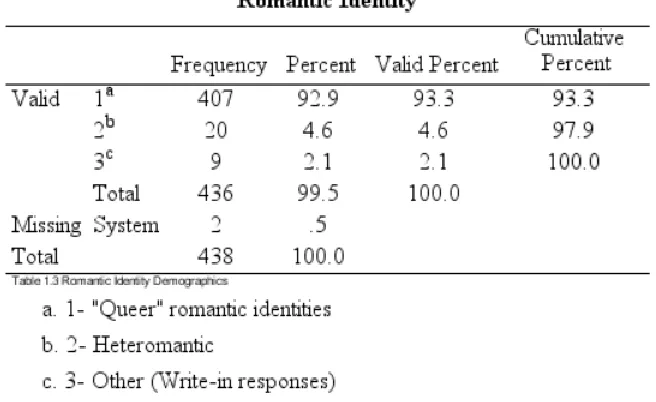
as a queer sexuality, while only 13 identified as heterosexual. Lastly, Table 3 shows that 407
individuals identified with a queer romantic identity, and only 20 individuals identified as
heteromantic. Overall, the majority of individuals in the Carmilla fandom are queer, cisgender
women.
Of the quantitative data, daily internet usage, fandom participation, and influences
surrounding initial interest in Carmilla have been the most conducive to explaining the
participatory nature of individuals in the community. I myself spend more than 6 hours online a
[image:33.612.145.473.395.596.2]day, a practice that was unchanged during my observation of the Carmilla fandom. Surveyed
individuals, as documented in Figure 2, reported similar numbers; 39.3% spent roughly 4-5
hours online, while only 1.6% spent less than two hours online a day (Rheingold 2002). In
addition, while the majority of respondents answered that they passively interacted with content
online—from reblogging to watching new videos on Vervegirl sponsored by U by Kotex—
almost 25% of the sample reported writing fan fiction, and 10% drew fan art. To 60% of
participants, queer female characters were the most influential in their decision to watch
Carmilla, while 47% stated that an inclusive cast was very influential. Three categories were
equally regarded as very influential or most influential at 40%: queer-normative narrative,
exploration of female sexuality, and uninhibited by mainstream television constraints (Lothian
2013; Lothian, Busse & Reid 2007).
Interviewed informants placed an emphasis on the flexibility afforded through social
media and transmedia storytelling compared to that of mainstream television. First, storylines are
less centered around one-dimensional “coming out stories”. As Sarah, one of my interviewees,
described it:
I think one thing that sets it apart from mainstream series that pulled a lot of the fanbase (including me) in was that it was an LGBT representative series written by people in the community. It was normalized that these characters are yes-lesbians and a Non-Binary character (the first I had encountered)-but it wasn't a huge driving force behind the story. It was who they were and being able to see that on screen and without the heavy
handedness of mainstream media was refreshing.
Secondly, one informant, Emma, stated that transmedia allowed for the short episodes of
Carmilla to be elaborated upon in a way that is easily accessible (i.e. Twitter). Lastly,
participants believed that although mainstream media handles queer characters and storylines in
irrefutably harmful ways, online communities and transmedia narrative have collective power to
Methodologically, 481 surveys were initiated through Tumblr, and 436 were fully
completed—a 91% completion rate. Surveys were created in Survey Gizmo, and consisted of 19
questions ranging from basic demographics, internet usage, participation, and expectations as
previously discussed. The survey was completed—on average— in four minutes, and was
available for one week to individuals in the community. While I originally only intended to have
42 surveys completed, a recruitment message I posted on my tumblr was reblogged by several
‘higher profile’ tumblrs, and resulted in 10x the responses. My normal Internet usage patterns
and passive participation enabled to observe interactions and discussions between individuals
without disrupting communicative and participatory practices (Beaulieu 2004).
Data involving online usage, community involvement, and conceptions of self and
collectivity are imperative to understanding future implications in queer theory, representation,
and activism in media. As Fink & Miller (2014) state, cases in which content in social media
becomes dependent on visual mediums means that individuals that were already predisposed to
online communities (Rheingold 1993) become increasingly interconnected. Considering the
consumer based nature of the media and film production, certain aspects of Marxist theory can
be applied in terms of the marketability of identity (Spitulnik 1993).
Methods
Interviews were conducted using Tumblr’s ‘Messaging’ feature. While interviews are
normally completed through audio or visual recordings, it is a practice mediated through F2F.
Therefore, in order to maintain participatory practices of informants online, I chose to use a
communication system contextualized in its environment (Woods & Baughman). Likewise,
participants were chosen based on their role in the community. Out of the five participants, four
authors and creators of fan art and fan fiction, and the general acquisition of clout that occurs
from knowledge of queer and feminist ideology. The intertextual nature of online communities
and visual mediums allows individuals to understand social issues (Spitulnik 1993; Fink &
Miller 2014) and it also allows individuals to have a safe space to mediate identities that could
engender harm in offline spaces (Alexander 2002). It is worth noting that the tables discussed in
the previous section combined multiple genders, sexualities, and romantic identities into single
groups of “queer identities” in order to show the dichotomy of queer and heteronormative
identities endemic to the Carmilla fandom. Survey Gizmo allowed data to be exported into Excel
files that could be read in Excel or IBM SPSS; however, only simple frequency tables were
calculated based on gender, sexuality, and romantic identity as previously referenced. Other
demographic data such as age, ethnicity, household income, and education were assessed through
Survey Gizmo’s reporting function and involved visual aids such as pie charts and bar graphs,
that were not included in this paper due to the limited scope of the topic.
Results
Who’s Who in the Carmilla Fandom?
Rheingold (1993) stated that “symbolic analysts” were individuals involved in activities
such as computer programming, writing and journalism, art and design, research, and
independent media broadcasting (in this case, web series and vlogs) that had a natural proclivity
for online communities. Likewise, Rheingold later expanded upon this when he discussed Reed’s
Law and the inevitable mobile interconnectivity that individuals would have to one another,
regardless of spatial divides (2002). Where older generations see a socio-economy of ‘political
correctness’, they neglect to acknowledge the interconnectedness that individuals from all over
representation (Alexander 2002). The community also encompasses individuals who are not
“out” yet to friends and family in their social life. Depending on the social conditions in which
individual’s offline lives occur, being queer can be dangerous, and therefore use fandoms in
online communities like Tumblr to connect with people that hold similar beliefs (Lothian 2007).
As Sarah explains:
I've actually been very lucky with my interactions outside of the community concerning Carmilla-mainly because I'm still fairly private about how I identify. I'm in North Carolina and while my family would be understanding... I'm not sure about a lot of people in this state. NC just recently passed a terrible homophobic bill (that fortunately doesn't reflect the majority of the population's views), but it's still scary.
For individuals like Emma, the Carmilla fandom provided a support system and something that
engages her:
Personally, I've met the most amazing people, I've found something that I'm really
passionate about doing. Its weirdly given me some direction in terms of what I want to do in the future. And as someone who is out and has been for a long time its [sic] been lovely watching a story that wasnt [sic] a coming out story.
Participatory Culture and Embodiment
In the case of social media like Tumblr, where content is exclusively textual or visual in
nature, individuals who participate in the production of digital artifacts like fan fiction and fan art
are able to easily distribute and disseminate ideologies of queer identity and collectivity to
audiences that acknowledge the fandom as a safe space. In this way, fan content allows
individuals whose offline identity practices differ from their online personas a form of mediation,
discussion, and knowledge acquisition of what it means to be queer (Yourd 2014). One
participant, Sydney, responded with a statement in similar fashion:
entertainment. Also, being on youtube [sic], a platform that most everyone has access too, we can provide a safe form of media for kids who are still trying to figure themselves out.
Data gathered from the surveys showed that 34% believed that the convenience and accessibility
of Carmilla was very influential in their decision to watch, and 32% thought it was most
influential. While there are mainstream representations of GSRM individuals, pitfalls do occur.
As Emma previously mentioned, mainstream networks focus on “coming out” stories, or
stereotypes when representing queer individuals. Queer characters can only be recognized for
being queer—and thus creates a sense of “othering”. Heteronormative individuals come to only
know these models, and when confronted with the possibility of varied identities—well, it makes
consumer based media and mass-consumption more difficult (Fink & Miller 2014). Despite the
issues of queer representation in mainstream media, one participant, Hannah, stated:
I think as our community continues to grow, particularly online, mainstream media will begin to understand the importance of it. It’s evident that we have a voice and we offer support to basically any queer positive show. I think a lot of mainstream media will begin catering more to that representation as our voice gets louder.
Discussion
My time in the Carmilla fandom allowed me understand what “everyday activists”
(Vivienne & Burgess) in the community take issue with, as well as how they cope with these
issues. Without the Internet and the evolution of social media, Carmilla would not exist. GSRM
individuals would have less safe spaces to communicate with collectivities that identify and
experience life in a similar way, and there would be less opportunities for ‘political mobilization’
of queer rights and representation in media.
1. We Queer, and We’re Here to Stay: GSRM representation in mainstream media is
shallow and underdeveloped compared to the embodied and varied experiences of
multidimensional way incorporating female agency, mainstream television shows
fall back on stereotypes and tropes that prove to be detrimental to the queer
community by a) delegitimizing variegated queer experiences, and b) show queer
individuals as “other” to heteronormative audiences. This othering makes GSRM
individuals appear unrelatable.
2. Who Cares If We’re Connected: Without the evolution of CMC and mobile
Internet, individuals and communities would have adapted more slowly to
different cultures and ideologies of identity. Anthropological discourse on online
communities and mass media should become less concerned with offline social
polities and geographic divides, and more concerned with how the Internet
constitutes its own culture of beliefs, practices, artifacts, and languages.
3. Now Taking Fic Requests: Transmedia storytelling allows for the fan engagement
through social media role play and archontic narratives, where community fan
fictions writers incorporate divergent perspectives to canon media and literature,
where either a) storylines or character development was viewed negatively, or b)
fans want more content that is not readily provided by the network (Lothian
2013).
It also sheds an academic light on the varying representation of queer characters and
narratives in mainstream media. Recent examples include The Legend of Korra and The 100.
Because mainstream television shows are streamed not only in the United States, but
transnationally as well, queer identities are harder to portray due to the risk of losing viewer
patronage (and thus, capital) from these polities. The successor to Avatar: The Last Airbender,
and Asami, entering a romantic relationship. For some this was legitimation seen on an
unprecedented level. At first glance, some individuals would assume the relationship between the
two evolved as a regular platonic friendship. However, queer individuals read these interactions
between the characters in drastically different ways—they are implicitly queer. Although the
characters were female, interactions and cues that were romantic in nature were viewed as
exactly that, regardless of the gender and unexpressed sexuality of the characters.
Similarly, The 100 is another recent example of queer representation in mainstream
media, however, it doesn’t end as happily. The introduction of the lesbian character Lexa in the
second season also brought about the discussion of the female lead, Clarke’s, sexuality and the
romantic tropic discourse that occurs in media representation of queer characters. The
relationship builds up in the third season, but after a romantic interaction between Lexa and
Clarke, Lexa is killed by a stray bullet. To the average viewer, this was not overtly harmful, but
to the queer viewers of the show this was just another example of the “bury your gays” trope. In
media, when sexual or romantic interactions occur between two queer, female characters, the
immediate result is typically a stray bullet killing the love interest of the main character (for
whom the bullet was intended). Although bullets are not always the choice, this trope has
occurred through television, including Buffy the Vampire Slayer. The community outrage at this
act of violence against a queer character prompted the creation of an online campaign “LGBT
Fans Deserve Better” in which fans raised proceeded to raise close to $30,000 in a few hours for
Conclusion
Limitations of These Studies
After completing the quantitative surveys, I realized that 1) they could have been
constructed better, and 2) because of this, the ability to perform statistical analyses such as
comparative tests and provide regression models was impossible. Questions that utilized the
‘Check all that apply’ function, such as those of Figure 2, created problems with variable
groupings, and was the primary reason that statistical calculations apart from frequency tables
were incapable of being created. In addition, demographic data including ethnicity and class
were no included, and perhaps skew the findings of an intersectional topic and community.
As an individual that participates in the Carmilla fandom outside of the context of this
research there is always the concern that certain aspects of interaction and participation may go
unnoticed due to the habitual imbrication of participatory practices and technology usage in
everyday life. Some interactions online are subtly enacted and engaged in, with or without
explicit cues, and as such can be hard to qualitatively identity and analyze.
Implications for Future Research
Providing an anthropological lens to communities that are typically observed and studied
through scholars in media and communications exemplifies how important online communities
are to anthropological discourse. Online communities and the subcultures within it have their
own beliefs, communicative practices and lexicons, and ways in which individuals and
collectives mediate identity between each other and through unknown public audiences
(Vivienne & Burgess 2012). The anthropological analysis of transformative works like fan art
diverse representations of identity also provide a basis for future discourse surrounding media
References
Alexander, J.
2002 Introduction to the special issue: Queer webs: Representations of LGBT people and communities on the World Wide Web. International Journal of Sexuality and Gender Studies, 7(2): 77-84.
Beaulieu, A.
2004 Mediating ethnography: objectivity and the making of ethnographies of the internet. Social Epistemology, 18(2-3): 139-163.
Boellstorff, T.
2015 Coming of age in Second Life: An anthropologist explores the virtually human. Princeton University Press.
Carmilla-Feels-HQ
2015 Creampuff World Domination Map. Google Maps.
< https://www.google.com/maps/d/u/0/viewer?mid=zFDBXHpn4tOk.ktjmtXHfVZOI>.
Coleman, E. G.
2010 Ethnographic approaches to digital media. Annual review of anthropology, 39: 487- 505.
DiMaggio, P., Hargittai, E., Neuman, W. R., & Robinson, J. P.
2001 Social implications of the Internet. Annual review of sociology, 307-336.
Eldeib, D.
2010 ‘Millennials’ dubbed ‘always connected’ generation in Pew report. Chicago Tribune.
February 23, 2010.
< http://articles.chicagotribune.com/2010-02-23/news/ct-met-pew-millenials- 20100223_1_generation-pew-report-young-adults>.
Evans, E.
2007 Character, audience agency and trans-media drama. Media, Culture and Society, 30(1).
Grossman, L.
2011 The boy who lived forever. Time Entertainment. July 7, 2011.
< http://content.time.com/time/arts/article/0,8599,2081784,00.html>.
Haastrup, H. K.
2014 Storytelling Intertextuality. Film International (16516826), 12(1): 85-97. <doi:10.1386/fiin.12.1.85_1>.
Hills, M.
9(2): 409-428. Fink, M., & Miller, Q.
2014 Trans Media Moments Tumblr, 2011–2013. Television & New Media, 15(7): 611-626.
Lorde, A.
1977 Poems Are Not Luxuries. Chrysalis: A Magazine of Female Culture, (3): 7-9.
Lothian, A.
2013 Archival anarchies: Online fandom, subcultural conservation, and the transformative
work of digital ephemera. International Journal of Cultural Studies, 16(6): 541-556.
Lothian, A., Busse, K., & Reid, R. A.
2007 "Yearning Void and Infinite Potential": Online Slash Fandom as Queer Female Space. English Language Notes, 45(2): 103.
McClellan, A.
2013 A case of identity: Role playing, social media and BBC Sherlock. The Journal of Fandom Studies, 1(2): 139-157.
Reich, R. B.
1992 The Work of Nations: Preparing Ourselves for 21st Century Capitalis. Vintage.
Rheingold, H.
1993 The virtual community: Finding connection in a computerized world. Addison- Wesley Longman Publishing Co., Inc..
Rheingold, H.
2002 Smart mobs: The next social revolution. Recuperado el, 19.
Rheingold, H.
2008 17 Mobile Media and Political Collective Action. Handbook of mobile communication studies, 225.
Scott, S.
2010 The trouble with transmediation: Fandom's negotiation of transmedia storytelling
systems. Spectator, 30(1): 30-34.
Spitulnik, D.
1993 Anthropology and mass media. Annual review of Anthropology, 22: 293-315.
Smith, M.
1992 “Voices from the WELL: The Logic of the Virtual Commons”. University of California
at Los Angeles, Department of Sociology.
Vivienne, S., & Burgess, J.
2012 The digital storyteller's stage: Queer everyday activists negotiating privacy and
publicness. Journal of Broadcasting & Electronic Media, 56(3): 362-377.
Wendling, M.
2016 Fans revolt after gay TV character kill off. BBC Trending. March 11, 2016.
<http://www.bbc.com/news/blogs-trending-35786382>.
Wilson, S. M., & Peterson, L. C.
2002 The anthropology of online communities. Annual review of anthropology, 449-467.
Wood, M. M., & Baughman, L.
2012 Glee fandom and Twitter: Something new, or more of the same old
thing? Communication Studies, 63(3): 328-344.
Wright, J.
2013 Millennials: The Worst, Most Entitled, Most Spoiled Generation in the History of
Humankind? Alternet. June 1, 2013.
< http://www.alternet.org/culture/millennials-generation-y>.
Yourd, M.