Knowledge Management Strategy for Indigenous
Knowledge on Land Use and Agricultural
Development in Western Ethiopia
Ramata Mosissa
1, Worku Jimma
2,*, Rahel Bekele
31Mettu University, Ethiopia
2Department of Information Science, Jimma University, Ethiopia 3School of Information Sciences, Addis Ababa University, Ethiopia
Copyright©2017 by authors, all rights reserved. Authors agree that this article remains permanently open access under the terms of the Creative Commons Attribution License 4.0 International License
Abstract
Knowledge plays a great role whenever there is change and growths follow a complex field and competitive. Agriculture in Ethiopia today is such field. Encouraging knowledge in this field is a critical point in the transformation of agricultural sector in Ethiopia. Also managing knowledge within the communities enhances agricultural development. Therefore the main aim of this study is to develop knowledge management strategy in managing indigenous knowledge of land use and agricultural development in western Ethiopia, Ilu Aba Bora zone which is crucial to enhance management of agricultural indigenous knowledge and land Data was collected using focus group discussion, questionnaire, information mapping from local communities, extension officers and land management officers of Ilu Aba Bora Zone. The result of the study revealed that local communities had various IK on land use and agricultural development. However, this knowledge was not acquired, developed, shared and preserved well. The major barriers to indigenous knowledge of land use and agricultural development in the local communities include poor knowledge sharing culture, lack of IK records, lack of trust, no interest to receive IK by younger generation, oral transfer of IK, change of life style and poor recognition of IK. Further research works are recommended to enhance management of indigenous knowledge of local communities.Keywords
Knowledge Management, Indigenous Knowledge, Agricultural Development, Land Use1. Introduction
Rural communities in a developing country have extensive indigenous knowledge (IK). IK is unique to a given culture or society and is the basis for agricultural development, resource management, health care, education and various
activities [1]. According to Grenier [2], the contribution of IK for sustainable development is quite strong because they have evolved in close contact with specific cultural and environmental conditions. IK had been playing a great role in sub-Saharan African developing countries because; it has ensuring food security and sustainable agricultural productivity over centuries [3].
agricultural products [11]. (UDP Ethiopia, 2012). But, methods of farming activities in developing countries are based on IK which shared and communicated orally have been eroded by death of IK holders [12]. Knowledge management (KM) which normally give emphasis on capturing, creating, preserving and sharing start to show its importance in the management of indigenous knowledge of agricultural in developing countries [13]. It is important to promote KM practices in rural communities by strengthening the interaction between local networks and organizational structures, even though communication and learning processes in rural communities take place in a less structured way through social networks and loose groups or between individuals” [14]. The explicit knowledge shared easily stored and popularized.
1.1. The Role of Indigenous Knowledge for Agricultural Development
The role of indigenous knowledge in agricultural development is widely understood [15]. The importance of IK as stated by Murdoch and Clark [16] has a great role in sustainable agriculture development and global concern. Since IK is combined knowledge, it improves life of rural society through validated knowledge. Most of the populations in developing country depend on agriculture. Desert based community cannot access scientific knowledge for sake of food preparation and natural resource management; they remained practically with IK [17].
Local communities have various IK that is used to solve various problems of crop and livestock production. A study revealed that in South Africa, farmers have broad criteria to classify soil, land, crop and livestock that are relevant for explaining the decision and the action taken by farmers [18].
The careful amalgamation of indigenous and exogenous knowledge would be most promising, leaving the choice, the rate and the degree of adoption and adaptation to the clients. Exogenous knowledge does not necessarily mean modern technology, it includes also indigenous practices developed and applied under similar conditions elsewhere. These techniques are then likely to be adopted faster and applied more successfully. To foster such a transfer a sound understanding of indigenous knowledge is needed. This requires means for the capture and validation, as well as for the eventual exchange, transfer and dissemination of indigenous knowledge [19].
1.2. Exchange of Indigenous Knowledge
Although IK is readily shared among members of a community (in so far as these IK practices are a part of the daily life of the community), it is generally shared to a lesser degree across communities. Moreover, as IK is predominantly tacit or embedded in practices and experiences, it is most commonly exchanged through personal communication and demonstration: from master to apprentice, from parents to children, from neighbor to
neighbor, from priest to parish. Tacit knowledge recording, transferring and disseminating is, therefore, a challenge. Exchange within a community where providers and recipients speak the same language and share its underlying cultural concepts is much more easily accomplished than transferring tacit knowledge across cultures. To facilitate the understanding of the exchange process, it is useful to break down the process into its various elements.
2. Materials and Methods
2.1. Research Design
The research method used for this research was both qualitative and quantitative research design. This was done in order to reveal knowledge management strategies in managing indigenous knowledge of agricultural development. Studies in area of IK show that “effective method to collect different types of data, which can be used to confirm the validity and consistency of IK of a certain locality” [20]. For the quantitative method questionnaire was used whereas for the qualitative data collection such as in group discussion, observation and participatory rural appraisal (PRA) technique (information mapping and linkage diagram) were used.
The group discussions were concerned to examine the indigenous knowledge of agricultural development from the local communities. Questionnaires were distributed for the agriculture sector offices to understand what they did and how they managing indigenous knowledge of agricultural knowledge. The observation was to find out indigenous knowledge they use for their crop protection.
2.2. Sampling Procedures
Representative sample was taken from four purposively selected Kebeles (the smallest administrative level in Ethiopia) of both Districts in the Zone. Because it is a method that is limited to specific types of people who can provide the desired information, either because they are the ones who have it, or they conform to some Criteria set by the researcher [21]. The elders more than 50 years were selected from the local communities. Then farmers that have IK were selected based on information obtained from informants. The purposive sampling was used to select local communities but for agricultural officers and land management officers, no sample was done since numbers of respondents was manageable.
2.3. Population of the Study
farmers because their livelihood based on agriculture. Farmers have extensive amount of IK that is accumulated over generations through local experiments and innovations and agricultural extension workers or DAs were selected to participate because they are involved in management of IK in rural areas.
2.4. Data Collection Procedures
Data collection for this study began on 10th of March 2014 and ended first of April 2014. The support letters obtained from the Jimma University and the researcher’s informants from the community helped to get permission to conduct the research in the selected kebeles of the districts. Entering and gaining access to the research site also involves writing a letter to inform the study participants about the aim of the study and thus permission letters were obtained from Yayo and Mettu district.
2.5. Procedures on Data Analysis
The collected data was cleaned and coded then entered into SPSS version 20 and Microsoft office excel. Frequencies, percentages and forms of graphical presentation were used to analyze and present quantitative data, while the data from qualitative is presented qualitatively.
3. Results
3.1. Criteria to Select Land for Different Crop Types
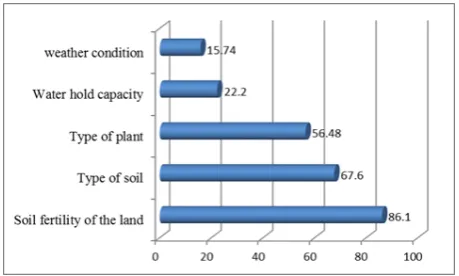
[image:3.595.317.547.289.439.2]Among one hundred and eight farmers participated on the study, most of them used different criteria to decide which crop type to be planted on a given plot of land. It was revealed that 86.15% (93) use types of soil criteria, 67.6% (73) used fertility of the land as criteria and 56.48% (61) used type of plants as criteria to select the land for planting different crops. Other criteria include: weather condition 24 (22.2%) and water hold capacity 17(15.74%) (Figure 1).
Figure 1. Criteria used to select land for different crops by the farmers, the percentage is frequency.
The findings from the focus group discussions showed
that mainly the type of soil, soil fertility and type of plants were important criteria to select land for planting different crops. Note that the percentage indicates frequency.
3.2. Methods of Weed Control
[image:3.595.63.293.574.712.2]When the respondents were asked ways or methods used for weed control different methods that are in use were revealed to control weeds. Majority of the respondents used hand weeding 78.7% (85) followed by crop rotation 65.4% (71), short term fallow 53.7% (58), herbicide 16.66% (17) and long term fallow 9.23% (10) to control weeds using the indigenous farming techniques as depicted in (Figure 2). The finding indicated that all most all farmers use indigenous knowledge of weed control except few farmers, using modern agricultural input, namely herbicide. Note that the percentage indicates frequency.
Figure 2. Methods of weeding control used by the farmers, the percentage are frequency.
As to the time of weed removal from their farm, they indicated that it is done three weeks to five weeks after planting because weeding at early stage avoid competition of nutrients between weed and crops. The respondents asked which method they prefer in weed control and they replied that indigenous weed control method is preferred because indigenous weed control has no effect on the land.
3.3. Method of Storing and Preservation of Seeds
to preserve seeds.
To avoid soil erosion, making terraces around their farming land is practiced. Moreover, they sow mono crops on their farms because it avoid competition for nutrients and increase yield. During the focus group discussion it was revealed that use transplanting techniques for sorghum because there is no failure in case of sorghum while for other crop there is a failure. This indicates that farmers try out different things and found that transplanting sorghum is possible.
3.4. The Current Management of Indigenous Knowledge of Agriculture in the Local Communities
3.4.1. Sources of Indigenous Knowledge
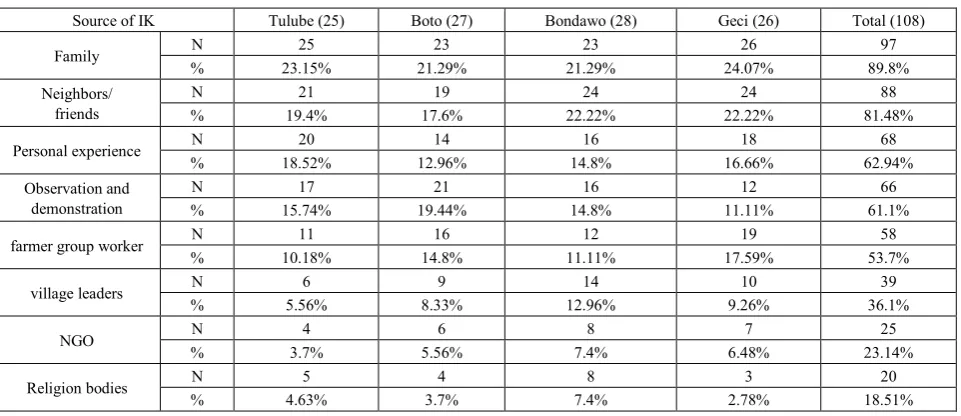
The respondents were asked to indicate main sources of indigenous knowledge of agricultural development and they gave multiple responses as presented in table 1. The result of this study shows that family 89.8% (97) and neighbors/friends 81.48% (88) were the main sources of agricultural indigenous knowledge in the local communities. In addition personal experience 62.94% (68), demonstration and observation 61.1% (66), farmers’ group worker 53.7% (58) were among the sources. Though considered lesser, village leaders 36.1% (39), NGOs 23.14% (25) and religious institutions such as churches/mosques 18.51% (20) were also considered as sources of agricultural indigenous knowledge source by the local communities.
3.5. Sharing and Preservation of Indigenous Knowledge
3.5.1. Folklore Practices
The respondents of focus group discussion were asked to describe folklore performed in their communities, in agriculture development the purpose of performing those aspects of folklore.
Farmers have folklore practices in the local communities.
Songs are the major form of folklore practiced in the communities. This folklore is significant used to encourage farmers in agricultural development. Among the folklore, the following famous proverb is what the study respondents told the researcher.
“Haati qottuu dhagaa waqaratti haati sobduu ganda keessa deemti”. This is to mean the mother of a good farmer prepares her millstone; the mother of a liar (deceiver) wanders through the village. Such, proverbs are used to encourage farming. It is common that shepherd use songs to encourage brave farmers echoing the song across the mountains.
Another common proverb is: “Qoti in qonnaa yaa daalee qonneetu bajjii tarsaasnaa galleetu beela wal baafnaa”. Farmers do not only encourage one another, but also their oxen and the above proverb is a good word about their oxen, they sing while they plough. Roughly translated it is to mean that my ox, the ‘daalee’ let’s plough hard and crake the new plot of land, the ‘bajjii’ and we come back home and relief each other from hunger. As it is known such folklore are powerful to influence the community member to be hardworking. In general, the proverb approach of sharing and or preserving IK in the area is found to be very effective as the people give more value, because it is also a sort of entertainment as they keep on saying one after the other echoing through the mountains as they plough or till the land and sow the seed or harvest it. It is most probable that it is the most important to contribute to the IK to reach today’s generation.
[image:4.595.67.548.541.749.2]When asked to indicate how they preserved their agricultural IK, the respondents replied affirmatively that they preserved their knowledge in their minds. They also said that the transfer of IK of agriculture to their children and sharing it among each other is done through the word of mouth or orally. This shows that there is a danger of losing indigenous knowledge if not codified and documented.
Table 1. Sources of agricultural indigenous knowledge by the local communities
Source of IK Tulube (25) Boto (27) Bondawo (28) Geci (26) Total (108)
Family N 25 23 23 26 97
% 23.15% 21.29% 21.29% 24.07% 89.8%
Neighbors/ friends
N 21 19 24 24 88
% 19.4% 17.6% 22.22% 22.22% 81.48%
Personal experience N 20 14 16 18 68
% 18.52% 12.96% 14.8% 16.66% 62.94%
Observation and demonstration
N 17 21 16 12 66
% 15.74% 19.44% 14.8% 11.11% 61.1%
farmer group worker N 11 16 12 19 58
% 10.18% 14.8% 11.11% 17.59% 53.7%
village leaders N 6 9 14 10 39
% 5.56% 8.33% 12.96% 9.26% 36.1%
NGO N 4 6 8 7 25
% 3.7% 5.56% 7.4% 6.48% 23.14%
Religion bodies N 5 4 8 3 20
3.6. Barriers of Indigenous Knowledge Acquisition, Preserving and Sharing
3.6.1. Barriers that inhibit the Effective Acquisition of Agricultural Indigenous Knowledge
[image:5.595.318.547.125.262.2]The respondents were asked about the barriers of effective acquisition of agricultural indigenous knowledge in local communities. Accordingly, the majority indicated that poor recognition 94.4% (102), lack of IK records 88.89% (96); poor knowledge sharing culture 75% (81) and difficulty to identify the indigenous knowledge bearers 59.26% (64) are the barriers that inhibit effective acquisition of agricultural IK (Figure 3). Note that the percentage indicates frequency.
Figure 3. Barriers that hinder acquisition of IK, the percentage are frequency.
[image:5.595.63.293.245.383.2]3.6.2. Barriers that Hinder the Sharing of Indigenous Knowledge
Figure 4. Barrier that hinder IK sharing, the percentage is frequency
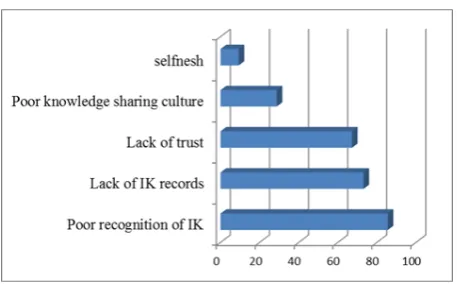
The barriers that inhibited farmers from sharing their agricultural IK were poor recognition of IK 85.55% (85), lack of IK records 73.15% (79), lack of trust67.59% (73), poor knowledge sharing culture 28.7% (31) and selfishness occurrence 9.26% (10) (Figure 4).
The respondents were asked questions to indicate the problem they faced in preservation of agricultural IK.They mentioned several problems faced in the preservation of agricultural IK which include: IK not received by younger generations 86.1%(93), poor recognition of IK 80.55% (87), lack of IK record 71.3% (77) and poor knowledge sharing
[image:5.595.64.293.445.587.2]culture 27.77% (30) and lack of trust 25.93% (27).The figure below (Figure 5) depicts barrier that hinder preserving IK. Note that the percentage indicates frequency.
Figure 5. Barriers that hinder preserving IK, the percentage are frequency.
3.7. The Flow Mechanism of Agricultural Indigenous Knowledge
The study needed to establish whether the knowledge extension officers understood IK flow mechanism of the local communities. There are different questions posed to know the knowledge flow such as carefully accessed IK, forum of IK like meeting, sharing of IK at individual level, concerns to share IK, the view of the younger generation to learn about IK from elders and impact of modernization/technology. Summary of the response of the extension officers is presented in table 2.
Regarding the first questions respondents are asked whether IK is carefully accessed and used easily by farmers in the local communities or not. About 20.8% (5) of the respondents replied that they strongly disagreed and 45% (11) of the respondents disagreed with access of indigenous knowledge by farmers in local communities. However, 16.7% (4) and 12.5% (3) of the respondents are disagreed and strongly disagreed concerning this question. From this, we can conclude that indigenous knowledge is not easily accessed by the farmers in local communities.
Respondents asked whether there is a forum for indigenous knowledge sharing, like face to face (example, meeting and apprentice) showed that 20.8% (5)of them were strongly disagree, while 50% (12) were disagreed; Whereas 12.5% (3) of the respondents were agreed and strongly agreed respectively. This indicated that no formal forum of indigenous knowledge in the local communities.
Table 2. Indigenous Knowledge flow mechanism in the local community
Questions Items Disagree Strongly Disagree Neutral Agree Strongly agree Missing Mean deviatiSt. on IK is carefully accessed and
used easily by farmers in the local communities
No 5 11 1 4 3 0
2.54 1.35
% 20.8% 45% 4.2% 16.7% 12.5% 0%
There is a forum for indigenous knowledge sharing, like face to
face(example, meeting )
No 5 12 1 3 3 0
2.46 1.318
% 20.8% 50.% 4.2% 12.5% 12.5% 0%
IK is shared informally at individual level
No 3 2 5 12 2 0
3.42 1.139
% 12.5% 8.3% 20.8% 50.0% 8.3% 0%
Everybody is interested to share IK No 4 12 1 5 2 0 2.54 1.25
% 16.7% 50.0% 4.2% 20.8% 8.3% 0%
Old and knowledgeable people in the Community feels responsible to
Transfer/share IK
No 2 7 4 10 1 0
3.04 1.122
% 8.3% 29.2% 16.7% 41.7% 4.2% 0%
No one is concerned to share IK No 4 8 3 5 4 0 2.88 1.393
% 16.7% 33.3% 12.5% 20.8% 16.7% 0%
Younger generation is learning about IK from Elders
No 6 10 1 4 3 0
2.5 1.383
% 25% 41.7% 4.2% 16.7% 12.5% 0%
The impact of
modernization/technology is high on sharing IK
No 3 4 1 10 4 2
3.36 1.364
% 12.5% 16.7% 4.2% 41.2% 16.7% 8.3%
In responding to the question regarding everybody is interested to share IK in the local communities, 16.7% (4) of the respondents were strongly disagrees and 50% (12) of them were disagreed. However, 20.8% (5) of the respondents were agreed and 8.3% (2) were strongly agreed. This reflects that most respondents confirmed not everybody interest share indigenous knowledge in local communities.
With the question of Old and knowledge people in the Community feels responsible to transfer/share IK, about 8.3% (2) of the respondents were strongly disagreed with the view and 29.2% (7) of the respondents were disagreed. Among the respondents, 41.7% (10) agreed that Old and knowledge people in the Community feels responsible to transfer/share IK, while 4.2% (2) strongly agreed. This indicated that Old and knowledge people in the Community feels responsible to transfer/share IK.
Regarding no one is concerned to share IK, about 16.7% (4) strongly disagreed and 33.3% (8) disagreed. However 20.8% (5) of the respondents agreed and 16.7% of the respondents were strongly agreed. From this we conclude that major parts of the community concerned to share indigenous knowledge for their community.
For the younger generation is learning about IK from Elders, about 25% (6) of the respondents strongly disagreed and 41.7% (10) of them were disagreed, whereas 16.7% (4) respondents agreed and 12.5% (5) of them strongly agree with it. This indicates that younger generations were not learning about IK from Elders.
Concerning the impact of modernization/technology is high on sharing IK, 12.5% (3) of the respondents were strongly disagreed and 16.7% (4) of the respondents were disagreed. However, 41.7% (10) of the respondent agreed,
while 16.7% (4) of them strongly were agreed. This reflects that most respondents agreed that the impact of modernization/technology is high on sharing indigenous knowledge.
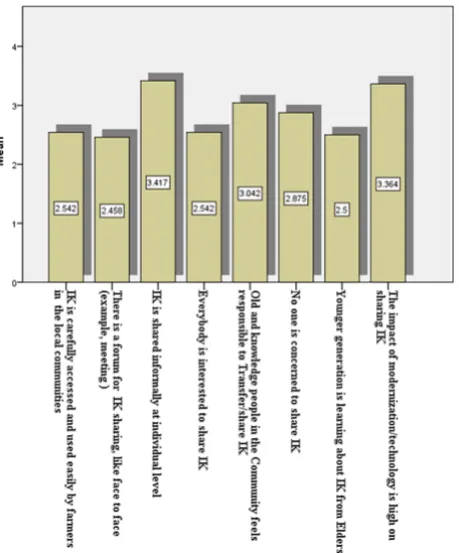
Figure 6. Mean value of Knowledge flow mechanism
[image:6.595.320.550.434.711.2]knowledge flow in the local communities. Figure 6 described the mean values of mechanism of knowledge in local communities.
The highest mean value for knowledge flow mechanism in local communities is 3.417, with a standard deviation of 1.36, which is for the question statement: IK is shared informally at individual level. This shows that IK shared at individual level in local communities. Moreover, a statement: Old and knowledgeable people in the community feels responsible to Transfer/share IK is scored a mean value of 3.042 with a standard deviation of 1.122, which is a wanted behavior as the holders of IK are willing to share than hording their knowledge.
4. Discussion
4.1. Types of Agricultural Indigenous Knowledge
The study findings confirmed that farmers possessed IK on various farm tasks such as soil fertility, weed control selecting land for crops or arable land, weed control, method of preserving and storing seeds, soil erosion, and cropping system. A similar observation was made by Lwoga et al [22] in Tanzania and Eyong [23], who reported that local people in Central Africa possessed an enormous wealth of IK that covered clearing the land, selecting crop for planting, harvesting and storage. Related observations were made by various studies in developing countries, such as Laos [24].
4.2. The Management of Agricultural Indigenous Knowledge
This focuses on the managing agricultural IK in the local communities such as acquisition, sharing and preservation of IK. The result of this study shows that family (89.8% (97), neighbors/friends 81.48% (88), personal experience 62.94% (68), demonstration and observation 61.1% (66), farmers’ group worker 53.7% (58) were among the sources. Though considered lesser, village leaders 36.1% (39), NGOs 23.14% (25) and religious institutions such as churches/mosques 18.51% (20) were the source of agricultural knowledge. These findings were the same as with the results of other finding such as Uzbekistan [25]. Similar observation were made in other African countries such as Lwoga et al. [22] in Tanzania, and Ethiopia [26]that informal sources were the dominant sources of agricultural.
In the sharing agricultural IK is discussed related indigenous practices that enable sharing and distribution of IK in the local communities. Songs are the major form of folklore practiced in the communities. This folklore is significant used to encourage farmers in agricultural development. The finding similar with previous studies [27] reported that IK was shared among individuals and within the communities through events such as apprenticeships, initiation rites and folklore.
In preserving, the present study showed that local
communities preserved their knowledge in their minds thus it was disappearing at a high rate. Another study presented by Mosia and Nglube [28] stated that IK was limited by knowledge loss due to the lack of prescribed structures and preserved in human minds.
4.3. Barriers that Inhibit the Management of Agricultural Indigenous Knowledge
The major problems that faced farmers when acquiring agricultural IK poor recognition 94.4% (102), lack of IK records 88.89% (96); poor knowledge sharing culture 75% (81) and difficulty to identify the indigenous knowledge bearers 59.26% (64) are the barriers that inhibit effective acquisition of agricultural IK. Similar study was made in other country in Ecuador [14]. This finding indicates that farmers inadequately recognized and explored their knowledge and capacities to innovate to improve their farming activities.
In relation to barriers that hinder knowledge sharing , study findings showed that poor recognition of IK 85.55% (85), lack of IK records 73.15% (79), lack of trust 67.59% (73), poor knowledge sharing culture 28.7% (31) and selfishness occurrence 9.26% (10). It is thus important for the village leaders and extension officers to encourage a knowledge sharing culture, mutual trust and relationship building to enable local people to openly share their knowledge. Similar study was made by Akullo et al. [29] found that formal education, disappearance of local inputs, and large scale farming, government laws and selfishness inhibited sharing of agricultural IK in the local communities in Uganda.
The study findings on preservation of agricultural knowledge and Land use showed IK not received by younger generations 86.1% (93), poor recognition of IK 80.55% (87), lack of IK record 71.3% (77) and poor knowledge sharing culture 27.77% (30) and lack of trust 25.93% (27).Similarly, a study by Agea et al. [30] found that lack of records on IK was the major limiting factor to the use of IK enhancing food security in Uganda.
5. Conclusions
The study showed that local communities use indigenous knowledge highly in improving soil fertility, selection of land for different crops, weed control, method of storing seed and preservation of seeds. The local communities acquired from family, friends/neighbors, personal experience, demonstration and observation, NGOs, village leaders and religion bodies. These findings indicate that while trust can enable knowledge sharing in the local communities, it can also inhibit access to knowledge if it is not nurtured. Various indigenous cultures enabled the sharing of indigenous knowledge in the local communities, which included cultural practices such as folklore. However, these cultural practices were practiced at a low rate to share agricultural knowledge in the local communities. It can thus be concluded that it is important to strengthen these cultural practices to improve sharing of IK in the local communities.
REFERENCES
[1] Warren, D. (1991). Using Indigenous Knowledge in Agricultural Development. World Bank Discussion Paper No.127. Washington, D.C.: The World Bank.
[2] Grenier, L. (1998). Working with Knowledge - A Guideline for researchers, IDRC, Ottawa.
[3] Mascarenhas, A. (2003). Indigenous knowledge, livelihood and development: is a high rate of sustainable growth achievable? Paper read at the Inaugural Tanzanian Biennial Development Forum, Dar es Salaam Tanzania, 24 – 25 [4] Warren, D. & Rajasekaran, B. (1993). Putting local
knowledge to good use. InternationalAgricultural Development 13 (4): 8‐10.
[5] Rist, S & Guebas, F. (2006). Ethno sciences- a step towards the integration of scientific and indigenous forms of knowledge in the management of natural resources for the future, Environment Development and Sustainability, 8 , pp 467-493
[6] Karlsson, J. (1995). Methods of information provision to rural communities in South Africa. In Johansson, E. (ed.) Seminar on information provision to rural communities in Africa: proceedings of the seminar, Gaborone, Botswana, 22-25 June 1994. pp. 47 – 57
[7] World Bank, (1998).Indigenous knowledge for development: a framework for action. http://www.worldbank.org/afr/ik/ikr ept.pdf. Accessed on April 15, 2014
[8] Reijntjes, C. (2004). Bridging local knowledge and global science, COMPAS Magazine, pp 41-43, Sept, 2004.
[9] Chambers, R. (1983). Rural Development: Putting the last First. 246 pp, John Wiley and Sons, Inc., New York.
[10] Kolawole, O (2001). Local Knowledge Utilization and Sustainable Development in 21st Century, Indigenous Knowledge and Development Monitor 9-3 (4), Nov 2001. [11] United States Department of Agricultural Project. (2012).
International Food Security
[12] Assessment, 2012–22. GFA-23 (Report from the Economic Research Service). Washington, DC: Author
[13] Tandi Lwoga E, Ngulube P. Managing indigenous and exogenous knowledge through information and communication technologies for agricultural development and achievement of the UN Millennium Development Goals in Tanzania. IFLA publications. 2008:73-88.
[14] Ha, L., Okigbo, R. N. and Igboaka, P. (2008). Knowledge creation and dissemination in sub-Saharan Africa, Management Decision, Vol. 46 No. 3, pp. 392-405.
[15] Bode, R. (2007). Knowledge management and communication in smallholder organizations: lessons learned. GTZ Bulletin: Services for Rural Development, Vol. 16, pp. 27-29
[16] Hart, T. & Mouton, J. (2005). Indigenous knowledge and its relevance for agriculture: a case study in Uganda. INDILINGA: African Journal of Indigenous Knowledge Systems 4 (1): 249-263.
[17] Murdoch, J. and Clark J. (2005) Sustainable Knowledge, Geoforum, New York, 25.2: 115-132
[18] Nonaka.(1991).The Knowledge Creating Company‖, Harvard Business Review, Nov/Dec 1991, pp. 96 – 104.
[19] Magoro, M. & Masoga, M. (2005). Aspects of indigenous knowledge and protection in small-scale farming systems: a challenge for advancement. INDILINGA: African Journal of Indigenous Knowledge Systems 4 (2): 414-428.
[20] What is indigenous knowledge?
http://www.worldbank.org/afr/ik/basic.htm. Accessed on 10 March. 2014.
[21] Kiptot, E. (2007). Eliciting indigenous knowledge on tree fodder among Maasai Pastoralists via aknowledge management principles be used effectively? South African Journal of Library andInformation Science 68 (1):1-15. [22] Sekaran, U. (2003). Research methods for business: a
skill-building approach. 4th ed. New York: John Wiley and Sons. Thousand Oaks, Sage Publication, pp. 97 – 150. [23] Lwoga, E. T., Ngulube, P., & Stilwell, C. (2010).
Understanding indigenous knowledge: Bridging the knowledge gap through a knowledge creation model for agricultural development. SA Journal of Information Management, 12(1), 8-pages
[24] Eyong, E. T. 2007. Indigenous knowledge and sustainable development in Africa: case study on Central Africa. In indigenous knowledge systems and sustainable development: relevance for Africa Tribes and Tribals Special Volume 1. Durban: UKZN. pp. 121-139.
[25] Saito K, Linquist B, Keobualapha B, Shiraiwa T, Horie T. Farmers' knowledge of soils in relation to cropping practices: A case study of farmers in upland rice based slash-and-burn systems of northern Laos. Geoderma. 2006 Dec 1; 136 (1):64-74.
[26] Wall, C. (2006).Knowledge management in rural Uzbekistan: peasant, project and post socialist perspectives in Khorezm. Ph.D. thesis. <http://hss.ulb.unibonn.de/diss_online> 26 November 2007.
Publishing
[28] Owuor, J.A. (2007), “Integrating African indigenous knowledge in Kenya’s formal education system: the potential for sustainable development”, Journal of Contemporary Issues in Education, Vol. 2 No. 2, pp. 21-37, available at: http://ejournals.library.ualberta.ca/index. php/JCIE (accessed 22 June 2009)
[29] Mosia, L., Ngulube, P. (2005). Managing the collective intelligence of local communities for the sustainable utilization of estuaries in the Eastern Cape, South Africa. South African Journal of Library and Information Science 71 (2): 175-186.Multi-method sequencing approach. Agriculture
and Human Values 24(2):231-243.
[30] Akullo D, Kanzikwera R, Birungi P, Alum W, Aliguma L, Barwogeza M. Indigenous Knowledge in Agriculture: a case study of the challenges in sharing knowledge of past generations in a globalized context in Uganda. Durban, South Africa. http://WWW. ifla. org/iv/ifla73/index. htm. 2007 Aug.