Psychology Theses Department of Psychology
8-12-2016
The Longitudinal Relationship between Racial
Discrimination and Depression in Ethnic Minority
College Freshmen: The Potential Moderating Role
of Peer and Faculty Support
Zahra Murtaza
Georgia State University
Follow this and additional works at:https://scholarworks.gsu.edu/psych_theses
This Thesis is brought to you for free and open access by the Department of Psychology at ScholarWorks @ Georgia State University. It has been accepted for inclusion in Psychology Theses by an authorized administrator of ScholarWorks @ Georgia State University. For more information, please [email protected].
Recommended Citation
Murtaza, Zahra, "The Longitudinal Relationship between Racial Discrimination and Depression in Ethnic Minority College Freshmen: The Potential Moderating Role of Peer and Faculty Support." Thesis, Georgia State University, 2016.
DEPRESSION IN ETHNIC MINORITY COLLEGE FRESHMEN: THE POTENTIAL MODERATING ROLE OF PEER AND FACULTY SUPPORT
By
ZAHRA MURTAZA
Under the Direction of Winnie Chan, Ph.D.
ABSTRACT
Racial discrimination has been linked to depressive symptoms (Pascoe & Richman, 2009), but only a few studies have explored this relationship longitudinally. This study examines the possible moderating role of faculty and peer support on the discrimination-depression
relationship amongst 180 ethnic minority college freshmen. Results of the hierarchical regression indicate that racial discrimination, β = .13, p < .05, in the first semester of freshman year
significantly predicted depressive symptoms in the second semester of freshman year. No interactions were found between discrimination and peer support (β = .06, p > .05), or between discrimination and two forms of faculty support (faculty interactions, β = .05, p > .05, and faculty concern, β = -.10, p > .05). Thus, unlike predicted, peer and faculty support did not serve as protective factors against discrimination-related stress. Future studies should investigate which types of coping most benefit ethnic minority freshmen.
DEPRESSION IN ETHNIC MINORITY COLLEGE FRESHMEN: THE POTENTIAL MODERATING ROLE OF PEER AND FACULTY SUPPORT
by
ZAHRA MURTAZA
A Thesis Submitted in Partial Fulfillment of the Requirements for the Degree of Master of Arts
in the College of Arts and Sciences Georgia State University
Copyright by Zahra Murtaza
DEPRESSION IN ETHNIC MINORITY COLLEGE FRESHMEN: THE POTENTIAL MODERATING ROLE OF PEER AND FACULTY SUPPORT
by
ZAHRA MURTAZA
Committee Chair: Wing Yi Chan
Committee: Erin Tully Chris Henrich
Electronic Version Approved:
DEDICATION
I am indebted to my Ammi, Abbu, younger brother, Yahya, and my grandparents for their constant encouragement, love and prayers. Needless to say, my growth and success is naturally yours, too.
I also appreciate the “rocks” in my life (e.g. friends) who are my second family. I cherish
your endless pep talks and support.
ACKNOWLEDGEMENTS
TABLE OF CONTENTS
ACKNOWLEDGEMENTS ... v
1 LIST OF TABLES ... viii
1 INTRODUCTION... 1
1.1 Theoretical framework ... 3
1.2 Depression in Ethnic Minority College Students ... 5
1.3 The Unique Stressors of First-Generation College Students ... 6
1.4 Discrimination as a Source of Stress and a Predictor of Depression... 8
1.5 Longitudinal Relationship between Discrimination and Depression ... 9
1.6 Social Support ... 12
1.6.1 Faculty Support ... 14
1.6.2 Peer Support... 15
1.7 Present Study ... 17
2 METHODS ... 17
2.1 Measures ... 19
2.2 Regression Assumptions ... 21
2.3 Missing Data ... 21
2.4 Data Analysis Plan ... 23
3 RESULTS ... 24
3.2 Regression ... 25
3.2.1 Step 1 ... 25
3.2.2 Step 2 ... 26
3.2.3 Step 3 ... 26
4 CONCLUSION ... 26
4.1 Relationship between Racial Discrimination and Depression ... 27
4.2 First-Generation Ethnic Minority College Students: A Double Burden ... 30
4.3 The Role of Faculty and Peer Support ... 32
4.3.1 Faculty Support ... 32
4.3.2 Peer Support... 34
4.4 Active Coping: An Important Protective Mechanism ... 35
4.5 Strengths and Limitations ... 36
4.6 Future Directions... 38
4.7 Conclusion ... 41
REFERENCES ... 45
APPENDICES ... 62
Appendix A ... 62
Appendix A.1 ... 62
Appendix A.2 ... 65
Appendix A.3 ... 67
LIST OF TABLES
1 INTRODUCTION
Major depression is a serious public health concern for college students (Blanco et al., 2008). A large national college study of 27,000 college students found that 14.5% of college students attending 2- or 4-year colleges reporting feeling so depressed that they were unable to function (American College Health Association, 2011). While major depression is a serious concern for all college students navigating the stressful developmental stage of emerging adulthood, there is growing evidence to suggest that ethnic minority college students are at higher risk for developing depression than their White counterparts (Mejía & McCarthy, 2010; Mokrue & Acri, 2015; Young, Fang, & Zisook, 2010).
There are several reasons why ethnic minority college students may be at higher risk for developing major depression. Socioeconomic disparities – in particular, the inability to access basic resources - have been found to mediate the relationship between ethnic group identification and depression in ethnic minorities (Plant & Sachs-Ericsson, 2004). Ethnic minority college students and their families often have access to fewer resources and may live in poorer
neighborhoods which increase the stress of their daily living, which can contribute to depressive symptoms. Furthermore, ethnic minority college students are more likely to be of first-generation status, which can contribute to a more stressful transition to college (Dennis, Phinney, &
ethnic minority individuals and there is now a growing research literature investigating its effects on mental health in college students. However, the longitudinal relationship between racial discrimination and depression is lesser understood, particularly across the freshman year.
It is essential to understand what contributes to depression in ethnic minority college freshmen as stressors experienced during the first year notably contribute to attrition and dropout in college students (Strumpf & Hunt, 1993; Tinto, 1987). For instance, one study found that 75% of attrition occurs in the first two years of college (Tinto, 1987). No study to date has explored the discrimination-depression in ethnic minority college students across different time points in the freshman year. Further, few studies have taken into consideration the unique role first-generation status may play in depression among ethnic minority college students. Most of the research literature defines a first-generation college student as someone who is the first in his or her family to attend college (Terenzini, Springer, Yaeger, Pascarella, & Nora, 1996). In
comparison to their non-first-generation counterparts, first-generation college students often experience greater stress in their transition to college, particularly in their first year (Terenzini et al., 1996; Zalaquett, 1999). The current study seeks to investigate the longitudinal relationship between racial discrimination and depression in ethnic minority college students across both semesters of freshman year, while considering the potentially unique experience of first-generation students. In addition, the study will explore the potential protective role of campus-based faculty and peer support against racial discrimination.
the effect of discrimination on depression, but research has not examined the influences of social support from within the college institution itself. The aim of the proposed study is threefold: 1) to examine the development of the discrimination-depression relationship within ethnic minority college students across the first year of college 2) to examine the potential impact of
first-generation status on the discrimination-depression relationship and 3) to examine which sources of social support would be most beneficial in protecting students from the negative impact of discrimination. In particular, we will examine faculty and peer support, which are sources of support embedded within the college setting.
1.1 Theoretical framework
Social support has been theorized as a protective factor for individuals experiencing stressful life events such as discrimination. According to the stress-buffering model (Cohen & Wills, 1985), social support reduces stress by offering individuals beneficial interpersonal resources. The presence of support from family, friends and members of one’s community may
help individuals perceive their stress differently, increase knowledge about a problem, offer material support to alleviate stress or contribute to individuals’ overall self-esteem and
connectedness to a social network (House, 1981). Research on social support suggests that the broader the network of social support, the higher the chance of reducing the negative effects of stressful life events (Keppel-Benson & Ollendick, 1993). Furthermore, there is evidence that a lack of social support is associated with onset or relapse of major depression (Paykel, 1994). This finding suggests that social support from multiple sources could prevent negative mental health outcomes resulting from stress, particularly depression.
life stressors. According to Cohen and McKay’s stressor-support specificity model, different
stressors require different support mechanisms (e.g. tangible, emotional, etc.), which can be provided through different sources of support (e.g. family, peers, etc.). Furthermore, stressors can be conceptualized as sources of deficits or losses, in which the nature of a loss determines the type of required replacement (Cutrona & Russel, 1990). Thus, in order for social support to be beneficial, the context – including the type of stressor and the type of individual experiencing that stressor – will dictate the type of support needed. In the case of ethnic minority college students, many of whom are first-generation or who come from low-income backgrounds, a lack of awareness about the new college context and lack of academic guidance from parents may necessitate support and guidance from campus-based peers and faculty members.
There is also a need to study depression in college students across time, as there is evidence to suggest that experiences of depression may change across emerging adulthood (Arnett, 2000). A recent study found that while emerging adults reported experiencing higher rates of depression compared to other age groups, on average their depressive symptoms
become increasingly salient. It is unclear whether or not discrimination at an earlier time point predicts depression in emerging adulthood. While cross-sectional research on this topic exists, there has been scarce investigation of a longitudinal link between discrimination and depression. A longitudinal inquiry of the discrimination and depression relationship in a sample of ethnic minority college freshmen – while exploring the possible protective role of social support – may account for possible causal links between these variables and may elucidate how social support can impact these students who are emerging adults.
1.2 Depression in Ethnic Minority College Students
There is a growing research literature to suggest that ethnic minority college students are at higher risk for developing depression than their White peers. For instance, a study of 1,837 college students at the University of California San Diego found that Asian American college students reported significantly more elevated levels of depression compared to their White peers (Young, Fang & Zisook, 2010). Another study of 168 Mexican college students of migrant and non-migrant backgrounds found that these students reported high levels of depression (55%) compared to an estimate of the general population (Mejía and McCarthy, 2010). Notably, migrant students in this study reported higher levels of depression and anxiety than their non-migrant counterparts when language preference was not held constant. This finding indicates that acculturative stress (as measured by language preference) may be a factor contributing to
depression was suppressed by higher interpersonal functioning. Ethnic minorities reported higher interpersonal functioning, a measure of social support quality, which suppressed the relationship between their ethnic group status and depression. Thus, there is growing evidence to suggest that ethnic minority college students are at high risk for developing depression for several reasons, including socioeconomic factors and acculturative stress; however, there is also evidence that social support may uniquely protect this group (Plant and Sachs-Ericsson, 2004).
Amongst the stressors ethnic minority college students experience, racial discrimination is a prominent contributor to depression. Ethnic minority college students often experience increased stress and depression associated with discrimination on account of their racial/ethnic minority status (Cabrera & Nora, 1994; Schmader, Major, & Gamow, 2001). Ethnic minority students studying at predominantly White institutions can be negatively impacted by a lack of relevant support services, actual or perceived racism or negative interpersonal relationships with peers, faculty and academic staff at the university (Fleming, 1984). These negative experiences influence ethnic minority students’ perspectives about the academic environment, which can
contribute to feelings of isolation and alienation for them as students (Loo & Rolison, 1986). A study of college students found that Asian and Black college students perceive significantly higher discrimination on college campuses compared to White students (Pieterse, Carter, Evans, & Walter, 2010). The widespread prevalence of perceived discrimination, a deleterious stressor, in the lives of ethnic minority college students makes it important to study its impact on these students’ mental health further.
1.3 The Unique Stressors of First-Generation College Students
students are more likely to be racial/ethnic minorities (Terenzini et al., 1996; Young, Fang & Zisook, 2010). In addition to stressors that college students commonly face, such as adaptation to a new academic environment, course and career selection, new living arrangements and
associated new responsibilities (Terenzini et al., 1996), first-generation students experience some unique stressors related to their first-generation status. First-generation college students often
experience academic and social challenges which their parents are unable to support them with
due to a lack of experience in the United States’ educational system (Zalaquett, 1999).
Additionally, these students grapple with stressors such as financial hardships, responsibilities towards their families and higher perceived discrimination on account of their racial/ethnic minority status (Pliner & Brown, 1985). Additionally, they often work – part-time or full-time - to support their families and their educational aspirations (Terenzini et al., 1996). Thus, first-generation college students sometimes juggle academic and work responsibilities, in addition to other family obligations. In addition, they often report feeling that their families do not
understand the burden these multiple responsibilities place on their academic life, resulting in a lower likelihood of them reaching out to their families for support (Fuligni, Tseng & Lam, 1999).
is important to explore the role of first-generation status within our study population of ethnic minority college students. It is possible that first-generation ethnic minority college students are impacted more negatively by racial discrimination than non-first generation ethnic minority college students; therefore, we will explore first-generation status as a predictor in our study as we explore racial discrimination’s effects on depression.
1.4 Discrimination as a Source of Stress and a Predictor of Depression
Racial discrimination, conceptualized as a psychosocial stressor, is related to numerous negative mental health outcomes, including depression (Pascoe & Richman, 2009).
Discrimination has been defined as “beliefs, attitudes, institutional arrangements and acts that
tend to denigrate or deny equal treatment to individuals or groups based on racial characteristics or group affiliation” (Clark, Anderson, Clark, & Williams, 1999). Many studies have highlighted
the negative psychological effects of discrimination on racial/ethnic minority individuals (Clark et al. 1999; Flores et al., 2010; Noh & Caspar, 2003; Tummala-Narra, Alegría & Chen, 2012). In a meta-analysis of 139 studies, Pascoe and Richman (2009) documented that those who perceive higher discrimination also report higher stress, which increases one’s vulnerability to developing
depressive symptoms. The stress that results from continued exposure to discrimination (Clark et al., 1999) can deplete an individual’s internal coping resources (Sellers & Shelton, 2003;
Williams, Neighbors & Jackson, 2003). Furthermore, individuals may internalize negative feedback about themselves, which can reduce self-esteem and engender hopelessness,
helplessness, sadness and demoralization (Allport, 1979; Riggs & Hann, 2009; Rutter, 1988). Stressors such as discrimination which target core aspects of individuals’ identities are theorized
Recent literature has differentiated between overt discrimination and covert
discrimination, with the former having become less prominent in the United States in the post-Civil Rights era wherein being outwardly racist is considered less acceptable than it used to be (Nadal, Griffin, Wong, Hamit, & Rasmus, 2014). However, covert discrimination still regularly impacts the lives of racial/ethnic minority individuals, through subtle, unintentional daily events known as “racial microaggressions” (Nadal et al., 2014). These microaggressions are comprised of several different categories ranging from recipients perceiving or experiencing “assumptions of criminality” to “ascriptions of intelligence” to feeling like an “alien in [one’s] own land”
(Nadal et al., 2014). These microaggressions often result in the receiving individual feeling markedly different and misunderstood on account of his or her racial/ethnic background. The context of college is important to consider, as research suggests that racial microaggressions that occur in the workplace or school environment may be more detrimental to well-being than those which occur in other environments (Nadal et al., 2014). Racial microaggressions in the college setting can result in students experiencing self-doubt, frustration and isolation from others (Solórzano, Ceja & Yosso, 2000). As a result of these experiences, students often end up
engaging in a phenomenon known as ‘racial battle fatigue’ wherein they may feel confused as to
whether something was a microaggression or discriminatory experience or not (Solórzano et al., 2000). These continuous, daily, rumination-like mental routines often result in students
experiencing depleted cognitive energy, reduced coping and negative mental health outcomes, including depression (Sue et al., 2007).
1.5 Longitudinal Relationship between Discrimination and Depression
longitudinally. Given that experiences of discrimination and depression (separately) can evolve over time, investigating the longitudinal perspective can elucidate at which time points ethnic minority young adults are most susceptible to discrimination’s negative effects. This exploration
can then clarify appropriate temporal points of intervention. Because adolescents and young adults become more aware of complex concepts such as race, ethnic identity and discrimination over time due to social and cognitive changes in development, they may report increases in perceived discrimination over time (Inhelder & Piaget, 1958; Phinney, 2003). If ethnic minority college students’ perceptions of discrimination really do increase over time, it is important to
understand whether depression also subsequently changes over time.
Most studies examining the relationship between discrimination and depression are cross-sectional in design, which does not address the long-term consequences of discrimination. However, some studies have attempted to fill this gap in the literature. For example, a study by Schulz and colleagues (2006) examined the longitudinal association of self-reported everyday discrimination with depressive symptoms and general health in a sample of African American women living in East Detroit over 2 waves (1996 and 2001). This study found that when
discrimination increased, symptoms of depression increased and general health status decreased, while controlling for age, education, income, discrimination and health status at baseline.
variables besides race, such as perceptions of inequality (note: this study did not specifically measure racial discrimination but studied discrimination broadly). Furthermore, this study only included women participants. These factors make it difficult to extrapolate the findings of this study to males, those of other socioeconomic backgrounds or those living in a more racially diverse setting. Our study will seek to fill these gaps by drawing from a racially and ethnically diverse sample of ethnic minority college students from a large public university.
Similarly, a 3-wave study conducted over the span of 5 years also established a longitudinal link between perceived discrimination and depression in African American
adolescents (Brody et al., 2006). Brody et al. (2006) found that increases in discrimination were associated with increases in depression across time. No gender differences were found between changes in girls’ and boys’ depression outcomes. The association between perceived
discrimination and depression weakened when adolescents reported having higher academic achievement, prosocial friendships and nurturing parenting. This finding highlights the important role of social networks in buffering the discrimination-depression relationship, as this
relationship was weakened with the presence of supportive parents or extrafamilial adults who could offer support and monitor their children’s daily activities (Brody et al., 2006; Luthar,
2006). An interesting finding from this study was that youth from higher SES were more likely to experience increases in perceived discrimination over time. Like the previous study by Schulz et al. (2006), the study by Brody et al. (2006) also focuses on African Americans, but particularly studies the outcomes of African American adolescents.
All of these studies are consistent with previous work which demonstrates that
these studies investigate the impact of discrimination in participants of different age cohorts. One of these studies focuses on adults, while the other focuses on high school students. No study to our knowledge has explored the longitudinal discrimination-depression link in a sample of ethnic minority college students over the span of freshman year of college. Developmental differences between these age groups may necessitate different forms of contextual support to buffer the discrimination-depression relationship. Furthermore, an increase in general life stress and a heightened awareness of group differences may predict a stronger discrimination-depression link in ethnic minority college freshmen who are emerging adults.
1.6 Social Support
Social support is an important protective factor, which can alleviate the negative effects of discrimination on depression (Ajrouch, Reisine, Lim, Sohn, & Ismail, 2010). According to the stress-buffering model (Cohen & Wills, 1985), social support may reduce stress by offering individuals beneficial interpersonal resources through which they can cope with stressful circumstances. Of the various types of social support, House (1981) defines the four most
important ones as instrumental, informational, emotional and appraisal support. While all four of these types of support are important, informational and emotional support are especially valuable to adolescents as they become emerging adults and navigate college (Malecki & Demaray, 2003).
isolation. This study also found that undergraduate students with lower quality social support were six times more likely to experience depressive symptoms compared to students with higher quality social support (Hefner & Eisenberg, 2009). Furthermore, a study of first-generation college students (most of whom come from ethnic minority backgrounds) found that these students perceive significantly less instrumental and emotional support from their parents during their transition to college compared to their continuing-generation peers (Sy, Fong, Carter, Boehme, & Alpert, 2011). As a result of this lack of support from their parents, first-generation ethnic minority students report high levels of stress, depression and poor adjustment to college compared to their majority-race or continuing-generation peers whose parents can offer them guidance and important resources during their transition (Jenkins et al., 2013; Pascarella et al. 2004). The knowledge and utilization of several sources of support can bolster ethnic minority college students’ transition into college (Stanton-Salazar & Spina, 2003).
To compensate for this gap in support, faculty and peer support can offer key
1.6.1 Faculty Support
Faculty support in college has been linked to important college adjustment outcomes for ethnic minority college students. Faculty members can offer students information about
transitioning to college, can answer questions related to major selection or career planning, and can serve as a symbolic representation of integration within the institution, all of which are beneficial to ethnic minority college students (Loo & Rolison, 1986). Previous literature has highlighted the significant role of faculty mentors in offering students direction, skill-building techniques and confidence in their overall personal and professional development (Young & Wright, 2001). Often, ethnic minority and first-generation college students report feeling lost within the new institution or unsupported socially by faculty and peers alike (Loo & Rolison, 1986; Tinto, 1975). Ethnic minority college students often belong to lower socioeconomic backgrounds, which tends to correspond with lower levels of preparation in high school and a sense of marginalization and isolation in majority-white college environments (Astin, 1982; Willie, 1981). Support from faculty is a mechanism through which college students begin to feel that people involved within the institution hear their voices and will help them navigate
uncharted hurdles in this novel environment (Tinto, 1975). Furthermore, ethnic minority first-generation college students often report being self-driven to achieve their goals (as opposed to being pushed from their parents) (Blackwell & Pinder, 2014). Given that their parents may be unable to guide them due to a lack of knowledge about the college context, faculty members can serve as alternate adult role models who can guide these students’ inner motivations further and
environment (Ramos-Sánchez & Nichols, 2007). At times, the discrimination they perceive or experience may come from faculty members in and outside of classes; thus, support from faculty members may serve as a means of re-establishing trust in an institution which was previously perceived as a source of disempowerment. However, one study elucidated a surprising finding that more frequent interaction with faculty mentors is negatively related to students’ social
transition to college (Inkelas, Daver, Vogt, & Leonard, 2007). The authors explained that this negative relationship may be as a result of a possible negative relationship between faculty support and peer support. Students who seek out more faculty mentorship may do so as a result of feeling isolated from peers; they may also have less time to build relationships with peers and may end up experiencing a poorer social transition to college (Inkelas et al., 2007). On the contrary, a prominent study by Pascarella and Terenzini (2001) found that a higher frequency of informal study-faculty interactions – specifically focusing on course-related or other intellectual subjects – significantly predicted freshmen year academic achievement and self-perceived intellectual and personal development. In light of these mixed research findings, the current study will explore the role of faculty social support in buffering the relationship between racial discrimination and depression in ethnic minority college students.
1.6.2 Peer Support
sample of ethnic minority college students to determine that peer support for problems related to college was a significant predictor of GPA and college adjustment. Contrarily, a lack of peer support and a lack of family resources negatively predicted GPA and college adjustment in the following spring (Dennis, Phinney, & Chuateco, 2005). Lastly, a study of Latino college students found that peer support was the only support variable which uniquely predicted students’ social
adjustment (Schneider & Ward, 2003).
While informal peer support has been shown to be beneficial (particularly in the academic domain), more formalized peer support can be protective for students as well. For instance, one study found that a peer-led social support group intervention for a sample of freshman college students resulted in participants reporting lower levels of loneliness and higher levels of perceived support (Mattanah et al., 2010). Pascarella and colleagues (2004) also investigated generation college students’ engagement with peers; they found that while
first-generation students benefited from peer engagement, they were less likely to participate in
activities which could promote the development of these peer relationships. These studies
highlight the crucial role of peer support in helping first-generation college students – many of whom are ethnic minority backgrounds – acclimate and adjust to college.
However, studies of ethnic minority and/or first-generation college students tend to measure adjustment in terms of academic achievement or attachment to the institution. Mental health outcomes, such as depression, are essential outcome variables which must be studied in order to enhance our understanding of how ethnic minority college students experience and cope with discrimination-related stress in their freshman year. Furthermore, campus-based faculty and peer support are virtually unexamined constructs in prior research on the
minority college students’ mental health. Therefore, the current study will explore the potential
buffering role of peer and faculty support on the discrimination-depression relationship across freshman year.
1.7 Present Study
Perceived discrimination has been linked to depression in ethnic minority college students (Hwang & Goto, 2009). However, no study to date has examined the longitudinal discrimination and depression link in ethnic minority college students across various time points over freshman year, while considering the role of first-generation status. The present study aimed to understand the association between perceived discrimination and depression in a sample of ethnic minority college students across the first year of college (at the end of the first and second semester of freshman year). We hypothesized that perceived discrimination would be positively associated with depression in this sample of college students across the two waves of the study. Secondly, we predicted that first-generation college students would report higher levels of depression compared to their non-first generation counterparts due to the additional levels of stress and family disadvantage first-generation college students often experience. Lastly, this study aimed to examine the potential moderating role of peer and faculty support in protecting ethnic minority college students from discrimination-related stress. It was predicted that the presence of social support from peers and faculty in the university would weaken the
discrimination-depression relationship, such that discrimination would be positively associated with depression only for those who report low levels of faculty support and peer support.
2 METHODS
.48). Of the 180 participants, 52.8% were Black/African American, 5% were Latino, 25.6% were Asian/Asian American, 13.3% were Mixed Race and 3.3% noted that they were of other racial or ethnic backgrounds. 23.3% of participants were male while 76.7% were female. 37.8% of
participants were first-generation college students, reporting that neither one of their parents attended and finished college; contrarily, 62.2% were non-first-generation college students. Three hundred and seventy-four students completed the first wave of the study (at the end of first semester of freshman year) and 200 students (at the end of second semester of freshman year) completed the second wave of the study. However, 180 participants completed both waves of the study resulting in a final sample size of 180. The final sample included students who completed at least one item on key study variables in both waves of data collection.
Incoming freshmen were contacted online at the end of the first semester of freshmen year, with an invitation to complete an online survey. They were contacted again in the following semester with an invitation to complete the survey once more at the end of the semester.
Participants were compensated with a $5 Amazon Gift Card upon completion of the survey. Participants completed an online survey which included the following scales: the Racial and Ethnic Microaggressions Scale (REMS; Nadal, 2011; α = .95) which was used to measure
discrimination, the Institutional Integration Scale (IIS; Pascarella & Terenzini, 1980; α = 0.92) which was used to measure various sources of faculty and peer support (using the subscales Faculty Interactions, Faculty Concern for Student Development and Teaching, and Peer
2.1 Measures
The Racial and Ethnic Microaggressions Scale was used in our study to measure
perceived racial discrimination; participants reported on their experiences of microaggressions in the past 30 days (REMS; Nadal, 2011). The REMS assesses the type and frequency of
microaggressions perceived by individuals in their daily interactions. The REMS is composed of 45 items across 6 subscales. Sample items include, “I received substandard service in stores compared to customers of other racial groups,” and “Someone assumed that my work would be inferior to people of other racial groups.” Participants rate their experience with each item based
on frequency in the past 6 months on a 6-point Likert scale (1=none of the time to 6=all of the time). The six subscale items are combined resulting in a composite score, ranging from 0-45,
such that higher scores indicate higher reported or perceived levels of microaggressions. The current study utilized 44 out of 45 items from the original scale because one item was
accidentally omitted in the initial stage of data collection. The initial reliability study for the REMS suggests good internal consistency for the overall scale with α =.93 for all the participants (Nadal, 2011). Similarly, the reliability of the REMS for this sample is α = .91.
The IDAS-General Depression Scale was used to measure depression in our sample. The IDAS is a 64-item scale that assesses symptoms of major depression and anxiety disorders occurring in the last two weeks (Watson et al., 2007). The IDAS is composed of seven depressive symptom subscales, including lassitude (six items; e.g., “I felt exhausted,” “I slept more than usual”), insomnia (six items; “I slept less than usual,” “I woke up early and could not get back to sleep”), suicidality (six items; “I had thoughts of suicide,” “I hurt myself
“I felt like breaking things”), and well-being (eight items; “I felt optimistic”). The subscales in
IDAS demonstrate strong stability and internal consistency, along with excellent convergent, discriminant, criterion, and incremental validity in community, college student, and psychiatric patient samples (Watson et al., 2007, 2008). For the sake of brevity and participant ease in the online study, we used the 20-item IDAS-General Depression Scale which is based on the original IDAS scale and which utilizes a 5-point Likert Scale (1 = not at all to 5 = extremely). The
reliability of the IDAS-GD scale for this sample was α = .92.
To measure perceived social support from peers and faculty in the university, we utilized the Institutional Integration Scale (IIS) developed by Pascarella and Terenzini (1980). The IIS contains 30 items arranged into five subscales encompassing the domains of peer group interactions, interactions with faculty, faculty concern for student development and teaching, academic and intellectual development, and institutional and goal commitments. Participants rate to what extent they agree with items on the scale, using a 5-point Likert scale (1 = strongly disagree to 5 = strongly agree). The internal consistency for the IIS is 0.92 while sub-scale
values have ranged from 0.61 to 0.88 (French & Oakes, 2004).
We used the subscales of Peer Interactions, Faculty Interactions and Faculty Concern for Student Development and Teaching as potential moderating variables in our study. The Peer Interactions subscale measures perceived quality of friendships with fellow student peers. We used this subscale as a measure of peer support. The Faculty Interactions subscale measures perceived quality of non-classroom interactions with faculty members. Lastly, the Faculty Concern subscale measures students’ perceptions of faculty members’ concern for student
Both the Faculty Interactions and Faculty Concern scales were used as two separate measures of faculty support.
Sample items from these scales include: “My interpersonal relationships with other students have had a positive influence on my personal growth, attitudes, and values” (Peer Interactions), “My nonclassroom interactions with faculty have had a positive influence on my personal growth, values, and attitudes” (Faculty Interactions subscale), and “Most of the faculty I have had contact with are interested in helping students grow in more than just academic areas”
(Faculty Concern). The internal consistency of the items on these three scales were α = .84, α = .89 and α = .88, respectively (French and Oakes, 2004).
2.2 Regression Assumptions
Firstly, regression assumptions within the data were tested. In particular, the assumptions of independence, linearity, normality and homoscedasticity were tested. Multicollinearity
amongst study variables and interaction terms was not an issue in the current dataset as the Variance Inflation Factor (VIF) amongst these variables ranged from 1.00 to 1.26. Furthermore, P-P and Q-Q plots revealed that the data are normally distributed with only a few outliers. Lastly, scatterplots of standardized residuals were plotted against standardized predicted values to assess homoscedasticity. The data appeared to meet the assumption for homoscedasticity as the error variance was relatively constant across all values of the predicted variable.
2.3 Missing Data
1. Wave 1 variables (including gender, age, first-generation status, racial/ethnic background, racial discrimination, peer support, two measures of faculty support and depression) were used as predictors in the regression model. Results of this logistic regression indicate that only gender (b = -.60, p = .02, OR = .55) and racial/ethnic group (Black students: b = .65, p = .04, OR = 1.9; Asian students: b = 1.01, p = .01, OR = 2.7) emerged as significant predictors of the likelihood that a participant would complete Wave 2. Exp(B) values indicate that when other variables were held constant, men were about 55 percent (.55) less likely than women to complete Wave 2. Furthermore, when all other variables were held constant, Black students were 1.9 times more likely to complete Wave 2 and Asian students were 2.7 times more likely to complete Wave 2. In the final sample, around 77% of participants are female (n = 180) while in Wave 1, around 71% were female (n = 374). In the final sample, around 53% of participants are Black/African American and around 26% of participants are Asian/Asian American. On the contrary, in Wave 1, around 48% of participants were Black/African American and around 22% were
Asian/American.
These results suggest that the proportion of female, African/African American and Asian/Asian American study participants increased from Wave 1 to Wave 2. In other words, in comparison to students of other racial/ethnic backgrounds, African/African American and Asian/Asian American students were more likely to complete Wave 2; similarly, female participants were more likely to complete Wave 2. However, according to the current logistic regression analysis, participants were not likely to have dropped out due to their experiences of racial discrimination, peer or faculty support, or depression, all of which are key study variables.
Wave 1, 173 out of 180 participants had complete data; 3.8% of participants (7 out of 180 participants) were missing on average 16% of their data. In Wave 2, 178 out of 180 participants had complete data; 1.1% of participants (2 out of 180 participants) were missing on average 47.5% of their data. In Wave 2, one participant was missing 90% of their data while the other was missing 5% of their data, resulting in an average of 47.5% of missing data.
The EM (Expectation-Maximization) Estimation method was utilized to impute missing data at the item level (Enders, 2001; IBM SPSS 20, 2011). In particular, imputation was used to account for any missing data in key variables in our regression model – discrimination,
depression, faculty interactions, faculty concern and peer support. Participants who completed at least one question within a scale were retained in the study and their missing data was imputed. However, participants who completed less than one item within a scale measuring a key study variable were excluded from the study. The final sample size of participants who met this criteria in Wave 1 and 2 was n = 180. A post-hoc power analysis estimated that the current sample size (n = 180) has 76% power to detect a small to medium effect with nine predictors and an alpha level of .05 (Faul, Erdfelder, Buchner, & Lang, 2009).
These new datasets include estimates for variables produced using ordinary least squares (OLS) estimates of T1 Discrimination, T1 Faculty Interactions, T1 Faculty Concern, T1 Peer Support, and T1 and T2 depression intercepts and rates of change, as well as demographic variables. All analyses were conducted using IBM SPSS Statistics 21.
2.4 Data Analysis Plan
freshman year in predicting academic and emotional adjustment of ethnic minority students during college. The study used a residualized change regression model, controlling for Time 1 Depression (DepT1) to understand whether Time 1 Discrimination (DiscT1) was related to Time 2 Depression (DepT2).
Gender and country of birth were not used as covariates as initially planned because they were not correlated with the dependent variable (Depression Time 2). However, as planned, first-generation status was used as a covariate, due to theoretical evidence that first-first-generation college students report higher levels of stress in college. A hierarchical regression was conducted in order to measure residualized change. The first step of the model included covariates: Depression Time 1 (in order to control for this variable) and first-generation status. The second step of the model included covariates and main effects (Discrimination Time 1, Peer Interactions, Faculty Interactions and Faculty Concern for Student Teaching and Development). The third step included covariates, main effects and interactions between the main study variables
(Discrimination x Peer Interactions, Discrimination x Faculty Interactions and Discrimination x Faculty Concern for Student Teaching and Development). All of these variables were mean-centered; the resulting interaction terms were created by cross-multiplying two centered variables (Cohen & Cohen, 1983).
3 RESULTS
3.1 Descriptive Statistics
between Discrimination Time 1 and Depression Time 1, r = .24, p < .01, as well as between Discrimination Time 1 and Depression Time 2, r = .26, p < .01.
Peer Interactions were significantly positively associated with Faculty Concern for Student Teaching and Development, r = .16, p = .03, and Faculty Interactions, r = .35, p < .01. Additionally, Peer Interactions were significantly negatively associated with Depression Time 1, r = -.20, p < .01.
First-generation students (M = 46.12, SD = 14.10) did not significantly differ from non-first generation students (M = 46.18, SD = 16.10) in their reported depressive symptoms during first semester (Depression Time 1), t(178) = .02, p = .98. The effect size for this analysis (d = 0.004) was found to fall below the small (0.2) range for effect size according to Cohen’s (1988)
classification. Similarly, first-generation students (M = 50.49, SD = 18.01) did not significantly differ from their non-first generation counterparts (M = 45.67, SD = 16.83) in their reported depressive symptoms during their second semester (Depression Time 2), t(178) = -1.81, p = .07. The effect size for this analysis (d = 0.27) was found to fall in the small (0.2) to medium (0.5) range for effect size according to Cohen’s (1988) classification.
3.2 Regression
3.2.1 Step 1
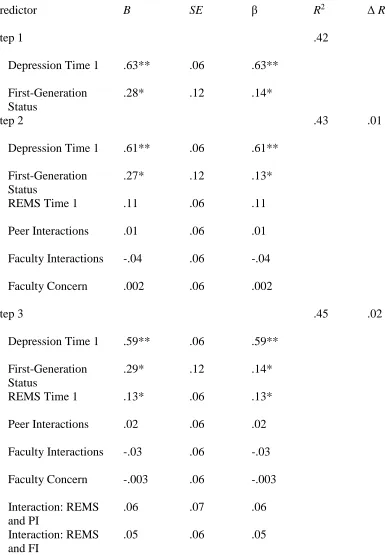
In the first step of the model, Depression at Time 1 significantly predicted Depression at Time 2, β = .63, p < .01. Furthermore, first-generation status significantly predicted Depression at Time 2, β = .14, p = .02. The first step of the model (which included the variable Depression
3.2.2 Step 2
The second step of the model included main effects. Depression at Time 1 again significantly predicted Depression at Time 2, β = .61, p < .01. Similarly, first-generation status again predicted Depression at Time 2, β = .13, p = .02. However, Discrimination Time 1 did not significantly predict Depression at Time 2, β = .11, p = .07. Similarly, neither Peer Interactions (β = .01, p = .83), Faculty Interactions (β = -.04, p = .57) nor Faculty Concern (β = .002, p = .97) predicted Depression at Time 2. The second step of the model explained an additional 1% of variance in Depression Time 2, accounting for 43% of the variance in Depression Time 2, R2 =.43, F(6, 173) = 21.77, p < .01.
3.2.3 Step 3
The third and final step of the model included main effects and interactions.
Depression at Time 1 again significantly predicted Depression at Time 2, β = .59, p < .01, as did first-generation status, β = .14, p = .02. Racial discrimination at Time 1 significantly predicted Depression at Time 2, β = .13, p = .03. Neither Peer Interactions (β = .02, p = .73), Faculty Interactions (β = -.03, p = .63), nor Faculty Concern (β = -.003, p = .96) predicted Depression at Time 2. Additionally, no interactions were found between Discrimination Time 1 and Peer Interactions (β = .06, p = .37), Discrimination Time 1 and Faculty Interactions (β = .05, p = .38) or Discrimination Time 1 and Faculty Concern (β = -.10, p = .11). The third step of the model explained an additional 2% of variance in Depression Time 2, accounting for 45% of the variance in Depression Time 2, R2 =.45, F(9, 170) = 15.20, p < .01.
4 CONCLUSION
association between racial discrimination in the first semester and depression in the second semester. Contrary to the hypothesis, peer and faculty support did not moderate the relationship between racial discrimination and depression. The study also found that depression measured at the end of first semester of freshman year was significantly associated with depression assessed at the end of second semester of freshman year.
Additionally, the current study found that students’ reported perceptions of peer support
(as measured by peer interactions) were significantly associated with two measures of faculty support (faculty interactions and faculty concern for student teaching and development).
Furthermore, peer support in the first semester of freshman year was negatively associated with depression in the same semester. These findings will be explored in further detail below.
4.1 Relationship between Racial Discrimination and Depression
The primary finding of the current study is that racial discrimination in the first semester of freshman year significantly predicted depressive symptoms in the second semester of
negative effects of racial discrimination on ethnic minority college freshmen may continue over from first semester to second semester, resulting in depressive symptoms even a semester later.
While the current study did find that racial discrimination predicted depression, this relationship was only significant in the third step of the regression model and not in the second step of the model. In other words, racial discrimination did not contribute a significant amount of variance to the model in the second step. However, strong associations were found between Wave 1 racial discrimination and depression as well as Wave 1 racial discrimination and Wave 2 depression. These findings suggest that while racial discrimination in first semester does predict depressive symptoms in second semester, there may very well exist a bidirectional relationship between depression and discrimination as well. In other words, it is possible that students who report more depression may perceive higher levels of discrimination. There is evidence to
investigate this relationship in the future to understand the effects of racial discrimination in a complex way.
Depressive symptoms emerge and persist due to a combination of both genetic factors and life stress. An extant literature suggests that underlying genetic vulnerability (Burcusa & Iacono, 2007) as well as major life stress (Lewinsohn et al., 1999) contribute to the onset of depression (Monroe & Simons, 1991). The notion that underlying genetic vulnerability is activated by a stressful event and jointly contributes to psychological disorders such as
depression is known as the diathesis-stress model (Belsky & Pluess, 2009; Monroe & Simons, 1991). Recurrent depression may be related to the presence of recurrent stressors such as daily hassles. These daily hassles have been defined in previous studies as recurrent, day-to-day stressors; they may include day-to-day concerns about finances, classwork, housekeeping, health or relationships (Bouteyre et al., 2006). Racial discrimination, particularly in the form of racial and ethnic microaggressions, can fit in the category of daily hassles. Racial and ethnic
microaggressions (a form of daily discrimination) are stressful in nature; the daily nature of this stress can result in increased cortisol secretion which in turn contributes to increased depressive symptoms (Sher, 2004). Another study of 233 first-year college students found that daily hassles were an important risk factor for depression. In this study, 41 percent of participants reported experiencing depressive symptoms and the authors argued that the recurrent nature of stressors played a large role in their depression (Bouteyre et al., 2006).
Future studies should continue to investigate third variables which can explain the discrimination-depression relationship over time, particularly in the early years of college.
Taknint, 2015). Stress responses to perceived or experienced discrimination can result in individuals feeling avoidant, aroused or hypervigilant, feeling as though they cannot control the event (Carlson, 1997; Carter, 2007). This study provides evidence that the stress of racial discrimination remains burdensome and contributes to depressive symptoms even a semester later into the freshman year of college.
Another important finding of the current study is that first-generation status predicted depression. First-generation status independently predicted depression in the following semester in all three steps of the model. This finding suggests that while racial discrimination is a stressful experience that is linked with depression for ethnic minority college students, first-generation ethnic minority college students may be at an even higher risk for developing depressive symptoms. First-generation status (independent of racial discrimination) contributed to depressive symptoms in the following semester, a finding that suggests that first-generation ethnic minority college students may carry a double burden.
4.2 First-Generation Ethnic Minority College Students: A Double Burden
This study found that first-generation status was associated with depression amongst ethnic minority college students. This finding confirms findings from previous studies that first-generation college students report higher levels of depression compared to non-first first-generation students (Jenkins et al., 2013; Stebleton et al., 2014). There are several notable stressors that first-generation ethnic minority college students experience in addition to their ethnic minority status, which may result in depressive symptoms in their freshman year.
under-resourced high schools or due to a lack of academic guidance from parents who did not attend college (Richardson & Skinner, 1992; Zalaquett, 1999). Thus, these students’ disadvantaged first-generation identities might be salient in a new academic environment amongst peers who may be more prepared to handle certain academic challenges. First-generation college students report experiencing a great deal of “academic acculturative stress,” the stress of adjusting to a
completely new college environment that is not shared with parents or family members at home (Jenkins et al., 2013; Mitchell, 1997; York-Anderson & Bowman, 1991). Having to balance two completely different worlds – their world at home and their new academic world - these students may experience “significant dissonance” (Somers et al., 2004, p. 429). In college, these students may have unrealistic expectations about college success (Brooks-Terry, 1988). Academic stressors may result in daily burdens and associated depressive symptoms, as demonstrated by previous studies (Huang et al., 2015; Mikolajczyk et al., 2008). Future studies should consider academic stressors when seeking to understand the development of depression in first-generation ethnic minority college students.
many things at the same time, juggling many responsibilities and experiencing financial burdens (Lindsey et al., 2011). This study highlights the fact that many college students appraise
financial stressors and stressors related to balancing responsibilities as burdensome. A recent study of 165 college undergraduates found that general life stressors (including financial stress) as well as college-related stressors predicted depressive symptoms (Lester et al., 2014). These stressors may contribute to depression even more prominently in first-generation ethnic minority freshmen who often report high levels of academic and financial stress. The existence of these multiple stressors may explain the current study’s finding that first-generation status uniquely
predicts depressive symptoms in first-generation students. Stressors associated with their racial/ethnic minority status and first-generation status doubly tax first-generation ethnic minority freshmen, predicting depressive symptoms across the freshman year.
4.3 The Role of Faculty and Peer Support
The current study hypothesized that peer support and faculty support are important sources of support which can potentially lessen the impact of discrimination on depression in ethnic minority college students. However, this study found no significant interactions between racial discrimination and faculty and peer support in predicting depression. The following sections will explore possible reasons why faculty and peer support did not buffer
discrimination-related stress and will also highlight some other ways ethnic minority college students report coping with discrimination-related stress.
4.3.1 Faculty Support
One possible reason that faculty support did not protect against the stress resulting from racial discrimination is that faculty support may specifically buffer academic stress, not
perceived faculty support have examined how it relates to academic adjustment (DeFreitas & Bravo Jr., 2012; Pascarella and Terenzini, 1980). Other studies have examined the role of faculty support or concern on influencing campus climate (Palmer & Maramba, 2015). The present study examined the effect of faculty support on discrimination. It is possible that students reach out to faculty when they are experiencing distress related to academics. Faculty on campus may be perceived as experts of their academic areas and not as individuals whom students can turn to for other life stressors, such as racial discrimination.
(Komarraju et al., 2010). It is important for future studies to investigate under which
circumstances students feel comfortable reaching out to faculty members when coping with racial discrimination. As such, future research needs to consider the impact of faculty support on student help-seeking behavior in response to race-related stress.
4.3.2 Peer Support
Peer support in the college setting has been shown to predict positive adjustment and reduced negative psychological outcomes in the transition to college. Research suggests that loneliness significantly contributes to depressive symptoms in freshmen college students (Wei et al., 2005). Our study found that peer support in the first semester was negatively related to depressive symptoms in the first semester. However, the longitudinal relationship between peer support in the first semester and depression in the second semester was not significant.
The present study did not find a significant interaction between discrimination and peer support on depression. One possible reason that peer support did not protect against
Although “mattering” to a friend at school is not equivalent to social support, the latter study
identified the importance of feeling connected to college friends for first-generation college students, many of whom may also belong to ethnic minority backgrounds. These studies demonstrate the importance of peer support for college students’ academic outcomes, but not necessarily for their mental health outcomes.
It is also possible that ethnic minority first-generation college students who commute to campus may have stronger social support off-campus, a source of support not accounted for by the current study. First-generation students are often commuters who spend a limited amount of time on campus and, as a result, are less engaged with campus activities (Chickering, 1974; Pascarella, 1992). This routine may limit the time and opportunities commuters have to build on-campus support (Pascarella, 1992). Ethnic minority first-generation college students may already discuss their concerns regarding racial discrimination with friends off-campus, resulting in a reduced need for support from peers on campus. Thus, it is possible that participants in this study have important sources of off-campus support not considered in the present study, such as family support and off-campus peer support. Future studies should seek to understand the protective role of off-campus supports on discrimination-related stress. In addition to faculty and peer support, it is important to consider other sources of support such as family support, co-ethnic peer support or community support from their cultural, religious or neighborhood organizations.
4.4 Active Coping: An Important Protective Mechanism
reduce that stress (Lazarus & Folkman, 1984). For instance, an ethnic minority student who responds to racial discrimination through active coping may confront a person making a racist statement or join a club on campus that raises awareness about an individual’s racial/ethnic group (Museus et al., 2015).
Previous studies about ethnic minority college students’ coping strategies for
acculturative stress such as discrimination demonstrate a higher prevalence of active coping, as opposed to seeking social support (Mena et al., 1987; Phinney & Haas, 2003). A qualitative study of 30 first-generation ethnic minority college students found that proactive coping (e.g. working harder in a class, identifying resources to handle a problem) was the most common form of coping with a stressful event (Phinney & Haas, 2003). Another study of Mexican American college students found that compared to other possible coping techniques, only problem solving significantly mediated the association between discrimination and well-being (Villegas-Gold & Yoo, 2014). Similarly, a study of generation immigrant college students found that first-generation students were more likely to respond to acculturative stress including discrimination by trying to solve the problem directly (e.g. confronting the individual who made the racist statement), while their second- and third-generation counterparts were more likely to talk about the problem with others (Mena et al., 1987). In sum, the literature has identified that ethnic minority and first-generation college students use active coping strategies more regularly, which requires further investigation.
4.5 Strengths and Limitations
measured by racial and ethnic microaggressions) and depressive symptoms across freshman year. Secondly, this study also found that peer support is associated with reduced depressive
symptoms in the first semester of freshman year. Thirdly, this study found that first-generation status was related to depression in the second semester of freshman year, highlighting the stress that may accompany the multiple social identities carried by ethnic minority first-generation college freshmen.
However, some limitations should be considered. First, this study only investigated freshman year outcomes. It is possible that a different relationship between discrimination and depression would have emerged across a longer developmental period. Prior research has found that the first year in college is well-known to be the most stressful. Given that the first year is compounded with numerous transitions, racial discrimination could have lost its salience as a stressor when compared to all the other different stressors ethnic minority college students may experience in freshman year.
Secondly, more than half of the participants who completed the first wave of the study did not proceed to complete the second wave of the study, which resulted in a lower sample size than desired. While the current study had 76% power to detect an effect, a larger sample size would have enhanced the statistical power of our study and our confidence to detect an effect.
Finally, peer and faculty support were measured using subscales of the Institutional Integration Scale which was originally developed to measure academic adjustment outcomes amongst college students (Pascarella & Terenzini, 1980). Specifically, the subscales “peer interactions”, “faculty interactions” and “faculty concern for student teaching and development”
as discrimination) experienced by college freshmen. While this is a reliable scale, it may not be the most valid measure of overall social support from peers and faculty, especially when trying to understand the potential buffering effect of peer and faculty support against discrimination-related stress. Furthermore, this scale is a self-report measure and may not most accurately reflect students’ levels of support-seeking in the college context.
Lastly, results of this study should be interpreted with caution given that all measures completed by participants were based on self-report. Additionally, the IDAS-GD scale which asked about participants’ experiences of depression was based on reported depressive symptoms
in the past two weeks which does not accurately account for depressive symptoms across the entire semester.
4.6 Future Directions
Additionally, future studies must address barriers to help-seeking from faculty on campus. For instance, Jenkins et al. (2013) suggest that cultural differences between ethnic minority first-generation college students and peers or faculty members may limit them from seeking support from peers or faculty who they feel may not be able to understand their
circumstances. Thus, help-seeking behaviors of first-generation ethnic minority students may be inhibited by a real or exaggerated perception that peers or faculty of other ethnic backgrounds cannot even relate to their experiences. Understanding whom students feel most connected to may help researchers and practitioners identify how to further support those relationships and perhaps bridge gaps with additional potential sources of support.
Given that there is mixed evidence about which coping strategies help first-generation ethnic minority college students the most in alleviating the impact of discrimination, future studies should seek to identify in which situations active coping is needed versus which situations may require social support, a form of emotion-focused coping. Furthermore, there is evidence that several strategies may be concurrently used by ethnic minority college students experiencing discrimination. For instance, a study of multiracial college students found that these students used active coping, emotion-focused coping and avoidant coping (e.g. educating others, seeking out supportive spaces and avoiding environments in which they may experience racial discrimination, respectively) (Museus et al., 2015). It was unclear whether or not certain students within this subgroup had a greater tendency to use certain types of coping and, if so, in which situations they did so. Future studies should aim to identify in which setting and for whom certain types of coping elicit the most adaptive outcomes.
besides hierarchical regression. Advanced longitudinal designs such as latent growth curve modeling should be utilized in order to elucidate the impact of racial discrimination and other stressors on depression over time (Singer & Willett, 2003). Additionally, using growth curve analysis can not only assist researchers in understanding the potential effect of discrimination at certain time points in college on the development of depression over time, but it can also
contribute to the understanding about the potential bidirectionality of this effect (i.e. using
depression at certain time points as a predictor variable in the model). Growth curve models have been utilized in several other studies examining acculturative stress and mental health outcomes amongst ethnic minority adolescents (Brody et al., 2006; Rogers-Sirin & Gupta, 2012). For instance, Brody et al. (2006) utilized growth curve modeling to investigate the longitudinal relationship amongst racial discrimination, conduct problems and depression amongst 10-12 year olds. Future studies should similarly utilize growth curve modeling to investigate the effects of discrimination within ethnic minority college students.
Lastly, future studies should consider the use of mixed-methods approaches. Very few studies have explored college students’ coping strategies in response to discrimination (Phinney
4.7 Conclusion
Ethnic minority college freshmen experience a multitude of stressors during their
transition to college, which can result in higher rates of depression. The current study found that racial discrimination significantly predicted depression across freshman year. Because ethnic minority first-generation college students report lower graduation rates compared to White students (Fischer, 2010), it is important to understand the ways in which these students cope with different types of stress on campus. Campus-based faculty and peer support did not buffer
against discrimination-related stress; future studies should continue to investigate sources of beneficial support for ethnic minority college students. Lastly, first-generation status emerged as an important predictor of depression in our study, underscoring the significance of considering students’ multiple social identities when investigating their mental health and well-being
outcomes. This research builds on previous literature about the importance of considering
various sources of support for ethnic minority first-generation college students. It is our hope that this area of research can continue to elucidate processes that highlight pathways to healthy
Table 1 Correlations
Correlations Among Discrimination, Depression, Faculty Support and Peer Support
Variable 1 2 3 4 5 6 7
1. REMS T1 .91
2. Depression T1
.24** .91
3. Depression T2
.26** .63** .94
4. Peer
Interactions
-.06 -.20** -.12 .84
5. Faculty Interactions
.08 .05 .01 .35** .89
6. Faculty Concern for Student Teaching and Development
-.07 -.02 -.01 .16* .03 .88
7. First-Generation
Status .04
-.002 .14 .02 .02 .08 ---
Mean 2.00 46.16 47.46 3.58 3.11 3.33 1.37
Standard deviation
0.53 15.34 17.38 0.70 0.98 0.60 0.49
Note. n = 180; scale internal consistencies (coefficient alpha) are displayed in boldfaced