Middle and Secondary Education Dissertations Department of Middle and Secondary Education
8-7-2018
Multiple Perspectives in a Virtual Environment:
Critically Examining Virtual History Curriculum
Tiffany McBeanFollow this and additional works at:https://scholarworks.gsu.edu/mse_diss
This Dissertation is brought to you for free and open access by the Department of Middle and Secondary Education at ScholarWorks @ Georgia State University. It has been accepted for inclusion in Middle and Secondary Education Dissertations by an authorized administrator of ScholarWorks @ Georgia State University. For more information, please [email protected].
Recommended Citation
McBean, Tiffany, "Multiple Perspectives in a Virtual Environment: Critically Examining Virtual History Curriculum." Dissertation, Georgia State University, 2018.
This dissertation, MULTIPLE PERSPECTIVES IN A VIRTUATL ENVIRONMENT: CRITICALLY EXAMINING VIRTUAL HISTORY, by TIFFANY RAE MCBEAN, was prepared under the direction of the candidate’s Dissertation Advisory Committee. It is accepted by the committee members in partial fulfillment of the requirements for the degree, Doctor of Philosophy, in the College of Education and Human Development, Georgia State University.
The Dissertation Advisory Committee and the student’s Department Chairperson, as
representatives of the faculty, certify that this dissertation has met all standards of excellence and scholarship as determined by the faculty.
_________________________________ Joseph Feinberg, Ph.D.
Committee Chair
_________________________________ Chantee Earl, Ph.D.
Committee Member
_________________________________ Yali Zhao, Ph.D.
Committee Member
_________________________________ Natalie King, Ph.D.
Committee Member
_________________________________ Date
_________________________________ Gertrude Tinker Sachs, Ph.D.
Chairperson, Department of Middle and Secondary Education
_________________________________ Paul A. Alberto, Ph.D.
By presenting this dissertation as a partial fulfillment of the requirements for the advanced degree from Georgia State University, I agree that the library of Georgia State University shall
make it available for inspection and circulation in accordance with its regulations governing materials of this type. I agree that permission to quote, to copy from, or to publish this dissertation may be granted by the professor under whose direction it was written, by the College
of Education and Human Development’s Director of Graduate Studies, or by me. Such quoting,
copying, or publishing must be solely for scholarly purposes and will not involve potential financial gain. It is understood that any copying from or publication of this dissertation which
involves potential financial gain will not be allowed without my written permission.
All dissertations deposited in the Georgia State University library must be used in accordance with the stipulations prescribed by the author in the preceding statement. The author of this
dissertation is:
Tiffany Rae McBean
Department of Middle and Secondary Education College of Education and Human Development
Georgia State University
The director of this dissertation is:
Dr. Joseph Feinberg
Department of Middle and Secondary Education College of Education and Human Development
Tiffany Rae McBean
ADDRESS: 476 Wilmer St. NE
Atlanta, GA 30308
EDUCATION:
PROFESSIONAL EXPERIENCE:
2016-present Virtual Learning Specialist Dekalb County School District
2015-2016 University Supervisor
Georgia State University
2013-2015 Department Chair
Douglas County School System
PRESENTATIONS AND PUBLICATIONS:
National Council for History Education Conference (April 2017): History Teachers’ Perspectives on Teaching about Race and Racism
Sources of Urban Education Conference (October 2017): In the Classroom Training: Career Exploration Challenge for Adult Basic Education Students
PROFESSIONAL SOCIETIES AND ORGANIZATIONS
2018 Kappa Delta Pi- International Honor Society in Education Ph.D. 2018 Georgia State University
Teaching and Learning M.Ed. 2006 Georgia State University
Social Studies Education
MULTIPLE PERSPECTIVES IN A VIRTUAL ENVIRONMENT: CRITICALLY EXAMINING VIRTUAL HISTORY CURRICULUM
by
TIFFANY RAE MCBEAN
Under the Direction of Dr. Joseph Feinberg
ABSTRACT
This study is an examination of the publicly shared United States History curriculum for Georgia Virtual School. The study focuses on how inclusive the curriculum is to the perspectives of people of color, as well as how the curriculum addresses race, racism and the impact of racism on Black Americans. In this study of Georgia Virtual School’s United States History curriculum, Critical Race Theory is used to analyze current social studies curriculum that is publicly
available. With a growing number of students accessing online education and virtual schools, this research contributes to an emerging literature regarding online social studies curriculum and critical race theory.
with online students. The results from this research illustrate a picture of Georgia Virtual School (GAVS) that coincides with research on race and racism in social studies education. In particular, analysis of the U.S. History course from GAVS shows race and racism are not addressed to the degree that Georgia Standards of Excellence require. In addition, traditionally marginalized groups, such as LatinX, Asian Americans and Native Americans, are given significantly less curricular coverage than African Americans. Racism is also presented as an overarching systemic problem. Overall, the data results show that GAVS U.S. History curriculum inadequately addresses the significance of race and racism in United States history.
by
TIFFANY RAE MCBEAN
A Dissertation
Presented in Partial Fulfillment of Requirements for the
Degree of
Doctor of Philosophy
in
Teaching & Learning
in
Social Studies Education
in
the College of Education and Human Development Georgia State University
Copyright by Tiffany Rae McBean
DEDICATION
ACKNOWLEDGMENTS
TABLE OF CONTENTS
LIST OF TABLES ... vi
LIST OF FIGURES ... vii
1 THE PROBLEM ... 1
Problem Statement ... 4
Theoretical Framework ... 5
Critical Theory ... 6
Evolution of Critical Race Theory ... 8
Research Questions ... 13
Purpose ... 14
Significance of the Study ... 15
Assumptions and Limitations ... 16
Summary of Key Point ... 17
Definition of Terms ... 18
2 REVIEW OF THE LITERATURE ... 19
Purpose of Social Studies Education ... 19
Social Studies Curriculum ... 20
Formal and Enacted Curriculum ... 21
Critical Perspectives on Social Studies Curriculum ... 23
Classroom Implications ... 26
Controversial Issues in the Classroom... 30
Related Studies ... 36
3 METHODOLOGY ... 38
Qualitative Research ... 38
Case Study Research ... 40
Content Analysis ... 42
Qualitative Content Analysis ... 43
Nature of Content ... 44
Role of Theory ... 46
Performing Content Analysis ... 46
Instrumentation ... 53
Response Categories ... 53
Appropriateness of Instruments ... 55
Validity in Qualitative Content Analysis ... 56
Reliability ... 57
Interrater Reliability Procedures. ... 58
Limitations ... 60
Researcher Positionality ... 61
4 FINDINGS ... 65
Coding Frame One Definitions ... 65
References to Race in Units ... 67
Quality of Representation ... 74
Coding Frame Two Definitions ... 77
References to Racism in Units ... 78
Aspects of Racism ... 80
NVivo Annotations ... 83
Analysis ... 85
Reccomendations ... 87
5 DISCUSSION ... 92
Summary of Study ... 92
Conclusions ... 94
Findings Related to the Literature ... 95
Limitations ... 100
Suggestions for Further Research ... 100
LIST OF TABLES
Table 1. References Per Unit (Content)……….…...……….67
Table 2. References per Unit (Key Terms)………..………..69
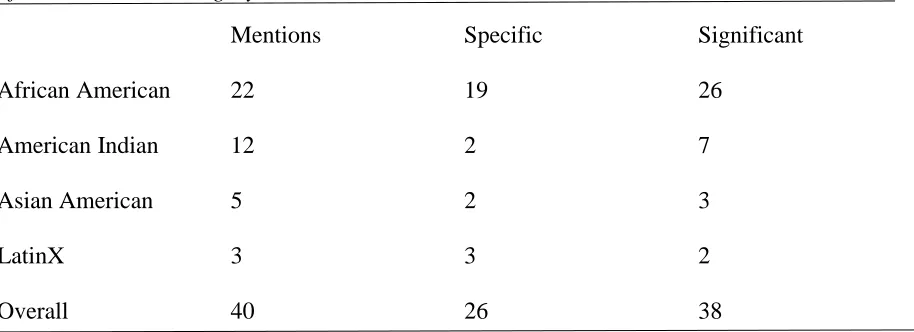
Table 3. References Per Category………..71
Table 4. References Per Subcategory………....74
Table 5. References Per Unit (Content)……….76
Table 6. References Per Unit (Key Terms)………78
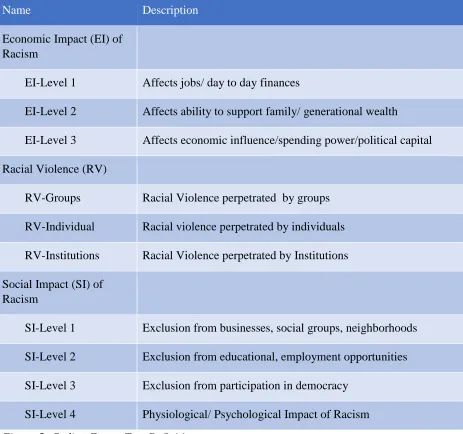
Table 7. Social Impact of Racism………..79
Table 8. Economic Impact of Racism………80
LIST OF FIGURES
Figure 1.Qualitative Content Analysis Process ………49
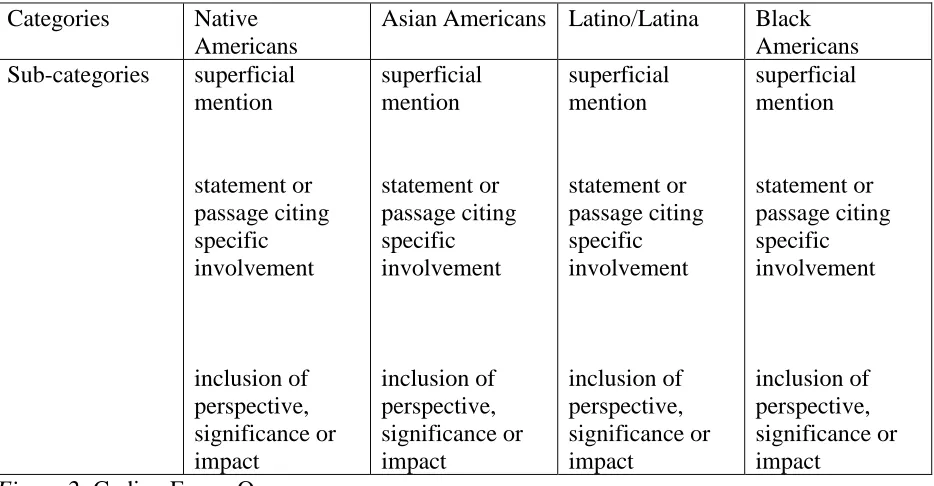
Figure 2. Coding Frame One……….……56
Figure 3. Coding Frame Two ………56
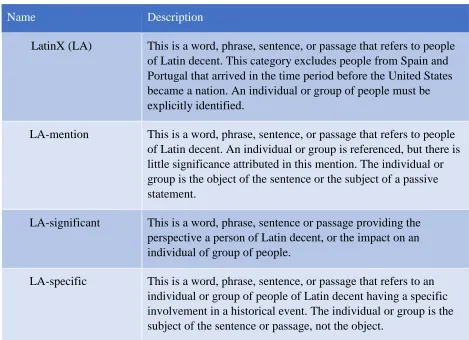
Figure 4. Coding Frame One Definitions ……….65
1 THE PROBLEM
The effects of white supremacy manifest in many ways for people of color, such as racial profiling, disproportionate drug and death row convictions, higher unemployment, higher infant mortality rates, and more special education placements (West, 1993). Race has been the
motivation behind many social, legal, and economic policies and practices (Howard, 2004). Racial disparities are observed in various aspects of life including (but not limited to) wealth, education, health, employment, and homeownership. Modern critical race researchers (Castles, 1996; Howard 2004; Loury, 2002; Winant, 2001) agree that race is not a biological phenomenon, it is a social construct; the effects of this construct are real and deeply rooted in American
society. Ladson-Billings and Tate (1995) go further by arguing that restricting race to an
ideological construct contradicts the existence of a racialized society and how it affects everyone. Moreover, Warmington (2009) explains, "[d]espite its status as a social-historical construct lacking any kind of scientific credibility, the ongoing and pervasive effects of racial ideology are all too real, such that ‘race' remains a persistent social fact at the level of lived experience and
social organization" (p. 284). When the effects of racial ideology are not acknowledged, it creates negative societal consequences (Foreman, 2004).
households had eight times the wealth (Kochhar & Fry, 2014). Tyson (2003) insists that to overcome the racial oppression that has historically plagued the nation, there has to be acknowledgment and understanding of how race continues to negatively impact lives.
only when they understand the roles played by all constituents parts of the society under study”
(p. 239).
Social studies classes are a space where educators should take the opportunity to address
systemic racism and its effects. Howard (2004) contends that social studies educators are the most logical choice to theorize and offer strategies on how to discuss differences to eliminate
racist attitudes and discrimination. Social, economic and political history illustrates how race has been used to rationalize inequity and oppression. Social studies can be the foundation for
unlearning racism (Ladson-Billings, 2003).
Unfortunately, the field of social studies has inadequately addressed issues of race and racism. Tyson (2003) insists that the absence of race in curriculum standards and position statements makes race invisible in social studies. Ladson-Billings (2003a) reveals that social studies and history textbooks usually do not even use the term race. She adds that race is always present in social studies curriculum, policies, and profession, but educators do not want to discuss race because it contradicts with how we view American life. Ladson-Billings (2003a) also evaluates the National Council for the Social Studies (NCSS) curriculum standards by highlighting that educators find race and racism submerged under the rubrics of prejudice and discrimination. Although, the standards make no direct statement concerning race and racism, which reinforces the idea that there should be a change in attitudes and behaviors without addressing the structural and ideological foundations on which the attitudes and behaviors are built (Ladson-Billings, 2003a).
post-secondary teacher education, but he maintains that the biggest problem is a lack of
sociocultural knowledge about race and racism. Brown (2011) also argues that preservice teacher candidates enter their programs devoid of the knowledge about the role that racism has played in the United States, in addition to how institutionalized racism has maintained social inequities. Teachers and students in teacher education programs have “gaps in racial knowledge,” which is another challenge to teaching about race and racism (Brown 2011, p. 250).
Problem Statement
In this study, the U.S. History curriculum for Georgia Virtual School (GAVS) is assessed with a dual focus: (1) how inclusive it is to the perspective of people of color, and (2) how does the curriculum address race and racism and its historical impact on Black Americans. For this study, I employ a qualitative case study methodology. I collect and perform a content analysis of the curriculum materials provided to the students through the online course. These materials cover all of the units and standards in GAVS U.S. History course. .
There are several key reasons this study is a necessary addition to the body of literature on race and social studies education. First, it is essential for students to have a broader, more critical understanding and analysis of history. Loewen (2007) explains the problem.
While there is nothing wrong with optimism, it can become something of a burden for students of color, children of working-class parents, girls who notice the dearth of female historical figures, or members of any group that has not achieved socioeconomic success. The optimistic approach prevents any understanding of failure other than blaming the victim. (p. 25)
are evident today. For students to identify and understand the implications of institutional racism in contemporary American society, they must critically examine and understand institutionalized racism in history.
Virtual schools have become “one of the fastest growing trends in education” (Ingram 2016, p.34); therefore, it is timely, relevant, and imperative that researchers examine virtual social studies curriculum. Enrollment in virtual and blended schools continues to grow despite school performance measures indicating traditional public schools are more successful (Miron, Shank, & Davidson, 2018). Curriculum designers and online teachers could benefit from an assessment of the curriculum and recommendations on designing content that further incorporates the perspectives of people of color.
Theoretical Framework
Since race and racism are at the center of analysis in this study, Critical Race Theory (CRT) is used to provide a race-based critique of the GAVS virtual curriculum. CRT provides a theoretical tool to eliminate racism, which is part of a more extensive effort to end the
subordination of all marginalized groups. CRT also operates to dismantle the process of
knowledge construction that exists in higher education and allows researchers to create a space to employ research outside of the Eurocentricity of academia (Malagon, Huber, & Velez, 2009). A common theme of critical race theory is centering and validating the experiences of Black people in their marginalization and alienation.
social studies education offers a unique opportunity to utilize Critical Race Theory. If social studies educators are genuinely committed to upholding democratic and multicultural values, critical race theory and research offer a perspective and method to analyze current social studies practices. To contextualize CRT, it is necessary to understand its origins. Since CRT arose from Critical Theory, I will first explain what Critical Theory is by discussing its origins, assumptions, goals, methodologies, and approaches. Next, I will trace the path from Critical Theory to Critical Race Theory. Moving forward, I will define Critical Race Theory with its underlying
presumptions from legal studies and education. Following its definitions, I will explore the assumptions, research questions, methodologies, and methodological tools employed by critical race theorists. Finally, I address the significance of Critical Race Theory in social studies education and research.
Critical Theory
Critical Race Theory (CRT) is a derivative of Critical Theory. Critical Theory, a term which was coined in 1937, differs from traditional forms of social theory. The belief is that Critical Theory is part of the struggle to liberate human beings to the end that everyone has an equal chance at self-development. Critical Theory proposes that there is an actual possibility to liberate human beings, as a whole, but at the same time recognizes that struggle is necessary to realize this possibility (Wellmer, 2014). Critical Theory was designed as a general social theory, which was incited by the need for liberation. Because changing social conditions inspire new ideas and new problems, the practitioners of critical theory presumed that the character of critical theory would change accordingly (Bronner, 2011).
present and in force. Critics inquire into texts, institutions, practices, uses of language, and actions to clarify their meanings, constitution, and justification" (p. 42). Critical Theory rejects the idea that freedom is associated with any institution or system of thought and it questions and exposes the purposes of competing theories. Critical Theory maintains that analysis must evolve with the problems and possibilities for liberation that develop from shifting historical circumstances (Bronner, 2011).
According to Sim and Van Loon (2012), Critical Theory is inherently pluralist which means there is a scope of possible perspectives and methods to analyze artifacts and their historical, political, social, gender and ethnic contexts. Critical Theory supports pluralism, which is the current cultural paradigm in Western culture, by harboring debate between multiple interpretations. Two ideas that are often associated with Critical Theory are alienation and reification. Alienation identifies with the psychological effects of exploitation and the division of labor, where reification is identified with how people are treated as “things” (Sim & Van Loon, 2012). Since Critical Theory seeks to transform, it only makes sense that the methodologies associated with Critical Theory probe or assess possible institutional changes. Cohen and Crabtree (2006) suggest that critical theorists attempt to make change, not just describe situations from a particular perspective. The history of making change in Critical Theory can be traced back to its first project “critical theory of society” (Wellmer, 2014).
the project. Members of the Institute sought transformation through collaboration between philosophers, economists, and psychoanalysts, which would result in a critical theory of society that would be sufficient for the social and historical condition that prevailed after the war. What the authors intended to show, through the lens of Marx, is that contrary to popular belief, life in modern society does not foster a fully emancipated society; adversely, it leads to the opposite of emancipation (Wellmer, 2014).
Evolution of Critical Race Theory
Critical Theory evolved into several more distinct theoretical frameworks. The shift from Critical Theory began in the mid-1970s and developed through the National Critical Legal Studies conferences, which took place during the early to mid-1980s at Harvard and UC-
Berkley Law Schools. Critical Legal Studies (CLS) challenges traditional legal scholarship “[i]n favor of a form of law that spoke to the specificity of individuals and groups in social and cultural contexts” (Ladson-Billings, 1998, p. 10). A group of law professors and students began
to "question the objective rationalist nature of the law and the process of adjunction in U.S. courts" (Lynn & Parker 2006, p. 259). The CLS movement, which aspires to justice and liberation, is grounded in the social missions of the 1960s (Tate, 1997). The scholars explored how the law privileged the wealthy and powerful in the U.S. while ignoring the rights of poor people (Lynn & Parker, 2006).
Crenshaw (1988) argue that CRT should go further than Critical Legal Studies by addressing the racialized nature of law and how it affects people of color (Lynn & Parker, 2006).
As a pioneer of CRT, a meaningful connection exists between Bell's work as a civil rights lawyer and his work as an academic. Bell served as a civil rights lawyer for the NAACP where he gained experience using the law to direct civil rights (Lynn and Parker, 2006), after which he propelled into an academic career in law where the methods he used to write about race and racism were at the cutting edge of Critical Race Theory (Tate, 1997). Bell is credited with developing an underlying presumption of Critical Race Theory called interest convergence.
Interest convergence is the idea that "white elites will tolerate or encourage racial advances for blacks only when they also promote white self-interest" (Delgado 1995, p. xiv). Bell (1995) explains "the interest of blacks in achieving racial equality will be accommodated only when it converges with the interests of whites" (p. 22). Any corrective actions taken are those that will not harm and most likely promote the interests of the White middle and upper classes (Bell, 1995).
that racism will not be addressed or detoured by critical legal scholarship exposing the relationships between rights, laws and the power structure (Tate, 1995). Lastly, Delgado (1987) believes that the notion of false consciousness implies that people of color buy into and defend an oppressive system. Delgado views the notion of false consciousness as untrue for marginalized people because many have a distrust of the legal system (Tate, 1995). These views were part of the foundation for the social movement to come.
In 1981, at Harvard Law School, there was a student boycott and subsequently, an alternative course organized. The social origins of CRT can be tied to this movement, which urged the Harvard administration to raise the number of tenured faculty members who were people of color. The students wanted the university to hire someone to teach Race, Racism, and Law, previously taught by Bell (1980). When the university did not meet the demands, Kimberle Crenshaw, who was a student at that time, emerged as one of the essential organizers of an alternative course, which led to discussions among legal scholars about new ways to conceptualize race and law (Tate, 1995).
Through her scholarship, Crenshaw (1988) noted three ways that CLS was faulty for people of color. First, the scholars did not ground their analyses in the reality of racially oppressed people. Next, CLS critique did not analyze the hegemonic role of racism. Finally, CLS exaggerates the role of liberal legal consciousness, yet minimizes the possible transformative power of liberalism. Crenshaw (1998) argued that CLS's deficiencies are shown in the fact that "it fails to speak to or about African-Americans and other people of color" (Tate, 1995, p. 230). Tate (1995) adds that Crenshaw (1998) saw CLS’s analysis unrealistic. The critiques of CLS by these scholars
predecessor, CLS, by “challenging the specific racialized nature of the law and its impact on persons of color” (Lynn & Parker, 2006, p. 257). Delgado (1995) explains three basic constructs
underlying Critical Race Theory: (a) Racism is normal in American society. Racism appears “ordinary and natural” (p. xvi) because it is so ingrained in our daily lives, (b) Critical Race Theory’s challenge to racial oppression can take the form of storytelling or narrative, and (c)
interest convergence is the idea that “white elites will tolerate or encourage racial advances for blacks only when they also promote white self-interest” (p. xvii).
Delgado (1995) describes the basic insights of Critical Race Theory (CRT) with the first presumption being the notion that racism is normal in American society. Racism appears natural and ordinary because it is so ingrained in the daily lives of humans. Consequently, formal equality (laws that mandate Blacks and Whites be treated equally) has little effect on the covert forms of racism that people of color encounter every day. The second presumption is that CRT’s challenge to racial oppression can take the form of storytelling. Since people construct the world with words (stories and silence), people should not entertain those (words, stories, and silence) that are biased and unfair. Instead, people should write and speak out against them. Ladson-Billings (1998) states “[t]he primary reason, then, that stories, or narratives, are deemed important among CRT scholars
is that they add necessary contextual contours to the seeming “objectivity” of positivist perspectives” (p. 11). A third presumption underlying CRT is the previously described interest
convergence, which was developed by Derrick Bell. Although CRT was grounded in legal studies, there were scholars who discovered an opportunity to apply it to the field of education.
students are a logical result of a racialized society. To use race as a theory and tool for dissecting inequities in schools, they set forth three central propositions:
1. Race continues to be a significant factor in determining inequality in the United States. 2. U.S. society is based on property rights.
3. The intersection of race and property creates an analytic tool through which we can understand social (and, consequently, school) inequality. (Ladson-Billings and Tate 1995, p. 48)
Ladson-Billings and Tate (1995) make two meta-propositions to elaborate on their first point that “[r]ace continues to be a significant factor in determining inequity in the United States” (p. 48).
First, the authors contend that race remains untheorized. They report that Carter G. Woodson and W.E.B. Du Bois “used race as a theoretical lens for assessing social inequity” (p. 50). When the
article was first published, the academic community marginalized their work, yet both scholars presented strong arguments that race should be placed as the centerpiece for understanding inequality. Ladson-Billings and Tate (1995) contend that there had not been a systematic analysis of educational inequity. The second meta-proposition is “class- and gender-based explanations are not powerful enough to explain all of the difference (or variance) in school experience and performance” (Ladson-Billings & Tate 1995, p. 51). They point out that class and gender alone
cannot account for the difference in educational achievement between White and students of color. The second proposition, which addresses U.S. property rights, evaluates the effects of capitalism on democracy. Ladson-Billings and Tate (1995) assert “traditional civil rights approaches to solving inequality have depended on the “rightness” of democracy while ignoring the structural inequality of capitalism” (p. 52). They insist that there has been a tension between
was to protect society, and African people were brought to the U.S. as “property”; therefore,
government could not provide human rights for African Americans while also protecting the rights of property owners.
In addressing the third proposition, Ladson-Billings and Tate (1995) explain that “[t]he ability to define, possess, and own property has been a central feature of power in America" (p. 53), and property relates to education in many ways. First, schools in more affluent neighborhoods receive more funding. Additionally, intellectual property is obtained at school, and the quantity and quality of curriculum varies with property value. Lastly, there must be real property to support the intellectual property such as technology, materials for labs and qualified teachers (Ladson-Billings and Tate, 1995). The authors' third proposition is that institutional and structural racism is the reason for poverty and the inequitable condition of schools.
Research Questions
In education research, CRT is used to investigate the ways that racism can create
focus on an anti-racist social justice agenda. According to a major assumption of CRT, we live in an unequal and fundamentally racially stratified society in which racially oppressed people are disenfranchised by power processes (Hylton, 2012).
Critical race research operates by placing race at the center of the discussion. CRT positions race as a unit of analysis, which is key to considering the roles of race, racism, and power (Tyson, 2003). The following research questions were used for this investigation.
1. How inclusive is an online U.S. History curriculum to the perspectives of people of color?
2. To what extent is race, systemic racism, and its social and economic impact on Black people addressed in an online U.S. History curriculum?
Purpose
The purpose of this study is to examine how the U.S. History curriculum of Georgia Virtual School incorporates the perspectives of people of color and how it addresses race, racism and its social and economic impact on Black people. Because the number of students accessing online education and virtual schools is significantly growing, it is important that social studies educators focus on research in those areas. Many virtual schools offer alternative solutions for K-12 students who may not fit with traditional schools for a variety of reasons, such as safety issues, bullying, attendance, geographically remote, and students who must be mobile for their family’s livelihood (Toppin & Toppin, 2016). In 1997, the first two virtual schools in the U.S.
were 34 states that had full time virtual schools and 29 with blended schools (Miron, Shank, & Davidson, 2018).
Georgia is considered a leader in online learning (Ingram, 2016). The Georgia virtual school was created because state officials were looking for ways to provide alternatives to
systems that had limited offerings, scheduling conflicts, and a lack of highly qualified teachers in rural and low-income areas (Ingram, 2016). Unfortunately, the “rapid growth of k-12 virtual academies is outpacing researchers’ ability to study the phenomenon and generate data,”
therefore, there is a critical need of virtual school faculty for best practice research (Toppin & Toppinn 2016, p. 1574). This study supplements the nascent research on social studies
curriculum in the virtual setting.
Significance of the Study
This study has significance in two areas: (1) research and practice on teaching race and racism in social studies education; (2) teacher education best practices in a virtual setting. First, this study contributes to the research and practice on teaching race and racism in social studies classrooms. Howard (2003) contends that there has been an absence of research on race and racism and social studies researchers have not been troubled with research and discussion of the effects of race and racism or how to undo racial inequalities. Howard (2003) explains “[i]n order to begin
U.S. History curriculum provides insight on if and how the research on these instructional practices have translated into social studies classrooms.
Assumptions and Limitations
I chose this study because social studies classes, particularly U.S. History, have an impact on how students perceive their world and how they construct their social reality. Race and racism have a significant impact on the social structure of the U.S. and it must be addressed throughout history courses for students to fully contextualize the social and economic circumstances of various groups of people, particularly people of color. There are several fields of research (for example, multiculturalism and culturally relevant pedagogy) that encourage incorporating diverse perspectives and integrating the voices of people of color into traditional curriculum. I question whether the push for inclusion has translated into a virtual curriculum.
Because I used Critical Race Theory as my theoretical framework, this study placed race as the focal point of the research. I only assessed the curriculum for references to people of color, race, and racism. As a part of the examination, I made recommendations. These
recommendations are limited to my knowledge about history, people of color, racism and its impact.
Summary of Key Point
This study sits at the intersection of two under-researched areas in the field of social studies education: (1) addressing race and racism in social studies curriculum and (2) best practices in a virtual school setting. Because race and racism continues to impact the social and economic lives of all people in the United States, it is important for students to understand the origins (Hylton, 2012). To give students this important learning opportunity, race must be discussed as a factor throughout social studies curriculum and particularly U.S. History. Multicultural education, culturally relevant pedagogy, and other pedagogical approaches have encouraged including the perspectives of people of color in social studies curriculum. I examine Georgia Virtual Schools U.S, History curriculum for evidence of these practices.
Definition of Terms
Race: a social construct that encompasses the notion of essentialized innate difference based on phenotype, ancestry and culture, and that intersects in complex ways with other forms of
privilege/ oppression (Paradies, 2006, p. 2).
Racism: A societal system in which actors are divided among socially constructed dimensions
with power unevenly distributed. The social system of privilege/oppression is based on ideologies (worldviews) concerning differences between groups, which are embodied through attitudes, beliefs, behaviors, laws, norms, and practices (Paradies, 2006, p. 2).
Virtual School: schools or programs that utilize the internet to offer online courses or entire programs of study (Toppin & Toppin, 2016).
Critical Race Theory (CRT): A race-based critique of society and social institutions.
Critical Legal Studies (CLS): Achallenge to traditional legal scholarship “[i]n favor of a form
of law that spoke to the specificity of individuals and groups in social and cultural contexts”
(Ladson-Billings, 1998, p. 10).
2 REVIEW OF THE LITERATURE
Purpose of Social Studies Education
Finding a consensus on the purpose of social studies education is not an easy task. Critical theorists in social studies education have sustained lively debate in the field surrounding the aim of social studies education and approaches to social studies content and curriculum. In the first section of the literature review, I will highlight the varying philosophies and critiques of social studies education. Additionally, I will discuss critical examinations and the different aspects of social studies curriculum.
The debate over curricular issues in social studies, such as the nature, purpose, and organization, has stifled or energized the field (depending on one's perspective) since its
beginning. Several other social studies researchers also note the debate over the purpose of social studies. Nelson (2001) states, “[s]ocial studies has been disputed academic terrain for over a
century” (p. 17). Stanley (2001) contends that as a field, social studies is trying to resolve various competing rationales and is searching for an identity, while Ross (2006a) reveals that the basic aspects of social studies have always been contested.
This debate has led to an extensive list of varying purposes for social studies education. Barr, Barth, and Shermis (1977) and Morrissett and Haas (1982) organize the list by constructing schemes. These two sets of researchers agree on three main purposes of social studies education, which are: “(1) socialization into society's norms; (2) transmission of facts, concepts, and
generalizations from the academic disciplines; and (3) the promotion of critical or reflective thinking” (Ross 2006b, loc. 296). For example, Ross (2006b) explains that subject centered approaches to social studies education push for the purpose and content to be derived from disciplines taught in higher education. Civics-centered approaches highlight individual and social attitudes and behaviors, while issue-centered approaches promotes the examination of specific issues in social studies (Ross, 2006b). DeLeon and Ross (2010) argue that despite the debate over the aim of social studies education, surrounding topics possess a disguise of curricular and pedagogical diversity, the aim of social studies is to preserve the “dominant cultural
perspectives” (p. x).
Social Studies Curriculum
The debate over the purpose of social studies has also sparked critique. Various
society and democracy, for example, equality and justice. Noffke (2000) presents many insightful critiques including (a) the field has failed to address many of the systemic and
prevalent issues that affect schools and society, which include the widening gap between the rich and the poor and the privilege and oppression associated with race and gender; (b) instead of accepting the current definitions of social studies, which are grounded in an unequal and unjust system, educators must seek to create new definitions based on justice and democracy; (c) strengthening democratic citizenship must be tied to racial and economic justice and must constantly be addressed and constructed as society changes (Ross, 2006). Similarly, Dewey (1938) explains that only when “the educator views teaching and learning as a continuous process of reconstruction of experience” will educators appropriately address and re-address
concepts important to American society. Beane and Apple (2007) insist that educators in a democratic society are obliged to facilitate students in recognizing their voice. Furthermore, for there to be a democracy, there must be informed consent of the people and only a democratic curriculum will afford students access to a plethora of information and viewpoints (Beane & Apple, 2007). Other critiques have focused on the delivery of social studies curriculum.
Formal and Enacted Curriculum
Thornton’s (2008) critique of social studies curriculum highlights the dichotomy of formal and enacted curriculum. From a critical perspective, he deems the plans of curriculum reformers ambitious and unobtainable in practice. In his analysis of continuity and change in the social studies curriculum, he focuses on the official or formal curriculum. Thornton (1991) describes the official curriculum as "the curriculum devised in advance by authorities beyond the classroom, which is intended to guide curricular-instructional gatekeepers" (p. 16). The
what knowledge is of worth to pass onto the students and do so based on their education, experiences, and beliefs. Thornton also acknowledges that solely examining official curriculum does not speak to what actually goes on in the social studies classroom. The differences between official curriculum and what actually goes on in the social studies classroom is also examined by Wayne E. Ross.
In the Social Studies Curriculum: Purposes, Problems, and Possibilities, Wayne E. Ross presents definitions for two types of curriculum that students experience in every classroom. Ross (2006b) attests that there is one essential distinction among the many definitions of
curriculum, which is the difference between formal and enacted curriculum. Similar to Thornton (2008), Ross describes the formal curriculum as the official curriculum. He further explains that the formal curriculum includes state frameworks, textbooks, and curriculum standards, while the enacted curriculum is the curriculum experienced by students through the day to day interactions with the teacher (Ross, 2006b). While the teacher is responsible for the enacted curriculum, the formal curriculum is frequently separated and developed by others (Ross, 2006b).
problematic in that teachers may not know the underlying reasons for their instruction if they are not involved in the development of the formal curriculum.
Ross (2006b) reveals that because many teachers have “internalized” the separation between curriculum and instruction, they view their role as an instructional decision maker only (loc. 414). When states produce curriculum frameworks or standards, there usually is a state-mandated standardized test that will accompany those standards. Thornton (2008) argues that social studies curriculum can potentially shape students’ world views. Therefore, there is
pressure to preserve or change aspects of the curriculum. Some states deny that frameworks or standards equal a true curriculum, but in effect, they do especially when frameworks, standards, textbooks, and tests are all aligned (Ross, 2006b).
Critical Perspectives on Social Studies Curriculum
Using the framework of Critical Race Theory, I critically examine U.S History
overtones, while others want to offer students an inclusive history of our country (Nash, Crabtree & Dunn, 1997). Through an examination of curriculum materials, standards, and common approaches to social studies, these critical theorists (Beane & Apple, 2007; Nash, 1989; Nash, Crabtree & Dunn, 1997;) find that the field of social studies education does not take responsibility for presenting the multi-faceted and complex social interactions that have created present conditions in society. Critical theorists describe specific ways that social studies curriculum can be more inclusive of multiple perspectives.
Critical theorists describe specific ways that social studies curriculum can be more inclusive of multiple perspectives. Beane and Apple (2007) describe a democratic curriculum as a tool that allows students to actively make meaning of knowledge by studying external sources and participating in activities that compel them to construct knowledge. A democratic
curriculum allows students to examine topics that exist in society, for example, justice or environmental politics.
Beane and Apple (2007) argue that schools are not fulfilling their obligation to promote a democratic society. Schools continue to silence voices outside the dominant culture by limiting the knowledge and only reproducing forms of knowing and knowledge by the dominant culture (Beane & Apple, 2007). These outside voices include people of color, women and the young. Schools are teaching this knowledge as truth despite the fact that knowledge is socially constructed; therefore, specific values, interests, and biases will always influence this
Similarly, Nash (1989) asserts that the superficial treatment of m arginalized groups in history does not create an environment where these groups are viewed or feel like equal members of society. In his book, History on Trial, Gary Nash asks:
[c]an there be any grand narrative more powerful, coherent, democratic, and inspiring than the struggles of groups that have suffered discrimination, exploitation, and hostility but have overcome passivity and resignation to challenge their exploiters, fight for legal rights, resist and cross racial boundaries, and hence embrace and advance the American credo “all men are created equal? (p. 101)
He explains that including groups such as enslaved Africans, Native Americans, women, immigrant laborers and others only as victims denies their full humanity. Nash (1989) also argues that presenting history only from the perspective of the majority immediately disengages many students. In addition to academically disengaging marginalized students, the majority narrative also robs students of a sense of belonging. When traditionally marginalized groups are not presented as having an active role in the nation's history, members do not consider
themselves or their group as being a part of this nation. Dewey (1916) expressed a similar sentiment. He explained that when individuals believe they are a sharer or partner, they take ownership of the successes and failures of the group, possess the emotional attitude of the group, and subsequently the individual's beliefs and ideas will take a form akin to those of the group. Nash (1989) also challenges the “biographical/great men approach” to history found in a majority of history textbooks.
elitist history for a democratic society has been challenged by a small number of historians for at least a century, but the closest that history, as a profession, came to an inclusive approach was during the Progressive period in the early twentieth century. During this period, historians argued for the role of ordinary people in history, but they did not give any attention to gender or race. Moreover, Nash (1989) states the principle of inclusiveness is key to a democratically
constructed history, and the difference between contemporary historians and the historians of the early twentieth century is that present-day historians are not only focused on the issues of class, but also the issues of gender and race. He concludes, “[t]he guiding assumption today is that students can truly learn about the historical processes that have produced present-day societies only when they understand the roles played by all constituent parts of the society under study”
(Nash 1989, p. 239). He describes how the complex interaction of the “elite and nonelite” and social, political, and religious movements driven by agendas that changed and displaced leaders should be at the center of national history. Additionally, Evans (2004) speaks to inclusiveness as he highlights a multicultural approach to social studies education. He explains that a
multicultural education based on the deliberate inclusion of stories, literature, and perspectives of diverse groups in curriculum and textbooks can assist in the creation of a more equitable society (Evans, 2004). Unfortunately, there are several philosophical and systemic challenges that impede teachers’ ability to enact a democratic or multicultural curriculum.
Classroom Implications
the development of the first social studies curriculum by the Committee of Ten in 1894 (Evans, 2004; Nelson, 2001; Ross, 2006a). Different philosophies and beliefs guide different “camps” in their quests to have control or influence over social studies curriculum (Evans, 2004). These camps promote divergent approaches to social studies education. Some of the more conservative camps push for traditional or Eurocentric content and/or a standards based approach, while some of the more progressive camps promote a more issue-centered, multicultural, and critical
thinking approach (Thornton, 2008). Both the formal and enacted curriculum are effected by whichever camp was most influential at different points in history (DeLeon & Ross, 2010). Currently, the standards movement has the most influence on social studies curriculum (Beane & Apple, 2007; Ravitch, 2010; Thornton, 2008). It is the job of social studies educators to reconcile the competing factors associated with curricular change (Thornton, 2008).
The standards movement is an attempt to centralize curriculum at the local, state and national levels. Most curriculum-centralization efforts assume that instruction can be separated from the curricular goals and objectives (Ross, 2006b). Levstik (2008) critiques the changes in social studies classrooms since the early 1990s. She explains how restructuring, integrated instruction, and stakes testing have had a negative effect on social studies. Because high-stakes tests focus on reading and math, the time devoted to social studies curriculum has declined especially in elementary grades. Frequently, social studies are swallowed into integrated reading programs (Levstik, 2008). Crocco and Thornton (2002) conducted a study where they examined restructured classrooms in New York City Schools. They found that the restructuring had an inconsistent effect on social studies in urban secondary schools due to less experienced teachers, more fragmented curriculum, and goals that were slanted for English language arts.
complex interdisciplinary instruction (Crocco & Thornton, 2002). DeLeon and Ross (2010) note how accountability systems, such as high-stakes testing threatens diversity in the formal and enacted curriculum.
Race and Racism in Social Studies
Race is a defining social characteristic in the United States (Ladson-Billings, 1998; Gordon, 1995), meaning race has social and economic implications. Gordon (1995) notes, “the economic, political, and social configurations of a racialized society impact directly on the economic, political, and social existence of individual members of that society” (p. 189). In other
words, the economic, political and social existence of people of color are different due to race and experiences in those realms are guided by race.
Instead of highlighting how racism has enabled a reproduction of the social and economic class systems in the United States, social studies curriculum focuses on reinforcing the ideology that the United States is a true meritocracy (Ross, 2006). Contemporary and historical social studies curriculum has and continues to ignore the role of race and racism in the current conditions of society (Howard, 2003). Moreover, social studies curriculum as expressed in textbooks is a powerful instrument in supporting ideology that detours Americans from critically examining flawed American institutions (Loewen, 1996; Ross, 2006).
According to Ladson-Billings (2003), the NCSS policy and position statements highlight little about race and racism except for the multicultural education curriculum guidelines. There is no statement explicitly integrating race and racism in the NCSS standards; they subside under the rubrics of “prejudice” and “discrimination.” Designing the rubrics in this manner supports the
that NCSS has purposefully promoted a deracialized citizen education agenda. He reveals that position statements issued by NCSS during and since the 1980s are silent of the issues race and racism and its effects on education and citizenship.
According to Howard (2003), the issues of race and racism have been absent from most social studies discourse, research, and scholarship. Critical Race Theory (CRT) allows scholars to inquire about the relationship between racism and inequity in education. Howard (2003) believes that a critical race framework in social studies education would recognize the roles the race and racism play in American life, and it would allow race and racism to be examined in democratic citizenship. Another prominent social studies education scholar, Tyson (2003) insists that as a theoretical framework, CRT can encourage social studies to move further than the traditional boundaries of its multiple disciplines by providing a lens in which to critique it. Furthermore, Tyson (2003) explains,
[s]ocial studies educators, particularly those involved in teaching, research, and scholarship have an opportunity to help actualize the tenets of the field by engaging in thoughtful dialogue, critical inquiry, and inclusive solution-seeking to address the role of race and racism in the pursuit of democratic citizenship. (p. 31)
Controversial Issues in the Classroom
In a broader context, Brown and Brown (2011) explain that race is a sociocultural factor that is challenging and complex to understand. Because it is a complicated and highly charged issue, it is not often addressed in schools. Brown and Brown argue that despite the limitations of curriculum knowledge about African Americans, teachers can employ pedagogical practices that help students embrace important perspectives about the history of race and racism. Moreover, U.S. History is an ideal space to explore the issues of race and racism.
There has been a debate about how marginalized groups have been represented in official school curriculum (Brown & Brown, 2011; Zimmerman, 2004). Brown and Brown (2011) also argue,
the current situation exemplified by limited textbook content about race, racism, and social justice—unless supplemented with other critical texts or additional knowledge presented by the teacher—is inadequate, yet it is likely employed unquestioningly by many teachers (both White or Black) as they enter and serve in our schools. (p. 9)
found that White and African American students both developed more positive attitudes toward African Americans, while African Americans did not develop more negative attitudes toward Whites.
Brown and Brown (2011) present ways in which teachers can address race and racism in social studies. They contend that teachers can draw from textbook knowledge to engage in discussions about race and racism alongside traditional social studies content knowledge. Teachers in the U.S. can engage students in discussions about race by having students read directly from the text and then participate in a discussion about the meaning, assumptions, and implications of race. Brown and Brown also highlight contemporary texts and how they can be a starting point to critically examine race. Additionally, making space for students to identify the individuals or groups of individuals who participated in, actively and passively, or supported racism or racial violence towards marginalized people and how they may have advanced or benefitted from the actions (Brown & Brown, 2011). Moreover, Brown and Brown explain how fictionalized books that target racism can supplement textbooks. This approach allows students to contemplate how victims of racism and racial violence challenge these actions.
and Brown (2011), “through questioning and inquiry, teachers and students recognize the
relationship between their own social realities and those from the past” (p. 11).
Childs (2014) asks, “Can public schools be sites whereby students and teachers critically
engage the topics of race? Can middle grades and secondary social studies classrooms facilitate such controversial topics?” (p. 291). Childs suggests that using popular culture as a catalyst for a critical examination of race is an effective strategy to engage students in a critical analysis of race. Teachers can use pop culture to examine racial stereotypes in the U.S. and the impact the media has on their worldviews and identity. Moreover, teachers can promote conversations surrounding racial identity by preparing prompts and questions focused on representations of race in the media and entertainment industry (Childs, 2014). There are several tools that can be utilized when discussing popular culture. Texts can be used as a tool for discussion, debate, and teaching students to support their ideas using valid arguments. Students can create their own popular culture artifacts (i.e., comic strip or mock radio broadcasts) to gain a deeper understanding of history (Childs, 2014). Popular music can be integrated into the social studies classroom to promote efficacy and activism. Music can also strengthen teaching and learning by connecting songs to historical periods, current events, cultural identity, social issues, and foster historical thinking more effectively than many other primary sources (Childs, 2014; Pellegrino, 2013; White & McCormack, 2006).
Branch (2003) explains another reason that teachers fail to address race and racism is because they adopt a “blind perspective” and the fear of race can lead to taking this position. The color-blind perspective is an attempt to ignore the influence of race in society, where individuals deny that they see race or that race has any bearing on the decisions that they make (Branch, 2003). This perspective can have devastating effects on children (Branch, 2003; Ladson-Billings, 1994; Schofield, 1997; Tate, 1997). Ladson-Billings (1995) contends that ignoring race is ignoring reality.
A race-less consciousness, which is an element of CRT, is a third reason that teachers do not address race and racism. The consciousness of people of color is different from Whites because of the ongoing experiences of racism that people of color encounter (Delgado, 1998; Tate, 1997). White people rarely experience acts of racism, while minorities experience them often, therefore “since Whites are not targets in the systematic oppression called racism, it is reasonable that they
would not understand the importance of making sure children of color and White children understood the devastating effects of racism” (Branch, 2003, p. 112).
Interest convergence is another principal of Critical Race Theory which lends understanding to why teachers may not address race and racism. Interest convergence is the idea that “white elites will tolerate or encourage racial advances for blacks only when they also promote
white self-interest” (Delgado, 1995, p. xiv). Bell (1995) explains “the interest of blacks in achieving racial equality will be accommodated only when it converges with the interests of whites” (p. 22). Any corrective actions that are taken are those that will not harm and most likely
Branch (2003) believes that high stakes testing is also a factor that prevents many teachers from addressing race and racism in the classroom. A focus on testing does not translate to higher academic achievement for all students. Branch (2003) states,
This focus on high stakes testing to the deprivation of social studies content will have devastating results measured in the lack of knowledge, skills, and decision-making ability in each of the ten themes in the national standards for the social studies. Not the least of what students will lack is valuable and necessary instruction in race, racism, and race-relations. (p. 116)
As high stakes testing replaces critical and higher levels of thinking, opportunities for students to learn about race and racism in the schools becomes much less likely.
Finally, a major reason that teachers do not address race and racism in the classroom is a lack of sociocultural knowledge. There are many institutional factors that inhibit the study of race and racism, but the biggest barrier is a lack of sociocultural knowledge. Schools are in important setting for students to acquire sociocultural knowledge but teachers often avoid dealing with the issue of race. Frequently, teachers present the topic as benign or non-contentious, or teach about it in non-critical ways that reinforce White privilege (Brown, 2011; Cochran-Smith, 2000; Epstein 2009; Ladson-Billings, 1997).
illustrate how race has been used to rationalize inequity and oppression, and social studies can be the foundation for unlearning that racism (Ladson-Billings, 2003). Ladson-Billings (2003) argues,
the historical, social, economic, and political records provide compelling blueprints for the way the nation has recruited the concept of race to justify hierarchy, inequity, and oppression. The social studies can serve as a curricular home for unlearning the racism that has confounded us a nation. (p. 8)
Social studies is uniquely situated to unlearn racism and critically challenge the inequities and oppression.
In order to change racial attitudes and the manifestations of those attitudes in the U.S., it must be acknowledged that our fundamental institutions assist in reproducing racism. Banks (1995) explains, “by the late 19th century, rigid and racist ideas about inherited characteristics of
different racial groups were codified in established social science in the United States" (p. 20). Helping students navigate the process of understanding other races is necessary due to increasing racial and ethnic diversity in the U.S. (Banks, 2006; Howard, 2004).
Multicultural curriculum potentially helps students to develop the skills to examine issues of power, difference, and social justice (Sleeter, 2002). Students must have a deeper, more critical understanding and analysis of history (Loewen, 2007). The study of race and racism is an integral piece to understanding history. “The guiding assumption today is that students can truly learn about
the historical processes that have produced present-day societies only when they understand the roles played by all constituents parts of the society under study” (Nash 1989, p. 239). These
educators push for curriculum that is inclusive of multiple perspectives, it is important that educators examine and hold accountable the new frontier of education, virtual learning.
Related Studies
In a review of studies related to this research, no studies were found that critically
examined virtual U.S. history curriculum through a content analysis with a specific focus on race and racism. There are multiple studies that used content analysis to critically examine official social studies curriculum and several of the studies are summarized in the following discussion. Scott and Yonghee (2015) performed a qualitative and quantitative content analysis which focused on manifest and latent content in the text. They used several sources of data which included the Virginia Standards of Learning for Civics and U.S. Government, three civics
3 METHODOLOGY
This study is grounded in Critical Race Theory, which places race at the center of analysis when dissecting social issues (Lynn & Parker, 2006). Through qualitative content analysis, the curriculum of Georgia Virtual Schools’ online U.S. History course is examined to
determine the degree of inclusivity of race and racism and the experiences and perspectives of people of color.This chapter begins with an introduction to qualitative research. I then discuss a brief history of content analysis (Berg, 2009; Berg & Lune, 2012; Krippendorff, 2013; Shapiro & Markoff, 1997) and how qualitative content analysis (Mayring, 2000; McDonald et al., 2009; Potter & Levine-Donnerstein, 1999; Schreier, 2012) can be a beneficial tool to investigate how students can interpret or create meaning from online curriculum. I follow with a description and explanation of qualitative content analysis, research design, procedure and guiding questions for data analysis. Next, I consider validity, reliability, and limitations. I conclude with describing my subjectivity as the researcher in this study.
Qualitative Research
human instrument is an ideal means to collect and analyze data considering humans can be responsive and adaptive. The third characteristic of qualitative research is that it is an inductive process which means researchers gather data to construct concepts and hypotheses. Information from multiple sources of data is combined to derive themes. Additionally, a richly descriptive final product is another characteristic of qualitative research. Merriam (2009) adds, "qualitative researchers are interested in understanding the meaning people have constructed, that is, how people make sense of their world and the experiences they have in the world” (p. 13).
The broad definition yet complex methods of qualitative research allow for various types of studies and enable researchers to explore a problem and redefine it on the way to the answer. Due to the nature of the research, a qualitative study is the best choice to yield meaningful results. My study is grounded in Critical Race Theory, which puts race at the center of analysis when dissecting social issues (Lynn & Parker, 2006). Because race is a social construct, which means people give the term its meaning, a qualitative study is the most appropriate method to assess the role of race in educational settings. I am examining how the curriculum of an online U.S. History course address race and racism and the inclusiveness of the experiences and perspectives of people of color, therefore, a qualitative study allows me to uncover any agenda that is disguised through numbers and statistics. For example, in an examination of a textbook chapter or section, the frequency or abundance of specific terms or references to events does not reveal the meaning that the text conveys to students or how students might interpret or
understand the text. To deconstruct and reconstruct the messages that online curriculum
tone, and content selection that researchers cannot fully explain using quantitative methods. A qualitative study allows me to highlight themes in curriculum standards and analyze the ways students interact with the material.
Case Study Research
A case study is one method of qualitative research. According to Merriam (2009) and Yin (2009), a case study is an in-depth analysis of a contemporary phenomenon in its real-life
context. One common misconception of a case study is that all data collection must be qualitative. On the contrary, quantitative data collection in a case study might inform and strengthen the results (Goetz & LeCompte, 1991). A case study is an analysis of a case or bounded system, not a topic, and there are four functions of a case study that can assist when deciding whether a case study is an appropriate method: (1) a case study explains a causal relationship that is too complex to be identified by surveys; (2) a case study will describe an intervention in its real-world context; (3) a case study will allow researchers to illustrate an evaluation (provide an in-depth description); and (4) a case study will enlighten an intervention that has more than one possible single or set of outcomes (Merriam, 2009; Yin, 2009). The case or bounded system that was examined in this study is the U.S. History curriculum for Georgia Virtual School.
Researchers typically use case studies when they want to answer “how” or “why”
manipulated. Although the topics of race and racism date back to the beginning of U.S. History, the issues of race, racism, and inclusion continue to be contemporary issues.
Yin (2009) outlines six primary methods of data collection involved with a case study, which are documentation, archival records, observation, participant observation, interviews, and physical artifact. Documentation can come in the form of email correspondence, letters,
calendars, agendas, meeting minutes, lesson plans, or any other noted form of communication. Documentation can help to support the analysis of data collected by other methods like
interviews. Yin (2009) cautions researchers when searching for and using documentation. He notes that with access to so many documents on the internet, it is easy to acquire too much documentation and waste time with unimportant data. The documentation I used for this study was shared content curriculum. The curriculum documents collected for this study were those that are shared content for all Georgia public school students and teachers.
Yin (2009) explains why the role of the researcher in a case study is extremely important. First, the researcher is directly responsible for the data collection, so it is imperative that the researcher focuses on his or her line of inquiry in a case study. Additionally, to preserve the integrity of the study, the researcher must attend to asking unbiased questions. Saldana (2009) counters this by stating “It is impossible to be an ‘objective’ evaluator, but it is possible to be systematic in your collection and analysis of data to assess merit and worth” (p. 101). Lastly, the
Content Analysis
Berg (2009) suggests that content analysis is a “beneficial procedure for assessing events
or processes in social groups when public records exist,” and it is useful in exploratory and descriptive studies (p. 365). Various researchers provide descriptions to the arguably vague term content analysis. With the growth of technology, media, and communication, many researchers focus their efforts on how “humans read texts, rearticulate texts, or justify actions informed by the reading of text” (Krippendorff, 2013, p. 1003). Berg (2009) explains that, in content analysis,
artifacts of social communication are investigated (Berg, 2009). Berg (2009) also describes content analysis as a "systematic examination and interpretation," which is performed on different types of human communication to uncover themes, patterns and meanings. Similar to several other research methods, there are slight variations in descriptions and definitions, but for this study I use a recognized and broad definition of content analysis as “any methodological measurement applied to text (or other symbolic material) for social science purposes” (Shapiro &
Markoff, 1997, p. 14).
A solely quantitative approach to content analysis would not yield appropriate data for my research problem because it is the qualitative characteristics of the content that reveal the messages that the sender is communicating to U.S. History students. Krippendorff (2013) explains,
For analysts seeking specific political information, quantitative indicators are extremely insensitive and shallow. Even where large amounts of
quantitative data are available, as required for statistical analyses, these tend not to lead to the “most obvious” conclusions that political experts would
draw from qualitative interpretations of textual data. (p. 791)
On the contrary, incorporating aspects of both qualitative and quantitative analysis could yield data that is beneficial to my study. I focus my research on the qualitative aspects of the
curriculum, but I took into account and explored any descriptive aspect that proves to be significant.
Qualitative Content Analysis