Georgia State University
ScholarWorks @ Georgia State University
Nutrition Theses Department of Nutrition
Summer 8-8-2018
Comparison of Nutrition Outcomes by Enteral
Nutrition Feeding Method during Weaning from
Parenteral Nutrition in Children with Intestinal
Failure
Anita Nucci
Elizabeth Thomas
Georgia State University
Barbara Hopkins
Georgia State University
Jessica White
Georgia State University
Follow this and additional works at:https://scholarworks.gsu.edu/nutrition_theses
This Thesis is brought to you for free and open access by the Department of Nutrition at ScholarWorks @ Georgia State University. It has been accepted for inclusion in Nutrition Theses by an authorized administrator of ScholarWorks @ Georgia State University. For more information, please contact
Recommended Citation
All theses deposited in the Georgia State University library must be used in accordance with the stipulations prescribed by the author in the preceding statement. The author of this thesis is:
Elizabeth K. Thomas 1503 Pineland Drive Bainbridge, GA 39819
The director of this thesis is:
Anita M. Nucci, PhD, RD, LD Associate Professor Department of Nutrition
Byrdine F. Lewis College of Nursing and Health Professions Georgia State University
VITA
Elizabeth K. Thomas
ADDRESS: 1503 Pineland Drive
Bainbridge, GA 39819
EDUCATION: M.S. 2018 Georgia State University
Health Sciences
B.B.A. 2015 University of Georgia Marketing
PROFESSIONAL EXPERIENCE:
Graduate Marketing Assistant 2017-2018
Georgia State University, Department of Nutrition
Business Plan Leader 2017-2017
Georgia State University and Family Health Centers of Georgia, Inc.
Marketing Intern 2016-2017
Eating Disorders Information Network
Graduate Teaching Assistant 2016-2017
Georgia State University
Academic Tutor 2015-2016
University of Georgia Athletic Department
PROFESSIONAL SOCIETIES AND ORGANIZATIONS:
Academy of Nutrition and Dietetics 2016-present
Georgia Academy of Nutrition and Dietetics 2016-present
Greater Atlanta Dietetic Association 2016-present
International Federation of Eating Disorder Dietitians 2018-present
Behavioral Health Nutrition Dietetics Practice Group 2018-Present
AWARDS AND PUBLICATIONS:
Georgia Academy of Nutrition and Dietetics Outstanding Coordinated 2018
Program Student Award
Georgia State University’s Outstanding Coordinated Program Student 2018
Award
COMPARISON OF NUTRITION OUTCOMES BY ENTERAL NUTRITION FEEDING METHOD DURING WEANING FROM PARENTERAL NUTRITION IN
CHILDREN WITH INTESTINAL FAILURE by
Elizabeth K. Thomas
Objective: To evaluate the difference in time to achieve enteral autonomy, survival, and
linear growth velocity by parenteral nutrition (PN) weaning strategy in children with
intestinal failure.
Methods: Analysis of retrospectively reviewed medical record data included comparison
of time to PN wean since the date of the first clinic visit, survival time, and differences in
height z-scores between PN wean and two-years post-wean by whether an enteral tube
feeding (TF) was used during the weaning process.
Results: 32 of 49 children (65%) received an enteral TF with or without oral diet during
the two-year follow-up period. Median time to weaning did not differ significantly
between those who received a TF (21.5 months [IQR;10.3, 37.8]) vs. oral diet alone (19.0
months [IQR; 14.5, 40.0]). The probability of survival did not differ by TF status with
only one death in the TF group. Linear growth velocity between the time of PN weaning
to two-years post-wean did not significantly differ by TF status. Children who weaned
via oral diet alone had a similar decrease in height z-score vs. those who received a TF
(-0.14 vs. -0.15, respectively); however, a greater increase in z-score between years 1 and 2
post-wean was observed (+0.27 vs. +0.11, respectively).
Conclusions: No association between weaning strategy and outcomes in children with IF
rebounds in year two. Future studies should examine the long-term benefits of oral
CHILDREN WITH INTESTINAL FAILURE
by
Elizabeth K. Thomas
A Thesis
Presented in Partial Fulfillment of Requirements for the Degree of
Master of Science in Health Sciences
The Byrdine F. Lewis College of Nursing and Health Professions
Department of Nutrition
Georgia State University
ii
ACKNOWLEDGMENTS
I would like to express my deepest appreciation to my committee chair, Dr. Anita Nucci,
who has offered endless support, guidance, and positivity throughout this process.
Without her support, this thesis would not have been possible. I would also like to thank
my committee members, Barbara Hopkins and Jessica White, for their assistance in
writing this thesis. Their expertise and feedback has been invaluable. To Jane Anne
Yaworski, thank you for continuously offering insight throughout data collection and
analysis. Finally, I am grateful to my family, friends, and cohort members, without their
iii
TABLE OF CONTENTS
List of Tables ... vi
List of Figures ... vii
Abbreviations ... viii
Chapter I. INTRODUCTION ...1
II. LITERATURE REVIEW ...7
Pediatric Short Bowel Syndrome ...7
Intestinal Adaptation ...8
Treatment Strategies ...10
Pharmacologic Intervention ...10
Surgical Management ...11
Nutrition Therapy ...12
Pediatric Nutrition Assessment ...15
Anthropometric Measures ...16
Length and Height ...16
Weight ...17
Mid-Upper Arm Circumference and Triceps Skinfold ...17
iv
Body Mass Index ...18
Growth Charts ...18
Nutrition-Focused Physical Exam ...19
Malnutrition ...20
Etiology and Pathogenesis ...21
Anthropometric Measurements ...22
Growth ...22
Developmental and Functional Outcomes ...23
Pediatric Nutrition Requirements ...23
Pediatric Critically Ill Patient...23
Premature Infant...24
Pediatric Nutrition Support ...25
Parenteral Nutrition ...25
Enteral Nutrition ...26
Medical and Nutritional Outcomes ...27
Survival ...27
Nutrition Intake ...28
Growth ...29
Achievement of Enteral Autonomy ...29
III. MATERIALS AND METHODS……….…31
Study Design ...31
Sample Population ...31
v
Data Management and Analysis ...33
IV. RESULTS……… ....35
V. DISCUSSION AND CONCLUSIONS………... 43
REFERENCES ...48
APPENDICES ...57
Appendix A ...57
Appendix B ...60
vi
LIST OF TABLES
Table Page
1. Demographic and Anthropometric Characteristics of the Intestinal Care and
Rehabilitation Center Sample Population by Feeding Method during Parenteral
Nutrition Weaning ...38
2. Baseline Clinical Characteristics of the Intestinal Care and Rehabilitation
Center Sample Population by Feeding Method during Parenteral Nutrition
Weaning ...40
3. Change in Height z-Score from Parenteral Nutrition Wean to 1 Year after
Wean ...42
4. Change in Height z-Score from 1 Year to 2 Years after Parenteral Nutrition
vii
LIST OF FIGURES
Figure Page
1. Mean Height z-Scores at the Time of Parenteral Nutrition Wean and One- and
viii
ABBREVIATIONS
ASPEN American Society for Parenteral and Enteral Nutrition
BMI Body Mass Index
Ca calcium
CDC Centers for Disease Control and Prevention
Cl chlorine
cm centimeter
EN Enteral Nutrition
ESPGHAN The European Society for Paediatric Gastroenterology Hepatology
and Nutrition
g gram
GIR Glucose Infusion Rate
GH Growth Hormone
Gln Glutamine
GLP-2 Glucagon-like peptide 2
Ht Height
ICARE Intestinal Care and Rehabilitation Center
IF Intestinal Failure
IFALD Intestinal Failure Associated Liver Disease
IV Intravenous
K potassium
ix
Kg kilogram
Mmol millimole
Mo month
MUAC Mid-Upper Arm Circumference
Na sodium
NEC Necrotizing Enterocolitis
NFPE Nutrition-Focused Physical Exam
PI Principal Investigator
PICU Pediatric Intensive Care Unit
PN Parenteral Nutrition
SBBO Small Bowel Bacterial Overgrowth
SBS Short Bowel Syndrome
STEP Serial Transverse Enteroplasty
TSF Triceps Skinfold
UPMC University of Pittsburgh Medical Center
WHO World Health Organization
Wt weight
1 CHAPTER I
COMPARISON OF NUTRITION OUTCOMES BY ENTERAL NUTRITION FEEDING METHOD DURING WEANING FROM PARENTERAL NUTRITION IN
CHILDREN WITH INTESTINAL FAILURE
Introduction
Intestinal failure (IF) in the pediatric population is a clinical condition
characterized by malabsorption, malnutrition, and growth retardation secondary to
extensive loss of intestinal length or function.1 Short bowel syndrome (SBS) occurs after
massive resection of the small bowel, often due to necrotizing enterocolitis, intestinal
atresia, midgut volvulus, or gastroschisis.2 Resection is the most common cause of IF in
children.2 Many infants with SBS are born prematurely and at very low birth weight
(<1,500 grams); most receive parenteral nutrition (PN) beginning within the first three
days of life.3 Children with IF caused by SBS undergo progressive intestinal adaptation
of their remaining bowel over a period of a few months to years. During this time,
medical and surgical management includes maintenance of fluid and electrolyte balance
and enteral nutrition (EN) and PN support.4 Adaptation is defined as an enhanced
absorptive capacity of residual small bowel through increases in cellular proliferation,
villus height, and crypt depth. The most effective strategy for stimulating intestinal
adaptation, achieving intestinal rehabilitation, and reducing the risk of PN-related
complications remains the provision of EN.5
Advances in neonatal intensive care, anesthesia, and surgical techniques have
currently estimated to be 3 to 5 per 100,000 births per year and the prevalence of SBS has
likely increased in recent years due to advances in medical and nutritional care.3,6
Approximations of the prevalence of IF and SBS are difficult to determine in children as
they are based on the number of patients receiving home PN, currently ~16,000, which is
the therapy most often indicated for SBS.3 Although cases of IF and SBS are rare, the
human and societal costs are considerable with medical charges exceeding $500,000 in
the first year of life and averaging ~$300,000 in subsequent years.7 Children with IF are
at risk for multiple complications including metabolic abnormalities, mechanical and
infectious complications of central venous catheters, structural and functional bowel
disorders, chronic liver disease and a lower quality of life.3 Although the survival rate for
pediatric patients with SBS has improved with the use of PN, many pediatric patients still
fail to maintain adequate somatic growth, and the complications associated with its
long-term use may be life-threatening.8,9 Morbidity and mortality rates in patients with IF and
SBS have been associated with many factors including: 1) age at the time of surgery, 2)
residual bowel length, 3) function and adaptive capacity of the remnant bowel, 4) the
ability to achieve enteral autonomy, 5) incidence of sepsis, and 6) the development of PN
associated liver disease.3,5
Maintenance of nutritional status and growth in children with SBS can be difficult
because of the potential clinical manifestations of the disorder, including feeding
intolerance, altered intestinal motility, malabsorption of electrolytes and macro- and
micronutrients,10,11 and oral aversion.12 The survival rate for many children with SBS,
the avoidance of long-term PN associated complications such as central line catheter
3
healthcare providers.13 The nutritional support of patients with SBS is complex and must
be individualized based on the acute and chronic medical issues and conditions of each
patient.9 After patients are stabilized postoperatively, standard practice has been to
gradually cycle PN hours downward while concurrently maximizing enteral tube
feedings. Despite the use of PN and standard medical management, growth failure by
anthropometry is still observed in a high percentage of patients. Rates of underweight
(weight for age <5th percentile) and stunting (length or height for age <5th percentile)
have been reported between 21-38% and 34-46%, respectively in this population.3,9
Interdisciplinary management of children with chronic intestinal disease is
essential to improve the outcome of the disease process as it can result in cessation of PN
support, accelerated growth, and improved survival.9,14 Moreover, interdisciplinary care
serves to enhance communication of the treatment plan to the patient/family as well as
maintain the continuity of care throughout the entire treatment process. The high
mortality rate of patients in the IF and SBS populations, who have been neither weaned
from PN nor transplanted, emphasizes the critical importance of a concentrated effort
toward the goal of eliminating PN support.9 The initial publication of the Pediatric
Intestinal Failure Consortium, which included 14 pediatric centers in the United States
and Canada, reported that of 272 children examined retrospectively, breast milk was
given to 52 (19%); twenty different infant formulas were used as the initial enteral diet
and 40 different formulas were used overall.3 While practice variations are expected, the
effectiveness of these strategies it is important to compare to determine a best practice.3
The Intestinal Care and Rehabilitation Center (ICARE) at Children’s Hospital of
leading referral center for the evaluation and management of children with IF or SBS
since 1996. Previous research conducted in Pittsburgh found that patients weaned from
PN achieved 93% survival vs. 26% for those not weaned.9 Children with SBS require
months to years to adapt, and still others are never able to achieve enteral autonomy.3,14
The confluence of factors such as diagnosis, intestinal anatomy, nutritional intake or
growth status that contribute to the problem within this population is not yet understood.
Nutrition management strategies vary between intestinal care centers and many practices
are not evidence-based.3 Therefore, we proposed the first observational retrospective
study to evaluate the effectiveness of a standard PN weaning regimen using enteral tube
feedings vs. a more direct approach of weaning to oral diet in a sample of infants and
children with SBS. This research enables us to better understand factors that contribute
to successful weaning from PN and develop a treatment approach to improve outcomes
for these children.
The ICARE registry, which existed between 1996 and 2009, contains the nation’s
largest center database for children with IF/SBS (n=444). In 2010, the center clinicians
adopted a regimen for patients with IF and SBS that involved weaning from PN directly
to oral diet without the use of supplemental tube feedings. This change in the nutrition
management protocol has provided us with the opportunity to assess the effect of using
tube feedings vs. oral diet during weaning of PN on survival, nutritional intake, growth,
and time to enteral autonomy. The benefits of using a regimen that does not incorporate
supplemental tube feedings include: 1) reduced discomfort to children, 2) lower cost, 3)
decreased stooling, 4) reduced risk of losing the suck/swallow reflex, and 5) less oral
5
calories. However, ultimately intestinal adaptation is what enables enteral autonomy and
the discontinuation of PN. Early parabiotic mouse studies clearly showed the hormonal
influence on intestinal adaptation.15 We hypothesize that intermittent feeding provides an
advantageous milieu for intestinal adaptation and that the introduction of oral feeding
may outperform continuous tube feedings for this reason. By resuming the ICARE
registry to include patients referred since 2009, we assessed this most recent change in
practice and compared outcomes to those achieved using the previous standard of
nutritional care.
Specific Aim: To describe and compare the effect of a PN weaning strategy with and
without continuous enteral tube feedings on survival, nutrition intake, growth, and time to
achieving enteral autonomy in children with IF.
Hypothesis 1: The time to achieve enteral autonomy will be shorter in patients
who did not receive a continuous enteral tube feeding during the weaning process.
Null Hypothesis 1: The time to achieve enteral autonomy will not differ by PN
weaning approach.
Hypothesis 2: Survival time will be longer in patients who did not receive a
continuous enteral tube feeding during the weaning process.
Hypothesis 3: Linear growth velocity will be greater in patients who did not
receive a continuous enteral tube feeding during the weaning process.
Null Hypothesis 3: Growth will not differ by PN weaning approach.
We anticipated identifying a high percentage of children who remain on PN
beyond the first year after initial surgery. We hypothesized that participants who were
weaned from PN using a more direct approach to oral diet (without continuous enteral
tube feeding) will have a shorter time to weaning than those who received enteral tube
feedings during the transition process. The purpose of this study is to describe the
medical, nutritional, and growth outcomes of children with SBS as they transition from
PN to oral nutrition and to evaluate the effectiveness of various nutrition strategies on
outcomes, including survival, nutrition intake, growth, and time to achieve enteral
autonomy. Our future goal is to conduct a multicenter prospective study to assess
nutritional interventions in children with intestinal failure that will shorten time on PN
7 CHAPTER II
Review of Literature
Pediatric Short Bowel Syndrome
Short Bowel Syndrome is traditionally defined as a clinical condition resulting
from extensive resection of the small bowel, congenital defect, or disease-associated loss
of absorption that is characterized by inadequate absorption of enteral nutrients.2,5,16,17
Most commonly, SBS occurs following significant injury to the gastrointestinal tract or
intestinal failure, which is the reduction in functional intestinal capacity to maintain
growth, hydration, and/or electrolyte balance requiring dependence on PN for greater
than 4 weeks. 2,5,18 While SBS can be congenital or acquired, in pediatric patients,
particularly infants, necrotizing enterocolitis (NEC) and subsequent surgical intervention
is the most common cause, with 22% to 50% of SBS cases resulting from NEC.2,5,19,20
Additional causes of SBS include intestinal atresia, abdominal wall defects, volvulus,
Hirschsprung disease, and meconium ileus.20,21 Though the etiology and pathophysiology
of necrotizing enterocolitis are not fully understood, NEC is characterized by ischemia,
severe damage or necrosis of intestinal cells, and ulcerative inflammation of the intestinal
wall.19,22 While NEC may be treated with conservative, symptomatic treatment, such as
fasting, PN, fluid balance, and pain medication, bowel resection is often necessitated,
leading to SBS.22
Full-term infants typically have between 200 and 250 cm of small bowel at birth,
while those with SBS have a portion of small bowel that is nonfunctional or removed.2,19
categories: jejuno-colic anastomosis, end-jejunostomy, or jejuno-ileal anastomosis. The
pathophysiology of SBS varies widely depending on the amount and portion of intestine
resected. 2,19,23 Jejuno-colic anastomosis results from removal of the ileum and often
ileocecal valve leaving the remaining jejunum and colon.24 Patients with removal of the
ileum, colon, and some portion of the jejunum have an end-jejunostomy, and those with a
primarily jejunal resection with more than 10 cm of ileum and colon remaining have a
jejuno-ileal anastomosis.24 Because the portion and length of remaining bowel is
indicative of absorption, hormone and enzyme production and secretion, and adaptive
capacity, the length of small bowel remnant remaining is one of the essential variables
predicting survival and weaning of PN.2,23 The potential problems associated with
resection of various portions of the small intestine are shown in Appendix A
Treatment of SBS is focused on maintenance of normal growth and development
and restoration of full EN, and prognosis is closely related to 1) age at the time of
surgery, 2), site and amount of bowel resected, 3) function (absorption and motility of the
remnant bowel), (4) adaptive capacity of the remnant bowel, 5) injury to the bowel (due
to infections, bacterial overgrowth, ischemia, stricture), and 6) whether complications
(liver disease, recurrent line infections, and loss of vascular access) associated with
chronic PN occur.5,19,21
Intestinal Adaptation
Following intestinal resection, there is decreased mucosal surface area and
decreased intestinal transit time, which results in reduced intestinal absorption of
9
physiologic changes of the intestine whereby the bowel attempts to regain absorptive
capacity and transit time comparable to the level prior to resection. 2,19,23,26 Adaptation
begins immediately following the resection and continues for at least two years,
sometimes extending to more than three years.2,19,23,26 While the physiologic changes are
poorly understood, intestinal adaptation is known to be affected by EN, circulating gut
hormones, and endogenous luminal secretions.19 Beginning EN as early as is medically
feasible is integral to intestinal adaptation.19 Furthermore, circulating enteroglucagon and
luminal cholecystokinin and secretin stimulate intestinal cell proliferation, and these
luminal secretions are stimulated by enteral nutrition.19
While the degree of adaptation depends on the site and length of the remaining
bowel, some degree of adaptation can occur no matter the remaining length of bowel
remaining.19,23 When comparing resection of various portions of the small intestine,
absorptive and adaptive capacity of each section of the intestine must be considered. The
ileum is responsible for fluid and electrolyte management, absorption of a multitude of
nutrients, including vitamin B12, A, D, E, and K, phosphorus, and zinc, and has a greater
capacity for adaptation both structurally and functionally, so resection of portions of the
duodenum or jejunum are better tolerated in terms of nutrient and electrolyte maintenance
than ileum resection.2,23 Overall, intestinal adaptation results in increased small bowel
surface area, villus length, intestinal crypts, and length and diameter of the remaining
Treatment Strategies
Pharmacologic Intervention
Many clinical manifestations of SBS can be treated with pharmacologic
interventions.19 Gastric hypersecretion is a common result of intestinal resection and
further inhibits absorption because the increased acidity inactivates pancreatic enzymes
and precipitates bile acid while also damaging the intestinal epithelium.5,19 Therefore,
gastric hypersecretion should be managed quickly with an H2 receptor antagonist or
proton-pump inhibitor.5,19 Intestinal transit time is reduced in SBS resulting in decreased
nutrient absorption and often excess stool.19 Pharmacologic intervention can be used to
slow transit time, optimize absorption, and encourage weaning from parenteral nutrition
more quickly.19
Small bowel bacterial overgrowth (SBBO), a common problem in SBS, occurs
when excess bacteria exists in the small intestine.19,27 While some patients may tolerate
SBBO and benefit from the production of the production of short chain fatty acids, others
may experience feeding intolerance, abdominal distention, gassiness, diarrhea or
increased ostomy output, or early satiety and may have further reduced nutrient
absorption.5,19,20 Furthermore, SBBO is associated with villous atrophy and mucosal
inflammatory response, and the risk for developing a bloodstream infection is higher in
patients with SBS and SBBO than those without SBBO.28 Pharmacologic intervention is
necessary to reduce bacterial overgrowth and promote mucosal health and feeding
tolerance, but large randomized control trials evaluating antimicrobial treatment are
lacking.5,19,29 Diagnosing SBBO is challenging because the associated symptoms are
11
invasive, and breath hydrogen tests may be unreliable in SBS patients.20 Therefore, SBS
patients with symptomatic SBBO or an anatomic predisposition to SBBO are treated with
cycled antimicrobials.20,29 Antimicrobials are given for a one to two week cycle each
month, and a different antimicrobial is prescribed at each monthly administration to avoid
bacterial resistance.20,29 Pharmacologic interventions for the management of SBBO
symptoms include stool bulking agents used to limit bacterial translocation, glutamine
supplementation to increase intestinal immunity, and probiotics; however, data detailing
the risks and benefits of glutamine and probiotic supplementation are limited.29
Surgical Management
Surgical intervention may be indicated to promote intestinal adaptation and
enteral autonomy. 19,26 These interventions include procedures to increase intestinal
surface area for absorption, improve motility through the small intestine, and slow
intestinal transit time. 19,26 Surgical interventions may also be used to lengthen the
intestine through serial tapering enteroplasty (STEP) or Bianchi procedures.19,26 If other
medical or surgical interventions are unsuccessful or additional complications arise,
isolated intestinal transplantation is a possiblity.26 Additionally, for patients who have
developed end-stage liver disease related to long-term PN therapy, intestine-liver
transplantation may be considered.24 While surgical intervention may be necessary, to
promote intestinal adaptation, it should be withheld for at least one year following small
Nutrition Therapy
Appropriate nutrition therapy for pediatric short bowel syndrome is integral for
promoting intestinal adaptation, managing fluid and electrolytes, reducing infection and
disease associated with intestinal resection and PN, and improving overall health
outcomes. Nutrition management includes recommendations for macronutrient
composition of PN and EN as well as micronutrient, hormonal, and trophic
supplementation.
Intestinal failure-associated liver disease is common in patients with SBS relying
on PN, and intravenous (IV) lipids are closely associated with its development.5 The
American Society for Parenteral and Enteral Nutrition (A.S.P.E.N.) recommends lipid
dosage in the PN solutions be between 0.5 g/kg/day and 1 g/kg/day to reduce the risk for
essential fatty acid deficiency while also reducing the risk for Intestinal Failure
Associated Liver Disease (IFALD).5 Though closely managing lipid content of PN is
necessary to prevent complications, the inevitable calorie deficit is most often replaced
with dextrose.5 A.S.P.E.N., the European Society for Pediatric Gastroenterology
Hepatology and Nutrition (ESPGHAN), and the American Academy of Pediatrics
recommend limiting the glucose infusion (GIR) rate to 12-14 mg/kg/min to prevent
hepatic steatosis.5 If meeting energy needs at this GIR is impossible, increases in PN
glucose content should be made with close monitoring for hyperglycemia and liver
disease.5
When beginning trophic EN feeding in patients with short bowel syndrome,
continuous EN is arguably most appropriate to promote better tolerance, improved
13
Human milk or an amino acid-based formula is the optimal choice for enteral
feeding and may reduce the duration of PN.5,21,23 At initiation of EN, human milk should
be provided for all infants when available because it contains growth factors,
immunoglobins, long-chain fatty acids, and free amino acids that promote intestinal
adaptation. 20,30 Protein concentration and caloric density of breast milk is limited, so
hydrolyzed protein may be added after considering growth parameters and blood urea
nitrogen levels.20
When breast milk is not available, in older children, or with a protein allergy, an
elemental amino-acid based formula is appropriate.20 Amino-acid based formulas
contain long-chain and medium-chain triglycerides that promote intestinal adaptation and
ensure direct absorption by enterocytes.5,21,23,30 Macronutrient composition should
include a 30%:70% ratio of medium-chain triglycerides to long-chain triglycerides to
promote fat absorption.5 It is recommended that EN begin at a concentration of 20
kcal/30 mL and be increased by 0.5 to 1 mL/kg/day to reduce the risk of volume-related
complications.23
Because micronutrient absorption will differ depending on the type of bowel
resected and may be hindered by a variety of medical complications associated with SBS,
nutrient supplementation must be monitored closely and supplemented as necessary,
particularly when PN is discontinued.19,21 To differing degrees, patients with SBS will
likely have decreased fat-soluble vitamin absorption due to bile acid deficiency;
therefore, vitamins A, D, E, and K require supplementation in water-soluble form.21
selenium, copper, iron, calcium, zinc, and vitamin B12 may also necessitate
supplementation (Appendix A).19,21,24,31
Growth hormone (GH) has been shown to promote mucosal cell proliferation,
increase mucosal height, and increase water, sodium, and amino acid absorption in
patients with SBS.5,32 Unfortunately, data supporting the benefits of GH on improving
tolerance of EN and increasing body weight, lean body mass, and fat-free mass in
pediatric patients are inconclusive; therefore, GH is not approved for use in the pediatric
population.5
Glutamine (Gln), a nonessential amino acid that is utilized as a major fuel for
intestinal mucosal cells and immune cells, is found abundantly in human milk; however,
Gln is not included in standard IV amino acid solutions. While Gln is adequately
produced during times of health, supplementation during catabolic conditions may be
necessary.33 Multiple studies suggest Gln supplementation enhances gut mucosal growth,
repair, and function, increases duodenal villus height, reduces intestinal mucosa atrophy,
improves nitrogen balance, and decreases gut-origin sepsis.5,33 Despite these known
benefits of supplemental Gln, a multicenter clinical trial of extremely low birth weight
infants found that PN supplemented with Gln did not decrease mortality, increase
tolerance of enteral feeds, effect growth, or reduce incidence of late-onset sepsis.34
Supplemental Gln is currently not approved for pediatric use; though, additional studies
are ongoing.5
Glucagon-like peptide 2 (GLP-2) is a trophic peptide produced by mucosal cells
in the ileum and proximal colon and pancreatic cells that has been shown to stimulate
15
is often diminished in patients with small bowel resection, but its use is not approved for
pediatric patients since there are no pediatric studies examining the safety and efficacy of
GLP-2 supplementation.5
Soluble fiber slows gastric emptying and intestinal transit, which are necessary to
increase absorption in patients with SBS.5 Additionally, soluble fiber is metabolized by
colonic bacteria to produce short-chain fatty acids, which can be used as an energy source
for colonocytes and promote sodium and water absorption.5 Several studies indicate a
potential role of supplemental soluble fiber in improving diarrhea associated with
SBS.5,21,36
Pediatric Nutrition Assessment
As defined by the Academy of Nutrition and Dietetics, a nutrition assessment is
the process “to obtain, verify, and interpret data needed to identify nutrition related
problems, their causes, and significance.”37,38 Because of the intensive growth and
development occurring through infancy and childhood, pediatric patients are particularly
vulnerable to nutrition-related concerns and malnutrition.38 A comprehensive nutrition
assessment is imperative for pediatric patients, especially those with nutrition-related
chronic conditions like SBS.38 Nutrition assessment is comprised of five categories:
food/nutrition-related history; anthropometric measurements; biochemical data; medical
tests and procedures; nutrition-focused physical findings; and patient history. Data can be
obtained from the medical record, through patient and caregiver interviews, and in the
nutrition-focused physical assessment.38 Often, extensive information can be gleaned
past visits to specialty clinics or other providers.38 In the record, the following should be
noted: reason for clinic visit or referral; medical history, surgeries, and nutrition-related
conditions; current medications, supplements; laboratory data, medical tests, and
procedures; Tanner stage; growth history; anthropometric measurements with growth
chart plots and z scores; and prenatal and birth history.38
Anthropometric Measures
Anthropometric measures are essential for observing growth changes over a
continuum of time and should be assessed at admission, throughout hospital stay, and
prior to discharge.38 Often, correct anthropometric measures are difficult to obtain due to
contractures, poor cooperation, or clinician error.38 This increases the importance of
routine anthropometric measures.
Length and Height
Traditionally, for children < 24 months old, length should be recorded using a
solid length board or infantometer with two clinicians present, one to hold the head of the
patient while the other places the patient’s feet at a right angle with legs straight against
the lower plate.38 Length is recorded to the nearest 0.1 cm, and the process should be
repeated to ensure accuracy.38 For patients > 2 years old, height should be measured
using a fixed stadiometer or vertical measuring tape secured to a solid surface.38 The
patient should stand looking straight ahead with heels together and heels, buttocks,
shoulders, and head resting against the solid surface where the measuring tool is
17
ensure accuracy.38 In patients with limitations hindering the ability to use a standard
measuring method, alternative methods, such as knee height measure, arm span, and
tibial length, should be used.
Weight
Weight is a necessary parameter when assessing growth and nutrition; however,
weight can fluctuate widely depending on time of day, intake, IVs, and scale used, among
other factors, so weight should be recorded at all clinician interactions. 38 In infants,
weight should be measured naked or with a dry diaper using a pan scale.38 Pan scale
weight is recorded to the nearest 10 g.38 Weight for children greater than two years of age
should be measured using a platform scale with minimal excess weight from clothing and
shoes. Platform scale weight is recorded in kilograms to the nearest one decimal place.38
If a weight is unable to be obtained by traditional methods, a bed scale, wheelchair scale,
or hold and subtract method may be used.38
Mid-Upper Arm Circumference and Triceps Skinfold
When there is concern that weight measures may be inaccurate or fluctuating due
to fluid changes, Mid-Upper Arm Circumference (MUAC) and Triceps Skinfold (TSF)
are easily obtainable measures that can be used as predictors of malnutrition risk and
mortality.38 These measures are often better at predicting body composition and
malnutrition because unlike weight and BMI, they are more indicative of muscle and fat
Weight for Length
For patients less than two years of age, weight for length is a comparison used to
assess proportionality and linearity of growth using the World Health Organization 0-to
24-month growth charts.38 Weight for length and growth chart plots can be used to assess
linearity of growth over time.
Body Mass Index
Proportionality and acceptability of weight and height for patients older than two
years is assessed using body mass index.38
BMI = Weight in kg/Height in m2
BMI can be used to assess trends over time and visualize growth patterns.
However, BMI may be skewed in individuals who have increased muscle mass or short
stature, so additional measures like MUAC and TSF should be gathered during the
assessment to determine if BMI is an adequate measure of growth.38
Growth Charts
Growth charts provide necessary data for determining pediatric nutrition status.
Pediatric growth rate varies widely through the growth process, so differing growth are
used depending on the age of the patient. For term infants up to two years of age, the
2006 WHO charts are most appropriate because they were developed using data from
exclusively breastfed children from diverse backgrounds and geographic regions. Growth
charts from the WHO can be used to determine percentiles, and z scores are available for
19
for length.38 At two to twenty years of age, patients are plotted on the Centers for Disease
Control and Prevention (CDC) growth charts published in 2000.38 CDC growth charts are
available for boys and girls for weight for age, stature for age, and BMI for age.38 For
patients born prematurely or those with Down syndrome, Turner syndrome, Cerebral
palsy, Prader-Willi syndrome, Achondroplasia, Noonan syndrome, or Williams
syndrome, specialty growth charts exist that correspond with various growth differences
in these populations.38
Nutrition-Focused Physical Exam
The nutrition-focused physical exam (NFPE) is a system-based examination of
each region of the body to evaluate nutrition status.39 The exam focuses on
anthropometric measurements, visualization, assessment of subcutaneous fat and muscle
stores, and assessment of the hair, eyes, oral cavity, skin, and nails for micronutrient
deficiencies.38 The NFPE is completed using inspection and palpitation, though
percussion and auscultation may be included if deemed necessary.38
In infants and toddlers, fat stores should be assessed by palpating the orbital,
buccal, triceps, ribs, and buttocks.38 As fat stores are depleted, bony prominences become
more protuberant, depressions between bones are more apparent, and less fat is found
pinching and rolling skin together.38 Muscle store assessment includes the temples,
muscles surrounding the clavicle, shoulders, muscles overlying the scapula, quadriceps,
and calves, and loss of muscle stores results in more apparent bony prominences and less
visually observing the eyes and oral cavity and by visually observing the hair and nails
and palpating the skin (Appendix A).38
Malnutrition
Pediatric malnutrition is defined by A.S.P.E.N. as an imbalance between nutrient
requirement and intake, resulting in cumulative deficits of energy, protein or
micronutrients that negatively affect growth, development, and other relevant outcomes.40
In patients with chronic conditions or who require long-term nutrition support,
nutrition-related issues are a concern, and patients with intestinal failure are at a higher risk for
malnutrition.38,41 In the United States, most malnutrition results directly from acute or
chronic illness, and in critically ill patients, malnutrition is associated with longer periods
of ventilation, higher-risk of hospital-acquired infection, longer pediatric intensive care
unit (PICU) and hospital stay, and increased mortality.38,42 Because of the adverse
outcomes associated with malnutrition in critically ill patients, it is recommended that
patients in the PICU undergo a thorough nutrition assessment within 48 hours of
admission and weekly throughout hospitalization.42 While a standardized method for
diagnosing pediatric malnutrition has not been established, several indicators have been
identified for assessment and diagnosis. These include food and nutrient intake,
assessment of energy and protein needs, growth parameters, weight gain velocity,
mid-upper arm circumference, and handgrip strength.40 When determining a pediatric
malnutrition diagnosis, a nutrition assessment with data from five domains: 1) etiology
21
developmental and functional outcomes, should be collected to ensure accuracy and
completeness.38
Attention should be paid to those patients considered at-risk by A.S.P.E.N.
criteria. Nutritionally-at-risk neonates who are at high nutrition risk are those born at less
than 28 weeks gestational age, of extremely low birth weight less than 1000 g,
establishing feeds after an episode of necrotizing enterocolitis or gastrointestinal
perforation, or with severe congenital malformations like gastroschisis.43 Infants at
moderate risk are those born preterm between 28 and 31 weeks, at a weight less than the
9th percentile, at a very low birth weight of 1000-1500 g, or with an illness or congenital
anomaly that compromises feeding.43 Children considered nutritionally-at-risk are those
with a weight for length or weight for height or sex less than the 10th percentile or greater
than the 95th percentile, body mass index for age or sex less than the 5th percentile or
greater than the 85th percentile, increased metabolic requirements, impaired ability to
ingest or tolerate oral feedings, documented inadequate provision of or tolerance of
nutrients, or inadequate weight gain or a significant decrease in usual growth
percentile.40,41
Etiology and Pathogenesis
Malnutrition can be classified as illness or non-illness-related and can be further
specified as acute or chronic.38 Illness-related malnutrition is related to one or more
disease, illness, or trauma and results in nutrient imbalance from decreased intake,
increased needs, increased losses, and/or altered utilization of nutrients.38
decreased nutrient intake and can be associated with adverse developmental and/or
physiologic outcomes.38 Malnutrition that has been present for less than three months is
considered acute malnutrition and is most commonly seen using the measures of
weight/age, weight/length, or BMI.38 Malnutrition that has endured for more than 3
months is considered chronic malnutrition and is often seen in a skewed linear growth
pattern or stunted growth.38
Anthropometric Measurements
Anthropometric measurements are necessary for a malnutrition diagnosis and
therefore should be recorded regularly and accurately.38 Measures like weight,
length/height, and mid-upper arm circumference should be plotted on growth charts to
determine growth.38Z scores for body mass index for age (weight for length, < 2 years)
or weight for age should be used to further assess patients who may fall on extreme ends
of the spectrum, and head circumference for patients < 36 months of age should be
documented.42
Growth
When anthropometric measures are plotted on a growth chart, the corresponding z
score is used to determine the degree of malnutrition.38 A diagnosis can be further
supported using multiple data points over time.38 The criteria for malnutrition diagnosis
23
Developmental and Functional Outcomes
While handgrip strength can be used to assess functional status of patients greater
than six years old with minimal physical or developmental limitations, often
developmental and functional status is assessed through observation, care with the
medical team, and/or a caregiver interview.38 A pediatric patient with malnutrition may
have decreased mobility, muscle loss, or weakness, which may result in vent dependence,
immune dysfunction, cognitive and developmental delays, or delayed wound healing.38
Pediatric Nutrition Requirements
Pediatric Critically Ill Patient
When determining a pediatric patient’s energy expenditure, indirect calorimetry is
the most precise method because it accounts for the metabolic alterations that may occur
throughout the course of an illness.40,42 Moreover, indirect calorimetry is independent of
nutrition status, diagnosis, or severity of the illness.42 When indirect calorimetry is
unavailable, predictive equations for energy and protein may be used. Evaluation of
energy and protein needs regularly is important to adjust for changing needs throughout
the course of illness and to ensure adequacy of energy intake.42 Despite evidence that
most predictive equations are inaccurate, according to A.S.P.E.N., if indirect calorimetry
is unavailable, the Schofield or Food Agriculture Organization of the United
Nations/WHO equations are suggested for use without inclusion of a stress factor.42 Upon
determining energy requirements, it is necessary to ensure that patients receive at least
Adequate protein intake attenuates the loss of lean muscle mass and is necessary to
achieve positive or neutral nitrogen balance. The Recommended Dietary Allowance and
WHO recommendations should not be used to determine protein needs in critically ill
patients because they were developed for use in healthy children.42 A minimum
recommendation has been made by A.S.P.E.N. at 1.5 g/kg/day, but optimal protein intake
may be higher, particularly in young children, critically ill patients, and patients receiving
mechanical ventilation.42 While clinical expertise should be considered, the safety of
protein intake of greater than 3 g/kg/day in children older than one month of age has not
been established, so particular care and monitoring should be in place when protein needs
are expected to be >3 g/kg/day.42 Recommended predictive equations for the pediatric
critically ill patient appear in Appendix C.
Premature Infant
Infants born prematurely have increased nutrient requirements compared to
infants born at term, and adequate nutrient provision is necessary to promote growth
similar to that of the in utero growth of a normal fetus.44 According to ESPGHAN
guidelines, enteral energy requirements for neonates are 110-135 kcal/kg, and protein
requirements are 3.5-4.0 g/kg.45,46 Because enteral nutrition promotes dietary induced
thermogenesis, enteral needs are 10% higher than parenteral needs.45 Parenteral energy
requirements are 110-120 kcal/kg, and protein requirements are 1.5-4.0 g/kg (Appendix
25
Pediatric Nutrition Support
Parenteral Nutrition
Parenteral nutrition has dramatically changed the course of treatment for pediatric
SBS and is an imperative piece of medical management.19,47 Patients with short bowel
syndrome require supplemental PN to ensure sufficient growth and development.47
Following intestinal resection, three distinct phases of intestinal adaptation and
nutritional needs are noted. The phase immediately following intestinal resection is
characterized by watery diarrhea, high gastric output, and significant fluid and electrolyte
loss.2,5 While in this phase, PN is imperative for fluid and electrolyte management and
maintenance of growth and development.5,19 Initially, fluid replacement is based on the
amount lost from ostomies, fistulas, or drainage tubes and is replaced at 1 mL for every
mL of fluid lost.5 The second phase of SBS is known as the transition phase and
nutritional support becomes the primary focus, particularly introduction of EN.2,19 This
phase generally occurs over one year or longer and is characterized by intestinal
adaptation and mucosal hyperplasia.2,19 During the transitional phase, continuous enteral
feedings should begin at a low rate.19 As tolerance increases and adaptation occurs,
enteral feedings can be advanced while PN is reduced.19 The third and final phase
following intestinal resection includes weaning of PN and complete enteral autonomy,
and few adaptive changes or improvement are seen in phase three.2,19
Though necessary for survival and growth, the duration of PN is associated with
increased morbidity and risk for serious complications like sepsis and cholestasis.47
Moreover, throughout the course of PN, complications like exhausted venous access
failure has been responsible for 67% to 89% of deaths among PN-dependent patients with
SBS.23,47 For these reasons, patients requiring PN should be monitored closely and
advanced to enteral nutrition as quickly as medically feasible.5,9,47
Enteral Nutrition
When oral intake is not feasible, enteral nutrition is the preferred method for
feeding in critically ill patients.42 However, for patients with short bowel syndrome,
enteral feeding is not practicable at initiation of nutrition support.47 Following intestinal
resection, structural and functional intestinal adaptation of the remnant bowel occurs
leading to improved nutrient and fluid absorption.48 This includes bowel lengthening and
thickening, increases in villus height and crypt depth, increased nutrient transporter
expression, accelerated crypt cell differentiation, and slowed transit time.48 While
intestinal length and quality of remnant bowel are integral in influencing the time at
which EN can be initiated, early achievement of EN fosters intestinal adaptation and
rehabilitation and should be strongly pursued as clinical circumstances allow.5 Regardless
of remnant bowel length, enteral autonomy is achievable for most patients. 5,47
While advancing EN, special attention should be paid to stool output, vomiting,
and irritability to determine if advancement is appropriate.5 Stool output >40 mL/kg is a
contraindication to increasing enteral feeds and suggests that fluid and electrolyte
replacements are necessary.23,42 If stool output is between 30 and 40 mL/kg body weight,
EN should be advanced cautiously.42 If feeding intolerance is suspected, it is
recommended that feeds be reduced rather than stopped, unless there is evidence of
27
assistance of a multidisciplinary nutrition support team is appropriate for use to advance
EN.42 As EN is advanced and reaches >20% of nutrition intake, PN volume and duration
should be reduced isocalorically.5 It is necessary to ensure sufficient calories are
absorbed, so malabsorption should be evaluated and considered when increasing calories
provided by EN.23
As EN is advanced and tolerated, bolus oral feedings, at a volume of what is
being tolerated continuously or less, should be introduced three to four times a day to
promote oral-motor development and mimic normal infant eating patterns.5,21,30 Patients
may have oral aversion due to delayed oral feeds, intubation, and cardiovascular
instability; feeding therapy may be necessary to encourage oral intake.5
Medical and Nutritional Outcomes
Survival
Morbidity and mortality are high in infants and children with SBS.16
Comprehensive, longitudinal, multidisciplinary care has resulted in improved outcomes
in many cases, but21 despite improvements in care, mortality rates still consistently range
between 20-30%.7 A 1972 study found survival rates for pediatric IF to be 54%.49
Whereas, more recent studies have found survival rates to have improved to
70-100%.3,14,50 A large retrospective cohort study found cholestasis and age-adjusted small
bowel length to be significant predictors of mortality in pediatric SBS, and the SBS case
fatality rate was 37.5%.16 In this study, gestational age, number of septic episodes, and
etiology of SBS were not significant predictors of mortality.16 Additional studies have
of the ileocecal valve to be significant contributors to increased incidence of morbidity
and mortality among patients with SBS.9 While survival rates have increased and
mortality and PN-associated morbidity have decreased, it appears that reducing the time
to enteral autonomy will further improve survival.9
Nutrition Intake
Following resection, most intestinal rehabilitation centers initiate continuous
rather than bolus feeds because they are believed to be tolerated better, promote intestinal
adaptation, and result in increased body weight and enteral retention of formula and
nutrients.30,51 Few studies exist comparing nutritional value and absorption of EN with
oral intake.23 A randomized crossover study of adults with SBS evaluated nutrient
absorption by mode of nutrition therapy and found significantly greater absorption of
carbohydrates, protein, and lipids with a tube feeding alone or a tube feeding alongside
oral feeding than with oral feeding alone.17
Depending on the type of bowel resected, various micronutrient deficiencies may
present. Deficiencies appear to be more prevalent after transition from PN to EN, but the
risk for deficiency still exists with PN use.21 A longitudinal study of 30 children with IF
found that patients receiving partial PN had a high prevalence of micronutrient
deficiencies, including copper (56%), iron (46%), selenium (35%), and zinc (31%).52
Another study found that after achieving enteral autonomy, vitamin D deficiency
29
Growth
Meeting nutrition requirements and ensuring optimal growth can be challenging
in pediatric patients with SBS because of fluid loss, nutrient malabsorption, electrolyte
malabsorption, and PN-associated complications.10,11,13,16 Growth and development
should be evaluated routinely to promote positive health outcomes. A study of pediatric
patients on long-term PN found that 75% exhibited failure to thrive, often related to
inadequate protein supplementation.53 In a study of very low birth weight preterm infants,
those with short bowel syndrome were more likely to have growth delay with shorter
lengths and smaller head circumferences than those without SBS, and between 18 and 22
months, 74% were below the 10th percentile on at least one growth parameter (weight,
length, or head circumference).54 After the onset of SBS, one study found that at six
months, 76.5% of patients were classified as failure to thrive.16 At one year, patients
exhibiting failure to thrive diminished to 68.3% and 47.6% at two and one-half years or
later.16 The increased incidence of failure to thrive (body weight <5%) is indicative of the
challenges of ensuring needs are met.16
Achievement of Enteral Autonomy
Though PN is necessary to sustain growth and development in patients with SBS,
promoting enteral autonomy by reducing the duration of PN may decrease complications
and improve survival for pediatric patients with SBS while also promoting intestinal
adaptation and maintenance of structural and functional integrity of the remaining
bowel.20,21,23 Many studies have found intestinal length to be the primary predictor of
been percent of daily energy intake tolerated through the enteral route, presence of the
ileocecal valve, and underlying NEC. 16,55,56 A 2008 retrospective study found that those
patients weaned from PN by two and on-half years after referral to a multidisciplinary
intestinal rehabilitation center achieved 95% survival after five years compared to 52%
for those patients not weaned from PN.9 A 2014 retrospective study found 78%, in total,
were weaned from PN, and while the primary predictor of PN wean was intestinal length,
of those with less than 50 cm of intestinal length, 71% weaned from PN, indicating that
achievement of enteral autonomy is still possible for patients regardless of intestinal
length.47 Another retrospective cohort study found that over an average of 5.1 years,
64% of pediatric SBS patients had successfully weaned from PN, and presence of the
ileocecal valve and age-adjusted bowel length were significant predictors of enteral
autonomy.16 A multicenter, retrospective cohort analysis of 272 infants found that 43%
achieved enteral autonomy, and achievement of enteral autonomy was promoted with
preservation of the ileocecal valve, longer bowel length, and underlying NEC.55 While
many studies indicate the role of the ileocecal valve in achieving enteral autonomy,
others have shown that the ileocecal valve is not a contributing factor in reducing PN
31 CHAPTER III
Materials and Methods
Study Design
The project is an observational retrospective study with a large cohort of infants
and children who have SBS/IF. Study variable data were extracted from an existing
registry. The de-identified registry was reviewed to obtain demographic characteristics,
medical history, modes of nutrition therapy, nutritional intake, and growth starting at the
time of referral and quarterly or biannually thereafter until achievement of enteral
autonomy, intestinal transplantation, or death.
Sample Population
The Intestinal Care and Rehabilitation Center (ICARE) at Children’s Hospital of
Pittsburgh of the University of Pittsburgh Medical Center (UPMC) is staffed by an
interdisciplinary team of pediatric specialists including gastroenterologists, pediatric
surgeons, transplant surgeons, clinical dietitians, a clinical nurse specialist, a social
worker, and an occupational therapist. Each patient is evaluated with a history and
physical examination, review of pertinent laboratory data, and nutritional assessment.
Subsequently, a coordinated treatment plan and goals are constructed, implemented and
communicated to referring physicians. Families are recruited and consented for select
components of their child’s medical information to be included in the ICARE registry at
the time of a regularly scheduled clinic visit. Based on ICARE registry data from 2008,
PN with or without enteral supplementation (~85%), followed by oral intake
alone (~10%) and enteral tube feedings with or without oral intake (~5%).5 Eligibility
criteria for the current study includes: 1) referral to the ICARE center between 2006 and
2015, diagnosis with SBS or Intestinal Failure at <12 months of age, 2) weaned from PN
while receiving medical care by the ICARE center team, 3) receipt of a continuous tube
feeding with or without oral diet or oral diet alone during weaning, and 4) minimum of
one year of follow-up data after PN weaning. Children were excluded from the current
study if PN was weaned prior to referral, if the child received an intestinal transplant, if a
tube feeding was received after PN weaning, if tube feedings were provided as bolus
feedings with an oral diet during weaning, or if PN was not weaned prior to data analysis.
Procedures and Measures
The study principal investigator (PI) and student PI extracted select data variables
from the ICARE registry for the purpose of the current study. Data included the
following variables:
Demographic characteristics (gender, race, gestational age, age at first ICARE
visit, medical diagnoses)
Intestinal characteristics (small bowel length and anatomy, percent of small bowel
remaining after initial surgery*)
Physical assessment by systems at the time of referral (presence of liver disease
[serum total bilirubin >5] and lung disease)
Anthropometric indices (weight, length/height, weight for length/height, and head
33
Mode of nutrition therapy (PN, EN, oral diet) and percent of total daily calories
from parenteral and enteral sources
Transplant status
Death
Nutritional outcomes (enteral autonomy [>3 months off of PN], transition from
enteral tube feeding to oral feeding)
*The percent of small bowel remaining after initial surgery was estimated using normal
values for intestinal length identified by Touloukian.57
**Weight (kilograms) was measured with a digital medical scale, height (centimeters)
was determined using a stadiometer. Infants and toddlers (newborn to 18 months) had
their weight and length measured using a digital infant scale and recumbent length board.
Gestation adjusted weight-for-age, length/height-for-age and weight-for-length/height
percentiles were determined using gender specific WHO/CDC growth charts for infants
birth-24 months and 2-20 years.58
Data Management and Analysis
Data were cleaned and examined for missing data, outliers, and meeting the
assumptions of normality prior to analysis. Demographic and clinical characteristics,
modes of nutrition therapy, and linear growth were described using frequency statistics.
Demographic, anthropometric, and clinical characteristics were compared between
feeding method using an independent samples t-Test for continuous variables that were
baseline, height z-score at year 1 post-wean, height z-score at year 2 post-wean,
difference between height z-score from time of weaning and year 1 post-wean, and
difference between height z-score from time of weaning and year 2 post-wean) or the
Mann Whitney U test for variables that were skewed (age at referral, total bilirubin, direct
bilirubin, total small bowel length, percent small bowel remaining, and time to PN wean
from initial visit). The Chi-square test was used to determine differences by tube feeding
status for categorical variables (gender, race, presence of ileocecal valve, and intestinal
procedures).
The Kaplan-Meier survival statistic was used to examine the difference in
survival by mode of nutrition therapy during weaning at two-years post-wean. The
z-score statistic was used to standardize values of relative position on a percentile growth
curve to obtain an overall assessment of growth in the sample population, which includes
children of varying age and gender. The positive or negative trends in growth velocities
and z-scores between baseline measurements and those taken at subsequent time points
35 CHAPTER IV
Results
The electronic medical records of 114 patients initially seen at the ICARE center
between June 2006 and November 2015 were reviewed. At the time of the review, 38
patients had not weaned from PN, 24 patients had undergone intestinal transplant, 4
patients received bolus tube feedings during the weaning process, and 3 patients were lost
to follow up within the first year after the initial visit. The final sample included 45
patients with short bowel syndrome or intestinal failure who met the study inclusion
criteria. Twenty-one of the 45 patients (47%) received a continuous enteral tube feeding
with an oral diet during the weaning process while 24 patients (53%) were weaned
directly to an oral diet without tube feeding support. The majority of the participants were
male (64%), Caucasian (73%), and non-Hispanic (100%). The demographic,
anthropometric, and clinical characteristics of the sample population at the time of
referral by mode of nutrition therapy during PN weaning are shown in Tables 1 and 2.
Several differences between feeding groups were observed. A higher percentage of
children in the oral diet vs. TF group were male (79% vs. 48%, respectively; p=0.027).
Children weaned to an oral diet were younger than those who received a tube feeding (1
to 2 months vs. 6 months, respectively; p=0.029). In addition, children weaned to an
oral diet had a higher serum direct bilirubin level at the time of referral than those who
received a continuous tube feeding (1.9 mg/dL vs. 0.1 mg/dL, respectively; p=0.045).
The majority (64%) of the children weaned from PN who were referred to the
the weaning process. Those who were referred between 2010 and 2015 (n=23) were
primarily weaned directly to oral diet (70%). Time to complete the weaning process
from the date of the initial visit did not differ significantly between patients who received
a continuous enteral tube feeding and those who received only oral diet (p=0.345). The
median time for patients who received a tube feeding was 14.0 months (Interquartile
Range [IQR]; 9.5, 36.0) while the median time for patients who did not receive an enteral
tube feeding was 21.5 months (IQR; 14.5, 41.0). No patient deaths occurred within the
first two years after PN weaning; therefore, the probability of survival did not differ
significantly between patients who received an enteral tube feeding during weaning and
those who did not.
Mean height z-score values did not differ between children who did and did not
receive a continuous enteral tube feeding during the PN weaning process at baseline
(p=0.608), year one post-wean (p=0.220), or year two post-wean (p=0.126). Repeated
measures analysis of linear growth between the time of PN weaning to two-years
post-wean was not significant for either feeding method (TF, p=0.116; oral diet, p=0.436).
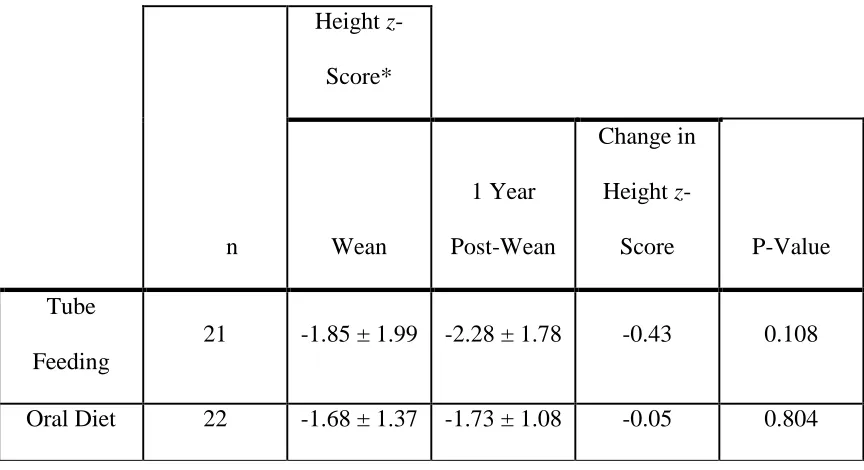
Patients who weaned from PN directly to an oral diet had a smaller decrease in z-score
from the time of weaning to year one than those who received a continuous enteral tube
feeding (-0.05 vs. -0.43, respectively; Table 3) and a larger increase in z-score from year
one to year two after PN wean (+0.22 vs. +0.02, respectively; Table 4). The mean
change in height z-score from time of weaning to year one post-wean was not
significantly different between feeding method groups (p=0.228). The same was true for
37
who received a continuous enteral tube feeding with an oral diet compared to those who
Table 1: Demographic and Anthropometric Characteristics of the Intestinal Care and
Rehabilitation Center Sample Population by Feeding Method during Parenteral Nutrition
Weaning
Characteristic
Tube Fed
n = 21
Oral Diet
n = 24 P-Value
Gender n (%) Male Female 10 (48) 11 (52) 19 (79)
5 (21) 0.027
Gestational age
(weeks)* 34.3 ± 4.1 33.5 ± 4.5 0.542
Age at referral
(years)** 0.5 (0.2, 2.2) 0.10 (0.00, 0.30) 0.029
Race n (%) Caucasian Black Asian Native American Other 16 (76) 4 (19) 0 (0) 0 (0) 1 (5) 17 (71) 6 (25) 1 (4) 0 (0) 0 (0)
Wt z-Score at
Baseline* -1.29 ± 1.98 -0.69 ± 1.25 0.242
Ht z-Score at
Baseline* -1.76 ± 2.75 -1.25 ± 1.85 0.463
Ht - height, Wt - weight
*Mean + Standard Deviation