Analysis of Factors Affecting Performance of
Distribution Logistics Among Manufacturing Firms in
Kenya: A Case Study of Kibos Sugar Company Limited
and Allied Industries
Odek Robert
1, Elmad Okoth
2 1Jomo Kenyatta University of Agriculture and Technology, Master of Science-Accounting 2
Maseno University, Master of Science in Finance
DOI: 10.29322/IJSRP.9.09.2019.p9343 http://dx.doi.org/10.29322/IJSRP.9.09.2019.p9343
Abstract- This study analyzed factors affecting performance of distribution logistics among production firms in Kenya: a case of Kibos Sugar Company limited and allied industries. The study applied descriptive approach through survey design. The target population comprised 122 employees. The sample size of the study was 24 respondents arrived at using the method of proportional allocation. Data analysis was done by descriptive statistics. The study realized that accuracy of data collected, size of data base and ability of management information system to predict future decisions are significant elements of information systems that has got vast influence on the performance of distribution logistics. This fills the gap in the study by Stank and Keller (2001), they did not find any relationship between information systems and distribution performance while the present study finds that indeed there exist a relationship between information systems and logistics performance at Kibos sugar Company and Allied Industries. The study therefore concludes that management information system coupled with various information technology are key in managing every distribution aspect for sure performance. The study also realized that distribution structure is a Senables customers to easily reach the products limiting stock outs which in the long run translates to positive distribution performance. Besides, route-planning if considered, enables timely deliveries of products, cost reduction in regard to time, fuel and vehicle maintenance. The present study fill the gap in the study by Knemeyer and Murphy, (2004) and in the study by Parthanadee and Logendran (2006) in USA, where he noticed that in logistics system, distribution cost is typically the highest single expense. That is, through implementing proper distribution structure, nearly all the avoidable costs will be limited. It is concluded that distribution structure used by a manufacturing firm have an impact on the ability of its Distribution Logistics to perform. The study recommends need of embracing modern and current technology which can help various users of organization information to collect, analyze, interpret and come up with various useful decisions affecting the organization. Further study needs to be done on the same topic but in other smaller institutions especially nationally so as to spur development in the country Kenya and in Africa at large.
Index Terms- Distribution channel, Distribution logistics and Performance Logistics.
I. INTRODUCTION
ogistics is increasingly becoming a strategic source of competitive advantage with the increase in global production sharing, shortening of product life cycles and intensification of global competition. In the highly competitive business environment, quality of logistics has assumed great significance; it influences such decisions of firms as the choice of; country to locate in, suppliers to buy from, and/or consumer markets to enter in. Essentially, high logistics costs coupled with low service quality are a barrier to trade and foreign direct investment (FDI) and consequently to economic growth. Massive investments are being made worldwide with some of the best-known investment gurus putting their bet on distribution industry which is directly linked to the growth of any economy (Prabhakarsri, 2010). Distribution is increasingly becoming a significant factor that can contribute to the realization of successful organizational strategy and thus the need of the present study on performance of distribution logistics.
originated in the military. The present study adopted this definition.
In United States logistics costs constitutes about 30% of the cost of the products sold (Eskigun, Uzsoy, Preckel, Beauj, Krishnan and Tew, 2005). In a logistics system, distribution cost is typically the highest single expense, which is usually greater than warehousing cost, inventory cost and order processing cost Parthanadee and Logendran (2006). Distribution has captured management’s attention due to rapid wage and freight rate inflation, critical swing of transportation costs and regulation, the high cost of carrying inventory, and oil market uncertainties. From the study by (Eskigun, Uzsoy, Preckel, Beauj, Krishnan and Tew, 2005), and Parthanadee and Logendran (2006), it implies that logistics is major concern as most of the costs incurred in a production system are majorly in logistics. The present study therefore sought to find out if cost is a factor that affect performance of distribution logistics in production firms with specific reference to Kibos Sugar Company and allied industries.
Since logistics advanced from 1950s, due to the trend of nationalization and Globalization in recent decades, the importance of logistics management has been growing in various areas. For industries, logistics helps to optimize the existing production and distribution processes based on the same resources through management techniques for promoting the efficiency and competitiveness of enterprises (Kahia, 2014). Distribution logistics makes goods and products movable and provides timely and regional efficacy to promote value-added under the least cost principle. Distribution affects the results of SCM activities and, of course, it influences production and sale. In the logistics system, transportation cost could be regarded as a restriction of the objective market. Value of distribution varies with different industries. According to Knemeyer and Murphy, (2004) for those products with small volume, low weight and high value, distribution cost simply occupies a very small part of sale and is less regarded; for those big, heavy and low- valued products, distribution occupies a very big part of sale and affects profits more, and therefore it is more regarded. The demand for products can only be satisfied through the proper and cost-effective delivery of goods and services of which the present study sought to establish if there was proper and cost effective delivery of goods and services at Kibos Sugar Company and allied industries.
Distribution channel consists of a group of individuals or organizations that assist in getting the product to the right place at the right time (Asiamah, Alfred and Solomon, 2013). Distribution plays a vital role, primarily because it ultimately affects the sales turnover and profit margins of the organization. If the product cannot reach its chosen destination at the appropriate time, then it can erode competitive advantage and customer retention. Therefore, distribution logistics is the link between a company and its customers (Skjoett, 2002); it comprises all activities related to the provision of finished products and merchandise to a customer. The products can be delivered directly from the production process or from the trader’s stock located close to the production site or, possibly, via additional regional distribution warehouses. Like procurement logistics, distribution logistics is a market-linked logistics system. It links a company’s production logistics with the
customer’s procurement logistics Kahia (2014). In distribution logistics, customer orientation plays a special role because of the close link to the customer. According to (Zheng and Zhang, 2010) distribution logistics is the management activities to pursue customer satisfaction and order fulfillment, connecting the main body of supply and demand, overcoming space and time obstacles to achieve efficient and rapid movement of goods. It also involves conveying of information related to the distribution of physical goods thus making it slightly distinct from physical distribution.
Performance of distribution logistics can be measured by on time delivery. This determines whether a perfect delivery has taken place or not, it thus measures customer service. Xu (2013) in Stewart (1995) identifies the following as the measures of performance logistics: request rate, delivery-to-commit date, order fill lead-time and goods in transit. Quality and the way the information is exchanged determine performance of distribution logistics to a large extent; possible performance indicators are: number of faultless invoices, flexibility of delivery systems to meet particular customer needs.
Kibos Sugar Company is manufacturing organization based within the outskirts of Kisumu at Kibos center. Its mission statement is ‘to maintain a competitive advantage by economical pricing, improving the production technology and empowerment of our stakeholders through skills, knowledge, inspiration and motivation. By strengthening commitment and partnership so as to achieve and sustain long term growth and wealth creating for all stakeholders while maintaining high health and safety standards. Focusing on differentiation and diversification of products by investing in research, development and innovation. Adapt environmentally friendly production techniques so as to reduce the global warming and embracing corporate governance practices’. Its main objective is to produce high quality refined sugar for the Kenyan market among other sugar products.
II. STATEMENT OF THE PROBLEM
detail needed in the distribution process from production to delivery point. This is one of the major factors that pose a great challenge to their distribution process and performance since they are not able to respond to customer enquiries’ in time, they are not able to communicate between departments effectively such that credit control section cannot easily know the levels of stock from production department instantly unless a physical verification from the manual bin cards is done. This implies that if a customer places an order, the invoicing department cannot proceed instantly implying time wastage which will spread to the customers. Besides, modern companies have networked their systems such that they are capable of accessing their bank accounts and instantly detecting payments that have been made by their customers in regard to their fresh orders. However, at Kibos Sugar Company and Allied industries, the customers still have to deliver the payment slips physically. That is, after depositing the cash, they have to find a way of the deposit slips reaching the credit controller. The time involved in doing all these equally spread to the whole distribution process. The present study therefore intended to establish how lack of modern information systems translates to poor distribution performance at Kibos Sugar Company and Allied Industries.
Distribution structure implies availability of regional deports, route planning, and mode of transport used. When there are regional deports, distribution would have been brought close to the customers as they are able to access the products easily and dispose them out. Equally, whenever routes are planned well, it will mean trucks will be utilized to capacity, costs will be saved in terms of time and fuel and company image will also be enhanced as deliveries will be done efficiently. Furthermore, the mode of transport used plays a great role. That is, depending on the customers’ location, the company identifies the mode of transport to use. Kibos Sugar Company and Allied Industries
lack enough regional depots within the market that they serve. This has in fact been one of their major challenge which has affected their distribution system as the customers must wait until the truck comes all the way from the main plant. In addition, they have-not clearly mapped their network of clients that they serve so as to enable them to understand which markets to concentrate in and how to reactivate other dead markets. This therefore has negatively impacted on their logistics system which the present study sought to find out.
III. OBJECTIVES OF THE STUDY
The study’s main objective was to analyze factors affecting performance of distribution logistics in Kibos Sugar and Allied Industries Limited, Kenya. The study was guided by the following specific objectives:
1.
To determine the effects of information systems on performance of distribution logistics in Kibos Sugar and Allied Industries Limited, Kenya2.
To establish the effects of distribution structure on performance of distribution in Kibos Sugar and Allied Industries Limited, KenyaIV. CONCEPTUAL FRAME WORK
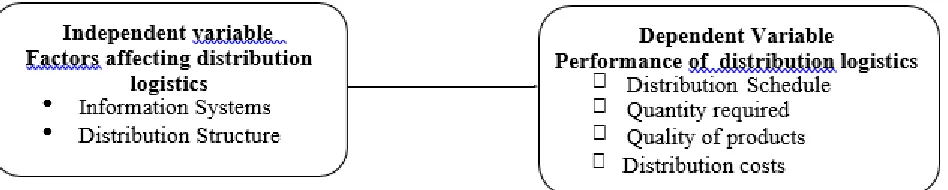
[image:3.612.60.534.458.553.2]A conceptual framework is “the abstract, logical structure of meaning that guides the development of the study and enables the researcher to link the findings to the existing body of knowledge” (Burns & Grove 2005:37). It is an image or symbolic representation of an idea.
Figure 1: Conceptual framework
V. THEORETICAL LITERATURE REVIEW
Theories are important in predicting, explaining and mastering phenomenon (behavior of systems, events, activities of employees and time). Generalizations about observations are made in theories (Matalanga, 2014). A theoretical framework explains the existence of the problem under study. It mainly guides how the research will be conducted. It is important to the researcher because it provides a general framework of the study. The current study was guided by the game theory.
VI. GAME THEORY
understand strategic scenarios (Dai &Chen, 2012). According to (Xu, et al., 2013) the game theory is divided into two main approaches: the non-cooperative and the cooperative game theory. The cooperative game theory can be applied to the case where players can achieve more benefit by cooperating than staying alone (Xu, et al., 2013). The gain sharing issue was intensively investigated in the cooperative game theory; therefore we adopted cooperative game theoretic approaches in constructing the hypothesis on transport management and firm performance. Today cooperation is becoming more and more crucial to improve the global performance of logistics (Drechsel & Kimms, 2010). As the complement of traditional vertical cooperation, a new cooperation model, the horizontal cooperation was proven efficient to reduce global cost and improve service rate in logistics (Drechsel & Kimms, 2010). In game theory, horizontal cooperation in logistics was proved efficient to reduce global cost and improve the performance level (Cruijssen, Cools, &Dullaert, 2007; Pan, Ballot, Fontane &Hakimi, 2012). However, despite these advantages, horizontal cooperation is not considerably employed in logistics (Muir, 2010). One main obstacle in the implementation of horizontal cooperation is the absence of an appropriate cooperation decision making model (Xu, etal., 2013). In regard to the present study, the game theory is applicable in that, Kibos Sugar Company and Allied Industries can decide to work hand in hand with their distributors. That is, they can outsource transportation services from their own distributors. Besides, they can also decide to empower one major distributor who can in most cases act as their point of sale so that at all times, the market is serviced and goods are at the reach of the customers.
VII. SUMMARY OF GAPS
In the study by Parthanadee and Logendran (2006) in USA, they noticed that in logistics system, distribution cost is typically the highest single expense, which is usually greater than warehousing cost, inventory cost and which implies that logistics is major concern as most of the costs incurred in a production system are majorly in logistics. The present study therefore sought to find out if cost was a factor that affect performance of distribution logistics in production firms with specific reference to Kibos Sugar Company while relating it to distribution structures. According to Knemeyer and Murphy, (2004) for those
products with small volume, low weight and high value, distribution cost simply occupies a very small part of sale and is less regarded; for those big, heavy and low- valued products, distribution occupies a very big part of sale and affects profits more, and therefore it is more regarded. The demand for products can only be satisfied through the proper and cost-effective delivery of goods and services of which the present study sought to establish, that is, if there was proper and cost effective mode of delivery of goods and services to clients of Kibos Sugar Company.
The performance of any distribution company is strongly dependent on application of proper information systems and applying proper distribution structure. Kibos sugar should not be an exception to applying the latter. However, according to Stank and Keller (2001) in their study, they did not find any relationship between information systems and distribution performance which the present study sought to find out at Kibos sugar Company and Allied Industries. Kahia (2014) on his study on factors affecting performance of distribution logistics in Bata shoe Company in Kenya, he noted that availability of regional depots refers to whether a manufacturing firm has set up depots in various regions so as to bring distribution near the customers. However, the findings of Kahia (2014) were specifically in regard to the Bata shoe company which may not necessarily apply to the present study which was based in a different sugar manufacturing industry.
VIII. RESEARCH METHODOLOGY
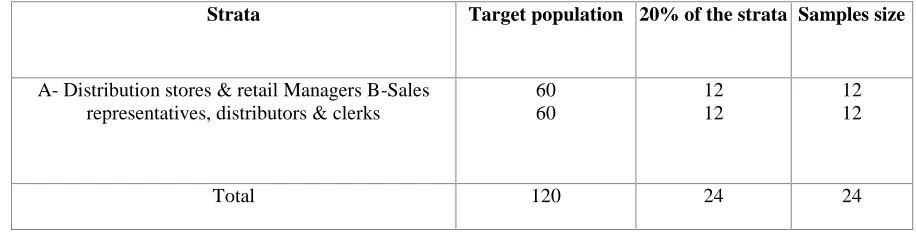
[image:4.612.75.533.602.718.2]This study was descriptive thus applied survey study design. The study was based at Kibos Sugar and Allied Industries Limited in Kisumu County. The target population of this study comprised of 7 retail and distribution managers, 54 store managers, 12 distribution center supervisors, 15 clerks, 11 distributors and 23 marketing executives, thus a target population of 122 employees with the sample size being 24. The 20% was out of 120 and not 122 since the remaining 2 was used to pilot test the study. Although the selected strata in the study may have had individual differences, they had greater similarities in terms of behavioral determinants. This therefore formed the criteria for sampling the actual respondents to be approached so that out of the stratified, 24 were picked instead of the other as explained by the rule of proportional allocation, (Kothari, 2008).
Table 1: Sample size
Strata Target population 20% of the strata Samples size
A- Distribution stores & retail Managers B-Sales representatives, distributors & clerks
60 60
12 12
12 12
The data collection components of the current research included physical collection of data by use of various data collection instruments. The researcher used questionnaire to collect primary data. This study used descriptive statistics to analyze quantitative data. Descriptive statistics involves the collection, organization and analysis of all data relating to some population or sample under study.
Results and Discussions
The research data were analyzed according to the objectives of the study and findings presented in the form of figures and tables.
Study findings
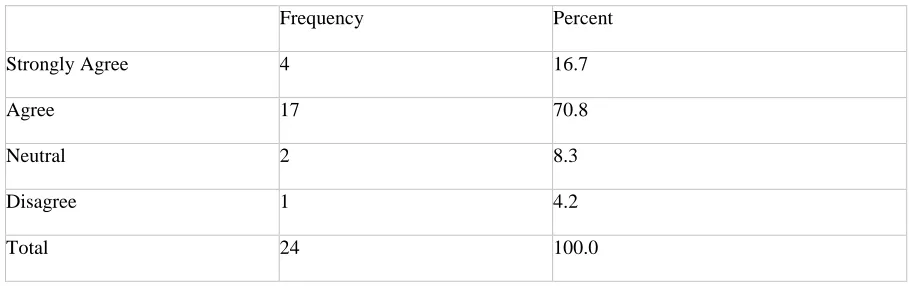
Information systems related factors that influence the performance of distribution In Table 2, 16.7% of the respondents strongly agreed that accuracy of information influence
[image:5.612.78.540.308.451.2]performance distribution, 70.8% of the respondents agreed with the same opinion, 8.3% were neutral while the remaining 4.2% disagreed. It is therefore true to conclude that information accuracy is one element of information systems that has got influence on the performance of distribution logistics at Kibos sugar company since majority of the respondents( 87%) supported the idea. The latter findings is affirmed by the study done on Global complexities challenge and how IT managers handle distribution by Cooper (2006) where he recognized that such tools of information system as cell phone and internet services, radio, and a wide range of digital devices and related tools, including cameras, GIS, a wide range of hand-held computing devices if appropriately used, has a potential of raising efficiency in the following distribution activities: record keeping, monitoring field agent activities, procurement operations, credit and payment tasks, input distribution, measuring productivity, and forecasting.
Table 2: Accuracy of information influence performance of distribution
Frequency Percent
Strongly Agree 4 16.7
Agree 17 70.8
Neutral 2 8.3
Disagree 1 4.2
Total 24 100.0
In table 3, size of data base is considered; 4.2% strongly agree that the size of data base that a company keeps has got influence on its distribution performance, 62.5% agreed with this opinion, 20.8% were neutral while the remaining 12.5% disagreed. The
study thus reveals that size of data base influences distribution performance at Kibos Sugar Company since majority of the respondents agreed with the same idea (67%).
Table 3: Size of data base influences distribution performance
Frequency Valid Percent
Strongly Agree 1 4.2
Agree 15 62.5
Neutral 5 20.8
Disagree 3 12.5
Total 24 100.0
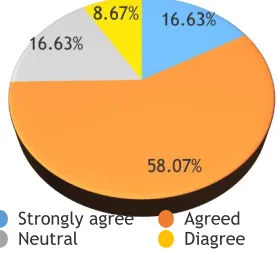
In figure 2, 16.7% of the respondents strongly agreed that satisfaction is an information factor affecting distribution, 58.3% agreed with the same opinion, 16.7% were neutral and the
Strongly agree
Neutral Agreed Diagree
[image:6.612.87.226.93.220.2]no satisfaction which is then detrimental to the distribution performance.
Figure 2: Satisfaction is an information element affecting distribution
[image:6.612.78.540.263.406.2]In table 4.6, 8.3% of the respondents indicated that predictability of information influences performance of distribution logistics, 66.7% agreed with the same opinion, 12.5% were neutral while 12.5% disagreed. It is hence true to comment that predictability affects financial information element is an important factor which affect performance distribution. This is in line with the study by Ceva (2010), who noted in their study on Logistics and Competitive Strategy, that Information system to manage distribution increases efficiency, predictability and reduce waste in value chains, which has positive impact on all market players.
Table 4: Predictability of information influences distribution performance
Frequency Valid Percent
Strongly Agree 2 8.3
Agree 16 66.7
Neutral 3 12.5
Disagree 3 12.5
Total 24 100.0
Effect of distribution structure on performance of distribution in Kibos Sugar and Allied Industries Limited, Kenya
In figure 3, 20.3% strongly agreed that distribution structure used by a manufacturing firms have impact on the ability of its Distribution Logistics performance, 63% agreed with the same opinion, 8.3% were indifferent while the remaining 8.3% disagreed. It therefore clear that distribution structure is a factor which to a greater extent assist or influences distribution performance. This is in line with the findings of Coyle et al (2009) in his study on Management of Business Logistics, a Supply Chain Perspective in South Western, Us, where he noted that distribution structure pertains to how the distribution processes are set up and thus the distribution structure used by a manufacturing firm may also have impact on the ability of its Distribution Logistics to perform.
Figure 3: Distribution structure used by a manufacturing firms have impact on the ability of its Distribution Logistics
performance
Strongly agree
[image:7.612.84.226.79.214.2]Neutral Agreed Diagree
Figure 4: Availability of regional depots impacts positively on the ability of its Distribution Logistics performance
[image:7.612.77.541.255.398.2]In table 5, route planning is strongly agreed with to be enabling distribution performance to n extent of 30%, 58% agreed while the remaining 12% were indifferent and disagreed consecutively. Route-planning is therefore a main element of distribution structure that if considered by the management at Kibos sugar company, then this can lead to increased distribution performance. This finding is supported by Kahia (2014) in his study on factors affecting performance of distribution logistics in Bata shoe Company in Kenya, noted that regional depots may allow for proper capacity utilization of transport over long distances as this is not dependent on individual customer orders.
Table 5: Route planning influences distribution performance
Valid Percent
Strongly Agree 30.0
Agree 58.0
Neutral 6.0
Disagree 6.0
Total 100.0
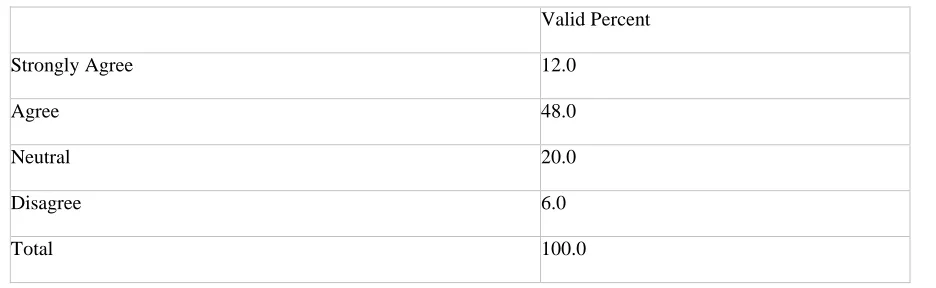
In table 6, mode of transport is considered and 12% of the respondents strongly agrees that the mode of transport is a factor, 48% are supporting the idea, 20% are neutral while the remaining 20% are disagreeing. It is true therefore that the mode
of transport like using a trailer instead of a ten-wheeler is recommended as it encourages performance distribution
Table 6: Mode of transport influences distribution performance
Valid Percent
Strongly Agree 12.0
Agree 48.0
Neutral 20.0
Disagree 6.0
Total 100.0
In figure 5, it is clearly evidenced that availability of regional depots allows proper capacity utilization supported by 22% of the respondents, brings products closer to the customer (34%), enable deliveries within short notice (24%) and reduces the lead time (20%). It is true then that the most significant factor
[image:7.612.76.544.496.640.2]Figure 5: Merits of regional depots
[image:8.612.78.535.211.311.2]In table 7, majority of the respondents 78% indicated that one of the importance of route planning is that it enables timely deliveries of products, and that it enables cost reduction as the customer is already predetermined therefore no more trials to consume cost in regard to time, fuel and vehicle maintenance costs.
Table 7: Merits of route planning
Valid Percent
Timely deliveries
78.0
Cost reduction
22.0
Total
100.0
Figure 6 clarifies the importance of adopting a given mode of transport where by 52% of the respondents support that transportation means determines flexibility and that
[image:8.612.53.542.342.517.2]transportation means also enables door to door deliveries thus enabling distribution performance in the long run.
Figure 6: Importance of adopting a particular mode of transport Conclusions
The findings of this study fills the gap left out in previous theoretical and qualitative studies on distribution and logistics performance. From the findings the study found that the main sub variables of distribution affects the distribution performance. On the effects of information systems on performance of distribution logistics, the study realized that accuracy of information/data collected, size of data base and ability of management information system to predict future decisions are significant elements of information systems that has got vast influence on the performance of distribution logistics. This fills the gap in the study by Stank and Keller (2001), they did not find any relationship between information systems and distribution performance while the present study finds that indeed there exist a relationship between information systems and logistics performance at Kibos sugar Company and Allied Industries. The study therefore concludes that management information system
single expense. That is, through implementing proper distribution structure, nearly all the avoidable costs will be limited. The study therefore concludes that distribution structure used by a manufacturing firm have an impact on the ability of its Distribution Logistics to perform.
IX. RECOMMENDATIONS
There is need of embracing modern and current technology which can aid various user of organization information to collect, analyze, interpret and come up with various useful decisions affecting the organization. Finally, the researcher recommends that Kibos Sugar Company and Allied Industries should consider the findings of this study on distribution structure which in the long run will give them an edge over other sugar suppliers/ manufacturers. That is, distribution structure which is more organized enables flow of information and activities which enables easy order tracking, efficient loading and delivery to the customers.
X. SUGGESTION FOR FURTHER STUDY
This study provides quantitative evidence for the implication of managing distribution channels and how this translates to the overall organizational goals. Therefore, this evidences that there is need to emphasize the need of proper distribution structure. Further, this study was only carried out in Kisumu specifically at Kibos Sugar Company and Allied Industries therefore the findings are only limited to this organization. Further study needs to be done on the same topic but in other smaller institutions especially nationally so as to spur development in the country and in Africa at large.
REFERENCES
[1] Asiamah Y., Alfred O., Solomon B.; Effective distribution management, a pre-requisite for retail operations: a case of Poku trading Published by European Centre for Research Training and Development UK, (www.ea-journals.org)
[2] Bataworldnewsteam. (2012). distribution logistics structure. Retrieved
August 14, 2013, from
bataworldnews:…http://www.world.bata.com/cn/en/virtual_library/ distribution_Infrastructure/Lo gistics.pdf
[3] Bowersox, Closs, & Cooper. (2010). Supply Chain Logistics Management. Boston: McGraw- Hil.
[4] Ceva, “Logistics and Competitive Strategy," European Management Journal, 11(2), 126-138, 2010
[5] Chopra, S., “Designing the distribution network in a supply chain”, Transportation Research Part E, 39(2), 123-140, 2003.
[6] Coyle et al (2009) The Management of Business Logistics, a Supply Chain Perspective,Thompson Learning, South Western
[7] Cooper, F. “Global complexities challenge how IT managers handle distribution,” Journal of Marketing, Fall. 47, pg. 96, 2006
[8] Cyplik, P., Hadaś , L. &Domański, R. (2009). Implementation of the theory of constraints in the area of stock management within the supply chain: a case study, Electronic Scientific Journal of Logistics, 5(6), 34
[9] Du, F. & Evans, G.W., “A bi-objective reverse logistics network analysis for post-sale service”, Computers & Operations Research, 35(8), 2617-2634, 2008.
[10] Eskigun, E., Uzsoy, R., Preckel, P.V., Beaujon, G., Krishnan, S., & Tew, [11] J.D.,“Outbound supply chain network design with mode selection, lead
times and capacitated vehicle distribution centers”, European Journal ofOperational Research, 165(1), 182-206, 2005.
[12] Kahia G. Factors Affecting the Performance of Distribution Logistics among Production Firms in Kenya: A Case Study of Bata Shoe Company (K) LimitedInternational Journal of Academic Research in Business and Social Sciences October 2014, Vol. 4, No. 10 ISSN: 2222-699
[13] Kothari, C. (2008). Pretesting in questionnaire design: The impact of respondent characteristics on error detection.Journal of theMarket Research Society, 36(October), 295–314.
[14] La-Londe, Martha, Cooper, & Noordewier. (2008). A management perspective:. Customer service , 51-56.
[15] M.Christopher, & D.Towill. (2001). An integrated model for the design of agile supply chains. International Journal of Physical distribution & Logistics Management , 235-246.
[16] Mugenda, O. &Mugenda, A. (2003). Research Methods: Quantitative & Qualitative Approaches. Nairobi: Acts Press.
[17] Parthanadee, P. & Logendran, R., “Periodicproduct distribution from multi-depots underlimited supplies”, IIE Transactions, 38(11), 1009-1026, 2006. [18] Paulraj, & Chen. (2007). “Strategic Buyer-Supplier Relationships. Journal
of Supply chain Management, 2-14. Vol. 1, No. 3, pp.28-44, September 2013
[19] Prabhakarsri, “A brief note on logistics industry in India,” Retrieved from http:// prabhakarsri.wordpress.com/ 2010/10/12/abrief-note-on-logistics-industry-in-india/ on November 7th, 2010
[20] Simatupang, T.M., & Sridharan, R. (2005).An integrative framework for supply chain collaboration, International Journal of Logistics Management11 (2), 257-274.
[21] Weiss, H.J and Gershon,M.E (2002) Production and Operation Management.
[22] XU Y. A Review of Distribution Related Problems inLogistics and Supply Chain Research Department of Marketing and Decision Sciences, San Jose State University1 Washington Square, San Jose, California, USA Vol. 2, No. 4, December 2013
AUTHORS
First Author – ODEK Robert, Jomo Kenyatta University of Agriculture and Technology, Master of Science-Accounting, [email protected]