MAY-JUNE 2017, VOL- 4/31 www.srjis.com Page 5897 EFFECT OF SNAP ON COMPONENTS OF SOCIAL NETWORKING AWARENESS
Mr. Rajendra Chandrakant Thigale
Associate Professor, Tilak College of Education, Pune 30
Introduction: -
This is the age of ICT. IT and BT are the buzz words in the learning society. Due to
ICT the quality and performance in all sectors are enhanced. Same is the case of teacher
education, if ICT is integrated in teacher Education.
Actually ICT subject is introduced in the teacher education syllabus of some Indian
Universities from the year 2000. ICT is very essential to enhance the quality of education
system. If we want to see the use of ICT in schools, then teacher must be techno savvy. That
is why there should be integration of ICT in Teacher Education Colleges. In future there will
be e- teachers and e- teaching.
It is assumed that today‟s students or student- teachers have the knowledge of
computers. They can work on computers offline as well as online. The social networking i.e.
use of Orkut, Facebook, Twitter, Skype, opera mini etc. are some ways of communication,
and education is nothing but communication. Now question arises that whether Novice
teachers can use these communication ways such as social networking? If they are using it
then what is the percentage of users? If it is less, compare to the other streams then, can we
develop any programme to increase the social networking awareness among the
Novice-teacher? After implementation of the social networking awareness programme, whether there
will be rise in the percentage of users? What is the effectiveness of the social networking
awareness programme? These are some questions raised in front of the researcher.
Background of the Research: -The term "Social Networking" refers to the formation of a
community on the Internet, facilitating users to interact for a common purpose or sharing
mutual views towards various aspects. Online Social Networking facilitates grouping of
friends or family members, helping them to share their opinions.
Wayne A. Selcher, “Use of Internet Sources in International Studies Teaching and Research, Elizabethtown College.” This bibliographic review discusses and evaluates
MAY-JUNE 2017, VOL- 4/31 www.srjis.com Page 5898 free, reliable, quality online content useful to academics in international studies, teaching and
research at the college level, including how and where to locate such materials through
guides, directories, gateway sites, repositories, and various types of search engines;
considerations about Internet use in college classes; and undergraduate assignments that use
sources of information from the Internet.
Awareness about social networking sites is generally high, although people are not
necessarily familiar with the term (ofcom young people and media tracking survey, wave3
September 2007) Despite young people being a core market of social networking sites,
spontaneous awareness of the generic term „social networking sites‟ was significantly lower
than that of their parents. Once the term was explained, overall awareness was similar to that
of their parents. Everyone was familiar to Facebook. The other social networking tools are:
Blogs Creation, Media sharing services, Wikis, Bookmarking and tagging etc.
Understanding existing status or level of social networking awareness of novice
teachers and to develop the social networking awareness programme to raise the social
networking awareness level, as well as to study its effectiveness were the key challenges
before the researcher.
Need of the Research: -
The subject ICT is introduced in B.Ed. syllabus of University of Pune since 2001.
And the researcher is teaching ICT at B.Ed level in Tilak College of Education, Pune 30. The
researcher has seen up gradation in ICT syllabus and gradual progress among the students in
computer proficiency. Considering all these changes in the ICT, One can develop the ICT
culture in the teacher education colleges. They should form social group or learning group of
the college, so that they can interact with one another and there will be peer learning which is
very effective. E-books, e-journals, e-publications, e- articles are the new avenues of
education. E-learning and e-teaching will be the buzz words in educational system. Teacher
should use technology in daily teaching- learning process to create ICT culture in the college.
Thus the use of ICT will be very effective to enhance the quality of teacher education.
Significance of the Research: -
The study is intended to find out social networking awareness of Novice teachers, as
well as development of social networking awareness programme and its effectiveness. It will
be useful for the in-service teachers at various levels such as primary, secondary, higher
secondary, pre-service teachers at various levels such as B.Ed, M.Ed. , the curriculum
planners, the educational researchers, the parents of student-teachers and even for other
MAY-JUNE 2017, VOL- 4/31 www.srjis.com Page 5899 The present study is useful as follows-
I. Social Networking Awareness Test (SNAT) will be useful -
i. To test the Level of Social networking Awareness of Novice teachers.
ii. To identify the Novice teachers with high and low level of Social Networking
Awareness.
iii. To analyse the Social Networking Awareness level as per the components of
Social Networking Awareness.
Statement of the Problem:-
To develop the social networking awareness programme for the Novice teachers,
studying in the Colleges of Education, located in all the three districts affiliated to the
Savitribai Phule Pune University, Pune and study the effectiveness of social networking
awareness programme developed by the researcher.
Operational definitions
Terms:- Social Networking: - The term "Social Networking" refers to the formation of a
community on the Internet, facilitating Novice teachers to interact for a common
purpose or sharing mutual views towards various aspects. With the help of social
networking tools like facebook, blogs, Wikis, bookmarking and tagging.
Social Networking Awareness (SNA):- The individual is exposed to a social
media or practice networking but lacks information about general understanding,
features of tools, technological information, cautious use, and judicious use,
principles of sharing, safety and security measure, threats and consequences, and
educational use of social networking.
Social Networking Awareness Programme (SNAP):- The Social Networking
Awareness Programme is a programme which includes various activities along
with theoretical orientation, and practical component. The SNAP focuses on the
areas where Novice teachers shown low level of awareness such as General,
Technology, Security, Sharing, Tool, Educational Use, Application, and Usage
components of social networking awareness and implemented for 16 weeks.
Novice Teachers: Pre service teachers pursuing bachelor degree in teacher
education institute termed as Novice teachers.
Social Networking Awareness Components:
1. General: It is about the internet, Web 1.0 and Web 2.0 in general social
MAY-JUNE 2017, VOL- 4/31 www.srjis.com Page 5900 2. Technology: Information about web technology handling of email, opening of SN
accounts, setting profile, uploading the content and judicious use of technology.
3. Security: It is about the security setting, precautionary measures, and
consequences of lack of security while using social networking tools.
4. Sharing: It is about content, nature of content and people to whom the content to
be shared or not. Consequences of sharing wrong things with wrong person.
5. Tool: Social networking tools, Features of facebook, blogs, wikis, book marking
and tagging, appropriate selection of the tool as per the need.
6. Educational Use: The use of social networking tools for educational purposes
such as classroom instruction, assignment, communication with students and
parents
7. Application: Use of social networking tools by the novice teachers during the
teacher training course such as communication and other purposes.
8. Usage: The use and its frequency regarding facebook, blogs, wikis, book marking
and tagging.
Objectives:-
1. To assess the Social Networking Awareness of the Novice teachers.
2. To analyze the Social Networking Awareness on the basis of its components
Assumptions: -
There are some assumptions related to this study, and they are as follows,
1. The large number of College students are using social networking feature of internet, as the
researcher is using Facebook. (Intel Teach Program Essentials course in-service Edition
V.10.1, 2008).
2. Novice teachers are less aware about the social networking. (Ofcom survey 2007)
3. A programme will be useful for developing and enhancing social networking awareness.
(Enhancing environmental awareness through marine education (M.A.J. Collins, 1998)
4. Social Networking can be used effectively in education. (Enhancing environmental
awareness through marine education (M.A.J. Collins, 1998)
Research Questions:-
Research question for objective no.1: -
1. Whether the level of social networking awareness among the Novice teachers is different
MAY-JUNE 2017, VOL- 4/31 www.srjis.com Page 5901 Research hypotheses: -
1. The Social Networking Awareness Programme is useful to raise the Social Networking
Awareness of Novice teacher
2. The Social Networking Awareness Programme is useful to raise the General component of
Social Networking Awareness of Novice teacher
3. The Social Networking Awareness Programme is useful to raise the Technology
component of Social Networking Awareness of Novice teacher
4. The Social Networking Awareness Programme is useful to raise the Security component of
Social Networking Awareness of Novice teacher
5. The Social Networking Awareness Programme is useful to raise the Sharing component of
Social Networking Awareness of Novice teacher
6. The Social Networking Awareness Programme is useful to raise the Tool component of
Social Networking Awareness of Novice teacher
7. The Social Networking Awareness Programme is useful to raise the Educational use
component of Social Networking Awareness of Novice teacher
8. The Social Networking Awareness Programme is useful to raise the Application
component of Social Networking Awareness of Novice teacher
9. The Social Networking Awareness Programme is useful to raise the Usage component of
Social Networking Awareness of Novice teacher
Null hypothesis:-
1. There is no significant difference in the mean scores of the Pre test and Post test of Novice
Teachers regarding the Social Networking Awareness
2. There is no significant difference in the mean scores of the Pre test and Post test of Novice
Teachers regarding the General component of Social Networking Awareness.
3. There is no significant difference in the mean scores of the Pre test and Post test of Novice
Teachers regarding the Technology component of Social Networking Awareness.
4. There is no significant difference in the mean scores of the Pre test and Post test of Novice
Teachers regarding the Security component of Social Networking Awareness.
5. There is no significant difference in the mean scores of the Pre test and Post test of Novice
Teachers regarding the Sharing component of Social Networking Awareness.
6. There is no significant difference in the mean scores of the Pre test and Post test of Novice
Teachers regarding the Tool component of Social Networking Awareness.
7. There is no significant difference in the mean scores of the Pre test and Post test of Novice
MAY-JUNE 2017, VOL- 4/31 www.srjis.com Page 5902 8. There is no significant difference in the mean scores of the Pre test and Post test of Novice
Teachers regarding the Application component of Social Networking Awareness.
9. There is no significant difference in the mean scores of the Pre test and Post test of Novice
Teachers regarding the Usage component of Social Networking Awareness.
Scope, Delimitations and Limitations of the research:
Scope: - The conclusions of this research study will be applicable to all the Novice teachers
of Savitribai Phule Pune University, Pune, regarding the Social Networking Awareness.
Delimitations: -
1) The Social Networking Awareness programme (SNAP) is delimited to the social
networking awareness.
2) The survey is conducted only on the Colleges of Education affiliated to Savitribai Phule
Pune University, Pune.
3) The experimental study is delimited to one College of Education only.
4) The age group is delimited to 21years and above.
5) The data was collected in the academic year 2014-2015
6) It is delimited to the only five tools. They are facebook, blogs, wikis, book marking and
tagging.
Limitations: -
1. The conclusions are based on the responses given by the Novice - teachers.
The Social Networking Awareness of All Novice Teachers:
All Novice teachers in the sample were considered here for studying their status of
Social Networking Awareness. There were 553 Novice teachers in the sample. The Social
Networking Awareness Test (SNAT) was of maximum 200 scores. The frequency
[image:6.595.97.499.590.735.2]distribution and mean of SNAT scores were calculated and given in the following table-
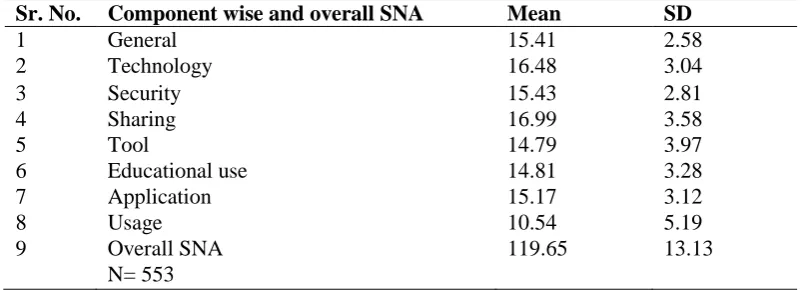
Table No.1: Component wise and Overall Mean and SD of SNA of all Novice teachers
Sr. No. Component wise and overall SNA Mean SD
1 General 15.41 2.58
2 Technology 16.48 3.04
3 Security 15.43 2.81
4 Sharing 16.99 3.58
5 Tool 14.79 3.97
6 Educational use 14.81 3.28
7 Application 15.17 3.12
8 Usage 10.54 5.19
9 Overall SNA 119.65 13.13
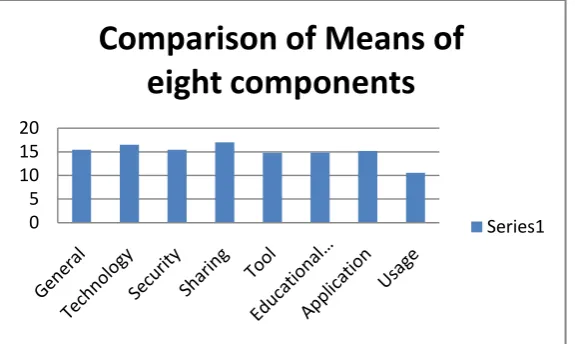
MAY-JUNE 2017, VOL- 4/31 www.srjis.com Page 5903 Graph No.1: Showing the comparison of means in eight components of SNA
Observations and interpretation: The mean score of technology and sharing components is
above 16; general, security, tool, educational use and application components mean scores
are in between 14 to 16, while the usage component mean-score is below 11. The mean score
of overall SNA is 119.65
Interpretation:
From the observation, it is clear that, the mean score of general, technology, security,
sharing, application, components are above average, whereas tool, educational use, and usage
[image:7.595.147.435.72.244.2]components are average (Table 1)
Table 2: Descriptive statistics for SNA components of all Novice teachers
Observation and interpretation for all eight components
For all the components skewness value is negative except usage component, therefore the
Normal Probability curve is negatively skewed towards the left. The distribution is near to
normal.
The skewness value of usage component is positive; therefore the Normal Probability Curve
is positively skewed towards the right. The distribution is near to normal.
The kurtosis value of General, Security, Sharing, Tool, Educational use, and Application is
greater than 0.263, therefore the NPC is platykurtic. i. e. The curve is more flat at the top than
the normal curve. 0 5 10 15 20
Comparison of Means of
eight components
Series1
Sr. No. Components Skewness Kurtosis
1 General -0.540 0.339
2 Technology -0.472 -0.162
3 Security -0.557 0.303
4 Sharing -0.287 0.514
5 Tool -0.82 0.425
6 Educational use -0.612 136
7 Application -0.701 0.845
MAY-JUNE 2017, VOL- 4/31 www.srjis.com Page 5904 The more novice teachers are distributed near to normal and to the average.
The kurtosis value of Technology and Usage component is less than 0.263, therefore the NPC
is leptokurtic, i.e. The curve is more peaked than the normal curve.
The more novice teachers are distributed near to normal and to the average some novice
[image:8.595.90.504.215.375.2]teachers are above the average.
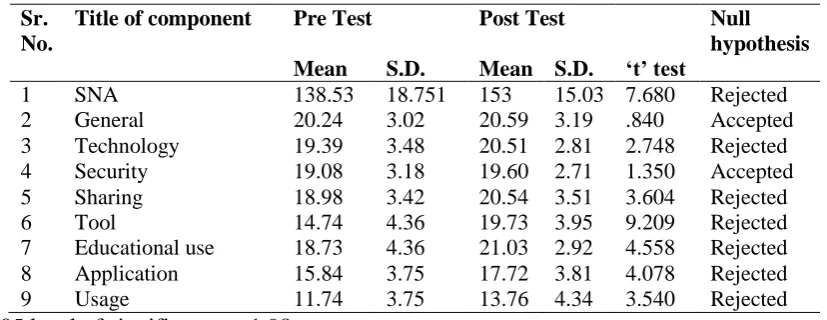
Table 3: Mean, S.D. and ‘t’ value of Pre test and Post test of SNA scores- eight social
networking awareness components Novice teachers
Sr. No.
Title of component Pre Test Post Test Null
hypothesis
Mean S.D. Mean S.D. ‘t’ test
1 SNA 138.53 18.751 153 15.03 7.680 Rejected
2 General 20.24 3.02 20.59 3.19 .840 Accepted
3 Technology 19.39 3.48 20.51 2.81 2.748 Rejected
4 Security 19.08 3.18 19.60 2.71 1.350 Accepted
5 Sharing 18.98 3.42 20.54 3.51 3.604 Rejected
6 Tool 14.74 4.36 19.73 3.95 9.209 Rejected
7 Educational use 18.73 4.36 21.03 2.92 4.558 Rejected
8 Application 15.84 3.75 17.72 3.81 4.078 Rejected
9 Usage 11.74 3.75 13.76 4.34 3.540 Rejected
* 0.05 level of significance = 1.98
Findings:
1. The social networking awareness of all the Novice teachers is above average
[119.62],
2. The general, technology, security, sharing, application, components are above
average, and tool, educational use, usage components are average
3. The social networking awareness programme is not effective to raise the general
component of social networking awareness of novice teachers
4. The social networking awareness programme is effective to raise the technology
component of social networking awareness of novice teachers.
5. The social networking awareness programme is not effective to raise the security
component of social networking awareness of novice teachers.
6. The social networking awareness programme is effective to raise the sharing
component of social networking awareness of novice teachers.
7. The social networking awareness programme is effective to raise the tool component
of social networking awareness of novice teachers.
8. The social networking awareness programme is effective to raise the educational use
MAY-JUNE 2017, VOL- 4/31 www.srjis.com Page 5905 9. The social networking awareness programme is effective to raise the application
component of social networking awareness of novice teachers.
10.The social networking awareness programme is effective to raise the usage
component of social networking awareness of novice teachers.
Conclusions:-
The conclusions were based upon the research data collected and the perception of the
researcher as the collector of the primary data. Conclusions regarding each of the research
questions and recommendations for further action or research are provided in the following
description.
i. The social networking awareness of Novice teachers is average.
ii. The social networking awareness programme is effective to raise the overall
social networking awareness of novice teachers.
iii. The social networking awareness programme is effective to raise the technology
component, sharing component, tool component, educational use component,
application component and usage component of social networking awareness of
novice teachers, but not effective to raise the general component and security
component of social networking awareness of novice teachers.
References: -
Best John W. and V. Kahn (1992) Research in Education, New Delhi, Prentice – Hall of India Pvt.
Ltd.
Brian Edward,(2011), Use of Social Networking as an instructional aide in higher education
Conole G. & Culver, J, (2011),Frameworks for understanding the nature of interactions, networking
& community in a social networking site for academic practice
Doug Gross, CNN, (2009), Social networks and kids: How young is too young?
Eric Zhi-Feng Liu, Huei-Tse Hou, How Teachers Use And Manage Their Blogs? A Cluster Analysis
Of Teachers’ Blogs In Taiwan
Forment, Marc Alier; De Pedro, Xavier; Casan, Maria Jose; Piguillem, Jordi; Galanis, Nikolas,
(2012), Wikis in Collaborative Educational Scenarios: Integrated in LMS or Standalone
Wikis?
Gabor Feuer [Ph.D], (2009), Net generation students and their use of social software: assessing
impacts on information literacy skills and learning at a laptop university.
Gloria J. Nobles, (2011), Social Networking: Indicators that connect instruction and learning in
MAY-JUNE 2017, VOL- 4/31 www.srjis.com Page 5906
Godfrey Mayende, Paul Birevu Muyinda, Ghislain Maurice Norbert Isabwe, Michael Walimbwa,
Samuel Ndeda Siminyu, (2006), Facebook Mediated Interaction And Learningin Distance
Learning At Makerere University
Kuhns, Kelly A. Kratzer, Nursing Faculty Members' Use of Web 2.0 Technology and Perceptions of
Importance of Online Faculty Presence
Lincoln Gill, Barney Dalgarno, Lauren Carlson, (2015), How Does Pre-Service Teacher
Preparedness to Use ICTs for Learning and Teaching Develop Through Their Degree
Program?
Marija Matesic, Kristina Vuckovic, (2009), Social software: teaching tool or not?
Abdul Latiff, Nani Rahayu Sallihuddin, Improving Undergraduates’ Critique Via Computer Mediated
Communication
Nora Gamin Barnes and Eric Mattson., (2007), Social Media Research: Blogs and Twitter use trends